Combining diffuse and sharp interface methods in shape optimisation
Pith reviewed 2026-06-28 00:28 UTC · model grok-4.3
The pith
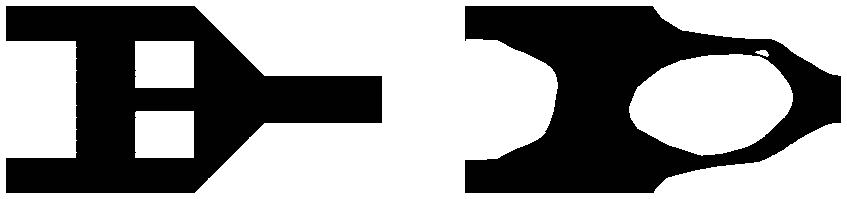
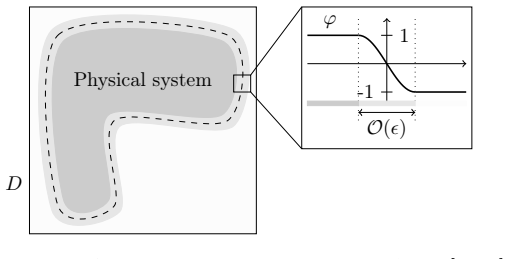
A two-stage method first optimizes shape and topology with phase field then refines boundaries with sharp interface.
A machine-rendered reading of the paper's core claim, the machinery that carries it, and where it could break.
Core claim
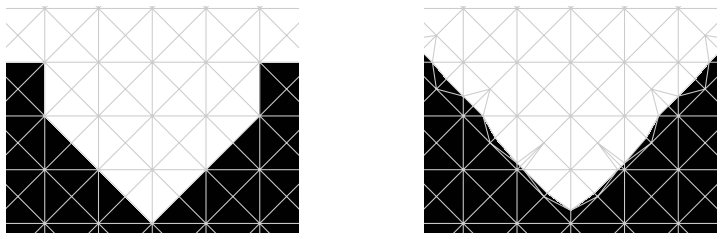
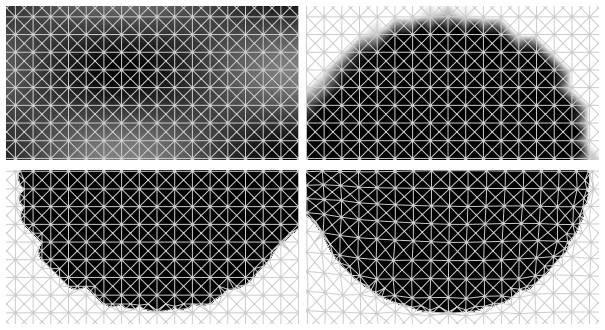
The paper establishes that an optimized shape obtained from a phase field method can be converted, via its properly post-processed zero-level set, into a suitable finite element mesh that serves as the initial guess for a sharp interface shape optimization method, thereby creating an effective two-stage process that exploits the complementary strengths of the two approaches.
What carries the argument
The two-stage process that first applies phase field optimization and then transfers the result to sharp interface optimization through a post-processed zero-level set mesh.
If this is right
- The method handles topological changes during the phase field stage.
- It supplies shape updates in the Lipschitz topology during the sharp interface stage.
- Finite element discretizations are maintained across both stages.
- The procedure is demonstrated on test problems from the literature and applications.
Where Pith is reading between the lines
- The same transition from diffuse to sharp representation could be tested on additional classes of interface problems.
- Further automation of the zero-level set post-processing step might increase robustness across different meshes.
- The two-stage idea suggests a template for other optimization tasks that require both global exploration and local boundary precision.
Load-bearing premise
The post-processed zero-level set from the phase field solution can be turned into a finite element mesh that functions as a reliable initial guess for the sharp interface method.
What would settle it
Apply the sharp interface method to the mesh constructed from the phase field zero-level set on the reported test problems and check whether convergence occurs without convergence failures or major additional adjustments.
Figures





read the original abstract
We develop a concept for the numerical treatment of shape optimization problems based on the combination of phase field and sharp interface methods. On the one hand, phase field methods are very well suited to numerically determine the shape, size and topology of a sought domain, but on the other hand they have problems to sharpen out domains where they e.g. should develop corners. However, this is the strength of a sharp-interface approach developed in our group, which provides shape updates in the Lipschitz topology. This leads to a two-stage process that first determines an optimized shape using the phase field method. The resulting domain is the starting solution for the sharp interface shape optimization method. Both methods are discretized with the finite element method. The starting mesh for the sharp method is constructed from the finite element mesh of the optimal phase field solution using its properly post processed zero-level set. We describe this construction process in detail and investigate the performance of our method on a selection of test problems from the literature and from applications.
Editorial analysis
A structured set of objections, weighed in public.
Referee Report
Summary. The paper develops a two-stage hybrid numerical method for shape optimization problems. Phase-field methods are first used to determine an optimized shape including its topology; the resulting zero-level set is post-processed to construct a finite-element mesh that initializes a sharp-interface method, which performs further optimization in the Lipschitz topology and is better suited to features such as corners. Both stages are discretized with finite elements, the mesh-construction procedure is described in detail, and the combined approach is tested on selected literature and application problems.
Significance. If the transition between stages proves reliable, the hybrid workflow would combine the topological flexibility of phase-field methods with the geometric precision of sharp-interface updates, offering a more automated route to shapes with both complex topology and sharp features than either method alone.
major comments (2)
- [mesh-construction process (as described after the abstract)] The two-stage claim (abstract and the section describing the mesh-construction process) rests on the assertion that the post-processed zero-level set of the optimal phase-field solution yields a Lipschitz domain whose finite-element mesh serves as a stable initial guess for the sharp-interface iteration. No explicit analysis or quantitative evidence is supplied showing that this extraction avoids non-smooth boundaries, topological artifacts, or poor element quality that could cause the sharp-interface solver to fail to converge or require manual fixes; this is load-bearing for the automated pipeline.
- [numerical results / test problems] The numerical investigation section reports performance on test problems but supplies no convergence histories, iteration counts, or failure rates for the sharp-interface stage when started from the phase-field mesh. Without these data it is impossible to verify that the initialization step consistently succeeds across the claimed test suite.
minor comments (2)
- [abstract] The abstract states that both methods are discretized with the finite element method but does not indicate the specific finite-element spaces or the treatment of the phase-field regularization parameter; a brief statement would improve clarity.
- [throughout the methods description] Notation for the phase-field variable and the sharp-interface velocity field should be introduced once and used consistently; occasional redefinition of symbols makes the two-stage description harder to follow.
Simulated Author's Rebuttal
We thank the referee for the thorough review and constructive feedback on our manuscript. We address each major comment below and outline the revisions we will make.
read point-by-point responses
-
Referee: [mesh-construction process (as described after the abstract)] The two-stage claim (abstract and the section describing the mesh-construction process) rests on the assertion that the post-processed zero-level set of the optimal phase-field solution yields a Lipschitz domain whose finite-element mesh serves as a stable initial guess for the sharp-interface iteration. No explicit analysis or quantitative evidence is supplied showing that this extraction avoids non-smooth boundaries, topological artifacts, or poor element quality that could cause the sharp-interface solver to fail to converge or require manual fixes; this is load-bearing for the automated pipeline.
Authors: We agree that the manuscript describes the mesh-construction procedure in detail but does not supply a dedicated quantitative analysis (e.g., element aspect ratios, boundary curvature measures, or explicit checks for topological artifacts) to demonstrate that the extracted mesh consistently provides a stable initial guess. In the revised manuscript we will add a short subsection or appendix with quantitative mesh-quality indicators and boundary-regularity observations for the test cases, together with a brief discussion of any observed limitations of the post-processing step. revision: yes
-
Referee: [numerical results / test problems] The numerical investigation section reports performance on test problems but supplies no convergence histories, iteration counts, or failure rates for the sharp-interface stage when started from the phase-field mesh. Without these data it is impossible to verify that the initialization step consistently succeeds across the claimed test suite.
Authors: The current numerical section presents final optimized shapes and objective values but indeed omits convergence histories, iteration counts, and any mention of failure rates for the sharp-interface stage. We will revise the numerical results section to include these data (convergence plots of the objective functional and iteration counts) for each test problem, thereby documenting the behavior of the sharp-interface solver when initialized from the phase-field mesh. revision: yes
Circularity Check
Minor self-citation to prior group work on sharp-interface method; combination claim remains independent
full rationale
The paper presents a procedural two-stage method that first applies a phase-field approach to determine an optimized shape and topology, then uses the post-processed zero-level set to construct a mesh as initial guess for a sharp-interface method. The abstract references a sharp-interface approach 'developed in our group' that provides updates in the Lipschitz topology, constituting one minor self-citation. However, this citation supports only the description of the second method's known strengths and is not load-bearing for the central claim of the combination or the mesh-construction process. No equations, fitted parameters, self-definitional reductions, or uniqueness theorems appear in the provided text that would force the result by construction. The approach is described as an empirical combination tested on literature problems, rendering the derivation self-contained.
Axiom & Free-Parameter Ledger
Reference graph
Works this paper leans on
-
[1]
Shape and topology optimization
G. Allaire, C. Dapogny, and F. Jouve. “Shape and topology optimization”. In:Handbook of numerical analysis. Vol. 22. Elsevier, 2021, pp. 1–132.doi:10.1016/bs.hna.2020.10.004 (cit. on p. 2). 20
-
[2]
Topology optimization for incremental elastoplasticity: a phase- field approach
S. Almi and U. Stefanelli. “Topology optimization for incremental elastoplasticity: a phase- field approach”. In:SIAM J. Control Optim.59.1 (2021), pp. 339–364.doi:10 . 1137 / 20M1331275(cit. on p. 3)
2021
-
[3]
AnalysisofaCombinedFiltered/Phase- Field Approach to Topology Optimization in Elasticity
F.Auricchio,M.Marino,I.Mazari,andU.Stefanelli.“AnalysisofaCombinedFiltered/Phase- Field Approach to Topology Optimization in Elasticity”. In:Applied Mathematics & Opti- mization89.2 (Feb. 2024).doi:10.1007/s00245-024-10104-x(cit. on p. 3)
-
[4]
A phase-field-based graded-material topology optimization with stress constraint
F. Auricchio et al. “A phase-field-based graded-material topology optimization with stress constraint”.In:Mathematical Models and Methods in Applied Sciences30.08(2020),pp.1461– 1483.doi:10.1142/S0218202520500281(cit. on p. 3)
-
[5]
Fitted and unfitted finite-element methods for ellip- tic equations with smooth interfaces
J. W. Barrett and C. M. Elliott. “Fitted and unfitted finite-element methods for ellip- tic equations with smooth interfaces”. In:IMA journal of numerical analysis7.3 (1987), pp. 283–300.doi:10.1093/imanum/7.3.283(cit. on p. 3)
-
[6]
Robustness of error estimates for phase field models at a class of topological changes
S. Bartels. “Robustness of error estimates for phase field models at a class of topological changes”. In:Comput. Methods Appl. Mech. Engrg.288 (2015), pp. 75–82.doi:10.1016/ j.cma.2014.11.005(cit. on p. 3)
2015
-
[7]
L. Blank and C. Rupprecht. “An extension of the projected gradient method to a Banach space setting with application in structural topology optimization”. In:SIAM J. Control Optim.55.3 (2017), pp. 1481–1499.doi:10.1137/16M1092301(cit. on p. 10)
-
[8]
L. Blank et al. “Phase-field Approaches to Structural Topology Optimization”. In:Con- strained Optimization and Optimal Control for Partial Differential Equations. Ed. by G. Leugering et al. Basel: Springer Basel, 2012, pp. 245–256.doi:10.1007/978- 3- 0348- 0133-1_13(cit. on pp. 3, 5, 14)
-
[9]
Enforcing mesh quality constraints in shape optimization with a gradient projection method
S. Blauth and C. Leithäuser. “Enforcing mesh quality constraints in shape optimization with a gradient projection method”. In:Computer Methods in Applied Mechanics and En- gineering448 (2026), p. 118451.doi:10.1016/j.cma.2025.118451(cit. on p. 2)
-
[10]
The Phase-Field Method in Optimal Design
A. Bourdin B. and Chambolle. “The Phase-Field Method in Optimal Design”. In:IUTAM Symposium on Topological Design Optimization of Structures, Machines and Materials. Ed. by M. Bendsøe, N. Olhoff, and O. Sigmund. Dordrecht: Springer Netherlands, 2006, pp. 207–215.doi:10.1007/1-4020-4752-5_21(cit. on p. 3)
-
[11]
D. Bucur and G. Buttazzo.Variational methods in shape optimization problems. Birkhäuser Boston, 2005.doi:10.1007/b137163(cit. on p. 5)
-
[12]
Phase-field relaxation of topology optimization with local stress constraints
M. Burger and R. Stainko. “Phase-field relaxation of topology optimization with local stress constraints”. In:SIAM J. Control Optim.45.4 (2006), pp. 1447–1466.doi:10.1137/ 05062723X(cit. on p. 3)
2006
-
[13]
Graded-material design based on phase-field and topology optimiza- tion
M. Carraturo et al. “Graded-material design based on phase-field and topology optimiza- tion”. In:Comput. Mech.64.6 (2019), pp. 1589–1600.doi:10.1007/s00466-019-01736-w (cit. on p. 3)
-
[14]
F. Chen, B. Li, J. Li, and R. Tang. “An inertial minimal-deformation-rate framework for shape optimization”. In:arXiv preprint arXiv:2601.22605(2026).doi:10.48550/arXiv. 2601.22605(cit. on p. 2)
work page internal anchor Pith review doi:10.48550/arxiv 2026
-
[15]
A novelW1,∞ approach to shape optimisation with Lipschitz domains
K. Deckelnick, P. J. Herbert, and M. Hinze. “A novelW1,∞ approach to shape optimisation with Lipschitz domains”. In:ESAIM: COCV28 (2022), p. 2.doi:10.1051/cocv/2021108 (cit. on p. 2). 21
-
[16]
K. Deckelnick, P. J. Herbert, and M. Hinze. “PDE constrained shape optimisation with first-order and Newton-type methods in theW 1,∞ topology”. In:Optimization Methods and Software(Dec. 2024), pp. 1–27.doi:10.1080/10556788.2024.2424525(cit. on pp. 2, 4, 10)
-
[17]
Convergence of a steepest descent algorithm in shape optimisation usingW 1,∞ functions
K. Deckelnick, P. J. Herbert, and M. Hinze. “Convergence of a steepest descent algorithm in shape optimisation usingW 1,∞ functions”. In:ESAIM: Mathematical Modelling and Numerical Analysis59.3 (May 2025), pp. 1505–1529.doi:10.1051/m2an/2025033(cit. on pp. 2, 4, 10)
-
[18]
Isogeometric Analysis for Topology Opti- mization with a Phase Field Model
L. Dedè, M. J. Borden, and T. J. R. Hughes. “Isogeometric Analysis for Topology Opti- mization with a Phase Field Model”. In:Archives of Computational Methods in Engineering 19.3 (2012), pp. 427–465.doi:10.1007/s11831-012-9075-z(cit. on p. 3)
-
[19]
A. Dedner, R. Kloefkorn, and M. Nolte.Python Bindings for the DUNE-FEM module. Version v2.7.0. Mar. 2020.doi:10.5281/zenodo.3706994(cit. on p. 10)
-
[20]
M. C. Delfour and J.-P. Zolésio.Shapes and geometries: metrics, analysis, differential cal- culus, and optimization. SIAM, 2011.doi:10.1137/1.9780898719826(cit. on p. 10)
-
[21]
First and second order shape opti- mization based on restricted mesh deformations
T. Etling, R. Herzog, E. Loayza, and G. Wachsmuth. “First and second order shape opti- mization based on restricted mesh deformations”. In:SIAM Journal on Scientific Comput- ing42.2 (2020), A1200–A1225.doi:10.1137/19m1241465(cit. on p. 2)
-
[22]
The Limits of Porous Materials in the Topology Optimization of Stokes Flows
A. Evgrafov. “The Limits of Porous Materials in the Topology Optimization of Stokes Flows”. In:Applied Mathematics and Optimization52.3 (2005), pp. 263–277.doi:10 . 1007/s00245-005-0828-z(cit. on p. 3)
2005
-
[23]
Numerical Approximation of Phase Field Based Shape and Topology Optimization for Fluids
H. Garcke, C. Hecht, M. Hinze, and C. Kahle. “Numerical Approximation of Phase Field Based Shape and Topology Optimization for Fluids”. In:SIAM Journal on Scientific Com- puting37.4 (2015), A1846–A1871.doi:10.1137/140969269(cit. on pp. 3, 5, 17, 18)
-
[24]
A Phase Field Approach to Shape Optimiza- tion in Navier–Stokes Flow with Integral State Constraints
H. Garcke, M. Hinze, C. Kahle, and K. Lam. “A Phase Field Approach to Shape Optimiza- tion in Navier–Stokes Flow with Integral State Constraints”. In:Advances in Computational Mathematics44.5 (2018), pp. 1345–1383.doi:10.1007/s10444-018-9586-8(cit. on pp. 6, 17)
-
[25]
Sharp-Interface Limit of a Multi-phase Spectral Shape Optimization Problem for Elastic Structures
H. Garcke, P. Hüttl, C. Kahle, and P. Knopf. “Sharp-Interface Limit of a Multi-phase Spectral Shape Optimization Problem for Elastic Structures”. In:Applied Mathematics & Optimization89.1 (Jan. 2024), p. 24.doi:10.1007/s00245-023-10093-3(cit. on pp. 3, 6, 14)
-
[26]
Phase-field methods for spec- tral shape and topology optimization
H. Garcke, P. Hüttl, C. Kahle, P. Knopf, and T. Laux. “Phase-field methods for spec- tral shape and topology optimization”. In:ESAIM: Control, Optimisation and Calculus of Variations29 (2023), p. 10.doi:10.1051/cocv/2022090(cit. on pp. 3, 5, 6, 10, 11)
-
[27]
H. Garcke, P. Hüttl, and P. Knopf. “Shape and topology optimization involving the eigen- values of an elastic structure: A multi-phase-field approach”. In:Advances in Nonlinear Analysis11.1 (2022), pp. 159–197.doi:doi:10.1515/anona-2020-0183(cit. on p. 14)
-
[28]
H. Garcke, K. F. Lam, R. Nürnberg, and A. Signori. “Overhang Penalization in Additive Manufacturing via Phase Field Structural Topology Optimization with Anisotropic Ener- gies”. In:Applied Mathematics & Optimization87.3 (2023).doi:10.1007/s00245- 022- 09939-z(cit. on p. 3)
-
[29]
A.HenrotandM.Pierre.Shape variation and optimization.EuropeanMathematicalSociety- EMS-Publishing House GmbH, 2018 (cit. on p. 5). 22
2018
-
[30]
Shape Optimization inW1,∞ with Geometric Constraints: a Study in Distributed-Memory Systems
P. J. Herbert, J. A. P. Escobar, and M. Siebenborn. “Shape Optimization inW1,∞ with Geometric Constraints: a Study in Distributed-Memory Systems”. In:Journal of Optimiza- tion Theory and Applications207.43 (Aug. 2025).doi:10.1007/s10957- 025- 02802- 5 (cit. on pp. 2, 4, 9)
-
[31]
A manifold of planar triangular meshes with complete Riemannian metric
R. Herzog and E. Loayza-Romero. “A manifold of planar triangular meshes with complete Riemannian metric”. In:Mathematics of Computation92.339 (2023), pp. 1–50.doi:10. 1090/MCOM/3775(cit. on p. 10)
2023
-
[32]
Hinze, R
M. Hinze, R. Pinnau, M. Ulbrich, and S. Ulbrich.Optimization with PDE Constraints. Mathematical Modelling: Theory and Applications. Springer Dordrecht, 2009.doi:10 . 1007/978-1-4020-8839-1(cit. on pp. 3, 6)
2009
-
[33]
Two-Dimensional Shape Optimization with NearlyConformalTransformations
J. A. Iglesias, K. Sturm, and F. Wechsung. “Two-Dimensional Shape Optimization with NearlyConformalTransformations”.In:SIAM Journal on Scientific Computing40.6(2018), A3807–A3830.doi:10.1137/17M1152711(cit. on p. 2)
-
[34]
Pre-shape calculus and its application to mesh quality optimiza- tion
D. Luft and V. Schulz. “Pre-shape calculus and its application to mesh quality optimiza- tion”. In:Control and Cybernetics50.3 (2021), pp. 263–301 (cit. on p. 2)
2021
-
[35]
Simultaneous shape and mesh quality optimization using pre-shape calculus
D. Luft and V. Schulz. “Simultaneous shape and mesh quality optimization using pre-shape calculus”. In:Control and Cybernetics50.4 (2021), pp. 473–520 (cit. on p. 2)
2021
-
[36]
The gradient theory of phase transitions and the minimal interface criterion
L. Modica. “The gradient theory of phase transitions and the minimal interface criterion”. In:Arch. Rational Mech. Anal.98.2 (1987), pp. 123–142.doi:10.1007/BF00251230(cit. on p. 6)
-
[37]
A Scalable Algorithm for Shape Optimization with Geometric Constraints in Banach Spaces
P. M. Müller, J. Pinzón, T. Rung, and M. Siebenborn. “A Scalable Algorithm for Shape Optimization with Geometric Constraints in Banach Spaces”. In:SIAM Journal on Sci- entific Computing45.2 (2023), B231–B251.doi:10.1137/22M1494609(cit. on pp. 2, 4, 9)
-
[38]
A novel p-harmonic descent approach applied to fluid dynamic shape optimization
P. M. Müller et al. “A novel p-harmonic descent approach applied to fluid dynamic shape optimization”. In:Structural and multidisciplinary optimization64.6 (2021), pp. 3489–3503. doi:10.1007/s00158-021-03030-x(cit. on pp. 2, 15)
-
[39]
Computing Multiple Solutions of Topology Optimization Problems
I. P. A. Papadopoulos, P. E. Farrell, and T. M. Surowiec. “Computing Multiple Solutions of Topology Optimization Problems”. In:SIAM Journal on Scientific Computing43.3 (2021), A1555–A1582.doi:10.1137/20M1326209(cit. on pp. 13, 15)
-
[40]
A phase-field model for compliance shape optimiza- tion in nonlinear elasticity
P. Penzler, M. Rumpf, and B. Wirth. “A phase-field model for compliance shape optimiza- tion in nonlinear elasticity”. In:ESAIM Control Optim. Calc. Var.18.1 (2012), pp. 229– 258.doi:10.1051/cocv/2010045(cit. on p. 3)
-
[41]
Sander.DUNE — The Distributed and Unified Numerics Environment
O. Sander.DUNE — The Distributed and Unified Numerics Environment. Springer Inter- national Publishing, 2020.doi:10.1007/978-3-030-59702-3(cit. on p. 10)
-
[42]
Shape Optimization by Constrained First-Order System Least Mean Approxi- mation
G. Starke. “Shape Optimization by Constrained First-Order System Least Mean Approxi- mation”. In:SIAM Journal on Scientific Computing46.5 (2024), A3044–A3066.doi:10. 1137/23M1605570(cit. on p. 2)
2024
-
[43]
Shape and topology optimization based on the phase field method and sensitivity analysis
A. Takezawa, S. Nishiwaki, and M. Kitamura. “Shape and topology optimization based on the phase field method and sensitivity analysis”. In:Journal of Computational Physics 229.7 (2010), pp. 2697–2718.doi:10.1016/j.jcp.2009.12.017(cit. on p. 3)
-
[44]
Optimal topologies derived from a phase-field method
M. Wallin, M. Ristinmaa, and H. Askfelt. “Optimal topologies derived from a phase-field method”. In:Structural and Multidisciplinary Optimization45.2 (2012), pp. 171–183.doi: 10.1007/s00158-011-0688-x(cit. on p. 3). 23
-
[45]
An extended level set method for shape and topology optimization
S. Wang, K. Lim, B. Khoo, and M. Wang. “An extended level set method for shape and topology optimization”. In:Journal of Computational Physics221.1 (2007), pp. 395–421. doi:10.1016/j.jcp.2006.06.029(cit. on p. 3)
-
[46]
Sequentially coupled gradient-basedtopologyanddomainshapeoptimization
Z. Wang, A. S. Suiker, H. Hofmeyer, I. Kalkman, and B. Blocken. “Sequentially coupled gradient-basedtopologyanddomainshapeoptimization”.In:Optimization and Engineering 23.1 (2022), pp. 25–58.doi:10.1007/s11081-020-09546-3(cit. on p. 3)
-
[47]
S. Zhou and M. Y. Wang. “Multimaterial structural topology optimization with a gener- alized Cahn–Hilliard model of multiphase transition”. In:Structural and Multidisciplinary Optimization33.2 (2006), p. 89.doi:10.1007/s00158-006-0035-9(cit. on p. 3). 24
discussion (0)
Sign in with ORCID, Apple, or X to comment. Anyone can read and Pith papers without signing in.