Direct reconstruction for acoustic inverse Born scattering
Pith reviewed 2026-06-28 00:19 UTC · model grok-4.3
The pith
Choosing Zernike expansion functions decouples the inverse Born scattering problem into independent triangular systems solvable by forward substitution.
A machine-rendered reading of the paper's core claim, the machinery that carries it, and where it could break.
Core claim
The central claim is that an appropriate choice of expansion functions in the Zernike basis allows the system matrix relating the far-field data to the contrast to decouple into separate infinite triangular systems for each spatial angular frequency. These systems can then be solved independently by forward substitutions to obtain the expansion coefficients of the contrast directly from those of the far-field data.
What carries the argument
Triangular Zernike decompositions of the far-field operator that decouple the inverse problem into independent angular-frequency subsystems.
If this is right
- The reconstruction expresses the contrast expansion coefficients explicitly in terms of the far-field data coefficients.
- Each angular frequency subsystem for the contrast is solved independently without coupling to other frequencies.
- The method can be applied to full nonlinear far-field data when paired with an adequate regularization technique.
- No iterative solver is required for the linearized Born problem once the basis expansions are fixed.
Where Pith is reading between the lines
- The independent subsystems could be computed in parallel for different angular frequencies to improve efficiency on large problems.
- The same basis choice may transfer to other linearized inverse problems that admit similar operator representations, such as certain tomography settings.
- Stability under data noise could be analyzed by bounding the growth of entries during the forward substitutions in each triangular block.
Load-bearing premise
The far-field operator admits a representation in the chosen Zernike basis such that the system matrix is triangular and decoupled by angular frequency.
What would settle it
A direct computation of the system matrix entries for the selected Zernike expansions on a known contrast, checking whether the matrix is exactly triangular with zeros above the diagonal blocks and whether forward substitution recovers the exact coefficients.
Figures



read the original abstract
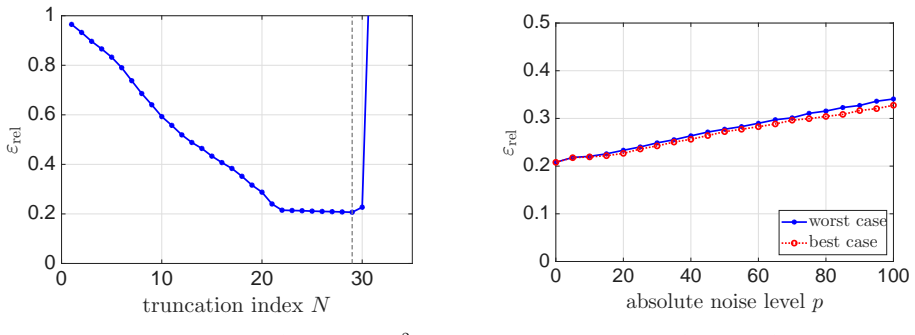
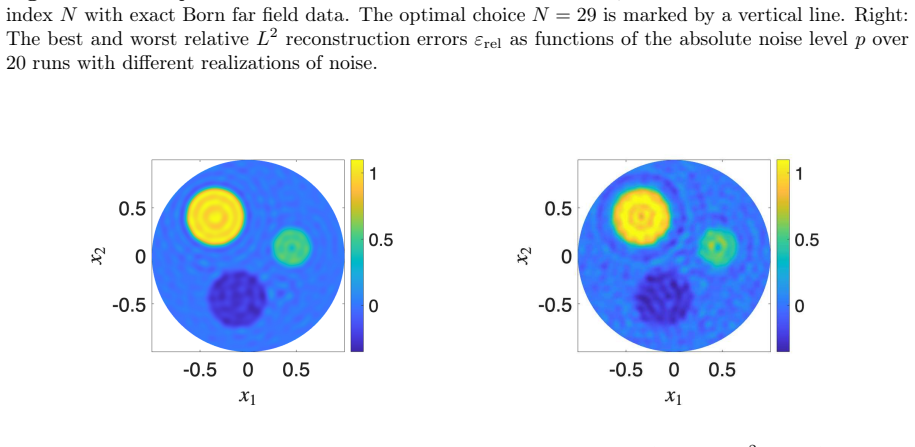
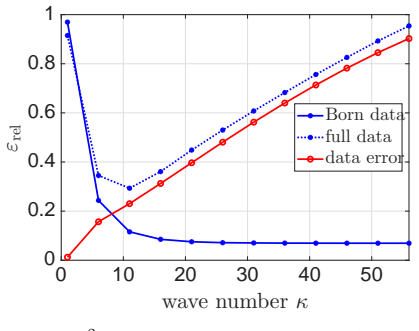
We consider the inverse medium scattering problem for the Helmholtz equation in two dimensions, i.e., the task to recover a compactly supported penetrable two-dimensional scatterer from full knowledge of the associated far field data or, equivalently, the far field operator. Although this problem is uniquely solvable, it is severely ill-posed and nonlinear. In the regime of weak scattering, the Born approximation yields a linearized relation between the contrast and the far field data, thus overcoming the second difficulty. This linear setting allows to build on recent work on linearized electrical impedance tomography, which relies on triangular Zernike decompositions, to derive an explicit reconstruction formula that expresses the expansion coefficients of the contrast in terms of those of the far field data. By choosing the expansion functions appropriately, the resulting system matrix decouples into separate (infinite) triangular systems for the spatial angular frequencies in the contrast. Consequently, each of these systems can be solved independently by performing forward substitutions. Our numerical experiments indicate that this approach, combined with an adequate regularization method, remains effective even when applied to full nonlinear far field data beyond the Born regime.
Editorial analysis
A structured set of objections, weighed in public.
Referee Report
Summary. The manuscript derives an explicit reconstruction formula for the contrast in the 2D acoustic inverse scattering problem under the Born approximation. Building on triangular Zernike decompositions from prior EIT work, it expands the contrast and far-field data in Zernike polynomials and asserts that an appropriate choice of basis functions decouples the linear system into independent infinite triangular systems indexed by angular frequency m, each solvable by forward substitution. Numerical experiments are reported to indicate that the approach, with regularization, remains effective when applied to full nonlinear far-field data.
Significance. If the claimed triangular decoupling holds for the acoustic Born operator, the work would supply a direct, non-iterative reconstruction procedure that is computationally attractive and extends the EIT technique to a new setting. The explicit formula and the numerical indication of utility beyond the linear regime are positive features. The absence of an error analysis or explicit matrix construction, however, limits the immediate strength of the contribution.
major comments (2)
- [Abstract and derivation section] Abstract (paragraph on triangular Zernike decompositions) and the derivation of the reconstruction formula: the central claim that the system matrix is block-diagonal in angular frequency m and strictly triangular in the radial index n rests on the assertion that the far-field operator admits a Zernike representation with the required vanishing properties. The acoustic Born kernel is the Fourier transform of the contrast sampled on the Ewald circle and involves phase factors e^{ik(d-d')·x}; unlike the EIT linearized operator, no explicit identity or ordering argument is supplied showing that the radial integrals ∫ R_n^m(r) J_m(kr) r dr vanish for n' > n (or the reverse). This property is load-bearing for the forward-substitution procedure and must be verified by direct computation of the matrix elements.
- [Numerical experiments] Numerical experiments section: the claim that the method 'remains effective even when applied to full nonlinear far field data' is supported only by qualitative statements; no quantitative error tables, condition-number estimates for the triangular systems, or verification that the computed matrix is indeed triangular are provided. This weakens the supporting evidence for the practical utility asserted in the abstract.
minor comments (2)
- The manuscript would benefit from an explicit statement of the ordering chosen for the Zernike indices (n,m) that produces the triangular structure.
- A brief comparison table or figure showing the reconstructed contrast for both Born and nonlinear data would improve clarity of the numerical results.
Simulated Author's Rebuttal
We thank the referee for the careful reading and constructive feedback on our manuscript. We address each major comment below and will revise the paper accordingly to strengthen the presentation.
read point-by-point responses
-
Referee: [Abstract and derivation section] Abstract (paragraph on triangular Zernike decompositions) and the derivation of the reconstruction formula: the central claim that the system matrix is block-diagonal in angular frequency m and strictly triangular in the radial index n rests on the assertion that the far-field operator admits a Zernike representation with the required vanishing properties. The acoustic Born kernel is the Fourier transform of the contrast sampled on the Ewald circle and involves phase factors e^{ik(d-d')·x}; unlike the EIT linearized operator, no explicit identity or ordering argument is supplied showing that the radial integrals ∫ R_n^m(r) J_m(kr) r dr vanish for n' > n (or the reverse). This property is load-bearing for the forward-substitution procedure and must be verified by direct computation of the matrix elements.
Authors: We agree that the triangular structure must be verified explicitly for the acoustic Born operator rather than relying solely on analogy with the EIT case. In the revised manuscript we will add a direct computation (in an appendix or dedicated subsection) of the relevant radial integrals involving the product of Zernike radial functions and the Bessel functions arising from the Fourier transform on the Ewald circle. This calculation will confirm the vanishing property for n' > n and thereby justify the block-diagonal and strictly triangular form of the system matrix. revision: yes
-
Referee: [Numerical experiments] Numerical experiments section: the claim that the method 'remains effective even when applied to full nonlinear far field data' is supported only by qualitative statements; no quantitative error tables, condition-number estimates for the triangular systems, or verification that the computed matrix is indeed triangular are provided. This weakens the supporting evidence for the practical utility asserted in the abstract.
Authors: We accept the referee's observation that the numerical evidence is currently qualitative. The revised numerical experiments section will include quantitative L² reconstruction error tables for several test contrasts, reported condition numbers of the triangular subsystems, and explicit numerical checks (e.g., matrix-entry norms or sparsity patterns) confirming that the assembled matrices are indeed triangular to machine precision. These additions will provide stronger support for the claimed practical utility beyond the Born regime. revision: yes
Circularity Check
No significant circularity; extends EIT triangularity independently to acoustic Born case
full rationale
The derivation builds on cited prior linearized EIT work for the triangular Zernike property but produces a new explicit reconstruction formula specific to the acoustic far-field operator under Born approximation. The decoupling into angular-frequency blocks is asserted to follow from basis choice in the acoustic kernel, without any reduction of the target formula to a self-referential definition, fitted parameter renamed as prediction, or load-bearing self-citation chain. The result remains independently verifiable against the acoustic integral operator and is not equivalent to its inputs by construction.
Axiom & Free-Parameter Ledger
axioms (2)
- standard math Zernike polynomials admit a triangular decomposition of the relevant far-field operator
- domain assumption Born approximation yields a linearized relation between contrast and far-field data
Reference graph
Works this paper leans on
-
[1]
L. Audibert and H. Haddar. A generalized formulation of t he linear sampling method with exact characterization of targets in terms of farfield measuremen ts. Inverse Problems , 30(3):035011, 20, 2014. doi:10.1088/0266-5611/30/3/035011
-
[2]
A. Autio, H. Garde, M. Hirvensalo, and N. Hyvönen. Linear ization-based direct reconstruc- tion for eit using triangular zernike decompositions. Inverse Probl. Imaging , 19(3), 2024. doi:10.3934/ipi.2024040
-
[3]
A. H. Barnett. Aliasing error of the exp(β √ 1 − z2) kernel in the nonuniform fast Fourier transform. Appl. Comput. Harmon. Anal. , 51:1–16, 2021. doi:10.1016/j.acha.2020.10.002
-
[4]
exponential of semicircle
A. H. Barnett, J. Magland, and L. af Klinteberg. A paralle l nonuniform fast Fourier transform library based on an “exponential of semicircle” kernel. SIAM J. Sci. Comput. , 41(5):C479–C504,
-
[5]
doi:10.1137/18M120885X
-
[6]
F. Bürgel, K. S. Kazimierski, and A. Lechleiter. Algorit hm 1001: IPscatt – A matlab toolbox for the inverse medium problem in scattering. ACM Trans. Math. Software , 45(4):Art. 45, 20, 2019. doi:10.1145/3328525
-
[7]
F. Cakoni, D. Colton, and H. Haddar. Inverse scattering theory and transmission eigenvalues , volume 98 of CBMS-NSF Regional Conference Series in Applied Mathematics . Society for Industrial and Applied Mathematics (SIAM), Philadelphia, PA, 2023. doi:10.1137/1.9781611974461. 21
-
[8]
D. Colton and A. Kirsch. A simple method for solving inver se scattering problems in the resonance region. Inverse Problems, 12(4):383–393, 1996. doi:10.1088/0266-5611/12/4/003
-
[9]
D. Colton and R. Kress. Eigenvalues of the far field operat or for the Helmholtz equation in an ab- sorbing medium. SIAM J. Appl. Math. , 55(6):1724–1735, 1995. doi:10.1137/S0036139993256114
-
[10]
D. Colton and R. Kress. Inverse acoustic and electromagnetic scattering theory , volume 93 of Applied Mathematical Sciences. Springer, fourth edition, 2019. doi:10.1007/978-3-030-30351-8
-
[11]
D. Colton and P. Monk. The inverse scattering problem fo r time-harmonic acoustic waves in an inhomogeneous medium. Quart. J. Mech. Appl. Math. , 41(1):97–125, 1988. doi:10.1093/qjmam/41.1.97
-
[12]
https://dlmf.nist.gov/, Release 1.1.11 of 2023- 09-15
NIST Digital Library of Mathematical Functions . https://dlmf.nist.gov/, Release 1.1.11 of 2023- 09-15. F. W. J. Olver, A. B. Olde Daalhuis, D. W. Lozier, B. I. S chneider, R. F. Boisvert, C. W. Clark, B. R. Miller, B. V. Saunders, H. S. Cohl, and M. A. M cClain, eds. URL: https://dlmf.nist.gov/
2023
-
[13]
A. Dutt and V. Rokhlin. Fast Fourier transforms for none quispaced data. SIAM J. Sci. Comput. , 14(6):1368–1393, 1993. doi:10.1137/0914081
-
[14]
H. Garde and M. Hirvensalo. Linearized calderón proble m: Reconstruction of unbounded perturba- tions in three dimensions. SIAM J. Appl. Math. , 85(1):210–223, 2025. doi:10.1137/24M1649162
-
[15]
Garde and N
H. Garde and N. Hyvönen. Linearized calderón problem: R econstruction and lipschitz stability for infinite-dimensional spaces of unbounded perturbations. SIAM J. Math. Anal. , 56(3):3588–3604,
-
[16]
doi:10.1137/23M1609270
-
[17]
R. Griesmaier, M. Hanke, and J. Sylvester. Far field spli tting for the Helmholtz equation. SIAM J. Numer. Anal. , 52(1):343–362, 2014. doi:10.1137/120891381
-
[18]
R. Griesmaier and B. Harrach. Monotonicity in inverse m edium scattering on unbounded domains. SIAM J. Appl. Math. , 78(5):2533–2557, 2018. doi:10.1137/18M1171679
-
[19]
R. Griesmaier and L. Schätzle. Far field operator splitt ing and completion in inverse medium scattering. Inverse Problems, 40(11):Paper No. 115010, 32, 2024. doi:10.1088/1361-6420/ad7c77
-
[20]
R. Griesmaier and L. Schätzle. Far field operator splitt ing by principal component pursuit. CRC 1173 Preprint 2025/53, Karlsruhe Institute of Technology, dec 2025. doi:10.5445/IR/1000188646
-
[21]
R. Griesmaier and J. Sylvester. Far field splitting by it eratively reweighted ℓ1 minimization. SIAM J. Appl. Math. , 76(2):705–730, 2016. doi:10.1137/15M102839X
-
[22]
R. Griesmaier and J. Sylvester. Uncertainty principle s for inverse source problems, far field splitting, and data completion. SIAM J. Appl. Math. , 77(1):154–180, 2017. doi:10.1137/16M1086157
-
[23]
K. Kilgore, S. Moskow, and J. C. Schotland. Inverse Born series for scalar waves. J. Comput. Math. , 30(6):601–614, 2012. doi:10.4208/jcm.1205-m3935
-
[24]
A. Kirsch. Characterization of the shape of a scatterin g obstacle using the spectral data of the far field operator. Inverse Problems, 14(6):1489–1512, 1998. doi:10.1088/0266-5611/14/6/009
-
[25]
A. Kirsch. Remarks on the Born approximation and the fac torization method. Appl. Anal., 96(1):70– 84, 2017. doi:10.1080/00036811.2016.1188286
-
[26]
A. Kirsch. An introduction to the mathematical theory of inverse problem s, volume 120 of Applied Mathematical Sciences. Springer, third edition, 2021. doi:10.1007/978-3-030-63343-1
-
[27]
Kirsch and N
A. Kirsch and N. Grinberg. The factorization method for inverse problems , volume 36 of Oxford Lecture Series in Mathematics and its Applications . Oxford University Press, Oxford, 2008
2008
-
[28]
S. Meng. Data-driven basis for reconstructing the cont rast in inverse scattering: Picard cri- terion, regularity, regularization, and stability. SIAM J. Appl. Math. , 83(5):2003–2026, 2023. doi:10.1137/23M1545409. 22
-
[29]
G. Vainikko. Fast solvers of the Lippmann-Schwinger eq uation. In Direct and inverse problems of mathematical physics (Newark, DE, 1997) , volume 5 of Int. Soc. Anal. Appl. Comput. , pages 423–440. Kluwer Acad. Publ., Dordrecht, 2000. doi:10.1007/978-1-4757-3214-6\_25
-
[30]
G. N. Watson. A Treatise on the Theory of Bessel Functions . Cambridge University Press, Cam- bridge; The Macmillan Company, New York, 1944
1944
-
[31]
Weidmann
J. Weidmann. Linear operators in Hilbert spaces , volume 68 of Graduate Texts in Mathematics . Springer-Verlag, New York-Berlin, 1980
1980
-
[32]
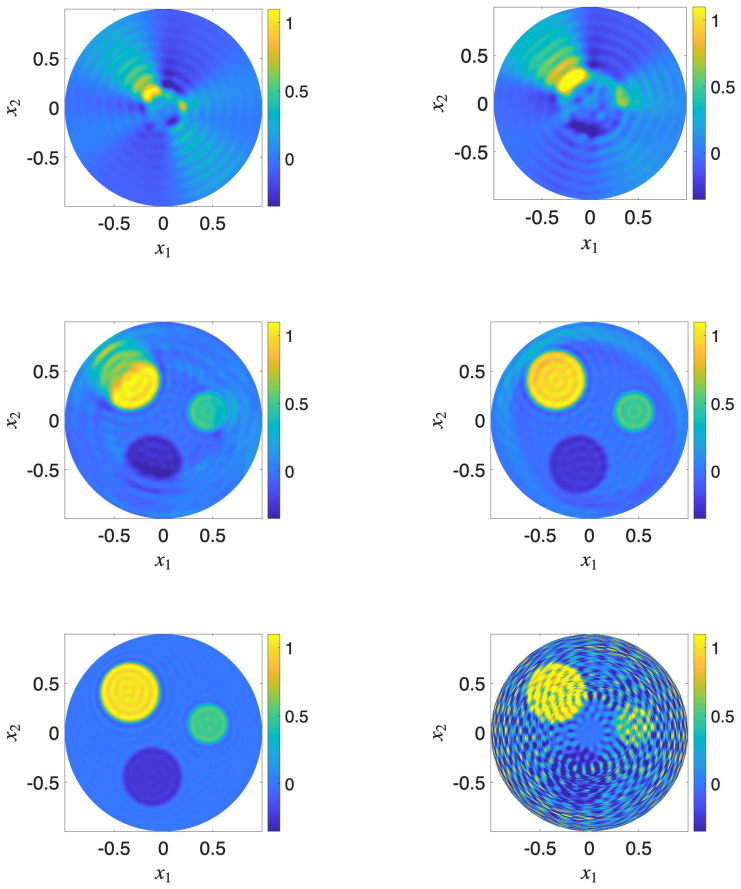
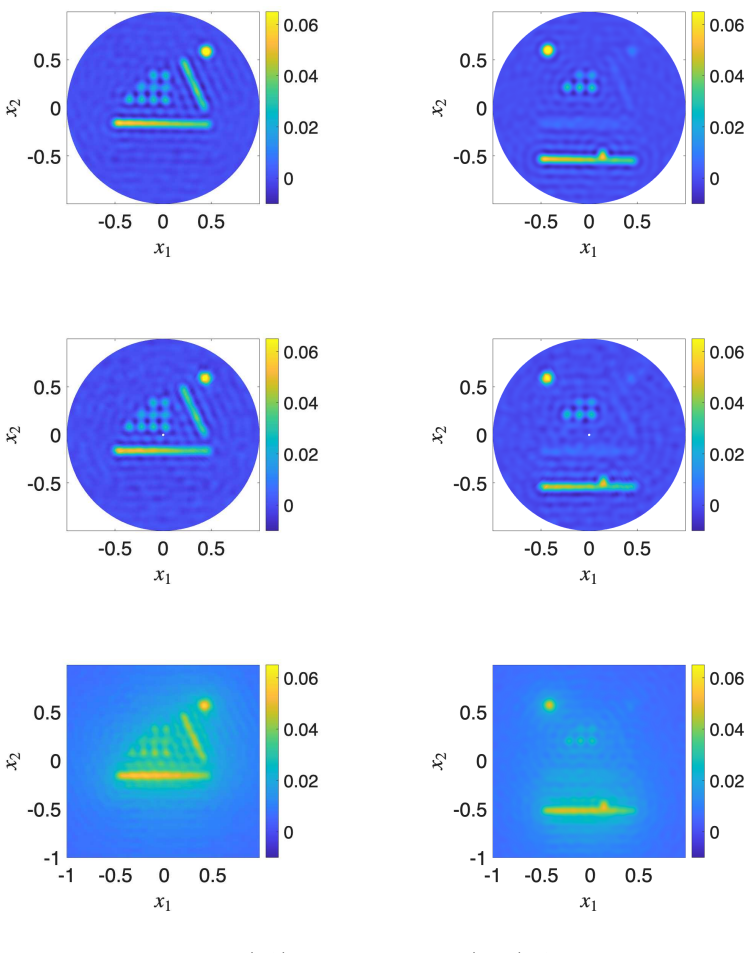
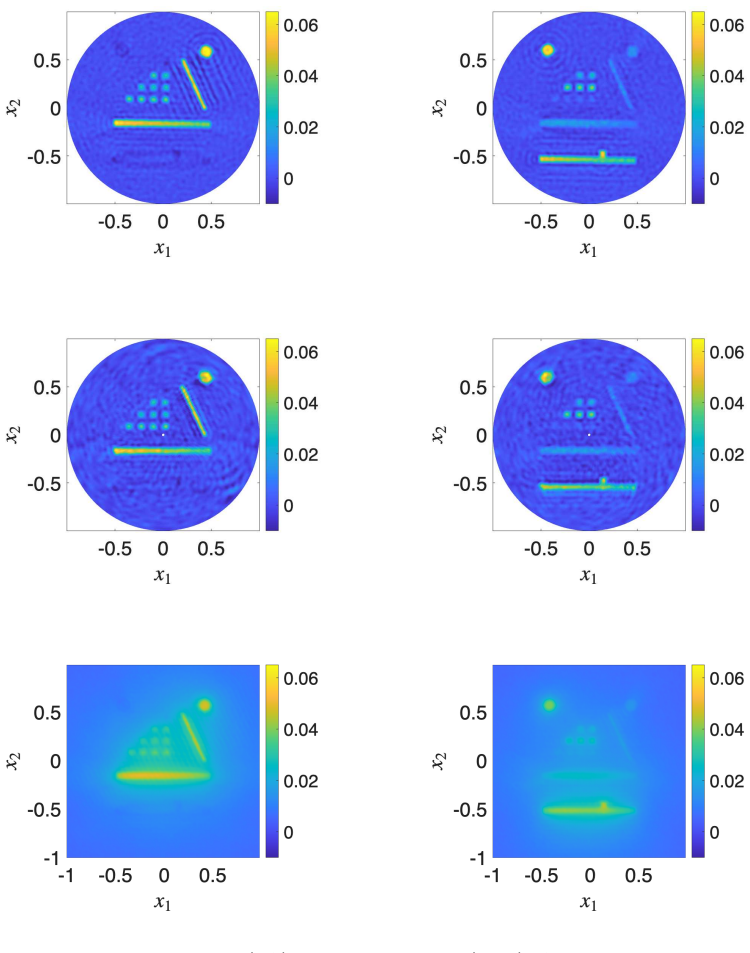
Y. Zhou, L. Audibert, S. Meng, and B. Zhang. Exploring lo w-rank structure for an inverse scattering problem with far-field data. SIAM J. Appl. Math. , 86(1):179–205, 2026. doi:10.1137/24M1663922. 23 Figure 5.8: Example 5.3. Real part (left) and imaginary part (right) of reconstruct ed contrast function for wave number κ = 30 from full far field data with 2...
discussion (0)
Sign in with ORCID, Apple, or X to comment. Anyone can read and Pith papers without signing in.