IA-RAG: Interval-Algebra-Driven Temporal Reasoning for Dynamic Knowledge Retrieval
Pith reviewed 2026-06-28 01:34 UTC · model grok-4.3
The pith
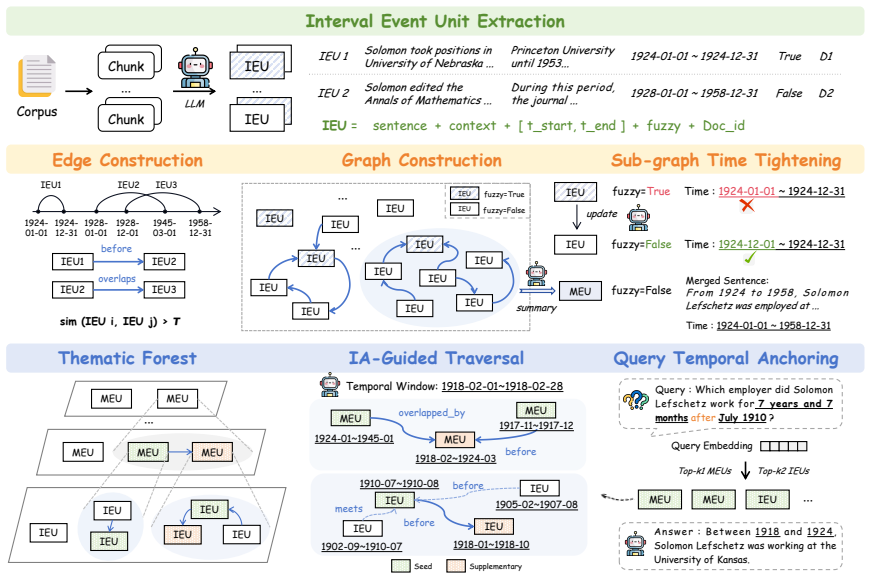
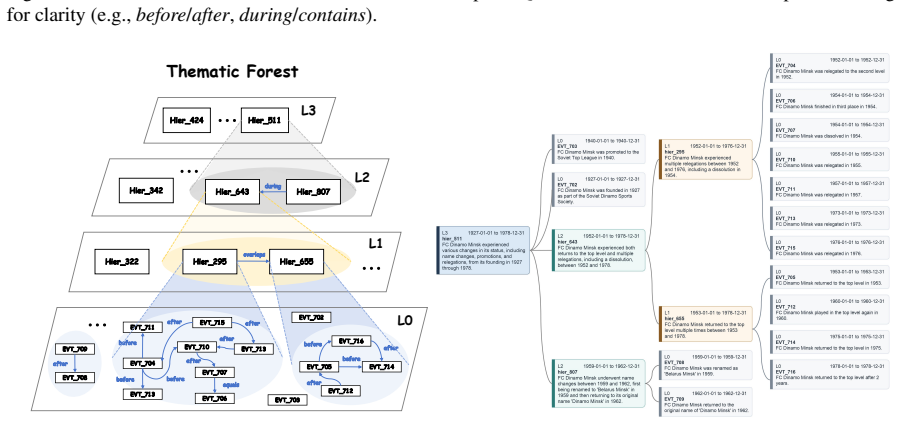
IA-RAG represents facts as time intervals in a hierarchical forest governed by Allen's Interval Algebra to strengthen retrieval for complex temporal questions.
A machine-rendered reading of the paper's core claim, the machinery that carries it, and where it could break.
Core claim
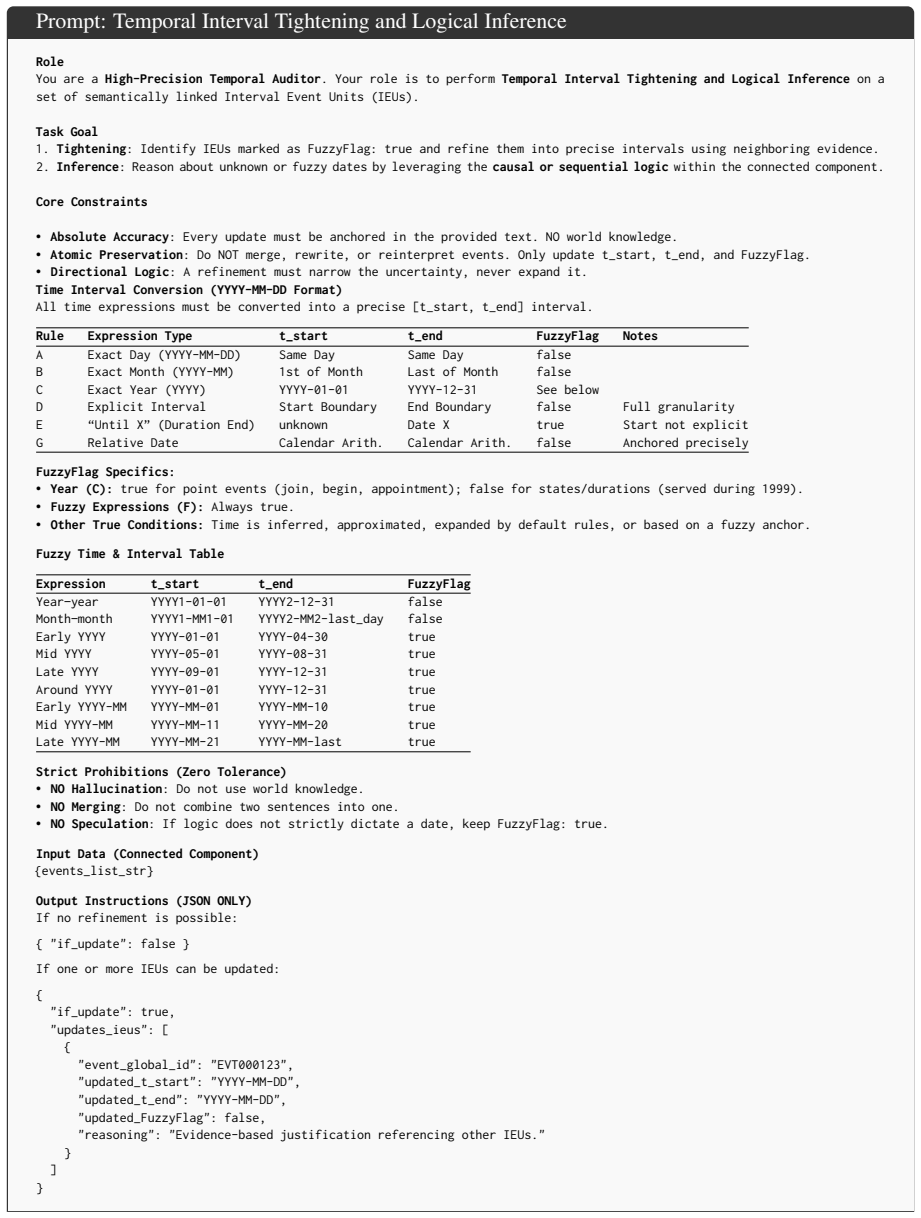
Facts are represented as Interval Event Units and assembled into a hierarchical Thematic Forest in which temporal dependencies obey Allen's Interval Algebra; a Sub-graph Time Tightening procedure refines fuzzy boundaries inside event subgraphs, enabling interval-algebra-guided traversal that improves retrieval and reasoning on temporal question-answering benchmarks, especially complex compositional tasks.
What carries the argument
Interval Event Units assembled into a Thematic Forest whose relations are defined by Allen's Interval Algebra, augmented by Sub-graph Time Tightening that propagates logical constraints across connected subgraphs.
If this is right
- Retrieval can now return facts whose time relations satisfy explicit constraints such as overlap or containment rather than surface similarity alone.
- Uncertain temporal boundaries can be tightened using only logical relations already present in the knowledge store.
- Compositional questions that chain multiple time relations become answerable without first materializing an explicit timeline.
- The same forest structure supports both explicit and implicit temporal semantic retrieval in a single traversal mechanism.
Where Pith is reading between the lines
- The forest organization may reduce the need for separate temporal indexing layers in production RAG pipelines.
- The same interval-algebra machinery could be applied to domains that already use event logs, such as clinical timelines or supply-chain records.
- Because tightening operates on subgraphs rather than the whole corpus, incremental updates to the knowledge base remain local.
- If the algebra relations prove too rigid for certain natural-language time expressions, a hybrid embedding-plus-algebra layer might be required.
Load-bearing premise
Representing facts as intervals inside an algebra-governed forest plus tightening their boundaries is sufficient to capture the temporal relations needed for the observed performance gains without unacceptable information loss.
What would settle it
A controlled ablation that removes the interval-algebra traversal and Sub-graph Time Tightening while keeping the same underlying documents and LLM would produce no accuracy drop on the ComplexTR benchmark.
Figures




read the original abstract
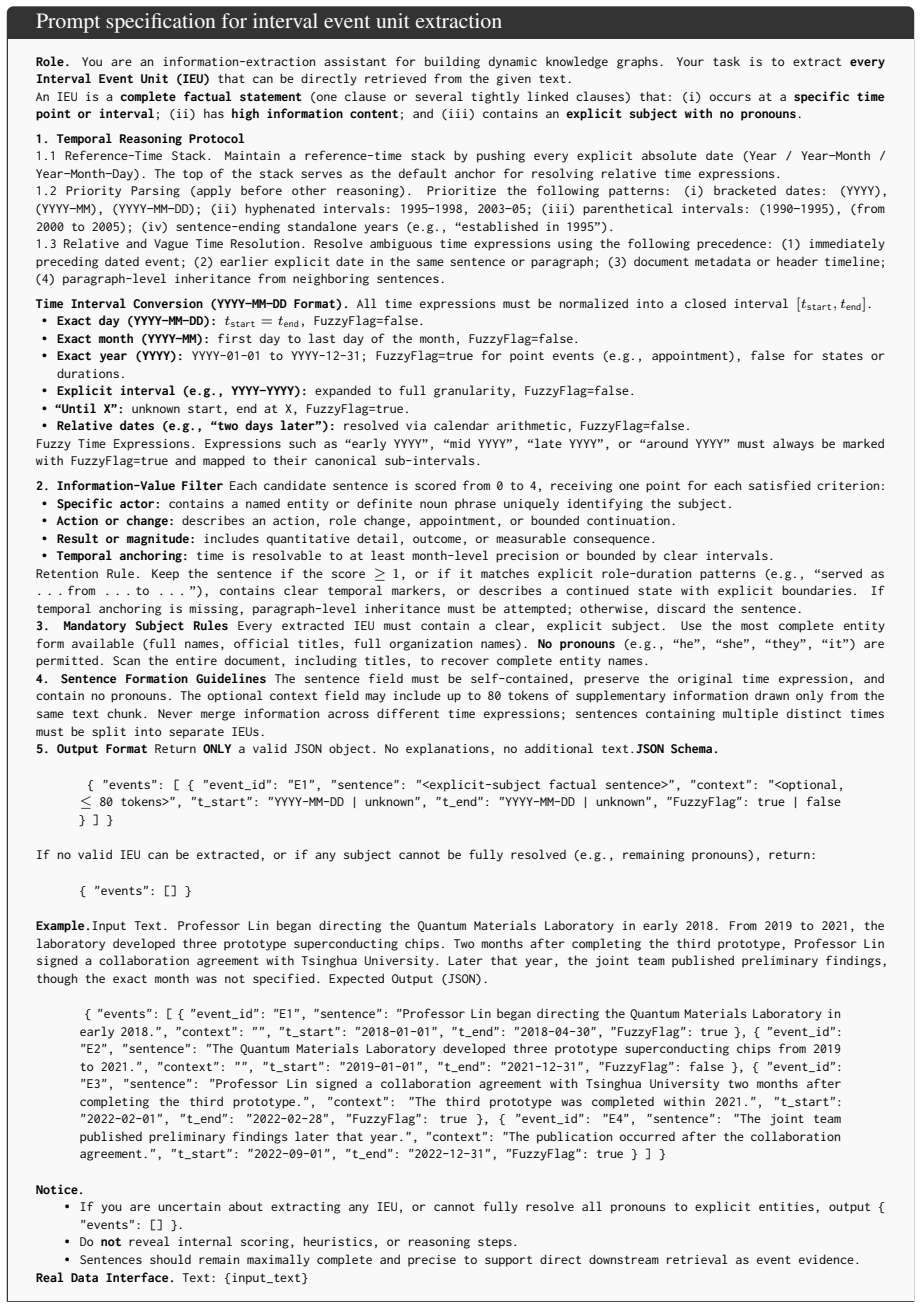
Retrieval-Augmented Generation (RAG) has shown strong effectiveness in grounding Large Language Models (LLMs) with external knowledge. However, existing RAG and Graph RAG frameworks largely treat knowledge as static or associate time with coarse-grained timestamps or metadata, failing to capture rich temporal structures such as duration, overlap, and containment. We propose IA-RAG, a hierarchical temporal RAG framework that models knowledge as time intervals and performs retrieval under formal temporal constraints. IA-RAG represents facts as Interval Event Units (IEUs) and organizes them into a hierarchical Thematic Forest, where temporal dependencies are governed by Allen's Interval Algebra. To handle incomplete or uncertain temporal boundaries, IA-RAG further introduces a Sub-graph Time Tightening mechanism that refines fuzzy intervals through logical constraints within connected event subgraphs. In addition, IA-RAG supports implicit temporal semantic retrieval through interval-algebra-guided traversal. Experiments on multiple temporal question answering benchmarks, including TimeQA, TempReason, and ComplexTR, demonstrate that IA-RAG achieves strong temporal retrieval and reasoning performance, particularly on complex compositional temporal reasoning tasks. Our code is released at https://github.com/xiaoAugenstern/LogicalRAG_TemporalQA.
Editorial analysis
A structured set of objections, weighed in public.
Referee Report
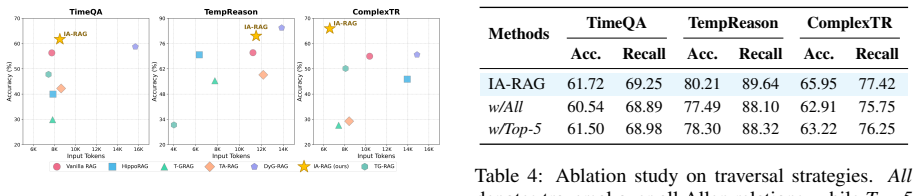
Summary. The manuscript proposes IA-RAG, a hierarchical temporal RAG framework that represents facts as Interval Event Units (IEUs) organized into a Thematic Forest whose temporal relations are governed by Allen's Interval Algebra. It introduces a Sub-graph Time Tightening mechanism to refine uncertain interval boundaries via logical constraints and supports implicit temporal retrieval through algebra-guided traversal. Experiments on TimeQA, TempReason, and ComplexTR are stated to demonstrate strong performance on complex compositional temporal reasoning tasks, with code released at https://github.com/xiaoAugenstern/LogicalRAG_TemporalQA.
Significance. If the performance claims hold, the work supplies a principled, algebraically grounded method for injecting temporal structure into RAG pipelines, addressing a recognized limitation of timestamp-only or static-graph approaches. The reliance on the established Allen interval algebra rather than ad-hoc temporal encodings, together with the public code release, provides a clear path for verification and extension.
major comments (1)
- [Abstract] Abstract: the central claim that IA-RAG 'achieves strong temporal retrieval and reasoning performance' on TimeQA, TempReason, and ComplexTR is asserted without any quantitative results, baseline comparisons, ablation studies, or error analysis. This absence prevents evaluation of the magnitude or robustness of the reported gains.
Simulated Author's Rebuttal
We thank the referee for the review and the recognition of the work's potential significance. We respond to the major comment below.
read point-by-point responses
-
Referee: [Abstract] Abstract: the central claim that IA-RAG 'achieves strong temporal retrieval and reasoning performance' on TimeQA, TempReason, and ComplexTR is asserted without any quantitative results, baseline comparisons, ablation studies, or error analysis. This absence prevents evaluation of the magnitude or robustness of the reported gains.
Authors: We agree that the abstract would benefit from including specific quantitative results to support the performance claim. The manuscript body already contains the full experimental results with baselines, ablations, and error analysis on TimeQA, TempReason, and ComplexTR. We will revise the abstract to incorporate key quantitative highlights from those experiments. revision: yes
Circularity Check
No significant circularity
full rationale
The IA-RAG framework is constructed from the externally established Allen's Interval Algebra applied to Interval Event Units within a Thematic Forest, plus the Sub-graph Time Tightening mechanism. No equations, derivations, or self-citations are shown that reduce the claimed retrieval/reasoning performance to a fitted parameter or self-defined input by construction. Benchmark results on TimeQA, TempReason, and ComplexTR are presented as empirical outcomes with released code for independent verification, keeping the central claims self-contained against external standards rather than internally forced.
Axiom & Free-Parameter Ledger
axioms (1)
- standard math Allen's Interval Algebra correctly captures the relevant temporal relations (duration, overlap, containment, etc.) for knowledge retrieval
invented entities (3)
-
Interval Event Unit (IEU)
no independent evidence
-
Thematic Forest
no independent evidence
-
Sub-graph Time Tightening mechanism
no independent evidence
Reference graph
Works this paper leans on
-
[1]
Proceedings of the 61st Annual Meeting of the Association for Computational Linguistics (Volume 1: Long Papers) , pages=
Towards benchmarking and improving the temporal reasoning capability of large language models , author=. Proceedings of the 61st Annual Meeting of the Association for Computational Linguistics (Volume 1: Long Papers) , pages=
-
[2]
Findings of the Association for Computational Linguistics: ACL 2024 , pages=
Towards robust temporal reasoning of large language models via a multi-hop QA dataset and pseudo-instruction tuning , author=. Findings of the Association for Computational Linguistics: ACL 2024 , pages=
2024
-
[3]
Proceedings of the AAAI Conference on Artificial Intelligence , volume=
Leanrag: Knowledge-graph-based generation with semantic aggregation and hierarchical retrieval , author=. Proceedings of the AAAI Conference on Artificial Intelligence , volume=
-
[4]
arXiv preprint arXiv:2507.13396 , year=
DyG-RAG: Dynamic Graph Retrieval-Augmented Generation with Event-Centric Reasoning , author=. arXiv preprint arXiv:2507.13396 , year=
-
[5]
arXiv preprint arXiv:2503.04338 , year=
In-depth Analysis of Graph-based RAG in a Unified Framework , author=. arXiv preprint arXiv:2503.04338 , year=
-
[6]
Proceedings of the 63rd Annual Meeting of the Association for Computational Linguistics (Volume 1: Long Papers) , pages=
Eventrag: Enhancing llm generation with event knowledge graphs , author=. Proceedings of the 63rd Annual Meeting of the Association for Computational Linguistics (Volume 1: Long Papers) , pages=
-
[7]
Advances in neural information processing systems , volume=
Retrieval-augmented generation for knowledge-intensive nlp tasks , author=. Advances in neural information processing systems , volume=
-
[8]
arXiv preprint arXiv:2404.16130 , year=
From local to global: A graph rag approach to query-focused summarization , author=. arXiv preprint arXiv:2404.16130 , year=
-
[9]
arXiv preprint arXiv:2410.05779 , volume=
Lightrag: Simple and fast retrieval-augmented generation , author=. arXiv preprint arXiv:2410.05779 , volume=
-
[10]
Zhao, Yibo and Zhu, Jiapeng and Guo, Ye and He, Kangkang and Li, Xiang , journal=. E\^
-
[11]
Advances in neural information processing systems , volume=
Hipporag: Neurobiologically inspired long-term memory for large language models , author=. Advances in neural information processing systems , volume=
-
[12]
Proceedings of the ACM on Web Conference 2025 , pages=
Memorag: Boosting long context processing with global memory-enhanced retrieval augmentation , author=. Proceedings of the ACM on Web Conference 2025 , pages=
2025
-
[13]
arXiv preprint arXiv:2510.13590 , year=
RAG Meets Temporal Graphs: Time-Sensitive Modeling and Retrieval for Evolving Knowledge , author=. arXiv preprint arXiv:2510.13590 , year=
-
[14]
arXiv preprint arXiv:2507.22917 , year=
Reading Between the Timelines: RAG for Answering Diachronic Questions , author=. arXiv preprint arXiv:2507.22917 , year=
-
[15]
arXiv preprint arXiv:2108.06314 , year=
A dataset for answering time-sensitive questions , author=. arXiv preprint arXiv:2108.06314 , year=
-
[16]
Qian, Xinying and Zhang, Ying and Zhao, Yu and Zhou, Baohang and Sui, Xuhui and Zhang, Li and Song, Kehui , booktitle=
-
[17]
Findings of the Association for Computational Linguistics: ACL 2024 , pages=
Two-stage generative question answering on temporal knowledge graph using large language models , author=. Findings of the Association for Computational Linguistics: ACL 2024 , pages=
2024
-
[18]
Wei, Yifan and Su, Yisong and Ma, Huanhuan and Yu, Xiaoyan and Lei, Fangyu and Zhang, Yuanzhe and Zhao, Jun and Liu, Kang , booktitle =. 2023 , pages =. doi:10.18653/v1/2023.findings-emnlp.100 , url =
-
[19]
Proceedings of the 33rd ACM International Conference on Multimedia , pages=
T-grag: A dynamic graphrag framework for resolving temporal conflicts and redundancy in knowledge retrieval , author=. Proceedings of the 33rd ACM International Conference on Multimedia , pages=
-
[20]
Han, Jiale and Cheung, Austin and Wei, Yubai and Yu, Zheng and Wang, Xusheng and Zhu, Bing and Yang, Yi , journal=
-
[21]
2025 , eprint=
Qwen2.5 Technical Report , author=. 2025 , eprint=
2025
-
[22]
Chen, Jianlv and Xiao, Shitao and Zhang, Peitian and Luo, Kun and Lian, Defu and Liu, Zheng , journal=
-
[23]
Artificial intelligence , volume=
Towards a general theory of action and time , author=. Artificial intelligence , volume=
-
[24]
ACM Transactions on Intelligent Systems and Technology , volume=
A comprehensive overview of large language models , author=. ACM Transactions on Intelligent Systems and Technology , volume=
-
[25]
Journal of the ACM , volume=
Reasoning about temporal relations: A maximal tractable subclass of Allen's interval algebra , author=. Journal of the ACM , volume=
-
[26]
2025 , eprint=
It's High Time: A Survey of Temporal Question Answering , author=. 2025 , eprint=
2025
-
[27]
2023 , eprint=
MenatQA: A New Dataset for Testing the Temporal Comprehension and Reasoning Abilities of Large Language Models , author=. 2023 , eprint=
2023
-
[28]
2025 , eprint=
HetaRAG: Hybrid Deep Retrieval-Augmented Generation across Heterogeneous Data Stores , author=. 2025 , eprint=
2025
-
[29]
Proceedings of the 2021 Conference of the North American Chapter of the Association for Computational Linguistics: Human Language Technologies , pages=
Structure-grounded pretraining for text-to-sql , author=. Proceedings of the 2021 Conference of the North American Chapter of the Association for Computational Linguistics: Human Language Technologies , pages=
2021
-
[30]
arXiv preprint arXiv:2305.11301 , year=
Neustip: A novel neuro-symbolic model for link and time prediction in temporal knowledge graphs , author=. arXiv preprint arXiv:2305.11301 , year=
-
[31]
Proceedings of the 19th Conference of the European Chapter of the Association for Computational Linguistics (Volume 1: Long Papers) , pages=
Respecting Temporal-Causal Consistency: Entity-Event Knowledge Graph for Retrieval-Augmented Generation , author=. Proceedings of the 19th Conference of the European Chapter of the Association for Computational Linguistics (Volume 1: Long Papers) , pages=
discussion (0)
Sign in with ORCID, Apple, or X to comment. Anyone can read and Pith papers without signing in.