Barbell Codes: qLDPC Codes for Superconducting Quantum Hardware
Pith reviewed 2026-06-28 00:38 UTC · model grok-4.3
The pith
Barbell codes achieve trillion-cycle error correction on superconducting chips with constant hardware complexity and under 30 qubits per logical qubit.
A machine-rendered reading of the paper's core claim, the machinery that carries it, and where it could break.
Core claim
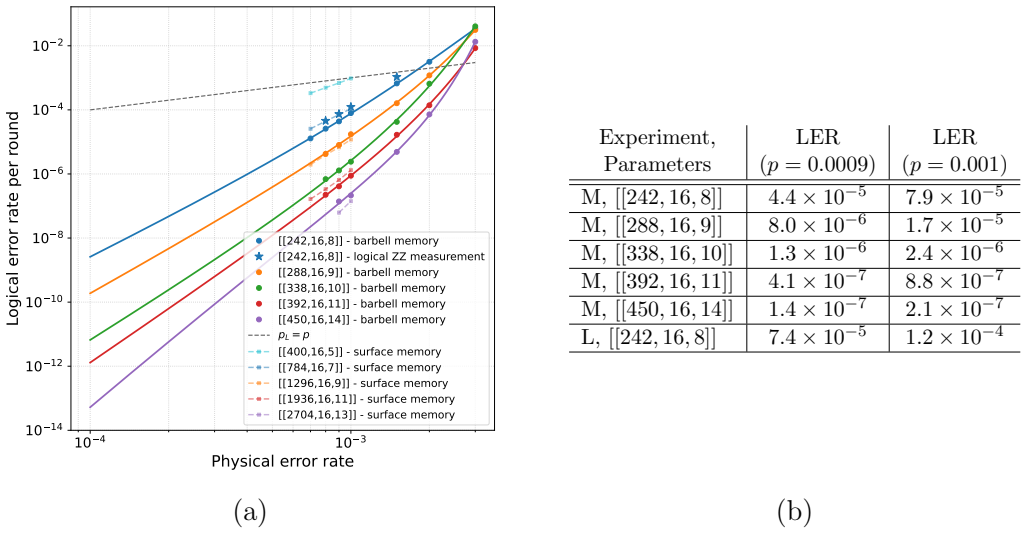
Barbell codes are a family of qLDPC codes paired with a realistic superconducting chip layout that natively supports all required two-qubit interactions in their quantum error correction cycles. The hardware complexity required remains constant as code distance increases. With fewer than 30 data qubits per logical qubit, these codes preserve information at a physical noise strength of 10^{-4} for several trillion QEC cycles. Simulations of logical multi-Pauli measurements using circuits matched to the chip layout yield comparable logical performance per round, showing that entangling gates between logical qubits can be realized fault-tolerantly.
What carries the argument
The barbell code family combined with its fixed-connectivity chip layout that supplies all two-qubit gates for the error-correction cycles without added complexity at larger distances.
If this is right
- Logical information survives several trillion QEC cycles at 10^{-4} physical noise with under 30 data qubits per logical qubit.
- Hardware complexity stays fixed while code distance increases.
- Fault-tolerant logical multi-Pauli measurements become available through circuits matched to the chip layout.
- qLDPC codes become implementable on fixed-connectivity superconducting hardware at scale.
Where Pith is reading between the lines
- The constant-complexity layout could allow construction of very large-distance codes on the same physical platform without redesign.
- Barbell-style connectivity patterns might extend to other qLDPC families or hardware types that face similar non-local gate constraints.
- Trillion-cycle stability opens the possibility of running algorithms whose gate count exceeds current surface-code thresholds by orders of magnitude.
Load-bearing premise
The proposed chip layout can implement every two-qubit interaction demanded by the error-correction cycles without any increase in hardware complexity when code distance grows.
What would settle it
A circuit-level simulation or device experiment at 10^{-4} noise that shows the logical error rate rising above the physical rate or growing over successive rounds, or that demonstrates added hardware resources are needed for larger distances.
Figures



read the original abstract
The major challenge on the way to fault-tolerant quantum computing comes from the insufficient quality of hardware components and the difficulty of scaling their number without further compromising fidelity. Quantum Low-Density Parity-Check (qLDPC) codes offer a promising solution by encoding logical qubits with low overhead and at a comparatively high code distance. However, it remains an open question how to scalably implement efficient qLDPC codes on fixed-connectivity quantum chips without increasing hardware complexity to enable the non-local interactions in their underlying QEC cycles. We resolve this challenge for the first time by introducing a family of qLDPC "barbell" codes accompanied by a realistic chip layout that natively supports all required two-qubit interactions. Crucially, the hardware complexity required to implement barbell codes remains constant as code distance increases. We provide a detailed investigation into the feasibility of all required hardware components and simulate a specific family of barbell codes against circuit-level noise. We find that, with a modest overhead of $<30$ data qubits per logical qubit, barbell codes can preserve information at a physical noise strength of $10^{-4}$ for several trillion QEC cycles. Simulations of logical multi-Pauli measurements, performed with circuits tailored to the chip, yield similar logical performance per QEC round, indicating that entangling gates between logical qubits in barbell codes can be realized fault-tolerantly.
Editorial analysis
A structured set of objections, weighed in public.
Referee Report
Summary. The manuscript introduces a family of qLDPC 'barbell' codes together with a fixed-connectivity superconducting chip layout that is claimed to realize all stabilizer-measurement two-qubit gates using only local couplers whose number and type per physical qubit remain independent of code distance. Circuit-level simulations are reported to show that, with an overhead of fewer than 30 data qubits per logical qubit, logical information is preserved at physical error rate 10^{-4} for several trillion QEC cycles, and that logical multi-Pauli measurements can be performed with comparable per-round logical performance.
Significance. If the layout and simulation claims are substantiated, the work would constitute a concrete step toward practical implementation of low-overhead qLDPC codes on superconducting hardware by removing the usual connectivity-scaling obstacle. The emphasis on constant hardware complexity and chip-tailored circuits is a notable strength; reproducible simulation results at this overhead would be of immediate interest to the fault-tolerance community.
major comments (2)
- [Abstract / simulation section] Abstract and simulation section: the headline claim of logical preservation at p=10^{-4} for trillions of cycles rests on circuit-level simulations, yet the manuscript supplies no noise-model parameters, gate-error assumptions, circuit-construction details, data-exclusion criteria, or error bars. Without these, the numerical results cannot be verified or reproduced.
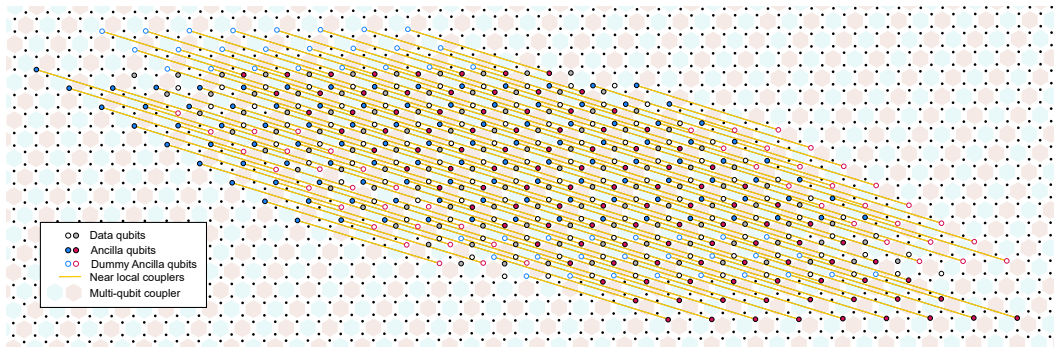
- [Chip-layout section] Chip-layout section (paragraph on barbell codes and chip layout): the assertion that 'hardware complexity remains constant as code distance increases' and that the layout 'natively supports all required two-qubit interactions' is load-bearing for both the scalability statement and the validity of the reported simulations. The manuscript does not supply explicit coupler counts per qubit, a connectivity graph, or a demonstration that no distance-dependent auxiliary routing is required.
minor comments (1)
- [Abstract] The phrase 'several trillion QEC cycles' is stated without an accompanying logical-error-rate value or explicit conversion from per-round error probability.
Simulated Author's Rebuttal
We thank the referee for their constructive feedback and positive assessment of the potential impact of barbell codes. We address each major comment below and will revise the manuscript accordingly to improve reproducibility and explicit documentation of the hardware layout.
read point-by-point responses
-
Referee: [Abstract / simulation section] Abstract and simulation section: the headline claim of logical preservation at p=10^{-4} for trillions of cycles rests on circuit-level simulations, yet the manuscript supplies no noise-model parameters, gate-error assumptions, circuit-construction details, data-exclusion criteria, or error bars. Without these, the numerical results cannot be verified or reproduced.
Authors: We agree that these parameters are essential for verification and reproducibility. The revised manuscript will add a dedicated subsection in the methods or simulation section that explicitly states the circuit-level noise model (depolarizing noise at rate 10^{-4} on all gates and measurements), gate-error assumptions, the precise construction of the stabilizer measurement circuits, data-exclusion criteria, and statistical error bars obtained from repeated simulation runs. revision: yes
-
Referee: [Chip-layout section] Chip-layout section (paragraph on barbell codes and chip layout): the assertion that 'hardware complexity remains constant as code distance increases' and that the layout 'natively supports all required two-qubit interactions' is load-bearing for both the scalability statement and the validity of the reported simulations. The manuscript does not supply explicit coupler counts per qubit, a connectivity graph, or a demonstration that no distance-dependent auxiliary routing is required.
Authors: We accept that explicit documentation is required to substantiate the constant-complexity claim. The revision will include a new figure showing the full connectivity graph of the barbell-code chip layout together with a table that lists coupler counts and types per physical qubit. These additions will confirm that the hardware resources per qubit are independent of distance and that all two-qubit interactions are realized by native local couplers without auxiliary routing. revision: yes
Circularity Check
No circularity: claims rest on explicit layout design and external simulations
full rationale
The paper introduces barbell codes together with an accompanying chip layout asserted to realize all required two-qubit gates with distance-independent hardware complexity. Performance numbers (logical lifetime at p=10^{-4}, overhead <30) are stated as outputs of circuit-level simulations performed on that layout. No equation, parameter fit, or uniqueness theorem is shown to reduce by construction to the target result itself; the constant-complexity property is presented as an engineered feature of the proposed connectivity graph rather than a derived prediction. No self-citation chain is invoked to justify the central claims, and the simulations constitute an independent check against the stated noise model. The derivation chain is therefore self-contained against external benchmarks.
Axiom & Free-Parameter Ledger
axioms (1)
- domain assumption Circuit-level noise model accurately represents superconducting qubit hardware at 10^{-4} error rate
invented entities (1)
-
Barbell codes
no independent evidence
Forward citations
Cited by 1 Pith paper
-
Nearest-neighbour gates are all you need: High-rate quantum low-density parity-check codes on a planar grid
Presents planar open-boundary quantum LDPC codes with nearest-neighbor iSWAP-based syndrome extraction that outperform rotated surface codes in code-efficiency and logical error rate on finite instances like [[323,14,15]].
Reference graph
Works this paper leans on
-
[1]
Tumbling Blocks , author =
-
[2]
Conway, John H. and Burgiel, Heidi and. The. doi:10.1201/b21368 , urldate =
-
[3]
2023 , eprint=
New circuits and an open source decoder for the color code , author=. 2023 , eprint=
2023
-
[4]
Physical Review Letters , volume=
Tile codes: High-efficiency quantum codes on a lattice with boundary , author=. Physical Review Letters , volume=. 2025 , publisher=
2025
-
[5]
2025 , eprint=
A Superconducting Qubit-Resonator Quantum Processor with Effective All-to-All Connectivity , author=. 2025 , eprint=
2025
-
[6]
Quantum Error Detection in Qubit-Resonator Star Architecture , author =. PRX Quantum , volume =. 2025 , month =. doi:10.1103/8m33-wn4g , url =
-
[7]
doi:10.48550/arXiv.2506.01779 , urldate =
Improved Belief Propagation Is Sufficient for Real-Time Decoding of Quantum Memory , author =. doi:10.48550/arXiv.2506.01779 , urldate =. arXiv , keywords =:2506.01779 , primaryclass =
-
[8]
Planar Quantum Low-Density Parity-Check Codes with Open Boundaries , author =. PRX Quantum , volume =. 2025 , month =. doi:10.1103/qv65-vmzr , url =
-
[9]
2025 , eprint=
Logical Operators and Derived Automorphisms of Tile Codes , author=. 2025 , eprint=
2025
-
[10]
npj Quantum Information , year=
Placing and routing quantum LDPC codes in multilayer superconducting hardware , author=. npj Quantum Information , year=
-
[11]
Trading Classical and Quantum Computational Resources , author =. Phys. Rev. X , volume =. 2016 , month =. doi:10.1103/PhysRevX.6.021043 , url =
-
[12]
2025 , eprint=
Planar Fault-Tolerant Quantum Computation with Low Overhead , author=. 2025 , eprint=
2025
-
[13]
Localized statistics decoding for quantum low-density parity-check codes , author=. 2025 , eprint=. doi:https://doi.org/10.1038/s41467-025-63214-7 , url=
-
[14]
arXiv preprint arXiv:2509.00850 , year=
A simple universal routing strategy for reducing the connectivity requirements of quantum LDPC codes , author=. arXiv preprint arXiv:2509.00850 , year=
-
[15]
arXiv preprint arXiv:2508.20858 , year=
Louvre: Relaxing Hardware Requirements of Quantum LDPC Codes by Routing with Expanded Quantum Instruction Set , author=. arXiv preprint arXiv:2508.20858 , year=
-
[16]
arXiv preprint arXiv:2511.10479 , year=
Quantum Design Automation: Foundations, Challenges, and the Road Ahead , author=. arXiv preprint arXiv:2511.10479 , year=
-
[17]
arXiv preprint arXiv:2603.10699 , year=
Efficient and accurate two-qubit-gate operation in a high-connectivity transmon lattice utilizing a tunable coupling to a shared mode , author=. arXiv preprint arXiv:2603.10699 , year=
-
[18]
Scalable low-overhead superconducting nonlocal coupler for circuit connectivity enhancement , author =. Phys. Rev. Appl. , volume =. 2026 , month =. doi:10.1103/kfy3-bwgr , url =
-
[19]
Physical Review Letters , volume=
Randomized benchmarking of a remote cnot gate via a meter-scale microwave link , author=. Physical Review Letters , volume=. 2025 , publisher=
2025
-
[20]
Physical Review Applied , volume=
Tunable hybrid-mode coupler enabling strong interactions between transmons at centimeter-scale distance , author=. Physical Review Applied , volume=. 2026 , publisher=
2026
-
[21]
Long-Distance Transmon Coupler with cz-Gate Fidelity above 99.8 \ author =. PRX Quantum , volume =. 2023 , month =. doi:10.1103/PRXQuantum.4.010314 , url =
-
[22]
2026 , eprint=
Shor's algorithm is possible with as few as 10,000 reconfigurable atomic qubits , author=. 2026 , eprint=
2026
-
[23]
2026 , eprint=
Exponential quantum advantage in processing massive classical data , author=. 2026 , eprint=
2026
-
[24]
2026 , eprint=
The Pinnacle Architecture: Reducing the cost of breaking RSA-2048 to 100 000 physical qubits using quantum LDPC codes , author=. 2026 , eprint=
2048
-
[25]
2025 , eprint=
The Grand Challenge of Quantum Applications , author=. 2025 , eprint=
2025
-
[26]
Relaxing Hardware Requirements for Surface Code Circuits using Time-dynamics , volume=
McEwen, Matt and Bacon, Dave and Gidney, Craig , year=. Relaxing Hardware Requirements for Surface Code Circuits using Time-dynamics , volume=. doi:10.22331/q-2023-11-07-1172 , journal=
-
[27]
Nature , volume=
Scaling and logic in the colour code on a superconducting quantum processor , author=. Nature , volume=. 2025 , publisher=
2025
-
[28]
Nature , volume=
Realizing repeated quantum error correction in a distance-three surface code , author=. Nature , volume=. 2022 , publisher=
2022
-
[29]
2023 , publisher=
Suppressing quantum errors by scaling a surface code logical qubit , journal=. 2023 , publisher=
2023
-
[30]
2025 , publisher=
Quantum error correction below the surface code threshold , journal=. 2025 , publisher=
2025
-
[31]
Physical Review Letters , volume=
Experimental quantum error correction below the surface code threshold via all-microwave leakage suppression , author=. Physical Review Letters , volume=. 2025 , publisher=
2025
-
[32]
Technology and performance benchmarks of
Abdurakhimov, Leonid and Adam, Janos and Ahmad, Hasnain and Ahonen, Olli and Algaba, Manuel and Alonso, Guillermo and Bergholm, Ville and Beriwal, Rohit and Beuerle, Matthias and Bockstiegel, Clinton and others , journal=. Technology and performance benchmarks of. 2024 , url=
2024
-
[33]
Tunable Coupling Scheme for Implementing High-Fidelity Two-Qubit Gates , author =. Phys. Rev. Appl. , volume =. 2018 , month =. doi:10.1103/PhysRevApplied.10.054062 , url =
-
[34]
Nature Physics , pages=
Demonstration of low-overhead quantum error correction codes , author=. Nature Physics , pages=. 2026 , publisher=
2026
-
[35]
npj quantum information , volume=
3D integrated superconducting qubits , author=. npj quantum information , volume=. 2017 , publisher=
2017
-
[36]
Modular superconducting-qubit architecture with a multichip tunable coupler , author =. Phys. Rev. Appl. , volume =. 2024 , month =. doi:10.1103/PhysRevApplied.21.054063 , url =
-
[37]
Signal Crosstalk in a Flip-Chip Quantum Processor , author =. PRX Quantum , volume =. 2024 , month =. doi:10.1103/PRXQuantum.5.030350 , url =
-
[38]
EPJ Quantum Technology , year=
Performance characterization of a multi-module quantum processor with static inter-chip couplers , author=. EPJ Quantum Technology , year=
-
[39]
npj Quantum Information , volume=
Solid-state qubits integrated with superconducting through-silicon vias , author=. npj Quantum Information , volume=. 2020 , publisher=
2020
-
[40]
arXiv preprint arXiv:2103.08536 , year=
Fabrication of superconducting through-silicon vias , author=. arXiv preprint arXiv:2103.08536 , year=
-
[41]
Kovalev, Alexey A. and Pryadko, Leonid P. , year=. Improved quantum hypergraph-product LDPC codes , url=. doi:10.1109/isit.2012.6284206 , booktitle=
-
[42]
Foundations of Computational Mathematics , volume=
Projective plane and planar quantum codes , author=. Foundations of Computational Mathematics , volume=. 2001 , publisher=
2001
-
[43]
Tradeoffs for Reliable Quantum Information Storage in 2D Systems , volume=
Bravyi, Sergey and Poulin, David and Terhal, Barbara , year=. Tradeoffs for Reliable Quantum Information Storage in 2D Systems , volume=. Physical Review Letters , publisher=. doi:10.1103/physrevlett.104.050503 , number=
-
[44]
Tillich, Jean-Pierre and Zemor, Gilles , year=. Quantum LDPC Codes With Positive Rate and Minimum Distance Proportional to the Square Root of the Blocklength , volume=. IEEE Transactions on Information Theory , publisher=. doi:10.1109/tit.2013.2292061 , number=
-
[45]
2024 , eprint=
Matching Generalized-Bicycle Codes to Neutral Atoms for Low-Overhead Fault-Tolerance , author=. 2024 , eprint=
2024
-
[47]
Pereira and Vincent Steffan , year=
Jens Niklas Eberhardt and Francisco Revson F. Pereira and Vincent Steffan , year=. Pruning. 2412.04181 , archivePrefix=
-
[48]
and Pupillo, Guido , journal =
Pecorari, Laura and Jandura, Sven and Brennen, Gavin K. and Pupillo, Guido , journal =. High-rate quantum. 2025 , issn =. doi:10.1038/s41467-025-56255-5 , publisher =
-
[49]
2023 , eprint=
Hierarchical memories: Simulating quantum LDPC codes with local gates , author=. 2023 , eprint=
2023
-
[50]
Quantum Kronecker sum-product low-density parity-check codes with finite rate , author =. Phys. Rev. A , volume =. 2013 , month =. doi:10.1103/PhysRevA.88.012311 , url =
-
[51]
Knill, Emanuel and Laflamme, Raymond and Zurek, Wojciech H. , year=. Resilient quantum computation: error models and thresholds , volume=. Proceedings of the Royal Society of London. Series A: Mathematical, Physical and Engineering Sciences , publisher=. doi:10.1098/rspa.1998.0166 , number=
-
[52]
1999 , eprint=
Fault-Tolerant Quantum Computation With Constant Error Rate , author=. 1999 , eprint=
1999
-
[53]
quant-ph/9811052 , archivePrefix=
Quantum codes on a lattice with boundary , author=. quant-ph/9811052 , archivePrefix=
-
[54]
2024 , eprint=
Toward a 2D Local Implementation of Quantum LDPC Codes , author=. 2024 , eprint=
2024
-
[55]
2020 , eprint=
Limitations on transversal gates for hypergraph product codes , author=. 2020 , eprint=
2020
-
[56]
Triangular color codes on trivalent graphs with flag qubits , volume=
Chamberland, Christopher and Kubica, Aleksander and Yoder, Theodore J and Zhu, Guanyu , year=. Triangular color codes on trivalent graphs with flag qubits , volume=. New Journal of Physics , publisher=. doi:10.1088/1367-2630/ab68fd , number=
-
[57]
2024 , eprint=
Architecture for fast implementation of qLDPC codes with optimized Rydberg gates , author=. 2024 , eprint=
2024
-
[58]
Brennen and Guido Pupillo , year=
Laura Pecorari and Sven Jandura and Gavin K. Brennen and Guido Pupillo , year=. High-rate quantum. 2404.13010 , archivePrefix=
-
[59]
Bombin, H. and Martin-Delgado, M. A. , year=. Topological Quantum Distillation , volume=. Physical Review Letters , publisher=. doi:10.1103/physrevlett.97.180501 , number=
-
[60]
2024 , eprint=
Logical Operators and Fold-Transversal Gates of Bivariate Bicycle Codes , author=. 2024 , eprint=
2024
-
[61]
Breuckmann, Nikolas P. and Burton, Simon , journal =. Fold-. doi:10.22331/q-2024-06-13-1372 , url =
-
[63]
Good quantum error-correcting codes exist , author =. Phys. Rev. A , volume =. 1996 , month =. doi:10.1103/PhysRevA.54.1098 , url =
-
[64]
Proceedings of the Royal Society of London
Steane, Andrew , title =. Proceedings of the Royal Society of London. Series A: Mathematical, Physical and Engineering Sciences , volume =. 1996 , doi =
1996
-
[65]
and Webster, Paul and Vasmer, Michael , year=
Quintavalle, Armanda O. and Webster, Paul and Vasmer, Michael , year=. Partitioning qubits in hypergraph product codes to implement logical gates , volume=. doi:10.22331/q-2023-10-24-1153 , journal=
-
[66]
2024 , eprint=
Trivariate Bicycle Codes , author=. 2024 , eprint=
2024
-
[67]
2024 , eprint=
Fast and Parallelizable Logical Computation with Homological Product Codes , author=. 2024 , eprint=
2024
-
[68]
2024 , eprint=
Quantum error correction below the surface code threshold , author=. 2024 , eprint=
2024
-
[69]
doi:10.22331/q-2021-07-06-497 , url =
Stim: a fast stabilizer circuit simulator , author =. doi:10.22331/q-2021-07-06-497 , url =
-
[70]
Panteleev, Pavel and Kalachev, Gleb , journal =. Degenerate. doi:10.22331/q-2021-11-22-585 , url =
-
[71]
Roffe, Joschka , title =
-
[72]
Decoding across the quantum low-density parity-check code landscape , author =. Phys. Rev. Res. , volume =. 2020 , month =. doi:10.1103/PhysRevResearch.2.043423 , url =
-
[73]
Zijian Liang and Bowen Yang and Joseph T. Iosue and Yu-An Chen , year=. Operator algebra and algorithmic construction of boundaries and defects in (2+1). 2410.11942 , archivePrefix=
-
[74]
Extracting Topological Orders of Generalized Pauli Stabilizer Codes in Two Dimensions , author =. PRX Quantum , volume =. 2024 , month =. doi:10.1103/PRXQuantum.5.030328 , url =
-
[75]
Lichtenbaum, Stephen , year =. On the Vanishing of. Illinois Journal of Mathematics - ILL J MATH , volume =. doi:10.1215/ijm/1256055103 , file =
-
[76]
Sparse-Graph Codes for Quantum Error Correction , author =. 2004 , month = oct, journal =. doi:10.1109/TIT.2004.834737 , urldate =
-
[77]
uneri, Cem and \
G\"uneri, Cem and \"Ozkaya, Buket , journal=. Multidimensional Quasi-Cyclic and Convolutional Codes , year=
-
[78]
A theory of two-dimensional cyclic codes , journal =
Hideki Imai , abstract =. A theory of two-dimensional cyclic codes , journal =. 1977 , issn =. doi:https://doi.org/10.1016/S0019-9958(77)90232-7 , url =
-
[79]
, journal=
Jensen, J. , journal=. The concatenated structure of cyclic and Abelian codes , year=
-
[80]
, booktitle=
Lacan, J. , booktitle=. Diagonals of 2D-abelian codes , year=
-
[81]
Quantum two-block group algebra codes , author =. Phys. Rev. A , volume =. 2024 , month =. doi:10.1103/PhysRevA.109.022407 , url =
-
[82]
Abelian and Non-Abelian Quantum Two-Block Codes , author =. 2023 , month = jul, number =. arxiv , langid =:2305.06890 , primaryclass =
arXiv 2023
discussion (0)
Sign in with ORCID, Apple, or X to comment. Anyone can read and Pith papers without signing in.