REVIEW 2 major objections 1 cited by
Revisiting Lexicon Evaluation in Unsupervised Word Discovery
T0 review · 2 major / 0 minor · reviewed 2026-06-27 · grok-4.3
Pith's one-line read Two metrics reduce bias in unsupervised speech lexicon evaluation by weighting cluster size and tracking true-class spread.
desk verdict NED is biased toward large clusters and ignores class distribution; the two proposed metrics are sensible fixes from clustering work but the superiority claims rest on unshown experiments. read the letter →
The pith
A machine-rendered reading of the paper's core claim, the machinery that carries it, and where it could break.
The reading
What carries the argument
Size-weighted within-cluster consistency metric paired with inverse true-class spread metric, which together adjust for cluster size imbalance and measure label distribution across clusters.
What would settle it
A new zero-resource dataset and discovery algorithm where the combined metrics produce rankings that diverge from actual ground-truth distribution similarity in the opposite direction from the reported correlations.
Extended reading notes
Core claim
Normalized edit distance has an inherent bias toward the quality of large clusters and ignores how true classes are distributed across clusters. Based on clustering theory, a size-weighted metric for within-cluster consistency and an inverse metric for true-word spread across clusters are introduced. On synthetic and real-world lexicons these two metrics combined correlate more closely with ground-truth distribution similarity and prove more robust to the identified biases.
Load-bearing premise
The synthetic and real-world lexicons used in the experiments are representative enough for the correlation and robustness claims to generalize to other zero-resource speech datasets and discovery algorithms.
Editorial extensions
If this is right
- Lexicon evaluations will no longer systematically favor outputs with a few oversized clusters over more balanced ones.
- Comparisons across unsupervised discovery algorithms become less skewed by the size-bias of normalized edit distance.
- Lexicons that match the ground-truth distribution more closely will receive higher combined scores even if they contain small clusters.
- Evaluation pipelines can now separately diagnose within-cluster consistency and cross-cluster distribution problems.
Reading between the lines
- These metrics could be adapted to evaluate discovered units in other unsupervised audio or language tasks that rely on clustering.
- Algorithms might be retrained or selected by directly optimizing the new combined score instead of normalized edit distance.
- Theoretical analysis could quantify exactly how much cluster-size imbalance distorts rankings under different data regimes.
Signed reviews
Editorial analysis
A structured set of objections, weighed in public.
Referee Report
Summary. The manuscript claims that normalized edit distance (NED) for evaluating discovered lexicons in zero-resource speech processing is biased toward large clusters and ignores how true classes are distributed across clusters. Drawing on clustering theory, it proposes two alternative metrics—a size-weighted within-cluster consistency metric and an inverse spread metric—and reports that experiments on synthetic and real-world lexicons show the combined metrics are more closely correlated with ground-truth distribution similarity and more robust to evaluation biases than NED.
Significance. If the experimental claims hold, the work would supply more reliable evaluation tools for unsupervised word discovery, directly addressing documented biases in a core task of zero-resource speech processing. The explicit grounding in established clustering literature is a positive feature of the metric design.
major comments (2)
- [Abstract] Abstract: the claim that 'experiments on synthetic and real lexicons support the claims' is load-bearing for the central argument, yet the abstract supplies no quantitative results, error bars, correlation coefficients, or details on metric computation and baseline selection, preventing assessment of the reported improvements.
- [Experiments] Experiments section: the generalization that the two metrics are 'more robust to biases that skew lexicon evaluations' requires that the tested synthetic and real lexicons instantiate large-cluster dominance and uneven true-class distributions at frequencies and combinations representative of other discovery algorithms and corpora; no evidence or justification for this coverage is supplied.
Simulated Author's Rebuttal
We thank the referee for the constructive comments on our manuscript. We address each major point below and indicate the revisions planned for the next version.
read point-by-point responses
-
Referee: [Abstract] Abstract: the claim that 'experiments on synthetic and real lexicons support the claims' is load-bearing for the central argument, yet the abstract supplies no quantitative results, error bars, correlation coefficients, or details on metric computation and baseline selection, preventing assessment of the reported improvements.
Authors: We agree that the abstract would be strengthened by including quantitative support. The revised abstract will report the key correlation coefficients (e.g., between the combined metrics and ground-truth distribution similarity) and note the baseline comparisons used in the experiments. revision: yes
-
Referee: [Experiments] Experiments section: the generalization that the two metrics are 'more robust to biases that skew lexicon evaluations' requires that the tested synthetic and real lexicons instantiate large-cluster dominance and uneven true-class distributions at frequencies and combinations representative of other discovery algorithms and corpora; no evidence or justification for this coverage is supplied.
Authors: The synthetic lexicons were generated with explicit control over cluster-size distributions and class spreads to cover the bias scenarios identified in the clustering literature, while the real lexicons come from standard zero-resource corpora (e.g., TIMIT-derived units). We will add a short justification subsection explaining how these choices instantiate the relevant bias conditions at representative frequencies. revision: yes
Circularity Check
No significant circularity; metrics defined from clustering quantities and validated empirically
full rationale
The paper defines its two proposed metrics directly from cluster-size weighting and inverse class-spread quantities drawn from established clustering theory. It then reports empirical correlations with ground-truth distribution similarity on synthetic and real lexicons. No equations reduce a claimed prediction to a fitted parameter by construction, no self-citation chain is load-bearing for the central result, and no ansatz or uniqueness theorem is smuggled in. The derivation chain is therefore self-contained against external benchmarks.
Assumptions & free parameters
Cite this review
Pith. "Pith review of Revisiting Lexicon Evaluation in Unsupervised Word Discovery." pith.science (2026). https://pith.science/paper/4PM7J74V
@misc{pith2026260606183,
  author       = {Pith},
  title        = {Pith review of: Revisiting Lexicon Evaluation in Unsupervised Word Discovery},
  year         = {2026},
  howpublished = {\url{https://pith.science/paper/4PM7J74V}},
  note         = {Machine review of arXiv:2606.06183}
}
read the original abstract
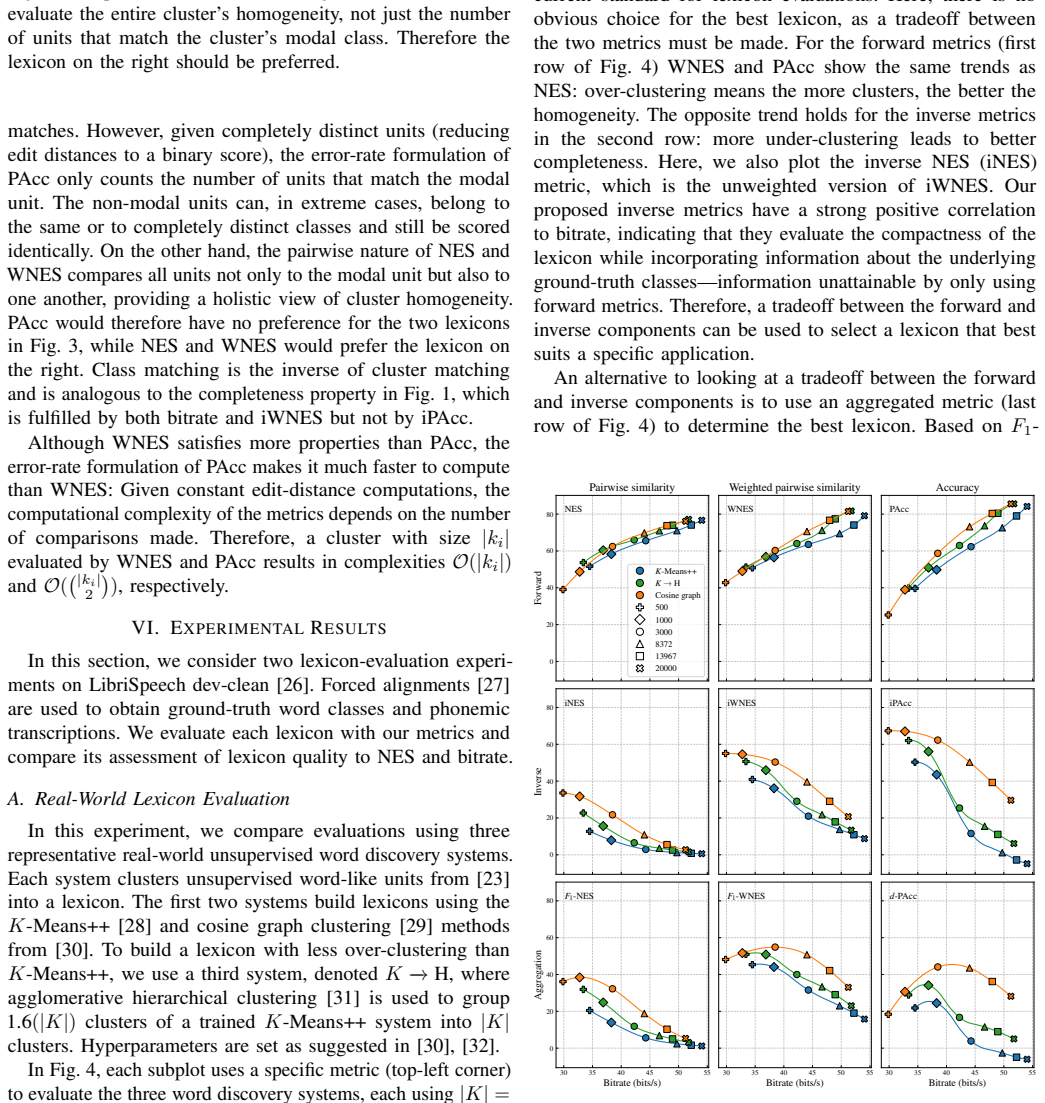
Building a lexicon from discovered word-like units is a central goal in zero-resource speech processing. But do our evaluations provide a trustworthy indication of lexicon quality? A common metric, normalized edit distance, averages the phoneme edit distances between discovered units in each cluster. We show that this metric has an inherent bias toward the quality of large clusters, inhibiting fair evaluation. Moreover, it ignores how well true classes are distributed across clusters. Based on established theory in clustering literature, we propose two metrics that address these shortcomings: a modified metric that weighs cluster size when assessing within-cluster consistency, and an inverse metric that assesses how true words are spread across clusters. Through experiments on synthetic and real-world lexicons, we demonstrate that combined, these metrics are: (1) more closely correlated with how similar a lexicon is to the ground-truth distribution, and (2) more robust to biases that skew lexicon evaluations.
Figures


Figures from the paper (1 more)

Forward citations
Cited by 1 Pith paper
-
Recovering the Zipfian Distribution in Unsupervised Term Discovery
Graph clustering with Leiden recovers Zipfian distributions in unsupervised speech term discovery more effectively than K-means, GMM or BIRCH across three languages.
Reference graph
Works this paper leans on
-
[1]
Unsupervised word acquisition from speech using pattern discovery,
A. Park and J. Glass, “Unsupervised word acquisition from speech using pattern discovery,” inICASSP, 2006
2006
-
[2]
Sylber: Syllabic embedding representation of speech from raw audio,
C. J. Cho, N. Lee, A. Gupta, D. Agarwal, E. Chen, A. W. Black, and G. K. Anumanchipalli, “Sylber: Syllabic embedding representation of speech from raw audio,” inICLR, 2025
2025
-
[3]
SyllableLM: Learning coarse semantic units for speech language models,
A. Baade, P. Peng, and D. Harwath, “SyllableLM: Learning coarse semantic units for speech language models,” inICLR, 2025
2025
-
[4]
The Zero Resource Speech Challenge 2020: Discovering discrete subword and word units,
E. Dunbar, J. Karadayi, M. Bernard, X.-N. Cao, R. Algayres, L. Ondel, L. Besacier, S. Sakti, and E. Dupoux, “The Zero Resource Speech Challenge 2020: Discovering discrete subword and word units,” in Interspeech, 2020
2020
-
[5]
On generative spoken language modeling from raw audio,
K. Lakhotia, E. Kharitonov, W.-N. Hsu, Y . Adi, A. Polyak, B. Bolte, T.-A. Nguyen, J. Copet, A. Baevski, A. Mohamed, and E. Dupoux, “On generative spoken language modeling from raw audio,”Transactions of the Association for Computational Linguistics, vol. 9, pp. 1336–1354, 2021
2021
-
[6]
AudioLM: A language modeling approach to audio generation,
Z. Borsos, R. Marinier, D. Vincent, E. Kharitonov, O. Pietquin, M. Sharifi, D. Roblek, O. Teboul, D. Grangier, M. Tagliasacchi, and N. Zeghi- dour, “AudioLM: A language modeling approach to audio generation,” IEEE/ACM Transactions on Audio, Speech, and Language Processing, vol. 31, pp. 2523–2533, 2023
2023
-
[7]
On the landscape of spoken language models: A comprehensive survey,
S. Arora, K.-W. Chang, C.-M. Chien, Y . Peng, H. Wu, Y . Adi, E. Dupoux, H. yi Lee, K. Livescu, and S. Watanabe, “On the landscape of spoken language models: A comprehensive survey,”Transactions on Machine Learning Research, 2025
2025
-
[8]
Criterion functions for document clustering: Experiments and analysis,
Y . Zhao and G. Karypis, “Criterion functions for document clustering: Experiments and analysis,”Technical Report TR 01–40, Department of Computer Science, University of Minnesota, 2001
2001
Show all 32 references
-
[9]
V-measure: A conditional entropy- based external cluster evaluation measure,
A. Rosenberg and J. Hirschberg, “V-measure: A conditional entropy- based external cluster evaluation measure,” inEMNLP-CoNLL, 2007
2007
-
[10]
Bridging the gap between speech technology and natural language processing: an evaluation toolbox for term discovery systems,
B. Ludusan, M. Versteegh, A. Jansen, G. Gravier, X.-N. Cao, M. Johnson, and E. Dupoux, “Bridging the gap between speech technology and natural language processing: an evaluation toolbox for term discovery systems,” inLREC, 2014
2014
-
[11]
Unsupervised word discovery from speech using automatic segmentation into syllable-like units,
O. J. R ¨as¨anen, G. Doyle, and M. Frank, “Unsupervised word discovery from speech using automatic segmentation into syllable-like units,” in Interspeech, 2015
2015
-
[12]
A segmental framework for fully-unsupervised large-vocabulary speech recognition,
H. Kamper, A. Jansen, and S. Goldwater, “A segmental framework for fully-unsupervised large-vocabulary speech recognition,”Computer Speech & Language, vol. 46, pp. 154–174, 2017
2017
-
[13]
An embedded segmental K-means model for unsupervised segmentation and clustering of speech,
H. Kamper, K. Livescu, and S. Goldwater, “An embedded segmental K-means model for unsupervised segmentation and clustering of speech,” inASRU, 2017
2017
-
[14]
Unsupervised discovery of recurring speech patterns using probabilistic adaptive metrics,
O. R¨as¨anen and M. A. C. Bland ´on, “Unsupervised discovery of recurring speech patterns using probabilistic adaptive metrics,” inInterspeech, 2020
2020
-
[15]
Self-expressing autoencoders for unsupervised spoken term discovery,
S. Bhati, J. Villalba, P. ˙Zelasko, and N. Dehak, “Self-expressing autoencoders for unsupervised spoken term discovery,” inInterspeech, 2020
2020
-
[16]
Word discovery in visually grounded, self- supervised speech models,
P. Peng and D. Harwath, “Word discovery in visually grounded, self- supervised speech models,” inInterspeech, 2022
2022
-
[17]
Spoken- term discovery using discrete speech units,
B. van Niekerk, J. Za ¨ıdi, M.-A. Carbonneau, and H. Kamper, “Spoken- term discovery using discrete speech units,” inInterspeech, 2024
2024
-
[18]
Revisiting speech segmentation and lexicon learning with better features,
H. Kamper and B. van Niekerk, “Revisiting speech segmentation and lexicon learning with better features,”arXiv preprint arXiv:2401.17902, 2024
2024
-
[19]
An information-theoretic external cluster-validity measure,
B. E. Dom, “An information-theoretic external cluster-validity measure,” Technical Report RJ10219, IBM, 2001
2001
-
[20]
Comparing clusterings by the variation of information,
M. Meil ˘a, “Comparing clusterings by the variation of information,” in COLT, 2003
2003
-
[21]
A comparison of extrinsic clustering evaluation metrics based on formal constraints,
E. Amig ´o, J. Gonzalo, J. Artiles, and F. Verdejo, “A comparison of extrinsic clustering evaluation metrics based on formal constraints,” Information Retrieval, vol. 12, pp. 461–486, 2009
2009
-
[22]
Unsupervised pattern discovery in speech,
A. S. Park and J. R. Glass, “Unsupervised pattern discovery in speech,” IEEE/ACM Transactions on Audio, Speech, and Language Processing, vol. 16, pp. 186–197, 2008
2008
-
[23]
What do self- supervised speech models know about words?
A. Pasad, C.-M. Chien, S. Settle, and K. Livescu, “What do self- supervised speech models know about words?”Transactions of the Association for Computational Linguistics, vol. 12, pp. 372–391, 2024
2024
-
[24]
Should top-down clustering affect boundaries in unsupervised word discovery?
S. Malan, B. van Niekerk, and H. Kamper, “Should top-down clustering affect boundaries in unsupervised word discovery?”IEEE Transactions on Audio, Speech and Language Processing, vol. 34, pp. 1163–1172, 2026
2026
-
[25]
Comparing clusterings–an information based distance,
M. Meil ˘a, “Comparing clusterings–an information based distance,” Journal of multivariate analysis, vol. 98, pp. 873–895, 2007
2007
-
[26]
LibriSpeech: An ASR corpus based on public domain audio books,
V . Panayotov, G. Chen, D. Povey, and S. Khudanpur, “LibriSpeech: An ASR corpus based on public domain audio books,” inICASSP, 2015
2015
-
[27]
Montreal Forced Aligner: Trainable text-speech alignment using Kaldi,
M. McAuliffe, M. Socolof, S. Mihuc, M. Wagner, and M. Sonderegger, “Montreal Forced Aligner: Trainable text-speech alignment using Kaldi,” inInterspeech, 2017
2017
-
[28]
k-means++: the advantages of careful seeding,
D. Arthur and S. Vassilvitskii, “k-means++: the advantages of careful seeding,” inSODA, 2007
2007
-
[29]
Community detection in graphs,
S. Fortunato, “Community detection in graphs,”Physics Reports, vol. 486, pp. 75–174, 2010
2010
-
[30]
Unsupervised lexicon learning from speech is limited by representations rather than clustering,
D. Slabbert, S. Malan, and H. Kamper, “Unsupervised lexicon learning from speech is limited by representations rather than clustering,” in ICASSP, 2026
2026
-
[31]
Nielsen,Introduction to HPC with MPI for Data Science
F. Nielsen,Introduction to HPC with MPI for Data Science. Springer, 2016, ch. Hierarchical Clustering, pp. 195–211
2016
-
[32]
Unsupervised word discovery: Boundary detection with clustering vs. dynamic programming,
S. Malan, B. van Niekerk, and H. Kamper, “Unsupervised word discovery: Boundary detection with clustering vs. dynamic programming,” in ICASSP, 2025
2025
Reviewed June 27, 2026 · model on record in the stance chip above.
Discussion (0). Continue with ORCID to comment.