Plasma wakefield dynamics of self-generated electron bunch trains
Pith reviewed 2026-06-27 23:15 UTC · model grok-4.3
The pith
Laser-driven plasma wakefields generate narrow quasi-monoenergetic electron bunch trains with periodic energy spacing through downramp injection.
A machine-rendered reading of the paper's core claim, the machinery that carries it, and where it could break.
Core claim
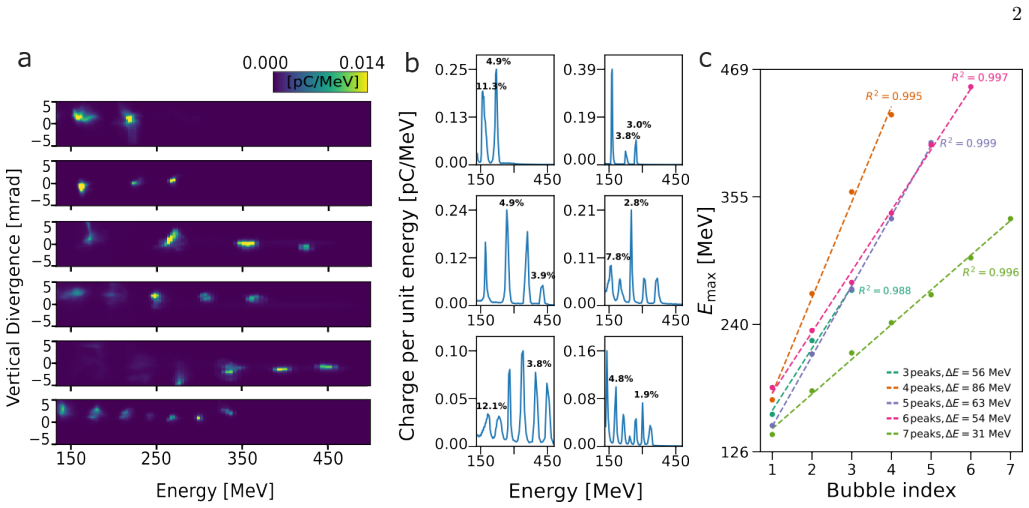
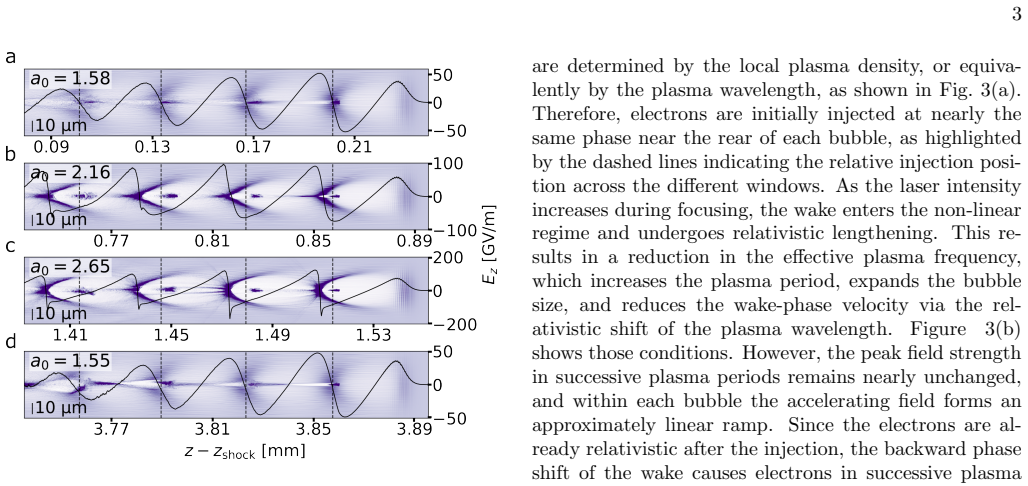
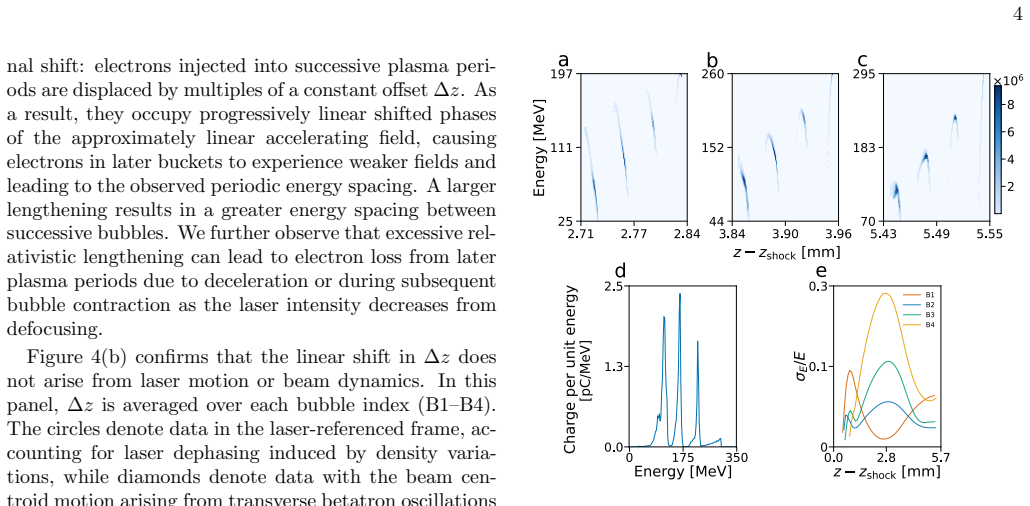
Narrow, quasi-monoenergetic electron bunch trains with periodic energy spacing are generated from downramp injection in a laser driven wakefield accelerator. The periodicity in energy is shaped via relativistic lengthening of the wakefield during the acceleration phase, while the spatial periodicity is obtained via injection into multiple plasma periods. At the end of the accelerator, a rotation in phase-space is performed to compress each bunch in energy, producing narrow periodic spikes in the spectrum. The experimental observations are supported by particle-in-cell simulations, which reproduce the formation and evolution of the periodic bunch trains.
What carries the argument
Downramp injection into multiple plasma periods, combined with relativistic wake lengthening during acceleration and a final phase-space rotation that compresses each bunch in energy.
If this is right
- Energy periodicity follows directly from the relativistic lengthening of the wakefield as electrons gain energy.
- Spatial periodicity is set by injection occurring across successive plasma periods.
- Phase-space rotation at the accelerator exit narrows the energy spread within each individual bunch.
- The resulting spectrum shows distinct narrow spikes separated by the wake-lengthening interval.
Where Pith is reading between the lines
- Adjusting the downramp length or gradient could select the number of bunches in the train.
- The structured beams might drive secondary wakefields with controlled relative phasing between bunches.
- The mechanism suggests a route to produce beams whose energy spectrum can be tuned without external timing hardware.
Load-bearing premise
The periodic energy spacing and narrow spectral spikes arise specifically from relativistic wake lengthening plus multi-period downramp injection followed by phase-space rotation, rather than from other uncontrolled injection or acceleration processes.
What would settle it
An experiment that produces the same periodic narrow spikes in the electron spectrum but without a density downramp or without measurable wake lengthening would show that the proposed mechanism is not necessary.
Figures


read the original abstract
Laser plasma accelerators can deliver high-energy, quasi-monoenergetic electron beams over centimeter-scale distances. In this work, we report on the generation of narrow, quasi-monoenergetic electron bunch trains with periodic energy spacing issued from downramp injection in a laser driven wakefield accelerator. The periodicity in energy is shaped via relativistic lengthening of the wakefield during the acceleration phase, while the spatial periodicity is obtained via injection into multiple plasma periods. At the end of the accelerator, a rotation in phase-space is performed to compress each bunch in energy, producing narrow periodic spikes in the spectrum. The experimental observations are supported by particle-in-cell simulations, which reproduce the formation and evolution of the periodic bunch trains, providing an insight into the underlying plasma dynamics.
Editorial analysis
A structured set of objections, weighed in public.
Referee Report
Summary. The manuscript reports the generation of narrow, quasi-monoenergetic electron bunch trains with periodic energy spacing from downramp injection in a laser-driven wakefield accelerator. Energy periodicity arises from relativistic lengthening of the wakefield during acceleration, spatial periodicity from injection into multiple plasma periods, and final compression of each bunch into narrow spectral spikes via phase-space rotation. Experimental observations are stated to be supported by particle-in-cell simulations that reproduce the formation and evolution of the periodic bunch trains.
Significance. If the proposed mechanism holds and is robustly validated, the work would demonstrate a controllable route to structured electron beams in plasma accelerators, with potential relevance to applications requiring periodic bunch trains. The combination of experiment and simulation to elucidate the underlying wakefield dynamics is a constructive element of the study.
major comments (1)
- [Abstract] The central claim that experimental observations are supported by PIC simulations (Abstract) rests on an unverified comparison; without access to quantitative metrics, error bars, exclusion criteria, or side-by-side data-simulation plots, it is not possible to confirm that the observed spectral periodicity and bunch compression arise specifically from relativistic wake lengthening plus multi-period injection rather than alternative injection or acceleration processes.
minor comments (1)
- Notation for plasma periods and wakefield lengthening should be defined explicitly on first use to aid readability.
Simulated Author's Rebuttal
We thank the referee for the constructive review. The single major comment is addressed point-by-point below. We agree that additional quantitative support for the simulation-experiment comparison will strengthen the manuscript.
read point-by-point responses
-
Referee: [Abstract] The central claim that experimental observations are supported by PIC simulations (Abstract) rests on an unverified comparison; without access to quantitative metrics, error bars, exclusion criteria, or side-by-side data-simulation plots, it is not possible to confirm that the observed spectral periodicity and bunch compression arise specifically from relativistic wake lengthening plus multi-period injection rather than alternative injection or acceleration processes.
Authors: We agree that the abstract claim would benefit from more explicit quantitative backing. The full manuscript contains multiple figures comparing experimental spectra to PIC results, including wake evolution, injection timing, and final phase-space rotation leading to the observed periodicity. To directly address the concern, the revised version will add: (i) overlaid experimental and simulated spectra with error bars on peak positions and widths, (ii) a table quantifying energy spacing periodicity (mean and standard deviation) for both data and simulation, (iii) explicit data-selection criteria (e.g., shot-to-shot stability thresholds), and (iv) a brief discussion ruling out alternative mechanisms based on the simulated wake dynamics. These additions will be placed in the results and discussion sections and referenced from the abstract. revision: yes
Circularity Check
No significant circularity detected
full rationale
The paper reports experimental generation of electron bunch trains via downramp injection, with periodicity attributed to relativistic wake lengthening, multi-period injection, and phase-space rotation. These are physical mechanisms supported by PIC simulations that reproduce the observed formation and evolution. No derivation chain, fitted parameters renamed as predictions, or self-citation load-bearing steps are present; claims rest on direct observations and independent numerical reproduction rather than quantities defined in terms of themselves.
Axiom & Free-Parameter Ledger
Reference graph
Works this paper leans on
-
[1]
Malka, S
V. Malka, S. Fritzler, E. Lefebvre, M.-M. Al´ eonard, F. Burgy, J.-P. Chambaret, J.-F. Chemin, K. Krushel- nick, G. Malka, S. P. D. Mangles, Z. Najmudin, M. Pittman, J.-P. Rousseau, J.-N. Scheurer, B. Walton, and A. E. Dangor, Science298, 1596 (2002)
2002
-
[2]
Tajima and J
T. Tajima and J. M. Dawson, Phys. Rev. Lett.43, 267 (1979)
1979
-
[3]
Esarey and M
E. Esarey and M. Pilloff, Physics of Plasmas2, 1432 (1995)
1995
-
[4]
Pukhov and J
A. Pukhov and J. Meyer-ter Vehn, Applied Physics B74, 355 (2002)
2002
-
[5]
S. P. D. Mangles, C. D. Murphy, Z. Najmudin, A. G. R. Thomas, J. L. Collier, A. E. Dangor, E. J. Divall, P. S. Foster, J. G. Gallacher, C. J. Hooker, D. A. Jaroszynski, A. J. Langley, W. B. Mori, P. A. Norreys, F. S. Tsung, R. Viskup, B. R. Walton, and K. Krushelnick, Nature 431, 535 (2004)
2004
-
[6]
Faure, Y
J. Faure, Y. Glinec, A. Pukhov, S. Kiselev, S. Gordienko, E. Lefebvre, J.-P. Rousseau, F. Burgy, and V. Malka, Nature431, 541 (2004)
2004
-
[7]
Bulanov, N
S. Bulanov, N. Naumova, F. Pegoraro, and J. Sakai, Phys. Rev. E58, R5257 (1998)
1998
-
[8]
C. G. R. Geddes, K. Nakamura, G. R. Plateau, C. Toth, E. Cormier-Michel, E. Esarey, C. B. Schroeder, J. R. Cary, and W. P. Leemans, Phys. Rev. Lett.100, 215004 (2008)
2008
-
[9]
Malka, Physics of Plasmas19, 055501 (2012)
V. Malka, Physics of Plasmas19, 055501 (2012)
2012
-
[10]
Chien, C.-L
T.-Y. Chien, C.-L. Chang, C.-H. Lee, J.-Y. Lin, J. Wang, and S.-Y. Chen, Phys. Rev. Lett.94, 115003 (2005)
2005
-
[11]
L. T. Ke, K. Feng, W. T. Wang, Z. Y. Qin, C. H. Yu, Y. Wu, Y. Chen, R. Qi, Z. J. Zhang, Y. Xu, X. J. Yang, Y. X. Leng, J. S. Liu, R. X. Li, and Z. Z. Xu, Phys. Rev. Lett.126, 214801 (2021)
2021
-
[12]
Y. Ge, K. Feng, R. Hu, K. Jiang, H. Jiang, X. Chen, S. Luan, W. Wang, and R. Li, Plasma Physics and Con- trolled Fusion68, 045036 (2026)
2026
-
[13]
Faure, C
J. Faure, C. Rechatin, O. Lundh, L. Ammoura, and V. Malka, Physics of Plasmas17, 083107 (2010)
2010
-
[14]
Brijesh, C
P. Brijesh, C. Thaury, K. T. Phuoc, S. Corde, G. Lam- bert, V. Malka, S. P. D. Mangles, M. Bloom, and S. Kneip, Physics of Plasmas19, 063104 (2012)
2012
-
[15]
F. M. Foerster, A. D¨ opp, F. Haberstroh, K. v. Grafen- stein, D. Campbell, Y.-Y. Chang, S. Corde, J. P. Couperus Cabada˘ g, A. Debus, M. F. Gilljohann, A. F. Habib, T. Heinemann, B. Hidding, A. Irman, F. Ir- shad, A. Knetsch, O. Kononenko, A. Martinez de la Ossa, A. Nutter, R. Pausch, G. Schilling, A. Schlet- ter, S. Sch¨ obel, U. Schramm, E. Travac, P. ...
2022
-
[16]
K. v. Grafenstein, F. M. Foerster, F. Haberstroh, D. Campbell, F. Irshad, F. C. Salgado, G. Schilling, E. Travac, N. Weiße, M. Zepf, A. D¨ opp, and S. Karsch, Scientific Reports13, 11680 (2023)
2023
-
[17]
Faure, C
J. Faure, C. Rechatin, A. Norlin, A. Lifschitz, Y. Glinec, and V. Malka, Nature444, 737 (2006)
2006
-
[18]
J. Wenz, A. D¨ opp, K. Khrennikov, S. Schindler, M. F. Gilljohann, H. Ding, J. G¨ otzfried, A. Buck, J. Xu, M. Heigoldt, W. Helml, L. Veisz, and S. Karsch, Nature Photonics13, 263 (2019)
2019
-
[19]
Golovin, V
G. Golovin, V. Horn´ y, W. Yan, C. Fruhling, D. Haden, J. Wang, S. Banerjee, and D. Umstadter, Physics of Plas- mas27, 033105 (2020)
2020
-
[20]
Umstadter, J
D. Umstadter, J. K. Kim, and E. Dodd, Phys. Rev. Lett. 76, 2073 (1996)
2073
-
[21]
Bourgeois, J
N. Bourgeois, J. Cowley, and S. M. Hooker, Phys. Rev. 6 Lett.111, 155004 (2013)
2013
-
[22]
G¨ otzfried, A
J. G¨ otzfried, A. D¨ opp, M. F. Gilljohann, F. M. Foerster, H. Ding, S. Schindler, G. Schilling, A. Buck, L. Veisz, and S. Karsch, Phys. Rev. X10, 041015 (2020)
2020
-
[23]
A. Buck, J. Wenz, J. Xu, K. Khrennikov, K. Schmid, M. Heigoldt, J. M. Mikhailova, M. Geissler, B. Shen, F. Krausz, S. Karsch, and L. Veisz, Phys. Rev. Lett.110, 185006 (2013)
2013
-
[24]
T. Kurz, T. Heinemann, M. F. Gilljohann, Y. Y. Chang, J. P. Couperus Cabada˘ g, A. Debus, O. Kononenko, R. Pausch, S. Sch¨ obel, R. W. Assmann, M. Bussmann, H. Ding, J. G¨ otzfried, A. K¨ ohler, G. Raj, S. Schindler, K. Steiniger, O. Zarini, S. Corde, A. D¨ opp, B. Hidding, S. Karsch, U. Schramm, A. Martinez de la Ossa, and A. Irman, Nature Communications...
2021
-
[25]
A. Oguchi, A. Zhidkov, K. Takano, E. Hotta, K. Nemoto, and K. Nakajima, Physics of Plasmas15, 10.1063/1.2833593 (2008)
-
[26]
A. Angella, E. L¨ ofquist, C. Gustafsson, V. Poulain, F. D’Souza, C. Guo, A. Persson, P. Eng- Johnsson, C.-G. Wahlstr¨ om, and O. Lundh, arXiv 10.48550/arXiv.2508.10829 (2025), arXiv:2508.10829
-
[27]
Kroupp, S
E. Kroupp, S. Tata, Y. Wan, D. Levy, S. Smartsev, E. Y. Levine, O. Seemann, M. Adelberg, R. Piliposian, T. Queller, E. Segre, K. Ta Phuoc, M. Kozlova, and V. Malka, Matter and Radiation at Extremes7, 044401 (2022)
2022
-
[28]
R. Lehe, M. Kirchen, I. A. Andriyash, B. B. Godfrey, and J.-L. Vay, Computer Physics Communications203, 66 (2016)
2016
-
[29]
Fryxell, K
B. Fryxell, K. Olson, P. Ricker, F. X. Timmes, M. Zin- gale, D. Lamb, P. MacNeice, R. Rosner, J. Truran, and H. Tufo, The Astrophysical Journal Supplement Series 131, 273 (2000)
2000
-
[30]
Schmid, A
K. Schmid, A. Buck, C. M. S. Sears, J. M. Mikhailova, R. Tautz, D. Herrmann, M. Geissler, F. Krausz, and L. Veisz, Phys. Rev. ST Accel. Beams13, 091301 (2010)
2010
-
[31]
H. Suk, N. Barov, J. B. Rosenzweig, and E. Esarey, Phys. Rev. Lett.86, 1011 (2001)
2001
-
[32]
A. J. Gonsalves, K. Nakamura, C. Lin, D. Panasenko, S. Shiraishi, T. Sokollik, C. Benedetti, C. B. Schroeder, C. G. R. Geddes, J. van Tilborg, J. Osterhoff, E. Esarey, C. Toth, and W. P. Leemans, Nature Physics7, 862 (2011)
2011
-
[33]
D¨ opp, C
A. D¨ opp, C. Thaury, E. Guillaume, F. Massimo, A. Lifs- chitz, I. Andriyash, J.-P. Goddet, A. Tazfi, K. Ta Phuoc, and V. Malka, Phys. Rev. Lett.121, 074802 (2018)
2018
-
[34]
Kirchen, S
M. Kirchen, S. Jalas, P. Messner, P. Winkler, T. Eich- ner, L. H¨ ubner, T. H¨ ulsenbusch, L. Jeppe, T. Parikh, M. Schnepp, and A. R. Maier, Phys. Rev. Lett.126, 174801 (2021)
2021
-
[35]
Rechatin, J
C. Rechatin, J. Faure, A. Ben-Ismail, J. Lim, R. Fitour, A. Specka, H. Videau, A. Tafzi, F. Burgy, and V. Malka, Phys. Rev. Lett.102, 164801 (2009)
2009
discussion (0)
Sign in with ORCID, Apple, or X to comment. Anyone can read and Pith papers without signing in.