gr8stars II : judgement day for spectroscopic parameter model systematics
Pith reviewed 2026-06-27 23:29 UTC · model grok-4.3
The pith
Scatter across five spectroscopic methods on 585 FGK stars induces at most 3% fractional uncertainty in exoplanet radii and 5% in masses.
A machine-rendered reading of the paper's core claim, the machinery that carries it, and where it could break.
Core claim
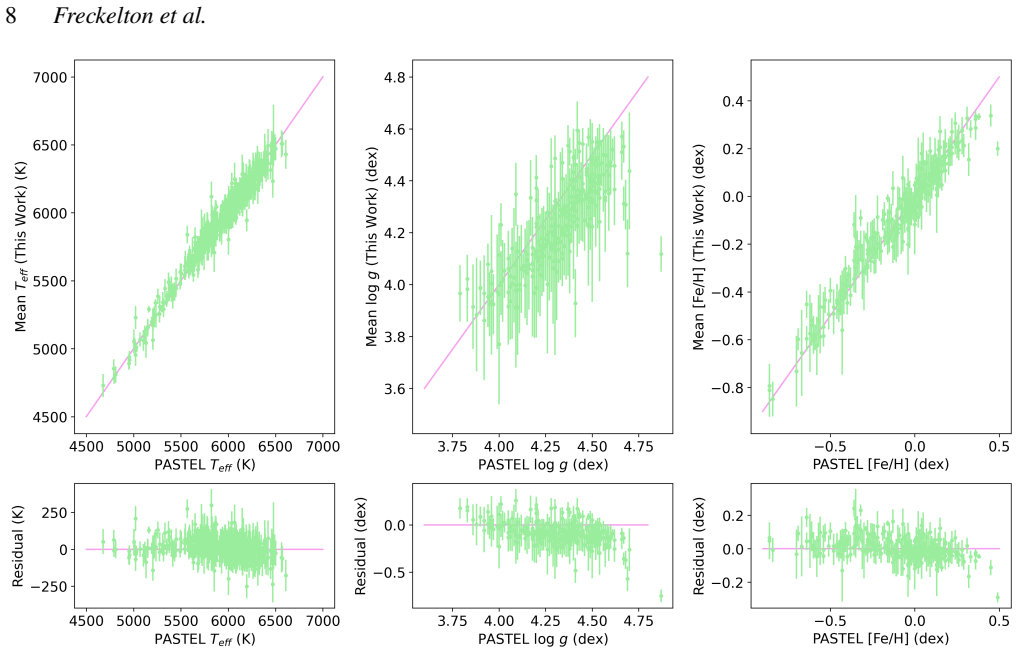
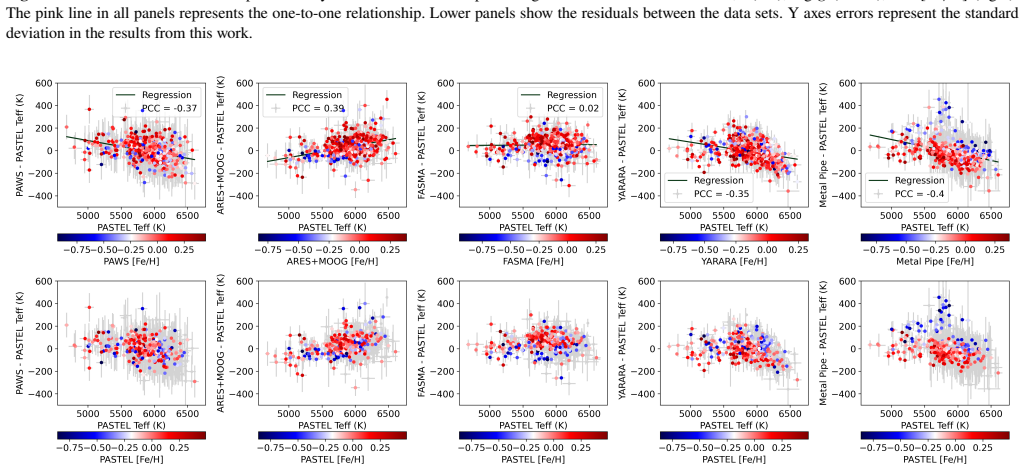
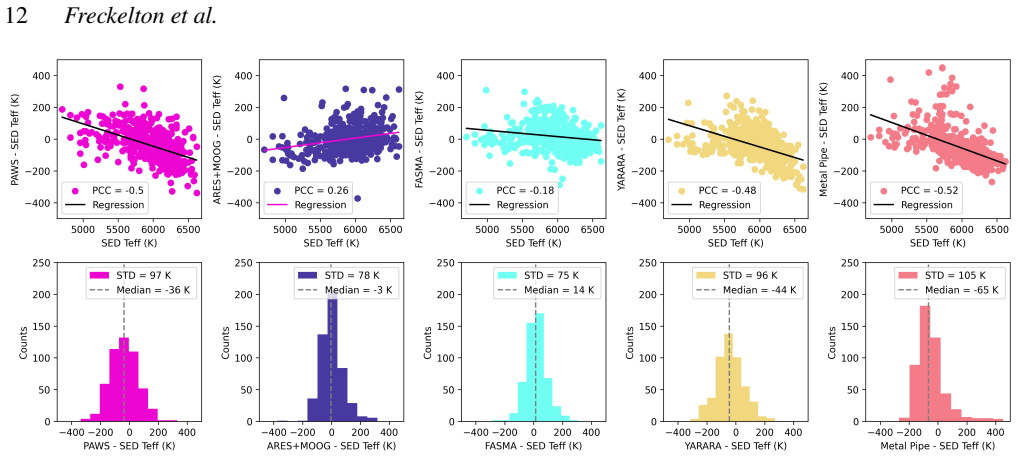
Five spectroscopic methods yield typical scatters of 76 K in effective temperature, 0.14 dex in surface gravity, and 0.07 dex in metallicity; when propagated through isochrone fitting, these produce fractional uncertainties of ≲3% in planetary radius and ≲5% in planetary mass, with a lower limit of ≈4% on planetary equilibrium temperature uncertainty.
What carries the argument
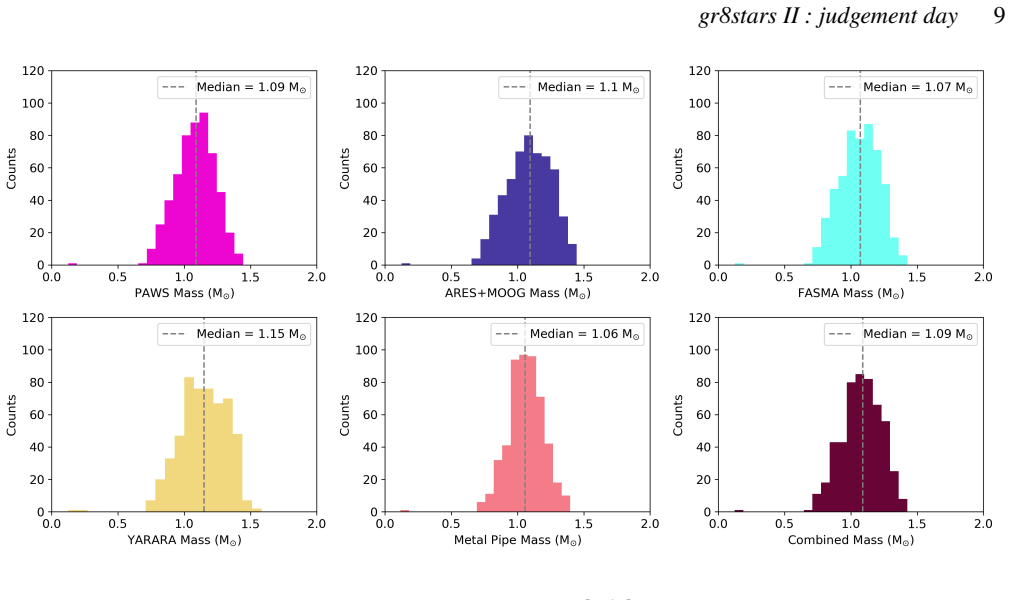
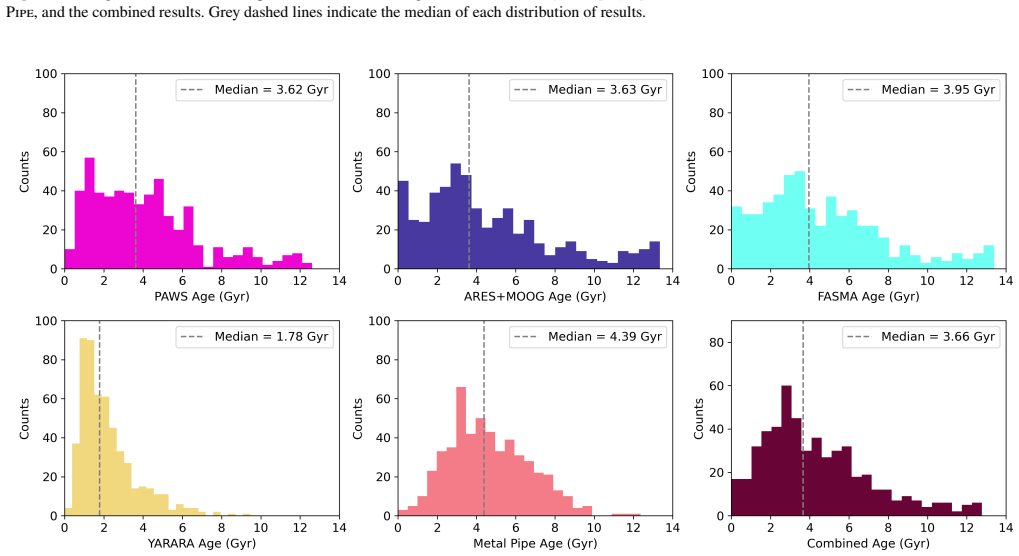
The scatter among five spectroscopic parameter sets, propagated through isochrone-derived stellar masses and radii to exoplanet properties and compared against SED radii.
If this is right
- Planetary radius uncertainties arising from spectroscopic method choice stay at or below 3 percent.
- Planetary mass uncertainties arising from spectroscopic method choice stay at or below 5 percent.
- Planetary equilibrium temperature carries a minimum fractional uncertainty of approximately 4 percent from this source alone.
- These limits lie below the uncertainties typically reported for exoplanet parameters in the literature.
Where Pith is reading between the lines
- Other error sources such as orbital fitting or photometric calibration may now dominate the error budget in many exoplanet radius and mass determinations.
- A combined analysis that averages or selects among multiple spectroscopic methods could reduce the effective scatter below the single-method values reported here.
- The 4 percent floor on equilibrium temperature uncertainty would propagate directly into retrievals of planetary atmospheric properties and into assessments of potential habitability.
Load-bearing premise
The radii obtained by SED fitting in the companion paper form an independent benchmark free of shared systematics with the spectroscopic and isochrone results.
What would settle it
A measurement showing that the SED radii and isochronal radii share common systematics larger than the reported method-to-method scatter would remove the basis for claiming the induced planetary uncertainties are truly below literature values.
Figures




read the original abstract
Many areas of astrophysics, including exoplanetary studies, rely on precise and accurate stellar parameters. This demands that uncertainties on these parameters truly reflect all biases and systematics. Within this second work of the \texttt{gr8stars} collaboration, we take a set of 585 bright FGK dwarfs with high resolution, high signal-to-noise ratio spectra from the SOPHIE spectrograph. We determine stellar effective temperature, surface gravity, and metallicity using five different spectroscopic methods for each star, with an additional method used for comparisons. We find a typical scatter of 76 K in \teff, 0.14 dex in \logg, and 0.07 dex in \feh. These deviations are significantly larger than the average precision error on these parameters. We furthermore use isochrone fitting to determine mass, radius, and age for all 585 stars, using input from all results. We use the radii determined by SED fitting in the first \texttt{gr8stars} paper as a comparison to our isochronal radii from this work, in addition to comparing the isochronal \logg to spectroscopic \logg. The scatter in mass and radius from the use of different spectroscopic methods is investigated and propagated to exoplanetary parameters. The induced fractional uncertainties in planetary radius ($\lesssim$ 3 \%) and mass ($\lesssim$ 5\%) are found to be below those typically found in the literature. We estimate a lower limit on planetary equilibrium temperature fractional uncertainty of $\approx$ 4\%, a noise floor that is currently not sufficiently represented in the literature.
Editorial analysis
A structured set of objections, weighed in public.
Referee Report
Summary. The paper analyzes spectroscopic parameters (Teff, log g, [Fe/H]) for 585 bright FGK dwarfs from SOPHIE spectra using five methods, reporting typical scatters of 76 K, 0.14 dex, and 0.07 dex. It performs isochrone fitting for masses, radii, and ages using these inputs, compares the resulting radii to SED-fitting radii from the companion gr8stars I paper (and isochronal vs. spectroscopic log g), and propagates the method-to-method scatter to estimate induced fractional uncertainties on exoplanet radius (≲3%), mass (≲5%), and a lower limit of ≈4% on equilibrium temperature.
Significance. If the benchmark comparison is independent, the work provides a concrete quantification of how spectroscopic method choice propagates to stellar and planetary parameters in a large, homogeneous sample. The finding that these systematics are smaller than typical literature values could help establish realistic uncertainty floors for exoplanet studies; the multi-method approach on 585 stars is a clear strength.
major comments (1)
- [the isochrone fitting and gr8stars I comparison section] The section describing the comparison of isochronal radii to SED-fitting radii from gr8stars I (and the propagation of scatters to planetary parameters): the central claim that the observed scatters (76 K, 0.14 dex, 0.07 dex) induce the quoted ≲3%/≲5%/≈4% fractional uncertainties on planetary radius/mass/Teq rests on treating the SED radii as an independent benchmark. The manuscript provides no quantitative test (e.g., overlap in photometry, model grids, or calibration steps) that the two pipelines are free of shared systematics; without this, the benchmark cannot independently confirm that the spectroscopic scatter is the dominant, well-quantified systematic.
minor comments (2)
- [Abstract] The abstract states that 'an additional method [is] used for comparisons' but does not identify the method or its role; this should be clarified in the methods section for reproducibility.
- [results on planetary uncertainties] The propagation to planetary parameters is described only at the level of the abstract; a dedicated subsection or table showing the exact error-propagation steps (including any assumptions on stellar mass/radius correlations) would improve clarity.
Simulated Author's Rebuttal
We thank the referee for their constructive comments and the opportunity to clarify aspects of our analysis. We address the major comment below.
read point-by-point responses
-
Referee: [the isochrone fitting and gr8stars I comparison section] The section describing the comparison of isochronal radii to SED-fitting radii from gr8stars I (and the propagation of scatters to planetary parameters): the central claim that the observed scatters (76 K, 0.14 dex, 0.07 dex) induce the quoted ≲3%/≲5%/≈4% fractional uncertainties on planetary radius/mass/Teq rests on treating the SED radii as an independent benchmark. The manuscript provides no quantitative test (e.g., overlap in photometry, model grids, or calibration steps) that the two pipelines are free of shared systematics; without this, the benchmark cannot independently confirm that the spectroscopic scatter is the dominant, well-quantified systematic.
Authors: The fractional uncertainties on planetary radius (≲3%), mass (≲5%), and equilibrium temperature (≈4%) are derived solely from the observed method-to-method scatter among the five spectroscopic pipelines applied to the SOPHIE spectra (76 K in Teff, 0.14 dex in log g, 0.07 dex in [Fe/H]). These scatters are measured internally to the spectroscopic analysis and propagated through isochrone fitting; the gr8stars I SED radii are used only as an external consistency check for the resulting isochrone radii and for comparing isochronal versus spectroscopic log g. They play no role in quantifying or propagating the scatters themselves. We will revise the manuscript to state this distinction explicitly and to add a short discussion of why the spectroscopic and SED approaches are expected to have limited shared systematics (distinct input data—high-resolution spectra versus broadband photometry—and different modeling frameworks). This addresses the concern without requiring new quantitative overlap tests. revision: partial
Circularity Check
No significant circularity; derivation from measured method scatter and propagation is self-contained.
full rationale
The paper measures inter-method scatter (76 K, 0.14 dex, 0.07 dex) across five spectroscopic pipelines on the same 585 spectra, performs isochrone fitting on those inputs, and directly propagates the resulting mass/radius scatter to planetary parameters to obtain the ≲3 % / ≲5 % / ≈4 % figures. The gr8stars I SED radii appear only as an external comparison benchmark (abstract: "We use the radii determined by SED fitting in the first gr8stars paper as a comparison to our isochronal radii from this work"), not as an input that defines or forces the reported scatters or propagated uncertainties. No equation reduces a claimed prediction to a fitted quantity by construction, and the central result does not rest on a self-citation chain. The derivation is therefore independent of the benchmark comparison.
Axiom & Free-Parameter Ledger
axioms (2)
- domain assumption Isochrone models provide reliable mass, radius, and age estimates when supplied with spectroscopic Teff, log g, and [Fe/H].
- domain assumption SED-fitting radii from the companion paper are independent of the spectroscopic methods tested here.
Reference graph
Works this paper leans on
-
[1]
Stellar Activity Masquerading as Planets in the Habitable Zone of the M dwarf Gliese 581
Stellar activity masquerading as planets in the habitable zone of the M dwarf Gliese 581. Science , keywords =. doi:10.1126/science.1253253 , archivePrefix =. 1407.1049 , primaryClass =
work page internal anchor Pith review Pith/arXiv arXiv doi:10.1126/science.1253253
-
[2]
Metal Pipe: A Broadly Applicable Stellar Abundance Pipeline Using Isochronal Parameters. , keywords =. doi:10.3847/1538-4357/ae3c0b , archivePrefix =. 2601.10794 , primaryClass =
-
[3]
Determining stellar macroturbulence using asteroseismic rotational velocities from Kepler
Determining stellar macroturbulence using asteroseismic rotational velocities from Kepler. , keywords =. doi:10.1093/mnras/stu1692 , archivePrefix =. 1408.3988 , primaryClass =
work page internal anchor Pith review Pith/arXiv arXiv doi:10.1093/mnras/stu1692
-
[4]
A new extensive library of PHOENIX stellar atmospheres and synthetic spectra
A new extensive library of PHOENIX stellar atmospheres and synthetic spectra. , keywords =. doi:10.1051/0004-6361/201219058 , archivePrefix =. 1303.5632 , primaryClass =
work page internal anchor Pith review Pith/arXiv arXiv doi:10.1051/0004-6361/201219058
-
[5]
Using the Sun to estimate Earth-like planet detection capabilities. VI. Simulation of granulation and supergranulation radial velocity and photometric time series. , keywords =. doi:10.1051/0004-6361/201525721 , adsurl =
-
[6]
RASSINE: Interactive tool for normalising stellar spectra. I. Description and performance of the code. , keywords =. doi:10.1051/0004-6361/202037722 , archivePrefix =. 2006.13098 , primaryClass =
-
[7]
YARARA: Significant improvement in RV precision through post-processing of spectral time series. , keywords =. doi:10.1051/0004-6361/202140986 , archivePrefix =. 2106.07301 , primaryClass =
-
[8]
YARARA V2: Reaching sub-m s ^ -1 precision over a decade using PCA on line-by-line radial velocities. , keywords =. doi:10.1051/0004-6361/202347232 , archivePrefix =. 2308.11812 , primaryClass =
-
[9]
Defining better activity proxies
Stellar surface information from the Ca II H&K lines - II. Defining better activity proxies. , keywords =. doi:10.1093/mnras/stae2508 , archivePrefix =. 2411.00557 , primaryClass =
-
[10]
State of the Field: Extreme Precision Radial Velocities
State of the Field: Extreme Precision Radial Velocities. , keywords =. doi:10.1088/1538-3873/128/964/066001 , archivePrefix =. 1602.07939 , primaryClass =
work page internal anchor Pith review Pith/arXiv arXiv doi:10.1088/1538-3873/128/964/066001
-
[11]
Characterisation of the radial velocity signal induced by rotation in late-type dwarfs
Characterization of the radial velocity signal induced by rotation in late-type dwarfs. , keywords =. doi:10.1093/mnras/stx771 , archivePrefix =. 1703.08884 , primaryClass =
work page internal anchor Pith review Pith/arXiv arXiv doi:10.1093/mnras/stx771
-
[12]
Measuring the masses of the two transiting planets
One year of AU Mic with HARPS - I. Measuring the masses of the two transiting planets. , keywords =. doi:10.1093/mnras/stac614 , archivePrefix =. 2203.01750 , primaryClass =
-
[13]
Stellar signal components seen in HARPS and HARPS-N solar radial velocities. , keywords =. doi:10.1051/0004-6361/202244663 , archivePrefix =. 2211.04251 , primaryClass =
-
[14]
The PLATO 2.0 mission. Experimental Astronomy , keywords =. doi:10.1007/s10686-014-9383-4 , archivePrefix =. 1310.0696 , primaryClass =
work page internal anchor Pith review Pith/arXiv arXiv doi:10.1007/s10686-014-9383-4
-
[15]
On the Feasibility of Intense Radial Velocity Surveys for Earth-twin Discoveries
On the Feasibility of Intense Radial Velocity Surveys for Earth-Twin Discoveries. , keywords =. doi:10.1093/mnras/sty1464 , archivePrefix =. 1806.00518 , primaryClass =
work page internal anchor Pith review Pith/arXiv arXiv doi:10.1093/mnras/sty1464
-
[16]
HARPS3 for a Roboticized Isaac Newton Telescope
HARPS3 for a roboticized Isaac Newton Telescope. Ground-based and Airborne Instrumentation for Astronomy VI , year = 2016, editor =. doi:10.1117/12.2232111 , archivePrefix =. 1608.04611 , primaryClass =
work page internal anchor Pith review Pith/arXiv arXiv doi:10.1117/12.2232111 2016
-
[17]
Target Prioritization and Observing Strategies for the NEID Earth Twin Survey. , keywords =. doi:10.3847/1538-3881/abd79e , archivePrefix =. 2101.11689 , primaryClass =
-
[18]
The NEID Earth Twin Survey. I. Confirmation of a 31 Day Planet Orbiting HD 86728. , keywords =. doi:10.3847/1538-3881/ad89bf , archivePrefix =. 2409.12315 , primaryClass =
-
[19]
Ground-based and Airborne Instrumentation for Astronomy X , year = 2024, editor =
Development and design of Second Earth Initiative Spectrograph (2ES). Ground-based and Airborne Instrumentation for Astronomy X , year = 2024, editor =. doi:10.1117/12.3019107 , adsurl =
-
[20]
Extreme Precision Radial Velocity Working Group Final Report. arXiv e-prints , keywords =. doi:10.48550/arXiv.2107.14291 , archivePrefix =. 2107.14291 , primaryClass =
-
[21]
Catalog for the ESPRESSO blind radial velocity exoplanet survey. , keywords =. doi:10.1051/0004-6361/201834729 , archivePrefix =. 1908.04627 , primaryClass =
-
[22]
Search for lithium-rich giants in 32 open clusters with high-resolution spectroscopy★. , keywords =. doi:10.1051/0004-6361/202244374 , archivePrefix =. 2303.16124 , primaryClass =
-
[23]
Constraining planet structure and composition from stellar chemistry: trends in different stellar populations. , keywords =. doi:10.1051/0004-6361/201731359 , archivePrefix =. 1711.00777 , primaryClass =
work page internal anchor Pith review Pith/arXiv arXiv doi:10.1051/0004-6361/201731359
-
[24]
New and updated stellar parameters for 71 evolved planet hosts. On the metallicity-giant planet connection. , keywords =. doi:10.1051/0004-6361/201321641 , archivePrefix =. 1307.7870 , primaryClass =
work page internal anchor Pith review Pith/arXiv arXiv doi:10.1051/0004-6361/201321641
-
[25]
Three regimes of extrasolar planets inferred from host star metallicities
Three regimes of extrasolar planet radius inferred from host star metallicities. , keywords =. doi:10.1038/nature13254 , archivePrefix =. 1405.7695 , primaryClass =
work page internal anchor Pith review Pith/arXiv arXiv doi:10.1038/nature13254
-
[26]
A compositional link between rocky exoplanets and their host stars. Science , keywords =. doi:10.1126/science.abg8794 , archivePrefix =. 2102.12444 , primaryClass =
-
[27]
The Dartmouth Stellar Evolution Database
The Dartmouth Stellar Evolution Database. , keywords =. doi:10.1086/589654 , archivePrefix =. 0804.4473 , primaryClass =
work page internal anchor Pith review Pith/arXiv arXiv doi:10.1086/589654
-
[28]
Homogeneous stellar analysis of potential circumbinary planet hosts
BEBOP V. Homogeneous stellar analysis of potential circumbinary planet hosts. , keywords =. doi:10.1093/mnras/stae1405 , archivePrefix =. 2406.03094 , primaryClass =
-
[29]
Astronomische Nachrichten , keywords =
FIES: The high-resolution Fiber-fed Echelle Spectrograph at the Nordic Optical Telescope. Astronomische Nachrichten , keywords =. doi:10.1002/asna.201312007 , adsurl =
-
[30]
The SOPHIE search for northern extrasolar planets . I. A companion around HD 16760 with mass close to the planet/brown-dwarf transition. , keywords =. doi:10.1051/0004-6361/200912427 , adsurl =
-
[31]
Ground-based and Airborne Instrumentation for Astronomy II , year = 2008, editor =
The SOPHIE spectrograph: design and technical key-points for high throughput and high stability. Ground-based and Airborne Instrumentation for Astronomy II , year = 2008, editor =. doi:10.1117/12.787379 , adsurl =
-
[32]
Determining stellar atmospheric parameters and chemical abundances of FGK stars with iSpec
Determining stellar atmospheric parameters and chemical abundances of FGK stars with iSpec. , keywords =. doi:10.1051/0004-6361/201423945 , archivePrefix =. 1407.2608 , primaryClass =
work page internal anchor Pith review Pith/arXiv arXiv doi:10.1051/0004-6361/201423945
-
[33]
Modern stellar spectroscopy caveats
Modern stellar spectroscopy caveats. , keywords =. doi:10.1093/mnras/stz549 , archivePrefix =. 1902.09558 , primaryClass =
work page internal anchor Pith review Pith/arXiv arXiv doi:10.1093/mnras/stz549 1902
-
[34]
Memorie della Societa Astronomica Italiana Supplementi , keywords =
ATLAS12, SYNTHE, ATLAS9, WIDTH9, et cetera. Memorie della Societa Astronomica Italiana Supplementi , keywords =
-
[35]
ATLAS and SYNTHE under Linux. Memorie della Societa Astronomica Italiana Supplementi , keywords =. doi:10.48550/arXiv.astro-ph/0406268 , archivePrefix =. astro-ph/0406268 , primaryClass =
work page internal anchor Pith review Pith/arXiv arXiv doi:10.48550/arxiv.astro-ph/0406268
-
[36]
The Calibration of MK Spectral Classes Using Spectral Synthesis. I. The Effective Temperature Calibration of Dwarf Stars. , keywords =. doi:10.1086/116893 , adsurl =
-
[37]
Memorie della Societa Astronomica Italiana Supplementi , keywords =
NIST atomic spectra database. Memorie della Societa Astronomica Italiana Supplementi , keywords =
-
[38]
isochrones: Stellar model grid package
-
[39]
The Two Micron All Sky Survey (2MASS). , keywords =. doi:10.1086/498708 , adsurl =
-
[40]
Explanatory Supplement to the AllWISE Data Release Products
-
[41]
Improved spectroscopic parameters for transiting planet hosts
Improved Spectroscopic Parameters for Transiting Planet Hosts. , keywords =. doi:10.1088/0004-637X/757/2/161 , archivePrefix =. 1208.1268 , primaryClass =
work page internal anchor Pith review Pith/arXiv arXiv doi:10.1088/0004-637x/757/2/161
-
[42]
Correcting the spectroscopic surface gravity using transits and asteroseismology. No significant effect on temperatures or metallicities with ARES and MOOG in local thermodynamic equilibrium. , keywords =. doi:10.1051/0004-6361/201424537 , archivePrefix =. 1410.1310 , primaryClass =
work page internal anchor Pith review Pith/arXiv arXiv doi:10.1051/0004-6361/201424537
-
[43]
K2-111: an old system with two planets in near-resonance. , keywords =. doi:10.1093/mnras/staa3144 , archivePrefix =. 2010.01993 , primaryClass =
-
[44]
2016, ApJS, 222, 8, doi: 10.3847/0067-0049/222/1/8
MESA Isochrones and Stellar Tracks (MIST) 0: Methods for the Construction of Stellar Isochrones. , keywords =. doi:10.3847/0067-0049/222/1/8 , archivePrefix =. 1601.05144 , primaryClass =
work page internal anchor Pith review Pith/arXiv arXiv doi:10.3847/0067-0049/222/1/8
-
[45]
``The Observation and Analysis of Stellar Photospheres, 3rd Edition, by D.F
The Observation and Analysis of Stellar Photospheres. ``The Observation and Analysis of Stellar Photospheres, 3rd Edition, by D.F. Gray. ISBN 0521851866. <A href=''http://www.cambridge.org/us/catalogue/catalogue.asp?isbn=0521851866. Cambridge``>http://www.cambridge.org/us/catalogue/catalogue.asp?isbn=0521851866. Cambridge</A>, UK: Cambridge University Pre...
2005
-
[46]
Gaia FGK benchmark stars: Fundamental T _ eff and log g of the third version. , keywords =. doi:10.1051/0004-6361/202347136 , archivePrefix =. 2310.11302 , primaryClass =
-
[47]
Stellar Diameters and Temperatures. I. Main-sequence A, F, and G Stars. , keywords =. doi:10.1088/0004-637X/746/1/101 , archivePrefix =. 1112.3316 , primaryClass =
work page internal anchor Pith review Pith/arXiv arXiv doi:10.1088/0004-637x/746/1/101
-
[48]
Fundamental Parameters of 87 Stars from the Navy Precision Optical Interferometer
Fundamental Parameters of 87 Stars from the Navy Precision Optical Interferometer. , keywords =. doi:10.3847/1538-3881/aa9d8b , archivePrefix =. 1712.08109 , primaryClass =
work page internal anchor Pith review Pith/arXiv arXiv doi:10.3847/1538-3881/aa9d8b
-
[49]
Surveying the Bright Stars by Optical Interferometry. II. A Volume-limited Multiplicity Survey of Main-sequence F Stars. , keywords =. doi:10.3847/1538-4365/ab32e1 , adsurl =
-
[50]
, keywords =
Speckle interferometric observations of binary systems with the Hte-Provence 1.93 M telescope. , keywords =
-
[51]
Mn abundances in the stars of the Galactic disc with metallicities -1.0 < [Fe/H] < 0.3
Mn abundances in the stars of the Galactic disc with metallicities -1.0 < [Fe/H] < 0.3. , keywords =. doi:10.1093/mnras/stv2038 , archivePrefix =. 1509.05341 , primaryClass =
work page internal anchor Pith review Pith/arXiv arXiv doi:10.1093/mnras/stv2038
-
[52]
VizieR Online Data Catalog: Li abundances & vsini for star-planet systems (Gonzalez+, 2010)
2010
-
[53]
Homogeneous abundance analysis of FGK dwarf, subgiant, and giant stars with and without giant planets. , keywords =. doi:10.1051/0004-6361/201525770 , adsurl =
-
[54]
Abundances in the Local Region II: F, G and K Dwarfs and Subgiants
Abundances in the Local Region II: F, G, and K Dwarfs and Subgiants. , keywords =. doi:10.3847/1538-3881/153/1/21 , archivePrefix =. 1611.02897 , primaryClass =
work page internal anchor Pith review Pith/arXiv arXiv doi:10.3847/1538-3881/153/1/21
-
[55]
Oxygen Abundances in Nearby Stars. Clues to the formation and evolution of the Galactic disk
Oxygen abundances in nearby stars. Clues to the formation and evolution of the Galactic disk. , keywords =. doi:10.1051/0004-6361:20066619 , archivePrefix =. astro-ph/0701362 , primaryClass =
work page internal anchor Pith review Pith/arXiv arXiv doi:10.1051/0004-6361:20066619
-
[56]
New constraints on the chemical evolution of the solar neighbourhood and Galactic disc(s). Improved astrophysical parameters for the Geneva-Copenhagen Survey. , keywords =. doi:10.1051/0004-6361/201016276 , archivePrefix =. 1103.4651 , primaryClass =
work page internal anchor Pith review Pith/arXiv arXiv doi:10.1051/0004-6361/201016276
-
[57]
Spectroscopic Parameters and atmosphEric ChemIstriEs of Stars (SPECIES). I. Code description and dwarf stars catalogue. , keywords =. doi:10.1051/0004-6361/201731533 , archivePrefix =. 1801.09698 , primaryClass =
work page internal anchor Pith review Pith/arXiv arXiv doi:10.1051/0004-6361/201731533
-
[58]
Stellar and substellar companions of nearby stars from Gaia DR2. Binarity from proper motion anomaly. , keywords =. doi:10.1051/0004-6361/201834371 , archivePrefix =. 1811.08902 , primaryClass =
work page internal anchor Pith review Pith/arXiv arXiv doi:10.1051/0004-6361/201834371
-
[59]
The Gaia mission. , keywords =. doi:10.1051/0004-6361/201629272 , archivePrefix =. 1609.04153 , primaryClass =
work page internal anchor Pith review Pith/arXiv arXiv doi:10.1051/0004-6361/201629272
-
[60]
Summary of the content and survey properties
Gaia Data Release 3. Summary of the content and survey properties. , keywords =. doi:10.1051/0004-6361/202243940 , archivePrefix =. 2208.00211 , primaryClass =
-
[61]
The chemical make-up of the Sun: A 2020 vision. , keywords =. doi:10.1051/0004-6361/202140445 , archivePrefix =. 2105.01661 , primaryClass =
work page internal anchor Pith review Pith/arXiv arXiv doi:10.1051/0004-6361/202140445 2020
-
[62]
Atomic data for the Gaia-ESO Survey. , keywords =. doi:10.1051/0004-6361/201936291 , archivePrefix =. 2011.02049 , primaryClass =
-
[63]
Improving Stellar and Planetary Parameters of Transiting Planet Systems: The Case of TrES-2
Improving Stellar and Planetary Parameters of Transiting Planet Systems: The Case of TrES-2. , keywords =. doi:10.1086/519214 , archivePrefix =. 0704.2938 , primaryClass =
work page internal anchor Pith review Pith/arXiv arXiv doi:10.1086/519214
-
[64]
Spectroscopic Properties of Cool Stars (SPOCS). I. 1040 F, G, and K Dwarfs from Keck, Lick, and AAT Planet Search Programs. , keywords =. doi:10.1086/430500 , adsurl =
-
[65]
The PASTEL catalogue: 2016 version
The PASTEL catalogue: 2016 version. , keywords =. doi:10.1051/0004-6361/201628497 , archivePrefix =. 1605.07384 , primaryClass =
work page internal anchor Pith review Pith/arXiv arXiv doi:10.1051/0004-6361/201628497 2016
-
[66]
A Guide to Realistic Uncertainties on the Fundamental Properties of Solar-type Exoplanet Host Stars. , keywords =. doi:10.3847/1538-4357/ac4bbc , archivePrefix =. 2012.07957 , primaryClass =
-
[67]
Exploring the M-dwarf Luminosity-Temperature-Radius relationships using Gaia DR2. , keywords =. doi:10.1093/mnras/stz2242 , archivePrefix =. 1908.03025 , primaryClass =
-
[68]
Erratum: Exploring the M-dwarf Luminosity-Temperature-Radius relationships using Gaia DR2. , keywords =. doi:10.1093/mnras/staa926 , adsurl =
-
[69]
SWEET-Cat: A catalogue of parameters for Stars With ExoplanETs. I. New atmospheric parameters and masses for 48 stars with planets. , keywords =. doi:10.1051/0004-6361/201321286 , archivePrefix =. 1307.0354 , primaryClass =
work page internal anchor Pith review Pith/arXiv arXiv doi:10.1051/0004-6361/201321286
-
[70]
Determination of Atmospheric Parameters of B , publisher =
ARES + MOOG: A Practical Overview of an Equivalent Width (EW) Method to Derive Stellar Parameters. Determination of Atmospheric Parameters , publisher =. doi:10.1007/978-3-319-06956-2_26 , adsurl =
-
[71]
Higher quality spectra and precise parallaxes from Gaia eDR3
SWEET-Cat 2.0: The Cat just got SWEETer. Higher quality spectra and precise parallaxes from Gaia eDR3. , keywords =. doi:10.1051/0004-6361/202141584 , archivePrefix =. 2109.04781 , primaryClass =
-
[72]
A new code for automatic determination of equivalent widths: Automatic Routine for line Equivalent widths in stellar Spectra (ARES). , keywords =. doi:10.1051/0004-6361:20077288 , archivePrefix =. astro-ph/0703696 , primaryClass =
work page internal anchor Pith review Pith/arXiv arXiv doi:10.1051/0004-6361:20077288
-
[73]
ARES v2 - new features and improved performance
ARES v2: new features and improved performance. , keywords =. doi:10.1051/0004-6361/201425463 , archivePrefix =. 1504.02725 , primaryClass =
work page internal anchor Pith review Pith/arXiv arXiv doi:10.1051/0004-6361/201425463
-
[74]
Spectroscopic parameters for 451 stars in the HARPS GTO planet search program. Stellar [Fe/H] and the frequency of exo-Neptunes. , keywords =. doi:10.1051/0004-6361:200809698 , archivePrefix =. 0805.4826 , primaryClass =
work page internal anchor Pith review Pith/arXiv arXiv doi:10.1051/0004-6361:200809698
-
[75]
SYNTHE spectrum synthesis programs and line data
-
[76]
Carbon and Nitrogen Abundances in Metal-Poor Stars
-
[77]
Deriving precise parameters for cool solar-type stars. Optimizing the iron line list
Deriving precise parameters for cool solar-type stars. Optimizing the iron line list. , keywords =. doi:10.1051/0004-6361/201321103 , archivePrefix =. 1304.6639 , primaryClass =
work page internal anchor Pith review Pith/arXiv arXiv doi:10.1051/0004-6361/201321103
-
[78]
aren, mit besonderer Ber\
Physik der Sternatmosph\"aren, mit besonderer Ber\"ucksichtigung der Sonne. Berlin, Springer, 1955. 2. Aufl. Berlin, Springer, 1955. 2. Aufl. , year = 1955, adsurl =
1955
-
[79]
Atmospheric stellar parameters for large surveys using FASMA, a new spectral synthesis package
Atmospheric stellar parameters for large surveys using FASMA, a new spectral synthesis package. , keywords =. doi:10.1093/mnras/stx2564 , archivePrefix =. 1710.00260 , primaryClass =
work page internal anchor Pith review Pith/arXiv arXiv doi:10.1093/mnras/stx2564
-
[80]
The Journal of Open Source Software , keywords =
FASMA 2.0: A Python package for stellar parameters and chemical abundances. The Journal of Open Source Software , keywords =. doi:10.21105/joss.02048 , adsurl =
discussion (0)
Sign in with ORCID, Apple, or X to comment. Anyone can read and Pith papers without signing in.