Investigating frictional instability due to pressurization in granular media: insights from coupled computational fluid dynamics discrete element method
Pith reviewed 2026-06-27 23:23 UTC · model grok-4.3
The pith
Pore-pressure-induced instability in granular shear layers is controlled by coupled evolution of effective stress, drainage, dilation, and granular fabric rather than pressure magnitude alone.
A machine-rendered reading of the paper's core claim, the machinery that carries it, and where it could break.
Core claim
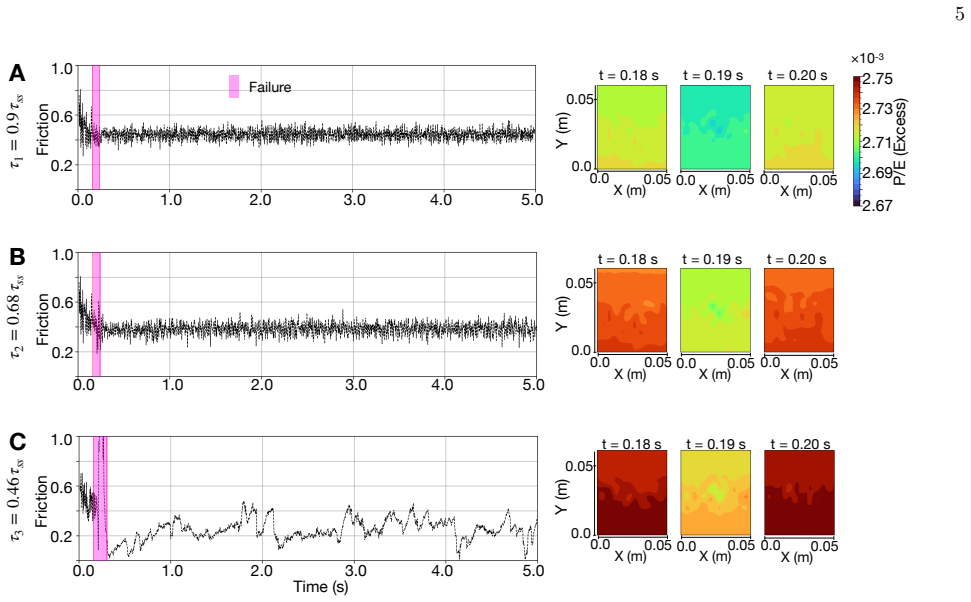
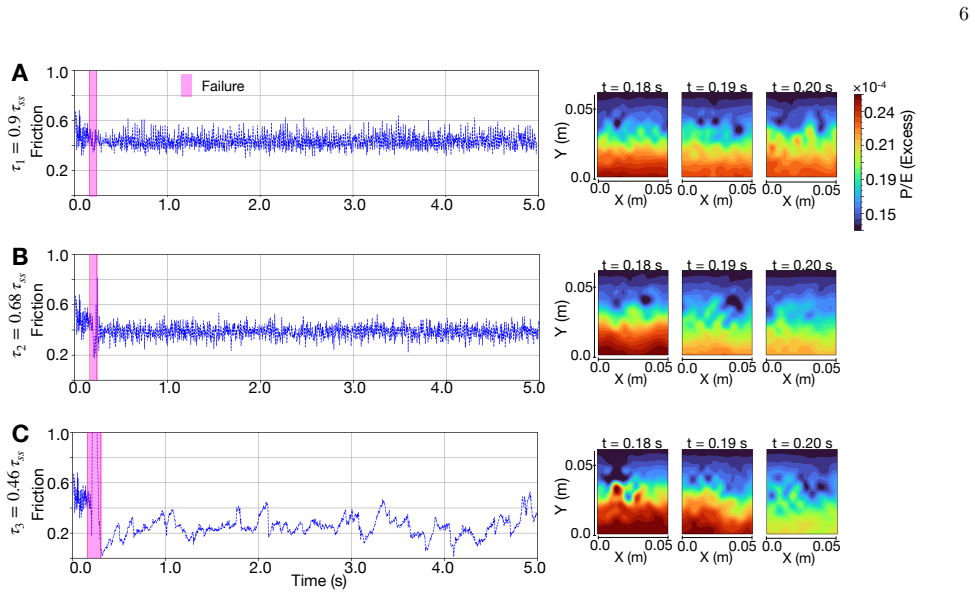
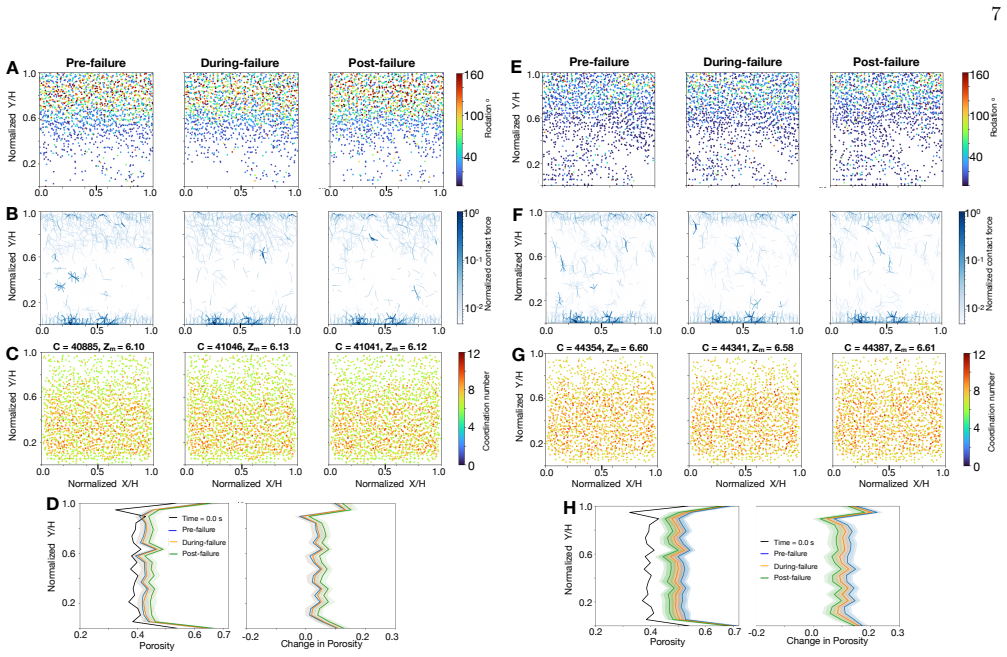
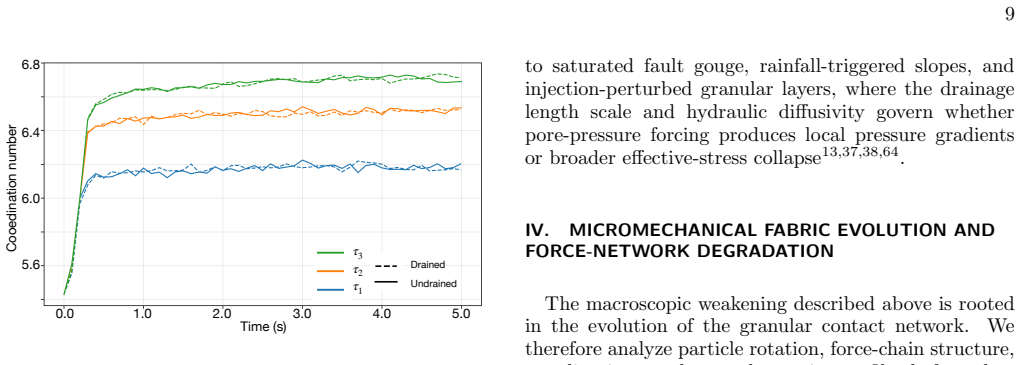
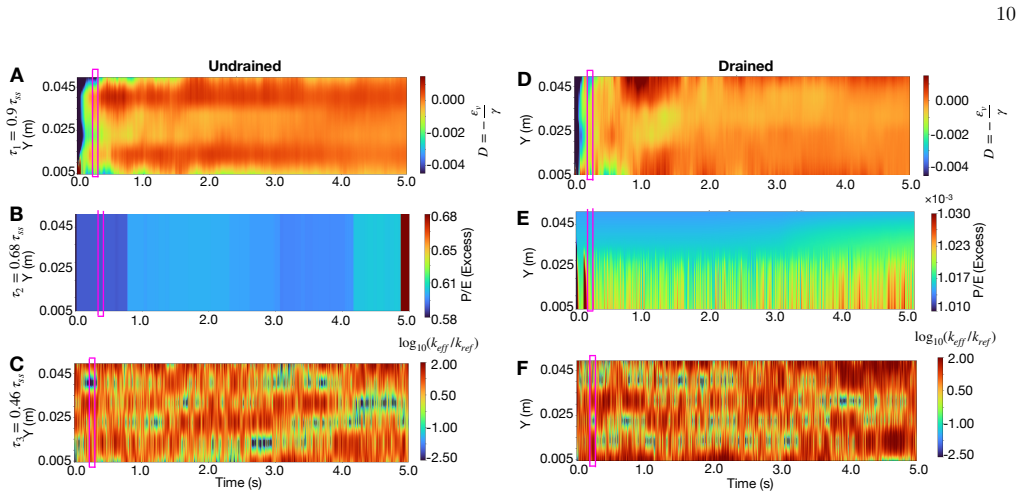
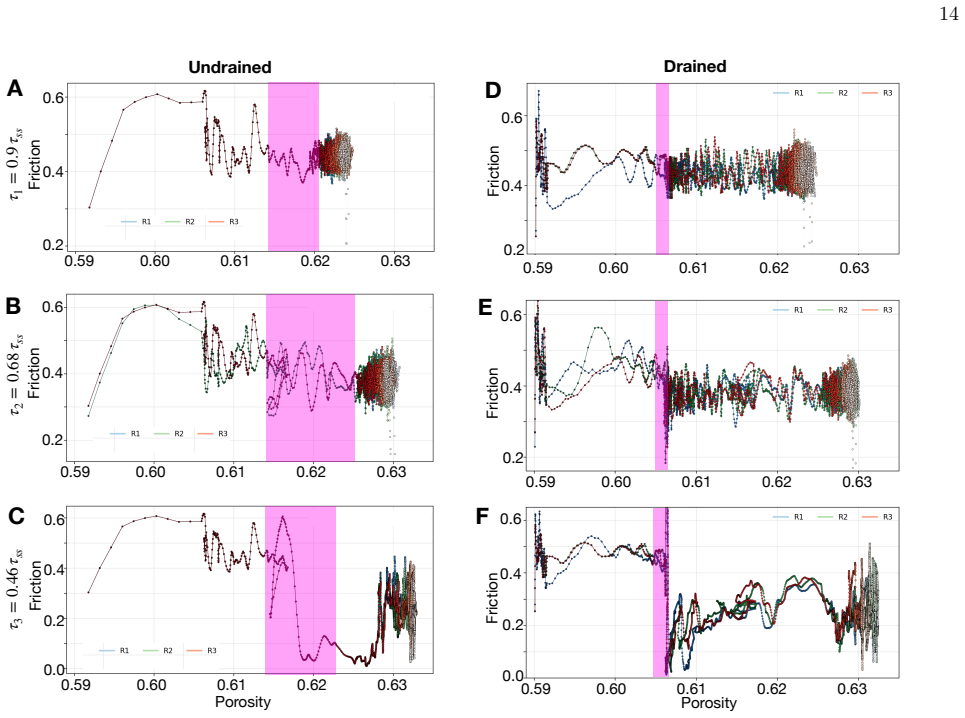
Instability is governed not by pore pressure alone, but by its coupled evolution with effective stress, drainage, dilation or compaction, hydraulic connectivity, and granular fabric. Undrained boundaries retain excess pore pressure, whereas drained boundaries maintain vertical gradients and suppress excess pressure. Internal fields reveal alternating dilation and compaction bands and reorganization of a porosity-derived permeability proxy. Micromechanical diagnostics identify localized particle rotation, force-chain reorganization, porosity redistribution, and coordination-number variations controlled mainly by imposed shear-stress level. Friction-velocity and friction-porosity trajectories
What carries the argument
The 3D coupled CFD-DEM model that tracks pore-pressure diffusion, drainage boundaries, and grain-scale fabric evolution during imposed shear stress increase.
If this is right
- Undrained conditions allow excess pore pressure to persist and promote instability while drained conditions suppress it through maintained gradients.
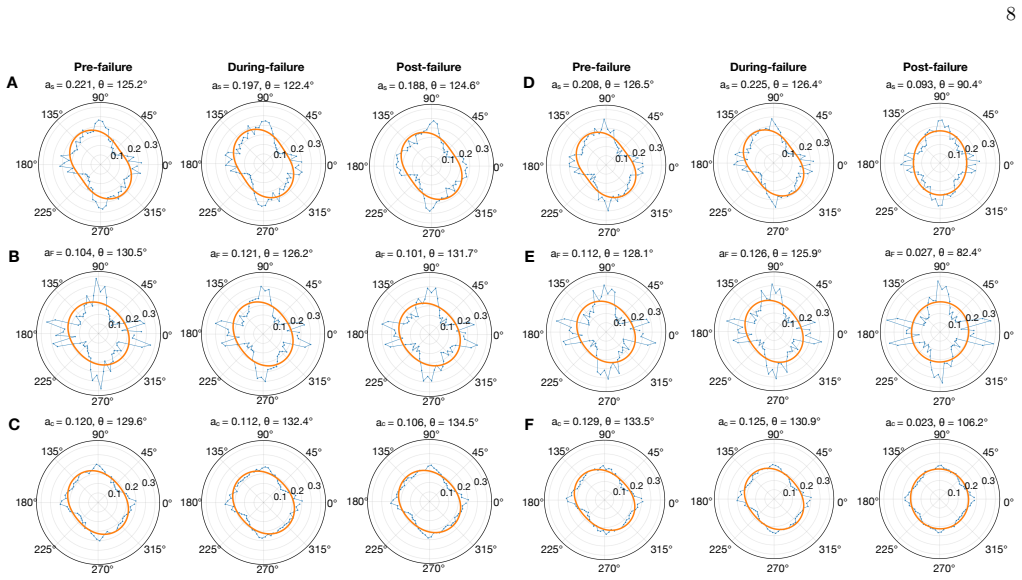
- Post-failure weakening coincides with loss of directional force-chain organization, especially at lower imposed shear stress.
- Hydraulic pathways evolve during deformation through alternating dilation and compaction bands and porosity redistribution.
- Viscous-number scaling partially organizes creeping response in the range 10^-8 <= Iv <= 10^-5 but does not collapse onto a unique local rheology.
- Micromechanical changes in particle rotation, coordination number, and fabric are controlled primarily by shear-stress level rather than drainage boundary.
Where Pith is reading between the lines
- Natural fault zones with spatially varying drainage might exhibit patchy reactivation patterns controlled by local hydraulic connectivity rather than uniform pressure.
- Monitoring changes in porosity-derived permeability or force-chain alignment could provide earlier indicators of impending instability than pressure measurements alone.
- The transition from dilatancy strengthening to pore-pressure weakening suggests that injection protocols could be designed to exploit dilatancy to delay failure.
- Extending the model to include thermal effects or chemical alteration would test whether the same coupled mechanisms dominate in geothermal or CO2 storage settings.
Load-bearing premise
The chosen 3D CFD-DEM model and drained-undrained boundary conditions accurately represent the grain-scale feedbacks between pressure diffusion, drainage, and contact-network degradation in real granular shear layers.
What would settle it
Laboratory experiments on fluid-saturated granular layers under identical shear stress and pressure ramp rates but with controlled drainage that produce identical instability thresholds regardless of measured fabric or dilation changes would falsify the claim.
Figures



read the original abstract
Fluid pressurization can reactivate subcritically stressed granular layers in faults, slopes, and injection-perturbed reservoirs, but grain-scale feedbacks among pressure diffusion, drainage, and contact-network degradation remain unresolved. Here, 3D coupled CFD-DEM simulations investigate pore-pressure-induced reactivation of confined, fluid-saturated granular shear layers under imposed shear stress. Strain-controlled tests define the Mohr-Coulomb strength envelope; stress-controlled simulations then impose subcritical shear stresses while basal pore pressure increases under drained and undrained conditions. Instability is governed not by pore pressure alone, but by its coupled evolution with effective stress, drainage, dilation or compaction, hydraulic connectivity, and granular fabric. Undrained boundaries retain excess pore pressure, whereas drained boundaries maintain vertical gradients and suppress excess pressure. Internal fields reveal alternating dilation and compaction bands and reorganization of a porosity-derived permeability proxy, showing that hydraulic pathways evolve during deformation. Micromechanical diagnostics identify localized particle rotation, force-chain reorganization, porosity redistribution, and coordination-number variations controlled mainly by imposed shear-stress level rather than drainage. Second-order fabric metrics show that post-failure weakening coincides with loss of directional force-chain organization, especially at lower shear. Friction-velocity and friction-porosity trajectories indicate a transition from dilatancy-dominated strengthening to pore-pressure-driven weakening. Viscous-number scaling partially organizes the low-Iv creeping response, 10^-8 <= Iv <= 10^-5, but not onto a unique local rheology. These results clarify how drainage-controlled hydromechanical feedbacks and fabric degradation convert pore-pressure forcing into instability.
Editorial analysis
A structured set of objections, weighed in public.
Referee Report
Summary. The manuscript uses 3D coupled CFD-DEM simulations of confined, fluid-saturated granular shear layers to study reactivation under basal pore-pressure increase at subcritical imposed shear stresses. Strain-controlled tests establish the Mohr-Coulomb envelope; stress-controlled runs then compare drained versus undrained boundaries. The central claim is that instability is controlled by the coupled evolution of pore pressure with effective stress, drainage, dilation/compaction, hydraulic connectivity (via porosity-derived permeability), and granular fabric, rather than pore pressure in isolation. Supporting evidence includes internal field diagnostics (alternating dilation/compaction bands, force-chain reorganization), micromechanical metrics (particle rotation, coordination number, fabric tensors), friction-velocity and friction-porosity trajectories, and partial organization by viscous number Iv in the creeping regime.
Significance. If the CFD-DEM implementation and boundary conditions faithfully reproduce grain-scale hydraulic and mechanical feedbacks, the work supplies mechanistic insight into hydromechanical instability relevant to faults, slopes, and reservoirs. Strengths include direct use of simulation outputs for fabric metrics and permeability proxies, explicit comparison of drained/undrained responses, and exploration of Iv scaling over 10^{-8} ≤ Iv ≤ 10^{-5}. The absence of external validation against laboratory benchmarks (e.g., CT-imaged shear bands under controlled pressurization) limits the strength of the conclusions.
major comments (2)
- [Methods] Methods (CFD-DEM coupling and boundary conditions): The central claim that observed dilation/compaction bands, permeability reorganization, and fabric degradation reflect physical grain-scale feedbacks rests on the untested assumption that the chosen 3D CFD-DEM implementation and drained/undrained boundaries reproduce real hydraulic connectivity and contact-network evolution without numerical artifacts. No comparison to laboratory data or analytical limits is provided, leaving open the possibility that the reported mechanisms are model-specific.
- [Results] Results (internal field diagnostics and fabric analysis): While alternating dilation/compaction bands and loss of directional force-chain organization are reported, the manuscript does not quantify how these features depend on the specific permeability evolution law or mesh resolution; without such sensitivity tests, it is unclear whether the claimed coupling between hydraulic pathways and fabric degradation is robust or an artifact of the porosity-derived permeability proxy.
minor comments (2)
- [Abstract] Abstract and introduction: The phrase 'parameter-free' is not used, but several quantities (imposed shear-stress levels, basal pressure-increase protocol) are free parameters; clarifying their selection criteria would aid reproducibility.
- [Methods] Notation: The definition of the viscous number Iv and the porosity-derived permeability proxy should be stated explicitly with equations in the main text rather than only in supplementary material.
Simulated Author's Rebuttal
We thank the referee for the constructive feedback. We address each major comment below and will revise the manuscript to incorporate sensitivity analyses and expanded discussion of model assumptions where feasible.
read point-by-point responses
-
Referee: [Methods] Methods (CFD-DEM coupling and boundary conditions): The central claim that observed dilation/compaction bands, permeability reorganization, and fabric degradation reflect physical grain-scale feedbacks rests on the untested assumption that the chosen 3D CFD-DEM implementation and drained/undrained boundaries reproduce real hydraulic connectivity and contact-network evolution without numerical artifacts. No comparison to laboratory data or analytical limits is provided, leaving open the possibility that the reported mechanisms are model-specific.
Authors: We acknowledge the value of external validation. The CFD-DEM coupling follows standard, previously benchmarked implementations in the literature for fluid-granular systems. In revision we will add explicit comparisons to analytical undrained strength limits and cite existing numerical benchmarks for similar boundary conditions. Direct laboratory comparison (e.g., CT-imaged shear bands) lies outside the present numerical study and would require new experiments; we will instead expand the limitations section to discuss this openly. revision: partial
-
Referee: [Results] Results (internal field diagnostics and fabric analysis): While alternating dilation/compaction bands and loss of directional force-chain organization are reported, the manuscript does not quantify how these features depend on the specific permeability evolution law or mesh resolution; without such sensitivity tests, it is unclear whether the claimed coupling between hydraulic pathways and fabric degradation is robust or an artifact of the porosity-derived permeability proxy.
Authors: We agree that robustness checks are required. Additional simulations varying the permeability-porosity exponent and mesh resolution will be performed and reported in the revised manuscript to confirm that the dilation/compaction bands, permeability reorganization, and fabric metrics remain qualitatively consistent. revision: yes
Circularity Check
No circularity; central claims are direct simulation outputs without definitional reduction or self-citation chains.
full rationale
The paper reports instability mechanisms as direct outputs from 3D CFD-DEM simulations (strain-controlled Mohr-Coulomb envelopes, stress-controlled pressurization tests under drained/undrained boundaries, internal fields for dilation/compaction bands, fabric metrics, coordination number, and Iv scaling). No equations reduce predictions to fitted inputs by construction, no self-citations justify load-bearing premises, and no ansatzes or uniqueness theorems are imported to force results. The derivation chain consists of numerical model execution and post-processing diagnostics, which are self-contained against external benchmarks and do not exhibit the enumerated circular patterns.
Axiom & Free-Parameter Ledger
free parameters (2)
- imposed subcritical shear stress levels
- basal pore-pressure increase protocol
axioms (2)
- domain assumption CFD-DEM coupling accurately represents fluid-grain interactions at the resolved scale
- domain assumption Drained and undrained boundary conditions bracket relevant field scenarios
Reference graph
Works this paper leans on
-
[1]
Iverson, Richard M. , year =. Landslide triggering by rain infiltration , volume =. Water Resources Research , publisher =. doi:10.1029/2000wr900090 , number =
-
[2]
Montgomery, David R. and Dietrich, William E. , year =. A physically based model for the topographic control on shallow landsliding , volume =. Water Resources Research , publisher =. doi:10.1029/93wr02979 , number =
-
[3]
Rice, James R. , year =. Heating and weakening of faults during earthquake slip , volume =. Journal of Geophysical Research: Solid Earth , publisher =. doi:10.1029/2005jb004006 , number =
-
[4]
Peacock, Simon M. , year =. Are the lower planes of double seismic zones caused by serpentine dehydration in subducting oceanic mantle? , volume =. Geology , publisher =. doi:10.1130/0091-7613(2001)029<0299:atlpod>2.0.co;2 , number =
-
[5]
Ellsworth, William L. , year =. Injection-Induced Earthquakes , volume =. Science , publisher =. doi:10.1126/science.1225942 , number =
-
[6]
Zoback, Mark D. and Gorelick, Steven M. , year =. Earthquake triggering and large-scale geologic storage of carbon dioxide , volume =. Proceedings of the National Academy of Sciences , publisher =. doi:10.1073/pnas.1202473109 , number =
-
[7]
Daniller‐Varghese, Max and Smith, Everett and Mohrig, David and Myrow, Paul , year =. Wave‐Signal Entrainment Into Combined Flows: Consequences for Sediment Transport, Signal Dislocation, and Turbulence , volume =. Journal of Geophysical Research: Earth Surface , publisher =. doi:10.1029/2025jf008497 , number =
-
[8]
Smith, Everett and Daniller-Varghese, Max S. and Myrow, Paul M. and Mohrig, David , year =. Experimental Investigations of Combined Flow Sediment Transport , volume =. Journal of Sedimentary Research , publisher =. doi:10.2110/jsr.2019.43 , number =
-
[9]
1943 , publisher =
Karl Terzaghi , title =. 1943 , publisher =
1943
-
[10]
Iverson, Richard M. , year =. Regulation of landslide motion by dilatancy and pore pressure feedback , volume =. Journal of Geophysical Research: Earth Surface , publisher =. doi:10.1029/2004jf000268 , number =
-
[11]
Cappa, Frédéric and Guglielmi, Yves and Viseur, Sophie and Garambois, Stéphane , year =. Deep fluids can facilitate rupture of slow‐moving giant landslides as a result of stress transfer and frictional weakening , volume =. Geophysical Research Letters , publisher =. doi:10.1002/2013gl058566 , number =
-
[12]
and Harjes, Hans‐Peter , year =
Zoback, Mark D. and Harjes, Hans‐Peter , year =. Injection‐induced earthquakes and crustal stress at 9 km depth at the KTB deep drilling site, Germany , volume =. Journal of Geophysical Research: Solid Earth , publisher =. doi:10.1029/96jb02814 , number =
-
[13]
Rice, James R. , year =. Chapter 20 Fault Stress States, Pore Pressure Distributions, and the Weakness of the San Andreas Fault , ISBN =. doi:10.1016/s0074-6142(08)62835-1 , booktitle =
-
[14]
Rudnicki, J.W. and Rice, J.R. , year =. Conditions for the localization of deformation in pressure-sensitive dilatant materials , volume =. Journal of the Mechanics and Physics of Solids , publisher =. doi:10.1016/0022-5096(75)90001-0 , number =
-
[15]
LABORATORY-DERIVED FRICTION LAWS AND THEIR APPLICATION TO SEISMIC FAULTING , volume =
Marone, Chris , year =. LABORATORY-DERIVED FRICTION LAWS AND THEIR APPLICATION TO SEISMIC FAULTING , volume =. Annual Review of Earth and Planetary Sciences , publisher =. doi:10.1146/annurev.earth.26.1.643 , number =
-
[16]
Scholz, Christopher H. , year =. The Mechanics of Earthquakes and Faulting , ISBN =. doi:10.1017/9781316681473 , publisher =
-
[17]
Saffer, Demian M. and Wallace, Laura M. , year =. The frictional, hydrologic, metamorphic and thermal habitat of shallow slow earthquakes , volume =. Nature Geoscience , publisher =. doi:10.1038/ngeo2490 , number =
-
[18]
Sulem, J. and Famin, V. , year =. Thermal decomposition of carbonates in fault zones: Slip‐weakening and temperature‐limiting effects , volume =. Journal of Geophysical Research: Solid Earth , publisher =. doi:10.1029/2008jb006004 , number =
-
[19]
Garagash, Dmitry I. and Germanovich, Leonid N. , year =. Nucleation and arrest of dynamic slip on a pressurized fault , volume =. Journal of Geophysical Research: Solid Earth , publisher =. doi:10.1029/2012jb009209 , number =
-
[20]
Sulem, J. and Vardoulakis, I.G. , year =. Bifurcation Analysis in Geomechanics , ISBN =. doi:10.1201/9781482269383 , publisher =
-
[21]
Rathbun, Andrew P. and Marone, Chris , year =. Effect of strain localization on frictional behavior of sheared granular materials , volume =. Journal of Geophysical Research: Solid Earth , publisher =. doi:10.1029/2009jb006466 , number =
-
[22]
Rathbun, Andrew P. and Marone, Chris , year =. Symmetry and the critical slip distance in rate and state friction laws , volume =. Journal of Geophysical Research: Solid Earth , publisher =. doi:10.1002/jgrb.50224 , number =
-
[23]
Rudnicki, John W. and Chen, Chao‐Hsun , year =. Stabilization of rapid frictional slip on a weakening fault by dilatant hardening , volume =. Journal of Geophysical Research: Solid Earth , publisher =. doi:10.1029/jb093ib05p04745 , number =
-
[24]
Shear‐induced dilatancy of fluid‐saturated faults: Experiment and theory , volume =
Samuelson, Jon and Elsworth, Derek and Marone, Chris , year =. Shear‐induced dilatancy of fluid‐saturated faults: Experiment and theory , volume =. Journal of Geophysical Research: Solid Earth , publisher =. doi:10.1029/2008jb006273 , number =
-
[25]
Rathbun, Andrew P. and Renard, Fran. Numerical investigation of the interplay between wall geometry and friction in granular fault gouge , volume =. Journal of Geophysical Research: Solid Earth , publisher =. 2013 , month = mar, pages =. doi:10.1002/jgrb.50106 , number =
-
[26]
Mair, Karen and Hazzard, James F. , year =. Nature of stress accommodation in sheared granular material: Insights from 3D numerical modeling , volume =. Earth and Planetary Science Letters , publisher =. doi:10.1016/j.epsl.2007.05.006 , number =
-
[27]
Stick‐slip motion in simulated granular layers , volume =
Aharonov, Einat and Sparks, David , year =. Stick‐slip motion in simulated granular layers , volume =. Journal of Geophysical Research: Solid Earth , publisher =. doi:10.1029/2003jb002597 , number =
-
[28]
Ferdowsi, Behrooz and Rubin, Allan M. , year =. A Granular Physics‐Based View of Fault Friction Experiments , volume =. Journal of Geophysical Research: Solid Earth , publisher =. doi:10.1029/2019jb019016 , number =
-
[29]
Ferdowsi, Behrooz and Rubin, Allan M. , year =. Slide‐Hold‐Slide Protocols and Frictional Healing in Discrete Element Method (DEM) Simulations of Granular Fault Gouge , volume =. Journal of Geophysical Research: Solid Earth , publisher =. doi:10.1029/2021jb022125 , number =
-
[30]
Ferdowsi, Behrooz and Griffa, Michele and Guyer, Robert A. and Johnson, Paul A. and Marone, Chris and Carmeliet, Jan , year =. Acoustically induced slip in sheared granular layers: Application to dynamic earthquake triggering , volume =. Geophysical Research Letters , publisher =. doi:10.1002/2015gl066096 , number =
-
[31]
Ferdowsi, B. and Griffa, M. and Guyer, R. A. and Johnson, P. A. and Marone, C. and Carmeliet, J. , year =. Microslips as precursors of large slip events in the stick‐slip dynamics of sheared granular layers: A discrete element model analysis , volume =. Geophysical Research Letters , publisher =. doi:10.1002/grl.50813 , number =
-
[32]
Rigidity phase transition in granular packings , volume =
Aharonov, Einat and Sparks, David , year =. Rigidity phase transition in granular packings , volume =. Physical Review E , publisher =. doi:10.1103/physreve.60.6890 , number =
-
[33]
Morgan, Julia K. and Boettcher, Margaret S. , year =. Numerical simulations of granular shear zones using the distinct element method: 1. Shear zone kinematics and the micromechanics of localization , volume =. Journal of Geophysical Research: Solid Earth , publisher =. doi:10.1029/1998jb900056 , number =
-
[34]
Hazzard, James F. and Mair, Karen , year =. The importance of the third dimension in granular shear , volume =. Geophysical Research Letters , publisher =. doi:10.1029/2003gl017534 , number =
-
[35]
Cundall, P. A. and Strack, O. D. L. , year =. A discrete numerical model for granular assemblies , volume =. Géotechnique , publisher =. doi:10.1680/geot.1979.29.1.47 , number =
-
[36]
Tordesillas, A. , year =. Force chain buckling, unjamming transitions and shear banding in dense granular assemblies , volume =. Philosophical Magazine , publisher =. doi:10.1080/14786430701594848 , number =
-
[37]
Quasistatic rheology and the origins of strain , volume =
Roux, Jean-Noël and Combe, Gaël , year =. Quasistatic rheology and the origins of strain , volume =. Comptes Rendus. Physique , publisher =. doi:10.1016/s1631-0705(02)01306-3 , number =
-
[38]
Jaeger, Heinrich M. and Nagel, Sidney R. and Behringer, Robert P. , year =. Granular solids, liquids, and gases , volume =. Reviews of Modern Physics , publisher =. doi:10.1103/revmodphys.68.1259 , number =
-
[39]
and Jean, Michel and Moreau, Jean-Jacques , year =
Radjai, Farhang and Wolf, Dietrich E. and Jean, Michel and Moreau, Jean-Jacques , year =. Bimodal Character of Stress Transmission in Granular Packings , volume =. Physical Review Letters , publisher =. doi:10.1103/physrevlett.80.61 , number =
-
[40]
Rothenburg, L. and Bathurst, R. J. , year =. Analytical study of induced anisotropy in idealized granular materials , volume =. Géotechnique , publisher =. doi:10.1680/geot.1989.39.4.601 , number =
-
[41]
Cox, Nicholas J. , year =. Speaking Stata: Logarithmic Binning and Labeling , volume =. The Stata Journal: Promoting communications on statistics and Stata , publisher =. doi:10.1177/1536867x1801800116 , number =
-
[42]
Powder Technology , volume =
On the determination of grid size/smoothing distance in un-/semi-resolved CFD-DEM simulation of particulate flows , author =. Powder Technology , volume =. 2021 , doi =
2021
-
[43]
M. J. Andrews and P. J. O'Rourke , title =. International Journal of Multiphase Flow , volume =. 1996 , doi =
1996
-
[44]
Rowe, P. W. , year =. The stress-dilatancy relation for static equilibrium of an assembly of particles in contact , volume =. Proceedings of the Royal Society of London. Series A. Mathematical and Physical Sciences , publisher =. doi:10.1098/rspa.1962.0193 , number =
-
[45]
Force Distributions in Dense Two-Dimensional Granular Systems , volume =
Radjai, Farhang and Jean, Michel and Moreau, Jean-Jacques and Roux, Stéphane , year =. Force Distributions in Dense Two-Dimensional Granular Systems , volume =. Physical Review Letters , publisher =. doi:10.1103/physrevlett.77.274 , number =
-
[46]
Saffer, Demian M and Marone, Chris , year =. Comparison of smectite- and illite-rich gouge frictional properties: application to the updip limit of the seismogenic zone along subduction megathrusts , volume =. Earth and Planetary Science Letters , publisher =. doi:10.1016/s0012-821x(03)00424-2 , number =
-
[47]
Sulem, J. and Lazar, P. and Vardoulakis, I. , year =. Thermo‐poro‐mechanical properties of clayey gouge and application to rapid fault shearing , volume =. International Journal for Numerical and Analytical Methods in Geomechanics , publisher =. doi:10.1002/nag.584 , number =
-
[48]
Brantut, N. and Heap, M.J. and Meredith, P.G. and Baud, P. , year =. Time-dependent cracking and brittle creep in crustal rocks: A review , volume =. doi:10.1016/j.jsg.2013.03.007 , journal =
-
[49]
Brantut, N. and Sulem, J. and Schubnel, A. , year =. Effect of dehydration reactions on earthquake nucleation: Stable sliding, slow transients, and unstable slip , volume =. Journal of Geophysical Research , publisher =. doi:10.1029/2010jb007876 , number =
-
[50]
Lockner and Brian D
Brandon Proctor and David A. Lockner and Brian D. Kilgore and Tom M. Mitchell and Nicholas M. Beeler , title =. Geophysical Research Letters , year =
-
[51]
Earth and Planetary Science Letters , year =
Nicolas Brantut , title =. Earth and Planetary Science Letters , year =
-
[52]
Aben , title =
Dong Liu and Nicolas Brantut and Frans M. Aben , title =. Journal of Geophysical Research: Solid Earth , year =
-
[53]
Scuderi and Chris Marone , title =
Raphael Affinito and Derek Elsworth and Tanuj Mittal and Marco M. Scuderi and Chris Marone , title =. Journal of Geophysical Research: Solid Earth , year =
-
[54]
The Effect of Normal Stress Oscillations on Fault Slip Behavior Near the Stability Transition From Stable to Unstable Motion , journal =
Federico Pignalberi and Carolina Giorgetti and Corentin No. The Effect of Normal Stress Oscillations on Fault Slip Behavior Near the Stability Transition From Stable to Unstable Motion , journal =. 2024 , volume =
2024
-
[55]
Niemeijer and Christopher J
Jianye Chen and Andre R. Niemeijer and Christopher J. Spiers , title =. Geophysical Research Letters , year =
-
[56]
Bedford and Daniel R
John D. Bedford and Daniel R. Faulkner and Nadia Lapusta , title =. Nature Communications , year =
-
[57]
Guyer and Paul A
Behrouz Ferdowsi and Michele Griffa and Robert A. Guyer and Paul A. Johnson and Chris Marone and Jan Carmeliet , title =. Geophysical Research Letters , year =
-
[58]
Rock Mechanics and Rock Engineering , year =
Omid Dorostkar and Jan Carmeliet , title =. Rock Mechanics and Rock Engineering , year =
-
[59]
A novel semi-resolved CFD--DEM method with two-grid mapping: Methodology and verification , journal =
Hanqiao Che and Kit Windows. A novel semi-resolved CFD--DEM method with two-grid mapping: Methodology and verification , journal =. 2024 , volume =
2024
-
[60]
Computers and Geotechnics , year =
Gaoyang Hu and Bo Zhou and Wenbo Zheng and Kuang Cheng and Huabin Wang , title =. Computers and Geotechnics , year =
-
[61]
Geosciences , year =
Jun Xu and Fei Wang and Ruth Abegaz , title =. Geosciences , year =
-
[62]
Computers and Geotechnics , year =
Saman Farzi and Usama El Shamy , title =. Computers and Geotechnics , year =
-
[63]
Chemical Engineering Science , year =
Zhuangjian Yang and Xue Lian and Chiya Savari and Mostafa Barigou , title =. Chemical Engineering Science , year =
-
[64]
Fault Gouge Failure Induced by Fluid Injection: Hysteresis, Delay and Shear‐Strengthening , volume =
Sarma, Pritom and Aharonov, Einat and Toussaint, Renaud and Parez, Stanislav , year =. Fault Gouge Failure Induced by Fluid Injection: Hysteresis, Delay and Shear‐Strengthening , volume =. Journal of Geophysical Research: Solid Earth , publisher =. doi:10.1029/2024jb030768 , number =
-
[65]
Cornet, F. H. and Helm, J. and Poitrenaud, H. and Etchecopar, A. , year =. Seismic and Aseismic Slips Induced by Large-scale Fluid Injections , ISBN =. doi:10.1007/978-3-0348-8814-1_12 , booktitle =
-
[66]
Segall, Paul and Rice, James R. , year =. Dilatancy, compaction, and slip instability of a fluid‐infiltrated fault , volume =. Journal of Geophysical Research: Solid Earth , publisher =. doi:10.1029/95jb02403 , number =
-
[67]
Segall, Paul and Rubin, Allan M. and Bradley, Andrew M. and Rice, James R. , year =. Dilatant strengthening as a mechanism for slow slip events , volume =. Journal of Geophysical Research: Solid Earth , publisher =. doi:10.1029/2010jb007449 , number =
-
[68]
Journal of Geophysical Research: Earth Surface , volume=
Rate, water pressure, and temperature effects in landslide shear zones , author=. Journal of Geophysical Research: Earth Surface , volume=. 2023 , publisher=
2023
-
[69]
Shear behaviour of pre-existing shear zones under fast loading , author=. Advances in geotechnical engineering: The Skempton conference: Proceedings of a three day conference on advances in geotechnical engineering, organised by the Institution of Civil Engineers and held at the Royal Geographical Society, London, UK, on 29--31 March 2004 , pages=. 2004 ,...
2004
-
[70]
Geotechnique , volume=
Shear mechanisms and viscoplastic effects during impulsive shearing , author=. Geotechnique , volume=. 2010 , publisher=
2010
-
[71]
Journal of Geophysical Research: Solid Earth , volume=
Nucleation of slip-weakening rupture instability in landslides by localized increase of pore pressure , author=. Journal of Geophysical Research: Solid Earth , volume=. 2012 , publisher=
2012
-
[72]
Iverson, R. M. and Reid, M. E. and Iverson, N. R. and LaHusen, R. G. and Logan, M. and Mann, J. E. and Brien, D. L. , year =. Acute Sensitivity of Landslide Rates to Initial Soil Porosity , volume =. Science , publisher =. doi:10.1126/science.290.5491.513 , number =
-
[73]
Mechanics of dual-mode dilative failure in subaqueous sediment deposits , volume =
You, Yao and Flemings, Peter and Mohrig, David , year =. Mechanics of dual-mode dilative failure in subaqueous sediment deposits , volume =. doi:10.1016/j.epsl.2014.04.024 , journal =
-
[74]
Journal of Geophysical Research: Earth Surface , volume=
Frictional control on accelerating creep during the slow-to-fast transition of rainfall-induced catastrophic landslides , author=. Journal of Geophysical Research: Earth Surface , volume=. 2024 , publisher=
2024
-
[75]
and Kamrin, Ken and Bazant, Martin Z
Rycroft, Chris H. and Kamrin, Ken and Bazant, Martin Z. , year =. Assessing continuum postulates in simulations of granular flow , volume =. Journal of the Mechanics and Physics of Solids , publisher =. doi:10.1016/j.jmps.2009.01.009 , number =
-
[76]
Unifying Suspension and Granular Rheology , volume =
Boyer, Fran. Unifying Suspension and Granular Rheology , volume =. Physical Review Letters , publisher =. doi:10.1103/physrevlett.107.188301 , number =
-
[77]
Granular Avalanches in Fluids , volume =
Courrech du Pont, Sylvain and Gondret, Philippe and Perrin, Bernard and Rabaud, Marc , year =. Granular Avalanches in Fluids , volume =. Physical Review Letters , publisher =. doi:10.1103/physrevlett.90.044301 , number =
-
[78]
Rondon, L. and Pouliquen, O. and Aussillous, P. , year =. Granular collapse in a fluid: Role of the initial volume fraction , volume =. Physics of Fluids , publisher =. doi:10.1063/1.3594200 , number =
-
[79]
Wan, R.G. and Guo, P.J. , year =. A Pressure and Density Dependent Dilatancy Model for Granular Materials , volume =. Soils and Foundations , publisher =. doi:10.3208/sandf.39.6_1 , number =
-
[80]
and Jamali, Safa and Glynos, Emmanouil and Green, Peter F
Hsiao, Lilian C. and Jamali, Safa and Glynos, Emmanouil and Green, Peter F. and Larson, Ronald G. and Solomon, Michael J. , year =. Rheological State Diagrams for Rough Colloids in Shear Flow , volume =. Physical Review Letters , publisher =. doi:10.1103/physrevlett.119.158001 , number =
discussion (0)
Sign in with ORCID, Apple, or X to comment. Anyone can read and Pith papers without signing in.