Spin-orbit correlation of quarks within quarkonium
Pith reviewed 2026-06-28 00:36 UTC · model grok-4.3
The pith
Spin-orbit correlations of quarks within quarkonium can be extracted directly from parity-odd energy-momentum tensor matrix elements.
A machine-rendered reading of the paper's core claim, the machinery that carries it, and where it could break.
Core claim
The spin-orbit correlation is connected to light-front dynamics and extracted from the hadronic matrix elements of the P-odd EMT, allowing computation of SOC distributions for charmonium and B_c mesons that yield rich information regarding partonic dynamics.
What carries the argument
Parity-odd energy-momentum tensor (EMT) matrix elements in light-front dynamics, serving as the source for extracting the spin-orbit correlation.
Load-bearing premise
The light-front dynamics framework faithfully reproduces the formal field-theoretical definition of the parity-odd EMT matrix elements.
What would settle it
An independent computation of the P-odd EMT matrix elements for charmonium using lattice QCD that produces SOC values differing from the light-front results.
Figures
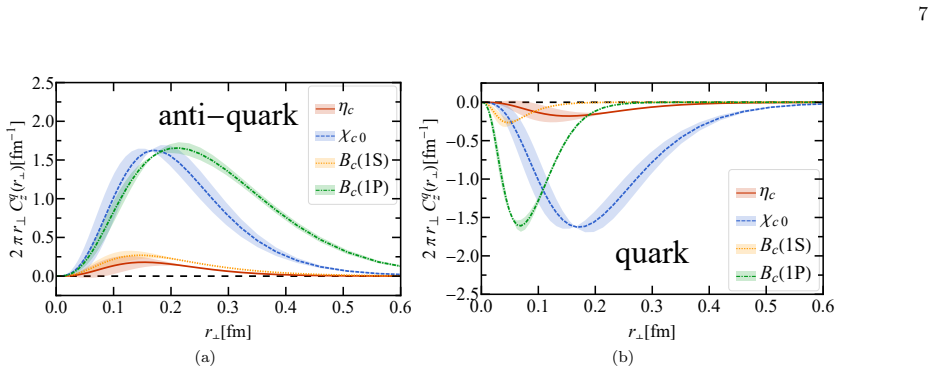
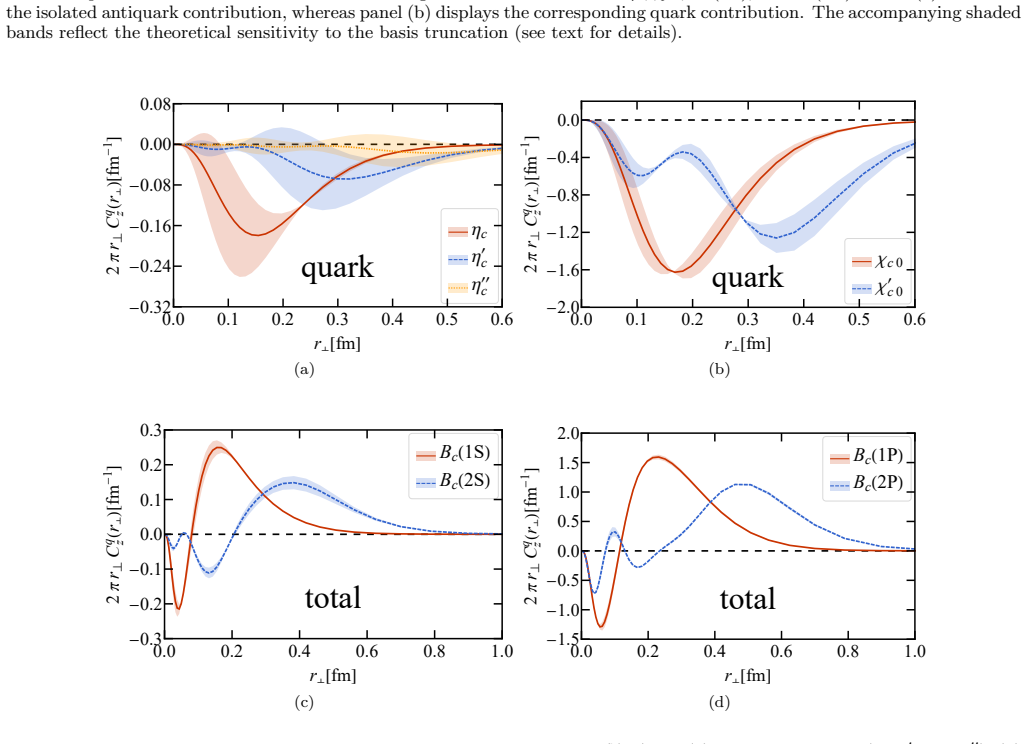
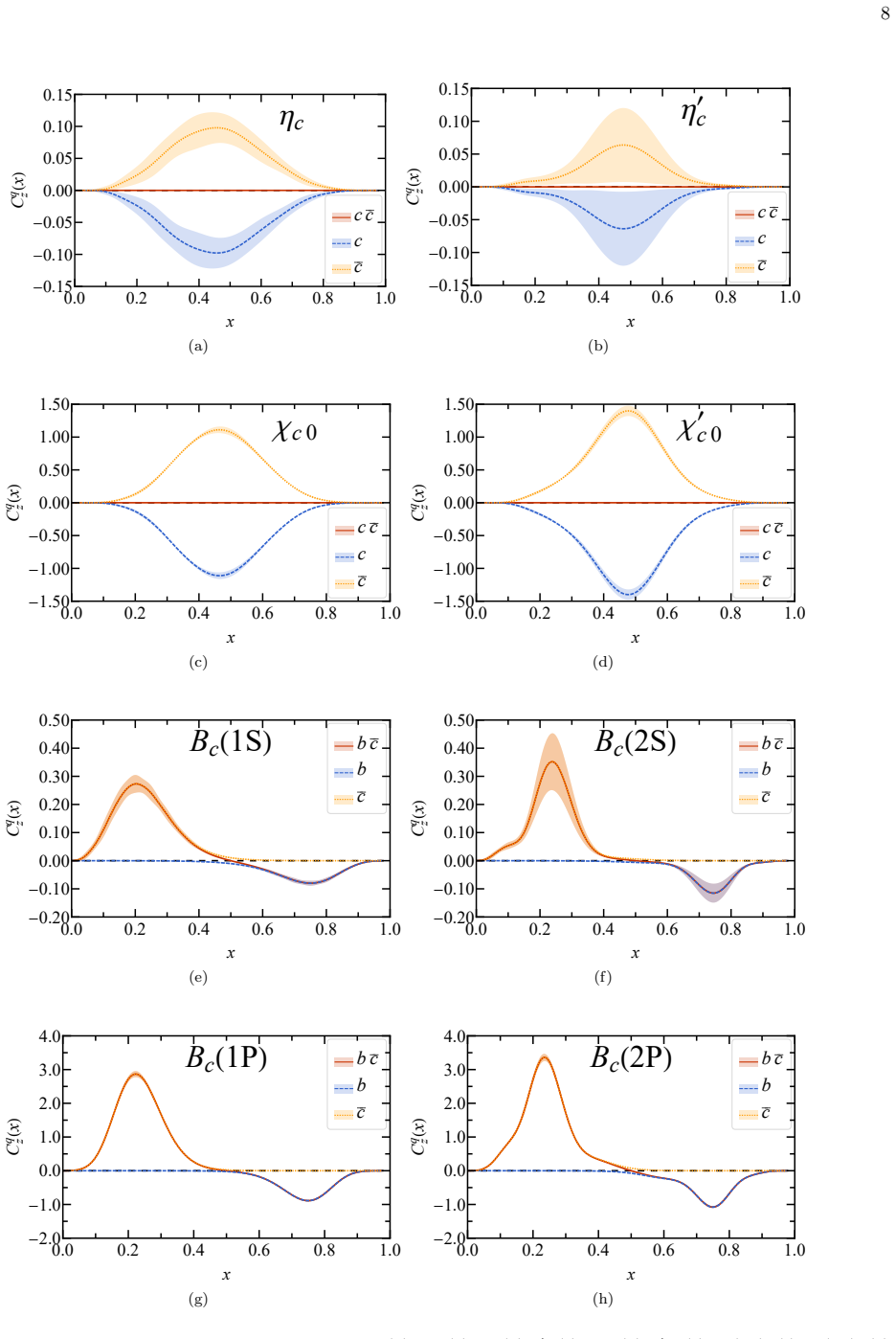
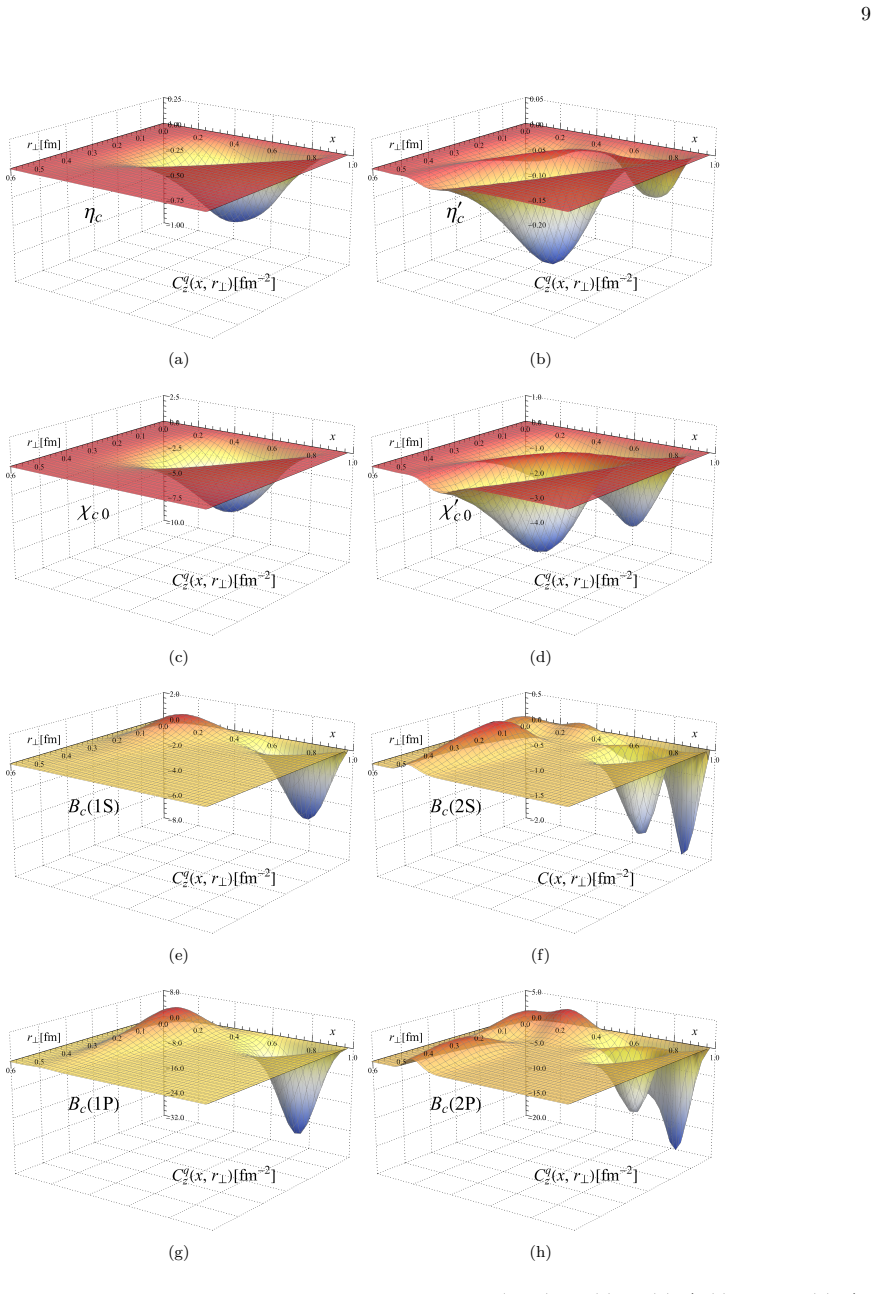
read the original abstract
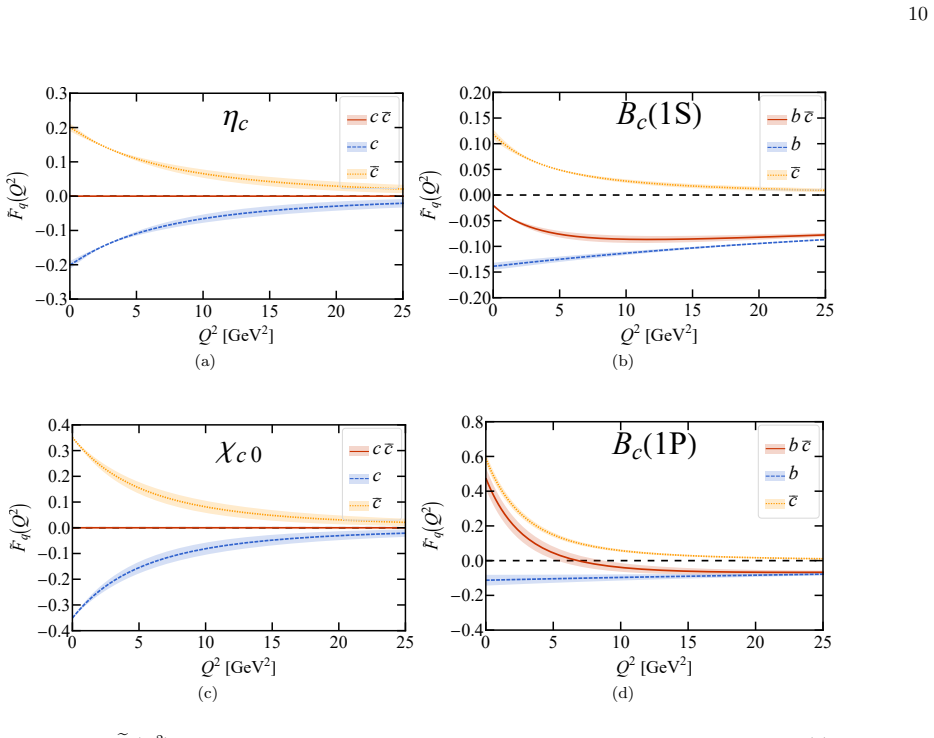
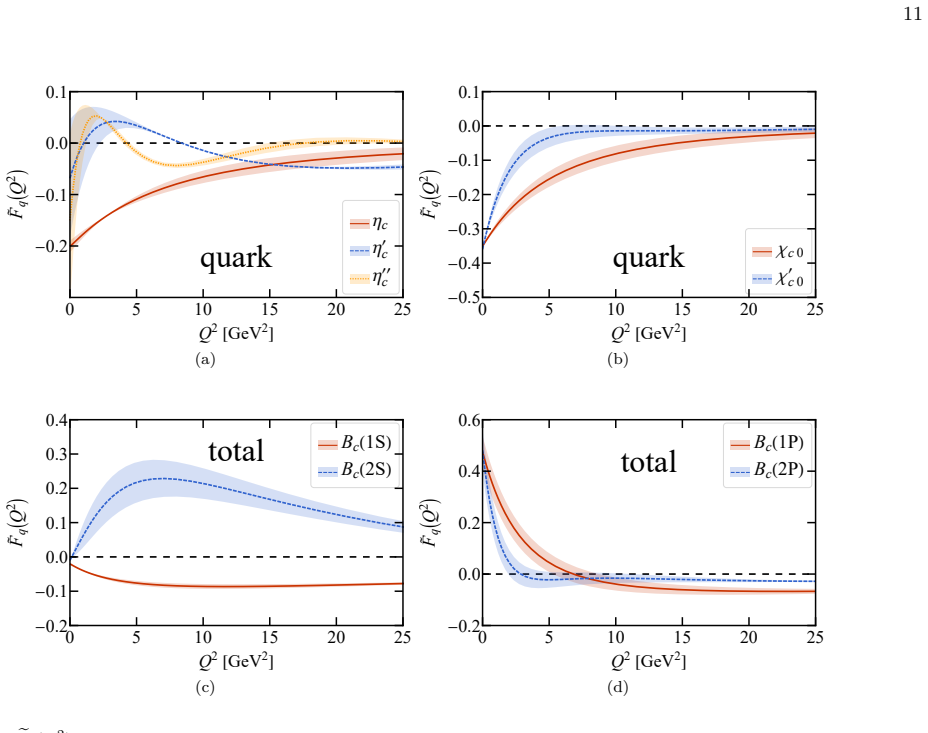
The spin-orbit correlation (SOC) provides a unique probe into the internal spin structure of hadrons. Defined via the parity-odd (P-odd) energy-momentum tensor (EMT), this observable can remain non-vanishing even in systems where the total angular momentum is zero. In this study, we connect the formal field-theoretical definition of the SOC to a non-perturbative quantum many-body framework utilizing light-front dynamics. Furthermore, we show how the SOC can be extracted directly from the hadronic matrix elements of the P-odd EMT, establishing a pathway to access this observable within the partonic picture. As a practical application, we compute the transverse and longitudinal SOC distributions for charmonium and $B_c$ mesons. While our findings align with rough estimates based on the Clebsch-Gordan decomposition, we demonstrate that these observables yield rich, non-trivial information regarding partonic dynamics.
Editorial analysis
A structured set of objections, weighed in public.
Referee Report
Summary. The manuscript connects the formal field-theoretical definition of spin-orbit correlation (SOC) via the parity-odd energy-momentum tensor (EMT) to a non-perturbative light-front dynamics framework. It shows extraction of SOC directly from hadronic matrix elements of the P-odd EMT and computes transverse and longitudinal SOC distributions for charmonium and B_c mesons. These results align with rough Clebsch-Gordan estimates while revealing additional partonic dynamics information.
Significance. If the light-front to covariant QFT mapping holds, the work provides a concrete pathway to access SOC observables in the partonic picture for systems with vanishing total angular momentum. The explicit computations for quarkonia supply falsifiable distributions that could be compared with future lattice or experimental data on spin structure.
major comments (2)
- [paragraph on connecting definitions] The paragraph on connecting definitions: the central claim that the non-perturbative light-front many-body framework reproduces the hadronic matrix elements of the parity-odd EMT (as defined in covariant QFT) is stated without explicit operator matching, renormalization procedure, or verification against frame dependence and zero-mode contributions specific to the P-odd sector. This equivalence is load-bearing for the extraction pathway and the subsequent partonic interpretation of the computed SOC distributions.
- [extraction from matrix elements] Section describing the extraction from matrix elements: no demonstration is provided that the SOC values obtained are independent of the light-front wave-function model parameters or reduce to Clebsch-Gordan coefficients only by construction; the reported alignment with rough estimates therefore requires a quantitative check (e.g., via variation of the model or comparison to an exactly solvable limit) to establish that non-trivial partonic information is genuinely extracted.
minor comments (2)
- Notation for the P-odd EMT components and the resulting SOC distributions should be defined explicitly with equations rather than referenced only descriptively.
- The abstract states that results 'align with rough estimates based on the Clebsch-Gordan decomposition'; a table or figure quantifying the numerical difference would improve clarity.
Simulated Author's Rebuttal
We thank the referee for the careful reading of our manuscript and the constructive major comments. We address each point below and will revise the manuscript to provide additional clarifications and analyses.
read point-by-point responses
-
Referee: The paragraph on connecting definitions: the central claim that the non-perturbative light-front many-body framework reproduces the hadronic matrix elements of the parity-odd EMT (as defined in covariant QFT) is stated without explicit operator matching, renormalization procedure, or verification against frame dependence and zero-mode contributions specific to the P-odd sector. This equivalence is load-bearing for the extraction pathway and the subsequent partonic interpretation of the computed SOC distributions.
Authors: We acknowledge the importance of explicitly establishing this equivalence. The light-front framework is constructed to reproduce the covariant matrix elements of the EMT via standard light-front quantization in the infinite-momentum frame, where the relevant operators correspond directly. However, we agree that a more detailed discussion of operator matching, renormalization, and potential zero-mode or frame-dependence issues specific to the P-odd sector would strengthen the presentation. In the revised manuscript we will add a dedicated paragraph outlining these aspects with appropriate references to light-front QCD literature. revision: yes
-
Referee: Section describing the extraction from matrix elements: no demonstration is provided that the SOC values obtained are independent of the light-front wave-function model parameters or reduce to Clebsch-Gordan coefficients only by construction; the reported alignment with rough estimates therefore requires a quantitative check (e.g., via variation of the model or comparison to an exactly solvable limit) to establish that non-trivial partonic information is genuinely extracted.
Authors: The SOC distributions are computed from the full light-front wave functions obtained by solving the bound-state equation, which incorporate dynamical information beyond pure Clebsch-Gordan angular-momentum coupling; the reported alignment is therefore a consistency check rather than a built-in result. We agree that an explicit quantitative demonstration would be valuable. In the revision we will add a short sensitivity analysis by varying key model parameters (quark mass and confinement scale) within physically motivated ranges and show that the main features of the SOC distributions remain stable, confirming that non-trivial partonic information is extracted. revision: yes
Circularity Check
No significant circularity; derivation is self-contained
full rationale
The paper connects the formal P-odd EMT definition of SOC to light-front dynamics matrix elements and computes transverse/longitudinal distributions for charmonium and B_c. Results are stated to align with but exceed rough Clebsch-Gordan estimates, with no equations or steps shown that reduce the extracted SOC to a fitted parameter, self-citation chain, or definitional tautology. The central pathway is presented as a direct extraction after the framework connection, without evidence of the prediction being forced by construction from inputs. This is the expected non-circular outcome for a computational application paper.
Axiom & Free-Parameter Ledger
Reference graph
Works this paper leans on
-
[1]
F. Gross, E. Klempt, S. J. Brodsky, A. J. Buras, V. D. Burkert, G. Heinrich, K. Jakobs, C. A. Meyer, K. Orginos and M. Strickland,et al.Eur. Phys. J. C83, 1125 (2023) doi:10.1140/epjc/s10052-023-11949-2 [arXiv:2212.11107 [hep-ph]]
-
[2]
Ashmanet al.[European Muon], Phys
J. Ashmanet al.[European Muon], Phys. Lett. B206, 364 (1988) doi:10.1016/0370-2693(88)91523-7
-
[3]
Measurement of the Spin-Dependent Structure Function $g_1(x)$ of the Proton
D. Adamset al.[Spin Muon (SMC)], Phys. Lett. B329, 399-406 (1994) [erratum: Phys. Lett. B 339, 332-333 (1994)] doi:10.1016/0370-2693(94)90793-5 [arXiv:hep-ph/9404270 [hep-ph]]
work page internal anchor Pith review Pith/arXiv arXiv doi:10.1016/0370-2693(94)90793-5 1994
-
[4]
Adevaet al.[Spin Muon (SMC)], Phys
B. Adevaet al.[Spin Muon (SMC)], Phys. Lett. B412, 414-424 (1997) doi:10.1016/S0370-2693(97)01106-4
-
[5]
M. G. Alekseevet al.[COMPASS], Phys. Lett. B 693, 227-235 (2010) doi:10.1016/j.physletb.2010.08.034 [arXiv:1007.4061 [hep-ex]]
work page internal anchor Pith review Pith/arXiv arXiv doi:10.1016/j.physletb.2010.08.034 2010
-
[6]
A. Adareet al.[PHENIX], Phys. Rev. D90, no.1, 012007 (2014) doi:10.1103/PhysRevD.90.012007 [arXiv:1402.6296 [hep-ex]]
-
[7]
C. A. Aidala, S. D. Bass, D. Hasch and G. K. Mallot, Rev. Mod. Phys.85, 655-691 (2013) doi:10.1103/RevModPhys.85.655 [arXiv:1209.2803 [hep-ph]]
work page internal anchor Pith review Pith/arXiv arXiv doi:10.1103/revmodphys.85.655 2013
-
[8]
The angular momentum controversy: What's it all about and does it matter?
E. Leader and C. Lorc´ e, Phys. Rept.541, no.3, 163-248 (2014) doi:10.1016/j.physrep.2014.02.010 [arXiv:1309.4235 [hep-ph]]
work page internal anchor Pith review Pith/arXiv arXiv doi:10.1016/j.physrep.2014.02.010 2014
-
[9]
Electron Ion Collider: The Next QCD Frontier - Understanding the glue that binds us all
A. Accardi, J. L. Albacete, M. Anselmino, N. Armesto, E. C. Aschenauer, A. Bacchetta, D. Boer, W. K. Brooks, T. Burton and N. B. Chang,et al.Eur. Phys. J. A52, no.9, 268 (2016) doi:10.1140/epja/i2016-16268-9 [arXiv:1212.1701 [nucl-ex]]
work page internal anchor Pith review Pith/arXiv arXiv doi:10.1140/epja/i2016-16268-9 2016
-
[10]
R. Abdul Khalek, A. Accardi, J. Adam, D. Adamiak, W. Akers, M. Albaladejo, A. Al-bataineh, M. G. Alexeev, F. Ameli and P. Antonioli,et al.Nucl. Phys. A1026, 122447 (2022) doi:10.1016/j.nuclphysa.2022.122447 [arXiv:2103.05419 [physics.ins-det]]
-
[11]
E. C. Aschenauer, S. Fazio, J. H. Lee, H. Mantysaari, B. S. Page, B. Schenke, T. Ullrich, R. Venugopalan and P. Zurita, Rept. Prog. Phys.82, no.2, 024301 (2019) doi:10.1088/1361-6633/aaf216 [arXiv:1708.01527 [nucl-ex]]
work page internal anchor Pith review Pith/arXiv arXiv doi:10.1088/1361-6633/aaf216 2019
-
[12]
M. V. Polyakov and P. Schweitzer, Int. J. Mod. Phys. A33, no.26, 1830025 (2018) doi:10.1142/S0217751X18300259 [arXiv:1805.06596 [hep-ph]]
work page internal anchor Pith review Pith/arXiv arXiv doi:10.1142/s0217751x18300259 2018
-
[13]
V. D. Burkert, L. Elouadrhiri and F. X. Girod, Na- ture557, no.7705, 396-399 (2018) doi:10.1038/s41586- 018-0060-z
-
[14]
X. D. Ji, Phys. Rev. Lett.78, 610-613 (1997) doi:10.1103/PhysRevLett.78.610 [arXiv:hep-ph/9603249 [hep-ph]]
work page internal anchor Pith review Pith/arXiv arXiv doi:10.1103/physrevlett.78.610 1997
-
[15]
On Gauge-Invariant Decomposition of Nucleon Spin
M. Wakamatsu, Phys. Rev. D81, 114010 (2010) doi:10.1103/PhysRevD.81.114010 [arXiv:1004.0268 [hep- ph]]
work page internal anchor Pith review Pith/arXiv arXiv doi:10.1103/physrevd.81.114010 2010
-
[16]
Notes on the orbital angular momentum of quarks in the nucleon
Y. Hatta, Phys. Lett. B708, 186-190 (2012) doi:10.1016/j.physletb.2012.01.024 [arXiv:1111.3547 [hep-ph]]
work page internal anchor Pith review Pith/arXiv arXiv doi:10.1016/j.physletb.2012.01.024 2012
-
[17]
L. H. Thomas, Nature117, 514 (1926) doi:10.1038/117514a0
-
[18]
S. J. Brodsky, D. S. Hwang, B. Q. Ma and I. Schmidt, Nucl. Phys. B593, 311-335 (2001) doi:10.1016/S0550- 3213(00)00626-X [arXiv:hep-th/0003082 [hep-th]]
work page internal anchor Pith review Pith/arXiv arXiv doi:10.1016/s0550- 2001
-
[19]
Quark Wigner Distributions and Orbital Angular Momentum
C. Lorce and B. Pasquini, Phys. Rev. D84, 014015 (2011) doi:10.1103/PhysRevD.84.014015 [arXiv:1106.0139 [hep-ph]]
work page internal anchor Pith review Pith/arXiv arXiv doi:10.1103/physrevd.84.014015 2011
-
[20]
Structure analysis of the generalized correlator of quark and gluon for a spin-1/2 target
C. Lorc´ e and B. Pasquini, JHEP09, 138 (2013) doi:10.1007/JHEP09(2013)138 [arXiv:1307.4497 [hep- ph]]
work page internal anchor Pith review Pith/arXiv arXiv doi:10.1007/jhep09(2013)138 2013
-
[21]
Twist-2 Generalized TMDs and the Spin/Orbital Structure of the Nucleon
K. Kanazawa, C. Lorc´ e, A. Metz, B. Pasquini and M. Schlegel, Phys. Rev. D90, no.1, 014028 (2014) 13 doi:10.1103/PhysRevD.90.014028 [arXiv:1403.5226 [hep- ph]]
work page internal anchor Pith review Pith/arXiv arXiv doi:10.1103/physrevd.90.014028 2014
-
[22]
A. Rajan, M. Engelhardt and S. Liuti, Phys. Rev. D98, no.7, 074022 (2018) doi:10.1103/PhysRevD.98.074022 [arXiv:1709.05770 [hep-ph]]
work page internal anchor Pith review Pith/arXiv arXiv doi:10.1103/physrevd.98.074022 2018
-
[23]
M. Engelhardt, J. Green, N. Hasan, T. Izubuchi, C. Kalli- donis, S. Krieg, S. Liuti, S. Meinel, J. Negele and A. Pochinsky,et al.PoSLA TTICE2021, 413 (2022) doi:10.22323/1.396.0413 [arXiv:2112.13464 [hep-lat]]
-
[24]
S. Bhattacharya, R. Boussarie and Y. Hatta, Phys. Lett. B859, 139134 (2024) doi:10.1016/j.physletb.2024.139134 [arXiv:2404.04208 [hep-ph]]
-
[25]
S. Bhattacharya, K. Cichy, M. Constantinou, X. Gao, A. Metz, J. Miller, S. Mukherjee, P. Petreczky, F. Steffens and Y. Zhao, JHEP01, 146 (2025) doi:10.1007/JHEP01(2025)146 [arXiv:2410.03539 [hep- lat]]
-
[26]
S. Beni´ c and Y. Hatta, Phys. Lett. B868, 139709 (2025) doi:10.1016/j.physletb.2025.139709 [arXiv:2505.05172 [hep-ph]]
-
[27]
S. Agrawal and R. Abir, Phys. Lett. B868, 139802 (2025) doi:10.1016/j.physletb.2025.139802 [arXiv:2505.21048 [hep-ph]]
-
[28]
Spin-orbit correlations in the nucleon
C. Lorc´ e, Phys. Lett. B735, 344-348 (2014) doi:10.1016/j.physletb.2014.06.068 [arXiv:1401.7784 [hep-ph]]
work page internal anchor Pith review Pith/arXiv arXiv doi:10.1016/j.physletb.2014.06.068 2014
-
[29]
Quark transverse spin-orbit correlations
A. Bhoonah and C. Lorc´ e, Phys. Lett. B774, 435-440 (2017) doi:10.1016/j.physletb.2017.10.003 [arXiv:1703.08322 [hep-ph]]
work page internal anchor Pith review Pith/arXiv arXiv doi:10.1016/j.physletb.2017.10.003 2017
-
[30]
C. Lorc´ e and Q. T. Song, Phys. Lett. B864, 139433 (2025) doi:10.1016/j.physletb.2025.139433 [arXiv:2501.05092 [hep-ph]]
-
[31]
C. Tan and Z. Lu, Phys. Rev. D105, no.3, 034004 (2022) doi:10.1103/PhysRevD.105.034004 [arXiv:2110.08502 [hep-ph]]
-
[32]
R. Acharyya, S. Puhan and H. Dahiya, Phys. Rev. D110, no.3, 034020 (2024) doi:10.1103/PhysRevD.110.034020 [arXiv:2405.00446 [hep-ph]]
- [33]
-
[34]
Y. Hatta and J. Schoenleber, JHEP09, 154 (2024) doi:10.1007/JHEP09(2024)154 [arXiv:2404.18872 [hep- ph]]
-
[35]
Y. Hatta and J. Montgomery, Phys. Rev. D111, no.1, 014024 (2025) doi:10.1103/PhysRevD.111.014024 [arXiv:2410.16082 [hep-ph]]
-
[36]
J. J. Dudek, R. G. Edwards, B. Joo, M. J. Pear- don, D. G. Richards and C. E. Thomas, Phys. Rev. D83, 111502 (2011) doi:10.1103/PhysRevD.83.111502 [arXiv:1102.4299 [hep-lat]]
work page internal anchor Pith review Pith/arXiv arXiv doi:10.1103/physrevd.83.111502 2011
-
[37]
Effective field theories for heavy quarkonium
N. Brambilla, A. Pineda, J. Soto and A. Vairo, Rev. Mod. Phys.77, 1423 (2005) doi:10.1103/RevModPhys.77.1423 [arXiv:hep-ph/0410047 [hep-ph]]
work page internal anchor Pith review Pith/arXiv arXiv doi:10.1103/revmodphys.77.1423 2005
-
[38]
Y. Li, P. Maris, X. Zhao and J. P. Vary, Phys. Lett. B 758, 118-124 (2016) doi:10.1016/j.physletb.2016.04.065 [arXiv:1509.07212 [hep-ph]]
work page internal anchor Pith review Pith/arXiv arXiv doi:10.1016/j.physletb.2016.04.065 2016
-
[39]
Y. Li, P. Maris and J. P. Vary, Phys. Rev. D 96, 016022 (2017) doi:10.1103/PhysRevD.96.016022 [arXiv:1704.06968 [hep-ph]]
-
[40]
S. Tang, Y. Li, P. Maris and J. P. Vary, Phys. Rev. D98, no.11, 114038 (2018) doi:10.1103/PhysRevD.98.114038 [arXiv:1810.05971 [nucl-th]]
work page internal anchor Pith review Pith/arXiv arXiv doi:10.1103/physrevd.98.114038 2018
-
[41]
S. Tang, Y. Li, P. Maris and J. P. Vary, Eur. Phys. J. C 80, no.6, 522 (2020) doi:10.1140/epjc/s10052-020-8081-9 [arXiv:1912.02088 [nucl-th]]
-
[42]
J. Wu, H. Zhao, K. Fu, Z. Hu, X. Zhao and J. P. Vary, [arXiv:2603.08114 [hep-ph]]
-
[43]
J. P. Varyet al.[BLFQ], Eur. Phys. J. ST235, no.5, 1557-1598 (2026) doi:10.1140/epjs/s11734-025-02084-y [arXiv:2512.08283 [hep-ph]]
-
[44]
X. Cao, S. Xu, Y. Li, G. Chen, X. Zhao, V. A. Kar- manov and J. P. Vary, JHEP07, 095 (2024) doi:10.1007/JHEP07(2024)095 [arXiv:2405.06896 [hep- ph]]
-
[45]
J. Carbonell, B. Desplanques, V. A. Karmanov and J. F. Mathiot, Phys. Rept.300, 215-347 (1998) doi:10.1016/S0370-1573(97)00090-2 [arXiv:nucl- th/9804029 [nucl-th]]
-
[46]
C. Shi, M. Li, X. Chen and W. Jia, Phys. Rev. D104, no.9, 094016 (2021) doi:10.1103/PhysRevD.104.094016 [arXiv:2108.10625 [hep-ph]]
-
[47]
X. Cao, Y. Li, C. Shi, J. P. Vary and Q. Wang, Phys. Rev. D113, no.1, 014028 (2026) doi:10.1103/g6t6-7ykh [arXiv:2507.17330 [hep-ph]]
-
[48]
S. Tang, S. Jia, P. Maris and J. P. Vary, Phys. Rev. D104, no.1, 016002 (2021) doi:10.1103/PhysRevD.104.016002 [arXiv:2011.05454 [hep-ph]]
-
[49]
Y. Li, M. Li and J. P. Vary, Phys. Rev. D105, no.7, L071901 (2022) doi:10.1103/PhysRevD.105.L071901 [arXiv:2111.14178 [hep-ph]]
-
[50]
Z. Wang, M. Li, Y. Li and J. P. Vary, Phys. Rev. D 109, no.3, 3 (2024) doi:10.1103/PhysRevD.109.L031902 [arXiv:2312.02604 [hep-ph]]
-
[51]
S. Bhattacharya, R. Boussarie and Y. Hatta, Phys. Rev. D111, no.3, 034019 (2025) doi:10.1103/PhysRevD.111.034019 [arXiv:2404.04209 [hep-ph]]
discussion (0)
Sign in with ORCID, Apple, or X to comment. Anyone can read and Pith papers without signing in.