Error Analysis of Tr-PINNs Algorithm for 2D Incompressible Navier-Stokes Equations with Non-Homogeneous Boundary Conditions
Pith reviewed 2026-06-28 00:14 UTC · model grok-4.3
The pith
Tr-PINNs corrects boundary errors in PINNs to raise accuracy for 2D Navier-Stokes equations with non-homogeneous boundaries.
A machine-rendered reading of the paper's core claim, the machinery that carries it, and where it could break.
Core claim
By correcting the boundary value error, the Tr-PINNs algorithm enables the error analysis derived from the nonhomogeneous Stokes problem to carry over to the 2D incompressible Navier-Stokes equations, yielding higher prediction accuracy than standard PINNs.
What carries the argument
The boundary value correction mechanism in Tr-PINNs, which adjusts the network outputs to satisfy non-homogeneous conditions more accurately than L2-norm enforcement alone.
If this is right
- The method provides a more reliable way to enforce non-homogeneous boundaries in neural network solvers for fluid dynamics.
- Error estimates for Tr-PINNs follow from known results on the nonhomogeneous Stokes problem.
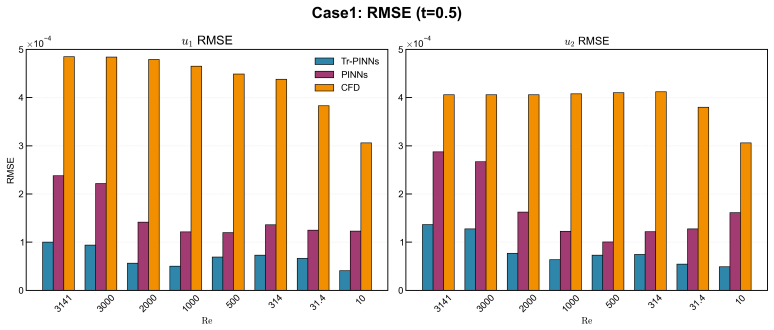
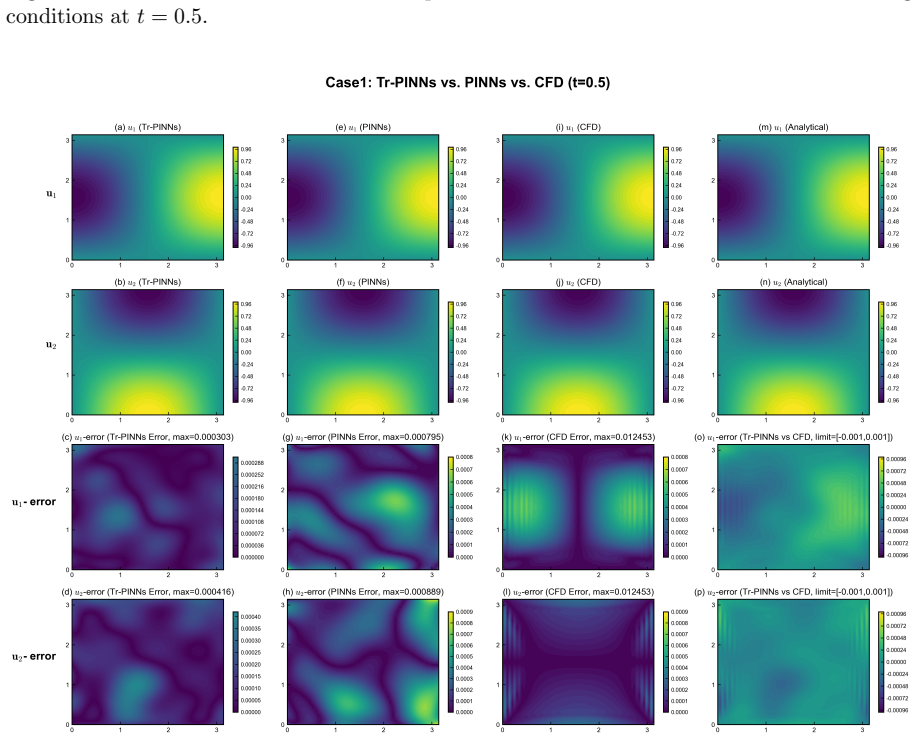
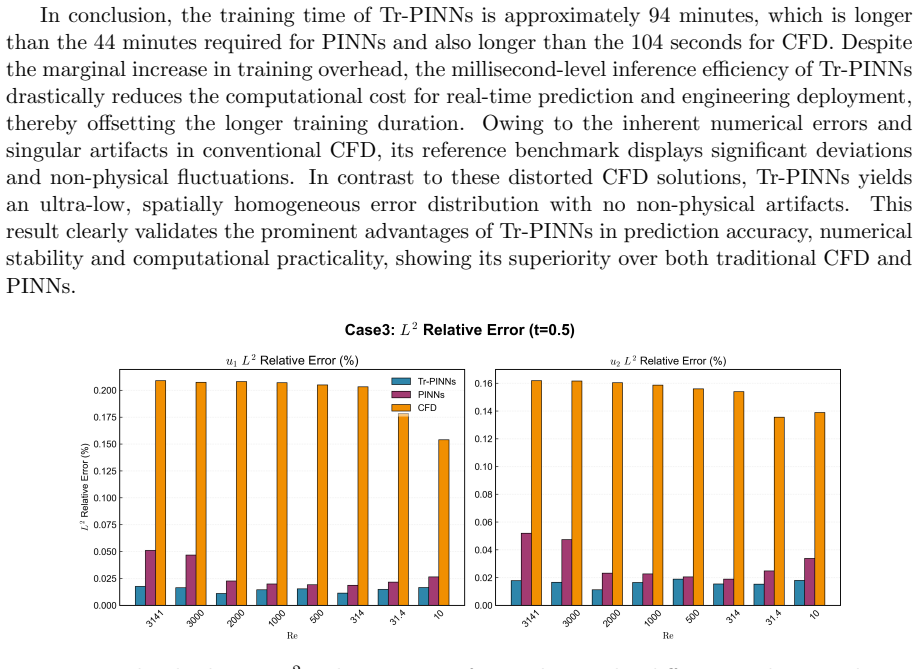
- Numerical tests show improved accuracy on specific 2D incompressible flow problems with non-homogeneous boundaries.
Where Pith is reading between the lines
- This correction approach may extend to other physics-informed neural network applications involving complex boundary conditions.
- Similar boundary adjustments could be tested on time-dependent or three-dimensional Navier-Stokes problems.
Load-bearing premise
The error analysis from the nonhomogeneous Stokes problem applies without additional gaps to the nonlinear Navier-Stokes equations under the same boundary correction.
What would settle it
A direct comparison of computed errors in Tr-PINNs versus standard PINNs on a Navier-Stokes problem where the Stokes-based error bounds predict a specific accuracy gain, but the observed gain differs substantially.
Figures





read the original abstract
Physics-informed neural networks (PINNs) have been widely applied to solve Navier-Stokes equations by enforcing outputs and gradients of deep models to satisfy target equations. However, conventional PINNs only constrain the boundary terms by means of the $L^2$-norm when addressing the equations with non-homogeneous boundary conditions. This single constraint strategy may cause inaccurate boundary simulation, further resulting in the decline of prediction accuracy. To resolve this critical issue, this paper proposes an improved physics-informed neural network by correcting the error of the boundary value, which is called Tr-PINNs. Based on the results of nonhomogeneous Stokes problem, the algorithm error analysis of Tr-PINNs is established. The efficacy of the Tr-PINNs algorithm is demonstrated via numerical experiments, which further demonstrate that the Tr-PINNs algorithm achieves a remarkable improvement in computational accuracy.
Editorial analysis
A structured set of objections, weighed in public.
Referee Report
Summary. The manuscript introduces Tr-PINNs, a boundary-error-corrected variant of physics-informed neural networks for the 2D incompressible Navier-Stokes equations with non-homogeneous boundary conditions. It asserts that an error analysis is established by transferring results from the nonhomogeneous Stokes problem and that numerical experiments confirm a remarkable improvement in accuracy over standard PINNs.
Significance. If the claimed error analysis can be made rigorous for the nonlinear system, the work would supply a concrete theoretical handle on boundary enforcement in PINNs for fluid problems, addressing a documented practical weakness of the standard L2-boundary penalty approach.
major comments (1)
- [Abstract] Abstract: the error analysis is stated to rest on 'the results of nonhomogeneous Stokes problem.' The full Navier-Stokes system contains the convective term (u·∇)u, which is absent from the linear Stokes problem. No explicit small-data assumption, a-priori bound, or fixed-point argument is referenced that would absorb this term once the neural-network approximation and boundary correction are introduced. Because the central claim is the establishment of error analysis for the NS equations, this transfer step is load-bearing.
minor comments (1)
- The abstract would be clearer if it stated the precise form of the error bound obtained (e.g., in which norm and under what regularity assumptions on the data).
Simulated Author's Rebuttal
We thank the referee for the careful reading and the important observation on the rigor of the error analysis. We address the comment below and will revise the manuscript to strengthen the presentation.
read point-by-point responses
-
Referee: [Abstract] Abstract: the error analysis is stated to rest on 'the results of nonhomogeneous Stokes problem.' The full Navier-Stokes system contains the convective term (u·∇)u, which is absent from the linear Stokes problem. No explicit small-data assumption, a-priori bound, or fixed-point argument is referenced that would absorb this term once the neural-network approximation and boundary correction are introduced. Because the central claim is the establishment of error analysis for the NS equations, this transfer step is load-bearing.
Authors: We agree that the transfer of error estimates from the linear non-homogeneous Stokes problem to the nonlinear Navier-Stokes equations requires explicit justification to control the convective term. The current manuscript states the analysis is based on Stokes results but does not detail the small-data assumption or fixed-point argument needed for the nonlinear case. In the revised version we will add this justification, including the precise small-data regime and the fixed-point construction that absorbs the nonlinear contribution after the boundary correction is applied, thereby making the central claim fully rigorous. revision: yes
Circularity Check
No significant circularity in derivation chain
full rationale
The paper derives its error analysis for Tr-PINNs explicitly from prior results on the nonhomogeneous Stokes problem and validates performance via separate numerical experiments. No equations, parameters, or claims reduce by construction to fitted inputs or self-referential definitions; no load-bearing self-citations or uniqueness theorems imported from the authors' prior work appear in the provided text. The central accuracy claim rests on external Stokes analysis plus empirical tests, making the derivation self-contained against the listed circularity patterns.
Axiom & Free-Parameter Ledger
axioms (1)
- domain assumption Error analysis of Tr-PINNs is established based on results of the nonhomogeneous Stokes problem
Reference graph
Works this paper leans on
-
[1]
Using Physics-Informed Neural Networks for Solving Navier-Stokes Equations in Fluid Dynamic Complex Scenarios
Tommaso Botarelli, Marco Fanfani, Paolo Nesi, Lorenzo Pinelli. Using Physics-Informed Neural Networks for Solving Navier-Stokes Equations in Fluid Dynamic Complex Scenarios. Engineering applications of artificial intelligence 148 (2025): 110347
2025
-
[2]
Physics Informed Neural Network with Fourier Feature for Natural Convection Problems
Younes Bounnah, Mustapha Kamel Mihoubi, Salah Larbi. Physics Informed Neural Network with Fourier Feature for Natural Convection Problems. Engineering applications of artificial intelligence 146 (2025): 110327
2025
-
[3]
Error Estimates for Deep Learning Methods in Fluid Dynamics
Animikh Biswas, Jing Tian, S¨ uleyman Ulusoy. “Error Estimates for Deep Learning Methods in Fluid Dynamics.” Numerische Mathematik 151.3 (2022): 753–777
2022
-
[4]
Monte Carlo Methods
Adrian Barbu, Song-Chun Zhu. Monte Carlo Methods. Springer Singapore, 2020
2020
-
[5]
Physics-Informed Neural Networks for Fluid Mechanics: A Review
Shengze Cai, Zhiping Mao, Zhicheng Wang, Minglang Yin, George Em Karniadakis. Physics-Informed Neural Networks for Fluid Mechanics: A Review. Acta mechanica Sinica 37.12 (2021): 1727–1738
2021
-
[6]
Error estimates for physics-informed neural networks approximating the Navier–Stokes equations
Tim De Ryck, Ameya D Jagtap, Siddhartha Mishra. Error estimates for physics-informed neural networks approximating the Navier–Stokes equations. IMA journal of numerical analysis 44.1 (2024): 83–119
2024
-
[7]
Numerical Analysis of Physics-Informed Neural Net- works and Related Models in Physics-Informed Machine Learning
Tim De Ryck, Siddhartha Mishra. Numerical Analysis of Physics-Informed Neural Net- works and Related Models in Physics-Informed Machine Learning. Acta numerica 33 (2024): 633–713
2024
-
[8]
Galdi.An Introduction to the Mathematical Theory of the Navier-Stokes Equa- tions: Volume I: Linearised Steady Problems, Revised ed., Vol
Giovanni P. Galdi.An Introduction to the Mathematical Theory of the Navier-Stokes Equa- tions: Volume I: Linearised Steady Problems, Revised ed., Vol. 38, New York, NY: Springer New York, 1998
1998
-
[9]
Advances in Physics-Informed Neural Networks for Solving Complex Partial Differential Equations and Their Engineering Ap- plications: A Systematic Review
Jiangtao Guo, Hao Zhu, Yujie Yang, Chenrui Guo. Advances in Physics-Informed Neural Networks for Solving Complex Partial Differential Equations and Their Engineering Ap- plications: A Systematic Review. Engineering Applications of Artificial Intelligence 161 (2025): 112044
2025
-
[10]
NSFnets (Navier-Stokes Flow Nets): Physics-Informed Neural Networks for the Incompressible Navier-Stokes Equations
Xiaowei Jin, Shengze Cai, Hui Li, George Em Karniadakis. NSFnets (Navier-Stokes Flow Nets): Physics-Informed Neural Networks for the Incompressible Navier-Stokes Equations. Journal of computational physics 426 (2021): 109951. 21
2021
-
[11]
Physics-Informed Neural Networks with Trainable Sinusoidal Activation Functions for Approximating the Solutions of the Navier-Stokes Equa- tions
Amirhossein Khademi, Steven Dufour. Physics-Informed Neural Networks with Trainable Sinusoidal Activation Functions for Approximating the Solutions of the Navier-Stokes Equa- tions. Computer physics communications 314 (2025): 109672
2025
-
[12]
Kevrekidis, Lu Lu et al
George Em Karniadakis, Ioannis G. Kevrekidis, Lu Lu et al. Physics-informed machine learning. Nature reviews physics 3.6 (2021): 422–440
2021
-
[13]
Error Bounds for Physics-Informed Neural Networks in Fokker-Planck PDEs
Chun-Wei Kong, Luca Laurenti, Jay McMahon, Morteza Lahijanian. Error Bounds for Physics-Informed Neural Networks in Fokker-Planck PDEs. Proceedings of the 41st Con- ference on Uncertainty in Artificial Intelligence 286 (2025): 2291–2301
2025
-
[14]
VS-PINN: A Fast and Efficient Training of Physics- Informed Neural Networks Using Variable-Scaling Methods for Solving PDEs with Stiff Behavior
Seungchan Ko, Sanghyeon Park. VS-PINN: A Fast and Efficient Training of Physics- Informed Neural Networks Using Variable-Scaling Methods for Solving PDEs with Stiff Behavior. Journal of computational physics 529 (2025): 113860
2025
-
[15]
Lions, Quelques M´ ethodes de R´ esolution des Probl´ emes aux Limites Non Lin´ eaires, Dunod, Gauthier-Villars, Paris, 1969
J.-L. Lions, Quelques M´ ethodes de R´ esolution des Probl´ emes aux Limites Non Lin´ eaires, Dunod, Gauthier-Villars, Paris, 1969
1969
-
[16]
Physics-Informed Neural Networks for Solving Forward and Inverse Flow Problems via the Boltzmann-BGK Formulation
Qin Lou, Xuhui Meng, George Em Karniadakis. Physics-Informed Neural Networks for Solving Forward and Inverse Flow Problems via the Boltzmann-BGK Formulation. Journal of computational physics 447 (2021): 110676
2021
-
[17]
Estimates on the Generalization Error of Physics- Informed Neural Networks for Approximating PDEs
Siddhartha Mishra, Roberto Molinaro. Estimates on the Generalization Error of Physics- Informed Neural Networks for Approximating PDEs. IMA journal of numerical analysis 43.1 (2023): 1–43
2023
-
[18]
Gosselin
Ga´ etan Raynaud, S´ ebastien Houde, Fr´ ed´ erick P. Gosselin. ModalPINN: An Extension of Physics-Informed Neural Networks with Enforced Truncated Fourier Decomposition for Periodic Flow Reconstruction Using a Limited Number of Imperfect Sensors. Journal of computational physics 464 (2022): 111271
2022
-
[19]
Stokes and Navier–Stokes Equations with Nonhomogeneous Boundary Conditions
Jean-Paul Raymond. Stokes and Navier–Stokes Equations with Nonhomogeneous Boundary Conditions. Annales de l’Institut Henri Poincar´ e. Analyse non lin´ eaire 24.6 (2007): 921–951
2007
-
[20]
Physics-Informed Neural Net- works: A Deep Learning Framework for Solving Forward and Inverse Problems Involv- ing Nonlinear Partial Differential Equations
Maziar Raissi, Paris Perdikaris, George Em Karniadakis. Physics-Informed Neural Net- works: A Deep Learning Framework for Solving Forward and Inverse Problems Involv- ing Nonlinear Partial Differential Equations. Journal of computational physics 378 (2019): 686–707
2019
-
[21]
On the Convergence and gener- alization of Physics Informed Neural Networks
Yeonjong Shin, J´ erˆ ome Darbon, George Em Karniadakis. On the Convergence and gener- alization of Physics Informed Neural Networks. ArXiv abs/2004.01806 (2020): n. pag
-
[22]
Ardekani
Sukirt Thakur, Maziar Raissi, Harsa Mitra, Arezoo M. Ardekani. Temporal consistency loss for physics-informed neural networks. Physics of Fluids 1 July 2024; 36 (7): 077136
2024
-
[23]
Physics Informed RNN-DCT Networks for Time-Dependent Partial Differential Equations
Benjamin Wu, Oliver Hennigh, Jan Kautz, Sanjay Choudhry, Wonmin Byeon. Physics Informed RNN-DCT Networks for Time-Dependent Partial Differential Equations. Com- putational Science, ICCS 2022, PT II. Vol. 13351. Switzerland: Springer International Publishing AG, 2022. 372–379
2022
-
[24]
RoPINN: Region Optimized Physics-Informed Neural Networks
Haixu Wu, Huakun Luo, Yuezhou Ma, Jianmin Wang, Mingsheng Long. RoPINN: Region Optimized Physics-Informed Neural Networks. Advances in Neural Information Processing Systems (NeurIPS 2024) vol. 37, 2024. 22
2024
-
[25]
When and Why PINNs Fail to Train: A Neural Tangent Kernel Perspective
Sifan Wang, Xinling Yu, Paris Perdikaris. When and Why PINNs Fail to Train: A Neural Tangent Kernel Perspective. Journal of computational physics 449 (2022): 110768
2022
-
[26]
Physics-Informed Neural Networks for the Reynolds-Averaged Navier–Stokes Modeling of Rayleigh-Taylor Turbulent Mixing
Meng-Juan Xiao, Teng-Chao Yu, You-Sheng Zhang, Heng Yong. Physics-Informed Neural Networks for the Reynolds-Averaged Navier–Stokes Modeling of Rayleigh-Taylor Turbulent Mixing. Computers & fluids 266 (2023): 106025. 23
2023
discussion (0)
Sign in with ORCID, Apple, or X to comment. Anyone can read and Pith papers without signing in.