Attitude-Aided Linear Calibration of Triaxial Accelerometers
Pith reviewed 2026-06-28 00:52 UTC · model grok-4.3
The pith
Attitude data turns accelerometer calibration into a closed-form linear least-squares problem solvable with five measurements.
A machine-rendered reading of the paper's core claim, the machinery that carries it, and where it could break.
Core claim
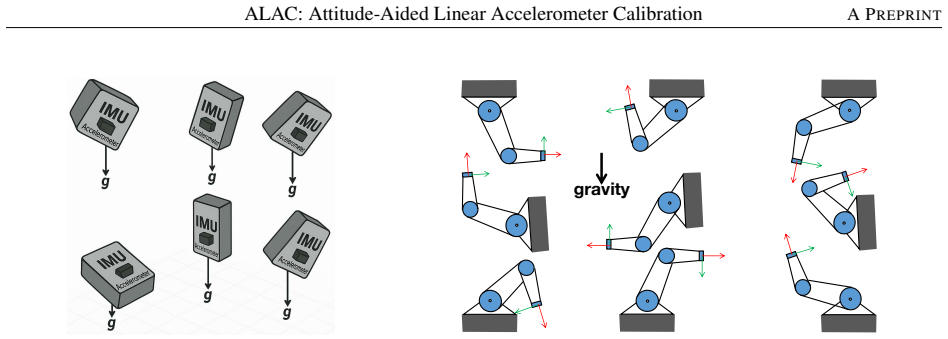
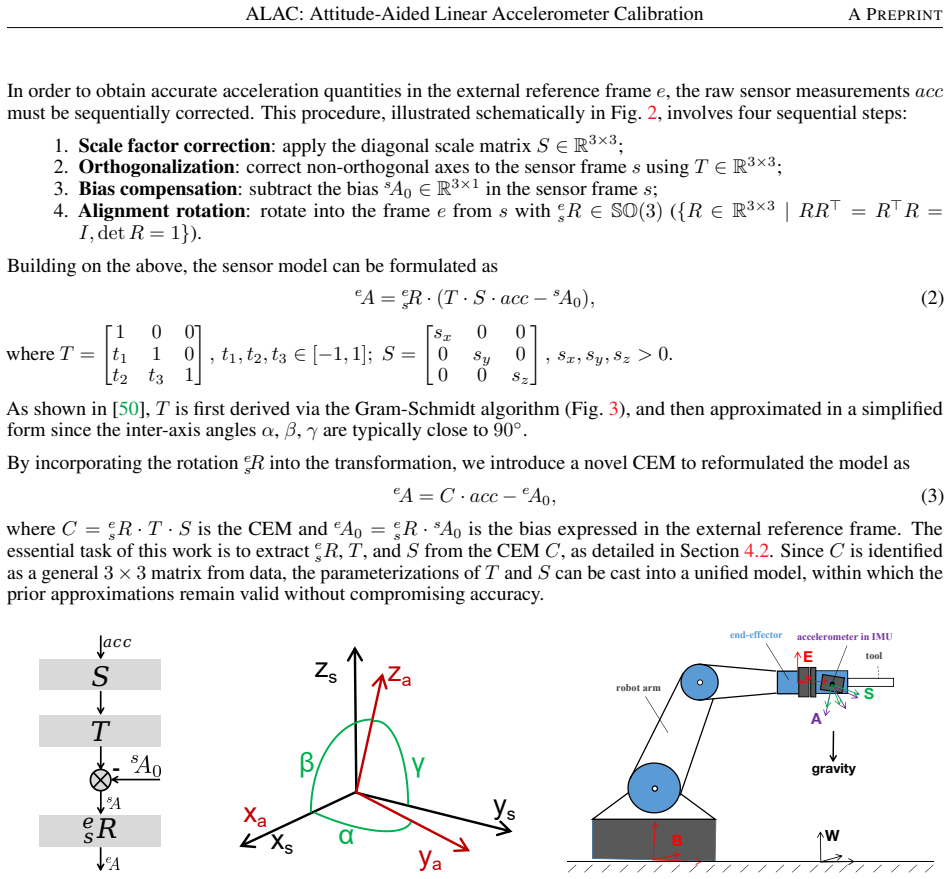
ALAC constructs a combined error matrix (CEM) to represent sensor errors in a unified calibration model and enables linear least-squares estimation. The bias and gravity vector are jointly estimated, implicitly accounting for platform misalignment, and matrix decomposition of the CEM recovers scale, non-orthogonality, and alignment rotation parameters. Under static gravity, calibration is formulated as a constrained homogeneous least-squares (CHLS) problem and solved in closed form using standard linear algebra. Only five arbitrarily oriented measurements are required.
What carries the argument
The combined error matrix (CEM) that unifies all sensor errors for linear estimation, together with the constrained homogeneous least-squares (CHLS) formulation solved under static gravity.
If this is right
- Calibration becomes feasible on any platform that already supplies orientation, such as robotic arms or IMUs, without dedicated reference equipment.
- The recursive extension supports continuous in-field recalibration during quasi-static operation.
- Joint estimation of bias and gravity removes the need for separate misalignment correction steps.
- Performance holds on raw unfiltered measurements where iterative methods degrade.
Where Pith is reading between the lines
- The linear formulation could be embedded directly inside existing Kalman-filter sensor-fusion pipelines without iteration overhead.
- Relaxing the static-gravity assumption to slowly varying gravity would require only a modest change to the constraint set.
- The same CEM construction might generalize to magnetometer or gyroscope calibration when attitude references are present.
Load-bearing premise
Accurate external attitude information must be available and all measurements must occur under truly static gravity so the gravity vector can be treated as a single constant unknown.
What would settle it
Collect a new set of five static accelerometer readings with known high-precision attitude and compare the ALAC-derived scale, misalignment, and bias parameters against those obtained from a full nonlinear batch optimizer on the same raw data; a statistically significant difference in residual gravity norm error would falsify the closed-form claim.
Figures
read the original abstract
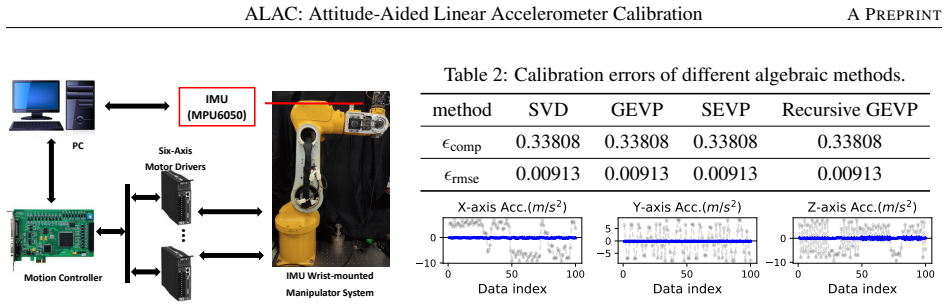
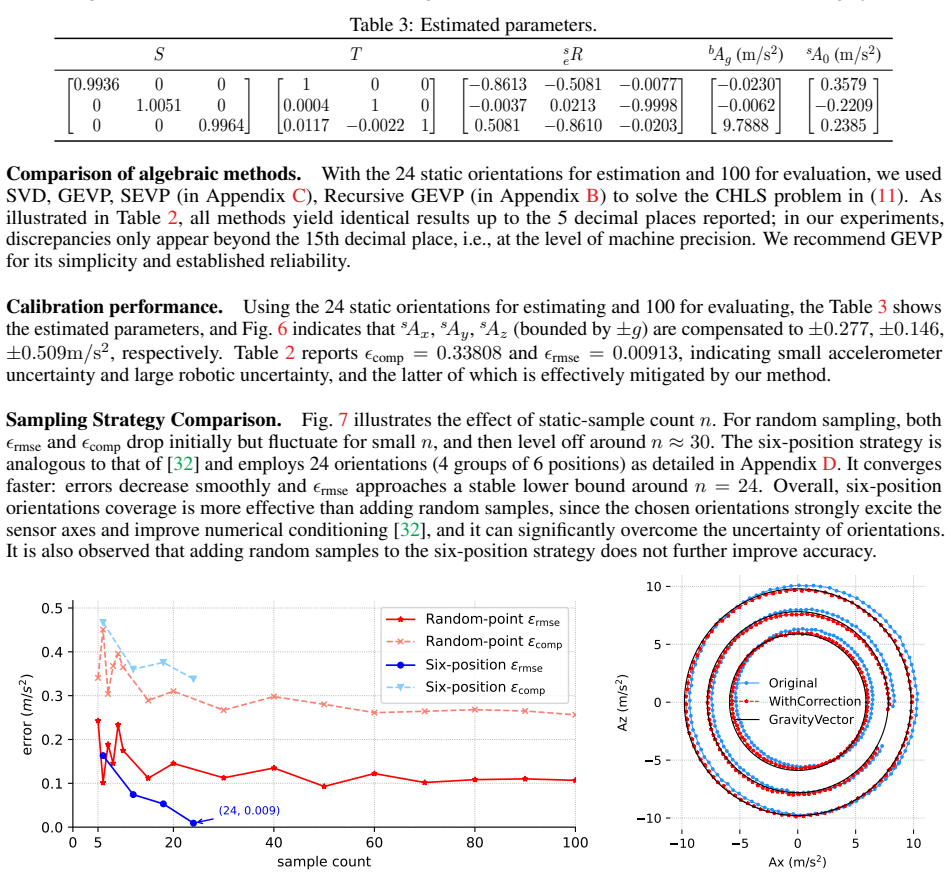
Triaxial MEMS accelerometers are widely used for inertial sensing, navigation, and sensor fusion, but existing calibration methods often rely on costly reference setups or nonlinear iterative optimization, limiting their efficiency and applicability to low-cost or self-calibrating systems. We present attitude-aided linear accelerometer calibration (ALAC), a method that operates on any platform providing orientation information, such as turntables, robotic arms, or inertial measurement units. ALAC constructs a combined error matrix (CEM) to represent sensor errors in a unified calibration model and enables linear least-squares estimation. The bias and gravity vector are jointly estimated, implicitly accounting for platform misalignment, and matrix decomposition of the CEM recovers scale, non-orthogonality, and alignment rotation parameters. Under static gravity, calibration is formulated as a constrained homogeneous least-squares (CHLS) problem and solved in closed form using standard linear algebra. Only five arbitrarily oriented measurements are required, and a recursive extension supports online or in-field calibration. Experiments on a stationary robot-mounted accelerometer and a quasi-static public IMU trajectory show that ALAC, in both offline and online modes, outperforms reference-based and online baselines in accuracy and robustness to sensor noise. On the same dataset, it matches iterative self-calibration under filtered conditions and surpasses all evaluated baselines on raw measurements. These results demonstrate a robust and practical calibration scheme for MEMS-based inertial platforms, especially low-cost IMUs and online calibration scenarios.
Editorial analysis
A structured set of objections, weighed in public.
Referee Report
Summary. The manuscript introduces Attitude-Aided Linear Accelerometer Calibration (ALAC), which constructs a Combined Error Matrix (CEM) to unify sensor error modeling for triaxial accelerometers and formulates calibration under static gravity as a constrained homogeneous least-squares (CHLS) problem solved in closed form via standard linear algebra. It requires only five arbitrarily oriented measurements, jointly estimates bias and gravity (implicitly handling misalignment), recovers scale/non-orthogonality/alignment via matrix decomposition, and provides a recursive online extension; experiments on a stationary robot-mounted accelerometer and a quasi-static public IMU trajectory claim outperformance over reference-based and online baselines in accuracy and noise robustness, matching iterative self-calibration under filtered conditions.
Significance. If the closed-form CHLS solution and minimal-measurement claim hold under the stated assumptions, the method offers an efficient linear alternative to nonlinear iterative calibration for MEMS IMUs on platforms supplying attitude (turntables, robotic arms, or IMUs), with the recursive extension enabling online use; the explicit construction of CEM and use of standard linear algebra for the homogeneous problem are strengths that could improve practicality for low-cost systems.
major comments (2)
- [Experiments] The CHLS formulation (min ||CEM · [g; 1]|| s.t. ||g||=1) treats attitude R as error-free and gravity as strictly constant across the five poses; the experiments section provides no sensitivity study or noise injection on R, leaving open whether attitude errors are absorbed into the recovered scale and non-orthogonality terms and thereby undermining the claim that five measurements suffice for accurate recovery.
- [Method (recursive extension)] The recursive online extension is presented as supporting in-field calibration, yet no analysis quantifies how deviations from the static-gravity assumption (e.g., platform dynamics or time-varying g) propagate into the CEM and bias the linear estimator.
minor comments (1)
- [Abstract] The abstract asserts outperformance without naming the quantitative error metrics (e.g., RMSE on scale factors or alignment angles) used in the comparisons; adding one sentence would improve clarity.
Simulated Author's Rebuttal
Thank you for the opportunity to respond to the referee's comments. We address each major comment below with clarifications based on the manuscript's assumptions and content, and indicate revisions where the points identify gaps.
read point-by-point responses
-
Referee: [Experiments] The CHLS formulation (min ||CEM · [g; 1]|| s.t. ||g||=1) treats attitude R as error-free and gravity as strictly constant across the five poses; the experiments section provides no sensitivity study or noise injection on R, leaving open whether attitude errors are absorbed into the recovered scale and non-orthogonality terms and thereby undermining the claim that five measurements suffice for accurate recovery.
Authors: The CHLS formulation in Sections 3–4 explicitly assumes error-free attitude R (provided by the platform) and constant g across poses, consistent with the attitude-aided setting. Experiments in Section 5 use a stationary robot mount and quasi-static trajectory satisfying these conditions. We agree that no sensitivity analysis to R noise is present, which leaves unquantified whether such errors are absorbed into scale/non-orthogonality estimates. We will add a sensitivity study in the revision by injecting controlled noise into R and reporting effects on parameter recovery and the five-measurement claim. revision: yes
-
Referee: [Method (recursive extension)] The recursive online extension is presented as supporting in-field calibration, yet no analysis quantifies how deviations from the static-gravity assumption (e.g., platform dynamics or time-varying g) propagate into the CEM and bias the linear estimator.
Authors: The recursive extension in Section 4.3 is derived directly from the batch CHLS solution under the static-gravity assumption and is evaluated on quasi-static data. We acknowledge the lack of explicit propagation analysis for dynamic deviations or time-varying g. In revision we will expand the discussion to clarify applicability limits to quasi-static conditions and note potential bias under dynamics, while preserving the original claims under the stated assumptions. revision: partial
Circularity Check
No significant circularity; derivation applies standard linear algebra to external attitude inputs.
full rationale
The ALAC method constructs a combined error matrix from known attitude R and measured acceleration, then solves the CHLS problem min ||CEM * [g; 1]|| subject to ||g||=1 in closed form. This is a direct application of linear algebra under the stated assumptions of accurate external attitude and static gravity; the recovered parameters (scale, bias, etc.) are not defined in terms of themselves, nor is any prediction fitted to a subset and renamed. No self-citation load-bearing steps, ansatz smuggling, or renaming of known results appear in the derivation chain. The approach is self-contained against the external benchmarks of attitude data and gravity constancy.
Axiom & Free-Parameter Ledger
axioms (2)
- domain assumption Platform provides accurate orientation information
- domain assumption Measurements taken under static gravity
invented entities (1)
-
Combined Error Matrix (CEM)
no independent evidence
Reference graph
Works this paper leans on
-
[1]
Norhafizan Ahmad, Raja Ariffin Raja Ghazilla, Nazirah M. Khairi, and Vijayabaskar Kasi. Reviews on various inertial measurement unit (imu) sensor applications.International Journal of Signal Processing Systems, 1(2): 256–262, December 2013. doi:10.12720/ijsps.1.2.256-262
-
[2]
William Johnston, Martin O’Reilly, Rob Argent, and Brian Caulfield. Reliability, validity and utility of inertial sensor systems for postural control assessment in sport science and medicine applications: A systematic review. Sports Medicine, 49(5):783–818, 2019. doi:10.1007/s40279-019-01095-9
-
[3]
Navigation grade mems imu for a satellite.Micromachines, 12(2), 2021
Wanliang Zhao, Yuxiang Cheng, Sihan Zhao, Xiaomao Hu, Yijie Rong, Jie Duan, and Jiawei Chen. Navigation grade mems imu for a satellite.Micromachines, 12(2), 2021. doi:10.3390/mi12020151. 10 ALAC: Attitude-Aided Linear Accelerometer CalibrationA PREPRINT
-
[4]
Mei Liu, Yuanli Cai, Lihao Zhang, and Yiqun Wang. Attitude estimation algorithm of portable mobile robot based on complementary filter.Micromachines, 12(11), 2021. doi:10.3390/mi12111373
-
[5]
Khaula Nurul Hakim, Yuniarto Wimbo Nugroho, Kandi Rahardiyanti, Mirza Zulfikar Rahmat, and Bagus Wicaksono. Leveraging a robotic arm platform for low-cost calibration of inertial sensors on lapan sounding rockets.International Journal on Advanced Science, Engineering and Information Technology, 15(2):456–463, April 2025. doi:10.18517/ijaseit.15.2.20593
-
[6]
Xu Ru, Nian Gu, Hang Shang, and Heng Zhang. Mems inertial sensor calibration technology: Current status and future trends.Micromachines, 13(6), 2022. doi:10.3390/mi13060879
-
[7]
Aparna Harindranath and Manish Arora. A systematic review of user - conducted calibration methods for mems-based imus.Measurement, 225:114001, 2024. doi:10.1016/j.measurement.2023.114001
-
[8]
Jan Rohac, Martin Sipos, and Jiri Simanek. Calibration of low-cost triaxial inertial sensors.IEEE Instrumentation & Measurement Magazine, 18(6):32–38, 2015. doi:10.1109/MIM.2015.7335836
-
[9]
Ravankar, Yukinori Kobayashi, and Takanori Emaru
Jixin Lv, Ankit A. Ravankar, Yukinori Kobayashi, and Takanori Emaru. A method of low-cost imu calibration and alignment. In2016 IEEE/SICE International Symposium on System Integration (SII), pages 373–378, 2016. doi:10.1109/SII.2016.7844027
-
[10]
An algorithm for the in-field calibration of a mems imu.IEEE Sensors Journal, 17(22):7479–7486, 2017
Umar Qureshi and Farid Golnaraghi. An algorithm for the in-field calibration of a mems imu.IEEE Sensors Journal, 17(22):7479–7486, 2017. doi:10.1109/JSEN.2017.2751572
-
[11]
An onsite calibration method for mems-imu in building mapping fields.Sensors, 19(19), 2019
Sen Li, Yunchen Niu, Chunyong Feng, Haiqiang Liu, Dan Zhang, and Hengjie Qin. An onsite calibration method for mems-imu in building mapping fields.Sensors, 19(19), 2019. doi:10.3390/s19194150
-
[12]
Analyses of triaxial accelerometer calibration algorithms
Martin Sipos, Pavel Paces, Jan Rohac, and Petr Novacek. Analyses of triaxial accelerometer calibration algorithms. IEEE Sensors Journal, 12(5):1157–1165, 2012. doi:10.1109/JSEN.2011.2167319
-
[13]
A robust and easy to implement method for imu calibration without external equipments
David Tedaldi, Alberto Pretto, and Emanuele Menegatti. A robust and easy to implement method for imu calibration without external equipments. In2014 IEEE International Conference on Robotics and Automation (ICRA), pages 3042–3049, 2014. doi:10.1109/ICRA.2014.6907297
-
[14]
Iuri Frosio, Federico Pedersini, and N. Alberto Borghese. Autocalibration of triaxial mems accelerometers with au- tomatic sensor model selection.IEEE Sensors Journal, 12(6):2100–2108, 2012. doi:10.1109/JSEN.2012.2182991
-
[15]
Oliver Dürr, Po-Yu Fan, and Zong-Xian Yin. Bayesian calibration of mems accelerometers.IEEE Sensors Journal, 23(12):13319–13326, 2023. doi:10.1109/JSEN.2023.3272907
-
[16]
Scale-free pso for in-run and infield inertial sensor calibration.Measurement, 147:106849, 2019
Shashi Poddar and Amod Kumar. Scale-free pso for in-run and infield inertial sensor calibration.Measurement, 147:106849, 2019. doi:10.1016/j.measurement.2019.07.077
-
[17]
Particle swarm optimization aided calibration of sensor installation errors for mems accelerometers
Richard Pesti, Peter Sarcevic, Dominik Csík, and Ákos Odry. Particle swarm optimization aided calibration of sensor installation errors for mems accelerometers. In2023 IEEE 17th International Symposium on Applied Com- putational Intelligence and Informatics (SACI), pages 493–498, 2023. doi:10.1109/SACI58269.2023.10158655
-
[18]
Soriano, Faheem Khan, and Rafiq Ahmad
Mario A. Soriano, Faheem Khan, and Rafiq Ahmad. Two-axis accelerometer calibration and nonlinear correction using neural networks: Design, optimization, and experimental evaluation.IEEE Transactions on Instrumentation and Measurement, 69(9):6787–6794, 2020. doi:10.1109/TIM.2020.2978568
-
[19]
Adaptive neuro fuzzy inference system- based error compensation for mems accelerometers
Richard Pesti, Peter Sarcevic, Dominik Csík, Marta Takacs, and Ákos Odry. Adaptive neuro fuzzy inference system- based error compensation for mems accelerometers. In2025 IEEE 19th International Symposium on Applied Computational Intelligence and Informatics (SACI), pages 1–6, 2025. doi:10.1109/SACI66288.2025.11030088
-
[20]
Shashi Poddar, Vipan Kumar, and Amod Kumar. A comprehensive overview of inertial sensor calibration tech- niques.Journal of Dynamic Systems, Measurement, and Control, 139(1):011006, 09 2016. doi:10.1115/1.4034419
-
[21]
Juan Botero-Valencia, David Marquez-Viloria, Luis Castano-Londono, and Luis Morantes-Guzmán. A low-cost platform based on a robotic arm for parameters estimation of inertial measurement units.Measurement, 110: 257–262, 2017. doi:10.1016/j.measurement.2017.07.002
-
[22]
Qingzhong Cai, Ningfang Song, Gongliu Yang, and Yiliang Liu. Accelerometer calibration with nonlinear scale factor based on multi-position observation.Measurement Science and Technology, 24(10):105002, aug 2013. doi:10.1088/0957-0233/24/10/105002
-
[23]
Seong-hoon Peter Won and Farid Golnaraghi. A triaxial accelerometer calibration method using a mathematical model.IEEE Transactions on Instrumentation and Measurement, 59(8):2144–2153, 2010. doi:10.1109/TIM.2009.2031849
-
[24]
Lin Ye, Ying Guo, and Steven W. Su. An efficient autocalibration method for triaxial accelerometer.IEEE Transactions on Instrumentation and Measurement, 66(9):2380–2390, 2017. doi:10.1109/TIM.2017.2706479. 11 ALAC: Attitude-Aided Linear Accelerometer CalibrationA PREPRINT
-
[25]
Matthias Gietzelt, Klaus-Hendrik Wolf, Michael Marschollek, and Reinhold Haux. Performance comparison of accelerometer calibration algorithms based on 3d-ellipsoid fitting methods.Computer Methods and Programs in Biomedicine, 111(1):62–71, 2013. doi:10.1016/j.cmpb.2013.03.006
-
[26]
An optimal calibration method for a mems inertial measurement unit
Bin Fang, Wusheng Chou, and Li Ding. An optimal calibration method for a mems inertial measurement unit. International Journal of Advanced Robotic Systems, 11(2):14, 2014. doi:10.5772/57516
-
[27]
Mems-imu automatic calibration system design and implementation
Jingxiao Wang and Ning Liu. Mems-imu automatic calibration system design and implementation. InJournal of Physics: Conference Series, volume 2492, page 012005, 2023. doi:10.1088/1742-6596/2492/1/012005
-
[28]
Alberto Cina, Ambrogio Maria Manzino, and Iosif Horea Bendea. Improving gnss landslide monitoring with the use of low-cost mems accelerometers.Applied Sciences, 9(23), 2019. doi:10.3390/app9235075
-
[29]
E.L. Renk, M. Rizzo, W. Collins, F. Lee, and D.S. Bernstein. Calibrating a triaxial accelerometer-magnetometer - using robotic actuation for sensor reorientation during data collection.IEEE Control Systems Magazine, 25(6): 86–95, 2005. doi:10.1109/MCS.2005.1550155
-
[30]
Tadej Beravs, Janez Podobnik, and Marko Munih. Three-axial accelerometer calibration using kalman filter covariance matrix for online estimation of optimal sensor orientation.IEEE Transactions on Instrumentation and Measurement, 61(9):2501–2511, 2012. doi:10.1109/TIM.2012.2187360
-
[31]
Mingjie Dong, Guodong Yao, Jianfeng Li, and Leiyu Zhang. Calibration of low cost imu’s inertial sen- sors for improved attitude estimation.Journal of Intelligent & Robotic Systems, 100(3):1015–1029, 2020. doi:10.1007/s10846-020-01259-0
-
[32]
Tongxu Xu, Xiang Xu, Dacheng Xu, and Heming Zhao. A novel calibration method using six positions for mems triaxial accelerometer.IEEE Transactions on Instrumentation and Measurement, 70:1–11, 2021. doi:10.1109/TIM.2020.3026024
-
[33]
Total least squares in-field identification for mems-based triaxial accelerometers
Massimo Duchi, Federico Zaccaria, Sébastien Briot, and Edoardo Ida’. Total least squares in-field identification for mems-based triaxial accelerometers. In Masafumi Okada, editor,Advances in Mechanism and Machine Science, pages 570–579, Cham, 2023. Springer Nature Switzerland. doi:10.1007/978-3-031-45770-8_57
-
[34]
Fethi Belkhouche. A differential accelerometer system: Offline calibration and state estimation.IEEE Transactions on Instrumentation and Measurement, 68(9):3109–3118, 2019. doi:10.1109/TIM.2018.2876776
-
[35]
A new calibration method of mems imu plus fog imu.IEEE Sensors Journal, 22(9):8728–8737, 2022
Jiazhen Lu, Lili Ye, Jingxian Zhang, Wei Luo, and Haiqiao Liu. A new calibration method of mems imu plus fog imu.IEEE Sensors Journal, 22(9):8728–8737, 2022. doi:10.1109/JSEN.2022.3160692
-
[36]
A. Kim and M.F. Golnaraghi. Initial calibration of an inertial measurement unit using an optical position tracking system. InPLANS 2004. Position Location and Navigation Symposium (IEEE Cat. No.04CH37556), pages 96–101, 2004. doi:10.1109/PLANS.2004.1308980
-
[37]
Dingjie Wang, Hanfeng Lv, and Jie Wu. Augmented cubature kalman filter for nonlinear rtk/mimu integrated navigation with non-additive noise.Measurement, 97:111–125, 2017. doi:10.1016/j.measurement.2016.10.056
-
[38]
Penghe Zhang, Craig Matthew Hancock, Lawrence Lau, Gethin Wyn Roberts, and Huib de Ligt. Low-cost imu and odometer tightly coupled integration with robust kalman filter for underground 3-d pipeline mapping. Measurement, 137:454–463, 2019. doi:10.1016/j.measurement.2019.01.068
-
[39]
Giancarlo Troni and Louis L. Whitcomb. Field sensor bias calibration with angular-rate sensors: Theory and experimental evaluation with application to magnetometer calibration.IEEE/ASME Transactions on Mechatronics, 24(4):1698–1710, 2019. doi:10.1109/TMECH.2019.2920367
-
[40]
Hussein Al Jlailaty, Abdulkadir Celik, Mohammad M. Mansour, and Ahmed M. Eltawil. Imu hand calibration for low-cost mems inertial sensors.IEEE Transactions on Instrumentation and Measurement, 72:1–16, 2023. doi:10.1109/TIM.2023.3301860
-
[41]
The Institution of Engineering and Technology, 2nd edition, 2004
David Titterton and John Weston.Strapdown Inertial Navigation Technology. The Institution of Engineering and Technology, 2nd edition, 2004. doi:10.1049/PBRA017E
-
[42]
Synaptic electronics: Materials, devices and applications,
Z F Syed, P Aggarwal, C Goodall, X Niu, and N El-Sheimy. A new multi-position calibration method for mems inertial navigation systems.Measurement Science and Technology, 18(7):1897, may 2007. doi:10.1088/0957- 0233/18/7/016
-
[43]
Tilt sensor with recalibration feature based on mems accelerometer.Sensors, 22(4), 2022
Sergiusz Łuczak, Maciej Zams, Bogdan D ˛ abrowski, and Zbigniew Kusznierewicz. Tilt sensor with recalibration feature based on mems accelerometer.Sensors, 22(4), 2022. doi:10.3390/s22041504
-
[44]
Niklas Grip and Natalia Sabourova. Simple non-iterative calibration for triaxial accelerometers.Measurement Science and Technology, 22(12):125103, oct 2011. doi:10.1088/0957-0233/22/12/125103. 12 ALAC: Attitude-Aided Linear Accelerometer CalibrationA PREPRINT
-
[45]
Maximum likelihood approach for low-cost mems triaxial accelerometer calibration
Xin Lu, Zhong Liu, and Jingbo He. Maximum likelihood approach for low-cost mems triaxial accelerometer calibration. In2016 8th International Conference on Intelligent Human-Machine Systems and Cybernetics (IHMSC), volume 01, pages 179–182, 2016. doi:10.1109/IHMSC.2016.184
-
[46]
Zuhao Zou, Liang Li, Xiangcheng Hu, Yilong Zhu, Bohuan Xue, Jin Wu, and Ming Liu. Robust equipment-free calibration of low-cost inertial measurement units.IEEE Transactions on Instrumentation and Measurement, 73: 1–12, 2024. doi:10.1109/TIM.2023.3234081
-
[47]
A new calibration method for mems accelerometers with genetic algorithm
Xiaole Cui, Chunliang Liu, Guangyi Shi, and Yufeng Jin. A new calibration method for mems accelerometers with genetic algorithm. In2017 IEEE International Conference on Real-time Computing and Robotics (RCAR), pages 240–245, 2017. doi:10.1109/RCAR.2017.8311867
-
[48]
Cui Chao, Jiankang Zhao, Jianbin Zhu, and Nassim Bessaad. Minimum settings calibration method for low-cost tri-axial imu and magnetometer.Measurement Science and Technology, 33(2):025103, dec 2021. doi:10.1088/1361- 6501/ac3ec2
-
[49]
Massimo Duchi and Edoardo Ida’. Total least squares in-field identification for mems-based inertial measurement units.Robotics, 13(11), 2024. doi:10.3390/robotics13110156
-
[50]
David Jurman, Marko Jankovec, Roman Kamnik, and Marko Topi ˇc. Calibration and data fusion solution for the miniature attitude and heading reference system.Sensors and Actuators A: Physical, 138(2):411–420, 2007. doi:10.1016/j.sna.2007.05.008
-
[51]
Gene H. Golub and Charles F. Van Loan.Matrix Computations. Johns Hopkins University Press, Baltimore, MD, 4th edition, 2013. ISBN 978-1421407944. doi:10.56021/9781421407944
-
[52]
Cambridge University Press, Cambridge, UK,
Stephen Boyd and Lieven Vandenberghe.Convex Optimization. Cambridge University Press, Cambridge, UK,
-
[53]
URLhttps://web.stanford.edu/~boyd/cvxbook/
ISBN 978-0521833783. URLhttps://web.stanford.edu/~boyd/cvxbook/
-
[54]
0 0−1 0 +1 0 +1 0 0 # ,
Miguel Rasteiro. Imu dataset. https://github.com/miguelrasteiro/IMU_dataset, 2019. Accessed: 2025-10-03. A Derivation of the GEVP Consider the quadratic constrained quadratic program min x ∥ ¯Ax∥2 2 s.t.∥Dx∥ 2 2 = 1→min x x⊤Gxs.t.x ⊤Bx= 1,(27) withG= ¯A⊤ ¯A⪰0andB=D ⊤D⪰0. Applying the method of Lagrange multipliers, L(x, λ) =x ⊤Gx−λ(x ⊤Bx−1)(28) and the st...
2019
discussion (0)
Sign in with ORCID, Apple, or X to comment. Anyone can read and Pith papers without signing in.