Probing anomalous quartic gauge couplings in same-sign W boson scattering with polarization and spin correlation
Pith reviewed 2026-06-28 00:20 UTC · model grok-4.3
The pith
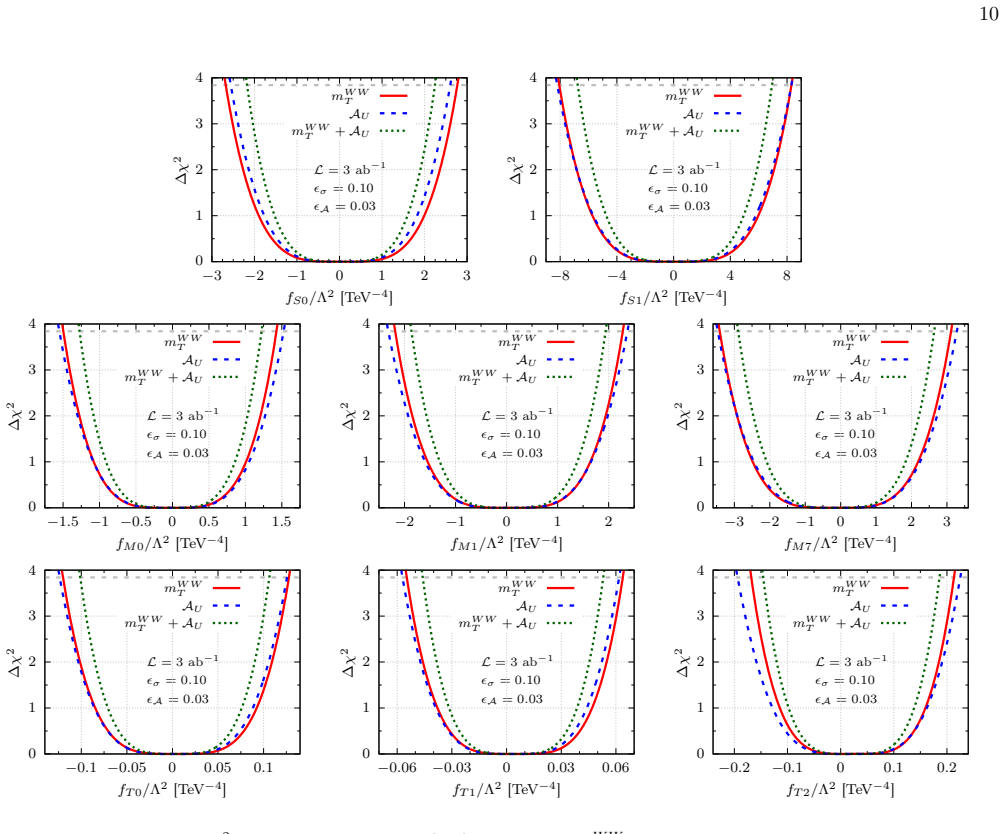
Spin-correlation asymmetries in same-sign W scattering match the sensitivity of transverse mass distributions for anomalous quartic gauge couplings.
A machine-rendered reading of the paper's core claim, the machinery that carries it, and where it could break.
Core claim
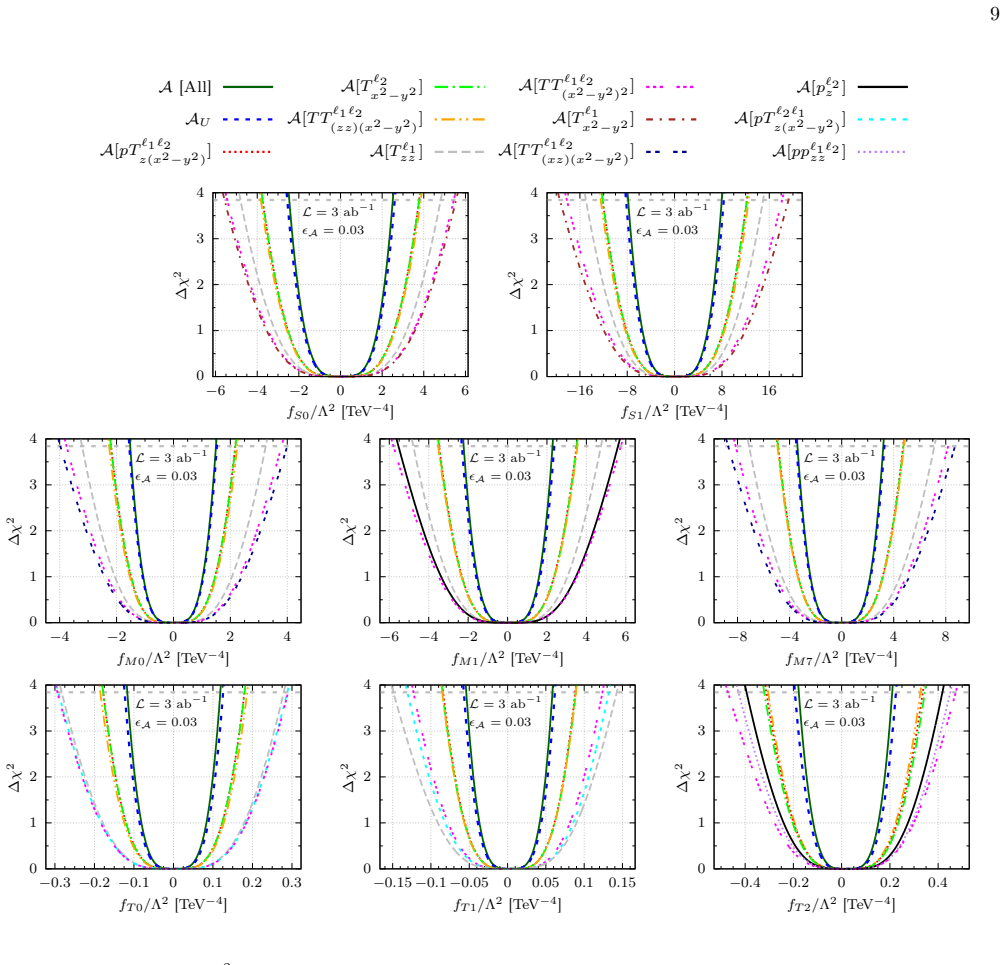
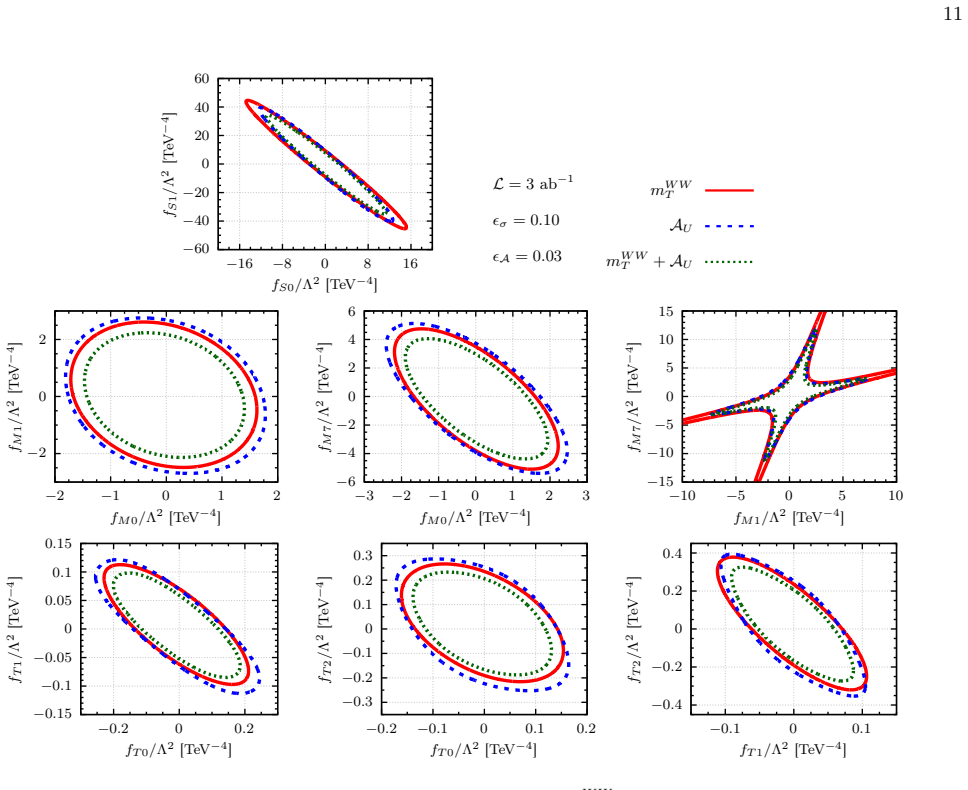
In the SMEFT framework, angular asymmetries derived from the polarization and spin correlations of the W bosons in same-sign WW scattering provide constraints on the anomalous WWWW couplings that are comparable in strength to those from the transverse mass distribution of the WW system. A minimal set of these asymmetries captures the dominant sensitivity, and their combination with kinematic information yields improved limits on the Wilson coefficients. Imposing invariant-mass cut-offs on the WW system identifies unitarity-safe regions for the anomalous couplings.
What carries the argument
Angular asymmetries encoding the polarization and spin correlations of the produced W bosons.
If this is right
- Spin-correlation asymmetries provide sensitivity to anomalous WWWW interactions comparable to the transverse mass distribution.
- A minimal set of the most sensitive asymmetries captures the dominant constraints on the Wilson coefficients.
- A combined analysis of angular asymmetries and kinematic information leads to improved limits compared to either approach alone.
- Invariant-mass cut-offs on the WW system determine unitarity-safe regions for the anomalous couplings.
Where Pith is reading between the lines
- This method could be extended to other vector boson scattering channels to obtain cross-checks on the same quartic couplings.
- At higher integrated luminosities the reduced set of asymmetries might allow experimental analyses to retain most sensitivity while simplifying event selection.
- The results suggest that full angular information can help separate the effects of different dimension-8 operators in future global EFT fits.
Load-bearing premise
The analysis assumes that the SMEFT truncation remains valid in the kinematic region studied and that Monte Carlo simulations accurately capture the interference between Standard Model and anomalous contributions.
What would settle it
A measurement showing that the limits from spin asymmetries are significantly weaker than from the transverse mass distribution, or that the combined limits do not improve, would contradict the central claim.
Figures


read the original abstract
The study of quartic couplings of electroweak gauge bosons not only provides a test of the Standard Model (SM) predictions, but also can look for signals of new physics beyond the SM. We present a comprehensive study of anomalous quartic gauge couplings in same-sign $W^\pm W^\pm$ production via vector boson scattering at the LHC. The analysis is carried out within the framework of the SM Effective Field Theory, exploiting polarization and spin-correlation effects encoded in angular asymmetries in addition to conventional kinematic observables. We demonstrate that spin-correlation asymmetries provide sensitivity to anomalous $WWWW$ interactions that is comparable to that obtained from the transverse mass distribution of the $WW$ system. By identifying a minimal set of the most sensitive asymmetries, we show that the dominant constraints on the Wilson coefficients can be captured with a reduced number of observables. A combined analysis of angular asymmetries and kinematic information leads to improved limits compared to either approach alone. The impact of unitarity considerations is also examined by imposing invariant-mass cut-offs on the $WW$ system, allowing us to determine unitarity-safe regions for the anomalous couplings.
Editorial analysis
A structured set of objections, weighed in public.
Referee Report
Summary. The manuscript presents a numerical study of anomalous quartic gauge couplings (aQGCs) in same-sign W±W± vector boson scattering at the LHC within the SMEFT framework. It examines polarization and spin-correlation effects via angular asymmetries in addition to standard kinematic observables such as the transverse mass m_T(WW). The central claims are that selected spin-correlation asymmetries yield sensitivity to dimension-8 WWWW operators comparable to m_T(WW), that a minimal subset of these asymmetries captures the dominant constraints on the Wilson coefficients, and that a combined angular-plus-kinematic analysis improves the resulting limits. Unitarity is addressed by imposing invariant-mass cut-offs on the WW system.
Significance. If the numerical results are robust, the work would be of moderate significance for LHC VBS analyses: it supplies concrete evidence that angular asymmetries can be used to probe dimension-8 operators with sensitivity comparable to conventional kinematic variables and that a reduced observable set suffices for the leading constraints. Explicit discussion of unitarity cuts is a positive feature that helps delineate the validity region of the EFT.
major comments (1)
- The provided manuscript text supplies no information on the Monte Carlo event generation, parton-shower settings, statistical procedure for extracting limits, or treatment of systematic uncertainties. These elements are load-bearing for the central numerical claims of comparable sensitivity and improved combined limits.
Simulated Author's Rebuttal
We thank the referee for the careful reading of our manuscript and the constructive comment. We address the point raised below.
read point-by-point responses
-
Referee: The provided manuscript text supplies no information on the Monte Carlo event generation, parton-shower settings, statistical procedure for extracting limits, or treatment of systematic uncertainties. These elements are load-bearing for the central numerical claims of comparable sensitivity and improved combined limits.
Authors: We agree that the manuscript does not currently provide explicit details on the Monte Carlo event generation, parton-shower settings, the statistical procedure for extracting limits, or the treatment of systematic uncertainties. These aspects are essential to support the robustness of the reported sensitivities and combined limits. In the revised manuscript we will add a dedicated subsection describing the simulation framework, including the generator and settings used for same-sign WW VBS production, parton-shower and hadronization parameters, the statistical method applied to derive Wilson-coefficient limits (e.g., chi-squared or profile-likelihood analysis of the binned distributions), and the treatment (or explicit neglect) of systematic uncertainties in this theoretical study. This addition will allow readers to fully assess the numerical results. revision: yes
Circularity Check
No significant circularity; numerical simulation study is self-contained
full rationale
The paper is a Monte Carlo-based phenomenological analysis of angular asymmetries and kinematic observables in same-sign WW scattering within SMEFT. Central results (comparable sensitivity of spin-correlation asymmetries to m_T(WW), and improved limits from combined observables) are obtained by generating events, applying cuts, and computing statistical sensitivities; these steps do not reduce to any fitted parameter renamed as a prediction or to a self-citation chain. No derivation equates an output to its input by construction, no ansatz is smuggled via citation, and unitarity cuts are applied explicitly. The analysis stands on external simulation tools and standard SMEFT operator definitions rather than internal self-reference.
Axiom & Free-Parameter Ledger
axioms (2)
- domain assumption SMEFT is the appropriate low-energy description of possible new physics in the electroweak sector
- domain assumption Monte Carlo generators correctly model polarization and spin correlations in VBS processes
Reference graph
Works this paper leans on
-
[1]
S. Godfrey, Quartic gauge boson couplings, AIP Conf. Proc.350, 209 (1995), arXiv:hep-ph/9505252
work page internal anchor Pith review Pith/arXiv arXiv 1995
-
[2]
Belanger and F
G. Belanger and F. Boudjema, Probing quartic couplings of weak bosons through three vectors production at a 500-GeV NLC, Phys. Lett.B288, 201 (1992)
1992
-
[3]
P. J. Dervan, A. Signer, W. J. Stirling, and A. Werthen- bach, Anomalous triple and quartic gauge boson cou- plings, J. Phys. G26, 607 (2000), arXiv:hep-ph/0002175
work page internal anchor Pith review Pith/arXiv arXiv 2000
-
[4]
O. J. P. Eboli, M. C. Gonzalez-Garcia, S. M. Lietti, and S. F. Novaes, Anomalous quartic gauge boson couplings at hadron colliders, Phys. Rev.D63, 075008 (2001), arXiv:hep-ph/0009262 [hep-ph]
work page internal anchor Pith review Pith/arXiv arXiv 2001
-
[5]
S. Chatrchyanet al.(CMS), Search forW W γandW Zγ production and constraints on anomalous quartic gauge couplings inppcollisions at √s= 8 TeV, Phys. Rev. D90, 032008 (2014), arXiv:1404.4619 [hep-ex]
work page internal anchor Pith review Pith/arXiv arXiv 2014
-
[6]
G. Aadet al.(ATLAS), Evidence ofW γγProduction in pp Collisions at √s= 8 TeV and Limits on Anoma- lous Quartic Gauge Couplings with the ATLAS Detector, Phys. Rev. Lett.115, 031802 (2015), arXiv:1503.03243 [hep-ex]
work page internal anchor Pith review Pith/arXiv arXiv 2015
-
[7]
M. Aaboudet al.(ATLAS), Study ofW W γand W Zγproduction inppcollisions at √s= 8 TeV and search for anomalous quartic gauge couplings with the ATLAS experiment, Eur. Phys. J.C77, 646 (2017), arXiv:1707.05597 [hep-ex]
work page internal anchor Pith review Pith/arXiv arXiv 2017
-
[8]
A. M. Sirunyanet al.(CMS), Measurements of the pp →W γγand pp→Zγγcross sections and limits on anomalous quartic gauge couplings at√s= 8 TeV, JHEP 10, 072, arXiv:1704.00366 [hep-ex]
work page internal anchor Pith review Pith/arXiv arXiv
-
[9]
Belanger and F
G. Belanger and F. Boudjema,γγ→W+W−andγγ→ ZZas tests of novel quartic couplings, Phys. Lett.B288, 210 (1992)
1992
-
[10]
S. Chatrchyanet al.(CMS), Study of Exclusive Two- Photon Production ofW +W − inppCollisions at √s= 7 TeV and Constraints on Anomalous Quartic Gauge Cou- plings, JHEP07, 116, arXiv:1305.5596 [hep-ex]
work page internal anchor Pith review Pith/arXiv arXiv
-
[11]
V. Khachatryanet al.(CMS), Evidence for exclusive γγ→W +W − production and constraints on anomalous quartic gauge couplings inppcollisions at √s= 7 and 8 TeV, JHEP08, 119, arXiv:1604.04464 [hep-ex]
work page internal anchor Pith review Pith/arXiv arXiv
-
[12]
A. S. Belyaev, O. J. P. Eboli, M. C. Gonzalez-Garcia, J. K. Mizukoshi, S. F. Novaes, and I. Zacharov, Strongly interacting vector bosons at the CERN LHC: Quartic anomalous couplings, Phys. Rev. D59, 015022 (1999), arXiv:hep-ph/9805229
work page internal anchor Pith review Pith/arXiv arXiv 1999
-
[13]
O. J. P. Eboli, M. C. Gonzalez-Garcia, and S. M. Lietti, Bosonic quartic couplings at CERN LHC, Phys. Rev. D69, 095005 (2004), arXiv:hep-ph/0310141 [hep-ph]
work page internal anchor Pith review Pith/arXiv arXiv 2004
-
[14]
V. Khachatryanet al.(CMS), Measurement of electroweak-induced production of Wγwith two jets in pp collisions at √s= 8 TeV and constraints on anomalous quartic gauge couplings, JHEP06, 106, arXiv:1612.09256 [hep-ex]
work page internal anchor Pith review Pith/arXiv arXiv
-
[16]
D. R. Green, P. Meade, and M.-A. Pleier, Multiboson interactions at the LHC, Rev. Mod. Phys.89, 035008 (2017), arXiv:1610.07572 [hep-ex]
work page internal anchor Pith review Pith/arXiv arXiv 2017
-
[17]
M. Aaboudet al.(ATLAS), Measurement ofW ±W ± vector-boson scattering and limits on anomalous quartic gauge couplings with the ATLAS detector, Phys. Rev. D 96, 012007 (2017), arXiv:1611.02428 [hep-ex]
-
[18]
V. Khachatryanet al.(CMS), Measurement of the cross section for electroweak production of Zγin association with two jets and constraints on anomalous quartic gauge couplings in proton–proton collisions at √s= 8 TeV, Phys. Lett.B770, 380 (2017), arXiv:1702.03025 [hep-ex]. 14
work page internal anchor Pith review Pith/arXiv arXiv 2017
-
[19]
A. M. Sirunyanet al.(CMS), Observation of electroweak production of same-sign W boson pairs in the two jet and two same-sign lepton final state in proton-proton colli- sions at √s= 13 TeV, Phys. Rev. Lett.120, 081801 (2018), arXiv:1709.05822 [hep-ex]
work page internal anchor Pith review Pith/arXiv arXiv 2018
-
[20]
A. M. Sirunyanet al.(CMS), Measurement of vector bo- son scattering and constraints on anomalous quartic cou- plings from events with four leptons and two jets in pro- ton–proton collisions at √s= 13 TeV, Phys. Lett.B774, 682 (2017), arXiv:1708.02812 [hep-ex]
work page internal anchor Pith review Pith/arXiv arXiv 2017
- [21]
- [22]
- [23]
- [24]
- [25]
-
[26]
G. Perez, M. Sekulla, and D. Zeppenfeld, Anomalous quartic gauge couplings and unitarization for the vec- tor boson scattering processpp→W +W +jjX→ ℓ+νℓℓ+νℓjjX, Eur. Phys. J. C78, 759 (2018), arXiv:1807.02707 [hep-ph]
work page internal anchor Pith review Pith/arXiv arXiv 2018
- [27]
-
[28]
G. Aadet al.(ATLAS), Evidence for Electroweak Pro- duction ofW ±W ±jjinppCollisions at √s= 8 TeV with the ATLAS Detector, Phys. Rev. Lett.113, 141803 (2014), arXiv:1405.6241 [hep-ex]
work page internal anchor Pith review Pith/arXiv arXiv 2014
-
[29]
M. Aaboudet al.(ATLAS), Observation of electroweak production of a same-signWboson pair in association with two jets inppcollisions at √s= 13 TeV with the ATLAS detector, Phys. Rev. Lett.123, 161801 (2019), arXiv:1906.03203 [hep-ex]
- [30]
- [31]
-
[32]
V. Khachatryanet al.(CMS), Study of vector boson scat- tering and search for new physics in events with two same-sign leptons and two jets, Phys. Rev. Lett.114, 051801 (2015), arXiv:1410.6315 [hep-ex]
work page internal anchor Pith review Pith/arXiv arXiv 2015
-
[33]
A. Gevorgyanet al.(CMS), First measurements of vec- tor boson scattering in W ±W± and WZ production in all-leptonic final states at √s= 13.6 TeV, (2026), arXiv:2605.15396 [hep-ex]
work page internal anchor Pith review Pith/arXiv arXiv 2026
- [34]
-
[35]
A. Ballestrero, E. Maina, and G. Pelliccioli, Differ- ent polarization definitions in same-signW Wscatter- ing at the LHC, Phys. Lett. B811, 135856 (2020), arXiv:2007.07133 [hep-ph]
- [36]
-
[37]
G. Chaudhary, J. Kalinowski, M. Kaur, P. Koz´ ow, K. Sandeep, M. Szleper, and S. Tkaczyk, EFT trian- gles in the same-signW Wscattering process at the HL- LHC and HE-LHC, Eur. Phys. J. C80, 181 (2020), arXiv:1906.10769 [hep-ph]
-
[38]
Same-sign WW scattering at the LHC: can we discover BSM effects before discovering new states?
J. Kalinowski, P. Koz´ ow, S. Pokorski, J. Rosiek, M. Szleper, and S. Tkaczyk, Same-sign WW scattering at the LHC: can we discover BSM effects before dis- covering new states?, Eur. Phys. J. C78, 403 (2018), arXiv:1802.02366 [hep-ph]
work page internal anchor Pith review Pith/arXiv arXiv 2018
-
[39]
Ballestreroet al., Precise predictions for same-sign W-boson scattering at the LHC, Eur
A. Ballestreroet al., Precise predictions for same-sign W-boson scattering at the LHC, Eur. Phys. J. C78, 671 (2018), arXiv:1803.07943 [hep-ph]
- [40]
-
[41]
B. J¨ ager and S. L. P. Chavez, Electroweak W +W+ production in association with three jets at NLO QCD matched with parton shower, JHEP01, 075, arXiv:2408.12314 [hep-ph]
-
[42]
S. Dittmaier, P. Maierh¨ ofer, C. Schwan, and R. Winter- halder, Like-sign W-boson scattering at the LHC — ap- proximations and full next-to-leading-order predictions, JHEP11, 022, arXiv:2308.16716 [hep-ph]
-
[43]
Leader,Spin in Particle Physics, Vol
E. Leader,Spin in Particle Physics, Vol. 15 (Cambridge University Press, 2001)
2001
-
[44]
A model independent spin analysis of fundamental particles using azimuthal asymmetries
F. Boudjema and R. K. Singh, A Model independent spin analysis of fundamental particles using azimuthal asym- metries, JHEP07, 028, arXiv:0903.4705 [hep-ph]
work page internal anchor Pith review Pith/arXiv arXiv
-
[45]
G. Aadet al.(ATLAS), Observation of a new particle in the search for the Standard Model Higgs boson with the ATLAS detector at the LHC, Phys. Lett.B716, 1 (2012), arXiv:1207.7214 [hep-ex]
work page internal anchor Pith review Pith/arXiv arXiv 2012
-
[46]
Observation of a new boson at a mass of 125 GeV with the CMS experiment at the LHC
S. Chatrchyanet al.(CMS), Observation of a new boson at a mass of 125 GeV with the CMS experiment at the LHC, Phys. Lett.B716, 30 (2012), arXiv:1207.7235 [hep- ex]
work page internal anchor Pith review Pith/arXiv arXiv 2012
-
[47]
C. Degrande, O. Eboli, B. Feigl, B. J¨ ager, W. Kil- ian, O. Mattelaer, M. Rauch, J. Reuter, M. Sekulla, and D. Wackeroth, Monte Carlo tools for studies of non-standard electroweak gauge boson interactions in multi-boson processes: A Snowmass White Paper, in Snowmass 2013: Snowmass on the Mississippi(2013) arXiv:1309.7890 [hep-ph]
work page internal anchor Pith review Pith/arXiv arXiv 2013
-
[48]
B. W. Lee, C. Quigg, and H. B. Thacker, Weak Inter- actions at Very High-Energies: The Role of the Higgs Boson Mass, Phys. Rev. D16, 1519 (1977). 15
1977
-
[49]
Englert and R
F. Englert and R. Brout, Broken Symmetry and the Mass of Gauge Vector Mesons, Phys. Rev. Lett.13, 321 (1964)
1964
-
[50]
P. W. Higgs, Broken Symmetries and the Masses of Gauge Bosons, Phys. Rev. Lett.13, 508 (1964)
1964
-
[51]
G. S. Guralnik, C. R. Hagen, and T. W. B. Kibble, Global Conservation Laws and Massless Particles, Phys. Rev. Lett.13, 585 (1964)
1964
-
[52]
O. J. P. Eboli, M. C. Gonzalez-Garcia, and J. K. Mizukoshi,pp→jje ±mu±ννandjje ±mu∓ννat O(α6 em) andO(α 6 emα2 s) for the study of the quartic elec- troweak gauge boson vertex at CERN LHC, Phys. Rev. D74, 073005 (2006), arXiv:hep-ph/0606118
work page internal anchor Pith review Pith/arXiv arXiv 2006
-
[53]
O. J. P. ´Eboli and M. C. Gonzalez-Garcia, Classifying the bosonic quartic couplings, Phys. Rev. D93, 093013 (2016), arXiv:1604.03555 [hep-ph]
work page internal anchor Pith review Pith/arXiv arXiv 2016
-
[54]
Bourrely, J
C. Bourrely, J. Soffer, and E. Leader, Polarization Phe- nomena in Hadronic Reactions, Phys. Rept.59, 95 (1980)
1980
-
[55]
R. Rahaman and R. K. Singh, Breaking down the entire spectrum of spin correlations of a pair of particles in- volving fermions and gauge bosons, Nucl. Phys. B984, 115984 (2022), arXiv:2109.09345 [hep-ph]
-
[56]
J. Alwall, R. Frederix, S. Frixione, V. Hirschi, F. Maltoni, O. Mattelaer, H. S. Shao, T. Stelzer, P. Torrielli, and M. Zaro, The automated computation of tree-level and next-to-leading order differential cross sections, and their matching to parton shower simulations, JHEP07, 079, arXiv:1405.0301 [hep-ph]
work page internal anchor Pith review Pith/arXiv arXiv
-
[57]
M. Cacciari, G. P. Salam, and G. Soyez, FastJet User Manual, Eur. Phys. J. C72, 1896 (2012), arXiv:1111.6097 [hep-ph]
work page internal anchor Pith review Pith/arXiv arXiv 2012
-
[58]
A Brief Introduction to PYTHIA 8.1
T. Sjostrand, S. Mrenna, and P. Z. Skands, A Brief Intro- duction to PYTHIA 8.1, Comput. Phys. Commun.178, 852 (2008), arXiv:0710.3820 [hep-ph]
work page internal anchor Pith review Pith/arXiv arXiv 2008
-
[59]
J. de Favereau, C. Delaere, P. Demin, A. Giammanco, V. Lemaitre, A. Mertens, and M. Selvaggi (DELPHES 3), DELPHES 3, A modular framework for fast simu- lation of a generic collider experiment, JHEP02, 057, arXiv:1307.6346 [hep-ex]
work page internal anchor Pith review Pith/arXiv arXiv
-
[60]
M. Aaboudet al.(ATLAS), Performance of missing transverse momentum reconstruction with the ATLAS detector using proton-proton collisions at √s= 13 TeV, Eur. Phys. J. C78, 903 (2018), arXiv:1802.08168 [hep- ex]
work page internal anchor Pith review Pith/arXiv arXiv 2018
-
[61]
TensorFlow: Large-Scale Machine Learning on Heterogeneous Distributed Systems
M. Abadiet al., TensorFlow: Large-Scale Machine Learn- ing on Heterogeneous Distributed Systems, (2016), arXiv:1603.04467 [cs.DC]
work page internal anchor Pith review Pith/arXiv arXiv 2016
-
[62]
Scikit-learn: Machine Learning in Python
F. Pedregosaet al., Scikit-learn: Machine Learning in Python, J. Machine Learning Res.12, 2825 (2011), arXiv:1201.0490 [cs.LG]
work page internal anchor Pith review Pith/arXiv arXiv 2011
discussion (0)
Sign in with ORCID, Apple, or X to comment. Anyone can read and Pith papers without signing in.