Causal Atlases from Entropic Inference: Bayesian Networks beyond Optimal DAGs
Pith reviewed 2026-06-28 02:23 UTC · model grok-4.3
The pith
Entropy-based inference generates atlases of multiple causal graphs consistent with data rather than single optimized DAGs.
A machine-rendered reading of the paper's core claim, the machinery that carries it, and where it could break.
Core claim
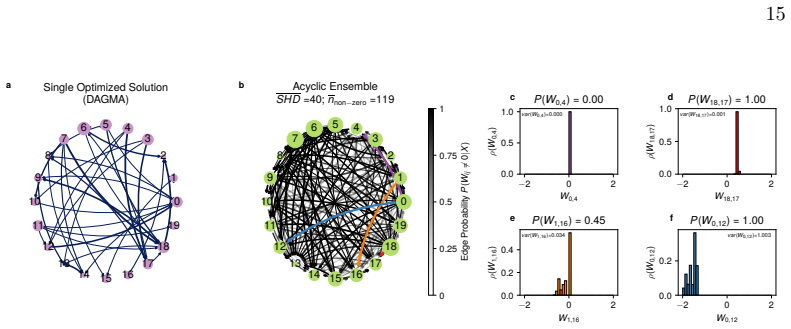
Entropy-based inference generates atlases of plausible causal relationships that are consistent with underlying data. On simulated noisy data of 2- and 20-node linear structural equation models, sampling a maximum-entropy ensemble of graphs quantifies the inherent structural ambiguity in underlying causal relationships. The method shows that optimized DAGs can contain causal artifacts not consistent across equivalently accurate topologies.
What carries the argument
maximum-entropy ensemble of graphs, which samples multiple directed acyclic graphs to quantify structural ambiguity instead of selecting one optimized network.
If this is right
- Optimized single DAGs may include causal artifacts that do not appear in other topologies of equivalent accuracy.
- The ensemble approach quantifies the degree of structural ambiguity present in noisy observations of linear structural equation models.
- Multiple causal maps can be produced that remain consistent with the variability in the underlying data.
- Bayesian networks need not be limited to one graph when data admit several plausible causal orderings.
Where Pith is reading between the lines
- The ensemble method could be tested on observational datasets with partial ground-truth causal information to check whether the atlases align with known relations.
- Extending the sampling to nonlinear or non-Gaussian data would show whether the ambiguity quantification generalizes beyond the linear case studied.
- Comparing the entropy-derived atlases against uncertainty estimates from other causal discovery algorithms on the same simulations would clarify relative strengths.
Load-bearing premise
The sampling from a maximum-entropy ensemble of graphs accurately captures the inherent structural ambiguity in the causal relationships without bias from the entropy measure or graph prior.
What would settle it
Applying the sampling procedure to data generated from a single known causal structure and finding that the resulting ensemble spreads probability across many inconsistent graphs instead of concentrating near the true structure.
Figures

read the original abstract
Data-driven causal relationship identification is pertinent to advancing understanding of complex systems both within and beyond science. Bayesian networks offer a probabilistic method for modelling generic causal relationships via directed acyclic graphs (DAGs). However, typical techniques for constructing Bayesian networks rely on optimization, which can be ill-suited for learning causal relationships because the underlying data may admit multiple chains of causation. More data-faithful representations of causal relationships would provide frameworks for constructing multiple causal maps that are consistent with the variability that is inherent in underlying data. Here, we show that entropy-based inference generates atlases of plausible causal relationships that are consistent with underlying data. On simulated noisy data of 2- and 20-node linear structural equation models, we sample a maximum-entropy ensemble of graphs that allow us to quantify the inherent structural ambiguity in underlying causal relationships. Our method shows that "optimized" DAGs can contain causal artifacts are not consistent across equivalently accurate topologies.
Editorial analysis
A structured set of objections, weighed in public.
Referee Report
Summary. The paper claims that entropy-based inference generates 'causal atlases'—ensembles of plausible DAGs consistent with data—allowing quantification of inherent structural ambiguity in causal relationships. On simulated noisy data from 2- and 20-node linear structural equation models, a maximum-entropy ensemble of graphs is sampled to show that single 'optimized' DAGs can contain causal artifacts not consistent across equivalently accurate topologies.
Significance. If the maximum-entropy ensemble is shown to faithfully capture data-consistent ambiguity independent of the specific entropy functional and graph prior, the approach would offer a principled way to represent causal uncertainty beyond point estimates from optimization, with potential utility in domains where multiple causal structures fit the data equally well.
major comments (2)
- [Methods (ensemble sampling procedure)] The central claim that the sampled maximum-entropy ensemble quantifies inherent structural ambiguity (rather than artifacts of the chosen entropy measure or implicit prior) is load-bearing, yet the manuscript provides no sensitivity analysis on alternative sufficient statistics for the entropy or on different graph priors; without such checks, the reported inconsistency of optimized DAGs with the ensemble cannot be distinguished from method dependence.
- [Abstract and Results] Abstract and results sections: the claims rest on simulations of 2- and 20-node linear SEMs, but no quantitative metrics (edge marginals, ambiguity measures, error bars, or comparison to ground-truth ambiguity) are reported, preventing assessment of whether the ensemble actually supports the stated conclusions about structural ambiguity.
minor comments (2)
- [Abstract] Abstract: grammatical error in 'causal artifacts are not consistent across equivalently accurate topologies' (missing 'that').
- [Methods] Notation for the entropy functional and the precise definition of the graph prior should be stated explicitly in the methods to allow reproducibility.
Simulated Author's Rebuttal
We thank the referee for their constructive comments, which highlight important aspects for strengthening our work on causal atlases via entropic inference. We provide point-by-point responses to the major comments and indicate the revisions we will make.
read point-by-point responses
-
Referee: [Methods (ensemble sampling procedure)] The central claim that the sampled maximum-entropy ensemble quantifies inherent structural ambiguity (rather than artifacts of the chosen entropy measure or implicit prior) is load-bearing, yet the manuscript provides no sensitivity analysis on alternative sufficient statistics for the entropy or on different graph priors; without such checks, the reported inconsistency of optimized DAGs with the ensemble cannot be distinguished from method dependence.
Authors: We recognize the importance of verifying that the observed structural ambiguity is not dependent on the specific entropy measure or graph prior used in our sampling procedure. Although our current implementation relies on a standard maximum-entropy formulation with particular sufficient statistics derived from the data, we agree that additional checks would bolster the claim. In the revised version, we will conduct sensitivity analyses by varying the sufficient statistics and employing alternative graph priors, reporting how these affect the ensemble properties and the inconsistencies with optimized DAGs. This will help confirm the robustness of our findings. revision: yes
-
Referee: [Abstract and Results] Abstract and results sections: the claims rest on simulations of 2- and 20-node linear SEMs, but no quantitative metrics (edge marginals, ambiguity measures, error bars, or comparison to ground-truth ambiguity) are reported, preventing assessment of whether the ensemble actually supports the stated conclusions about structural ambiguity.
Authors: We concur that incorporating quantitative metrics would enhance the clarity and assessability of our results. The simulations in the manuscript demonstrate the concept qualitatively through examples of inconsistencies, but to provide stronger evidence, we will add in the revision: computations of edge marginals from the ensemble, quantitative ambiguity measures such as the entropy of the graph distribution, error bars from repeated sampling, and where possible, comparisons against the known ground-truth ambiguity from the simulated SEMs. These additions will be reflected in both the abstract and results sections. revision: yes
Circularity Check
No significant circularity; derivation applies standard max-ent sampling independently to data
full rationale
The paper's core method samples a maximum-entropy ensemble of DAGs consistent with simulated linear SEM data to quantify structural ambiguity, without any quoted equations or steps that reduce by construction to fitted inputs, self-definitions, or load-bearing self-citations. The abstract and description present the entropy principle as an external tool applied to data, with no renaming of known results or ansatz smuggling; the claim that optimized DAGs contain inconsistent artifacts follows directly from comparing the ensemble to point estimates, remaining self-contained against external benchmarks.
Axiom & Free-Parameter Ledger
Reference graph
Works this paper leans on
-
[2]
Conformal
Franca, Guilherme and Sulam, Jeremias and Robinson, Daniel and Vidal, Rene , year = 2020, volume =. Conformal. Advances in
2020
-
[3]
Understanding Molecular Simulation:
Frenkel, Daan and Smit, Berend , year = 1996, publisher =. Understanding Molecular Simulation:
1996
-
[6]
Counterfactual
Kusner, Matt J and Loftus, Joshua and Russell, Chris and Silva, Ricardo , year = 2017, volume =. Counterfactual. Advances in
2017
-
[12]
Advances in
Wei, Dennis and Gao, Tian and Yu, Yue , year = 2020, volume =. Advances in
2020
-
[13]
Proceedings of the 36th
Yu, Yue and Chen, Jie and Gao, Tian and Yu, Mo , year = 2019, month = may, pages =. Proceedings of the 36th
2019
-
[16]
Nonnegative Matrices in the Mathematical Sciences , author =
-
[17]
Journal of Optimization Theory and Applications , volume =
The Essence of Invexity , author =. Journal of Optimization Theory and Applications , volume =. doi:10.1007/BF00941316 , urldate =
-
[19]
Annadani, Yashas and Pawlowski, Nick and Jennings, Joel and Bauer, Stefan and Zhang, Cheng and Gong, Wenbo , year = 2023, month = dec, journal =
2023
-
[21]
Advances in
Lorch, Lars and Rothfuss, Jonas and Sch. Advances in
-
[22]
Ng, Ignavier and Ghassami, AmirEmad and Zhang, Kun , year = 2020, volume =. On the. Advances in
2020
-
[23]
and Kohn, Robert , year = 2025, month = oct, urldate =
Thompson, Ryan and Bonilla, Edwin V. and Kohn, Robert , year = 2025, month = oct, urldate =. The
2025
-
[24]
Proceedings of the 38th
Yu, Yue and Gao, Tian and Yin, Naiyu and Ji, Qiang , year = 2021, month = jul, pages =. Proceedings of the 38th
2021
-
[25]
Learning
Zheng, Xun and Dan, Chen and Aragam, Bryon and Ravikumar, Pradeep and Xing, Eric , year = 2020, month = jun, pages =. Learning. Proceedings of the
2020
-
[26]
Causal protein-signaling networks derived from multiparameter single-cell data
author author K. Sachs , author O. Perez , author D. Pe'er , author D. A. \ Lauffenburger ,\ and\ author G. P. \ Nolan ,\ title title Causal Protein-Signaling Networks Derived from Multiparameter Single-Cell Data , \ https://doi.org/10.1126/science.1105809 journal journal Science \ volume 308 ,\ pages 523--529 ( year 2005 ) NoStop
-
[27]
author author B. Zhang , author C. Gaiteri , author L.-G. \ Bodea , author Z. Wang , author J. McElwee , author A. A. \ Podtelezhnikov , author C. Zhang , author T. Xie , author L. Tran , author R. Dobrin , author E. Fluder , author B. Clurman , author S. Melquist , author M. Narayanan , author C. Suver , author H. Shah , author M. Mahajan , author T. Gil...
-
[28]
author author P. Spirtes , author C. Glymour ,\ and\ author R. Scheines ,\ https://doi.org/10.1007/978-1-4612-2748-9 title Causation, Prediction , and Search ,\ edited by\ editor J. Berger , editor S. Fienberg , editor J. Gani , editor K. Krickeberg , editor I. Olkin ,\ and\ editor B. Singer ,\ series Lecture Notes in Statistics , Vol. volume 81 \ ( publi...
-
[29]
author author M. J. \ Kusner , author J. Loftus , author C. Russell ,\ and\ author R. Silva ,\ title title Counterfactual Fairness , \ in\ @noop booktitle Advances in Neural Information Processing Systems ,\ Vol. volume 30 \ ( publisher Curran Associates, Inc. ,\ year 2017 ) NoStop
2017
-
[30]
author author A. D. \ Sanford \ and\ author I. A. \ Moosa ,\ title title A Bayesian network structure for operational risk modelling in structured finance operations , \ https://doi.org/10.1057/jors.2011.7 journal journal Journal of the Operational Research Society \ volume 63 ,\ pages 431--444 ( year 2012 ) NoStop
-
[31]
DAGs with NO TEARS: Continuous Optimization for Structure Learning
author author X. Zheng , author B. Aragam , author P. Ravikumar ,\ and\ author E. P. \ Xing ,\ https://doi.org/10.48550/arXiv.1803.01422 title DAGs with NO TEARS : Continuous Optimization for Structure Learning , \ ( year 2018 ),\ https://arxiv.org/abs/1803.01422 arXiv:1803.01422 [stat] NoStop
work page internal anchor Pith review Pith/arXiv arXiv doi:10.48550/arxiv.1803.01422 2018
-
[32]
author author K. Bello , author B. Aragam ,\ and\ author P. Ravikumar ,\ https://doi.org/10.48550/arXiv.2209.08037 title DAGMA : Learning DAGs via M-matrices and a Log-Determinant Acyclicity Characterization , \ ( year 2023 ),\ https://arxiv.org/abs/2209.08037 arXiv:2209.08037 [cs] NoStop
-
[33]
editor D. Husmeier , editor R. Dybowski ,\ and\ editor S. Roberts ,\ eds.,\ https://doi.org/10.1007/b138794 title Probabilistic Modeling in Bioinformatics and Medical Informatics ,\ Advanced Information and Knowledge Processing \ ( publisher Springer London ,\ address London ,\ year 2005 ) NoStop
-
[34]
Yu , author J
author author Y. Yu , author J. Chen , author T. Gao ,\ and\ author M. Yu ,\ title title DAG-GNN : DAG Structure Learning with Graph Neural Networks , \ in\ @noop booktitle Proceedings of the 36th International Conference on Machine Learning \ ( publisher PMLR ,\ year 2019 )\ pp.\ pages 7154--7163 NoStop
2019
-
[35]
Zheng , author C
author author X. Zheng , author C. Dan , author B. Aragam , author P. Ravikumar ,\ and\ author E. Xing ,\ title title Learning Sparse Nonparametric DAGs , \ in\ @noop booktitle Proceedings of the Twenty Third International Conference on Artificial Intelligence and Statistics \ ( publisher PMLR ,\ year 2020 )\ pp.\ pages 3414--3425 NoStop
2020
-
[36]
Ng , author A
author author I. Ng , author A. Ghassami ,\ and\ author K. Zhang ,\ title title On the Role of Sparsity and DAG Constraints for Learning Linear DAGs , \ in\ @noop booktitle Advances in Neural Information Processing Systems ,\ Vol. volume 33 \ ( publisher Curran Associates, Inc. ,\ year 2020 )\ pp.\ pages 17943--17954 NoStop
2020
-
[37]
Yu , author T
author author Y. Yu , author T. Gao , author N. Yin ,\ and\ author Q. Ji ,\ title title DAGs with No Curl : An Efficient DAG Structure Learning Approach , \ in\ @noop booktitle Proceedings of the 38th International Conference on Machine Learning \ ( publisher PMLR ,\ year 2021 )\ pp.\ pages 12156--12166 NoStop
2021
-
[38]
author author Y. Annadani , author J. Rothfuss , author A. Lacoste , author N. Scherrer , author A. Goyal , author Y. Bengio ,\ and\ author S. Bauer ,\ https://doi.org/10.48550/arXiv.2106.07635 title Variational Causal Networks : Approximate Bayesian Inference over Causal Structures , \ ( year 2021 ),\ https://arxiv.org/abs/2106.07635 arXiv:2106.07635 [cs...
-
[39]
Lorch , author J
author author L. Lorch , author J. Rothfuss , author B. Sch \"o lkopf ,\ and\ author A. Krause ,\ title title DiBS : Differentiable Bayesian Structure Learning , \ in\ @noop booktitle Advances in Neural Information Processing Systems ,\ Vol. volume 34 \ ( publisher Curran Associates, Inc. ,\ year 2021 )\ pp.\ pages 24111--24123 NoStop
2021
-
[40]
Annadani , author N
author author Y. Annadani , author N. Pawlowski , author J. Jennings , author S. Bauer , author C. Zhang ,\ and\ author W. Gong ,\ title title BayesDAG : Gradient-Based Posterior Inference for Causal Discovery , \ @noop journal journal Advances in Neural Information Processing Systems \ volume 36 ,\ pages 1738--1763 ( year 2023 ) NoStop
2023
-
[41]
Thompson , author E
author author R. Thompson , author E. V. \ Bonilla ,\ and\ author R. Kohn ,\ title title ProDAG : Projected Variational Inference for Directed Acyclic Graphs , \ in\ @noop booktitle The Thirty-ninth Annual Conference on Neural Information Processing Systems \ ( year 2025 ) NoStop
2025
-
[42]
author author I. Babayan , author H. Aliahmadi ,\ and\ author G. Van Anders ,\ title title Sufficient is better than optimal for training neural networks , \ https://doi.org/10.1038/s41467-025-66983-3 journal journal Nature Communications \ volume 17 ,\ pages 271 ( year 2025 ) NoStop
-
[43]
author author G. J. \ Martyna , author M. E. \ Tuckerman , author D. J. \ Tobias ,\ and\ author M. L. \ Klein ,\ title title Explicit reversible integrators for extended systems dynamics , \ https://doi.org/10.1080/00268979600100761 journal journal Molecular Physics \ volume 87 ,\ pages 1117--1157 ( year 1996 ) NoStop
-
[44]
author author M. Tuckerman , author B. J. \ Berne ,\ and\ author G. J. \ Martyna ,\ title title Reversible multiple time scale molecular dynamics , \ https://doi.org/10.1063/1.463137 journal journal The Journal of Chemical Physics \ volume 97 ,\ pages 1990--2001 ( year 1992 ) ,\ https://arxiv.org/abs/https://doi.org/10.1063/1.463137 https://doi.org/10.106...
-
[45]
Frenkel \ and\ author B
author author D. Frenkel \ and\ author B. Smit ,\ @noop title Understanding Molecular Simulation: From Algorithms to Applications \ ( publisher Academic Press ,\ address San Diego ,\ year 1996 ) NoStop
1996
-
[46]
author author S. Jang \ and\ author G. A. \ Voth ,\ title title Simple reversible molecular dynamics algorithms for Nos\'e -- Hoover chain dynamics , \ https://doi.org/10.1063/1.475247 journal journal The Journal of Chemical Physics \ volume 107 ,\ pages 9514--9526 ( year 1997 ) NoStop
-
[47]
Franca , author J
author author G. Franca , author J. Sulam , author D. Robinson ,\ and\ author R. Vidal ,\ title title Conformal Symplectic and Relativistic Optimization , \ in\ @noop booktitle Advances in Neural Information Processing Systems ,\ Vol. volume 33 \ ( publisher Curran Associates, Inc. ,\ year 2020 )\ pp.\ pages 16916--16926 NoStop
2020
-
[48]
Berman \ and\ author R
author author A. Berman \ and\ author R. J. \ Plemmons ,\ @noop title Nonnegative Matrices in the Mathematical Sciences ,\ Computer Science and Applied Mathematics\ ( publisher Academic Press ,\ address New York ,\ year 1979 ) NoStop
1979
discussion (0)
Sign in with ORCID, Apple, or X to comment. Anyone can read and Pith papers without signing in.