REVIEW 2 major objections 3 minor 59 references
External controls and balancing weights can adjust for treatment switching in randomized oncology trials to reduce bias in survival estimates.
Reviewed by Pith at T0; open to challenge. T0 means a machine referee read the full paper against a public rubric. the ladder, T0–T4 →
T0 review · grok-4.3
2026-06-28 00:13 UTC pith:BW67PR6B
load-bearing objection The paper packages synthetic controls, balancing weights, multiple imputation, and time-varying weights into one framework for imputing no-switch survival using external controls in oncology RCTs. the 2 major comments →
Leveraging External Controls for Treatment Switching in Randomized Controlled Trials: A Weighted Causal Inference Framework for Overall Survival
The pith
A machine-rendered reading of the paper's core claim, the machinery that carries it, and where it could break.
Core claim
The authors develop a weighted causal inference framework that selects a risk set of external controls, balances them via synthetic controls and balancing weights, and uses multiple imputation of counterfactual survival times under no switching together with time-varying weights to estimate treatment effects despite switching.
What carries the argument
The weighted causal inference framework that combines synthetic control method and balancing weights to impute counterfactual survival times from external controls.
Load-bearing premise
External controls can be selected into an appropriate risk set and balanced such that the synthetic controls and balancing weights produce unbiased imputations of the counterfactual survival times under no switching.
What would settle it
A simulation or trial in which external controls come from a population that cannot be balanced to match the trial's risk set, causing the imputed counterfactual survival curves to deviate systematically from the true no-switching curves.
If this is right
- Treatment effect estimates for overall survival become less biased than those from standard adjustment methods that ignore external controls or use them naively.
- Multiple imputation with time-varying weights yields valid inference even when switching occurs at varying times.
- Risk-set selection for external controls provides a practical way to borrow strength from observational data without strong parametric assumptions.
- The framework applies directly to phase III oncology trials where switching is common due to disease progression.
Where Pith is reading between the lines
- The same imputation approach could be tested on non-survival endpoints such as progression-free survival or quality-of-life measures.
- Integration with existing switching adjustment methods like rank-preserving structural failure time models might further reduce variance.
- In settings with limited external data, the balancing step could be replaced by matching algorithms to assess robustness.
Editorial analysis
A structured set of objections, weighed in public.
Referee Report
Summary. The manuscript proposes a general framework for adjusting treatment switching in oncology RCTs with overall survival endpoints by incorporating external controls. It combines the synthetic control method with balancing weights to construct multiple-imputation and time-varying-weight estimators, discusses risk-set selection for the external controls, reports simulation results showing statistical improvements over naive external-control or no-external-control approaches, and applies the methods to two phase III trials.
Significance. If the simulation results and risk-set assumptions hold, the framework offers a practical extension of established causal tools (synthetic controls, balancing weights) to a common problem in oncology trials, potentially reducing bias from switching without requiring strong parametric assumptions on the switching mechanism. The explicit use of external data and the provision of both imputation and weighting estimators are constructive contributions.
major comments (2)
- [Risk-set selection section] Risk-set selection section: the central claim of unbiased imputation of counterfactual no-switch survival times rests on the ability to select and balance an appropriate risk set of external controls; however, the manuscript provides no sensitivity analyses or robustness checks for alternative risk-set definitions or for violations of the implicit exchangeability assumption after balancing.
- [Simulation studies] Simulation studies: while the abstract and text claim 'meaningful statistical improvements,' the reported metrics (bias, variance, coverage) are not compared against a pre-specified benchmark or against the performance under deliberate risk-set misspecification, making it difficult to assess whether the gains are robust or primarily driven by favorable simulation designs.
minor comments (3)
- Notation for the time-varying weights and the multiple-imputation procedure should be unified across sections to avoid ambiguity between the synthetic-control weights and the balancing weights.
- The real-data applications would benefit from a table summarizing the estimated treatment effects, standard errors, and confidence intervals under the proposed estimators versus the comparator methods.
- A brief discussion of computational implementation (e.g., software or code availability) would improve reproducibility.
Simulated Author's Rebuttal
We thank the referee for their constructive comments and recommendation for minor revision. We respond to each major comment below.
read point-by-point responses
-
Referee: [Risk-set selection section] Risk-set selection section: the central claim of unbiased imputation of counterfactual no-switch survival times rests on the ability to select and balance an appropriate risk set of external controls; however, the manuscript provides no sensitivity analyses or robustness checks for alternative risk-set definitions or for violations of the implicit exchangeability assumption after balancing.
Authors: We agree that sensitivity analyses for risk-set selection would strengthen the robustness assessment. The revised manuscript will add a new subsection with additional simulations exploring alternative risk-set definitions (e.g., varying covariate sets for balancing) and scenarios with mild violations of exchangeability after balancing, including their effects on bias and coverage. revision: yes
-
Referee: [Simulation studies] Simulation studies: while the abstract and text claim 'meaningful statistical improvements,' the reported metrics (bias, variance, coverage) are not compared against a pre-specified benchmark or against the performance under deliberate risk-set misspecification, making it difficult to assess whether the gains are robust or primarily driven by favorable simulation designs.
Authors: The referee correctly identifies that the current simulations lack explicit benchmarks and misspecification checks. We will revise the simulation section to incorporate comparisons to a pre-specified benchmark (such as an oracle no-switching estimator) and additional scenarios with deliberate risk-set misspecification to better evaluate the robustness of the reported improvements. revision: yes
Circularity Check
No significant circularity; framework draws on external causal tools and simulations
full rationale
The paper presents a framework that incorporates established methods from observational causal inference (synthetic controls, balancing weights) to propose estimators for treatment switching adjustment, with performance evaluated via simulation studies. No equations or claims in the provided abstract or description reduce the proposed estimators to quantities defined by the same data or self-citations; the central claims rest on external methodological foundations and independent simulation evidence rather than self-referential definitions or fitted inputs renamed as predictions. The selection of external controls is framed as an assumption, not a derived result.
Axiom & Free-Parameter Ledger
axioms (2)
- domain assumption External controls are exchangeable with the trial population after balancing on observed covariates (standard causal inference assumption for observational data).
- domain assumption The risk set of external controls can be chosen so that imputation does not introduce new bias.
read the original abstract
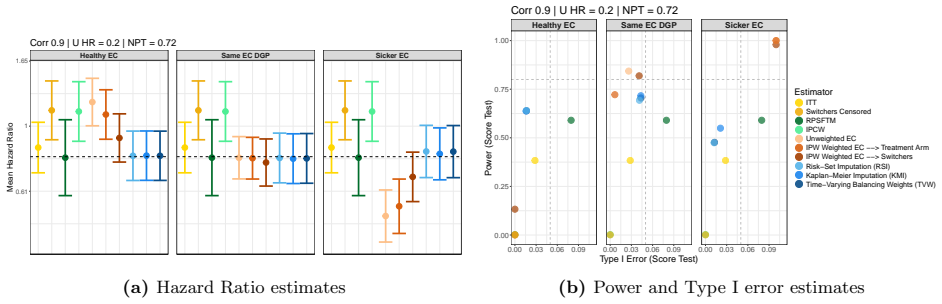
In many oncology clinical trials where overall survival is a key endpoint, patients are permitted to switch from the control arm to the experimental treatment arm or other suitable therapies. Switching can occur for various reasons, including disease progression. This violates the causal guarantees of randomized treatment assignment, resulting in biased treatment effect estimates. Existing methods often require strong assumptions, complicated model specifications, or both. In this paper, we propose a general framework that incorporates external controls to account for treatment switching in randomized controlled trials. Leveraging the synthetic control method and balancing weights from observational causal inference, we propose several estimators that use multiple imputation and time-varying weights to adjust for treatment switching. We also discuss approaches to selecting the risk set of external controls to impute from. Through extensive simulation studies, we show that our proposed methods lead to meaningful statistical improvements relative to standard adjustment methods that utilize external controls in naive ways or those that do not utilize external controls at all. We then demonstrate the utility of our external control-based approaches with two phase III oncology trials.
Figures


Reference graph
Works this paper leans on
-
[1]
, author=
Estimating causal effects of treatments in randomized and nonrandomized studies. , author=. Journal of educational Psychology , volume=. 1974 , publisher=
1974
-
[2]
European journal of cancer , volume=
New response evaluation criteria in solid tumours: revised RECIST guideline (version 1.1) , author=. European journal of cancer , volume=. 2009 , publisher=
2009
-
[3]
Journal of Biopharmaceutical Statistics , volume=
Estimating treatment effect in randomized trial after control to treatment crossover using external controls , author=. Journal of Biopharmaceutical Statistics , volume=. 2024 , publisher=
2024
-
[4]
arXiv preprint arXiv:2512.11751 , year=
Forest Kernel Balancing Weights: Outcome-Guided Features for Causal Inference , author=. arXiv preprint arXiv:2512.11751 , year=
-
[5]
Medical Decision Making , volume=
Adjusting survival time estimates to account for treatment switching in randomized controlled trials—an economic evaluation context: methods, limitations, and recommendations , author=. Medical Decision Making , volume=. 2014 , publisher=
2014
-
[6]
Statistics in Medicine , volume=
Estimating treatment effects in randomized trials with treatment switching , author=. Statistics in Medicine , volume=. 2006 , publisher=
2006
-
[7]
Proceedings of the biopharmaceutical section, American statistical association , volume=
Information recovery and bias adjustment in proportional hazards regression analysis of randomized trials using surrogate markers , author=. Proceedings of the biopharmaceutical section, American statistical association , volume=. 1993 , organization=
1993
-
[8]
Biometrics , volume=
Correcting for noncompliance and dependent censoring in an AIDS clinical trial with inverse probability of censoring weighted (IPCW) log-rank tests , author=. Biometrics , volume=. 2000 , publisher=
2000
-
[9]
CLINICAL TRIALS , volume=
Addendum on Estimands and Sensitivity Analysis in Clinical Trials , author=. CLINICAL TRIALS , volume=
-
[10]
Pharmaceutical Statistics , volume=
Estimands for overall survival in clinical trials with treatment switching in oncology , author=. Pharmaceutical Statistics , volume=. 2022 , publisher=
2022
-
[11]
Journal of Biopharmaceutical Statistics , pages=
A multiple imputation approach in enhancing causal inference for overall survival in randomized controlled trials with crossover , author=. Journal of Biopharmaceutical Statistics , pages=. 2024 , publisher=
2024
-
[12]
2019 , publisher=
Statistical analysis with missing data , author=. 2019 , publisher=
2019
-
[13]
Journal of the Royal Statistical Society Series A: Statistics in Society , volume=
Causal estimators for incorporating external controls in randomized trials with longitudinal outcomes , author=. Journal of the Royal Statistical Society Series A: Statistics in Society , volume=. 2025 , publisher=
2025
-
[14]
Journal of Biopharmaceutical Statistics , pages=
rdborrow: an R package for causal inference incorporating external controls in randomized controlled trials with longitudinal outcomes , author=. Journal of Biopharmaceutical Statistics , pages=. 2025 , publisher=
2025
-
[15]
Published online , year=
NICE DSU Technical Support Document 24: Adjusting Survival Time Estimates in the Presence of Treatment Switching: An update to TSD 16 , author=. Published online , year=
-
[16]
Biometrics , volume=
A causal inference framework for leveraging external controls in hybrid trials , author=. Biometrics , volume=. 2024 , publisher=
2024
-
[17]
The International Journal of Biostatistics , year=
Prognostic adjustment with efficient estimators to unbiasedly leverage historical data in randomized trials , author=. The International Journal of Biostatistics , year=
-
[18]
arXiv preprint arXiv:2110.14831 , year=
The balancing act in causal inference , author=. arXiv preprint arXiv:2110.14831 , year=
-
[19]
Journal of the Royal Statistical Society Series B: Statistical Methodology , volume=
Sensitivity analysis for inverse probability weighting estimators via the percentile bootstrap , author=. Journal of the Royal Statistical Society Series B: Statistical Methodology , volume=. 2019 , publisher=
2019
-
[20]
Biometrika , volume=
Variance-based sensitivity analysis for weighting estimators results in more informative bounds , author=. Biometrika , volume=. 2025 , publisher=
2025
-
[21]
Journal of the Royal Statistical Society Series A: Statistics in Society , volume=
Interpretable sensitivity analysis for balancing weights , author=. Journal of the Royal Statistical Society Series A: Statistics in Society , volume=. 2023 , publisher=
2023
-
[22]
Industrial Marketing Management , volume=
Endogeneity bias in marketing research: Problem, causes and remedies , author=. Industrial Marketing Management , volume=. 2017 , publisher=
2017
-
[23]
Journal of the Royal Statistical Society Series B: Statistical Methodology , volume=
Making sense of sensitivity: Extending omitted variable bias , author=. Journal of the Royal Statistical Society Series B: Statistical Methodology , volume=. 2020 , publisher=
2020
-
[24]
Statistics in biosciences , volume=
A gaussian copula model for multivariate survival data , author=. Statistics in biosciences , volume=. 2010 , publisher=
2010
-
[25]
BMC medical research methodology , volume=
Two-stage estimation to adjust for treatment switching in randomised trials: a simulation study investigating the use of inverse probability weighting instead of re-censoring , author=. BMC medical research methodology , volume=. 2019 , publisher=
2019
-
[26]
International journal of technology assessment in health care , volume=
Treatment switching: statistical and decision-making challenges and approaches , author=. International journal of technology assessment in health care , volume=. 2016 , publisher=
2016
-
[27]
2014 , publisher=
NICE DSU technical support document 16: adjusting survival time estimates in the presence of treatment switching , author=. 2014 , publisher=
2014
-
[28]
Pharmaceutical Statistics , volume=
Further Practical Guidance on Adjusting Time-To-Event Outcomes for Treatment Switching , author=. Pharmaceutical Statistics , volume=. 2025 , publisher=
2025
-
[29]
Pharmaceutical statistics , volume=
Adjusting overall survival for treatment switches: commonly used methods and practical application , author=. Pharmaceutical statistics , volume=. 2013 , publisher=
2013
-
[30]
Statistics in medicine , volume=
Quantifying the association between progression-free survival and overall survival in oncology trials using Kendall's , author=. Statistics in medicine , volume=. 2019 , publisher=
2019
-
[31]
Journal of Biopharmaceutical Statistics , volume=
Bias and type I error control in correcting treatment effect for treatment switching using marginal structural models in phase III oncology trials , author=. Journal of Biopharmaceutical Statistics , volume=. 2022 , publisher=
2022
-
[32]
, date-added =
Rubin, Donald B. , date-added =. Which Ifs Have Causal Answers , volume =. Journal of the American Statistical Association , month =
-
[33]
2024 , publisher=
A first course in causal inference , author=. 2024 , publisher=
2024
-
[34]
Biometrical Journal , volume=
Making apples from oranges: Comparing noncollapsible effect estimators and their standard errors after adjustment for different covariate sets , author=. Biometrical Journal , volume=. 2021 , publisher=
2021
-
[35]
Journal of Research on Educational Effectiveness , pages=
Balancing Weights for Estimating Treatment Effects in Educational Studies , author=. Journal of Research on Educational Effectiveness , pages=. 2025 , publisher=
2025
-
[36]
Annals of Applied Statistics , number =
Ben-Michael, Eli and Feller, Avi and Rothstein, Jesse , date-modified =. Annals of Applied Statistics , number =
-
[37]
Journal of the American Statistical Association , volume=
The augmented synthetic control method , author=. Journal of the American Statistical Association , volume=. 2021 , publisher=
2021
-
[38]
Journal of the American statistical Association , volume=
Synthetic control methods for comparative case studies: Estimating the effect of California’s tobacco control program , author=. Journal of the American statistical Association , volume=. 2010 , publisher=
2010
-
[39]
American Journal of Political Science , volume=
Comparative politics and the synthetic control method , author=. American Journal of Political Science , volume=. 2015 , publisher=
2015
-
[40]
Journal of the American Statistical Association , volume=
A penalized synthetic control estimator for disaggregated data , author=. Journal of the American Statistical Association , volume=. 2021 , publisher=
2021
-
[41]
Biometrika , volume=
The central role of the propensity score in observational studies for causal effects , author=. Biometrika , volume=. 1983 , publisher=
1983
-
[42]
Minimax Linear Estimation of the Retargeted Mean , year =
Hirshberg, David A and Maleki, Arian and Zubizarreta, Jose , date-modified =. Minimax Linear Estimation of the Retargeted Mean , year =
-
[43]
The Annals of Applied Statistics , volume=
Hospital quality risk standardization via approximate balancing weights , author=. The Annals of Applied Statistics , volume=. 2023 , publisher=
2023
-
[44]
Using balancing weights to target the treatment effect on the treated when overlap is poor , volume =
Ben-Michael, Eli and Keele, Luke , date-added =. Using balancing weights to target the treatment effect on the treated when overlap is poor , volume =. Epidemiology , number =
-
[45]
Multilevel calibration weighting for survey data , volume =
Ben-Michael, Eli and Feller, Avi and Hartman, Erin , date-added =. Multilevel calibration weighting for survey data , volume =. Political Analysis , number =
-
[46]
The Annals of Statistics , pages =
Hirshberg, David and Wager, Stefan , eprint =. The Annals of Statistics , pages =
-
[47]
Statistics & probability letters , volume=
Survival estimation and testing via multiple imputation , author=. Statistics & probability letters , volume=. 2002 , publisher=
2002
-
[48]
Statistics in medicine , volume=
Survival analysis using auxiliary variables via non-parametric multiple imputation , author=. Statistics in medicine , volume=. 2006 , publisher=
2006
-
[49]
Biometrics , pages=
Nonparametric survival estimation using prognostic longitudinal covariates , author=. Biometrics , pages=. 1996 , publisher=
1996
-
[50]
The Lancet Oncology , volume=
Atezolizumab in combination with carboplatin plus nab-paclitaxel chemotherapy compared with chemotherapy alone as first-line treatment for metastatic non-squamous non-small-cell lung cancer (IMpower130): a multicentre, randomised, open-label, phase 3 trial , author=. The Lancet Oncology , volume=. 2019 , publisher=
2019
-
[51]
The Lancet , volume=
Atezolizumab versus docetaxel in patients with previously treated non-small-cell lung cancer (OAK): a phase 3, open-label, multicentre randomised controlled trial , author=. The Lancet , volume=. 2017 , publisher=
2017
-
[52]
Journal of Thoracic Oncology , volume=
Atezolizumab versus docetaxel in pretreated patients with NSCLC: final results from the randomized phase 2 POPLAR and phase 3 OAK clinical trials , author=. Journal of Thoracic Oncology , volume=. 2021 , publisher=
2021
-
[53]
Statistics in medicine , volume=
A Calibrated Sensitivity Analysis for Weighted Causal Decompositions , author=. Statistics in medicine , volume=. 2025 , publisher=
2025
-
[54]
Statistical Methods in Medical Research , volume=
Augmented two-stage estimation for treatment switching in oncology trials: Leveraging external data for improved precision , author=. Statistical Methods in Medical Research , volume=. 2025 , publisher=
2025
-
[55]
Medical Decision Making , volume=
Estimating treatment-switching bias in a randomized clinical trial of ovarian cancer treatment: combining causal inference with decision-analytic modeling , author=. Medical Decision Making , volume=. 2022 , publisher=
2022
-
[56]
Value in Health , volume=
Adjusting for patient crossover in clinical trials using external data: a case study of lenalidomide for advanced multiple myeloma , author=. Value in Health , volume=. 2011 , publisher=
2011
-
[57]
2026 , note =
trtswitch: Treatment Switching , author =. 2026 , note =
2026
-
[58]
2019 , type =
Assessment report:. 2019 , type =
2019
-
[59]
arXiv preprint arXiv:2401.00649 , year=
Linear model and extensions , author=. arXiv preprint arXiv:2401.00649 , year=
discussion (0)
Sign in with ORCID, Apple, or X to comment. Anyone can read and Pith papers without signing in.