PC Layer: Polynomial Weight Preconditioning for Improving LLM Pre-Training
Pith reviewed 2026-06-28 02:13 UTC · model grok-4.3
The pith
A polynomial preconditioning layer stabilizes singular value spectra of weights in LLM training.
A machine-rendered reading of the paper's core claim, the machinery that carries it, and where it could break.
Core claim
The central claim is that inserting a polynomial preconditioning layer that uniformly bounds singular values of each weight matrix improves training stability and performance in transformer-based LLMs, with the weights mergeable post-training, and proven for linear networks to ensure convergence.
What carries the argument
The PC layer: a weight parameterization via polynomial preconditioner that reshapes the singular-value spectrum of weight matrices.
If this is right
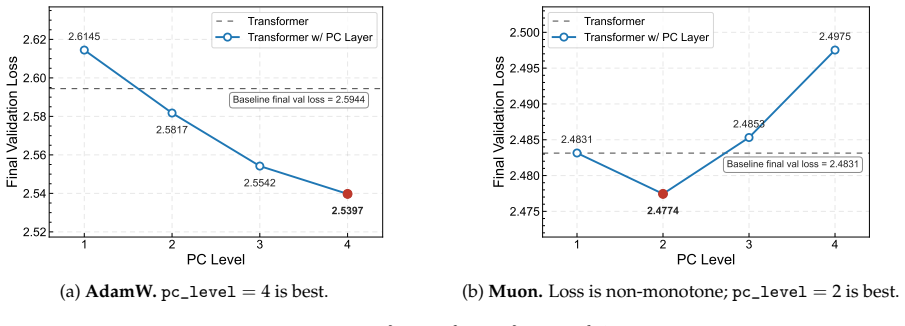
- Pre-training of Llama-1B benefits from the PC layer for both AdamW and Muon optimizers.
- The preconditioned weights can be merged back into the original architecture with no inference overhead.
- Uniformly bounding each layer's singular values ensures geometric convergence of gradient descent to global minima for certain deep linear networks.
Where Pith is reading between the lines
- The spectrum control may generalize beyond transformers to other neural network types.
- The method could reduce training instability in very large models without changing the inference architecture.
- Further analysis could check if the polynomial degree affects the trade-off between stability and expressivity.
Load-bearing premise
The spectrum-control principle proven only for deep linear networks will produce the observed stability gains when applied inside non-linear transformer blocks with attention and activations.
What would settle it
A direct measurement showing that the polynomial preconditioner does not maintain bounded singular values throughout non-linear transformer training, or no performance gain in Llama pre-training.
Figures






read the original abstract
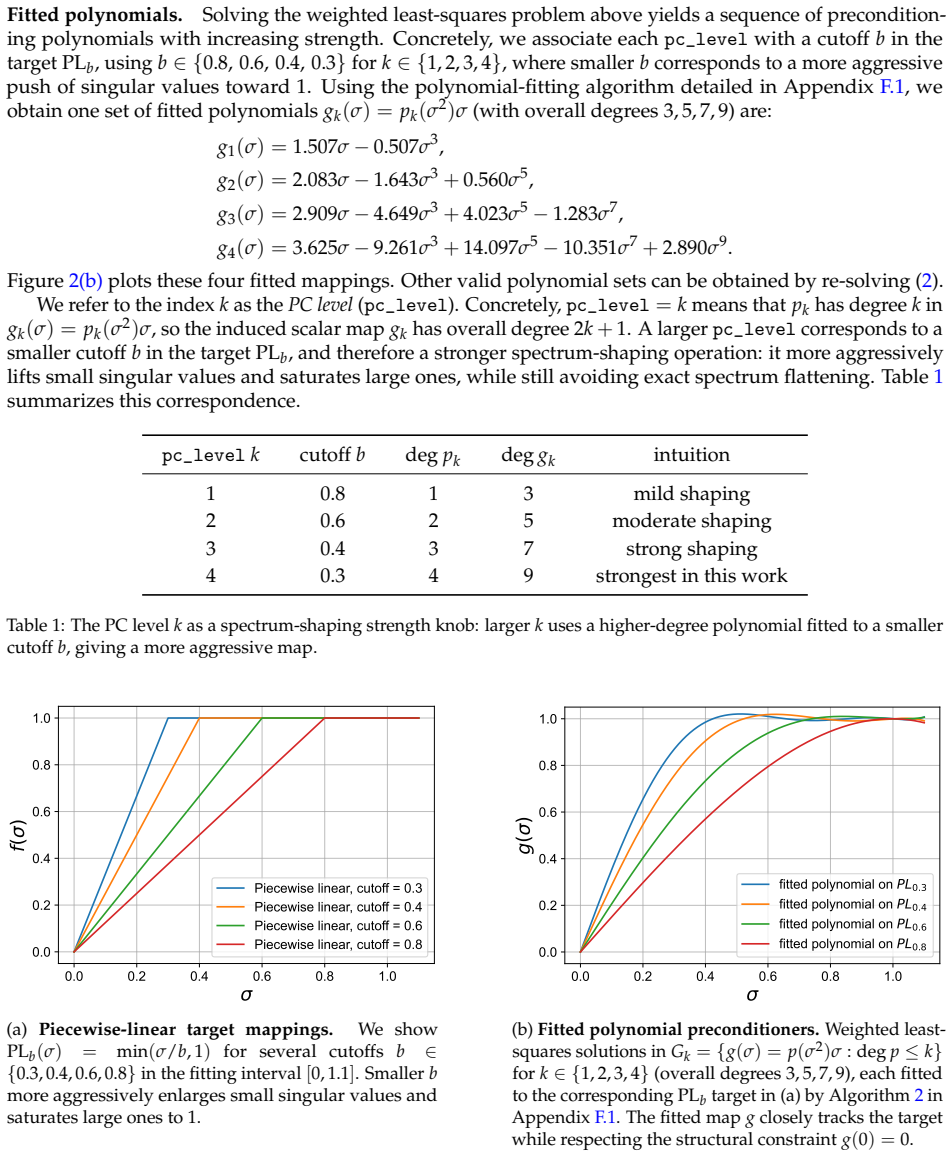
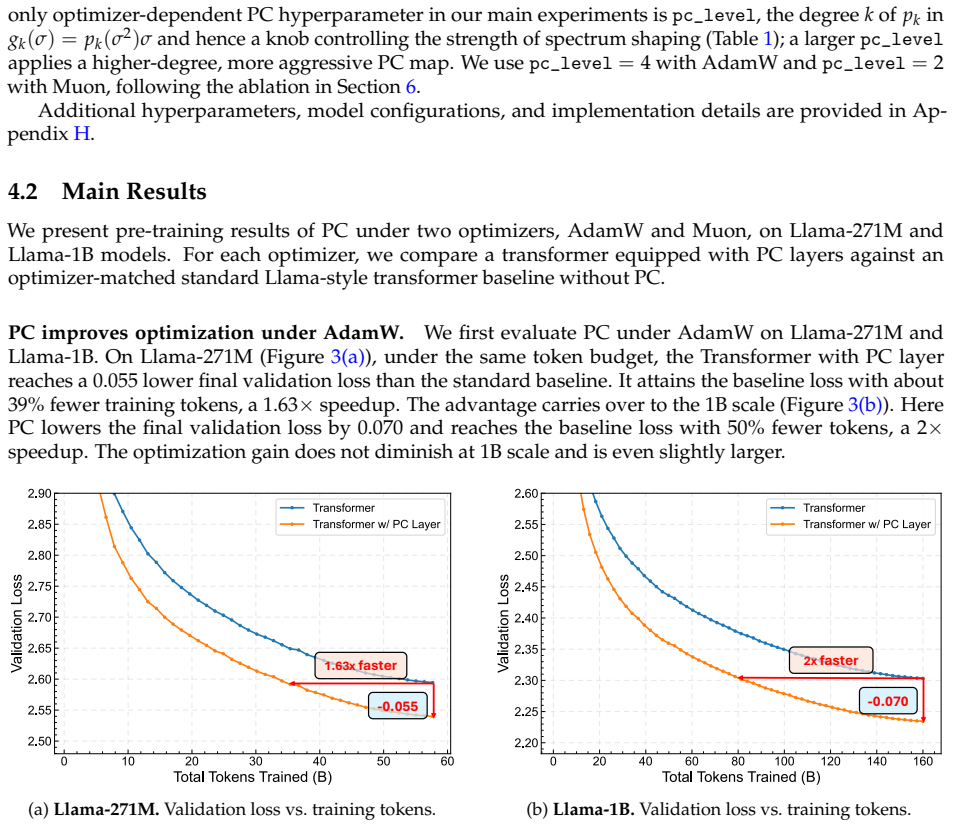
We propose a preconditioning (PC) layer, a weight parameterization via polynomial preconditioner that ensures stable weight conditioning throughout LLM training. The PC module reshapes the singular-value spectrum of weight matrices via low-degree polynomial preconditioning. After training, the preconditioned weights can be merged back into the original architecture, incurring no inference overhead. We demonstrate the advantage of the proposed PC layer over standard transformers in Llama-1B pre-training, for both the AdamW and Muon optimizers. Theoretically, we justify this spectrum-control principle by proving that uniformly bounding each layer's singular values ensures geometric convergence of gradient descent to global minima, for certain deep linear networks. Our code is available at https://github.com/Empath-aln/PC-layer.
Editorial analysis
A structured set of objections, weighed in public.
Referee Report
Summary. The paper proposes a PC (Polynomial Conditioning) layer that reparameterizes weight matrices in transformers via low-degree polynomial preconditioners to reshape their singular-value spectra and maintain stable conditioning during pre-training. The preconditioned weights merge back into the original architecture post-training with zero inference overhead. Empirical results claim improved training stability and performance for Llama-1B under both AdamW and Muon optimizers relative to standard transformers. A theoretical section proves that uniformly bounding each layer's singular values yields geometric convergence of gradient descent to global minima for certain deep linear networks.
Significance. If the empirical gains on Llama-1B prove robust and the spectrum-control mechanism transfers to nonlinear transformer blocks, the method would offer a practical, inference-free approach to improving optimizer stability in large-model training. The public code release is a clear strength supporting reproducibility. The linear-network convergence result is a clean, self-contained theoretical contribution, though its relevance to the LLM claims depends on an unshown transfer argument.
major comments (2)
- [§4] §4 (theoretical analysis): The geometric-convergence guarantee is derived only for deep linear networks under the assumption of uniformly bounded singular values per layer. No lemma, proposition, or argument is supplied showing that the polynomial preconditioner continues to enforce this bound once the weight matrix is composed inside a transformer block containing softmax attention and elementwise nonlinearities (GELU/SiLU).
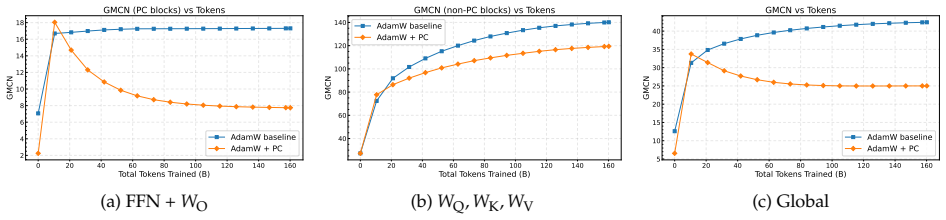
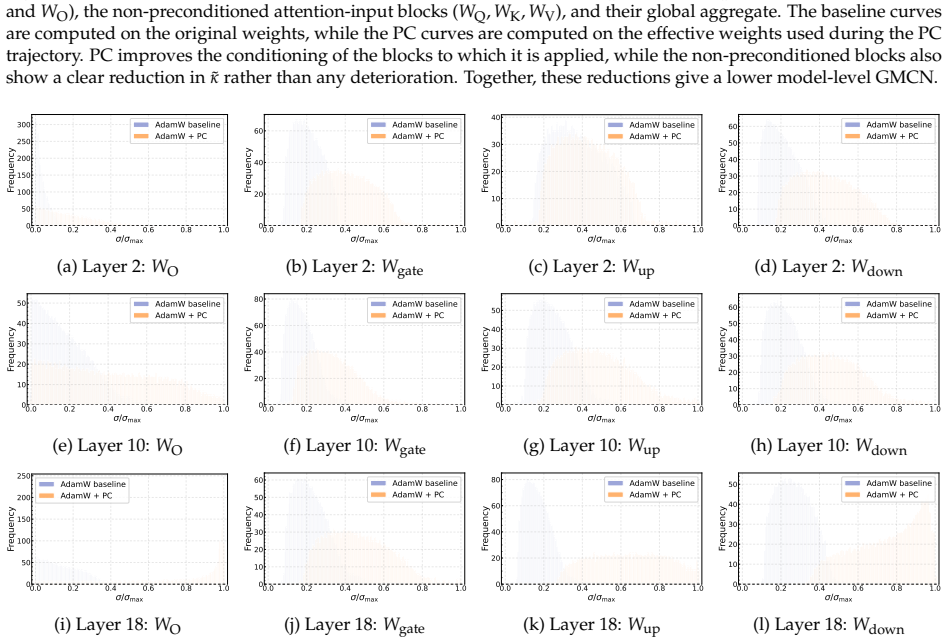
- [Llama-1B experiments] Llama-1B experiments section: The central empirical claim is that the PC layer improves stability via spectrum control, yet no table, figure, or checkpoint analysis reports the actual singular-value distributions (or their condition numbers) of the merged weights at any point during the 1B-scale run. Without this verification, it is impossible to confirm that the preconditioner is operating as intended inside the full nonlinear architecture.
minor comments (1)
- [Abstract / Introduction] The abstract and introduction use the phrase 'ensures stable weight conditioning' without a precise definition of the target spectrum (e.g., target condition-number bound or eigenvalue range); a short clarifying sentence would help readers map the method to the linear-network theorem.
Simulated Author's Rebuttal
We thank the referee for the thoughtful and constructive report. We address each major comment below, with revisions planned where the manuscript can be strengthened without misrepresenting its contributions.
read point-by-point responses
-
Referee: [§4] §4 (theoretical analysis): The geometric-convergence guarantee is derived only for deep linear networks under the assumption of uniformly bounded singular values per layer. No lemma, proposition, or argument is supplied showing that the polynomial preconditioner continues to enforce this bound once the weight matrix is composed inside a transformer block containing softmax attention and elementwise nonlinearities (GELU/SiLU).
Authors: We agree that the convergence result is stated only for deep linear networks. The manuscript does not supply a transfer argument or lemma for the nonlinear transformer setting. The linear analysis is presented as a clean justification for the spectrum-control principle in a controlled setting. We will revise §4 to explicitly state the scope of the theorem, remove any implication of direct applicability to transformers, and list extension to nonlinear blocks as future work. revision: yes
-
Referee: [Llama-1B experiments] Llama-1B experiments section: The central empirical claim is that the PC layer improves stability via spectrum control, yet no table, figure, or checkpoint analysis reports the actual singular-value distributions (or their condition numbers) of the merged weights at any point during the 1B-scale run. Without this verification, it is impossible to confirm that the preconditioner is operating as intended inside the full nonlinear architecture.
Authors: We acknowledge that direct measurement of singular-value spectra (or condition numbers) during the Llama-1B runs is absent. Such verification would strengthen the mechanistic claim. Computing full SVDs on all weight matrices at multiple checkpoints for a 1B-scale model is computationally prohibitive, so we relied on downstream stability and performance metrics as indirect evidence. We will add an explicit limitations paragraph in the experiments section noting this gap and the reliance on indirect indicators. revision: partial
Circularity Check
No significant circularity; derivation self-contained
full rationale
The paper's central claims consist of an empirical demonstration that the PC layer improves Llama-1B training stability under AdamW and Muon, plus a separate theoretical result that bounding singular values yields geometric GD convergence for certain deep linear networks. No equation, lemma, or claim in the abstract reduces a prediction to a fitted input by construction, invokes a self-citation as the sole justification for a uniqueness or ansatz step, or renames a known result as a new derivation. The linear-network proof is stated independently of the transformer experiments, and no load-bearing self-citation chain appears. The derivation chain therefore remains self-contained against external benchmarks.
Axiom & Free-Parameter Ledger
axioms (1)
- domain assumption Uniformly bounding each layer's singular values ensures geometric convergence of gradient descent to global minima for certain deep linear networks
Reference graph
Works this paper leans on
-
[1]
International Conference on Machine Learning , pages=
A convergence theory for deep learning via over-parameterization , author=. International Conference on Machine Learning , pages=. 2019 , organization=
2019
-
[2]
The polar express: Optimal matrix sign methods and their application to the
Amsel, Noah and Persson, David and Musco, Christopher and Gower, Robert M , journal=. The polar express: Optimal matrix sign methods and their application to the
-
[3]
International Conference on Learning Representations , year=
A convergence analysis of gradient descent for deep linear neural networks , author=. International Conference on Learning Representations , year=
-
[4]
Advances in Neural Information Processing Systems , volume=
On exact computation with an infinitely wide neural net , author=. Advances in Neural Information Processing Systems , volume=
-
[5]
Advances in Neural Information Processing Systems , volume=
Implicit regularization in deep matrix factorization , author=. Advances in Neural Information Processing Systems , volume=
-
[6]
arXiv preprint arXiv:1607.06450 , year=
Layer normalization , author=. arXiv preprint arXiv:1607.06450 , year=
-
[7]
Advances in Neural Information Processing Systems , volume=
Can we gain more from orthogonality regularizations in training deep networks? , author=. Advances in Neural Information Processing Systems , volume=
-
[8]
International Conference on Machine Learning , pages=
Gradient descent with identity initialization efficiently learns positive definite linear transformations by deep residual networks , author=. International Conference on Machine Learning , pages=. 2018 , organization=
2018
-
[9]
Journal of Computational Physics , volume=
Preconditioning techniques for large linear systems: a survey , author=. Journal of Computational Physics , volume=. 2002 , publisher=
2002
-
[10]
OPT 2024: Optimization for Machine Learning , year =
Old Optimizer, New Norm: An Anthology , author=. OPT 2024: Optimization for Machine Learning , year =
2024
-
[11]
Jeremy Bernstein , title =
-
[12]
Thinking Machines Lab: Connectionism , year =
Jeremy Bernstein , title =. Thinking Machines Lab: Connectionism , year =
-
[13]
Advances in Neural Information Processing Systems , volume=
On the inductive bias of neural tangent kernels , author=. Advances in Neural Information Processing Systems , volume=
-
[14]
2020 , month = apr, doi =
Bisk, Yonatan and Zellers, Rowan and Le Bras, Ronan and Gao, Jianfeng and Choi, Yejin , booktitle =. 2020 , month = apr, doi =
2020
-
[15]
Advances in Neural Information Processing Systems , volume=
Language models are few-shot learners , author=. Advances in Neural Information Processing Systems , volume=
-
[16]
International Conference on Machine Learning , pages=
Parseval networks: Improving robustness to adversarial examples , author=. International Conference on Machine Learning , pages=. 2017 , organization=
2017
-
[17]
Peter Clark and Isaac Cowhey and Oren Etzioni and Tushar Khot and Ashish Sabharwal and Carissa Schoenick and Oyvind Tafjord , title =. CoRR , volume =. 2018 , url =. 1803.05457 , timestamp =
Pith/arXiv arXiv 2018
-
[18]
Clark, Christopher and Lee, Kenton and Chang, Ming-Wei and Kwiatkowski, Tom and Collins, Michael and Toutanova, Kristina , booktitle=
-
[19]
Advances in Neural Information Processing Systems , volume=
A generalized neural tangent kernel analysis for two-layer neural networks , author=. Advances in Neural Information Processing Systems , volume=
-
[20]
2005 , publisher=
Matrix preconditioning techniques and applications , author=. 2005 , publisher=
2005
-
[21]
arXiv preprint arXiv:2506.15054 , year=
Muon Optimizes Under Spectral Norm Constraints , author=. arXiv preprint arXiv:2506.15054 , year=
-
[22]
International Conference on Learning Representations , year=
Gradient descent provably optimizes over-parameterized neural networks , author=. International Conference on Learning Representations , year=
-
[23]
International Conference on Machine Learning , pages=
Gradient descent finds global minima of deep neural networks , author=. International Conference on Machine Learning , pages=. 2019 , organization=
2019
-
[24]
International Conference on Machine Learning , pages=
Width provably matters in optimization for deep linear neural networks , author=. International Conference on Machine Learning , pages=. 2019 , organization=
2019
-
[25]
Transformer Circuits Thread , year =
A Mathematical Framework for Transformer Circuits , author =. Transformer Circuits Thread , year =
-
[26]
Cognitive science , volume=
Finding structure in time , author=. Cognitive science , volume=. 1990 , publisher=
1990
-
[27]
doi:10.5281/zenodo.12608602 , url =
Gao, Leo and Tow, Jonathan and Abbasi, Baber and Biderman, Stella and Black, Sid and DiPofi, Anthony and Foster, Charles and Golding, Laurence and Hsu, Jeffrey and Le Noac'h, Alain and Li, Haonan and McDonell, Kyle and Muennighoff, Niklas and Ociepa, Chris and Phang, Jason and Reynolds, Laria and Schoelkopf, Hailey and Skowron, Aviya and Sutawika, Lintang...
-
[28]
Precondition Layer and Its Use for
Tiantian Fang and Alex Schwing and Ruoyu Sun , year=. Precondition Layer and Its Use for
-
[29]
arXiv preprint arXiv:2505.22014 , year=
Learning in Compact Spaces with Approximately Normalized Transformer , author=. arXiv preprint arXiv:2505.22014 , year=
-
[30]
Nemotron-
Fu, Yonggan and Dong, Xin and Diao, Shizhe and Ye, Hanrong and Byeon, Wonmin and Karnati, Yashaswi and Liebenwein, Lucas and Zhang, Hannah and Binder, Nikolaus and Khadkevich, Maksim and others , journal=. Nemotron-
-
[31]
arXiv preprint arXiv:2403.08540 , year=
Language models scale reliably with over-training and on downstream tasks , author=. arXiv preprint arXiv:2403.08540 , year=
-
[32]
Proceedings of the 2021 Conference on Empirical Methods in Natural Language Processing , pages=
Transformer feed-forward layers are key-value memories , author=. Proceedings of the 2021 Conference on Empirical Methods in Natural Language Processing , pages=
2021
-
[33]
International Conference on Artificial Intelligence and Statistics , pages=
Understanding the difficulty of training deep feedforward neural networks , author=. International Conference on Artificial Intelligence and Statistics , pages=. 2010 , organization=
2010
-
[34]
Communications of the ACM , volume=
Generative adversarial networks , author=. Communications of the ACM , volume=. 2020 , publisher=
2020
-
[35]
Machine Learning , volume=
Regularisation of neural networks by enforcing lipschitz continuity , author=. Machine Learning , volume=. 2021 , publisher=
2021
-
[36]
Proceedings of the IEEE International Conference on Computer Vision , pages=
Delving deep into rectifiers: Surpassing human-level performance on imagenet classification , author=. Proceedings of the IEEE International Conference on Computer Vision , pages=
-
[37]
Findings of the Association for Computational Linguistics: EMNLP 2020 , pages=
Query-key normalization for transformers , author=. Findings of the Association for Computational Linguistics: EMNLP 2020 , pages=
2020
-
[38]
2008 , publisher=
Functions of matrices: theory and computation , author=. 2008 , publisher=
2008
-
[39]
arXiv preprint arXiv:2203.15556 , year=
Training compute-optimal large language models , author=. arXiv preprint arXiv:2203.15556 , year=
-
[40]
1819 , publisher=
Horner, William George , journal=. 1819 , publisher=
-
[41]
1994 , publisher=
Topics in matrix analysis , author=. 1994 , publisher=
1994
-
[42]
2012 , publisher=
Matrix analysis , author=. 2012 , publisher=
2012
-
[43]
International Conference on Learning Representations , year=
Provable benefit of orthogonal initialization in optimizing deep linear networks , author=. International Conference on Learning Representations , year=
-
[44]
Proceedings of the IEEE International Conference on Computer Vision , pages=
Centered weight normalization in accelerating training of deep neural networks , author=. Proceedings of the IEEE International Conference on Computer Vision , pages=
-
[45]
Proceedings of the AAAI Conference on Artificial Intelligence , volume=
Orthogonal weight normalization: Solution to optimization over multiple dependent stiefel manifolds in deep neural networks , author=. Proceedings of the AAAI Conference on Artificial Intelligence , volume=
-
[46]
Normalization techniques in training
Huang, Lei and Qin, Jie and Zhou, Yi and Zhu, Fan and Liu, Li and Shao, Ling , journal=. Normalization techniques in training. 2023 , publisher=
2023
-
[47]
International Conference on Machine Learning , pages=
Batch normalization: Accelerating deep network training by reducing internal covariate shift , author=. International Conference on Machine Learning , pages=. 2015 , organization=
2015
-
[48]
Advances in Neural Information Processing Systems , volume=
Neural tangent kernel: Convergence and generalization in neural networks , author=. Advances in Neural Information Processing Systems , volume=
-
[49]
International Conference on Learning Representations , year=
Gradient descent aligns the layers of deep linear networks , author=. International Conference on Learning Representations , year=
-
[50]
Proceedings of the IEEE Conference on Computer Vision and Pattern Recognition , pages=
Improving training of deep neural networks via singular value bounding , author=. Proceedings of the IEEE Conference on Computer Vision and Pattern Recognition , pages=
-
[51]
International Conference on Learning Representations , year=
On computation and generalization of generative adversarial networks under spectrum control , author=. International Conference on Learning Representations , year=
-
[52]
arXiv preprint arXiv:2603.14315 , year=
Enhancing LLM Training via Spectral Clipping , author=. arXiv preprint arXiv:2603.14315 , year=
-
[53]
SIAM Journal on Numerical Analysis , volume=
Polynomial preconditioners for conjugate gradient calculations , author=. SIAM Journal on Numerical Analysis , volume=. 1983 , publisher=
1983
-
[54]
2024 , url =
Keller Jordan and Yuchen Jin and Vlado Boza and Jiacheng You and Franz Cesista and Laker Newhouse and Jeremy Bernstein , title =. 2024 , url =
2024
-
[55]
arXiv preprint arXiv:2001.08361 , year=
Scaling laws for neural language models , author=. arXiv preprint arXiv:2001.08361 , year=
Pith/arXiv arXiv 2001
-
[56]
Proceedings of the IEEE/CVF Conference on Computer Vision and Pattern Recognition , pages=
Analyzing and improving the training dynamics of diffusion models , author=. Proceedings of the IEEE/CVF Conference on Computer Vision and Pattern Recognition , pages=
-
[57]
Advances in Neural Information Processing Systems , volume=
Deep learning without poor local minima , author=. Advances in Neural Information Processing Systems , volume=
-
[58]
2025 , month=
msign算子的Newton-Schulz迭代(上) , author=. 2025 , month=
2025
-
[59]
International Conference on Learning Representations , year=
Adam: A method for stochastic optimization , author=. International Conference on Learning Representations , year=
-
[60]
European conference on computer vision , pages=
Big transfer (bit): General visual representation learning , author=. European conference on computer vision , pages=. 2020 , organization=
2020
-
[61]
International Conference on Machine Learning , pages=
Deep linear networks with arbitrary loss: All local minima are global , author=. International Conference on Machine Learning , pages=. 2018 , organization=
2018
-
[62]
Proceedings of the IEEE , volume=
Gradient-based learning applied to document recognition , author=. Proceedings of the IEEE , volume=. 2002 , publisher=
2002
-
[63]
Advances in Neural Information Processing Systems , volume=
Wide neural networks of any depth evolve as linear models under gradient descent , author=. Advances in Neural Information Processing Systems , volume=
-
[64]
IEEE transactions on pattern analysis and machine intelligence , volume=
Orthogonal deep neural networks , author=. IEEE transactions on pattern analysis and machine intelligence , volume=. 2019 , publisher=
2019
-
[65]
Wanchao Liang and Tianyu Liu and Less Wright and Will Constable and Andrew Gu and Chien-Chin Huang and Iris Zhang and Wei Feng and Howard Huang and Junjie Wang and Sanket Purandare and Gokul Nadathur and Stratos Idreos , booktitle=
-
[66]
Advances in Neural Information Processing Systems , volume=
Faster Directional Convergence of Linear Neural Networks under Spherically Symmetric Data , author=. Advances in Neural Information Processing Systems , volume=
-
[67]
International Conference on Machine Learning , pages=
Learning by turning: Neural architecture aware optimisation , author=. International Conference on Machine Learning , pages=. 2021 , organization=
2021
-
[68]
Muon is scalable for
Liu, Jingyuan and Su, Jianlin and Yao, Xingcheng and Jiang, Zhejun and Lai, Guokun and Du, Yulun and Qin, Yidao and Xu, Weixin and Lu, Enzhe and Yan, Junjie and others , journal=. Muon is scalable for
-
[69]
Loshchilov, Ilya and Hsieh, Cheng-Ping and Sun, Simeng and Ginsburg, Boris , booktitle=. n
-
[70]
International Conference on Learning Representations , year=
Decoupled weight decay regularization , author=. International Conference on Learning Representations , year=
-
[71]
Can a suit of armor conduct electricity? a new dataset for open book question answering
Mihaylov, Todor and Clark, Peter and Khot, Tushar and Sabharwal, Ashish. Can a suit of armor conduct electricity? a new dataset for open book question answering. Proceedings of the 2018 Conference on Empirical Methods in Natural Language Processing. 2018. doi:10.18653/v1/D18-1260
-
[72]
International Conference on Learning Representations , year=
Spectral normalization for generative adversarial networks , author=. International Conference on Learning Representations , year=
-
[73]
Training Transformers with Enforced
Newhouse, Laker and Hess, R Preston and Cesista, Franz and Zahorodnii, Andrii and Bernstein, Jeremy and Isola, Phillip , journal=. Training Transformers with Enforced
-
[74]
International Conference on Machine Learning , pages=
The loss surface of deep and wide neural networks , author=. International Conference on Machine Learning , pages=. 2017 , organization=
2017
-
[75]
Advances in Neural Information Processing Systems , volume=
Global convergence of deep networks with one wide layer followed by pyramidal topology , author=. Advances in Neural Information Processing Systems , volume=
-
[76]
The LAMBADA dataset: Word prediction requiring a broad discourse context
Paperno, Denis and Kruszewski, Germ \'a n and Lazaridou, Angeliki and Pham, Ngoc Quan and Bernardi, Raffaella and Pezzelle, Sandro and Baroni, Marco and Boleda, Gemma and Fern \'a ndez, Raquel. The LAMBADA dataset: Word prediction requiring a broad discourse context. Proceedings of the 54th Annual Meeting of the Association for Computational Linguistics (...
-
[77]
Penedo, Guilherme and Kydl. The. Advances in Neural Information Processing Systems , volume=
-
[78]
Advances in Neural Information Processing Systems , volume=
Resurrecting the sigmoid in deep learning through dynamical isometry: theory and practice , author=. Advances in Neural Information Processing Systems , volume=
-
[79]
arXiv preprint arXiv:1903.10520 , year=
Micro-batch training with batch-channel normalization and weight standardization , author=. arXiv preprint arXiv:1903.10520 , year=
arXiv 1903
-
[80]
Reparameterized
Qiu, Zeju and Buchholz, Simon and Xiao, Tim and Dax, Maximilian and Sch. Reparameterized. Advances in Neural Information Processing Systems , volume=
discussion (0)
Sign in with ORCID, Apple, or X to comment. Anyone can read and Pith papers without signing in.