Iterative AI-guided optimisation of selective triple-drug combinations for breast cancer
Pith reviewed 2026-06-27 22:39 UTC · model grok-4.3
The pith
An iterative AI system using machine learning predictions and lab tests can discover selective three-drug combinations that kill breast cancer cells while sparing healthy ones.
A machine-rendered reading of the paper's core claim, the machinery that carries it, and where it could break.
Core claim
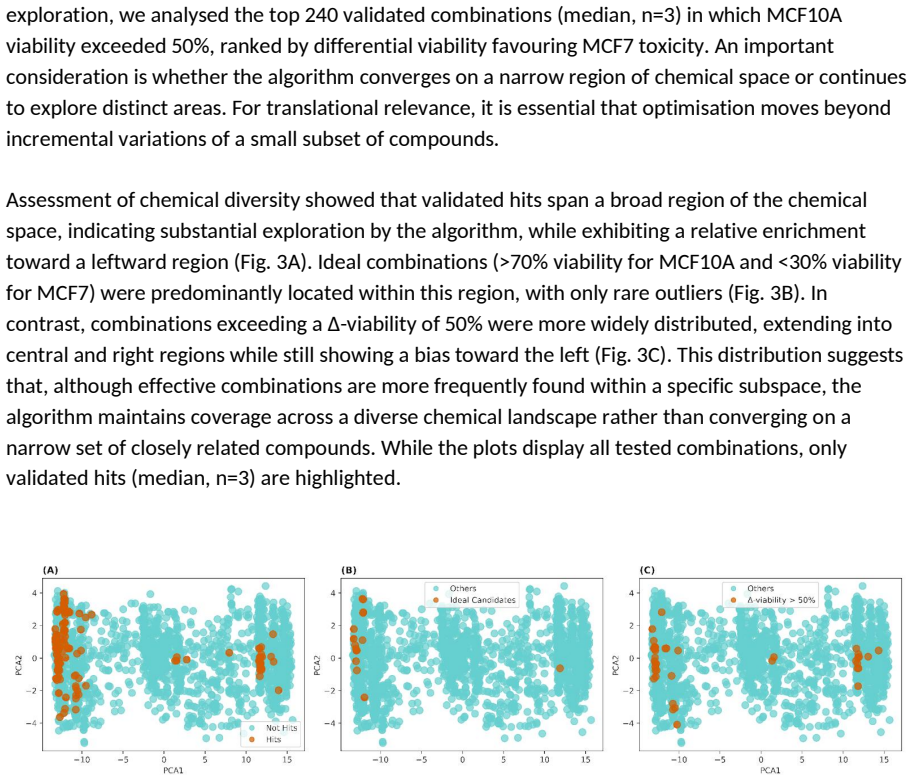
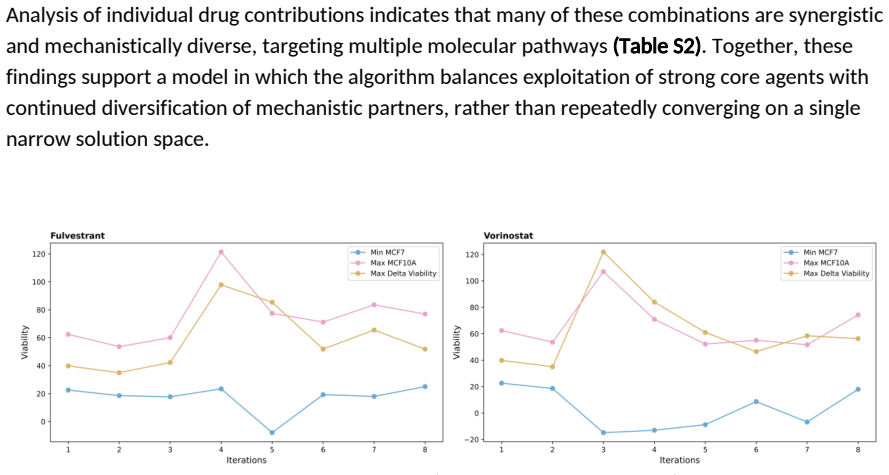
We present an AI-guided, QSAR-driven iterative optimisation framework that integrates machine learning with automated experimental screening to enable closed-loop discovery of selective multi-drug therapies. Starting from an initial random screen, the system iteratively predicts, tests, and refines three-drug combinations targeting MCF7 breast cancer cells. Incorporation of non-tumorigenic MCF10A cells enables explicit optimisation of tumour-selective efficacy, prioritising regimens that maximise cancer cell killing while sparing healthy cells. Across successive iterations, the framework rapidly enriched for highly selective, high-efficacy combinations, while maintaining chemical and mechani
What carries the argument
The closed-loop cycle in which quantitative structure-activity relationship models trained on prior experimental results predict and select new three-drug combinations for automated testing.
If this is right
- The method can navigate millions of possible three-drug combinations down to a small set of validated tumour-selective regimens.
- Chemical and mechanistic diversity is preserved across iterations instead of collapsing to similar solutions.
- Explicit inclusion of healthy-cell data allows direct optimisation for selectivity rather than efficacy alone.
- Continuous incorporation of new experimental results improves the model's guidance in each cycle.
Where Pith is reading between the lines
- The same loop could be run with cell lines from other cancer types to generate regimens tailored to different tumour profiles.
- Adding genomic or proteomic features from individual patient tumours might allow the predictions to shift toward personalised combinations.
- If the enrichment holds, the approach could cut the number of physical tests needed by orders of magnitude compared with brute-force screening.
Load-bearing premise
The machine learning model trained on the first random screen can predict the results of untested combinations accurately enough to produce real improvements in later rounds.
What would settle it
Running the full iterative process and finding that the combinations chosen in later rounds show no higher average selectivity or efficacy than those from the initial random screen, or that model predictions match experiments no better than chance.
Figures


read the original abstract
Personalised cancer therapy aims to tailor treatment to individual tumour profiles, yet tumour heterogeneity and adaptive resistance continue to limit clinical efficacy. Drug combinations offer a strategy to overcome resistance by simultaneously targeting multiple pathways, but their rational design is constrained by the vast combinatorial search space and experimental cost. Here, we present an AI-guided, QSAR-driven iterative optimisation framework that integrates machine learning with automated experimental screening to enable closed-loop discovery of selective multi-drug therapies. Starting from an initial random screen, the system iteratively predicts, tests, and refines three-drug combinations targeting MCF7 breast cancer cells. Incorporation of non-tumorigenic MCF10A cells enables explicit optimisation of tumour-selective efficacy, prioritising regimens that maximise cancer cell killing while sparing healthy cells. Across successive iterations, the framework rapidly enriched for highly selective, high-efficacy combinations, while maintaining chemical and mechanistic diversity and avoiding convergence on a narrow solution space. By continuously learning from experimental feedback, the approach efficiently navigates millions of combinations to identify a small set of validated, tumour-selective regimens. These results establish a scalable proof-of-concept for AI-driven, closed-loop optimisation of higher-order drug combinations, demonstrating how iterative integration of computation and experimentation can enable adaptive and potentially personalised therapeutic design in precision oncology.
Editorial analysis
A structured set of objections, weighed in public.
Referee Report
Summary. The manuscript presents an AI-guided, QSAR-driven iterative optimization framework for discovering selective triple-drug combinations targeting MCF7 breast cancer cells while sparing MCF10A normal cells. Starting from an initial random experimental screen, the system trains a machine learning model to predict efficacy and selectivity, then iteratively selects, tests, and refines combinations from a large search space, claiming rapid enrichment for high-efficacy, tumor-selective regimens while preserving chemical and mechanistic diversity.
Significance. If the QSAR model's predictive accuracy on untested triple combinations is demonstrated to be high, the work would provide a scalable proof-of-concept for closed-loop computational-experimental optimization of higher-order drug combinations, addressing the combinatorial explosion problem in precision oncology. The explicit incorporation of selectivity via parallel MCF7/MCF10A screening is a notable strength.
major comments (2)
- [Abstract, Results] Abstract and Results: The central claim of 'rapid enrichment' for selective, high-efficacy combinations across iterations is asserted without any reported quantitative metrics, such as model cross-validation performance (R², RMSE, or AUC on held-out triple combinations), enrichment factors relative to random sampling, statistical tests for iteration-to-iteration improvement, or error bars on efficacy/selectivity values. This absence prevents assessment of whether the iterative process is model-driven or equivalent to biased sampling.
- [Methods, Results] Methods/Results: The QSAR model is described as trained on an initial random screen of three-drug combinations, yet no details are provided on its formulation for capturing higher-order drug interactions (e.g., explicit synergy terms, multi-task learning for MCF7 vs MCF10A, or handling of combination-specific features). Standard single-molecule QSAR approaches carry substantial extrapolation risk to untested triples; without held-out accuracy numbers or ablation studies, the iterative optimization's reliability cannot be evaluated.
minor comments (2)
- [Methods] Clarify the total number of combinations screened per iteration and the size of the initial random screen to allow readers to gauge the scale of the search space navigated.
- [Results] Provide the chemical diversity metrics (e.g., Tanimoto similarity distributions) and mechanistic diversity measures used to support the claim of maintained diversity across iterations.
Simulated Author's Rebuttal
We thank the referee for their constructive feedback. We address the major comments below and will revise the manuscript to incorporate the requested quantitative metrics and expanded model details.
read point-by-point responses
-
Referee: [Abstract, Results] Abstract and Results: The central claim of 'rapid enrichment' for selective, high-efficacy combinations across iterations is asserted without any reported quantitative metrics, such as model cross-validation performance (R², RMSE, or AUC on held-out triple combinations), enrichment factors relative to random sampling, statistical tests for iteration-to-iteration improvement, or error bars on efficacy/selectivity values. This absence prevents assessment of whether the iterative process is model-driven or equivalent to biased sampling.
Authors: We agree that quantitative support for the enrichment claim is necessary for rigorous evaluation. In the revised manuscript we will add cross-validation performance (R², RMSE, AUC on held-out triples), enrichment factors versus random sampling, statistical tests for iteration-to-iteration gains, and error bars on efficacy/selectivity measurements. These additions will demonstrate that the observed improvements are model-driven. revision: yes
-
Referee: [Methods, Results] Methods/Results: The QSAR model is described as trained on an initial random screen of three-drug combinations, yet no details are provided on its formulation for capturing higher-order drug interactions (e.g., explicit synergy terms, multi-task learning for MCF7 vs MCF10A, or handling of combination-specific features). Standard single-molecule QSAR approaches carry substantial extrapolation risk to untested triples; without held-out accuracy numbers or ablation studies, the iterative optimization's reliability cannot be evaluated.
Authors: We acknowledge that additional methodological detail is required. The revised Methods section will describe the model’s handling of higher-order interactions via combination-specific features and multi-task learning across MCF7/MCF10A readouts. We will also report held-out accuracy and any ablation experiments performed. revision: yes
Circularity Check
No circularity: enrichment claim rests on experimental feedback loop, not self-referential derivation
full rationale
The paper presents an iterative experimental framework: an initial random screen trains a QSAR model, which then ranks untested triple combinations for automated testing; results feed back to retrain and repeat. No equations, fitted parameters, or uniqueness theorems are invoked. The central enrichment result is measured by post-iteration experimental outcomes (selectivity and efficacy on MCF7 vs MCF10A), which are independent of the model's internal predictions. No self-citations appear as load-bearing premises, and no step reduces a claimed prediction to a fitted input by construction. The derivation chain is therefore self-contained against external benchmarks.
Axiom & Free-Parameter Ledger
Reference graph
Works this paper leans on
-
[1]
N., Fourches, D., Varnek, A., Baskin, I
Cherkasov, A., Muratov, E. N., Fourches, D., Varnek, A., Baskin, I. I., Cronin, M., Dearden, J., Gramatica, P., Martin, Y. C., Todeschini, R., Consonni, V., Kuz'min, V. E., Cramer, R., Benigni, R., Yang, C., Rathman, J., Terfloth, L., Gasteiger, J., Richard, A., & Tropsha, A. (2014). QSAR modeling: where have you been? Where are you going to?. Journal of ...
-
[2]
Al-Lazikani, B., Banerji, U., & Workman, P. (2012). Combinatorial drug therapy for cancer in the post-genomic era. Nature biotechnology, 30(7), 679–692. https://doi.org/10.1038/nbt.2284
-
[3]
Vamathevan, J., Clark, D., Czodrowski, P., Dunham, I., Ferran, E., Lee, G., Li, B., Madabhushi, A., Shah, P., Spitzer, M., & Zhao, S. (2019). Applications of machine learning in drug discovery and development. Nature reviews. Drug discovery, 18(6), 463–477. https://doi.org/10.1038/s41573-019-0024-5
-
[4]
Tropsha, A., Isayev, O., Varnek, A., Schneider, G., & Cherkasov, A. (2024). Integrating QSAR modelling and deep learning in drug discovery: the emergence of deep QSAR. Nature reviews. Drug discovery, 23(2), 141–155. https://doi.org/10.1038/s41573-023-00832-0
-
[5]
Letai A. (2017). Functional precision cancer medicine-moving beyond pure genomics. Nature medicine, 23(9), 1028–1035. https://doi.org/10.1038/nm.4389
-
[6]
Perspective: The precision-oncology illusion
Prasad, V. Perspective: The precision-oncology illusion. Nature 537, S63 (2016). https://doi.org/10.1038/537S63a
-
[7]
Abdel-Rehim, A., Orhobor, O., Griffiths, G., Soldatova, L., & King, R. D. (2025). Establishing predictive machine learning models for drug responses in patient derived cell culture. NPJ precision oncology, 9(1), 180. https://doi.org/10.1038/s41698-025-00937-2
-
[9]
Dolgin E. (2024). The future of precision cancer therapy might be to try everything. Nature, 626(7999), 470–473. https://doi.org/10.1038/d41586-024-00392-2
-
[10]
Dobrolecki, L. E. et al., (2016). Patient-derived xenograft (PDX) models in basic and translational breast cancer research. Cancer metastasis reviews, 35(4), 547–573. https://doi.org/10.1007/s10555-016-9653-x
-
[11]
Weeber, F. et al., (2015). Preserved genetic diversity in organoids cultured from biopsies of human colorectal cancer metastases. Proceedings of the National Academy of Sciences of the United States of America, 112(43), 13308–13311. https://doi.org/10.1073/pnas.1516689112
-
[12]
Wensink, G.E., Elias, S.G., Mullenders, J. et al. Patient-derived organoids as a predictive biomarker for treatment response in cancer patients. npj Precis. Onc. 5, 30 (2021). https://doi.org/10.1038/s41698-021-00168-1
-
[13]
Liebers, N. et al., Ex vivo drug response profiling for response and outcome prediction in hematologic malignancies: the prospective non-interventional SMARTrial. Nat Cancer 4, 1648–1659 (2023). https://doi.org/10.1038/s43018-023-00645-5
-
[14]
Snijder, B. et al., (2017). Image-based ex-vivo drug screening for patients with aggressive haematological malignancies: interim results from a single-arm, open-label, pilot study. The Lancet. Haematology, 4(12), e595–e606. https://doi.org/10.1016/S2352-3026(17)30208-9
-
[15]
Kornauth, C. et al., (2022). Functional Precision Medicine Provides Clinical Benefit in Advanced Aggressive Hematologic Cancers and Identifies Exceptional Responders. Cancer discovery, 12(2), 372–387. https://doi.org/10.1158/2159-8290.CD-21-0538
-
[16]
Wang, S., Allauzen, A., Nghe, P., & Opuu, V. (2025). A guide for active learning in synergistic drug discovery. Scientific reports, 15(1), 3484. https://doi.org/10.1038/s41598-025-85600-3
-
[17]
A joint diffusion/collision model for crystal growth in pure liquid metals,
Tosh, C., Tec, M., White, J. B., Quinn, J. F., Ibanez Sanchez, G., Calder, P., Kung, A. L., Dela Cruz, F. S., & Tansey, W. (2025). A Bayesian active learning platform for scalable combination drug screens. Nature communications, 16(1), 156. https://doi.org/10.1038/s41467-024- 55287-7
-
[18]
Jin, S., Li, X., Yang, G., Zhang, Z., Shi, J. Q., Liu, Y., & Zhao, C. X. (2025). Active Learning-Based Prediction of Drug Combination Efficacy. ACS nano, 19(18), 17929–17940. https://doi.org/10.1021/acsnano.5c04810
-
[19]
Morrison, B. L., Mullendore, M. E., Stockwin, L. H., Borgel, S., Hollingshead, M. G., & Newton, D. L. (2013). Oxyphenisatin acetate (NSC 59687) triggers a cell starvation response leading to autophagy, mitochondrial dysfunction, and autocrine TNFα-mediated apoptosis. Cancer medicine, 2(5), 687–700. https://doi.org/10.1002/cam4.107
-
[20]
Cong, H., Xu, L., Wu, Y., Qu, Z., Bian, T., Zhang, W., Xing, C., & Zhuang, C. (2019). Inhibitor of Apoptosis Protein (IAP) Antagonists in Anticancer Agent Discovery: Current Status and Perspectives. Journal of medicinal chemistry, 62(12), 5750–5772. https://doi.org/10.1021/acs.jmedchem.8b01668
-
[21]
Zhang, H. P., Jiang, R. Y., Zhu, J. Y., Sun, K. N., Huang, Y., Zhou, H. H., Zheng, Y. B., & Wang, X. J. (2024). PI3K/AKT/mTOR signaling pathway: an important driver and therapeutic target in triple-negative breast cancer. Breast cancer (Tokyo, Japan), 31(4), 539–551. https://doi.org/10.1007/s12282-024-01567-5
-
[22]
Campone, M., Im, S. A., Iwata, H., Clemons, M., Ito, Y., Awada, A., Chia, S., Jagiełło-Gruszfeld, A., Pistilli, B., Tseng, L. M., Hurvitz, S., Masuda, N., Cortés, J., De Laurentiis, M., Arteaga, C. L., Jiang, Z., Jonat, W., Le Mouhaër, S., Sankaran, B., Bourdeau, L., … Baselga, J. (2018). Buparlisib plus fulvestrant versus placebo plus fulvestrant for pos...
-
[23]
Regua, A. T., Najjar, M., & Lo, H. W. (2022). RET signaling pathway and RET inhibitors in human cancer. Frontiers in oncology, 12, 932353. https://doi.org/10.3389/fonc.2022.932353
discussion (0)
Sign in with ORCID, Apple, or X to comment. Anyone can read and Pith papers without signing in.