The short and long of iPhoton science for a boosted Hubble
Pith reviewed 2026-06-27 23:19 UTC · model grok-4.3
The pith
A dedicated multi-orbit Hubble program using unique UV spectrographs can map how ionizing photons escape from star-forming galaxies to prepare for the Habitable Worlds Observatory.
A machine-rendered reading of the paper's core claim, the machinery that carries it, and where it could break.
Core claim
Boosting the Hubble Space Telescope will provide unique opportunities to carry out precursor science for the Habitable Worlds Observatory by determining the properties of star forming galaxies that contribute to creating and sustaining the universe in a mostly ionized state, through a deep panchromatic spectroscopic effort that answers questions on the shape of escaping ionizing radiation, captures missing spectral regions, and explores star formation history similarities to LyC leakers.
What carries the argument
The farUV and nearUV spectroscopic capabilities of the Cosmic Origins Spectrograph (COS) and the Space Telescope Imaging Spectrograph (STIS), deployed in a multi-orbit program unencumbered by orbit competition and open to the ionizing photon community.
If this is right
- The program would determine the properties of star-forming galaxies that sustain the ionized state of the universe.
- It would answer questions on the shape of rest-frame ionizing radiation escaping from galaxies at modest redshift.
- It would capture crucial missing spectral regions in panchromatic galaxy observations.
- It would test whether star formation histories in these galaxies match those of known LyC leakers.
- It would deliver lower-cost precursor science for the Habitable Worlds Observatory while enabling crowd-sourced community contributions.
Where Pith is reading between the lines
- This approach could serve as a template for future large telescopes to allocate dedicated blocks of time to specific science themes without standard proposal competition.
- The resulting data archive might be cross-matched with ground-based or other space observations to refine models of how galaxies drove reionization.
- If the unique UV capabilities remain unmatched, the program effectively extends Hubble's role in ionization studies into the era of next-generation observatories.
- Lower operating costs from reduced competition might encourage similar community-access models on other facilities facing high demand.
Load-bearing premise
The farUV and nearUV spectroscopic capabilities of COS and STIS are unique and unlikely to be replicated in the near future.
What would settle it
Announcement or launch of a new space-based instrument that matches or exceeds the far-UV and near-UV spectroscopic performance of COS and STIS before the proposed multi-orbit program can be completed.
Figures

read the original abstract
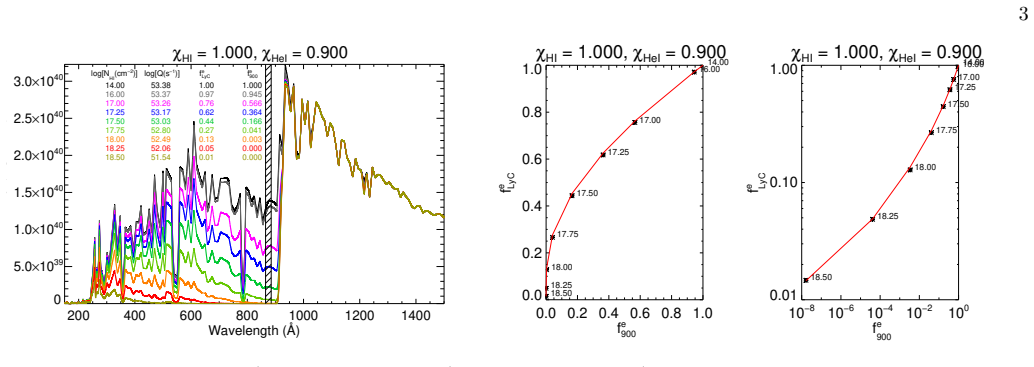
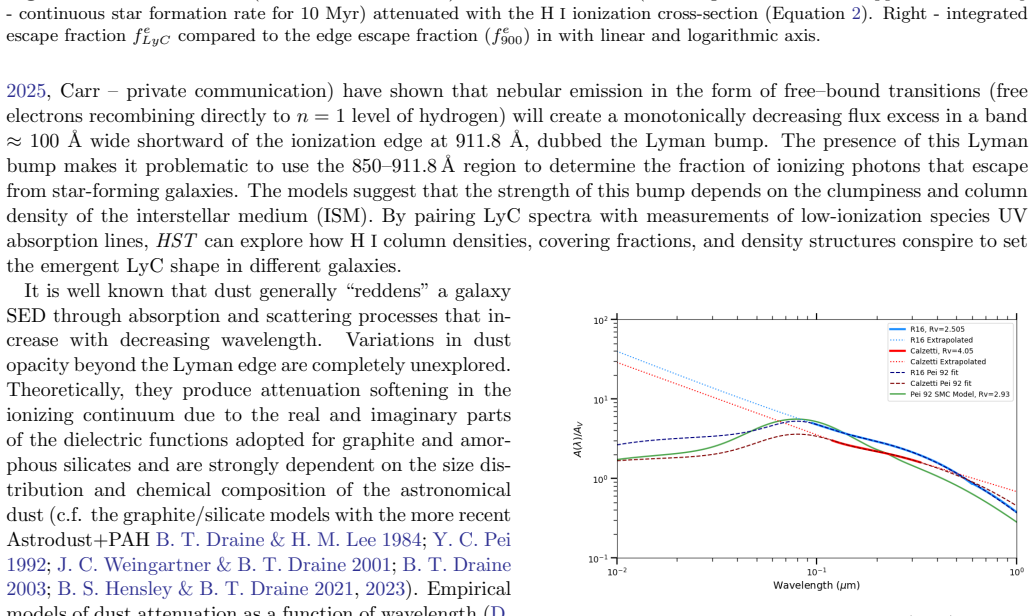
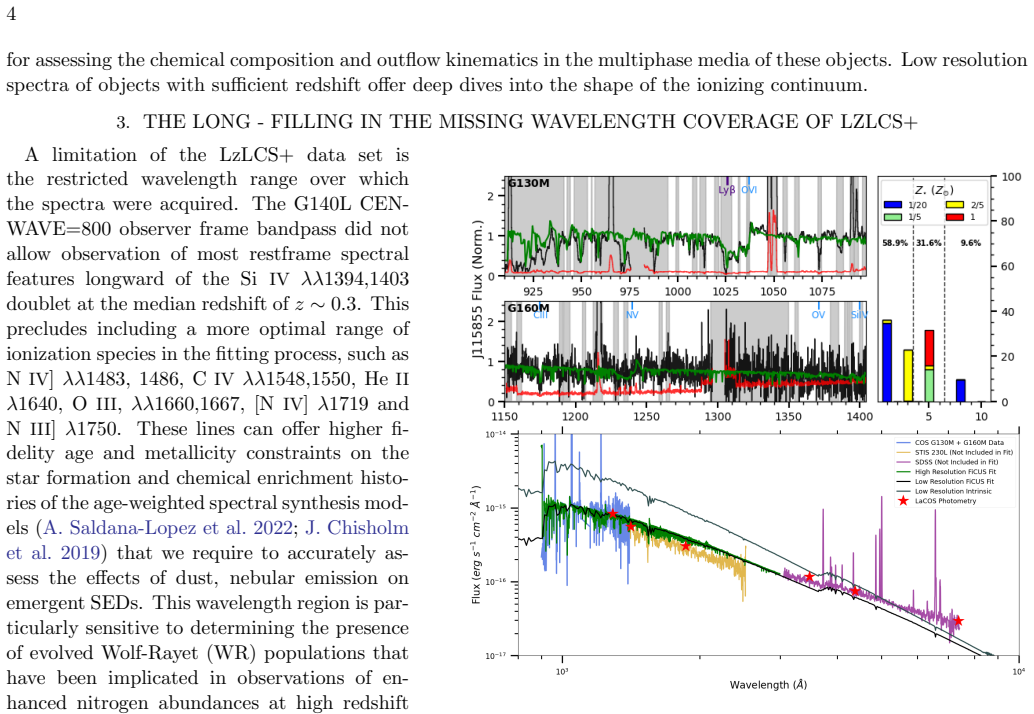
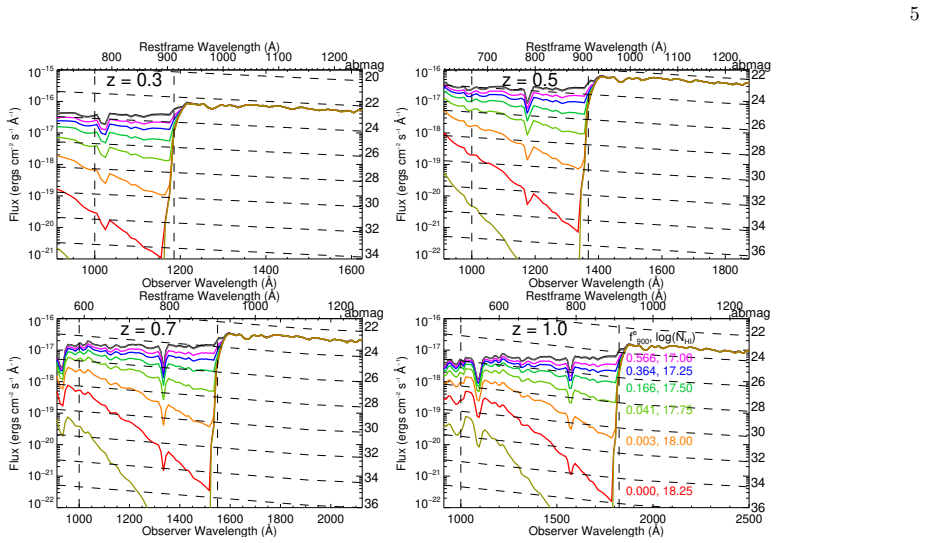
Boosting the Hubble Space Telescope (HST) will provide unique opportunities to carry out precursor science for the Habitable Worlds Observatory (HWO). Chief among them are science cases for determining the properties of star forming galaxies that contribute to creating and sustaining the universe in a mostly ionized state. The farUV and nearUV spectroscopic capabilities of the Cosmic Origins Spectrograph (COS) and the Space Telescope Imaging Spectrograph (STIS) are unique and unlikely to be replicated in the near future. Here we describe the benefits of a deep panchromatic spectroscopic effort to answer questions concerning the shape of the rest frame ionizing radiation escaping from star forming galaxies at modest redshift, capture crucial missing spectral regions, and explore whether their star formation histories are truly similar to the LyC leakers responsible for initiating and later sustaining the mostly-ionized-state of the universe. An observing program emphasizing multi-orbit observations, unencumbered by HST orbit competition and freely accessible to the wider ionizing photon (iPhoton) community, will catalyze crowd-sourced answers to these questions and offer a lower operating cost price point.
Editorial analysis
A structured set of objections, weighed in public.
Referee Report
Summary. The manuscript proposes that boosting the Hubble Space Telescope would enable a deep panchromatic UV spectroscopic program using COS and STIS to study the shape of ionizing radiation escaping from star-forming galaxies at modest redshift, capture missing spectral regions, and compare their star-formation histories to LyC leakers. It asserts that these far-UV/near-UV capabilities are unique and unlikely to be replicated soon, and advocates for a multi-orbit observing program unencumbered by orbit competition and freely accessible to the iPhoton community to catalyze crowd-sourced answers at lower cost as precursor science for the Habitable Worlds Observatory.
Significance. If the asserted uniqueness of COS/STIS capabilities and the feasibility of the proposed program hold, the work could outline a pathway for community-driven UV spectroscopy that addresses key questions in galaxy ionization and reionization. However, the manuscript contains no quantitative predictions, sensitivity comparisons, mission timelines, or feasibility analysis, so its significance remains speculative and dependent on external validation of the core premise.
major comments (1)
- [Abstract] Abstract: The central claim that 'the farUV and nearUV spectroscopic capabilities of the Cosmic Origins Spectrograph (COS) and the Space Telescope Imaging Spectrograph (STIS) are unique and unlikely to be replicated in the near future' is asserted without any comparison to existing or planned facilities, resolution/sensitivity metrics, or timelines. This premise is load-bearing for the rationale that a boosted-HST program offers irreplaceable advantages and lower-cost community access.
Simulated Author's Rebuttal
We thank the referee for their review of our manuscript on boosted HST for iPhoton science. We address the major comment below.
read point-by-point responses
-
Referee: [Abstract] Abstract: The central claim that 'the farUV and nearUV spectroscopic capabilities of the Cosmic Origins Spectrograph (COS) and the Space Telescope Imaging Spectrograph (STIS) are unique and unlikely to be replicated in the near future' is asserted without any comparison to existing or planned facilities, resolution/sensitivity metrics, or timelines. This premise is load-bearing for the rationale that a boosted-HST program offers irreplaceable advantages and lower-cost community access.
Authors: We agree that the uniqueness claim is presented without explicit supporting comparisons in the manuscript. We will revise the abstract and add a short dedicated paragraph in the introduction comparing COS/STIS far-UV/near-UV performance (wavelength coverage, resolution, and sensitivity) to planned facilities such as HWO concepts and other proposed UV missions, to substantiate why these capabilities are unlikely to be replicated soon. Detailed quantitative sensitivity metrics and mission timelines are outside the scope of this conceptual proposal. revision: yes
Circularity Check
No circularity; forward-looking proposal with no derivations, fits, or self-referential chains
full rationale
The document is a science proposal advocating for HST observations. It contains no equations, no fitted parameters, no predictions derived from data, and no derivation chain. The central premise (uniqueness of COS/STIS UV capabilities) is asserted directly in the abstract without reference to prior work by the same authors or any internal reduction. No self-citation load-bearing steps, ansatz smuggling, or renaming of known results appear. The text is self-contained as an advocacy document; its claims rest on external assertions rather than tautological internal logic.
Axiom & Free-Parameter Ledger
Reference graph
Works this paper leans on
-
[1]
2001, PASP, 113, 1449, doi: 10.1086/324269
Calzetti, D. 2001, PASP, 113, 1449, doi: 10.1086/324269
-
[2]
2023, A&A, 673, L7, doi: 10.1051/0004-6361/202346410
Charbonnel, C., Schaerer, D., Prantzos, N., et al. 2023, A&A, 673, L7, doi: 10.1051/0004-6361/202346410
-
[3]
Chisholm, J., Rigby, J. R., Bayliss, M., et al. 2019, ApJ, 882, 182, doi: 10.3847/1538-4357/ab3104
-
[4]
Draine, B. T. 2003, ApJ, 598, 1017, doi: 10.1086/379118
-
[5]
Draine, B. T., & Lee, H. M. 1984, ApJ, 285, 89, doi: 10.1086/162480
-
[6]
2024, in Society of Photo-Optical Instrumentation Engineers (SPIE) Conference Series, Vol
Fucik, J. 2024, in Society of Photo-Optical Instrumentation Engineers (SPIE) Conference Series, Vol. 13093, Space Telescopes and Instrumentation 2024: Ultraviolet to Gamma Ray, ed. J.-W. A. den Herder, S. Nikzad, & K. Nakazawa, 130933I, doi: 10.1117/12.3020427
-
[7]
Gordon, K. 2024, The Journal of Open Source Software, 9, 7023, doi: 10.21105/joss.07023
-
[8]
Hensley, B. S., & Draine, B. T. 2021, ApJ, 906, 73, doi: 10.3847/1538-4357/abc8f1
-
[9]
Hensley, B. S., & Draine, B. T. 2023, ApJ, 948, 55, doi: 10.3847/1538-4357/acc4c2
-
[10]
Inoue, A. K. 2010, MNRAS, 401, 1325, doi: 10.1111/j.1365-2966.2009.15730.x
-
[11]
Inoue, A. K., & Iwata, I. 2008, MNRAS, 387, 1681, doi: 10.1111/j.1365-2966.2008.13350.x
-
[12]
K., Shimizu, I., Iwata, I., & Tanaka, M
Inoue, A. K., Shimizu, I., Iwata, I., & Tanaka, M. 2014, MNRAS, 442, 1805, doi: 10.1093/mnras/stu936
-
[13]
Inoue, A. K., Kousai, K., Iwata, I., et al. 2011, MNRAS, 411, 2336, doi: 10.1111/j.1365-2966.2010.17851.x
-
[14]
I., Orlitov´ a, I., Schaerer, D., et al
Izotov, Y. I., Orlitov´ a, I., Schaerer, D., et al. 2016a, Nature, 529, 178, doi: 10.1038/nature16456
-
[15]
Izotov, Y. I., Schaerer, D., Thuan, T. X., et al. 2016b, MNRAS, 461, 3683, doi: 10.1093/mnras/stw1205
-
[16]
I., Schaerer, D., Worseck, G., et al
Izotov, Y. I., Schaerer, D., Worseck, G., et al. 2018a, MNRAS, 474, 4514, doi: 10.1093/mnras/stx3115
-
[17]
I., Schaerer, D., Worseck, G., et al
Izotov, Y. I., Schaerer, D., Worseck, G., et al. 2025, A&A, 704, A19, doi: 10.1051/0004-6361/202556004
-
[18]
I., Worseck, G., Schaerer, D., et al
Izotov, Y. I., Worseck, G., Schaerer, D., et al. 2018b, MNRAS, 478, 4851, doi: 10.1093/mnras/sty1378
-
[19]
2018, The Low-Redshift Lyman Continuum Survey,, HST Proposal 15626
Jaskot, A. 2018, The Low-Redshift Lyman Continuum Survey,, HST Proposal 15626
2018
-
[20]
Jaskot, A. E. 2025, ARA&A, 63, 45, doi: 10.1146/annurev-astro-111324-074935 Le Reste, A., Scarlata, C., Hayes, M. J., et al. 2025, ApJS, 280, 27, doi: 10.3847/1538-4365/adf227
-
[21]
2014, ApJS, 212, 14, doi: 10.1088/0067-0049/212/1/14
Leitherer, C., Ekstr¨ om, S., Meynet, G., et al. 2014, ApJS, 212, 14, doi: 10.1088/0067-0049/212/1/14
-
[22]
Leitherer, C., Li, I.-H., Calzetti, D., & Heckman, T. M. 2002, ApJS, 140, 303, doi: 10.1086/342486
-
[23]
1995, ApJ, 441, 18, doi: 10.1086/175332
Madau, P. 1995, ApJ, 441, 18, doi: 10.1086/175332
-
[24]
McCandliss, S. R., & O’Meara, J. M. 2017, ApJ, 845, 111, doi: 10.3847/1538-4357/aa7fbb
-
[25]
Paresce, F., McKee, C. F., & Bowyer, S. 1980, ApJ, 240, 387, doi: 10.1086/158244
-
[26]
Pei, Y. C. 1992, ApJ, 395, 130, doi: 10.1086/171637
-
[27]
Reddy, N. A., Steidel, C. C., Pettini, M., & Bogosavljevi´ c, M. 2016, ApJ, 828, 107, doi: 10.3847/0004-637X/828/2/107
-
[28]
Reddy, N. A., Oesch, P. A., Bouwens, R. J., et al. 2018, ApJ, 853, 56, doi: 10.3847/1538-4357/aaa3e7
-
[29]
Redwine, K., McCandliss, S. R., Zheng, W., et al. 2016, PASP, 128, 105006, doi: 10.1088/1538-3873/128/968/105006
-
[30]
2022, A&A, 663, A59, doi: 10.1051/0004-6361/202141864
Saldana-Lopez, A., Schaerer, D., Chisholm, J., et al. 2022, A&A, 663, A59, doi: 10.1051/0004-6361/202141864
-
[31]
2023, MNRAS, 522, 6295, doi: 10.1093/mnras/stad1283
Saldana-Lopez, A., Schaerer, D., Chisholm, J., et al. 2023, MNRAS, 522, 6295, doi: 10.1093/mnras/stad1283
-
[32]
2025, FiCUS: FItting the stellar Continuum of Uv Spectra,, Astrophysics Source Code Library, record ascl:2508.019 http://ascl.net/2508.019
Saldana-Lopez, A., Schaerer, D., Chisholm, J., et al. 2025, FiCUS: FItting the stellar Continuum of Uv Spectra,, Astrophysics Source Code Library, record ascl:2508.019 http://ascl.net/2508.019
2025
-
[33]
Schaerer, D., Izotov, Y. I., Marques-Chaves, R., et al. 2026, A&A, 708, A242, doi: 10.1051/0004-6361/202556832
-
[34]
Senchyna, P., Plat, A., Stark, D. P., et al. 2024, ApJ, 966, 92, doi: 10.3847/1538-4357/ad235e
-
[35]
Simmonds, C., Verhamme, A., Inoue, A. K., et al. 2024, MNRAS, 530, 2133, doi: 10.1093/mnras/stae1003
-
[36]
C., Bogosavljevi´ c, M., Shapley, A
Steidel, C. C., Bogosavljevi´ c, M., Shapley, A. E., et al. 2018, ApJ, 869, 123, doi: 10.3847/1538-4357/aaed28
-
[37]
Weingartner, J. C., & Draine, B. T. 2001, ApJ, 548, 296, doi: 10.1086/318651
discussion (0)
Sign in with ORCID, Apple, or X to comment. Anyone can read and Pith papers without signing in.