Demystifying Objectivity with Operator Algebra Quantum Error Correction
Pith reviewed 2026-06-28 00:35 UTC · model grok-4.3
The pith
Objectivity emerges when quantum information becomes algebraically locally recoverable in error-correcting codes.
A machine-rendered reading of the paper's core claim, the machinery that carries it, and where it could break.
Core claim
By connecting quantum Darwinism to operator algebra quantum error correction, we show that the emergence of objectivity can be identified with the algebraic local recoverability of quantum codes. Applying this algebraic framework to stabilizer codes yields a far more precise characterization of classicality and redundancy, unifies the traditional measures of objectivity, enables efficient classification via coding-theoretic tools, and supports large-scale Clifford simulations of decoherence dynamics.
What carries the argument
Algebraic local recoverability of quantum codes in the operator algebra quantum error correction framework, which detects when system information can be recovered from local subsystems without needing global access.
If this is right
- Stabilizer codes receive a precise algebraic criterion for when they produce classicality and redundancy.
- Separate existing measures of objectivity become special cases of a single recoverability condition.
- Coding-theoretic algorithms can classify which codes exhibit objectivity.
- Decoherence dynamics can be simulated at larger scales using Clifford-circuit methods.
Where Pith is reading between the lines
- The same algebraic test might be applied to non-stabilizer codes to predict objectivity in a wider range of physical systems.
- Existing quantum error correction software libraries could be repurposed to compute objectivity measures for many-body decoherence models.
- The unification suggests that debates over which objectivity measure is fundamental may be settled by checking which one aligns most closely with algebraic recoverability.
Load-bearing premise
The operator algebra quantum error correction framework accurately captures the relevant aspects of objectivity in quantum Darwinism without introducing extraneous structure or missing key decoherence features.
What would settle it
An explicit quantum Darwinism model in which observers agree on a classical record yet the associated quantum code lacks algebraic local recoverability, or conversely a code with algebraic local recoverability but no emergent classical consensus among observers.
Figures


read the original abstract
Quantum Darwinism extends the decoherence formalism to explain how objectivity emerges from quantum mechanics. However, existing approaches often capture only partial aspects of objectivity. By connecting quantum Darwinism to operator algebra quantum error correction, we show that the emergence of objectivity can be identified with the algebraic local recoverability of quantum codes. Applying this algebraic framework to stabilizer codes, we show that it yields a far more precise characterization of classicality and redundancy, unifies the traditional measures of objectivity, enables efficient classification via coding-theoretic tools, and supports large-scale Clifford simulations of decoherence dynamics.
Editorial analysis
A structured set of objections, weighed in public.
Referee Report
Summary. The manuscript claims that the emergence of objectivity in quantum Darwinism can be identified with the algebraic local recoverability of quantum codes in the operator algebra quantum error correction framework. Specializing to stabilizer codes, the approach is said to yield a more precise characterization of classicality and redundancy, unify traditional objectivity measures, enable classification via coding-theoretic tools, and support large-scale Clifford simulations of decoherence dynamics.
Significance. If the central identification is valid and the algebraic framework faithfully reproduces the redundant encoding of classical information under realistic decoherence without extraneous structure, the work could offer a rigorous bridge between quantum Darwinism and quantum error correction, allowing the use of established coding tools for classification and efficient simulation. The explicit application to stabilizer codes for these purposes is a concrete strength that could enable falsifiable numerical tests of objectivity measures.
major comments (2)
- [Abstract] Abstract: The identification of the emergence of objectivity with algebraic local recoverability is asserted without any derivation or argument showing that this algebraic condition is necessary or sufficient for the standard Darwinism observables (redundancy of classical information in the environment, pointer-basis selection) to arise from microscopic interaction Hamiltonians. This is load-bearing for the claim that the operator-algebra QEC framework captures the relevant aspects of quantum Darwinism.
- [Abstract] The specialization to stabilizer codes (mentioned in the abstract): It is not demonstrated whether the choice of von Neumann algebra or the algebraic recoverability condition reproduces the interaction-specific decoherence features without adding extraneous structure not forced by the dynamics, which directly affects whether the framework avoids the weakest assumption noted in the stress-test.
Simulated Author's Rebuttal
We thank the referee for their constructive comments on our manuscript. We address the major comments point by point below, indicating revisions where appropriate to strengthen the presentation of our arguments.
read point-by-point responses
-
Referee: [Abstract] Abstract: The identification of the emergence of objectivity with algebraic local recoverability is asserted without any derivation or argument showing that this algebraic condition is necessary or sufficient for the standard Darwinism observables (redundancy of classical information in the environment, pointer-basis selection) to arise from microscopic interaction Hamiltonians. This is load-bearing for the claim that the operator-algebra QEC framework captures the relevant aspects of quantum Darwinism.
Authors: We agree the abstract is concise and could more explicitly signal the supporting derivation. In the body of the manuscript the identification follows directly from the definition of objectivity as redundant encoding of a pointer observable, which algebraic local recoverability formalizes within the operator-algebra QEC framework; the construction ensures that the condition is both necessary and sufficient for the standard observables once the interaction Hamiltonian is mapped to the error model. To address the concern, we will revise the abstract and add a short paragraph in the introduction that sketches how the algebraic condition emerges from the microscopic dynamics, thereby making the load-bearing step explicit without changing the core claims. revision: yes
-
Referee: [Abstract] The specialization to stabilizer codes (mentioned in the abstract): It is not demonstrated whether the choice of von Neumann algebra or the algebraic recoverability condition reproduces the interaction-specific decoherence features without adding extraneous structure not forced by the dynamics, which directly affects whether the framework avoids the weakest assumption noted in the stress-test.
Authors: For stabilizer codes the von Neumann algebra is fixed by the logical operators that commute with the error operators induced by the given interaction Hamiltonian; the algebraic recoverability condition is then checked against that algebra. This choice is therefore dictated by the dynamics rather than imposed externally. We will add a clarifying paragraph in the revised manuscript (near the stabilizer-code application) that explicitly ties the algebra selection to the interaction Hamiltonian and references the stress-test to confirm that no extraneous structure is introduced, thereby addressing the concern directly. revision: yes
Circularity Check
No significant circularity: identification presented as derived connection, not definitional reduction.
full rationale
The abstract frames the central claim as a shown identification arising from connecting quantum Darwinism to operator-algebra QEC, followed by application to stabilizer codes for classification and simulation. No quoted equations or steps in the provided text reduce the claimed emergence of objectivity to a fitted parameter, self-citation chain, or ansatz smuggled from prior work by the same authors. The derivation chain is presented as external to the inputs, with the algebraic condition offered as a unifying characterization rather than a renaming or self-definition. This is the expected non-finding for a conceptual bridging paper whose load-bearing steps remain independent of the target observables.
Axiom & Free-Parameter Ledger
Reference graph
Works this paper leans on
-
[1]
For any operator ˜O∈M f and any state| ˜ψ⟩ ∈ C, there exists an operatorO f onH f such that ˜O| ˜ψ⟩= Of | ˜ψ⟩and ˜O†| ˜ψ⟩=O † f | ˜ψ⟩
-
[2]
In other words, accessibility of logical operators onf (statement 1) is equivalent to state-level recoverability fromf(statement 2)
We can decomposeH f =⊕ α(Hf α 1 ⊗ H f α 2 )such that for all basis states| gα, ij⟩there exists unitary transformationU f onfand orthonormal ancil- lary states|χ α,j⟩f α 2 ¯f ∈ H f α 2 ¯f such thatU f |gα, ij⟩= |α, i⟩f α 1 ⊗ |χα,j⟩f α 2 ¯f . In other words, accessibility of logical operators onf (statement 1) is equivalent to state-level recoverability fro...
-
[3]
\ i Z(M fi) =M fj ,∀j.(14) In other words, only classical information is found in each fragment, and the information is identical across all fragments inF
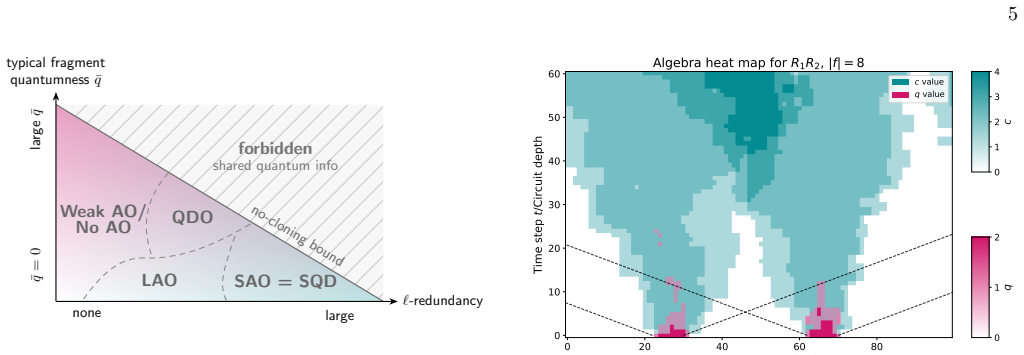
Strong algebraic objectivity (SAO) requires that all relevant fragmentsF={f i}have a common center that is maximal. \ i Z(M fi) =M fj ,∀j.(14) In other words, only classical information is found in each fragment, and the information is identical across all fragments inF. 5 no-cloning boundQDO LAO SAO = SQD Weak AO/No AO forbidden shared quantum info ℓ-red...
-
[4]
This means that, for some partitioning, each fragment only contains classical information of the system, but different fragments know about different parts of the decohered system
Localized algebraic objectivity (LAO), where all pro- liferated information is classical, i.e.M fi =Z(M fi) for alli, but the common center need not be maxi- mal across different fragments:M fi ∩M fj ⊂Z(M fi). This means that, for some partitioning, each fragment only contains classical information of the system, but different fragments know about differe...
-
[5]
The quantum information is ex- clusive to each fragment, but the classical information can remain redundant either globally or in a localized fashion like in LAO
Quantum doped objectivity (QDO), where we allow quantum information to be found in fragments such thatZ(M fi)⊂M fi. The quantum information is ex- clusive to each fragment, but the classical information can remain redundant either globally or in a localized fashion like in LAO. Systems showing QDO correspond to fragments that may contain some anticommutin...
-
[6]
Keeping only the rows that have no sup- port in the columns corresponding to qubits in ¯f and removing the zero columns, we obtain a re- ducedH ′ t = [f ′|R′]
We first shuffle the columns ofH t such that the columns (for both the Z and X sections) are ar- ranged as [ ¯f|f|R], then perform Gaussian elimina- tion overF 2 to obtain its reduced row echelon form (RREF). Keeping only the rows that have no sup- port in the columns corresponding to qubits in ¯f and removing the zero columns, we obtain a re- ducedH ′ t ...
-
[7]
Keeping only rows with support inR ′ and removing zero columns, we obtain a check ma- trixH ′′ t with the form [R ′′|f ′′] for both the Z and X sections
Next, we arrange the columns ofH ′ t with order [R′|f ′], then perform row elimination again to get its RREF. Keeping only rows with support inR ′ and removing zero columns, we obtain a check ma- trixH ′′ t with the form [R ′′|f ′′] for both the Z and X sections. This then eliminates any stabilizer gen- erators that don’t act non-trivially on the logical space
-
[8]
Finally, the rows of [f ′′] correspond to a logical ba- sis with support only inf. Performing the stan- dard row operation of [32], one can arrange it to the standard form with 2qrows that correspond to theqsymplectic pairs andcrows that correspond to elements in the center. By row counting, we can then determine precisely the qubits and bits recoverable ...
-
[9]
The most expensive step of the above algorithm is Gaussian elimination, which has complexity no more thanO((n+k) 3) for each time and fragment
using Choi states. The most expensive step of the above algorithm is Gaussian elimination, which has complexity no more thanO((n+k) 3) for each time and fragment. The over- all generation of such information dynamics is approxi- matelyO(T N f(n+k) 3) whereTis the total number of time steps andN f is the number of fragments we check per time step. ACKNOWLE...
-
[10]
A simple example of "Quantum Darwinism": Redundant information storage in many-spin environments
R. Blume-Kohout and W. H. Zurek, Foundations of Physics35, 1857 (2005), arXiv:quant-ph/0408147
work page internal anchor Pith review Pith/arXiv arXiv 2005
-
[11]
R. Blume-Kohout and W. H. Zurek, Physical Review A 73, 062310 (2006), arXiv:quant-ph/0505031
work page internal anchor Pith review Pith/arXiv arXiv 2006
-
[12]
W. H. Zurek, Nature Physics5, 181 (2009)
2009
-
[13]
Quantum origins of objectivity
R. Horodecki, J. K. Korbicz, and P. Horodecki, Physical Review A91, 032122 (2015), arXiv:1312.6588 [quant-ph]
work page internal anchor Pith review Pith/arXiv arXiv 2015
-
[14]
T. P. Le and A. Olaya-Castro, Physical Review Letters 122, 010403 (2019), arXiv:1803.08936 [quant-ph]
work page internal anchor Pith review Pith/arXiv arXiv 2019
- [15]
-
[16]
D. A. Chisholm, L. Innocenti, and G. M. Palma, Physical Review A110, 012218 (2024)
2024
-
[17]
E. Ryan, M. Paternostro, and S. Campbell, Physics Let- ters A416, 127675 (2021)
2021
- [18]
-
[19]
Dissipation, dephasing and quantum Darwinism in qubit systems with random unitary interactions
N. Balaneskovic and M. Mendler, The European Physical Journal D70, 177 (2016), arXiv:1606.09366 [quant-ph]
work page internal anchor Pith review Pith/arXiv arXiv 2016
-
[20]
B. Fert´ e and X. Cao, Physical Review Letters132, 110201 (2024), arXiv:2305.03694 [quant-ph]
-
[21]
B. Fert´ e, D. Farci, and X. Cao, Decoherent histories with(out) objectivity in a (broken) apparatus (2025), arXiv:2508.16482 [quant-ph]
-
[22]
The Ryu-Takayanagi Formula from Quantum Error Correction
D. Harlow, Communications in Mathematical Physics 354, 865 (2017), arXiv:1607.03901 [gr-qc, physics:hep-th, physics:quant-ph]
work page internal anchor Pith review Pith/arXiv arXiv 2017
-
[23]
Stabilizer Codes and Quantum Error Correction
D. Gottesman,Stabilizer Codes and Quantum Error Cor- rection, Ph.D. thesis, California Institute of Technology (1997), arXiv:quant-ph/9705052
work page internal anchor Pith review Pith/arXiv arXiv 1997
-
[26]
[5, 13, 32, 34]
See Supplemental Material at [URL will be inserted by publisher] for detailed proofs, and supporting calcula- tions, which includes Refs. [5, 13, 32, 34]
- [27]
-
[28]
Asymmetric quantum error correcting codes
L. Ioffe and M. M´ ezard, Phys. Rev. A75, 032345 (2007), arXiv:quant-ph/0606107 [quant-ph]
work page internal anchor Pith review Pith/arXiv arXiv 2007
-
[29]
B. Fert´ e and X. Cao, Physical Review A109, 032226 (2024), arXiv:2312.04284 [quant-ph]
-
[31]
D. Bacon and A. Casaccino, arXiv e-prints , quant- ph/0610088 (2006), arXiv:quant-ph/0610088 [quant-ph]
-
[32]
A. G. Fowler, M. Mariantoni, J. M. Martinis, and A. N. Cleland, Physical Review A86, 10.1103/phys- reva.86.032324 (2012)
-
[33]
Prange,Cyclic Error-Correcting Codes in Two Sym- bols, Tech
E. Prange,Cyclic Error-Correcting Codes in Two Sym- bols, Tech. Rep. TN-57-/03 (Air Force Cambridge Re- search Center, 1957)
1957
-
[34]
Girard, G
M. Girard, G. Cheng, and C. Cao, In preparation
-
[35]
We note that this is slightly different from the Zurekian definition where redundancy means the number of inde- pendent fragments of the environment that have access to almost all of the classical information. 8
- [36]
-
[37]
M. Zwolak and W. H. Zurek, Phys. Rev. A95, 030101 (2017), arXiv:1703.10096 [quant-ph]
work page internal anchor Pith review Pith/arXiv arXiv 2017
-
[38]
S. Aaronson and D. Gottesman, Physical Review A70, 10.1103/physreva.70.052328 (2004)
- [39]
-
[40]
Gidney, Quantum5, 497 (2021)
C. Gidney, Quantum5, 497 (2021)
2021
- [41]
-
[42]
Steinberg, J
M. Steinberg, J. Fan, R. J. Harris, D. Elkouss, S. Feld, and A. Jahn, Quantum9, 1826 (2025)
2025
-
[43]
S. Bravyi, D. Fattal, and D. Gottesman, Journal of Mathematical Physics47, 062106 (2006), arXiv:quant- ph/0504208. SUPPLEMENT AL MA TERIAL Proof of Theorem 3 We represent logical Pauli operators modulo phases and stabilizers by binary vectors, with the usual symplec- tic form encoding commutation, adopting the definition and results from [32]. LetW f be t...
discussion (0)
Sign in with ORCID, Apple, or X to comment. Anyone can read and Pith papers without signing in.