The accretion history of the Milky Way V. The kinematics of most globular clusters trace the merger epochs
Pith reviewed 2026-06-28 00:14 UTC · model grok-4.3
The pith
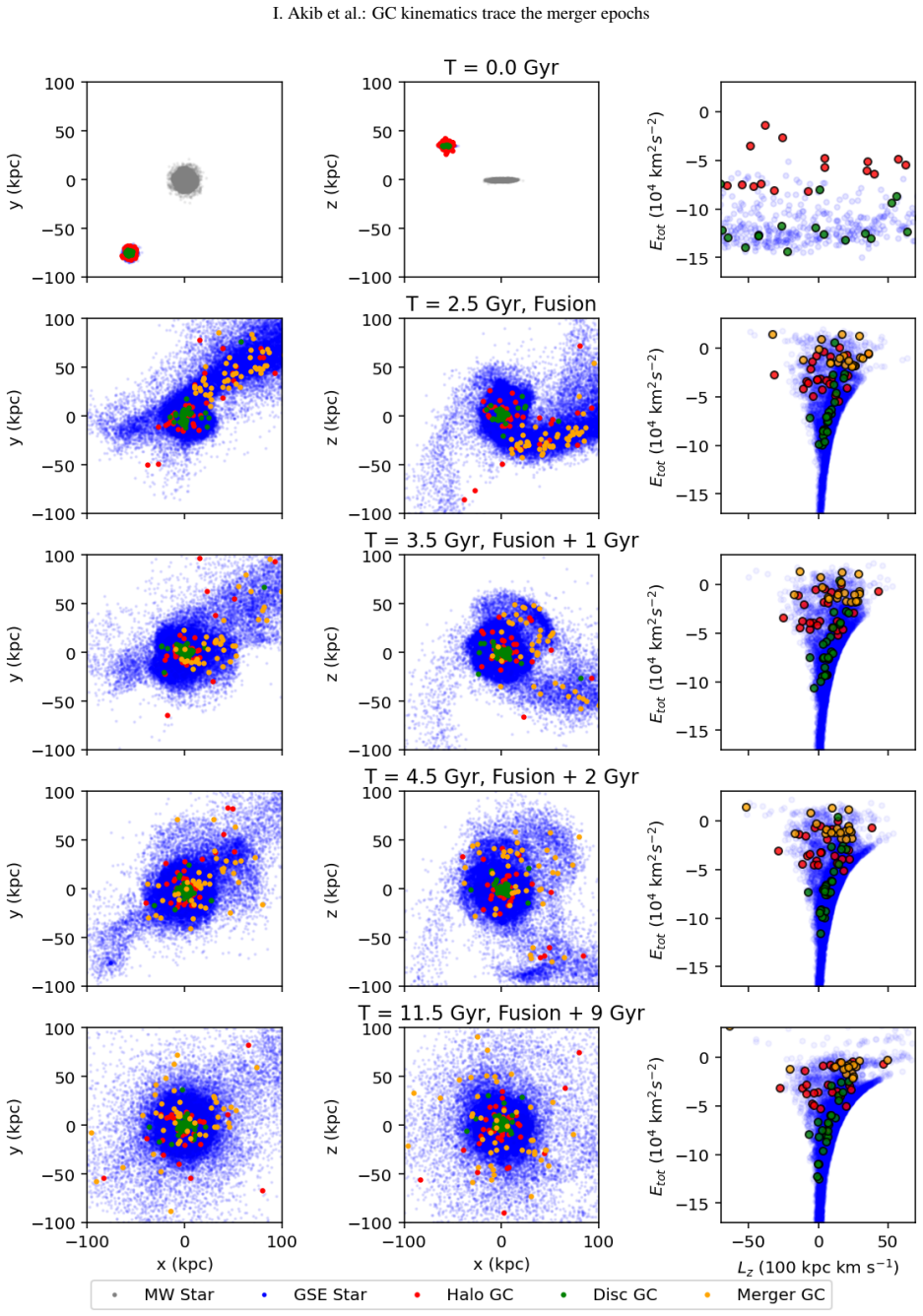
Simulations of the Milky Way-GSE merger show that most globular clusters linked to the event retain enough orbital energy to be identified with accretion in the E-Lz plane.
A machine-rendered reading of the paper's core claim, the machinery that carries it, and where it could break.
Core claim
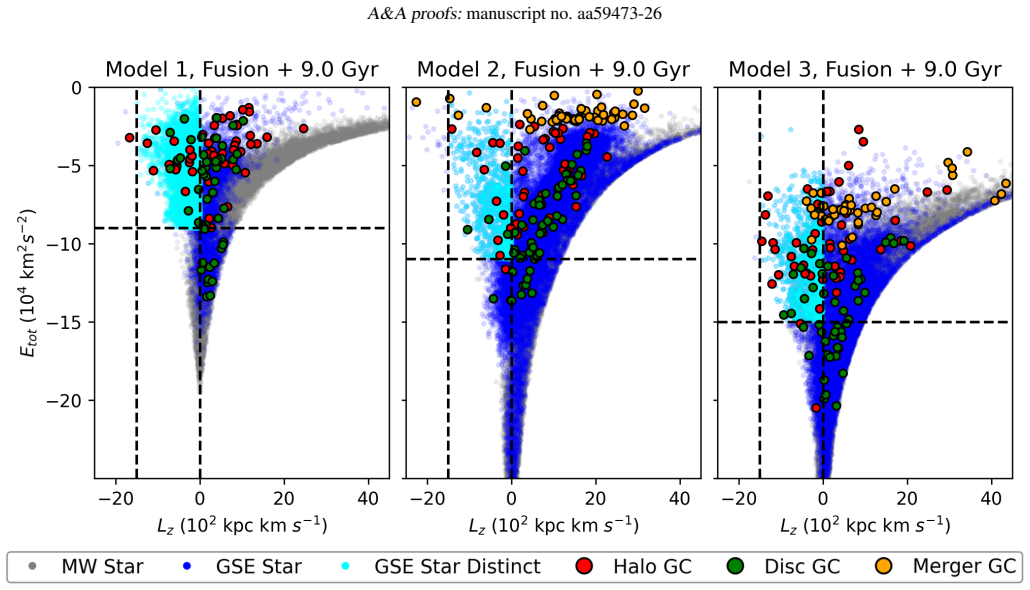
By modelling three N-body simulations of the Milky Way-GSE merger that vary initial masses, mass ratios and gas content, and by including GC populations from the GSE disc progenitor, its halo and those formed in the merger, the work shows that disc GCs lose orbital energy while halo and merger-formed GCs largely retain it. Consequently most GCs observationally linked to GSE remain associable with the accretion event in the E-Lz plane, supporting earlier identifications that combine kinematics with age-metallicity relations.
What carries the argument
The energy-angular momentum (E-Lz) plane, with the central mechanism being the differential orbital energy loss experienced by GSE disc GCs (via disc passages and possible tidal shocks) versus the retention of energy by halo GCs and those formed during the merger.
Load-bearing premise
The three N-body simulations with varied initial masses, mass ratios and gas content are sufficient to represent the real dynamical evolution and survival rates of globular clusters during the Milky Way-GSE merger.
What would settle it
A direct count showing that the majority of observed GSE-associated globular clusters have orbital energies well below the range retained by the simulated halo and merger-formed populations would falsify the claim.
Figures

read the original abstract
Several studies have associated globular clusters (GCs) with former Galactic accretion events by comparing their positions in the energy-angular momentum ($E$-$L_z$) plane, an approach further supported by similarities in their age-metallicity relations. However, recent merger simulations suggest that GCs initially associated with the Gaia-Sausage-Enceladus (GSE) disc may have lost their orbital energy and thus may not reliably trace this accretion event. We extend this framework by considering three N-body simulations of the Milky Way-GSE merger with different initial masses, mass ratios, and gas content. In addition to GCs belonging to the GSE disc progenitor, we accounted for GCs in its halo and, in gas-rich models, a population of GCs formed during the Milky Way-GSE merger. We confirm that most GCs originating in the disc have lost a significant part of their orbital energy during repeated passages through the dense disc medium, and we conjecture that associated tidal shocks may have destroyed many of them. In contrast, GCs from the halo and GCs formed during the merger have largely retained their orbital energy, which remains comparable to that of GSE stars even up to 9 Gyr after the completion of the merger. By using a more realistic GC population and GSE modelling, we find that most GCs linked to GSE can be associated with Milky Way accretion events in the $E$-$L_z$ plane, which supports previous observational associations based on a combination of energy-angular momentum and age-metallicity relations.
Editorial analysis
A structured set of objections, weighed in public.
Referee Report
Summary. The paper uses three N-body simulations of the Milky Way-GSE merger that vary initial masses, mass ratios, and gas content. In addition to disc GCs, it includes halo GCs from the GSE progenitor and, in gas-rich cases, merger-formed GCs. It finds that disc GCs lose orbital energy through repeated disc passages while halo and merger-formed GCs largely retain energy comparable to GSE stars even 9 Gyr post-merger. The central claim is that this more realistic GC population allows most observed GSE-linked clusters to be associated with accretion events in the E-Lz plane, supporting prior observational links based on E-Lz and age-metallicity relations.
Significance. If the result holds, the work strengthens the reliability of the E-Lz plane for associating Milky Way globular clusters with specific accretion events and helps reconcile simulation-based concerns about energy loss with observational associations. The explicit inclusion of halo and in-situ merger-formed populations across multiple realizations is a positive step beyond single-setup models.
major comments (2)
- [Abstract and simulation setup] Abstract and simulation-setup paragraph: The claim that halo and merger-formed GCs dominate the surviving GSE-linked population (and thus that most observed associations remain valid) rests on only three N-body runs that vary initial masses, mass ratios, and gas content. No fractions of surviving GCs per component are reported, and no sensitivity tests are described for other parameters such as orbital inclination or gas fraction at pericentre; without these, it is unclear whether the energy-retention result is generic or specific to the chosen setups.
- [Results] Results discussion: The statement that halo and merger-formed GCs 'have largely retained their orbital energy' and 'remain comparable to that of GSE stars' is presented without quantitative comparison (e.g., histograms, median E values, or Kolmogorov-Smirnov tests) between the simulated E-Lz distributions and the observed distribution of GSE-associated clusters; such a direct comparison is needed to substantiate that 'most GCs linked to GSE can be associated' in the E-Lz plane.
Simulated Author's Rebuttal
We thank the referee for their constructive comments and positive assessment of the significance of our work. We address each major comment below.
read point-by-point responses
-
Referee: [Abstract and simulation setup] Abstract and simulation-setup paragraph: The claim that halo and merger-formed GCs dominate the surviving GSE-linked population (and thus that most observed associations remain valid) rests on only three N-body runs that vary initial masses, mass ratios, and gas content. No fractions of surviving GCs per component are reported, and no sensitivity tests are described for other parameters such as orbital inclination or gas fraction at pericentre; without these, it is unclear whether the energy-retention result is generic or specific to the chosen setups.
Authors: We agree that explicitly reporting the fractions of surviving GCs per component (disc, halo, and merger-formed) will improve clarity and will add these values to the revised manuscript. The three simulations already vary initial masses, mass ratios, and gas content, with consistent energy retention for halo and merger-formed GCs across all runs. We acknowledge that further sensitivity tests (e.g., orbital inclination or pericentric gas fraction) would be desirable but would require additional simulations beyond the scope of this study. revision: partial
-
Referee: [Results] Results discussion: The statement that halo and merger-formed GCs 'have largely retained their orbital energy' and 'remain comparable to that of GSE stars' is presented without quantitative comparison (e.g., histograms, median E values, or Kolmogorov-Smirnov tests) between the simulated E-Lz distributions and the observed distribution of GSE-associated clusters; such a direct comparison is needed to substantiate that 'most GCs linked to GSE can be associated' in the E-Lz plane.
Authors: We will incorporate quantitative comparisons in the revised manuscript, including histograms of orbital energy distributions, median E values for each GC component, and direct overlays against the observed GSE-associated clusters to strengthen the substantiation of our claims. revision: yes
Circularity Check
No significant circularity; derivation is self-contained via new simulations
full rationale
The paper's central claim rests on three new N-body simulations of the MW-GSE merger (varying initial mass, mass ratio, and gas content) whose outputs are compared directly to observed GC positions in the E-Lz plane. No load-bearing step reduces a prediction to a fitted parameter from the same dataset, redefines a quantity in terms of itself, or relies on a self-citation chain whose validity is presupposed by the present work. The simulations are treated as independent dynamical experiments whose results are then juxtaposed with external observations; the derivation chain therefore remains externally falsifiable and does not collapse by construction.
Axiom & Free-Parameter Ledger
free parameters (2)
- initial masses and mass ratios
- gas content
axioms (1)
- domain assumption N-body simulations accurately capture the orbital energy evolution of GCs during repeated disc passages and tidal shocks.
Reference graph
Works this paper leans on
-
[1]
ApJ , volume =
Tidal Interactions Between Spherical Galaxies , author =. ApJ , volume =. 1985 , doi =
1985
-
[2]
, title =
Aguilar, Luis and Hut, Piet and Ostriker, Jeremiah P. , title =. ApJ , volume =. 1988 , doi =
1988
-
[3]
Galaxy Evolution
Destruction of Globular Clusters in Our Galaxy. Galaxy Evolution. The Milky Way Perspective , year = 1993, editor =
1993
-
[4]
Impact of merger histories on the timing argument estimate of the Local Group mass , volume=
Akib, Istiak and Hammer, François and Yang, Yanbin , year=. Impact of merger histories on the timing argument estimate of the Local Group mass , volume=. doi:10.1051/0004-6361/202553769 , journal=
-
[5]
MNRAS , volume=
Accurate distances to Galactic globular clusters through a combination of Gaia EDR3, HST, and literature data , author=. MNRAS , volume=. 2021 , publisher=
2021
-
[6]
Co-formation of the Galactic disc and the stellar halo
Co-formation of the disc and the stellar halo. MNRAS , keywords =. doi:10.1093/mnras/sty982 , archivePrefix =. 1802.03414 , primaryClass =
work page internal anchor Pith review Pith/arXiv arXiv doi:10.1093/mnras/sty982
-
[7]
MNRAS , volume=
Can we really pick and choose? Benchmarking various selections of Gaia Enceladus/Sausage stars in observations with simulations , author=. MNRAS , volume=. 2024 , publisher=
2024
-
[8]
NGC 288 as the first Splashed globular cluster , author=
Cluster Ages to Reconstruct the Milky Way Assembly (CARMA)-III. NGC 288 as the first Splashed globular cluster , author=. A&A , volume=. 2025 , publisher=
2025
-
[9]
MNRAS , volume=
On the origin of globular clusters in a hierarchical universe , author=. MNRAS , volume=. 2024 , publisher=
2024
-
[10]
PASA , volume=
The disc origin of the Milky Way bulge , author=. PASA , volume=. 2016 , publisher=
2016
-
[11]
and Rix, Hans-Walter and Ness, Melissa K
Eilers, Anna-Christina and Hogg, David W. and Rix, Hans-Walter and Ness, Melissa K. , year=. The Circular Velocity Curve of the Milky Way from 5 to 25 kpc , volume=. ApJ , publisher=. doi:10.3847/1538-4357/aaf648 , number=
-
[12]
Elmegreen, Bruce G. , year=. Two Thresholds for Globular Cluster Formation and the Common Occurrence of Massive Clusters in the Early Universe , volume=. ApJ , publisher=. doi:10.3847/1538-4357/aaed45 , number=
-
[13]
Recio-Blanco, A. and Kordopatis, G. and de Laverny, P. and Palicio, P. A. and Spagna, A. and Spina, L. and Katz, D. and Re Fiorentin, P. and Poggio, E. and McMillan, P. J. and Vallenari, A. and Lattanzi, M. G. and Seabroke, G. M. and Casamiquela, L. and Bragaglia, A. and Antoja, T. and Bailer-Jones, C. A. L. and Schultheis, M. and Andrae, R. and Fouesneau...
-
[14]
ApJ , year = 1975, month = oct, volume =
On the Formation of Elliptical Galaxies. ApJ , year = 1975, month = oct, volume =. doi:10.1086/153887 , adsurl =
-
[15]
Hammer, Francois and Wang, Jianling and Pawlowski, Marcel S. and Yang, Yanbin and Bonifacio, Piercarlo and Li, Hefan and Babusiaux, Carine and Arenou, Frederic , year=. Gaia EDR3 Proper Motions of Milky Way Dwarfs. II Velocities, Total Energy, and Angular Momentum , volume=. ApJ , publisher=. doi:10.3847/1538-4357/ac27a8 , number=
-
[16]
How it shapes globular clusters and dwarf galaxies , author=
The accretion history of the Milky Way--I. How it shapes globular clusters and dwarf galaxies , author=. MNRAS , volume=. 2023 , publisher=
2023
-
[17]
Internal kinematics of globular clusters and of dwarf galaxies , author=
The accretion history of the Milky Way--II. Internal kinematics of globular clusters and of dwarf galaxies , author=. MNRAS , volume=. 2024 , publisher=
2024
-
[18]
Hammer, F. and Jiao, Y. J. and Mamon, G. A. and Yang, Y. B. and Akib, I. and Amram, P. and Wang, H. F. and Wang, J. L. and Chemin, L. , year=. The Milky Way accretion history compared to cosmological simulations: From bulge formation to dwarf galaxy infall , volume=. doi:10.1051/0004-6361/202451381 , journal=
-
[19]
A&A , volume=
The age structure of stellar populations in the solar vicinity-Clues of a two-phase formation history of the Milky Way disk , author=. A&A , volume=. 2013 , publisher=
2013
-
[20]
A&A , volume=
When the Milky Way turned off the lights: APOGEE provides evidence of star formation quenching in our Galaxy , author=. A&A , volume=. 2016 , publisher=
2016
-
[21]
In Disguise or Out of Reach: First Clues about In Situ and Accreted Stars in the Stellar Halo of the Milky Way from Gaia DR2. ApJ , keywords =. doi:10.3847/1538-4357/aad235 , archivePrefix =. 1805.02617 , primaryClass =
work page internal anchor Pith review Pith/arXiv arXiv doi:10.3847/1538-4357/aad235
-
[22]
The merger that led to the formation of the Milky Way's inner stellar halo and thick disk
The merger that led to the formation of the Milky Way's inner stellar halo and thick disk. Nat , keywords =. doi:10.1038/s41586-018-0625-x , archivePrefix =. 1806.06038 , primaryClass =
work page internal anchor Pith review Pith/arXiv arXiv doi:10.1038/s41586-018-0625-x
-
[23]
Hopkins, Philip F. , year=. A new class of accurate, mesh-free hydrodynamic simulation methods , volume=. MNRAS , publisher=. doi:10.1093/mnras/stv195 , number=
-
[24]
Detection of the Keplerian decline in the Milky Way rotation curve , volume=
Jiao, Yongjun and Hammer, François and Wang, Haifeng and Wang, Jianling and Amram, Philippe and Chemin, Laurent and Yang, Yanbin , year=. Detection of the Keplerian decline in the Milky Way rotation curve , volume=. doi:10.1051/0004-6361/202347513 , journal=
-
[25]
Kruijssen, J M Diederik and Pfeffer, Joel L and Chevance, Mélanie and Bonaca, Ana and Trujillo-Gomez, Sebastian and Bastian, Nate and Reina-Campos, Marta and Crain, Robert A and Hughes, Meghan E , year=. Kraken reveals itself – the merger history of the Milky Way reconstructed with the E-MOSAICS simulations , volume=. MNRAS , publisher=. doi:10.1093/mnras...
-
[26]
Li, Yuexing and Mac Low, Mordecai-Mark and Klessen, Ralf S. , year=. Formation of Globular Clusters in Galaxy Mergers , volume=. ApJ , publisher=. doi:10.1086/425320 , number=
-
[27]
and Sharma, Sanjib and Famaey, Benoit and Bellazzini, Michele and Carlberg, Raymond G
Malhan, Khyati and Ibata, Rodrigo A. and Sharma, Sanjib and Famaey, Benoit and Bellazzini, Michele and Carlberg, Raymond G. and D’Souza, Richard and Yuan, Zhen and Martin, Nicolas F. and Thomas, Guillaume F. , year=. The Global Dynamical Atlas of the Milky Way Mergers: Constraints from Gaia EDR3–based Orbits of Globular Clusters, Stellar Streams, and Sate...
-
[28]
Massari, D. and Koppelman, H. H. and Helmi, A. , year=. Origin of the system of globular clusters in the Milky Way , volume=. doi:10.1051/0004-6361/201936135 , journal=
-
[29]
Proof that the Milky Way experienced a significant merger only 1.5 billion years after the Big Bang. ArXiv e-prints , keywords =. doi:10.48550/arXiv.2601.18896 , archivePrefix =. 2601.18896 , primaryClass =
-
[30]
Reconstructing the Last Major Merger of the Milky Way with the H3 Survey. ApJ , keywords =. doi:10.3847/1538-4357/ac2d2d , archivePrefix =. 2103.03251 , primaryClass =
-
[31]
A&A , volume=
The distribution of globular clusters in kinematic spaces does not trace the accretion history of the host galaxy , author=. A&A , volume=. 2023 , publisher=
2023
-
[32]
MNRAS , volume=
Most pseudo-bulges can be formed at later stages of major mergers , author=. MNRAS , volume=. 2018 , publisher=
2018
-
[33]
A&A , volume=
Formation and evolution of galactic disks with a multiphase numerical model , author=. A&A , volume=. 2002 , publisher=
2002
-
[34]
A&A , volume=
Galaxy archaeology for wet mergers: Globular cluster age distributions in the Milky Way and nearby galaxies , author=. A&A , volume=. 2024 , publisher=
2024
-
[35]
Chemical evolution of Enceladus, alias the Gaia Sausage , author=
The fall of a giant. Chemical evolution of Enceladus, alias the Gaia Sausage , author=. MNRASL , volume=. 2019 , publisher=
2019
-
[36]
Wang, Jianling and Hammer, Francois and Yang, Yanbin , year=. Milky Way total mass derived by rotation curve and globular cluster kinematics from Gaia EDR3 , volume=. MNRAS , publisher=. doi:10.1093/mnras/stab3258 , number=
-
[37]
Hydrodynamical simulations of Galactic dwarf galaxies at first infall , author=
The accretion history of the Milky Way: III. Hydrodynamical simulations of Galactic dwarf galaxies at first infall , author=. MNRAS , volume=. 2024 , publisher=
2024
-
[38]
Hints of recent star formation in Milky Way dwarf spheroidal galaxies , author=
The accretion history of the Milky Way-IV. Hints of recent star formation in Milky Way dwarf spheroidal galaxies , author=. A&A , volume=. 2024 , publisher=
2024
discussion (0)
Sign in with ORCID, Apple, or X to comment. Anyone can read and Pith papers without signing in.