Halo mass functions in mixed cold and fuzzy dark matter models
Pith reviewed 2026-06-27 23:37 UTC · model grok-4.3
The pith
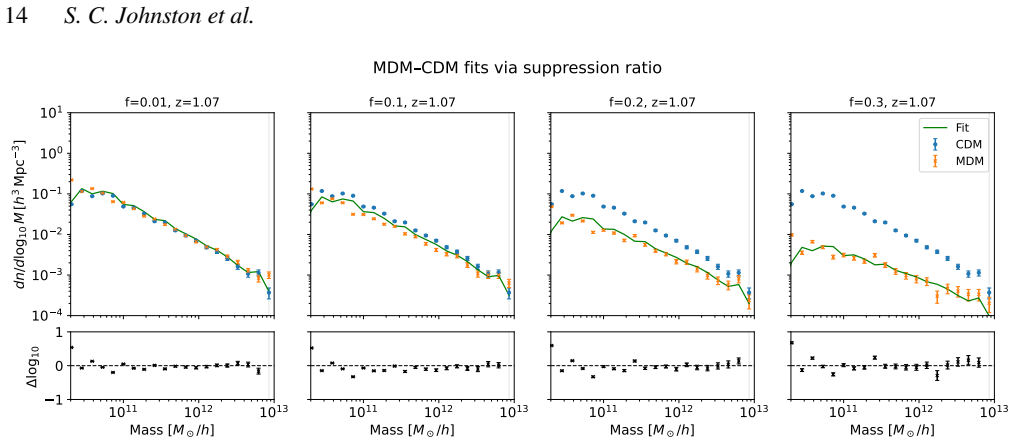
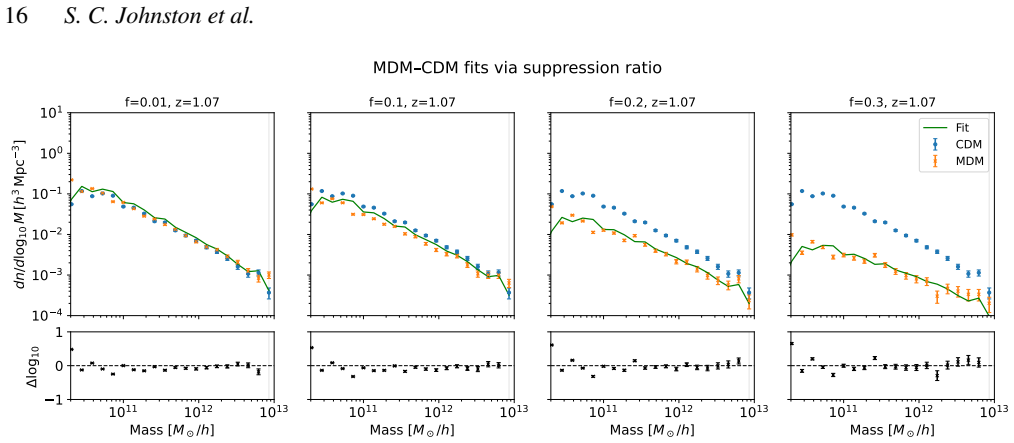
A suppression function maps CDM halo mass functions to mixed cold-fuzzy dark matter models within 0.2 dex for redshifts 1-4 and fuzzy fractions up to 0.3.
A machine-rendered reading of the paper's core claim, the machinery that carries it, and where it could break.
Core claim
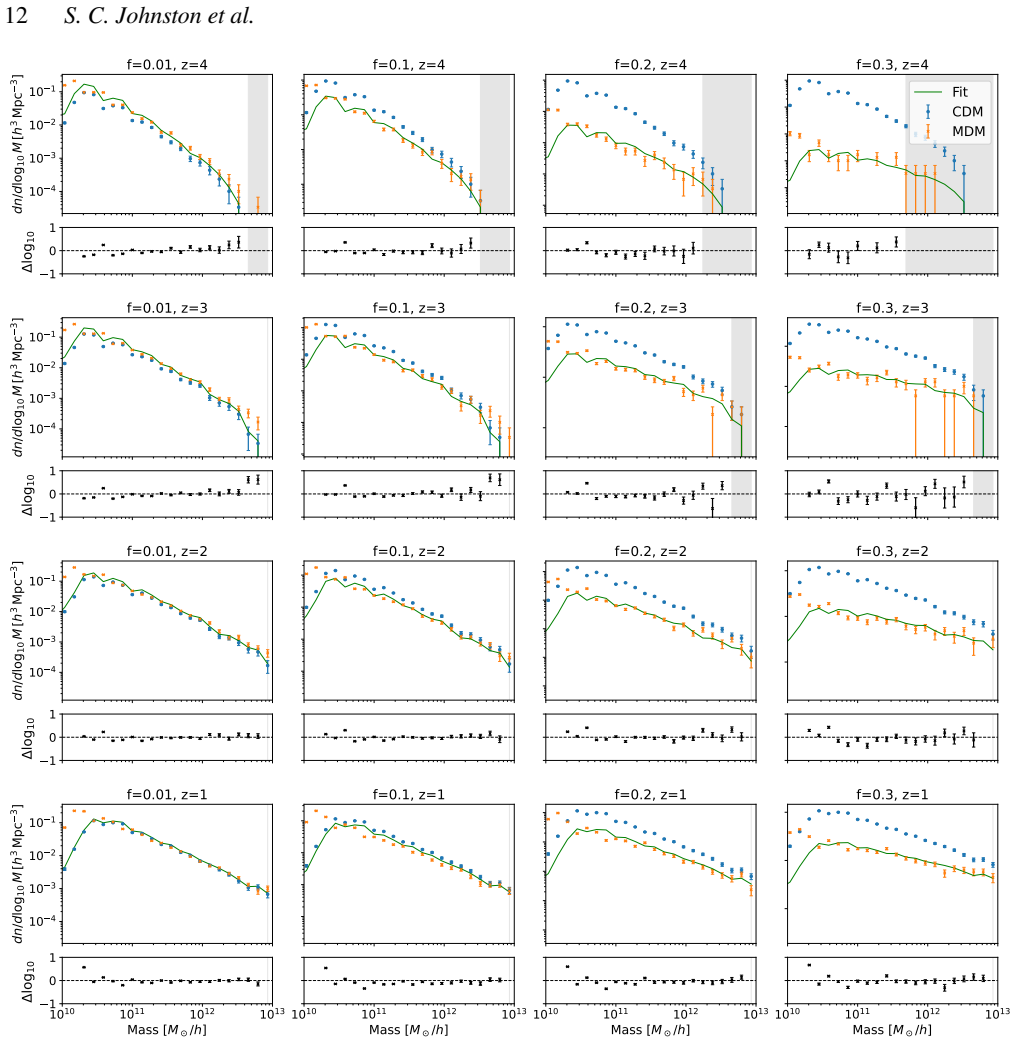
In mixed cold and fuzzy dark matter cosmologies with fuzzy fraction f ≤ 0.3 and fuzzy mass 10^{-24.5} eV, the halo mass function exhibits a systematic downward shift relative to pure cold dark matter, with the magnitude and high-mass slope depending on redshift and f. A phenomenological suppression function whose parameters are tuned to redshift and f maps the cold dark matter halo mass function directly onto the mixed dark matter result and reproduces the simulated halo abundances to within 0.1-0.2 dex for 1 ≤ z ≤ 4.
What carries the argument
The phenomenological suppression function with redshift- and FDM-fraction-dependent parameters that rescales the CDM halo mass function to predict MDM halo abundances.
If this is right
- Existing cold dark matter halo mass function fitting formulas can be reused for mixed dark matter predictions by simple multiplication with the suppression function.
- The computational cost of exploring mixed dark matter parameter space drops because dedicated simulations are no longer required for each new redshift or fuzzy fraction.
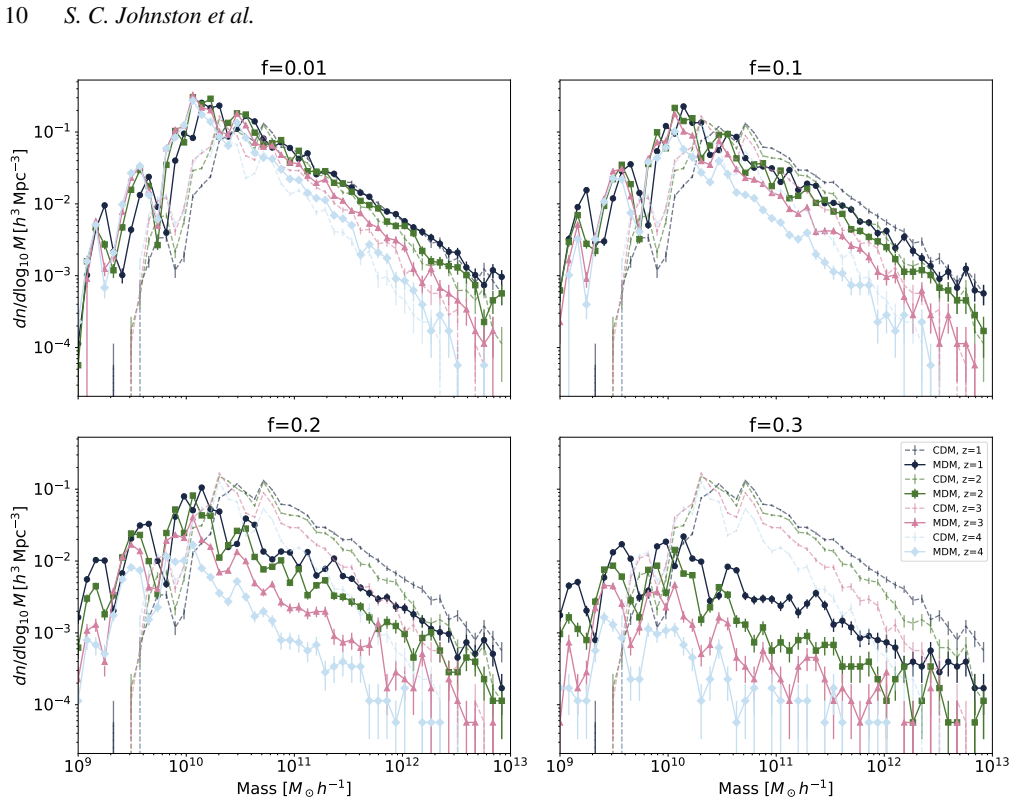
- Increasing the fuzzy fraction systematically reduces low-mass halo counts while also steepening or flattening the high-mass end of the halo mass function.
- The suppression strength grows with redshift in the range 1 to 4, implying stronger effects on early structure formation.
Where Pith is reading between the lines
- The same functional form might allow quick estimates for fuzzy masses different from 10^{-24.5} eV if the suppression parameters can be rescaled with mass.
- Galaxy survey number counts at high redshift could be reinterpreted with this mapping to place tighter limits on the fuzzy dark matter fraction without new simulations.
- The approach could be tested on other mixed dark matter combinations, such as cold plus warm dark matter, to see whether a similar suppression function works.
Load-bearing premise
The grid-based halo-finding pipeline accurately identifies halos in the combined CDM and FDM density field without significant biases from the wave-like nature of FDM or the mixing of components.
What would settle it
Running a new simulation at redshift 5 or fuzzy fraction 0.4 and checking whether the phenomenological model still matches the simulated halo mass function to better than 0.2 dex across the mass range.
Figures


read the original abstract
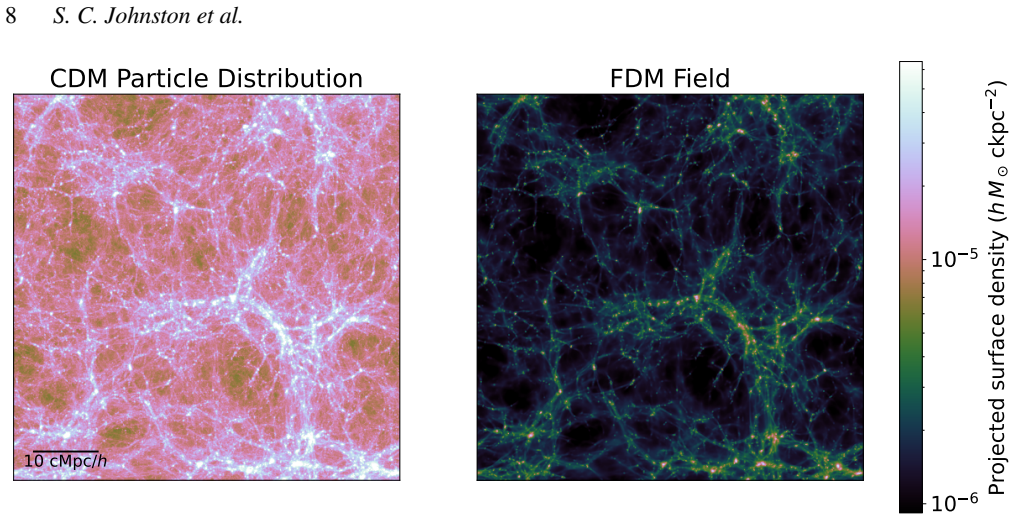
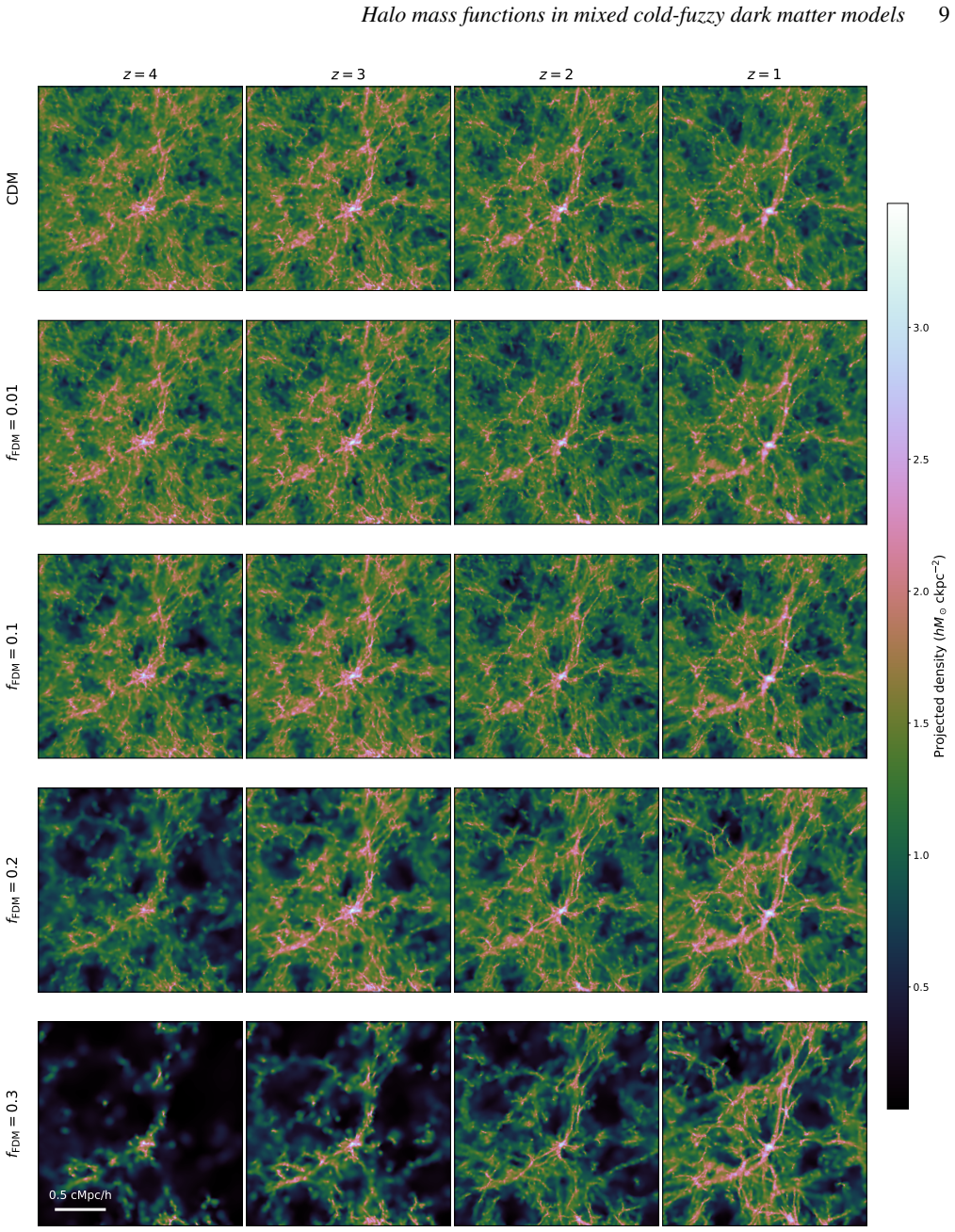
We investigate the impact of mixed cold and fuzzy dark matter (MDM) cosmologies on the halo mass function (HMF) using numerical simulations performed with the AxiREPO framework. We consider models in which an ultralight axion-like component with mass $m =10^{-24.5} \mathrm{eV}$ constitutes a fraction $f \leq 0.3$ of the total dark matter. To enable consistent halo identification in mixed-species scenarios, we develop a grid-based halo-finding pipeline that combines the particle-based cold dark matter (CDM) and wave-like fuzzy dark matter (FDM) components into a unified density field. We find that FDM traces the large-scale CDM distribution while suppressing small-scale structure through wave interference effects, leading to a reduction in the abundance of low-mass haloes and modifying the HMF in a manner dependent on redshift and FDM fraction. Increasing the FDM fraction produces a systematic downward shift in the HMF and modifies its high-mass slope. Motivated by these trends, we introduce a phenomenological model that maps CDM HMFs to their MDM counterparts using a suppression function with parameters dependent on redshift and FDM fraction. This model reproduces the simulated HMFs within approximately 0.1 to 0.2 dex across the parameter space explored ($1 \leq z \leq 4$, $f \leq 0.3$). Our results provide a computationally efficient method for predicting structure formation in MDM cosmologies without requiring dedicated simulations for each parameter choice, and establish a framework for exploring the impact of MDM on cosmological structure formation.
Editorial analysis
A structured set of objections, weighed in public.
Referee Report
Summary. The paper uses AxiREPO simulations of mixed cold+fuzzy dark matter (MDM) with m=10^{-24.5} eV and f≤0.3, develops a grid-based halo finder that merges particle CDM and wave FDM densities into one field, reports FDM-induced suppression of low-mass halos that depends on z and f, and introduces a phenomenological suppression function with z- and f-dependent parameters that maps CDM HMFs to MDM HMFs, reproducing the simulated HMFs to ~0.1-0.2 dex over 1≤z≤4 and f≤0.3.
Significance. If the extracted HMFs are robust, the suppression function supplies a computationally cheap mapping from standard CDM HMFs to MDM cases, enabling rapid exploration of structure formation in mixed dark matter without dedicated simulations for every parameter choice.
major comments (2)
- [halo-finding pipeline description] The grid-based halo-finding pipeline (described in the methods section on halo identification): no convergence tests, no comparison to pure-CDM or pure-FDM benchmarks, and no cross-checks with alternative finders are reported. Because FDM interference produces oscillatory small-scale density fluctuations that can generate spurious local maxima, the HMFs used to calibrate the suppression function may contain finder artifacts; this directly affects the claimed 0.1-0.2 dex accuracy and the fitted parameters.
- [phenomenological model] Phenomenological model section: the suppression function parameters are stated to depend on redshift and FDM fraction and to reproduce the simulated HMFs within 0.1-0.2 dex, yet no explicit functional form, fitting procedure, covariance, or cross-validation against independent data or hold-out redshifts/fractions is provided, leaving open whether the agreement is a genuine prediction or a fit by construction.
Simulated Author's Rebuttal
We thank the referee for their careful reading of our manuscript and for providing constructive comments that will help improve the presentation of our results. We respond to each major comment below.
read point-by-point responses
-
Referee: The grid-based halo-finding pipeline (described in the methods section on halo identification): no convergence tests, no comparison to pure-CDM or pure-FDM benchmarks, and no cross-checks with alternative finders are reported. Because FDM interference produces oscillatory small-scale density fluctuations that can generate spurious local maxima, the HMFs used to calibrate the suppression function may contain finder artifacts; this directly affects the claimed 0.1-0.2 dex accuracy and the fitted parameters.
Authors: We agree with the referee that the halo-finding pipeline requires additional validation to ensure the robustness of the reported halo mass functions. The grid-based approach was implemented to provide a consistent identification method for the combined CDM and FDM density fields. The manuscript currently describes the pipeline but does not report convergence tests or benchmark comparisons. In the revised manuscript, we will include these tests, including resolution studies, comparisons with pure-CDM cases, and an evaluation of potential artifacts arising from FDM interference patterns. This will strengthen confidence in the 0.1-0.2 dex accuracy of the suppression function. revision: yes
-
Referee: the suppression function parameters are stated to depend on redshift and FDM fraction and to reproduce the simulated HMFs within 0.1-0.2 dex, yet no explicit functional form, fitting procedure, covariance, or cross-validation against independent data or hold-out redshifts/fractions is provided, leaving open whether the agreement is a genuine prediction or a fit by construction.
Authors: We acknowledge that the phenomenological model section would benefit from more detailed documentation of the suppression function. The manuscript introduces the model and states its accuracy, but does not provide the explicit functional form or fitting details. We will revise this section to specify the functional form of the suppression function, describe the fitting procedure used to determine the redshift- and fraction-dependent parameters, include any relevant covariance information, and present cross-validation results using hold-out redshifts and FDM fractions. These additions will demonstrate the model's applicability beyond the specific simulation points used in fitting. revision: yes
Circularity Check
Phenomenological suppression function parameters fitted to own simulations, making reproduction tautological
specific steps
-
fitted input called prediction
[Abstract]
"Motivated by these trends, we introduce a phenomenological model that maps CDM HMFs to their MDM counterparts using a suppression function with parameters dependent on redshift and FDM fraction. This model reproduces the simulated HMFs within approximately 0.1 to 0.2 dex across the parameter space explored (1 ≤ z ≤ 4, f ≤ 0.3)."
The suppression-function parameters are determined by fitting to the HMFs extracted from the same set of simulations whose results the model is then said to reproduce. The quoted 0.1-0.2 dex agreement is therefore enforced by construction of the fit and does not constitute an independent prediction.
full rationale
The paper's main deliverable is a phenomenological model whose suppression function parameters are explicitly dependent on redshift and FDM fraction and are calibrated to reproduce the HMFs measured in the authors' own MDM simulations. The quoted accuracy (0.1-0.2 dex) is therefore the result of the fitting procedure itself rather than an independent derivation or external test. No self-citations, uniqueness theorems, or ansatzes from prior author work are invoked as load-bearing steps. The grid-based halo finder is a methodological choice whose validity is assumed but does not create a definitional loop in the reported model. This is a classic case of a fitted input being presented as a predictive mapping.
Axiom & Free-Parameter Ledger
free parameters (1)
- suppression function parameters
axioms (1)
- domain assumption The combined density field from CDM particles and FDM waves can be used to identify halos consistently.
Reference graph
Works this paper leans on
-
[1]
Planck 2018 results. VI. Cosmological parameters (Corrigendum). , keywords =. doi:10.1051/0004-6361/201833910e , adsurl =
-
[2]
An ultralight pseudoscalar boson , author =. Phys. Rev. D , volume =. 2016 , month =. doi:10.1103/PhysRevD.93.025027 , url =
-
[3]
Glimmers from the axiverse. , keywords =. doi:10.1088/1475-7516/2024/09/071 , archivePrefix =. 2309.13145 , primaryClass =
-
[4]
Fuzzy Cold Dark Matter: The Wave Properties of Ultralight Particles , author =. Phys. Rev. Lett. , volume =. 2000 , month =. doi:10.1103/PhysRevLett.85.1158 , url =
-
[5]
Ultralight scalars as cosmological dark matter
Ultralight scalars as cosmological dark matter. , keywords =. doi:10.1103/PhysRevD.95.043541 , archivePrefix =. 1610.08297 , primaryClass =
work page internal anchor Pith review Pith/arXiv arXiv doi:10.1103/physrevd.95.043541
-
[6]
A search for ultralight axions using precision cosmological data , author =. Phys. Rev. D , volume =. 2015 , month =. doi:10.1103/PhysRevD.91.103512 , url =
-
[7]
Cosmological simulations of mixed ultralight dark matter. , keywords =. doi:10.1103/PhysRevD.109.043507 , archivePrefix =. 2310.20000 , primaryClass =
-
[8]
Ultra-light axions and the S _ 8 tension: joint constraints from the cosmic microwave background and galaxy clustering. , keywords =. doi:10.1088/1475-7516/2023/06/023 , archivePrefix =. 2301.08361 , primaryClass =
-
[9]
Structure formation in large-volume cosmological simulations of fuzzy dark matter: impact of the non-linear dynamics. , keywords =. doi:10.1093/mnras/stab1764 , archivePrefix =. 2101.01828 , primaryClass =
-
[10]
The Overdensity and Masses of the Friends-of-friends Halos and Universality of Halo Mass Function. , keywords =. doi:10.1088/0067-0049/195/1/4 , archivePrefix =. 1103.0005 , primaryClass =
work page internal anchor Pith review Pith/arXiv arXiv doi:10.1088/0067-0049/195/1/4
-
[11]
Lyman- constraints on ultralight scalar dark matter: Implications for the early and late universe. , keywords =. doi:10.1103/PhysRevD.96.123514 , archivePrefix =. 1708.00015 , primaryClass =
work page internal anchor Pith review Pith/arXiv arXiv doi:10.1103/physrevd.96.123514
-
[12]
First Constraints on Fuzzy Dark Matter from Lyman- Forest Data and Hydrodynamical Simulations. , keywords =. doi:10.1103/PhysRevLett.119.031302 , archivePrefix =. 1703.04683 , primaryClass =
work page internal anchor Pith review Pith/arXiv arXiv doi:10.1103/physrevlett.119.031302
-
[13]
Strong Bound on Canonical Ultralight Axion Dark Matter from the Lyman-Alpha Forest. , keywords =. doi:10.1103/PhysRevLett.126.071302 , archivePrefix =. 2007.12705 , primaryClass =
-
[14]
Predictions for the abundance of high-redshift galaxies in a fuzzy dark matter universe. , keywords =. doi:10.1093/mnras/stz2085 , archivePrefix =. 1904.01604 , primaryClass =
-
[15]
Galaxy UV-luminosity function and reionization constraints on axion dark matter
Galaxy UV-luminosity function and reionization constraints on axion dark matter. , keywords =. doi:10.1093/mnras/stv624 , archivePrefix =. 1409.3544 , primaryClass =
work page internal anchor Pith review Pith/arXiv arXiv doi:10.1093/mnras/stv624
-
[16]
Fuzzy Dark Matter and the 21 cm Power Spectrum. , keywords =. doi:10.3847/1538-4357/abf0a9 , archivePrefix =. 2101.07177 , primaryClass =
-
[17]
Using the Full Power of the Cosmic Microwave Background to Probe Axion Dark Matter
Using the full power of the cosmic microwave background to probe axion dark matter. , keywords =. doi:10.1093/mnras/sty271 , archivePrefix =. 1708.05681 , primaryClass =
work page internal anchor Pith review Pith/arXiv arXiv doi:10.1093/mnras/sty271
-
[18]
Improved halo model calibrations for mixed dark matter models of ultralight axions. , keywords =. doi:10.1093/mnras/staf005 , archivePrefix =. 2409.11469 , primaryClass =
-
[19]
The Rockstar Phase-Space Temporal Halo Finder and the Velocity Offsets of Cluster Cores
The ROCKSTAR Phase-space Temporal Halo Finder and the Velocity Offsets of Cluster Cores. , keywords =. doi:10.1088/0004-637X/762/2/109 , archivePrefix =. 1110.4372 , primaryClass =
work page internal anchor Pith review Pith/arXiv arXiv doi:10.1088/0004-637x/762/2/109
-
[20]
Monthly Notices of the Royal Astronomical Society , author =
Populating a cluster of galaxies - I. Results at z=0. , keywords =. doi:10.1046/j.1365-8711.2001.04912.x , archivePrefix =. astro-ph/0012055 , primaryClass =
-
[21]
HBT+: an improved code for finding subhalos and building merger trees in cosmological simulations
HBT+: an improved code for finding subhaloes and building merger trees in cosmological simulations. , keywords =. doi:10.1093/mnras/stx2792 , archivePrefix =. 1708.03646 , primaryClass =
work page internal anchor Pith review Pith/arXiv arXiv doi:10.1093/mnras/stx2792
-
[22]
Planck 2015 results. XIII. Cosmological parameters. , keywords =. doi:10.1051/0004-6361/201525830 , archivePrefix =. 1502.01589 , primaryClass =
work page internal anchor Pith review Pith/arXiv arXiv doi:10.1051/0004-6361/201525830 2015
-
[23]
Improved mixed dark matter halo model for ultralight axions , author =. Phys. Rev. D , volume =. 2023 , month =. doi:10.1103/PhysRevD.107.063526 , url =
-
[24]
Observational and Theoretical Constraints on Singular Dark Matter Halos
Observational and Theoretical Constraints on Singular Dark Matter Halos. , keywords =. doi:10.1086/187350 , archivePrefix =. astro-ph/9402004 , primaryClass =
work page internal anchor Pith review Pith/arXiv arXiv doi:10.1086/187350
-
[25]
, year = 1994, month = aug, volume =
Evidence against dissipation-less dark matter from observations of galaxy haloes. , year = 1994, month = aug, volume =. doi:10.1038/370629a0 , adsurl =
-
[26]
The Core-Cusp Problem. Adv. Astron. , keywords =. doi:10.1155/2010/789293 , archivePrefix =. 0910.3538 , primaryClass =
work page internal anchor Pith review Pith/arXiv arXiv doi:10.1155/2010/789293 2010
-
[27]
Where are the missing galactic satellites?
Where Are the Missing Galactic Satellites?. , keywords =. doi:10.1086/307643 , archivePrefix =. astro-ph/9901240 , primaryClass =
work page internal anchor Pith review Pith/arXiv arXiv doi:10.1086/307643
-
[28]
Dark Matter Substructure in Galactic Halos
Dark Matter Substructure within Galactic Halos. , keywords =. doi:10.1086/312287 , archivePrefix =. astro-ph/9907411 , primaryClass =
work page internal anchor Pith review Pith/arXiv arXiv doi:10.1086/312287
-
[29]
doi:10.1111/j.1745-3933.2011.01088.x , eprint =
Too big to fail? The puzzling darkness of massive Milky Way subhaloes. , keywords =. doi:10.1111/j.1745-3933.2011.01074.x , archivePrefix =. 1103.0007 , primaryClass =
-
[30]
The Milky Way's bright satellites as an apparent failure of CDM. , keywords =. doi:10.1111/j.1365-2966.2012.20695.x , archivePrefix =. 1111.2048 , primaryClass =
-
[31]
A Model For Halo Formation With Axion Mixed Dark Matter
A model for halo formation with axion mixed dark matter. , keywords =. doi:10.1093/mnras/stt2079 , archivePrefix =. 1307.1705 , primaryClass =
work page internal anchor Pith review Pith/arXiv arXiv doi:10.1093/mnras/stt2079
-
[32]
Understanding the Core-Halo Relation of Quantum Wave Dark Matter from 3D Simulations , author =. Phys. Rev. Lett. , volume =. 2014 , month =. doi:10.1103/PhysRevLett.113.261302 , url =
-
[33]
Galaxy Formation with BECDM: I. Turbulence and relaxation of idealised haloes
Galaxy formation with BECDM - I. Turbulence and relaxation of idealized haloes. , keywords =. doi:10.1093/mnras/stx1887 , archivePrefix =. 1705.05845 , primaryClass =
work page internal anchor Pith review Pith/arXiv arXiv doi:10.1093/mnras/stx1887
-
[34]
Mocz, Philip and Fialkov, Anastasia and Vogelsberger, Mark and Becerra, Fernando and Shen, Xuejian and Robles, Victor H and Amin, Mustafa A and Zavala, Jesús and Boylan-Kolchin, Michael and Bose, Sownak and Marinacci, Federico and Chavanis, Pierre-Henri and Lancaster, Lachlan and Hernquist, Lars , title =. , volume =. 2020 , month =. doi:10.1093/mnras/sta...
-
[35]
Simulating mixed fuzzy and cold dark matter. , keywords =. doi:10.1103/PhysRevD.102.083518 , archivePrefix =. 2007.08256 , primaryClass =
-
[36]
Ultra-light dark matter. , keywords =. doi:10.1007/s00159-021-00135-6 , archivePrefix =. 2005.03254 , primaryClass =
-
[37]
Simulations of solitonic core mergers in ultra-light axion dark matter cosmologies
Simulations of solitonic core mergers in ultralight axion dark matter cosmologies. , keywords =. doi:10.1103/PhysRevD.94.043513 , archivePrefix =. 1606.05151 , primaryClass =
work page internal anchor Pith review Pith/arXiv arXiv doi:10.1103/physrevd.94.043513
-
[38]
Haloes gone MAD: The Halo-Finder Comparison Project. , keywords =. doi:10.1111/j.1365-2966.2011.18858.x , archivePrefix =. 1104.0949 , primaryClass =
-
[39]
A New Era in the Quest for Dark Matter
A new era in the search for dark matter. , keywords =. doi:10.1038/s41586-018-0542-z , archivePrefix =. 1810.01668 , primaryClass =
work page internal anchor Pith review Pith/arXiv arXiv doi:10.1038/s41586-018-0542-z
-
[40]
Fuzzy Dark Matter candidates from string theory. J. High Energy Phys. , keywords =. doi:10.1007/JHEP05(2022)107 , archivePrefix =. 2110.02964 , primaryClass =
-
[41]
Constraints on the fuzzy dark matter mass window from high-redshift observables. , keywords =. doi:10.1103/PhysRevD.110.123532 , archivePrefix =. 2407.19549 , primaryClass =
-
[42]
The halo mass function and filaments in full cosmological simulations with fuzzy dark matter. , keywords =. doi:10.1093/mnras/stad2031 , archivePrefix =. 2209.14886 , primaryClass =
-
[43]
The Galactic Halo in Mixed Dark Matter Cosmologies
The galactic halo in mixed dark matter cosmologies. , keywords =. doi:10.1088/1475-7516/2012/10/047 , archivePrefix =. 1206.3788 , primaryClass =
work page internal anchor Pith review Pith/arXiv arXiv doi:10.1088/1475-7516/2012/10/047 2012
-
[44]
Non-linear evolution of cosmological structures in warm dark matter models. , keywords =. doi:10.1111/j.1365-2966.2012.21252.x , archivePrefix =. 1112.0330 , primaryClass =
-
[45]
Lovell, Mark R. and Frenk, Carlos S. and Eke, Vincent R. and Jenkins, Adrian and Gao, Liang and Theuns, Tom , title =. , volume =. 2014 , month =. doi:10.1093/mnras/stt2431 , url =
-
[46]
"Non-cold" dark matter at small scales: a general approach
``Non-cold'' dark matter at small scales: a general approach. , keywords =. doi:10.1088/1475-7516/2017/11/046 , archivePrefix =. 1704.07838 , primaryClass =
work page internal anchor Pith review Pith/arXiv arXiv doi:10.1088/1475-7516/2017/11/046 2017
-
[47]
Axion-like particle oscillations. , keywords =. doi:10.1088/1475-7516/2022/01/013 , archivePrefix =. 2107.12813 , primaryClass =
-
[48]
Pierre Sikivie , abstract =. Axion dark matter , journal =. 2024 , note =. doi:https://doi.org/10.1016/j.nuclphysb.2024.116500 , url =
-
[49]
EAS2024, European Astronomical Society Annual Meeting , year = 2024, month = jul, eid =
Confronting Dark Matter Models with Nearby Dwarf Irregular Galaxies. EAS2024, European Astronomical Society Annual Meeting , year = 2024, month = jul, eid =
2024
-
[50]
Contrasting Galaxy Formation from Quantum Wave Dark Matter, DM, with CDM, using Planck and Hubble Data. , keywords =. doi:10.3847/0004-637X/818/1/89 , archivePrefix =. 1508.04621 , primaryClass =
work page internal anchor Pith review Pith/arXiv arXiv doi:10.3847/0004-637x/818/1/89
-
[51]
High-redshift, Small-scale Tests of Ultralight Axion Dark Matter Using Hubble and Webb Galaxy UV Luminosities. , keywords =. doi:10.3847/1538-4357/ad7a73 , archivePrefix =. 2404.11071 , primaryClass =
-
[52]
Lyman-$\alpha$ Forest Signatures of Mixed Fuzzy and Cold Dark Matter
Lyman- Forest Signatures of Mixed Fuzzy and Cold Dark Matter. doi:10.48550/arXiv.2604.06038 , archivePrefix =. 2604.06038 , primaryClass =
work page internal anchor Pith review Pith/arXiv arXiv doi:10.48550/arxiv.2604.06038
-
[53]
doi:10.48550/arXiv.2602.22990 , archivePrefix =
Cosmic voids as a probe of the nature of dark matter: simulations and galaxy survey forecasts. doi:10.48550/arXiv.2602.22990 , archivePrefix =. 2602.22990 , primaryClass =
-
[54]
Small-Scale Challenges to the CDM Paradigm. , keywords =. doi:10.1146/annurev-astro-091916-055313 , archivePrefix =. 1707.04256 , primaryClass =
-
[55]
The cold dark matter content of Galactic dwarf spheroidals: no cores, no failures, no problem
The cold dark matter content of Galactic dwarf spheroidals: no cores, no failures, no problem. doi:10.48550/arXiv.1607.06479 , archivePrefix =. 1607.06479 , primaryClass =
work page internal anchor Pith review Pith/arXiv arXiv doi:10.48550/arxiv.1607.06479
-
[56]
Reconciling Dwarf Galaxies with CDM Cosmology: Simulating a Realistic Population of Satellites around a Milky Way-mass Galaxy. , keywords =. doi:10.3847/2041-8205/827/2/L23 , archivePrefix =. 1602.05957 , primaryClass =
work page internal anchor Pith review Pith/arXiv arXiv doi:10.3847/2041-8205/827/2/l23 2041
-
[57]
Dark matter cores all the way down
Dark matter cores all the way down. , keywords =. doi:10.1093/mnras/stw713 , archivePrefix =. 1508.04143 , primaryClass =
work page internal anchor Pith review Pith/arXiv arXiv doi:10.1093/mnras/stw713
-
[58]
Baryonic clues to the puzzling diversity of dwarf galaxy rotation curves. , keywords =. doi:10.1093/mnras/staa1072 , archivePrefix =. 1911.09116 , primaryClass =
-
[59]
Excluding fuzzy dark matter with sizes and stellar kinematics of ultrafaint dwarf galaxies. , keywords =. doi:10.1103/PhysRevD.106.063517 , archivePrefix =. 2203.05750 , primaryClass =
-
[60]
Constraints on fuzzy dark matter from an extended gravitational arc
A lensed radio jet at milli-arcsecond resolution - II. Constraints on fuzzy dark matter from an extended gravitational arc. , keywords =. doi:10.1093/mnrasl/slad074 , archivePrefix =. 2302.10941 , primaryClass =
-
[61]
doi:10.48550/arXiv.2509.02781 , archivePrefix =
Updated bounds on ultra-light dark matter from the tiniest galaxies. doi:10.48550/arXiv.2509.02781 , archivePrefix =. 2509.02781 , primaryClass =
-
[62]
Baryonic solutions and challenges for cosmological models of dwarf galaxies. Nature Astronomy , keywords =. doi:10.1038/s41550-022-01689-w , archivePrefix =. 2206.05295 , primaryClass =
-
[63]
Real and counterfeit cores: how feedback expands haloes and disrupts tracers of inner gravitational potential in dwarf galaxies. , keywords =. doi:10.1093/mnras/stad109 , archivePrefix =. 2110.00142 , primaryClass =
-
[64]
The formation of cores in galaxies across cosmic time - the existence of cores is not in tension with the CDM paradigm. , keywords =. doi:10.1093/mnras/stae056 , archivePrefix =. 2310.13055 , primaryClass =
-
[65]
Philosophical Transactions of the Royal Society of London Series A , keywords =
Challenges to the CDM cosmology. Philosophical Transactions of the Royal Society of London Series A , keywords =. doi:10.1098/rsta.2024.0022 , archivePrefix =. 2406.12106 , primaryClass =
-
[66]
Journal of Physics Conference Series , year = 2025, series =
Dark matter direct detection: status, results and future plans. Journal of Physics Conference Series , year = 2025, series =. doi:10.1088/1742-6596/3162/1/012007 , archivePrefix =. 2512.23039 , primaryClass =
-
[67]
Cosmological particle-in-cell simulations with ultralight axion dark matter
Cosmological particle-in-cell simulations with ultralight axion dark matter. , keywords =. doi:10.1103/PhysRevD.94.123523 , archivePrefix =. 1608.00802 , primaryClass =
work page internal anchor Pith review Pith/arXiv arXiv doi:10.1103/physrevd.94.123523
-
[68]
On the cosmic web elongation in fuzzy dark matter cosmologies: Effects on density profiles, shapes, and alignments of haloes. , keywords =. doi:10.1093/mnras/stac3766 , archivePrefix =. 2208.03827 , primaryClass =
-
[69]
Cosmic web dissection in fuzzy dark matter cosmologies. , keywords =. doi:10.1093/mnras/stad2276 , archivePrefix =. 2301.09762 , primaryClass =
-
[70]
The Impact of Fuzzy Dark Matter Dynamics on the Accumulation and Fragmentation of Primordial Gas
The Impact of Fuzzy Dark Matter Dynamics on the Accumulation and Fragmentation of Primordial Gas. arXiv e-prints , keywords =. doi:10.48550/arXiv.2603.25546 , archivePrefix =. 2603.25546 , primaryClass =
work page internal anchor Pith review Pith/arXiv arXiv doi:10.48550/arxiv.2603.25546
discussion (0)
Sign in with ORCID, Apple, or X to comment. Anyone can read and Pith papers without signing in.