Tensor network study of deconfined quantum criticality in a one-dimensional spin-phonon model
Pith reviewed 2026-06-27 23:09 UTC · model grok-4.3
The pith
In a one-dimensional spin-phonon model the deconfined quantum critical point stays continuous only above a critical phonon frequency and ends in the four-state Potts class below it.
A machine-rendered reading of the paper's core claim, the machinery that carries it, and where it could break.
Core claim
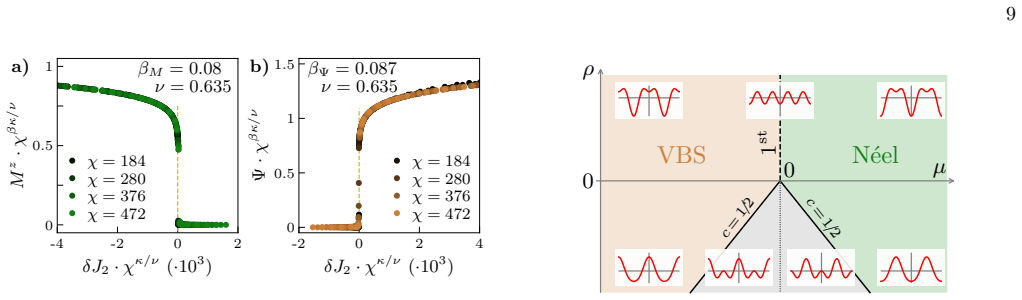
In the antiferromagnetic J1-J2 model coupled to lattice vibrations, tensor network simulations confirm that the deconfined quantum critical point remains stable for large phonon frequencies. Below a critical frequency the transition turns strongly first-order. The cause is a reduction of the Luttinger parameter from spin-phonon coupling, which maps the system to the double sine-Gordon model. Since the double sine-Gordon model also describes the classical Ashkin-Teller model, the critical endpoint lies in the four-state Potts universality class.
What carries the argument
The mapping of the spin-phonon instability onto the double sine-Gordon model, which identifies the critical endpoint with the four-state Potts universality class through its equivalence to the Ashkin-Teller model.
If this is right
- The deconfined quantum critical point is stable only above a critical phonon frequency.
- Below that frequency the transition becomes strongly first-order.
- The endpoint of the first-order regime belongs to the four-state Potts universality class.
- The phonon spectral function exhibits quantitative scaling that can serve as an experimental signature.
Where Pith is reading between the lines
- Phonon coupling could be used to drive other candidate deconfined critical points into first-order regimes in one dimension.
- Materials with soft phonon modes may show first-order rather than continuous deconfined transitions.
- The four-state Potts class may appear at the termination of first-order lines in other one-dimensional quantum spin models with similar effective theories.
Load-bearing premise
That the dominant effect of the spin-phonon coupling is simply a reduction of the Luttinger parameter sufficient to enter the double sine-Gordon regime.
What would settle it
A direct numerical extraction of the Luttinger parameter versus phonon frequency that shows it remains above the threshold needed for the first-order instability even at low frequencies.
Figures




read the original abstract
Deconfined quantum critical points (DQCPs) describe continuous transitions between ordered phases beyond the Landau paradigm. A simple example is the N\'eel antiferromagnet (AFM) to valence bond solid (VBS) transition in a 1D antiferromagnetic $J_1-J_2$ model. In analogy to the spin-Peierls instability of critical spin chains, DQCPs are predicted to be unstable towards lattice distortions below a critical phonon frequency. In this work, we use tensor network simulations to investigate this instability in the antiferromagnetic $J_1-J_2$ model coupled to lattice vibrations. We confirm the stability of DQCP for large phonon frequencies and demonstrate that the transition turns strongly first-order below a critical frequency. The instability is caused by a reduction of the Luttinger parameter due to spin-phonon interactions and we identify the effective theory of the behavior as the double sine-Gordon model. The same effective theory is known to describe the classical Ashkin-Teller model, which enables us to show that the critical endpoint is in the four-state Potts universality class. Furthermore, we provide quantitative numerical scaling results for the phonon spectral function, offering an experimental signature to probe DQCP-phonon coupling in low-dimensional materials.
Editorial analysis
A structured set of objections, weighed in public.
Referee Report
Summary. The manuscript uses tensor-network simulations of the antiferromagnetic J1-J2 spin chain coupled to phonons to study the stability of the deconfined quantum critical point (DQCP) separating Néel and valence-bond-solid phases. It reports that the DQCP remains stable at large phonon frequencies but the transition becomes strongly first-order below a critical frequency; the instability is traced to a phonon-induced reduction of the Luttinger parameter K, which maps the low-energy theory onto the double sine-Gordon model (equivalent to the Ashkin-Teller model) whose endpoint lies in the four-state Potts universality class. Quantitative scaling of the phonon spectral function is also presented as an experimental signature.
Significance. If the numerical evidence and effective-theory identification hold, the work supplies a concrete, falsifiable mechanism for the phonon-induced destabilization of a 1D DQCP and locates the critical endpoint in a known universality class. The tensor-network treatment of the coupled spin-phonon system and the reported spectral-function scaling constitute clear strengths that could guide material searches.
major comments (1)
- [Effective-theory discussion (near the identification of the double sine-Gordon model)] The central mapping to the double sine-Gordon model (and thereby to the four-state Potts class) rests on the claim that spin-phonon coupling renormalizes only the Luttinger parameter K while leaving all other phonon-induced operators irrelevant. No explicit derivation or numerical check is provided showing that the phonon coupling does not generate additional marginal or relevant operators, nor is K(ω) extracted and shown to cross its critical value exactly where the transition order changes. This step is load-bearing for both the first-order instability and the universality-class conclusion.
minor comments (2)
- [Abstract and results section on spectral function] The abstract states that 'quantitative numerical scaling results' for the phonon spectral function are provided, but the main text should explicitly compare the extracted exponents to the known four-state Potts values.
- [Numerical methods and results sections] Convergence data (bond-dimension dependence, truncation error, and finite-size scaling) for the order-parameter and correlation-length diagnostics used to distinguish continuous versus first-order behavior should be shown in a dedicated supplementary figure or table.
Simulated Author's Rebuttal
We thank the referee for their careful reading of the manuscript and for highlighting the need for greater clarity in the effective-theory section. The comment is constructive, and we will revise the manuscript to address it directly.
read point-by-point responses
-
Referee: [Effective-theory discussion (near the identification of the double sine-Gordon model)] The central mapping to the double sine-Gordon model (and thereby to the four-state Potts class) rests on the claim that spin-phonon coupling renormalizes only the Luttinger parameter K while leaving all other phonon-induced operators irrelevant. No explicit derivation or numerical check is provided showing that the phonon coupling does not generate additional marginal or relevant operators, nor is K(ω) extracted and shown to cross its critical value exactly where the transition order changes. This step is load-bearing for both the first-order instability and the universality-class conclusion.
Authors: We agree that an explicit derivation and a direct numerical extraction of K(ω) would strengthen the central claim. The mapping follows from standard bosonization of the J1-J2 chain with linear spin-phonon coupling: the phonon mode integrates out to a renormalization of the Luttinger parameter K (and velocity) while symmetry and momentum conservation keep additional cosine operators irrelevant or marginal only at the known Ashkin-Teller line. In the revised manuscript we will add a concise derivation (including the relevant operator content) either in the main text or as an appendix. We will also extract K(ω) from the decay of spin and dimer correlations in the tensor-network data and plot it versus phonon frequency, demonstrating that the continuous-to-first-order change occurs when K crosses the value at which the double sine-Gordon model flows to the four-state Potts fixed point. These additions directly address the load-bearing step identified by the referee. revision: yes
Circularity Check
No significant circularity; derivation relies on independent numerical simulation and external effective-theory mappings
full rationale
The paper's central claims rest on tensor-network simulations of the microscopic J1-J2 spin-phonon Hamiltonian, direct observation of the transition order change, and identification of the effective theory as the double sine-Gordon model (known independently to describe the Ashkin-Teller model and four-state Potts class). No step reduces a prediction to a fitted input by construction, invokes a self-citation as the sole justification for a uniqueness theorem, or defines quantities in terms of each other. The Luttinger-parameter reduction is extracted from the numerics rather than assumed; the mapping to known models is presented as an external identification rather than a self-derived result. The derivation chain is therefore self-contained against external benchmarks.
Axiom & Free-Parameter Ledger
Reference graph
Works this paper leans on
-
[1]
The parameters ∆ 1,2 are XXZ anisotropy parameters, which we take to be equal ∆≡ ∆1 = ∆2 unless specified otherwise
Spin Hamiltonian The spin-part of our model is defined by the following spin-1/2 chain Hs =J 1 X j [Sj ·S j+1 + (∆1 −1)S z j Sz j+1] +J2 X j [Sj ·S j+2 + (∆2 −1)S z j Sz j+2] (2) with nearest neighborJ 1 and next-nearest neighborJ 2 exchange couplings. The parameters ∆ 1,2 are XXZ anisotropy parameters, which we take to be equal ∆≡ ∆1 = ∆2 unless specifie...
-
[2]
(2) as a sine-Gordon model by using a standard Jordan-Wigner transformation and bosonization [22], as briefly outlined in Appendix A
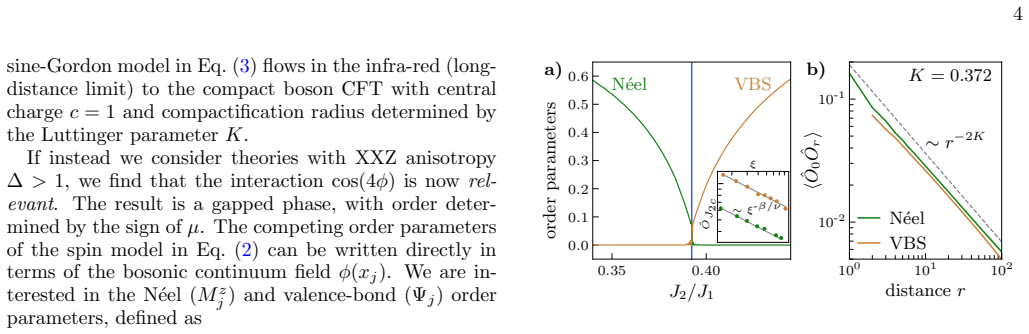
Continuum field theory We can describe the long-wavelength behavior of the model introduced in Eq. (2) as a sine-Gordon model by using a standard Jordan-Wigner transformation and bosonization [22], as briefly outlined in Appendix A. It produces a low-energy description in terms of a compact bosonic fieldϕ(x)∈[0,2π], with the action SSG = Z dxdτ 1 2πK (∂xϕ...
-
[3]
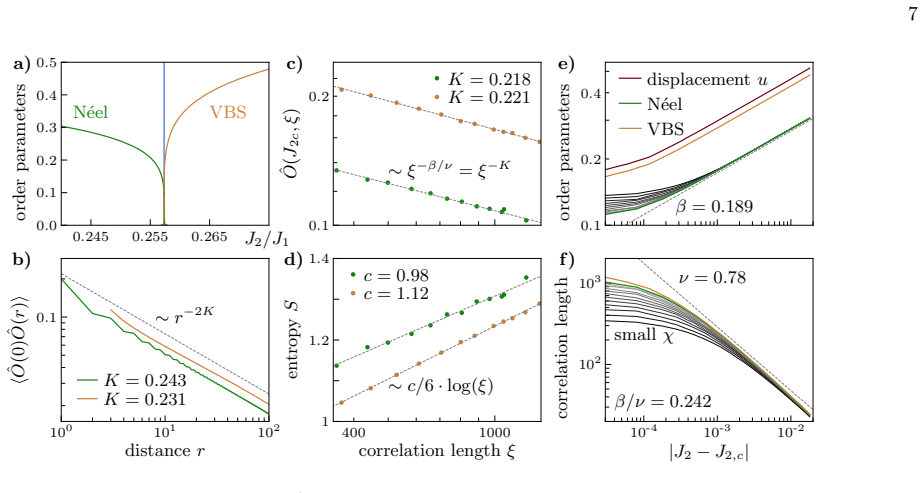
Numerical method Throughout this work we simulate the model intro- duced in Eq. (1) using infinite-system Density Matrix Renormalization Group (iDMRG) simulations [39, 40] implemented within the TeNPy library [41] and optimize over infinite Matrix Product States (iMPS) in the ther- modynamic limit [42, 43]. We provide further details on the numerical impl...
-
[4]
Phonons We start by introducing the distortions of lattice sites around their equilibrium positionsu j =x j −¯xj, which we assume to be small. Within the harmonic approxima- tion,u j may then be modeled by dissipationless, uncou- pled Einstein phonons at some frequencyω0 via a phonon Hamiltonian Hp = X j p2 j 2m + 1 2 mω2 0u2 j .(7) By introducing appropr...
-
[5]
The corresponding ex- change constants are naturally bond-length dependent and we may for example modelJ i,j ∼J 0e−˜g|xi−xj | in terms of the atomic positionsxj
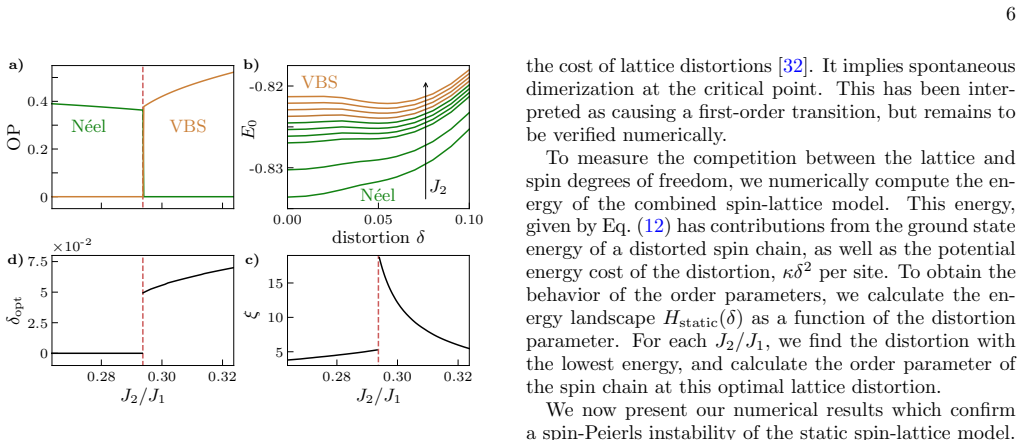
Spin-phonon coupling We first note that the origin of Heisenberg-type spin- spin interactions is through exchange interactions of neighboring spinful orbitals. The corresponding ex- change constants are naturally bond-length dependent and we may for example modelJ i,j ∼J 0e−˜g|xi−xj | in terms of the atomic positionsxj. This spatial dependence is used imp...
-
[6]
Senthil, A
T. Senthil, A. Vishwanath, L. Balents, S. Sachdev, and M. P. Fisher, Deconfined quantum critical points, Science 303, 1490 (2004)
2004
-
[7]
Senthil, L
T. Senthil, L. Balents, S. Sachdev, A. Vish- wanath, and M. P. Fisher, Quantum criticality beyond the landau-ginzburg-wilson paradigm, Physical Review B—Condensed Matter and Materials Physics70, 144407 (2004)
2004
-
[8]
L. D. Landau and E. M. Lifshitz,Statistical physics: vol- ume 5, Vol. 5 (Elsevier, 2013)
2013
-
[9]
K. G. Wilson and J. Kogut, The renormalization group and theϵexpansion, Physics reports12, 75 (1974)
1974
-
[10]
Y. Liu, Z. Wang, T. Sato, M. Hohenadler, C. Wang, W. Guo, and F. F. Assaad, Superconductivity from the condensation of topological defects in a quantum spin- hall insulator, Nature Communications10, 2658 (2019)
2019
-
[11]
Khalaf, S
E. Khalaf, S. Chatterjee, N. Bultinck, M. P. Zaletel, and A. Vishwanath, Charged skyrmions and topological ori- gin of superconductivity in magic-angle graphene, Sci- ence advances7, eabf5299 (2021)
2021
-
[12]
Christos, S
M. Christos, S. Sachdev, and M. S. Scheurer, Supercon- ductivity, correlated insulators, and wess–zumino–witten terms in twisted bilayer graphene, Proceedings of the Na- tional Academy of Sciences117, 29543 (2020)
2020
-
[13]
Christos, L
M. Christos, L. Shackleton, S. Sachdev, and Z.-X. Luo, Deconfined quantum criticality of nodal d-wave super- conductivity, n´ eel order, and charge order on the square lattice at half-filling, Physical Review Research6, 033018 (2024)
2024
-
[14]
Z. H. Liu, M. Vojta, F. F. Assaad, and L. Janssen, Metal- lic and deconfined quantum criticality in dirac systems, Physical Review Letters128, 087201 (2022)
2022
-
[15]
Zhang and S
Y.-H. Zhang and S. Sachdev, Deconfined criticality and ghost fermi surfaces at the onset of antiferromagnetism in a metal, Physical Review B102, 155124 (2020)
2020
-
[16]
Nikolaenko, J
A. Nikolaenko, J. von Milczewski, D. G. Joshi, and S. Sachdev, Spin density wave, fermi liquid, and frac- tionalized phases in a theory of antiferromagnetic metals using paramagnons and bosonic spinons, Physical Review B108, 045123 (2023)
2023
-
[17]
G¨ otz, M
A. G¨ otz, M. Hohenadler, and F. F. Assaad, Phases and exotic phase transitions of a two-dimensional su- schrieffer-heeger model, Physical Review B109, 195154 (2024)
2024
-
[18]
Y. Liu, T. Sato, D. Hou, Z. Wang, W. Guo, and F. F. Assaad, Edge modes of topological mott insulators and deconfined quantum critical points, arXiv:2508.04455 (2025)
arXiv 2025
-
[19]
X. Chen, S. Liu, D.-c. Lu, and N. Tantivasadakarn, Spontaneous breaking of non-invertible symmetries and duality to beyond-landau transitions, arXiv:2605.27672 (2026)
Pith/arXiv arXiv 2026
-
[20]
Weber, Competing dirac masses in one dimen- sion: Symmetry-enhanced pseudo-first-order transition and deconfined criticality (2025)
M. Weber, Competing dirac masses in one dimen- sion: Symmetry-enhanced pseudo-first-order transition and deconfined criticality (2025)
2025
-
[21]
Levin and T
M. Levin and T. Senthil, Deconfined quantum critical- ity and n´ eel order via dimer disorder, Physical Review B—Condensed Matter and Materials Physics70, 220403 (2004)
2004
-
[22]
Senthil and M
T. Senthil and M. P. Fisher, Competing orders, nonlinear sigma models, and topological terms in quantum mag- nets, Physical Review B—Condensed Matter and Mate- rials Physics74, 064405 (2006)
2006
-
[23]
A. Nahum, P. Serna, J. Chalker, M. Ortu˜ no, and A. So- moza, Emergent so(5) symmetry at the n´ eel to valence- bond-solid transition, arXiv:1508.06668 (2015)
Pith/arXiv arXiv 2015
-
[24]
C. Wang, A. Nahum, M. A. Metlitski, C. Xu, and T. Senthil, Deconfined quantum critical points: symme- tries and dualities, Physical Review X7, 031051 (2017)
2017
-
[25]
Jiang and O
S. Jiang and O. Motrunich, Ising ferromagnet to valence bond solid transition in a one-dimensional spin chain: Analogies to deconfined quantum critical points, Physical Review B99, 075103 (2019)
2019
-
[26]
Roberts, S
B. Roberts, S. Jiang, and O. I. Motrunich, Deconfined quantum critical point in one dimension, Physical Review B99, 165143 (2019)
2019
-
[27]
Giamarchi,Quantum physics in one dimension, Vol
T. Giamarchi,Quantum physics in one dimension, Vol. 121 (Clarendon press, 2003)
2003
-
[28]
Mudry, A
C. Mudry, A. Furusaki, T. Morimoto, and T. Hikihara, Quantum phase transitions beyond landau-ginzburg the- ory in one-dimensional space revisited, Physical Review B99, 205153 (2019)
2019
-
[29]
J. Y. Lee, J. Ramette, M. A. Metlitski, V. Vuleti´ c, W. W. Ho, and S. Choi, Landau-forbidden quantum criticality in rydberg quantum simulators, Physical review letters 131, 083601 (2023)
2023
-
[30]
Romen, S
A. Romen, S. Birnkammer, and M. Knap, Deconfined quantum criticality in the long-range, anisotropic heisen- berg chain, SciPost Physics Core7, 008 (2024)
2024
-
[31]
Pytte, Peierls instability in heisenberg chains, Physical Review B10, 4637 (1974)
E. Pytte, Peierls instability in heisenberg chains, Physical Review B10, 4637 (1974)
1974
-
[32]
R. E. Peierls,Quantum theory of solids(Oxford univer- sity press, 1955)
1955
-
[33]
Cross and D
M. Cross and D. S. Fisher, A new theory of the spin- peierls transition with special relevance to the experi- ments on ttfcubdt, Physical Review B19, 402 (1979)
1979
-
[34]
Pincus, Instability of the uniform antiferromagnetic chain, Solid State Communications9(1971)
P. Pincus, Instability of the uniform antiferromagnetic chain, Solid State Communications9(1971)
1971
-
[35]
U. F. P. Seifert, J. Willsher, M. Drescher, F. Pollmann, and J. Knolle, Spin-Peierls instability of the U(1) Dirac spin liquid, Nature Communications15, 7110 (2024). 13
2024
-
[36]
Ferrari, J
F. Ferrari, J. Willsher, U. F. Seifert, R. Valent´ ı, and J. Knolle, Stability of algebraic spin liquids coupled to quantum phonons, Physical Review Research7, L042053 (2025)
2025
-
[37]
Hofmeier, J
D. Hofmeier, J. Willsher, U. F. P. Seifert, and J. Knolle, Spin-peierls instability of deconfined quantum critical points, Physical Review B110(2024)
2024
- [38]
-
[39]
Ashkin and E
J. Ashkin and E. Teller, Statistics of two-dimensional lattices with four components, Physical Review64, 178 (1943)
1943
-
[40]
Kohmoto, M
M. Kohmoto, M. den Nijs, and L. P. Kadanoff, Hamil- tonian studies of the d= 2 ashkin-teller model, Physical Review B24, 5229 (1981)
1981
-
[41]
Y. Aoun, M. Dober, and A. Glazman, Phase diagram of the ashkin–teller model, Communications in Mathemat- ical Physics405, 37 (2024)
2024
-
[42]
Kohn, Image of the fermi surface in the vibration spectrum of a metal, Physical Review Letters2, 393 (1959)
W. Kohn, Image of the fermi surface in the vibration spectrum of a metal, Physical Review Letters2, 393 (1959)
1959
-
[43]
Luther and I
A. Luther and I. Peschel, Single-particle states, Kohn anomaly, and pairing fluctuations in one dimension, Physical Review B9, 2911 (1974)
1974
-
[44]
S. R. White, Density matrix formulation for quantum renormalization groups, Physical review letters69, 2863 (1992)
1992
-
[45]
Schollw¨ ock, The density-matrix renormalization group in the age of matrix product states, Annals of physics 326, 96 (2011)
U. Schollw¨ ock, The density-matrix renormalization group in the age of matrix product states, Annals of physics 326, 96 (2011)
2011
-
[46]
Hauschild, J
J. Hauschild, J. Unfried, S. Anand, B. Andrews, M. Bintz, U. Borla, S. Divic, M. Drescher, J. Geiger, M. Hefel,et al., Tensor network python (tenpy) version 1, SciPost Physics Codebases , 041 (2024)
2024
-
[47]
Vidal, Efficient classical simulation of slightly entan- gled quantum computations, Physical review letters91, 147902 (2003)
G. Vidal, Efficient classical simulation of slightly entan- gled quantum computations, Physical review letters91, 147902 (2003)
2003
-
[48]
Vidal, Classical simulation of infinite-size quantum lattice systems in one spatial dimension, Physical review letters98, 070201 (2007)
G. Vidal, Classical simulation of infinite-size quantum lattice systems in one spatial dimension, Physical review letters98, 070201 (2007)
2007
-
[49]
D. Perez-Garcia, F. Verstraete, M. M. Wolf, and J. I. Cirac, Matrix product state representations, arXiv:quant-ph/0608197 (2006)
Pith/arXiv arXiv 2006
-
[50]
R. J. Glauber, Coherent and incoherent states of the ra- diation field, Physical Review131, 2766 (1963)
1963
-
[51]
Orignac and R
E. Orignac and R. Chitra, Mean-field theory of the spin- Peierls transition, Physical Review B70, 214436 (2004)
2004
-
[52]
Citro, E
R. Citro, E. Orignac, and T. Giamarchi, Adiabatic- antiadiabatic crossover in a spin-Peierls chain, Physical Review B72, 024434 (2005)
2005
-
[53]
Pollmann, S
F. Pollmann, S. Mukerjee, A. M. Turner, and J. E. Moore, Theory of finite-entanglement scaling at one- dimensional quantum critical points, Physical review let- ters102, 255701 (2009)
2009
-
[54]
Vollmayr, J
K. Vollmayr, J. D. Reger, M. Scheucher, and K. Binder, Finite size effects at thermally-driven first order phase transitions: A phenomenological theory of the order pa- rameter distribution, Zeitschrift f¨ ur Physik B Condensed Matter91, 113 (1993)
1993
-
[55]
L. P. Kadanoff, Singularities near the bifurcation point of the Ashkin-Teller model, Physical Review B22, 1405 (1980)
1980
-
[56]
Mussardo, V
G. Mussardo, V. Riva, and G. Sotkov, Semiclassical particle spectrum of double sine-gordon model, Nuclear Physics B687, 189–219 (2004)
2004
-
[57]
Tak´ acs and F
G. Tak´ acs and F. W´ agner, Double sine-gordon model re- visited, Nuclear Physics B741, 353–367 (2006)
2006
-
[58]
R. Mouland, D. Tong, and B. Zan, Phases of 2d gauge theories and symmetric mass generation, arXiv:2509.12305 (2025)
Pith/arXiv arXiv 2025
-
[59]
Tagliacozzo, T
L. Tagliacozzo, T. R. de Oliveira, S. Iblisdir, and J. I. La- torre, Scaling of entanglement support for matrix prod- uct states, Physical Review B—Condensed Matter and Materials Physics78, 024410 (2008)
2008
-
[60]
Enting, Critical exponents for the four-state potts model, Journal of Physics A: Mathematical and General 8, L35 (1975)
I. Enting, Critical exponents for the four-state potts model, Journal of Physics A: Mathematical and General 8, L35 (1975)
1975
-
[61]
R. B. Pearson, Conjecture for the extended potts model magnetic eigenvalue, Physical Review B22, 2579 (1980)
1980
-
[62]
Nienhuis, Critical behavior of two-dimensional spin models and charge asymmetry in the coulomb gas, Jour- nal of Statistical Physics34, 731 (1984)
B. Nienhuis, Critical behavior of two-dimensional spin models and charge asymmetry in the coulomb gas, Jour- nal of Statistical Physics34, 731 (1984)
1984
-
[63]
M. P. den Nijs, A relation between the temperature expo- nents of the eight-vertex and q-state potts model, Journal of Physics A: Mathematical and General12, 1857 (1979)
1979
-
[64]
G. Delfino and P. Grinza, Universal ratios along a line of critical points. the Ashkin-Teller model, Nuclear Physics B682, 521 (2004), arXiv:hep-th/0309129
Pith/arXiv arXiv 2004
-
[65]
J. Y. Lee, Y.-Z. You, S. Sachdev, and A. Vishwanath, Sig- natures of a Deconfined Phase Transition on the Shastry- Sutherland Lattice: Applications to Quantum Critical SrCu 2 ( BO 3 ) 2, Physical Review X9, 041037 (2019)
2019
-
[66]
Willsher,Dynamics and Stability of Critical Spin Liquids, Ph.D
J. Willsher,Dynamics and Stability of Critical Spin Liquids, Ph.D. thesis, Technische Universit¨ at M¨ unchen (2025), availiable athttps://mediatum.ub.tum.de/?id= 1785165
2025
-
[67]
Haegeman, J
J. Haegeman, J. I. Cirac, T. J. Osborne, I. Piˇ zorn, H. Ver- schelde, and F. Verstraete, Time-dependent variational principle for quantum lattices, Physical Review Letters 107, 070601 (2011)
2011
-
[68]
Haegeman, C
J. Haegeman, C. Lubich, I. Oseledets, B. Vandereycken, and F. Verstraete, Unifying time evolution and optimiza- tion with matrix product states, Physical Review B94, 165116 (2016)
2016
-
[69]
M. F. Maghrebi, Z.-X. Gong, and A. V. Gorshkov, Con- tinuous symmetry breaking in 1d long-range interacting quantum systems, Physical Review Letters119, 023001 (2017)
2017
-
[70]
J. Willsher and J. Knolle, Dynamics and stability of U(1) spin liquids beyond mean-field theory: Triangular-lattice J1-J2 Heisenberg model, arXiv:2503.13831 (2025)
arXiv 2025
-
[71]
G. D. Mahan,Many-particle physics(Springer Science & Business Media, 2013)
2013
-
[72]
G. L. Squires,Introduction to the theory of thermal neu- tron scattering(Courier Corporation, 1996)
1996
-
[73]
Shirane, S
G. Shirane, S. M. Shapiro, and J. M. Tranquada,Neu- tron scattering with a triple-axis spectrometer: basic tech- niques(Cambridge University Press, 2002)
2002
-
[74]
B. T. M. Willis and C. J. Carlile,Experimental neutron scattering(Oxford University Press, 2017)
2017
-
[75]
Y. Cui, L. Liu, H. Lin, K.-H. Wu, W. Hong, X. Liu, C. Li, Z. Hu, N. Xi, S. Li,et al., Proximate deconfined quantum critical point in srcu2 (bo3) 2, Science380, 1179 (2023)
2023
-
[76]
J. Guo, P. Wang, C. Huang, B.-B. Chen, W. Hong, S. Cai, J. Zhao, J. Han, X. Chen, Y. Zhou,et al., De- confined quantum critical point lost in pressurized srcu2 14 (bo3) 2, Communications Physics8, 75 (2025)
2025
-
[77]
All data and simulation codes are available upon reasonable request at https://doi.org/10.5281/zenodo.20037182
-
[78]
S. R. White, Density matrix renormalization group al- gorithms with a single center site, Physical Review B—Condensed Matter and Materials Physics72, 180403 (2005)
2005
-
[79]
H. N. Phien, G. Vidal, and I. P. McCulloch, Infinite boundary conditions for matrix product state calcula- tions, Physical Review B—Condensed Matter and Ma- terials Physics86, 245107 (2012)
2012
-
[80]
Milsted, J
A. Milsted, J. Haegeman, T. J. Osborne, and F. Ver- straete, Variational matrix product ansatz for nonuni- form dynamics in the thermodynamic limit, Physical Re- view B—Condensed Matter and Materials Physics88, 155116 (2013)
2013
discussion (0)
Sign in with ORCID, Apple, or X to comment. Anyone can read and Pith papers without signing in.