Scalable Quantum Algorithms for Gutzwiller Projection
Pith reviewed 2026-06-27 22:04 UTC · model grok-4.3
The pith
Amplitude amplification quadratically reduces the number of queries needed to prepare Gutzwiller-projected BCS states.
A machine-rendered reading of the paper's core claim, the machinery that carries it, and where it could break.
Core claim
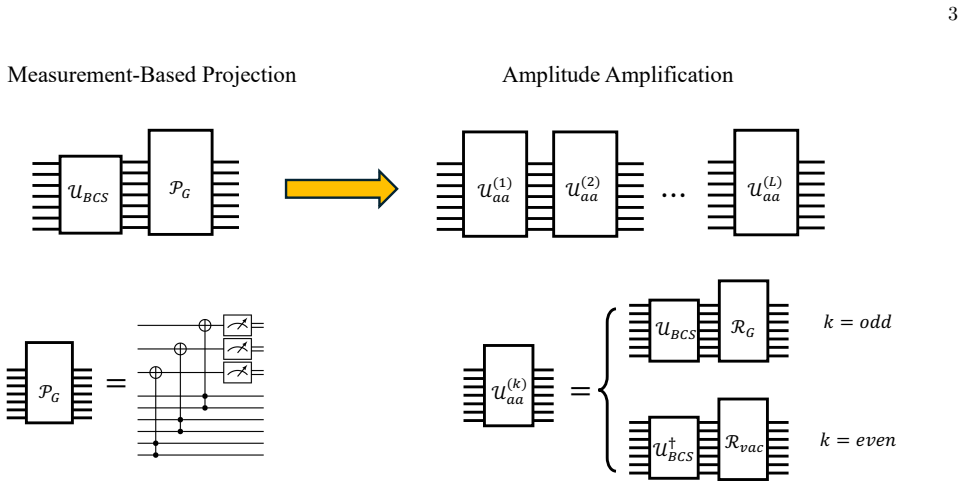
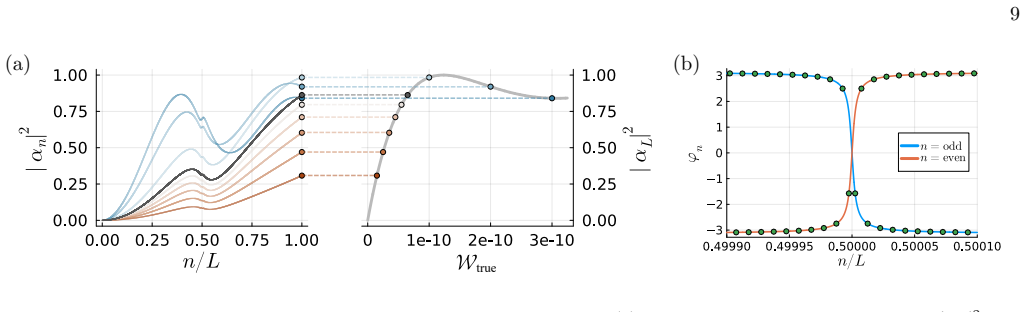
Combining a circuit construction for arbitrary BCS states with the amplitude amplification for Gutzwiller projection (AAGP) procedure yields a quadratic reduction in the number of projection queries compared with measurement-based postselection and leads to substantially improved fault-tolerant resource scaling; for projected BCS states optimized for the square-lattice t-J model the projected-state weight decreases exponentially with system size, but the quadratic improvement remains large enough at physically relevant finite sizes that, for a 100-site benchmark, AAGP reduces the required number of projection queries by about seven orders of magnitude.
What carries the argument
Amplitude Amplification for Gutzwiller Projection (AAGP), which uses repeated coherent applications of the projection operator together with a reflection about the initial BCS state to amplify the amplitude of the desired projected component.
If this is right
- Substantially improved fault-tolerant resource scaling for preparing accurate input states in quantum simulation of strongly correlated models.
- A decisive practical reduction in query count at system sizes such as 100 sites.
- Projected BCS states become usable input states for quantum simulation of the t-J model and related lattice Hamiltonians.
- The quadratic query reduction holds whenever the projection operator can be implemented coherently inside the quantum circuit.
Where Pith is reading between the lines
- The same amplification technique could be applied to other non-unitary projections that appear in variational wavefunctions for quantum many-body systems.
- Resource estimates for full fault-tolerant algorithms would improve further if AAGP is combined with early fault-tolerant techniques that tolerate some measurement noise.
- The method may generalize to preparing projected states on lattices with different geometries or with additional variational parameters.
Load-bearing premise
Even though the weight of the projected state decreases exponentially with system size, the quadratic improvement from AAGP is still large enough at physically relevant finite sizes to produce a decisive practical difference in total resource cost.
What would settle it
A direct numerical count, on a fault-tolerant simulator, of the total number of projection-operator applications required to reach a fixed target fidelity for a 100-site projected BCS state when using AAGP versus when using measurement-based postselection.
Figures



read the original abstract
Quantum simulation requires highly accurate input states. Gutzwiller-projected Bardeen-Cooper-Schrieffer (BCS) states provide physically motivated input states for solving strongly correlated lattice models, but their preparation on a quantum computer is hindered by the non-trivial nature of the Gutzwiller projection. We construct scalable quantum algorithms for this task by combining a circuit construction for arbitrary BCS states with the amplitude amplification for Gutzwiller projection (AAGP) procedure. AAGP yields a quadratic reduction in the number of projection queries compared with measurement-based postselection and leads to substantially improved fault-tolerant resource scaling. For projected BCS states optimized for the square-lattice $t$-$J$ model, we find that the projected-state weight decreases exponentially with system size, but the quadratic improvement is still large enough at physically relevant finite sizes to make a decisive practical difference. In particular, for a 100-site benchmark, AAGP reduces the required number of projection queries by about seven orders of magnitude. These results establish AAGP as an enabling input-state preparation protocol for projected BCS states in quantum simulation.
Editorial analysis
A structured set of objections, weighed in public.
Referee Report
Summary. The paper presents scalable quantum algorithms for Gutzwiller projection by combining a circuit for arbitrary BCS states with the amplitude amplification for Gutzwiller projection (AAGP) procedure. AAGP achieves a quadratic reduction in the number of projection queries relative to measurement-based postselection. For projected BCS states optimized for the square-lattice t-J model, the projected-state weight is shown to decrease exponentially with system size, yet the quadratic improvement results in a seven-order-of-magnitude reduction in required projection queries for a 100-site benchmark, improving fault-tolerant resource scaling.
Significance. If the claims hold, this work provides an enabling input-state preparation protocol for quantum simulation of strongly correlated lattice models, with substantially improved fault-tolerant scaling. The constructive combination of existing primitives (BCS preparation and amplitude amplification) without free parameters or circularity, together with explicit finite-size numerical benchmarks, is a strength that supports practical relevance at N=100.
Simulated Author's Rebuttal
We thank the referee for their positive assessment of the manuscript and their recommendation to accept. We appreciate the recognition of the constructive combination of primitives and the practical relevance for N=100 benchmarks.
Circularity Check
No significant circularity
full rationale
The central claim rests on combining a standard circuit for arbitrary BCS states with amplitude amplification (AAGP) to implement Gutzwiller projection. The quadratic query reduction follows directly from the known scaling of amplitude amplification (O(1/sqrt(w)) versus O(1/w) for post-selection), which is an external quantum primitive and not derived from or fitted to the paper's own data. The reported seven-order reduction at N=100 follows from explicit computation of the projected-state weight w for optimized t-J states; this is a numerical evaluation of an independent quantity, not a parameter fit renamed as a prediction. No self-citation is load-bearing for the scaling argument, and the derivation chain contains no self-definitional steps or ansatz smuggling.
Axiom & Free-Parameter Ledger
axioms (1)
- standard math Existence of efficient quantum circuits for arbitrary BCS states and standard amplitude amplification
invented entities (1)
-
AAGP procedure
no independent evidence
Reference graph
Works this paper leans on
-
[1]
R. P. Feynman, Int. J. Theor. Phys.21, 467 (1982)
1982
-
[2]
I. M. Georgescu, S. Ashhab, and F. Nori, Rev. Mod. Phys.86, 153 (2014)
2014
-
[3]
A. J. Daley, I. Bloch, C. Kokail, S. Flannigan, N. Pearson, M. Troyer, and P. Zoller, Nature607, 667 (2022)
2022
-
[4]
Y. Zhou, K. Kanoda, and T.-K. Ng, Rev. Mod. Phys.89, 025003 (2017)
2017
-
[5]
Auerbach,Interacting Electrons and Quantum Mag- netism(Springer, New York, 1994)
A. Auerbach,Interacting Electrons and Quantum Mag- netism(Springer, New York, 1994)
1994
-
[6]
D. P. Arovas, E. Berg, S. A. Kivelson, and S. Raghu, Annu. Rev. Condens. Matter Phys.13, 239 (2022)
2022
-
[7]
P. W. Anderson, Science235, 1196 (1987)
1987
-
[8]
Bardeen, L
J. Bardeen, L. N. Cooper, and J. R. Schrieffer, Phys. Rev. 108, 1175 (1957). 18
1957
-
[9]
Ortiz, J
G. Ortiz, J. E. Gubernatis, E. Knill, and R. Laflamme, Phys. Rev. A64, 022319 (2001)
2001
-
[10]
Wecker, M
D. Wecker, M. B. Hastings, N. Wiebe, B. K. Clark, C. Nayak, and M. Troyer, Phys. Rev. A92, 062318 (2015)
2015
-
[11]
Peruzzo, J
A. Peruzzo, J. McClean, P. Shadbolt, M.-H. Yung, X.-Q. Zhou, P. J. Love, A. Aspuru-Guzik, and J. L. O’Brien, Nat. Commun.5, 4213 (2014)
2014
-
[12]
J. R. McClean, J. Romero, R. Babbush, and A. Aspuru- Guzik, New J. Phys.18, 023023 (2016)
2016
-
[13]
Cerezo, A
M. Cerezo, A. Arrasmith, R. Babbush, S. C. Benjamin, S. Endo, K. Fujii, J. R. McClean, K. Mitarai, X. Yuan, L. Cincio, and P. J. Coles, Nat. Rev. Phys.3, 625 (2021)
2021
-
[14]
A. Y. Kitaev, Quantum measurements and the abelian stabilizer problem (1995), arXiv:quant-ph/9511026
Pith/arXiv arXiv 1995
-
[15]
D. S. Abrams and S. Lloyd, Phys. Rev. Lett.83, 5162 (1999)
1999
-
[16]
Lloyd, Science273, 1073 (1996)
S. Lloyd, Science273, 1073 (1996)
1996
-
[17]
A. M. Childs and N. Wiebe, Quantum Inf. Comput.12, 901 (2012)
2012
-
[18]
J. M. Martyn, Z. M. Rossi, A. K. Tan, and I. L. Chuang, PRX Quantum2, 040203 (2021)
2021
-
[19]
M. C. Gutzwiller, Phys. Rev. Lett.10, 159 (1963)
1963
-
[20]
M. C. Gutzwiller, Phys. Rev.134, A923 (1964)
1964
-
[21]
M. C. Gutzwiller, Phys. Rev.137, A1726 (1965)
1965
-
[22]
Park, Phys
K. Park, Phys. Rev. Lett.95, 027001 (2005)
2005
-
[23]
Park, Phys
K. Park, Phys. Rev. B72, 245116 (2005)
2005
-
[24]
Kwon and K
H. Kwon and K. Park, Phys. Rev. Research4, 013116 (2022)
2022
-
[25]
Murta and J
B. Murta and J. Fern´ andez-Rossier, Phys. Rev. B103, L241113 (2021)
2021
-
[26]
K. Seki, Y. Otsuka, and S. Yunoki, Phys. Rev. B105, 155119 (2022)
2022
-
[27]
L. K. Grover, inProceedings of the Twenty-Eighth Annual ACM Symposium on Theory of Computing (STOC ’96) (ACM, New York, 1996) p. 212
1996
-
[28]
T. J. Yoder, G. H. Low, and I. L. Chuang, Phys. Rev. Lett.113, 210501 (2014)
2014
-
[29]
Gily´ en, Y
A. Gily´ en, Y. Su, G. H. Low, and N. Wiebe, inProceed- ings of the 51st Annual ACM SIGACT Symposium on Theory of Computing(ACM, New York, 2019) p. 193
2019
-
[30]
Gros, Phys
C. Gros, Phys. Rev. B38, 931 (1988)
1988
-
[31]
Paramekanti, M
A. Paramekanti, M. Randeria, and N. Trivedi, Phys. Rev. Lett.87, 217002 (2001)
2001
-
[32]
Wen, Phys
X.-G. Wen, Phys. Rev. B65, 165113 (2002)
2002
-
[33]
Hermele, T
M. Hermele, T. Senthil, M. P. A. Fisher, P. A. Lee, N. Na- gaosa, and X.-G. Wen, Phys. Rev. B70, 214437 (2004)
2004
-
[34]
Y. Ran, M. Hermele, P. A. Lee, and X.-G. Wen, Phys. Rev. Lett.98, 117205 (2007)
2007
-
[35]
Hermele, Y
M. Hermele, Y. Ran, P. A. Lee, and X.-G. Wen, Phys. Rev. B77, 224413 (2008)
2008
-
[36]
Jiang, K
Z. Jiang, K. J. Sung, K. Kechedzhi, V. N. Smelyanskiy, and S. Boixo, Phys. Rev. Applied9, 044036 (2018)
2018
-
[37]
Bloch and A
C. Bloch and A. Messiah, Nucl. Phys.39, 95 (1962)
1962
-
[38]
Ring and P
P. Ring and P. Schuck,The Nuclear Many-Body Problem (Springer-Verlag, Berlin, 1980)
1980
-
[39]
G. Li, S. Feng, and L. Li, Front. Comput. Sci.20, 2010906 (2026)
2026
-
[40]
N. J. Ross and P. Selinger, Quantum Inf. Comput.16, 901 (2016)
2016
-
[41]
M. A. Nielsen and I. L. Chuang,Quantum Computation and Quantum Information: 10th Anniversary Edition (Cambridge University Press, Cambridge, 2011)
2011
-
[42]
M. Amy, D. Maslov, M. Mosca, and M. Roetteler, IEEE Trans. Comput.-Aided Des. Integr. Circuits Syst.32, 818 (2013)
2013
-
[43]
Gosset, V
D. Gosset, V. Kliuchinikov, M. Mosca, and V. Russo, Quantum Inf. Comput.14, 1261 (2014)
2014
-
[44]
N. M. Myers, R. Scott, K. Park, and V. W. Scarola, Phys. Rev. Research5, 023199 (2023)
2023
-
[45]
C. Gros, R. Joynt, and T. M. Rice, Phys. Rev. B36, 381 (1987)
1987
-
[46]
A. H. MacDonald, S. M. Girvin, and D. Yoshioka, Phys. Rev. B37, 9753 (1988)
1988
discussion (0)
Sign in with ORCID, Apple, or X to comment. Anyone can read and Pith papers without signing in.