DREAM: Dynamic Refinement of Early Assignment Mappings
Pith reviewed 2026-06-27 20:59 UTC · model grok-4.3
The pith
Early static commitment to Semantic IDs creates the main cold-start bottleneck in generative recommendation, which DREAM resolves through progressive refinement.
A machine-rendered reading of the paper's core claim, the machinery that carries it, and where it could break.
Core claim
The central claim is that the fundamental cold-start bottleneck in SID-based generative recommendation is the early static commitment to a single identifier through offline tokenization, and DREAM overcomes this by a three-stage framework of intent-aware tokenization to generate candidate SIDs, selection by the frozen backbone, and dynamic beam maintenance of multiple hypotheses.
What carries the argument
DREAM, the three-stage framework that rebuilds the SID space with counterfactual contrastive learning, uses the frozen backbone to select candidates, and applies a dynamic beam to keep multiple weighted SID hypotheses.
Load-bearing premise
The assumption that a frozen recommendation backbone can reliably select the most reliable SID candidate from the generated pool based on multi-context user support without any retraining or additional adaptation.
What would settle it
An experiment showing that the frozen backbone's candidate selections produce no measurable lift in cold-start recommendation accuracy would falsify the central claim.
Figures


read the original abstract
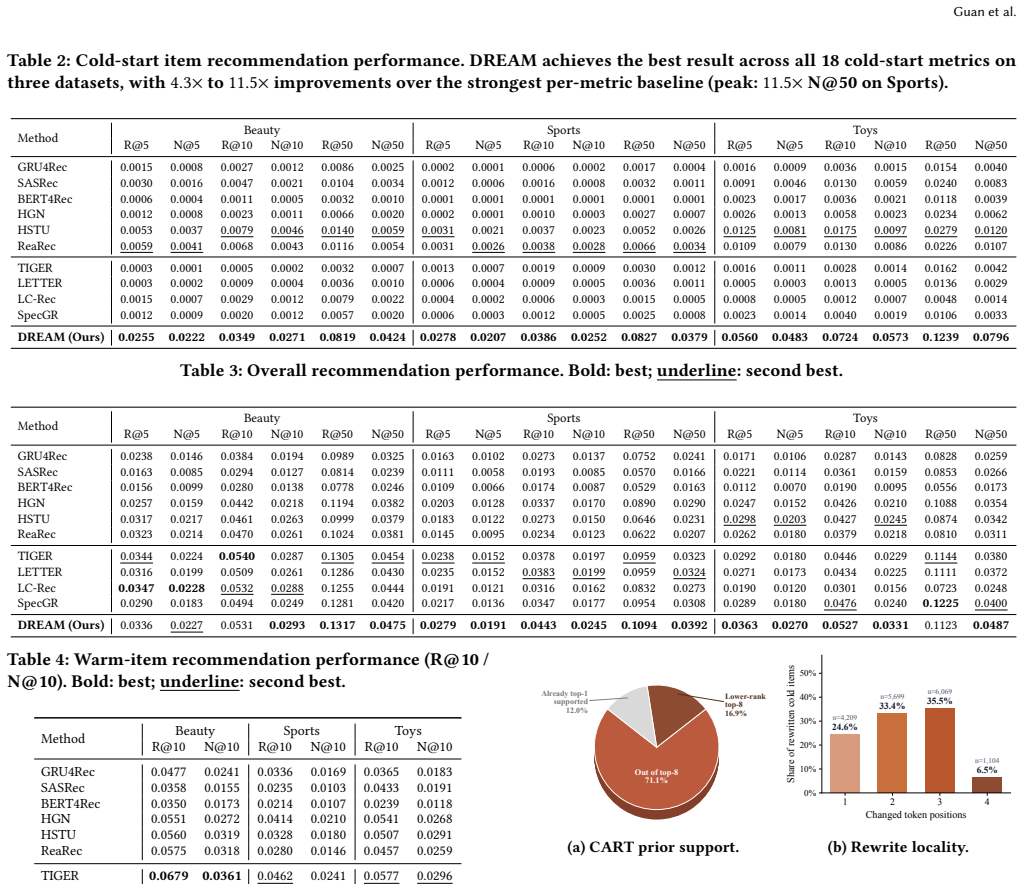
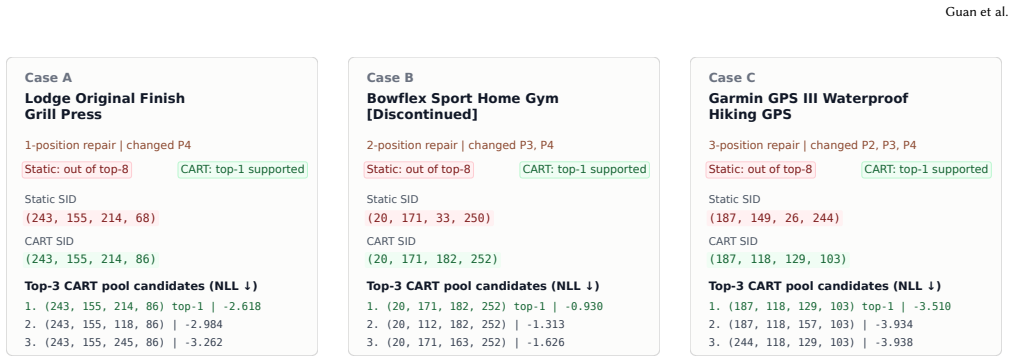
Generative recommendation advances item retrieval by reformulating it as autoregressive generation of Semantic IDs (SIDs), compact token sequences that encode item semantics. While SIDs offer a strong semantic prior, current SID-based methods assign each item a single static identifier through offline tokenization before sufficient user feedback is observed. For cold-start items, this one-shot commitment produces poorly discriminative codes, generating misaligned paths that remain unrefined because the associated tokens are rarely sampled during training. We identify this early static commitment, not model capacity, as the fundamental cold-start bottleneck in SID-based generative recommendation. To overcome this bottleneck and bridge the disjoint objectives of tokenization and generation, we propose DREAM (Dynamic Refinement of Early Assignment Mappings), a three-stage framework that resolves this flaw through progressive refinement. First, an intent-aware tokenizer rebuilds the SID space through counterfactual contrastive learning, generating a diverse pool of behavior-aligned candidates per cold-start item. Second, the frozen recommendation backbone serves as an evaluator, selecting the most reliable candidate based on multi-context user support without retraining. Third, a dynamic beam mechanism maintains multiple weighted SID hypotheses throughout training and inference, preventing premature collapse to a single assignment. Extensive experiments on three Amazon benchmarks show that DREAM substantially outperforms state-of-the-art generative and sequential baselines on cold-start metrics.
Editorial analysis
A structured set of objections, weighed in public.
Referee Report
Summary. The manuscript claims that early static assignment of Semantic IDs (SIDs) during offline tokenization is the fundamental cold-start bottleneck in SID-based generative recommendation systems, rather than model capacity. It proposes DREAM, a three-stage framework consisting of (1) an intent-aware tokenizer that generates a diverse pool of behavior-aligned SID candidates via counterfactual contrastive learning, (2) a frozen recommendation backbone that selects the most reliable candidate from the pool based on multi-context user support without retraining or adaptation, and (3) a dynamic beam mechanism that maintains multiple weighted SID hypotheses throughout training and inference. The paper reports that extensive experiments on three Amazon benchmarks show DREAM substantially outperforms state-of-the-art generative and sequential baselines on cold-start metrics.
Significance. If the central claims and experimental results hold, the work could meaningfully advance generative recommendation by decoupling tokenization from generation through progressive refinement, offering a targeted solution for cold-start items without requiring increased model capacity. The explicit identification of static early assignment as the bottleneck, supported by the proposed stages, provides a clear conceptual contribution if the load-bearing selection mechanism is validated.
major comments (1)
- Abstract (second stage description): The assumption that the frozen recommendation backbone can reliably select the most reliable SID candidate from the intent-aware tokenizer's pool 'based on multi-context user support without any retraining or additional adaptation' is load-bearing for the progressive refinement claim. Because the backbone's parameters were optimized exclusively for the original static SIDs, new counterfactual candidates lie outside its training distribution, so its ranking has no guaranteed alignment with true user preference. The manuscript must supply concrete evidence (e.g., ablation on selection accuracy, comparison to an adapted evaluator, or transfer metrics) to substantiate this step; without it the dynamic beam operates on potentially noisy hypotheses and the overall claim is undermined.
Simulated Author's Rebuttal
We thank the referee for the constructive comment on the load-bearing nature of the frozen backbone selection step. We address the concern directly below and commit to strengthening the manuscript with additional evidence.
read point-by-point responses
-
Referee: Abstract (second stage description): The assumption that the frozen recommendation backbone can reliably select the most reliable SID candidate from the intent-aware tokenizer's pool 'based on multi-context user support without any retraining or additional adaptation' is load-bearing for the progressive refinement claim. Because the backbone's parameters were optimized exclusively for the original static SIDs, new counterfactual candidates lie outside its training distribution, so its ranking has no guaranteed alignment with true user preference. The manuscript must supply concrete evidence (e.g., ablation on selection accuracy, comparison to an adapted evaluator, or transfer metrics) to substantiate this step; without it the dynamic beam operates on potentially noisy hypotheses and the overall claim is undermined.
Authors: We agree this is a load-bearing assumption and that the current manuscript does not provide direct ablations isolating selection accuracy on counterfactual SIDs. The reported gains on cold-start metrics across Amazon benchmarks are consistent with effective selection, but we acknowledge they do not isolate this mechanism from the tokenizer or dynamic beam. In the revision we will add: (i) an ablation reporting selection accuracy against held-out user feedback where available, (ii) a direct comparison of the frozen evaluator versus a lightly adapted evaluator on the same candidate pools, and (iii) transfer metrics showing downstream generation quality for selected versus randomly chosen candidates. These additions will either substantiate or qualify the claim. revision: yes
Circularity Check
No circularity detected; framework proposal is self-contained
full rationale
The manuscript presents a conceptual three-stage framework (intent-aware tokenizer, frozen backbone evaluator, dynamic beam) to address an identified cold-start bottleneck in SID-based recommendation. No equations, parameter fits, or derivation steps appear that reduce any claimed prediction or result to its own inputs by construction. The core claim (early static commitment as the fundamental bottleneck) is stated as an identification rather than derived from prior self-citations or ansatzes, and the stages are described as distinct operations without self-referential loops or renaming of known results. The selection assumption in stage two is an empirical hypothesis, not a definitional reduction.
Axiom & Free-Parameter Ledger
Reference graph
Works this paper leans on
-
[1]
Yimeng Bai, Chang Liu, Yang Zhang, Dingxian Wang, Frank Yang, Andrew Rabinovich, Wenge Rong, and Fuli Feng. 2026. Bi-Level Optimization for Gener- ative Recommendation: Bridging Tokenization and Generation. InProceedings of the 49th International ACM SIGIR Conference on Research and Development in Information Retrieval(Melbourne, VIC, Australia)(SIGIR ’26...
-
[2]
2013.Estimating or Propagating Gradients Through Stochastic Neurons for Conditional Computation
Yoshua Bengio, Nicholas Léonard, and Aaron Courville. 2013.Estimating or Propagating Gradients Through Stochastic Neurons for Conditional Computation. Technical Report. Université de Montréal
2013
-
[3]
Heng-Tze Cheng, Levent Koc, Jeremiah Harmsen, Tal Shaked, Tushar Chandra, Hrishi Aradhye, Glen Anderson, Greg Corrado, Wei Chai, Mustafa Ispir, Rohan Anil, Zakaria Haque, Lichan Hong, Vihan Jain, Xiaobing Liu, and Hemal Shah
-
[4]
Proceedings of the 1st Workshop on Deep Learning for Recommender Systems , pages =
Wide & Deep Learning for Recommender Systems. InProceedings of the 1st Workshop on Deep Learning for Recommender Systems (DLRS 2016). Association for Computing Machinery, New York, NY, USA, 7–10. doi:10.1145/2988450.2988454
-
[5]
Paul Covington, Jay Adams, and Emre Sargin. 2016. Deep Neural Networks for YouTube Recommendations. InProceedings of the 10th ACM Conference on Recommender Systems(Boston, Massachusetts, USA)(RecSys ’16). Association for Computing Machinery, New York, NY, USA, 191–198. doi:10.1145/2959100. 2959190
-
[6]
Jiaxin Deng, Shiyao Wang, Kuo Cai, Lejian Ren, Qigen Hu, Weifeng Ding, Qiang Luo, and Guorui Zhou. 2025. OneRec: Unifying Retrieve and Rank with Genera- tive Recommender and Iterative Preference Alignment. arXiv:2502.18965 [cs.IR]
Pith/arXiv arXiv 2025
-
[7]
Yijie Ding, Jiacheng Li, Julian McAuley, and Yupeng Hou. 2026. Inductive Generative Recommendation via Retrieval-based Speculation.Proceedings of the AAAI Conference on Artificial Intelligence40, 17 (2026), 14675–14683. doi:10.1609/aaai.v40i17.38486
-
[8]
Yuebo Feng, Jiahao Liu, Mingzhe Han, Dongsheng Li, Hansu Gu, Peng Zhang, Tun Lu, and Ning Gu. 2026. Drift-Aware Continual Tokenization for Generative Recommendation.arXiv preprint arXiv:2603.29705(2026)
arXiv 2026
-
[9]
Chelsea Finn, Pieter Abbeel, and Sergey Levine. 2017. Model-Agnostic Meta- Learning for Fast Adaptation of Deep Networks. InProceedings of the 34th In- ternational Conference on Machine Learning (Proceedings of Machine Learning Research, Vol. 70), Doina Precup and Yee Whye Teh (Eds.). PMLR, Sydney, Aus- tralia, 1126–1135
2017
-
[10]
Junchen Fu, Xuri Ge, Alexandros Karatzoglou, Ioannis Arapakis, Suzan Ver- berne, Joemon M. Jose, and Zhaochun Ren. 2026. Differentiable Semantic ID for Generative Recommendation.arXiv preprint arXiv:2601.19711(2026)
Pith/arXiv arXiv 2026
-
[11]
Shijie Geng, Shuchang Liu, Zuohui Fu, Yingqiang Ge, and Yongfeng Zhang. 2022. Recommendation as Language Processing (RLP): A Unified Pretrain, Personalized Prompt and Predict Paradigm (P5). InProceedings of the 16th ACM Conference on Recommender Systems. Association for Computing Machinery, New York, NY, USA, 299–315. doi:10.1145/3523227.3546767
-
[12]
Aaron Grattafiori et al . 2024. The Llama 3 Herd of Models.arXiv preprint arXiv:2407.21783(2024). doi:10.48550/arXiv.2407.21783
work page internal anchor Pith review Pith/arXiv arXiv doi:10.48550/arxiv.2407.21783 2024
-
[13]
Huifeng Guo, Ruiming Tang, Yunming Ye, Zhenguo Li, and Xiuqiang He. 2017. DeepFM: A Factorization-Machine Based Neural Network for CTR Prediction. InProceedings of the Twenty-Sixth International Joint Conference on Artificial Intelligence (IJCAI ’17). International Joint Conferences on Artificial Intelligence Organization, Melbourne, Australia, 1725–1731....
-
[14]
Kaiming He, Haoqi Fan, Yuxin Wu, Saining Xie, and Ross Girshick. 2020. Momen- tum Contrast for Unsupervised Visual Representation Learning. InProceedings of the IEEE/CVF Conference on Computer Vision and Pattern Recognition. 9729–9738. doi:10.1109/CVPR42600.2020.00975
-
[15]
Balázs Hidasi, Alexandros Karatzoglou, Linas Baltrunas, and Domonkos Tikk
-
[16]
In Proceedings of the International Conference on Learning Representations (ICLR ’16)
Session-Based Recommendations with Recurrent Neural Networks. In Proceedings of the International Conference on Learning Representations (ICLR ’16)
-
[17]
Yupeng Hou, Jiacheng Li, Ashley Shin, Jinsung Jeon, Abhishek Santhanam, Wei Shao, Kaveh Hassani, Ning Yao, and Julian McAuley. 2025. Generating Long Semantic IDs in Parallel for Recommendation. InProceedings of the 31st ACM SIGKDD Conference on Knowledge Discovery and Data Mining. Association for Computing Machinery, New York, NY, USA, 956–966. doi:10.114...
-
[18]
Yupeng Hou, Shanlei Mu, Wayne Xin Zhao, Yaliang Li, Bolin Ding, and Ji-Rong Wen. 2022. Towards Universal Sequence Representation Learning for Recom- mender Systems. InProceedings of the 28th ACM SIGKDD Conference on Knowl- edge Discovery and Data Mining (KDD ’22). Association for Computing Machinery, New York, NY, USA, 585–593. doi:10.1145/3534678.3539381
-
[19]
Hu, Yelong Shen, Phillip Wallis, Zeyuan Allen-Zhu, Yuanzhi Li, Shean Wang, Lu Wang, and Weizhu Chen
Edward J. Hu, Yelong Shen, Phillip Wallis, Zeyuan Allen-Zhu, Yuanzhi Li, Shean Wang, Lu Wang, and Weizhu Chen. 2022. LoRA: Low-Rank Adaptation of Large Language Models. InProceedings of the International Conference on Learning Representations
2022
-
[20]
Eric Jang, Shixiang Gu, and Ben Poole. 2017. Categorical Reparameterization with Gumbel-Softmax. InProceedings of the International Conference on Learning Representations (ICLR ’17)
2017
-
[21]
Wang-Cheng Kang and Julian McAuley. 2018. Self-Attentive Sequential Recom- mendation. InProceedings of the 2018 IEEE International Conference on Data Min- ing (ICDM ’18). IEEE Computer Society, 197–206. doi:10.1109/ICDM.2018.00035
-
[22]
Doyup Lee, Chiheon Kim, Saehoon Kim, Minsu Cho, and Wook-Shin Han. 2022. Autoregressive Image Generation Using Residual Quantization. InProceedings of the IEEE/CVF Conference on Computer Vision and Pattern Recognition (CVPR ’22). IEEE Computer Society, 11523–11532
2022
-
[23]
Hoyeop Lee, Jinbae Im, Seongwon Jang, Hyunsouk Cho, and Sehee Chung. 2019. MeLU: Meta-Learned User Preference Estimator for Cold-Start Recommendation. InProceedings of the 25th ACM SIGKDD International Conference on Knowledge Discovery and Data Mining (KDD ’19). Association for Computing Machinery, New York, NY, USA, 1073–1082. doi:10.1145/3292500.3330859
-
[24]
Lei Li, Yongfeng Zhang, Dugang Liu, and Li Chen. 2024. Large Language Models for Generative Recommendation: A Survey and Visionary Discussions. InPro- ceedings of the 2024 Joint International Conference on Computational Linguistics, Language Resources and Evaluation (LREC-COLING ’24)
2024
-
[25]
Xiaopeng Li, Bo Chen, Junda She, et al. 2025. A Survey of Generative Recom- mendation from a Tri-Decoupled Perspective: Tokenization, Architecture, and Optimization.Preprints(2025). doi:10.20944/preprints202512.0203.v1
-
[26]
Yongqi Li, Nan Yang, Liang Wang, Furu Wei, and Wenjie Li. 2023. Multiview Identifiers Enhanced Generative Retrieval. InProceedings of the 61st Annual Meeting of the Association for Computational Linguistics (ACL ’23). Association for Computational Linguistics, 6636–6648. doi:10.18653/v1/2023.acl-long.366
-
[27]
Guanyu Lin, Zhigang Hua, Tao Feng, Shuang Yang, Bo Long, and Jiaxuan You
-
[28]
arXiv preprint arXiv:2502.16474(2025)
Unified Semantic and ID Representation Learning for Deep Recommenders. arXiv preprint arXiv:2502.16474(2025)
arXiv 2025
-
[29]
Chang Liu, Yimeng Bai, Xiaoyan Zhao, Yang Zhang, Fuli Feng, and Wenge Rong
-
[30]
DiscRec: Disentangled Semantic-Collaborative Modeling for Generative Recommendation.arXiv preprint arXiv:2506.15576(2025)
arXiv 2025
-
[31]
Enze Liu, Bowen Zheng, Cheng Ling, Lantao Hu, Han Li, and Wayne Xin Zhao
-
[32]
Generative Recommender with End-to-End Learnable Item Tokenization. InProceedings of the 48th International ACM SIGIR Conference on Research and Development in Information Retrieval (SIGIR ’25). Association for Computing Machinery, New York, NY, USA, 729–739. doi:10.1145/3726302.3729989
-
[33]
Yu-Ze Liu, Jyun-Yu Jiang, and Pu-Jen Cheng. 2024. Multi-DSI: Non-Deterministic Identifier and Concept Alignment for Differentiable Search Index. InProceedings of the 33rd ACM International Conference on Information and Knowledge Manage- ment (CIKM ’24). Association for Computing Machinery, New York, NY, USA, 3917–3921. doi:10.1145/3627673.3679971
-
[34]
Xinchen Luo, Jiangxia Cao, Tianyu Sun, Jinkai Yu, Rui Huang, Wei Yuan, Hezheng Lin, Yichen Zheng, Shiyao Wang, Qigen Hu, Changqing Qiu, Jiaqi Zhang, Xu Zhang, Zhiheng Yan, Jingming Zhang, Simin Zhang, Mingxing Wen, Zhaojie Liu, Kun Gai, and Guorui Zhou. 2025. QARM: Quantitative Alignment Multi-Modal Recommendation at Kuaishou. InProceedings of the 34th AC...
-
[35]
Chen Ma, Peng Kang, and Xue Liu. 2019. Hierarchical Gating Networks for Sequential Recommendation. InProceedings of the 25th ACM SIGKDD Interna- tional Conference on Knowledge Discovery & Data Mining (KDD ’19). Association for Computing Machinery, New York, NY, USA, 825–833. doi:10.1145/3292500. 3330984
-
[36]
Maddison, Andriy Mnih, and Yee Whye Teh
Chris J. Maddison, Andriy Mnih, and Yee Whye Teh. 2017. The Concrete Distri- bution: A Continuous Relaxation of Discrete Random Variables. InProceedings of the 5th International Conference on Learning Representations (ICLR ’17)
2017
-
[37]
Tran, Jonah Samost, Maciej Kula, Ed H
Shashank Rajput, Nikhil Mehta, Anima Singh, Raghunandan Hulikal Keshavan, Trung Vu, Lukasz Heldt, Lichan Hong, Yi Tay, Vinh Q. Tran, Jonah Samost, Maciej Kula, Ed H. Chi, and Maheswaran Sathiamoorthy. 2023. Recommender Systems with Generative Retrieval. InAdvances in Neural Information Processing Systems (NeurIPS ’23, Vol. 36)
2023
-
[38]
The Probabilistic Relevance Framework: BM25 and Beyond,
Stephen E. Robertson and Hugo Zaragoza. 2009. The Probabilistic Relevance Framework: BM25 and Beyond.Foundations and Trends in Information Retrieval 3, 4 (2009), 333–389. doi:10.1561/1500000019
-
[39]
Chenglei Shen, Teng Shi, Weijie Yu, Xiao Zhang, and Jun Xu. 2026. Bringing Model Editing to Generative Recommendation in Cold-Start Scenarios.arXiv preprint arXiv:2603.14259(2026). Guan et al
Pith/arXiv arXiv 2026
-
[40]
Fei Sun, Jun Liu, Jian Wu, Changhua Pei, Xiao Lin, Wenwu Ou, and Peng Jiang
-
[41]
BERT4Rec: Sequential Recommendation with Bidirectional Encoder Repre- sentations from Transformer. InProceedings of the 28th ACM International Confer- ence on Information and Knowledge Management (CIKM ’19). Association for Com- puting Machinery, New York, NY, USA, 1441–1450. doi:10.1145/3357384.3357895
-
[42]
Juntao Tan, Shuyuan Xu, Wenyue Hua, Yingqiang Ge, Zelong Li, and Yongfeng Zhang. 2024. IDGenRec: LLM-RecSys Alignment with Textual ID Learning. InProceedings of the 47th International ACM SIGIR Conference on Research and Development in Information Retrieval (SIGIR ’24). Association for Computing Machinery, New York, NY, USA, 355–364. doi:10.1145/3626772.3657821
-
[43]
Jiakai Tang, Sunhao Dai, Teng Shi, Jun Xu, Xu Chen, Wen Chen, Jian Wu, and Yuning Jiang. 2025. Think Before Recommend: Unleashing the Latent Reasoning Power for Sequential Recommendation.arXiv preprint arXiv:2503.22675(2025). doi:10.48550/arXiv.2503.22675
-
[44]
Antti Tarvainen and Harri Valpola. 2017. Mean Teachers Are Better Role Models: Weight-Averaged Consistency Targets Improve Semi-Supervised Deep Learning Results. InAdvances in Neural Information Processing Systems (NeurIPS ’17, Vol. 30). 1195–1204
2017
-
[45]
Tran, Mostafa Dehghani, Jianmo Ni, Dara Bahri, Harsh Mehta, Zhen Qin, Kai Hui, Zhe Zhao, Jai Gupta, Tal Schuster, William W
Yi Tay, Vinh Q. Tran, Mostafa Dehghani, Jianmo Ni, Dara Bahri, Harsh Mehta, Zhen Qin, Kai Hui, Zhe Zhao, Jai Gupta, Tal Schuster, William W. Cohen, and Donald Metzler. 2022. Transformer Memory as a Differentiable Search Index. In Advances in Neural Information Processing Systems (NeurIPS ’22, Vol. 35)
2022
-
[46]
Hugo Touvron, Thibaut Lavril, Gautier Izacard, Xavier Martinet, Marie-Anne Lachaux, Timothée Lacroix, Baptiste Rozière, Naman Goyal, Eric Hambro, Faisal Azhar, Aurelien Rodriguez, Armand Joulin, Edouard Grave, and Guillaume Lam- ple. 2023. LLaMA: Open and Efficient Foundation Language Models.arXiv preprint arXiv:2302.13971(2023). doi:10.48550/arXiv.2302.13971
work page internal anchor Pith review Pith/arXiv arXiv doi:10.48550/arxiv.2302.13971 2023
-
[47]
Maksims Volkovs, Guangwei Yu, and Tomi Poutanen. 2017. DropoutNet: Ad- dressing Cold Start in Recommender Systems. InAdvances in Neural Information Processing Systems (NIPS ’17, Vol. 30). 4957–4966
2017
-
[48]
Huanjie Wang, Xinchen Luo, Honghui Bao, Zixing Zhang, Lejian Ren, Yunfan Wu, Hongwei Zhang, Liwei Guan, and Guang Chen. 2026. PIT: A Dynamic Personalized Item Tokenizer for End-to-End Generative Recommendation.arXiv preprint arXiv:2602.08530(2026). doi:10.48550/arXiv.2602.08530
-
[49]
Wenjie Wang, Honghui Bao, Xinyu Lin, Jizhi Zhang, Yongqi Li, Fuli Feng, See- Kiong Ng, and Tat-Seng Chua. 2024. Learnable Item Tokenization for Generative Recommendation. InProceedings of the 33rd ACM International Conference on Information and Knowledge Management (CIKM ’24). Association for Computing Machinery, New York, NY, USA, 2400–2409. doi:10.1145/...
-
[50]
Yujing Wang, Yingyan Hou, Haonan Wang, Ziming Miao, Shibin Wu, Hao Sun, Qi Chen, Yuqing Xia, Chengmin Chi, Guoshuai Zhao, Zheng Liu, Xing Xie, Hao Allen Sun, Weiwei Deng, Qi Zhang, and Mao Yang. 2022. A Neural Corpus Indexer for Document Retrieval. InProceedings of the 36th International Conference on Neural Information Processing Systems (NeurIPS ’22). C...
2022
-
[51]
Yidan Wang, Zhaochun Ren, Weiwei Sun, Jiyuan Yang, Zhixiang Liang, Xin Chen, Ruobing Xie, Su Yan, Xu Zhang, Pengjie Ren, Zhumin Chen, and Xin Xin. 2024. Content-Based Collaborative Generation for Recommender Systems. InProceedings of the 33rd ACM International Conference on Information and Knowledge Management (CIKM ’24). Association for Computing Machine...
-
[52]
Ye Wang, Jiahao Xun, Minjie Hong, Jieming Zhu, Tao Jin, Wang Lin, Haoyuan Li, Linjun Li, Yan Xia, Zhou Zhao, and Zhenhua Dong. 2024. EAGER: Two- Stream Generative Recommender with Behavior-Semantic Collaboration. In Proceedings of the 30th ACM SIGKDD Conference on Knowledge Discovery and Data Mining (KDD ’24). Association for Computing Machinery, New York...
2024
-
[53]
Zihan Wang, Yujia Zhou, Yiteng Tu, and Zhicheng Dou. 2023. NOVO: Learnable and Interpretable Document Identifiers for Model-Based IR. InProceedings of the 32nd ACM International Conference on Information and Knowledge Management (CIKM ’23). Association for Computing Machinery, New York, NY, USA, 2656–
2023
-
[54]
doi:10.1145/3583780.3614993
-
[55]
Yinwei Wei, Xiang Wang, Qi Li, Liqiang Nie, Yan Li, Xuanping Li, and Tat-Seng Chua. 2021. Contrastive Learning for Cold-Start Recommendation. InProceedings of the 29th ACM International Conference on Multimedia (MM ’21). Association for Computing Machinery, New York, NY, USA, 5382–5390. doi:10.1145/3474085. 3475665
-
[56]
Zheng Yuan, Fajie Yuan, Yu Song, Youhua Li, Junchen Fu, Fei Yang, Yunzhu Pan, and Yongxin Ni. 2023. Where to Go Next for Recommender Systems? ID- vs. Modality-based Recommender Models Revisited. InProceedings of the 46th International ACM SIGIR Conference on Research and Development in Information Retrieval (SIGIR ’23). Association for Computing Machinery...
-
[57]
Jiaqi Zhai, Lucy Liao, Xing Liu, Yueming Wang, Rui Li, Xuan Cao, Leon Gao, Zhaojie Gong, Fangda Gu, Jiayuan He, Yinghai Lu, and Yu Shi. 2024. Actions Speak Louder than Words: Trillion-Parameter Sequential Transducers for Gener- ative Recommendations. InProceedings of the 41st International Conference on Machine Learning (Proceedings of Machine Learning Re...
2024
-
[58]
Bowen Zheng, Yupeng Hou, Hongyu Lu, Yu Chen, Wayne Xin Zhao, Ming Chen, and Ji-Rong Wen. 2024. Adapting Large Language Models by Integrating Collaborative Semantics for Recommendation. InProceedings of the 2024 IEEE 40th International Conference on Data Engineering (ICDE ’24). IEEE, Utrecht, The Netherlands, 1435–1448
2024
-
[59]
Qiyong Zhong, Jiajie Su, Yunshan Ma, Julian McAuley, and Yupeng Hou
-
[60]
Pctx: Tokenizing Personalized Context for Generative Recommendation. arXiv:2510.21276 [cs.IR]
-
[61]
Guorui Zhou, Hengrui Hu, Hongtao Cheng, Huanjie Wang, Jiaxin Deng, Jinghao Zhang, Kuo Cai, Lejian Ren, Lu Ren, Liao Yu, Pengfei Zheng, Qiang Luo, Qianqian Wang, Qigen Hu, Rui Huang, Ruiming Tang, Shiyao Wang, Shujie Yang, Tao Wu, Wuchao Li, Xinchen Luo, Xingmei Wang, et al. 2025. OneRec-V2 Technical Report. arXiv:2508.20900 [cs.IR] doi:10.48550/arXiv.2508.20900
work page internal anchor Pith review Pith/arXiv arXiv doi:10.48550/arxiv.2508.20900 2025
-
[62]
Guorui Zhou, Xiaoqiang Zhu, Chengru Song, Ying Fan, Han Zhu, Xiao Ma, Yanghui Yan, Junqi Jin, Han Li, and Kun Gai. 2018. Deep Interest Network for Click-Through Rate Prediction. InProceedings of the 24th ACM SIGKDD International Conference on Knowledge Discovery and Data Mining (KDD ’18). Association for Computing Machinery, New York, NY, USA, 1059–1068. ...
arXiv 2018
-
[63]
Ziwei Zhu, Shahin Sefati, Parsa Saadatpanah, and James Caverlee. 2020. Rec- ommendation for New Users and New Items via Randomized Training and Mixture-of-Experts Transformation. InProceedings of the 43rd International ACM SIGIR Conference on Research and Development in Information Retrieval (SIGIR ’20). Association for Computing Machinery, New York, NY, ...
discussion (0)
Sign in with ORCID, Apple, or X to comment. Anyone can read and Pith papers without signing in.