Phase lag enhances synchronization in coupled oscillators with inertia
Pith reviewed 2026-06-27 20:45 UTC · model grok-4.3
The pith
A phase lag applied to a subset of inertial oscillators steers their primary cluster to merge with others and raises global synchronization.
A machine-rendered reading of the paper's core claim, the machinery that carries it, and where it could break.
Core claim
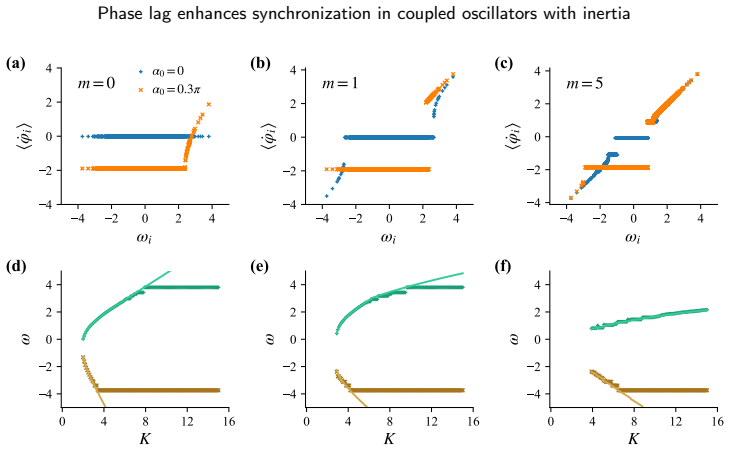
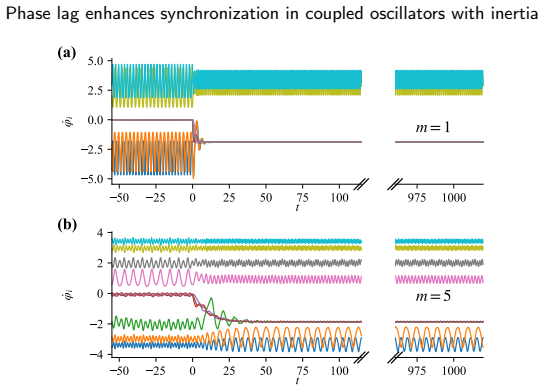
In the second-order Kuramoto model with inertia, multiple synchronized clusters with different frequencies lower overall synchronization. Applying a symmetry-breaking phase lag to a subset of oscillators steers the primary cluster along a specific path, enabling it to merge with higher-order clusters and thereby enhancing global synchronization.
What carries the argument
Selective phase lag applied to a subset of oscillators, which steers the primary cluster's path to permit merging with higher-order clusters.
Load-bearing premise
The system has already reached a steady state containing multiple synchronized clusters with different frequencies, and an external phase lag can be applied selectively to a subset without disrupting the underlying dynamics in unforeseen ways.
What would settle it
Numerical simulations in which the phase lag is introduced and the primary cluster remains at a distinct frequency from the higher-order clusters, with no measurable rise in the global order parameter.
Figures

read the original abstract
The second-order Kuramoto model with inertia exhibits different dynamical behaviors than the first-order KM without inertia. A central difference is its lower synchronization due to the emergence of multiple synchronized clusters with different frequencies. We aim to investigate how such lowered synchronization can be improved by applying external perturbations to the system in a steady state, for example, a symmetry-breaking phase lag to a subset of oscillators. We find that this phase lag steers the primary cluster along a specific path and enables it to merge with higher-order clusters, thereby enhancing global synchronization. Our results reveal a mechanism by which controlled phase lag can improve entrainment in inertial oscillator systems, with possible implications for synchronization control in inertial oscillator networks.
Editorial analysis
A structured set of objections, weighed in public.
Referee Report
Summary. The paper examines the second-order Kuramoto model with inertia, noting its reduced synchronization relative to the first-order case due to the formation of multiple clusters with distinct frequencies. It proposes that applying an external symmetry-breaking phase lag selectively to a subset of oscillators, once the system has reached a steady state with these clusters, steers the primary cluster along a path that enables merger with higher-order clusters and thereby improves global synchronization. The central result is presented as a control mechanism for entrainment in inertial oscillator systems.
Significance. If the mechanism is rigorously demonstrated, the work identifies a concrete perturbation strategy that can enhance synchronization in systems where inertia naturally produces frequency-offset clusters. This could inform control protocols in physical networks of inertial oscillators, provided the perturbation leaves the dynamics of non-targeted clusters unaltered.
major comments (2)
- [Abstract and the section describing the external perturbation] The functional form of the applied phase lag is not specified (whether it enters as a constant offset inside the sine coupling, shifts the natural frequency of the targeted subset, or acts as an additive torque). Without this definition it is impossible to confirm that the frequency offsets and inertia dynamics of the remaining clusters remain unchanged after the perturbation is switched on, which is required for the merger claim.
- [Results and Methods] No equations, simulation parameters, quantitative synchronization measures (e.g., order-parameter time series with error bars), or explicit demonstration that non-targeted clusters retain their original frequencies appear in the provided text. These are load-bearing for the assertion that selective phase lag produces merger without side effects on other clusters.
minor comments (1)
- [Abstract] The abstract states the central finding but supplies no supporting equations or data; the full manuscript should include these in the main text rather than relying on the abstract alone.
Simulated Author's Rebuttal
We thank the referee for their careful reading and constructive comments on our manuscript. We address the major comments point by point below and will incorporate the necessary clarifications and additions in the revised version.
read point-by-point responses
-
Referee: [Abstract and the section describing the external perturbation] The functional form of the applied phase lag is not specified (whether it enters as a constant offset inside the sine coupling, shifts the natural frequency of the targeted subset, or acts as an additive torque). Without this definition it is impossible to confirm that the frequency offsets and inertia dynamics of the remaining clusters remain unchanged after the perturbation is switched on, which is required for the merger claim.
Authors: We agree that the functional form of the symmetry-breaking phase lag must be defined explicitly to support the claim regarding unchanged dynamics in non-targeted clusters. The revised manuscript will include the precise mathematical implementation of the perturbation. revision: yes
-
Referee: [Results and Methods] No equations, simulation parameters, quantitative synchronization measures (e.g., order-parameter time series with error bars), or explicit demonstration that non-targeted clusters retain their original frequencies appear in the provided text. These are load-bearing for the assertion that selective phase lag produces merger without side effects on other clusters.
Authors: We acknowledge that the current manuscript text omits the governing equations, simulation parameters, quantitative measures, and explicit verification of unchanged frequencies for non-targeted clusters. These elements will be added to the revised manuscript, including order-parameter time series and supporting demonstrations. revision: yes
Circularity Check
No circularity in derivation chain
full rationale
The paper reports numerical observations on how an external phase lag applied to a subset of oscillators in the inertial Kuramoto model can promote cluster mergers and global synchronization. No load-bearing derivations, parameter fits renamed as predictions, self-citation chains, or ansatzes imported from prior author work appear in the abstract or described claims. The central result is presented as an empirical finding from the model's dynamics under perturbation and remains independent of its own inputs.
Axiom & Free-Parameter Ledger
Reference graph
Works this paper leans on
-
[1]
Predicting the Oscillatory Regimes of Global Synchrony Induced by Secondary Clusters , author=. 2512.24765 , archivePrefix=
-
[2]
Explosive Synchronization Transitions in Scale-Free Networks , author =. Phys. Rev. Lett. , volume =. 2011 , month =. doi:10.1103/PhysRevLett.106.128701 , url =
-
[3]
Explosive synchronization enhanced by time-delayed coupling , author =. Phys. Rev. E , volume =. 2012 , month =. doi:10.1103/PhysRevE.86.016102 , url =
-
[4]
Self-consistent method and steady states of second-order oscillators , volume =. Physical Review E , author =. 2018 , pages =. doi:10.1103/PhysRevE.98.042201 , number =
-
[5]
Chaos: An Interdisciplinary Journal of Nonlinear Science , author =
Synchronized clusters in globally connected networks of second-order oscillators:. Chaos: An Interdisciplinary Journal of Nonlinear Science , author =. 2021 , pages =. doi:10.1063/5.0057125 , abstract =
-
[6]
Physical Review Letters , author =
First. Physical Review Letters , author =. 1997 , pages =. doi:10.1103/PhysRevLett.78.2104 , number =
-
[7]
Physica D: Nonlinear Phenomena , author =
Self-synchronization of coupled oscillators with hysteretic responses , volume =. Physica D: Nonlinear Phenomena , author =. 1997 , pages =. doi:10.1016/S0167-2789(96)00193-5 , abstract =
-
[8]
Chaos, Solitons & Fractals , author =
Cluster-mediated synchronization dynamics in globally coupled oscillators with inertia , volume =. Chaos, Solitons & Fractals , author =. 2025 , pages =. doi:10.1016/j.chaos.2025.116281 , abstract =
-
[9]
Nonlinear Phenomena in Complex Systems , volume =
Yoshiki Kuramoto and Dorjsuren Battogtokh , title =. Nonlinear Phenomena in Complex Systems , volume =. 2002 , url =
2002
-
[10]
Abrams and Steven H
Daniel M. Abrams and Steven H. Strogatz , title =. Physical Review Letters , volume =. 2004 , month = oct, doi =
2004
-
[11]
Abrams and Rennie Mirollo and Steven H
Daniel M. Abrams and Rennie Mirollo and Steven H. Strogatz and Daniel A. Wiley , title =. Physical Review Letters , volume =. 2008 , month = aug, doi =
2008
-
[12]
Extended mean-field approach for chimera states in random complex networks , author =. Chaos , year =. doi:10.1063/5.0079471 , pmid =
-
[13]
Nature Communications , volume =
Network-induced multistability through lossy coupling and exotic solitary states , author =. Nature Communications , volume =. 2020 , publisher =. doi:10.1038/s41467-020-14417-7 , url =
-
[14]
Nature Communications , year =
Sajadi, Amirhossein and Kenyon, Rick Wallace and Hodge, Bri-Mathias , title =. Nature Communications , year =
-
[15]
Chaos: An Interdisciplinary Journal of Nonlinear Science , volume =
Low dimensional behavior of large systems of globally coupled oscillators , author =. Chaos: An Interdisciplinary Journal of Nonlinear Science , volume =. 2008 , publisher =
2008
-
[16]
Chaos: An Interdisciplinary Journal of Nonlinear Science , volume =
Long time evolution of phase oscillator systems , author =. Chaos: An Interdisciplinary Journal of Nonlinear Science , volume =. 2009 , publisher =
2009
-
[17]
Pinto and Alberto Saa , keywords =
Rafael S. Pinto and Alberto Saa , keywords =. Synchrony-optimized networks of Kuramoto oscillators with inertia , journal =. 2016 , issn =. doi:https://doi.org/10.1016/j.physa.2016.07.009 , url =
-
[18]
Higher-order interactions in Kuramoto oscillators with inertia , author =. Phys. Rev. E , volume =. 2023 , month =. doi:10.1103/PhysRevE.108.024215 , url =
-
[19]
Synchronization in the presence of time delays and inertia: Stability criteria , author =. Phys. Rev. E , volume =. 2022 , month =. doi:10.1103/PhysRevE.105.014210 , url =
-
[20]
, title =
Yi, Sudo and Kim, Cook Hyun and Kim, Heetae and Kahng, B. , title =. 2026 , note =
2026
-
[21]
Physical Review E , year =
Olmi, Simona and Navas, Aitor and Boccaletti, Stefano and Torcini, Alessandro , title =. Physical Review E , year =
-
[22]
Nature Physics , volume =
Symmetry breaking in twisted double bilayer graphene , author =. Nature Physics , volume =. 2021 , publisher =
2021
-
[23]
Independent Fast Phase Shifting Transformer: A Flexible and High-Precision Power Flow Controller , year=
Yuan, Jiaxin and Zhang, Weizhe and Mei, Jiajun and Gan, Dongliang and Zhou, Hang and Zheng, Yuankun and Liu, Jiawei , journal=. Independent Fast Phase Shifting Transformer: A Flexible and High-Precision Power Flow Controller , year=
-
[24]
Chaos, Solitons & Fractals , volume =
Hybrid synchronization with continuously varying exponent in modernized power grid , author =. Chaos, Solitons & Fractals , volume =. 2024 , doi =
2024
-
[25]
Progress of Theoretical Physics , volume =
Sakaguchi, Hidetsugu and Kuramoto, Yoshiki , title =. Progress of Theoretical Physics , volume =. 1986 , month =
1986
-
[26]
On the stability of the center for time periodic solutions , author=. Trans. Moscow Math. Soc , volume=
-
[27]
2013 , publisher=
Nonlinear oscillations, dynamical systems, and bifurcations of vector fields , author=. 2013 , publisher=
2013
-
[28]
Tyloo and L
M. Tyloo and L. Pagnier and P. Jacquod , title =. Science Advances , volume =. 2019 , doi =
2019
discussion (0)
Sign in with ORCID, Apple, or X to comment. Anyone can read and Pith papers without signing in.