Nonlinear sigma models, antiperiodic boundary conditions, spin chains, and 't Hooft anomalies
Pith reviewed 2026-06-27 20:55 UTC · model grok-4.3
The pith
The O(3) nonlinear sigma model cannot be gauged for its Z2 inversion symmetry when the topological angle Θ equals an odd multiple of π, because of an 't Hooft anomaly.
A machine-rendered reading of the paper's core claim, the machinery that carries it, and where it could break.
Core claim
When (-1)^{Θ/π} = -1 the partition function of the sigma model with antiperiodic boundary conditions exists but fails to be invariant under gauge transformations of the Z2 gauge field that implements the inversion symmetry n to -n. Therefore the sum over the two boundary conditions cannot be rendered modular invariant. The would-be gauged theory is the nonlinear sigma model with target space RP2 congruent to S2/Z2, which therefore does not exist for Θ = π mod 2π. The same obstruction appears in the spin-chain description when the number of sites is odd.
What carries the argument
Antiperiodic boundary conditions on the sigma model, which insert a Z2 flux through the spacetime torus for the inversion symmetry n → -n; their failure to produce a gauge-invariant partition function precisely when (-1)^{Θ/π} = -1 detects the 't Hooft anomaly.
If this is right
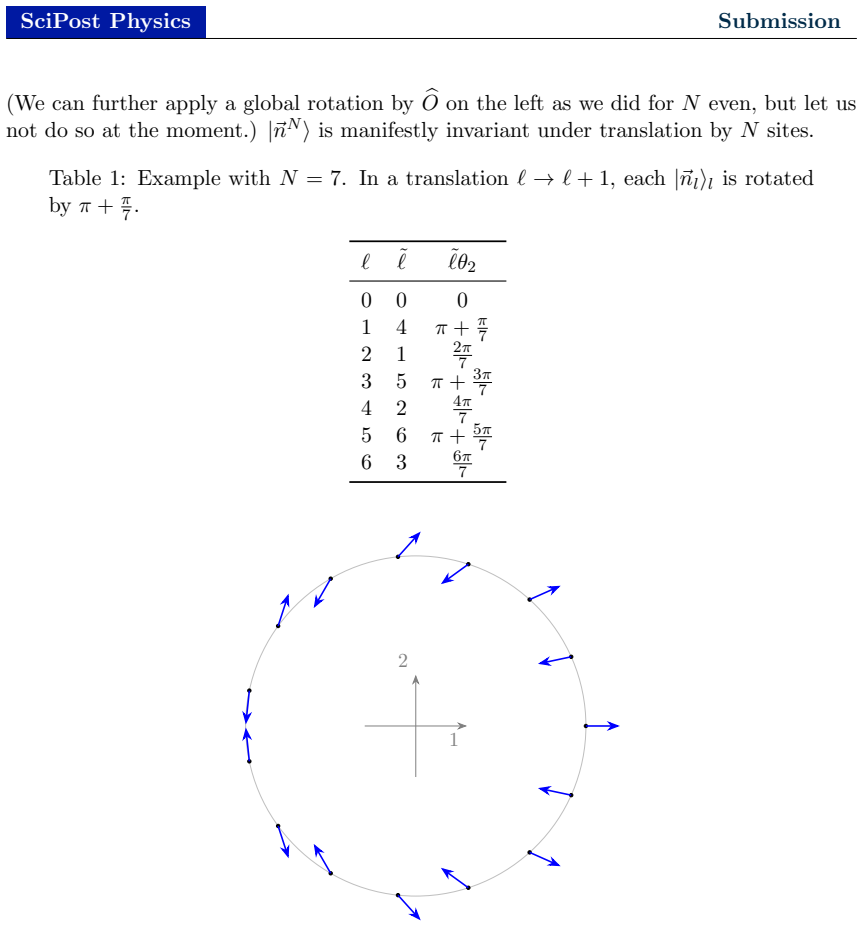
- Semiclassical quantization of the spin chain with odd N yields ground-state crystal momenta that depend at leading order only on N modulo 4 and 2S modulo 2.
- The partition function with antiperiodic boundaries cannot be summed to a modular-invariant result when the anomaly condition holds.
- For a large class of spin chains and sigma models the anomaly is controlled by the square of the time-reversal operator on a single spin, whose sign is fixed by the coefficients of the topological terms.
- The gauged theory with target RP2 is inconsistent exactly when Θ = π mod 2π.
Where Pith is reading between the lines
- Lattice models whose continuum limit would be the gauged RP2 sigma model may fail to exist for topological angles satisfying the anomaly condition.
- The boundary-condition test supplies a practical diagnostic for whether other discrete symmetries of sigma models or spin chains can be gauged without obstruction.
- The same logic may extend to sigma models on higher-dimensional tori or with additional discrete symmetries whose gauging would produce different quotient target spaces.
Load-bearing premise
Antiperiodic boundary conditions correspond exactly to a Z2 flux for the inversion symmetry n to -n, so that summing over the two boundary conditions implements gauging of that symmetry.
What would settle it
A direct evaluation of how the antiperiodic partition function transforms under a constant Z2 gauge transformation when Θ equals π; a nontrivial phase would confirm the anomaly while invariance when Θ equals 0 or 2π would show the gauging is possible.
Figures


read the original abstract
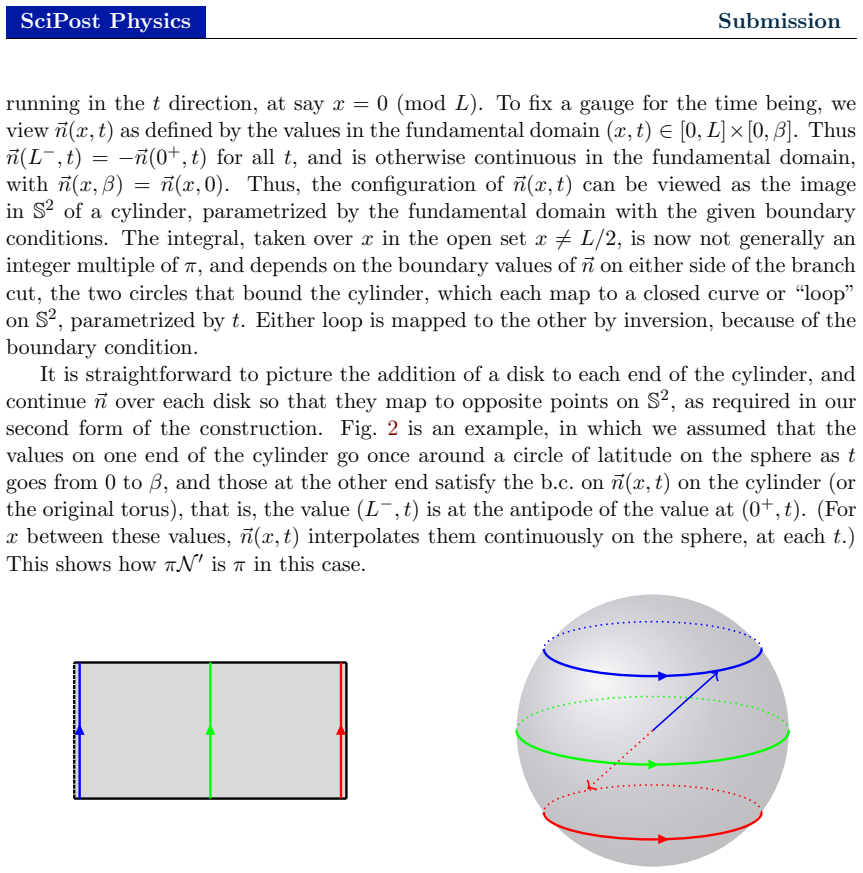
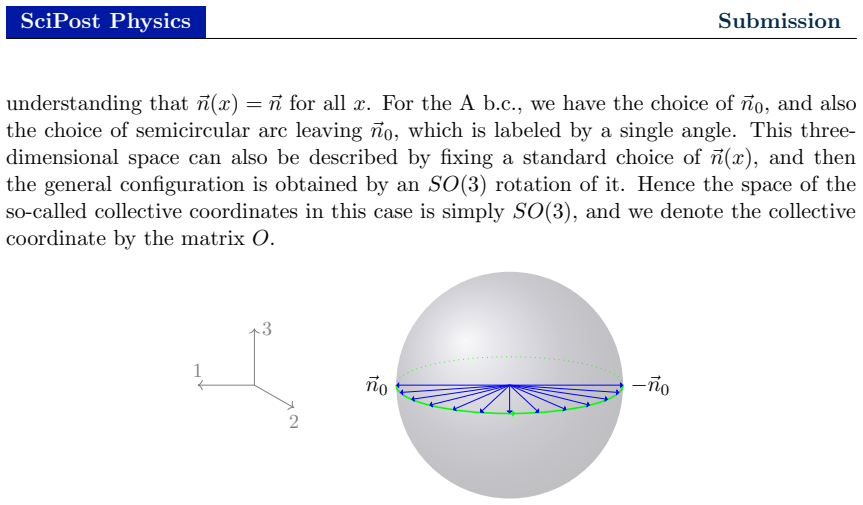
We consider two sets of related models: initially, these are $SU(2)$ antiferromagnetic spin chains with $N$ sites of spin $S$, and the $O(3)$ nonlinear sigma model in two dimensions with topological coefficient $\Theta$ a multiple of $\pi$ (and later, the extensions of these with any semisimple Lie group symmetry). It is known that, in a continuum description, the low-energy behavior of the spin chain is given by the sigma model with $\Theta=2\pi S$. We study these models with $N$ odd and with antiperiodic (A) boundary condition (b.c.), respectively, which correspond. The A b.c. in the sigma model involves the $\mathbb{Z}_2$ inversion symmetry $\vec{n}\to-\vec{n}$, and amounts to a flux of a $\mathbb{Z}_2$ gauge field through a spacetime torus; summing over the two b.c.s for each direction would amount to gauging the $\mathbb{Z}_2$ inversion symmetry. We show directly that, if and only if $(-1)^{\Theta/\pi}=-1$, the gauging cannot be carried out; there is an 't Hooft anomaly. The partition function for the A b.c. exists, but is not gauge invariant; consequently, the sum over b.c.s cannot be made modular invariant. The gauged model would be a sigma model with target space $\mathbb{R}\mathbb{P}^2\cong \mathbb{S}^2/\mathbb{Z}_2$, and hence this model does not exist for $\Theta=\pi$ (mod $2\pi$). A related result is that, using semiclassical quantization, in the spin chain we obtain the known values of the ground-state crystal momentum, which at leading order depend only on $N$ modulo $4$ and $2S$ modulo $2$. For a large class of spin chains and associated sigma models we find similar results, but now $(-1)^{\Theta/\pi}$ is replaced by the value $\pm 1$ of the square of the time-reversal operator acting on a single spin, which is still determined by the coefficients of the topological terms, in a way that depends on the symmetry group.
Editorial analysis
A structured set of objections, weighed in public.
Referee Report
Summary. The paper studies SU(2) antiferromagnetic spin chains with odd N and the O(3) nonlinear sigma model (NLSM) in 2D with topological angle Θ a multiple of π (and generalizations to other semisimple groups). It identifies antiperiodic boundary conditions (A b.c.) on the NLSM with insertion of Z2 flux for the inversion symmetry n → -n, such that summing over periodic and antiperiodic b.c.s implements gauging of this symmetry. The central claim is that this gauging is obstructed by an 't Hooft anomaly if and only if (-1)^{Θ/π} = -1 (i.e., Θ = π mod 2π), because the A b.c. partition function exists but is not gauge invariant, preventing a modular-invariant sum; equivalently, the gauged model with target RP² ≅ S²/Z₂ does not exist for these Θ values. A related semiclassical result reproduces the known ground-state crystal momenta of the spin chains (depending on N mod 4 and 2S mod 2).
Significance. If the boundary-condition-to-flux identification holds without extraneous phases, the result supplies a direct path-integral demonstration of an 't Hooft anomaly obstructing gauging in these sigma models, with immediate implications for the non-existence of the RP² target-space model at Θ = π mod 2π. The work also recovers known spin-chain momentum quantization at leading semiclassical order and extends the anomaly criterion to other groups via the square of the time-reversal operator. These connections between lattice models, continuum anomalies, and modular invariance are potentially useful for classifying symmetry-protected phases.
major comments (2)
- [abstract and paragraph on A b.c. and Z2 gauge field] The paragraph on A b.c. and Z2 gauge field (and the abstract statement that A b.c. 'amounts to a flux of a Z2 gauge field'): the identification of antiperiodic boundary conditions with Z2 flux insertion for the inversion symmetry n → -n is asserted directly, but the explicit path-integral map or operator equivalence (including any phase contributed by the Θ term under the b.c. change) is not exhibited. This map is load-bearing for the claim that non-invariance of the A b.c. partition function demonstrates an anomaly rather than a mismatch in the identification itself.
- [abstract] The statement that 'summing over the two b.c.s for each direction would amount to gauging': while the topological phase factor (-1)^{Θ/π} is derived, the argument that the resulting sum cannot be made modular invariant (and hence that the gauged RP² model does not exist) requires showing that no additional counterterms or redefinitions of the measure can restore invariance; this step is central to the non-existence conclusion but is stated at the level of the abstract without an explicit modular-transformation calculation.
minor comments (2)
- Notation for the topological coefficient is introduced as 'Θ a multiple of π' but later used as Θ = π (mod 2π); a single consistent definition early in the text would aid readability.
- The semiclassical quantization result for ground-state crystal momentum is presented as 'known values' recovered at leading order; a brief comparison table or explicit formula for the momentum shift would make the agreement more transparent.
Simulated Author's Rebuttal
We thank the referee for the careful reading and constructive comments. We address each major comment below and will revise the manuscript to incorporate clarifications where needed.
read point-by-point responses
-
Referee: [abstract and paragraph on A b.c. and Z2 gauge field] The paragraph on A b.c. and Z2 gauge field (and the abstract statement that A b.c. 'amounts to a flux of a Z2 gauge field'): the identification of antiperiodic boundary conditions with Z2 flux insertion for the inversion symmetry n → -n is asserted directly, but the explicit path-integral map or operator equivalence (including any phase contributed by the Θ term under the b.c. change) is not exhibited. This map is load-bearing for the claim that non-invariance of the A b.c. partition function demonstrates an anomaly rather than a mismatch in the identification itself.
Authors: We agree the explicit path-integral derivation of the map (including the phase from the Θ term) should be shown rather than asserted. In the revised manuscript we will add a dedicated subsection deriving the equivalence from the definition of the boundary conditions in the path integral, computing the phase factor contributed by the topological term under the change of boundary conditions, and confirming the identification with Z2 flux insertion for the inversion symmetry. revision: yes
-
Referee: [abstract] The statement that 'summing over the two b.c.s for each direction would amount to gauging': while the topological phase factor (-1)^{Θ/π} is derived, the argument that the resulting sum cannot be made modular invariant (and hence that the gauged RP² model does not exist) requires showing that no additional counterterms or redefinitions of the measure can restore invariance; this step is central to the non-existence conclusion but is stated at the level of the abstract without an explicit modular-transformation calculation.
Authors: The body derives the phase and states that the sum cannot be made modular invariant when the phase is -1. To address the request for an explicit demonstration that no counterterms restore invariance, we will add a calculation of the modular transformations of the periodic and antiperiodic partition functions (in the main text or an appendix) and explain why the resulting anomaly is topological and cannot be canceled by local counterterms or measure redefinitions. revision: yes
Circularity Check
No significant circularity; derivation uses standard known mapping and direct partition-function calculation.
full rationale
The continuum limit identification Θ=2πS is stated as known from prior literature, not derived here. The A b.c. to Z2 flux correspondence is introduced as the model definition, after which the paper computes the partition function explicitly and shows non-invariance precisely when (-1)^{Θ/π}=-1. This is a direct calculation rather than a reduction to a fitted input or self-citation. The semiclassical spin-chain result recovers previously known crystal momenta without re-deriving the mapping. No load-bearing step reduces by construction to the paper's own inputs.
Axiom & Free-Parameter Ledger
axioms (1)
- domain assumption Low-energy behavior of the SU(2) antiferromagnetic spin chain is given by the O(3) NLSM with Θ=2πS
Reference graph
Works this paper leans on
-
[1]
F. Haldane,Continuum dynamics of the 1-D Heisenberg antiferromagnet: Identifi- cation with the O(3) nonlinear sigma model, Physics Letters A93(9), 464 (1983), doi:https://doi.org/10.1016/0375-9601(83)90631-X
-
[2]
F. D. M. Haldane,Nonlinear field theory of large-spin Heisenberg antiferromagnets: Semiclassically quantized solitons of the one-dimensional easy-axis N´ eel state, Phys. Rev. Lett.50, 1153 (1983), doi:10.1103/PhysRevLett.50.1153
-
[3]
I. Affleck and F. D. M. Haldane,Critical theory of quantum spin chains, Phys. Rev. B36, 5291 (1987), doi:10.1103/PhysRevB.36.5291
-
[4]
E. H. Lieb, T. D. Schultz and D. C. Mattis,Two soluble models of an antiferromag- netic chain, Annals of Physics16(3), 407 (1961), doi:10.1016/0003-4916(61)90115-4
-
[5]
A. Luther and I. Peschel,Calculation of critical exponents in two dimensions from quantum field theory in one dimension, Phys. Rev. B12, 3908 (1975), doi:10.1103/PhysRevB.12.3908
-
[6]
N. D. Mermin,The topological theory of defects in ordered media, Rev. Mod. Phys. 51, 591 (1979), doi:10.1103/RevModPhys.51.591
-
[7]
V. Fateev, E. Onofri and A. Zamolodchikov,Integrable deformations of the O(3) sigma model. The sausage model, Nuclear Physics B406(3), 521 (1993), doi:https://doi.org/10.1016/0550-3213(93)90001-6
-
[8]
L. I. Schiff,Quantum Mechanics, McGraw-Hill, New York, 3rd edn., ISBN 0070856435 (1968)
1968
-
[9]
T. Sulejmanpasic and Y. Tanizaki,C-P-T anomaly matching in bosonic quantum field theory and spin chains, Phys. Rev. B97, 144201 (2018), doi:10.1103/PhysRevB.97.144201
-
[10]
A. Cappelli, C. Itzykson and J. B. Zuber,The A-D-E classification of minimal models and A1(1) conformal invariant theories, Communications in Mathematical Physics 113(1), 1 (1987), doi:10.1007/BF01221394
-
[11]
Gepner and E
D. Gepner and E. Witten,String theory on group manifolds, Nucl. Phys.B278, 493 (1986)
1986
-
[12]
E. Witten,Non-abelian bosonization in two dimensions, Communications in Mathe- matical Physics92(4), 455 (1984), doi:10.1007/BF01215276. 102 SciPost Physics Submission
-
[13]
G. ’t Hooft,Naturalness, chiral symmetry, and spontaneous chiral symmetry breaking, In G. ’t Hooft, C. Itzykson, A. Jaffe, H. Lehmann, P. K. Mitter, I. M. Singer and R. Stora, eds.,Recent Developments in Gauge Theories, vol. 59 ofNATO Science Series B, pp. 135–157. Springer, doi:10.1007/978-1-4684-7571-5 9 (1980)
-
[14]
M. Cheng and N. Seiberg,Lieb-Schultz-Mattis, Luttinger, and ’t Hooft - anomaly matching in lattice systems, SciPost Phys.15, 051 (2023), doi:10.21468/SciPostPhys.15.2.051
-
[15]
Z. Komargodski, A. Sharon, R. Thorngren and X. Zhou,Comments on abelian Higgs models and persistent order, SciPost Phys.6, 003 (2019), doi:10.21468/SciPostPhys.6.1.003
-
[16]
D. Gaiotto, A. Kapustin, Z. Komargodski and N. Seiberg,Theta, time re- versal and temperature, Journal of High Energy Physics2017(5), 91 (2017), doi:10.1007/JHEP05(2017)091
-
[17]
S. Seifnashri,Lieb-Schultz-Mattis anomalies as obstructions to gauging (non-on-site) symmetries, SciPost Phys.16, 098 (2024), doi:10.21468/SciPostPhys.16.4.098
-
[18]
I. Affleck and E. H. Lieb,A proof of part of Haldane’s conjecture on spin chains, Letters in Mathematical Physics12(1), 57 (1986), doi:10.1007/BF00400304
-
[19]
E. Witten,Current algebra, baryons, and quark confinement, Nuclear Physics B 223(2), 433 (1983), doi:https://doi.org/10.1016/0550-3213(83)90064-0
-
[20]
L. D. Landau and E. M. Lifshitz,Quantum Mechanics: Non-Relativistic Theory, vol. 3 ofCourse of Theoretical Physics, Pergamon Press, Oxford, 3rd edn., ISBN 9780080291402 (1981)
1981
-
[21]
Br¨ ocker and T
T. Br¨ ocker and T. tom Dieck,Reprentations of Compact Lie Groups, Springer (1985)
1985
-
[22]
Marshall,Antiferromagnetism, Proceedings of the Royal Society A232, 48 (1955)
W. Marshall,Antiferromagnetism, Proceedings of the Royal Society A232, 48 (1955)
1955
-
[23]
B. S. Shastry,Exact solution of an s=1/2 Heisenberg antiferromagnetic chain with long-ranged interactions, Phys. Rev. Lett.60, 639 (1988), doi:10.1103/PhysRevLett.60.639
-
[24]
K. B¨ arwinkel, H.-J. Schmidt and J. Schnack,Ground-state properties of antiferromag- netic Heisenberg spin rings, Journal of Magnetism and Magnetic Materials220(2), 227 (2000), doi:https://doi.org/10.1016/S0304-8853(00)00481-9
-
[25]
Affleck, T
I. Affleck, T. Kennedy, E. H. Lieb and H. Tasaki,Valence bond ground states in isotropic quantum antiferromagnets, Communications in Mathematical Physics 115(3), 477 (1988)
1988
-
[26]
P. W. Anderson,An approximate quantum theory of the antiferromagnetic ground state, Phys. Rev.86, 694 (1952), doi:10.1103/PhysRev.86.694
-
[27]
P. Roux, J. L. Jacobsen, S. Ribault and H. Saleur,Critical spin chains and loop models withP SU(n)symmetry, SciPost Phys.18, 033 (2025), doi:10.21468/SciPostPhys.18.1.033
-
[28]
A. B. Zamolodchikov and A. B. Zamolodchikov,Factorized S-matrices in two dimen- sions as the exact solutions of certain relativistic quantum field theory models, Annals of Physics120(2), 253 (1979), doi:https://doi.org/10.1016/0003-4916(79)90391-9. 103 SciPost Physics Submission
-
[29]
P. Wiegmann,Exact solution of the O(3) nonlinear sigma-model, Physics Letters B 152(3), 209 (1985), doi:https://doi.org/10.1016/0370-2693(85)91171-2
-
[30]
Hasenbusch, O(N)andRP N−1 models in two dimensions, Phys
M. Hasenbusch, O(N)andRP N−1 models in two dimensions, Phys. Rev. D53, 3445 (1996), doi:10.1103/PhysRevD.53.3445
-
[31]
Maier and A
W. Maier and A. Saupe,Eine einfache molekular-statistische theorie der nematischen kristallinfl¨ ussigen phase. teil 1, Zeitschrift f¨ ur Naturforschung A14, 882 (1959)
1959
-
[32]
Maier and A
W. Maier and A. Saupe,Eine einfache molekular-statistische theorie der nematischen kristallinfl¨ ussigen phase. teil 2, Zeitschrift f¨ ur Naturforschung A15, 287 (1960)
1960
-
[33]
P. A. Lebwohl and G. Lasher,Nematic-liquid-crystal order—a Monte Carlo calcula- tion, Phys. Rev. A6, 426 (1972), doi:10.1103/PhysRevA.6.426
-
[34]
S. M. Catterall, M. Hasenbusch, R. R. Horgan and R. Renken,Nature of the continuum limit in the 2dRP 2 gauge model, Phys. Rev. D58, 074510 (1998), doi:10.1103/PhysRevD.58.074510
-
[35]
A. Ueda and M. Oshikawa,Tensor network renormalization study on the crossover in classical Heisenberg andRP 2 models in two dimensions, Phys. Rev. E106, 014104 (2022), doi:10.1103/PhysRevE.106.014104
-
[36]
L. Burgelman, L. Devos, B. Vanhecke, F. Verstraete and L. Vanderstraeten,Con- trasting pseudocriticality in the classical two-dimensional Heisenberg andRP 2 models: Zero-temperature phase transition versus finite-temperature crossover, Phys. Rev. E 107, 014117 (2023), doi:10.1103/PhysRevE.107.014117
-
[37]
S. C. Furuya and M. Oshikawa,Symmetry protection of critical phases and a global anomaly in1 + 1dimensions, Phys. Rev. Lett.118, 021601 (2017), doi:10.1103/PhysRevLett.118.021601
-
[38]
Y. Ogata and H. Tasaki,Lieb–Schultz–Mattis type theorems for quantum spin chains without continuous symmetry, Communications in Mathematical Physics372(3), 951 (2019), doi:10.1007/s00220-019-03343-5
-
[39]
I. Affleck,The quantum Hall effects,σmodels atΘ =πand quantum spin chains, Nuclear Physics B257, 397 (1985), doi:https://doi.org/10.1016/0550-3213(85)90353- 0
-
[40]
I. Hason, Z. Komargodski and R. Thorngren,Anomaly matching in the symmetry broken phase: Domain walls, CPT, and the Smith isomorphism, SciPost Phys.8, 062 (2020), doi:10.21468/SciPostPhys.8.4.062
-
[41]
D. S. Dummit and R. M. Foote,Abstract Algebra, Wiley, Hoboken, NJ, 3rd edn., ISBN 978-0471433347 (2004)
2004
-
[42]
W. Fulton and J. Harris,Representation Theory: A First Course, vol. 129 ofGraduate Texts in Mathematics, Springer, ISBN 9780387974958, doi:10.1007/978-1-4612-0979- 9 (1991)
-
[43]
Gaudin,The Bethe Wavefunction, Cambridge University Press, Cambridge, ISBN 9781107045852, Translated from the original French editionLa Fonction d’Onde de Bethe(1995) (2014)
M. Gaudin,The Bethe Wavefunction, Cambridge University Press, Cambridge, ISBN 9781107045852, Translated from the original French editionLa Fonction d’Onde de Bethe(1995) (2014). 104 SciPost Physics Submission
1995
-
[44]
A. Klumper, M. T. Batchelor and P. A. Pearce,Central charges of the 6- and 19- vertex models with twisted boundary conditions, Journal of Physics A: Mathematical and General24(13), 3111 (1991), doi:10.1088/0305-4470/24/13/025
-
[45]
H. de Vega and M. Karowski,Conformal invariance and integrable theories, Nuclear Physics B285, 619 (1987), doi:https://doi.org/10.1016/0550-3213(87)90358-0
-
[46]
F. C. Alcaraz, M. N. Barber and M. T. Batchelor,Conformal invariance, the XXZ chain and the operator content of two-dimensional critical systems, Annals of Physics 182(2), 280 (1988), doi:https://doi.org/10.1016/0003-4916(88)90015-2
-
[47]
P. Di Francesco, H. Saleur and J.-B. Zuber,Relations between the coulomb gas picture and conformal invariance of two-dimensional critical models, Journal of statistical physics49(1-2), 57 (1987), doi:10.1007/BF01009954
-
[48]
W. Koo and H. Saleur,Representations of the virasoro algebra from lattice models, Nu- clear Physics B426(3), 459 (1994), doi:https://doi.org/10.1016/0550-3213(94)90018- 3
-
[49]
R. J. Baxter,Exactly Solved Models in Statistical Mechanics, Academic Press, Lon- don, ISBN 978-0-12-083180-7 (1982)
1982
-
[50]
Hatcher,Algebraic Topology, Cambridge University Press, ISBN 9780521795401 (2002)
A. Hatcher,Algebraic Topology, Cambridge University Press, ISBN 9780521795401 (2002)
2002
-
[51]
I. Affleck, D. Bykov and K. Wamer,Flag manifold sigma models: Spin chains and integrable theories, Physics Reports953, 1 (2022), doi:https://doi.org/10.1016/j.physrep.2021.09.004, Flag manifold sigma models: Spin chains and integrable theories
-
[52]
N. Read and S. Sachdev,Large-N expansion for frustrated quantum antiferromagnets, Phys. Rev. Lett.66, 1773 (1991), doi:10.1103/PhysRevLett.66.1773
-
[53]
S. Sachdev and N. Read,Large-N expansion for frustrated and doped quantum an- tiferromagnets, International Journal of Modern Physics B05(01n02), 219 (1991), doi:10.1142/S0217979291000158,https://doi.org/10.1142/S0217979291000158
-
[54]
Bourbaki,Lie Groups and Lie Algebras: Chapters 7–9, Elements of Mathematics
N. Bourbaki,Lie Groups and Lie Algebras: Chapters 7–9, Elements of Mathematics. Springer, Berlin Heidelberg, Berlin / Heidelberg, 1st edition, 2nd printing 2008 edn., ISBN 978-3-540-68851-8 (2005)
2008
-
[55]
J. F. Adams,Lectures on Exceptional Lie Groups, Chicago Lectures in Mathematics. University of Chicago Press, Chicago, ISBN 9780226005270 (1996)
1996
-
[56]
Milnor,Morse Theory, vol
J. Milnor,Morse Theory, vol. 51 ofAnnals of Mathematics Studies, Princeton University Press, Princeton, NJ (1963)
1963
-
[57]
G. D. James and A. Kerber,The Representation Theory of the Symmetric Group, vol. 16 ofEncyclopedia of Mathematics and its Applications, Addison-Wesley Pub- lishing Co., Reading, MA, ISBN 0-201-13515-9 (1981). 105
1981
discussion (0)
Sign in with ORCID, Apple, or X to comment. Anyone can read and Pith papers without signing in.