Beyond Matching: Category-Guided Latent Intent Reasoning for Generative Retrieval in E-Commerce
Pith reviewed 2026-06-27 20:48 UTC · model grok-4.3
The pith
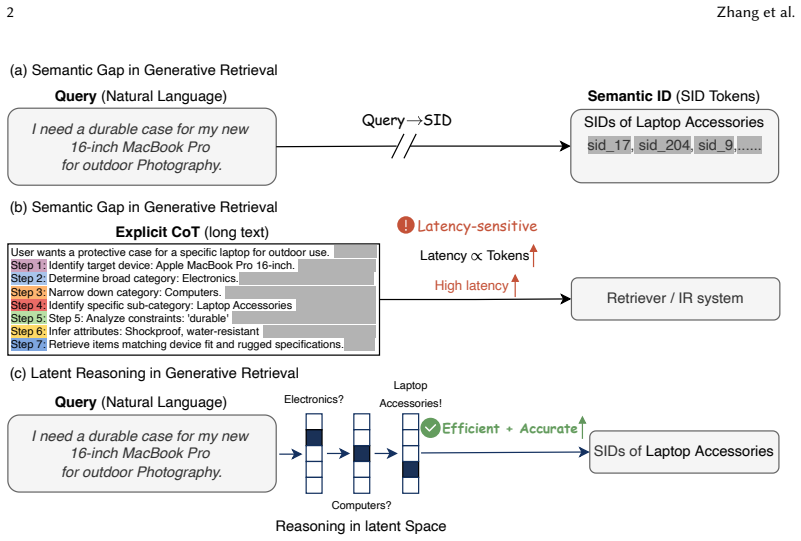
CaLIR replaces explicit chain-of-thought with latent states guided by product category hierarchies for generative e-commerce retrieval.
A machine-rendered reading of the paper's core claim, the machinery that carries it, and where it could break.
Core claim
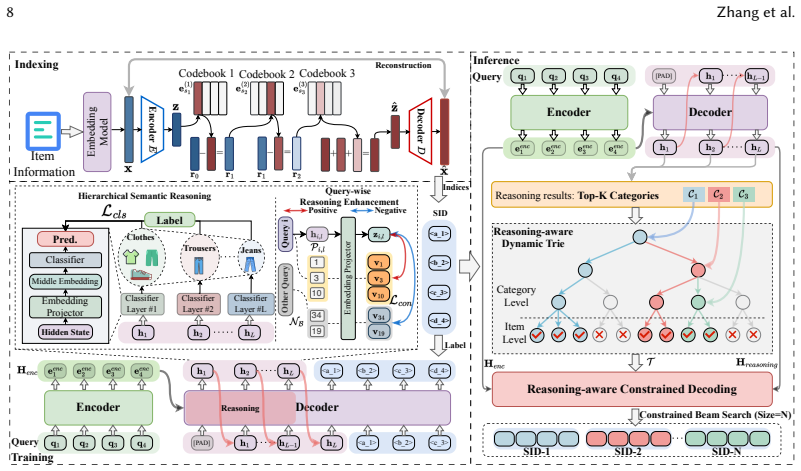
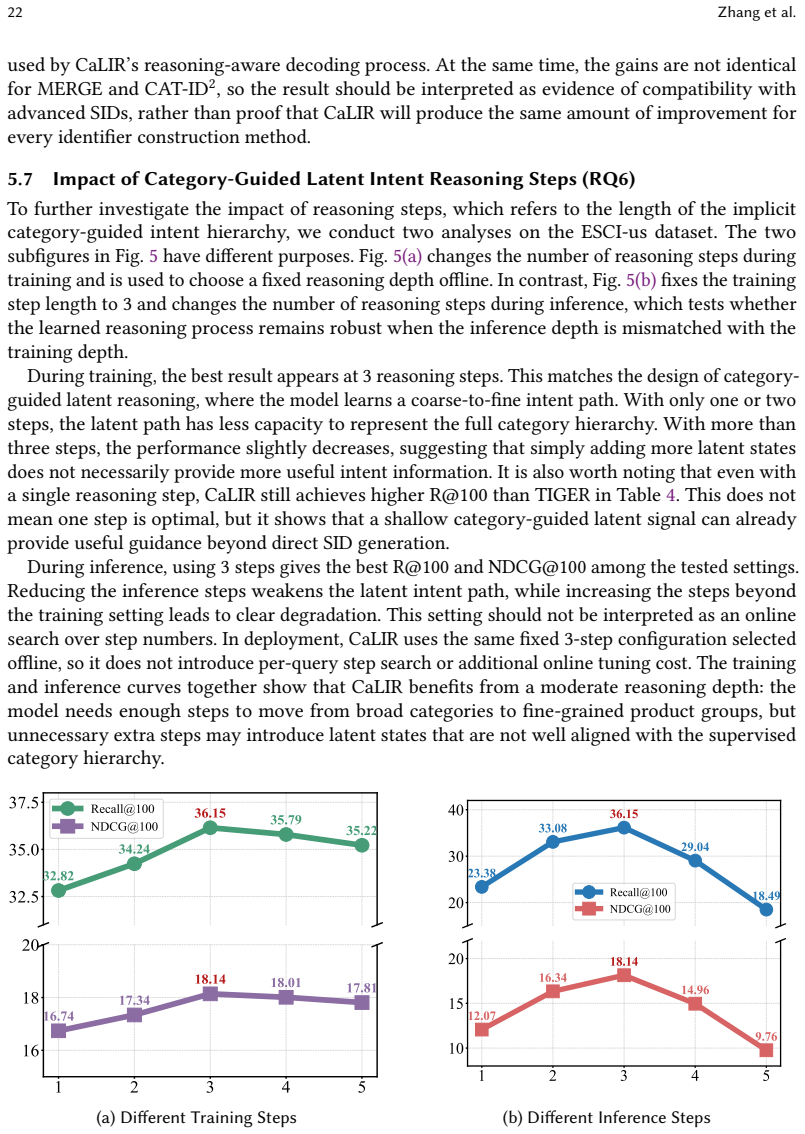
CaLIR learns continuous latent intent states before SID decoding and uses product category hierarchies as a natural scaffold for coarse-to-fine intent reasoning, specifically through hierarchical semantic reasoning to align latent states with category-level shopping intent and query-wise reasoning enhancement to model diverse intent paths under multi-positive queries, further combined with a query-specific dynamic prefix trie assembled from pre-indexed category-level tries and reasoning-aware constrained decoding.
What carries the argument
hierarchical semantic reasoning that aligns latent states with category-level shopping intent using product category hierarchies as a scaffold for coarse-to-fine intent reasoning
If this is right
- Achieves a better balance between retrieval effectiveness and inference efficiency than existing methods.
- Demonstrates transferability across induced hierarchies.
- Shows robustness across different generative backbones.
- Supports modeling of diverse intent paths for queries with multiple positive products.
Where Pith is reading between the lines
- The latent-state approach may lower costs in other generative systems that currently rely on explicit reasoning over hierarchical data.
- Evaluating performance on queries lacking clear category structure would test whether the scaffold is essential or can be induced dynamically.
- The dynamic trie construction could be extended to incorporate additional metadata constraints beyond categories.
Load-bearing premise
Product category hierarchies serve as a reliable natural scaffold for coarse-to-fine latent intent reasoning that can replace explicit textual chain-of-thought without performance loss.
What would settle it
An ablation study that removes the category-guided hierarchical reasoning component and shows retrieval metrics falling below those of standard generative retrieval baselines on the multilingual e-commerce datasets.
Figures

read the original abstract
Generative retrieval offers a new paradigm for e-commerce search by mapping user queries directly to product Semantic Identifiers (SIDs). However, e-commerce queries are often short, noisy, attribute-heavy, and associated with multiple category-consistent products, creating a substantial representation gap between natural-language shopping intent and artificially constructed item SIDs. Explicit Chain-of-Thought (CoT) reasoning can help bridge this gap, but its extra generation cost is difficult to reconcile with the low-latency requirements of online e-commerce systems. To address this challenge, we propose CaLIR (Category-guided Latent Intent Reasoning), a category-guided latent intent reasoning framework for e-commerce generative retrieval. Rather than generating explicit textual rationales, CaLIR learns continuous latent intent states before SID decoding and uses product category hierarchies as a natural scaffold for coarse-to-fine intent reasoning. Specifically, we introduce hierarchical semantic reasoning to align latent states with category-level shopping intent, and query-wise reasoning enhancement to model diverse intent paths under multi-positive queries. CaLIR further combines a query-specific dynamic prefix trie, assembled from pre-indexed category-level tries, with reasoning-aware constrained decoding. Experiments on multilingual e-commerce search datasets show that CaLIR achieves a better balance between retrieval effectiveness and inference efficiency than existing methods, while also demonstrating transferability and robustness across induced hierarchies and different generative backbones.
Editorial analysis
A structured set of objections, weighed in public.
Referee Report
Summary. The manuscript proposes CaLIR, a framework for generative retrieval in e-commerce search. It replaces explicit Chain-of-Thought reasoning with category-guided latent intent reasoning, using product category hierarchies as scaffolds for coarse-to-fine latent states, hierarchical semantic reasoning, query-wise enhancement, and a dynamic prefix trie with constrained decoding. The central claim is that this achieves a superior effectiveness-efficiency trade-off on multilingual datasets, with transferability and robustness.
Significance. If the experimental claims hold, the work could meaningfully advance generative retrieval methods for e-commerce by leveraging existing category structures to enable efficient latent reasoning, addressing the latency issues of textual CoT while handling noisy, multi-intent queries. The approach of using pre-indexed category tries for constrained decoding is a practical contribution if the net efficiency is demonstrated.
major comments (2)
- [Abstract] Abstract: The claim that 'Experiments on multilingual e-commerce search datasets show that CaLIR achieves a better balance between retrieval effectiveness and inference efficiency than existing methods' is presented without any supporting metrics, baselines, ablation results, or error analysis, preventing verification of the central claim.
- [Method (dynamic prefix trie)] Method description (dynamic prefix trie): The assembly of a query-specific dynamic prefix trie from pre-indexed category-level tries is introduced without any analysis or measurement of its computational overhead (assembly time, traversal cost, scaling with hierarchy depth); this directly bears on whether the claimed inference efficiency advantage over explicit CoT holds.
minor comments (2)
- [Method] The distinction between 'latent intent states' and 'category-level shopping intent' would benefit from explicit equations or pseudocode showing how alignment occurs.
- [Abstract] The abstract refers to 'induced hierarchies' and 'different generative backbones' without defining these terms or indicating how robustness was quantified.
Simulated Author's Rebuttal
We thank the referee for the constructive feedback on the abstract and method description. We address each major comment below and commit to revisions that strengthen the presentation of results and efficiency analysis.
read point-by-point responses
-
Referee: [Abstract] Abstract: The claim that 'Experiments on multilingual e-commerce search datasets show that CaLIR achieves a better balance between retrieval effectiveness and inference efficiency than existing methods' is presented without any supporting metrics, baselines, ablation results, or error analysis, preventing verification of the central claim.
Authors: The abstract serves as a high-level summary; the full quantitative support—including metrics, baselines, ablations, and error analysis—is provided in the Experiments section of the manuscript. To directly address the concern and improve verifiability at the abstract level, we will revise the abstract to include key performance highlights (e.g., relative gains in effectiveness and latency) drawn from the experimental results. revision: yes
-
Referee: [Method (dynamic prefix trie)] Method description (dynamic prefix trie): The assembly of a query-specific dynamic prefix trie from pre-indexed category-level tries is introduced without any analysis or measurement of its computational overhead (assembly time, traversal cost, scaling with hierarchy depth); this directly bears on whether the claimed inference efficiency advantage over explicit CoT holds.
Authors: We agree that explicit measurements of the dynamic prefix trie's overhead are needed to rigorously support the efficiency claims relative to explicit CoT. The manuscript currently emphasizes the construction and integration with constrained decoding. In revision we will add a dedicated analysis subsection reporting assembly time, traversal costs, scaling behavior with hierarchy depth, and direct latency comparisons against CoT baselines. revision: yes
Circularity Check
No significant circularity; empirical claims rest on external evaluation
full rationale
The paper introduces CaLIR as a new architectural framework combining latent intent states, hierarchical semantic reasoning over category hierarchies, query-wise enhancement, dynamic prefix tries, and constrained decoding. Its strongest claims concern improved effectiveness-efficiency trade-offs and robustness, which are asserted via experiments on multilingual e-commerce datasets rather than any closed-form derivation. No equations appear that define a target quantity in terms of fitted parameters from the same data or that rename an input as a prediction. No self-citation chains are invoked to justify uniqueness or load-bearing premises. The derivation chain is therefore self-contained: new components are proposed, implemented, and measured against baselines on held-out data, with no reduction of the reported gains to quantities defined by construction within the paper itself.
Axiom & Free-Parameter Ledger
Reference graph
Works this paper leans on
-
[1]
Michele Bevilacqua, Giuseppe Ottaviano, Patrick Lewis, Scott Yih, Sebastian Riedel, and Fabio Petroni. 2022. Autore- gressive search engines: Generating substrings as document identifiers.Advances in Neural Information Processing Systems35 (2022), 31668–31683
2022
-
[2]
Jiangxia Cao, Shuo Yang, Zijun Wang, and Qinghai Tan. 2025. OnePiece: The Great Route to Generative Recommendation–A Case Study from Tencent Algorithm Competition.arXiv preprint arXiv:2512.07424(2025)
arXiv 2025
-
[3]
Jianlyu Chen, Shitao Xiao, Peitian Zhang, Kun Luo, Defu Lian, and Zheng Liu. 2024. M3-embedding: Multi-linguality, multi-functionality, multi-granularity text embeddings through self-knowledge distillation. InFindings of the Associa- tion for Computational Linguistics ACL 2024. 2318–2335
2024
-
[4]
Yiwen Chen, Fuwei Zhang, Zehao Chen, Deqing Wang, Hehan Li, Peizhi Xu, Hanmeng Liu, Shuanglong Li, Xin Pei, Fuzhen Zhuang, et al. 2026. LASAR: Latent Adaptive Semantic Aligned Reasoning for Generative Recommendation. arXiv preprint arXiv:2605.10207(2026)
Pith/arXiv arXiv 2026
-
[5]
Jiehan Cheng, Zhicheng Dou, Yutao Zhu, and Xiaoxi Li. 2025. Descriptive and Discriminative Document Identifiers for Generative Retrieval. InProceedings of the AAAI Conference on Artificial Intelligence, Vol. 39. 11518–11526
2025
-
[6]
Marco Cuturi. 2013. Sinkhorn distances: Lightspeed computation of optimal transport.Advances in neural information processing systems26 (2013)
2013
-
[7]
Nicola De Cao, Gautier Izacard, Sebastian Riedel, and Fabio Petroni. 2021. Autoregressive Entity Retrieval. In International Conference on Learning Representations. OpenReview.net
2021
-
[8]
Paolo Ferragina and Giovanni Manzini. 2000. Opportunistic data structures with applications. InProceedings 41st annual symposium on foundations of computer science. IEEE, 390–398
2000
-
[9]
Shibo Hao, Sainbayar Sukhbaatar, DiJia Su, Xian Li, Zhiting Hu, Jason Weston, and Yuandong Tian. 2024. Training large language models to reason in a continuous latent space.arXiv preprint arXiv:2412.06769(2024)
Pith/arXiv arXiv 2024
-
[10]
Vladimir Karpukhin, Barlas Oğuz, Sewon Min, Patrick Lewis, Ledell Wu, Sergey Edunov, Danqi Chen, and Wen Tau Yih. 2020. Dense passage retrieval for open-domain question answering. In2020 Conference on Empirical Methods in Natural Language Processing, EMNLP 2020. Association for Computational Linguistics (ACL), 6769–6781
2020
-
[11]
Vladimir Karpukhin, Barlas Oguz, Sewon Min, Patrick Lewis, Ledell Wu, Sergey Edunov, Danqi Chen, and Wen-tau Yih. 2020. Dense Passage Retrieval for Open-Domain Question Answering. InProceedings of the 2020 Conference on Empirical Methods in Natural Language Processing (EMNLP). 6769–6781
2020
-
[12]
Tzu-Lin Kuo, Tzu-Wei Chiu, Tzung-Sheng Lin, Sheng-Yang Wu, Chao-Wei Huang, and Yun-Nung Chen. 2024. A survey of generative information retrieval.arXiv preprint arXiv:2406.01197(2024)
arXiv 2024
-
[13]
Xiaoxi Li, Jiajie Jin, Yujia Zhou, Yuyao Zhang, Peitian Zhang, Yutao Zhu, and Zhicheng Dou. 2025. From matching to generation: A survey on generative information retrieval.ACM Trans. Inf. Syst.43, 3 (2025), 1–62
2025
-
[14]
Yongqi Li, Nan Yang, Liang Wang, Furu Wei, and Wenjie Li. 2023. Multiview Identifiers Enhanced Generative Retrieval. InProceedings of the 61st Annual Meeting of the Association for Computational Linguistics (Volume 1: Long Papers). Association for Computational Linguistics, 6636–6648
2023
-
[15]
Yongqi Li, Nan Yang, Liang Wang, Furu Wei, and Wenjie Li. 2024. Learning to rank in generative retrieval. InProceedings of the AAAI Conference on Artificial Intelligence, Vol. 38. 8716–8723
2024
-
[16]
Yongqi Li, Zhen Zhang, Wenjie Wang, Liqiang Nie, Wenjie Li, and Tat-Seng Chua. 2024. Distillation Enhanced Generative Retrieval. arXiv:2402.10769 [cs.CL]
arXiv 2024
-
[17]
Enze Liu, Bowen Zheng, Xiaolei Wang, Wayne Xin Zhao, Jinpeng Wang, Sheng Chen, and Ji-Rong Wen. 2025. Lares: Latent reasoning for sequential recommendation.arXiv preprint arXiv:2505.16865(2025)
arXiv 2025
-
[18]
Jingzhe Liu, Liam Collins, Jiliang Tang, Tong Zhao, Neil Shah, and Clark Mingxuan Ju. 2025. Understanding Generative Recommendation with Semantic IDs from a Model-Scaling View.arXiv preprint arXiv:2509.25522(2025)
Pith/arXiv arXiv 2025
-
[19]
Xiaoyu Liu, Fuwei Zhang, Yiqing Wu, Xinyu Jia, Zenghua Xia, Fuzhen Zhuang, Zhao Zhang, Fei Jiang, and Wei Lin
-
[20]
arXiv preprint arXiv:2511.01461(2025)
CAT-ID 2: Category-Tree Integrated Document Identifier Learning for Generative Retrieval In E-commerce. arXiv preprint arXiv:2511.01461(2025). Under Review 28 Zhang et al
arXiv 2025
-
[21]
Zhanyu Liu, Shiyao Wang, Xingmei Wang, Rongzhou Zhang, Jiaxin Deng, Honghui Bao, Jinghao Zhang, Wuchao Li, Pengfei Zheng, Xiangyu Wu, et al. 2025. Onerec-think: In-text reasoning for generative recommendation.arXiv preprint arXiv:2510.11639(2025)
arXiv 2025
-
[22]
Xinyu Ma, Jiafeng Guo, Ruqing Zhang, Yixing Fan, and Xueqi Cheng. 2021. Contextualized late interaction over dense and sparse representations for information retrieval. InProceedings of the 44th International ACM SIGIR Conference on Research and Development in Information Retrieval. 2401–2405
2021
-
[23]
Petru Neague, Marcel Gregoriadis, and Johan Pouwelse. 2024. De-dsi: Decentralised differentiable search index. In Proceedings of the 4th Workshop on Machine Learning and Systems. 134–143
2024
-
[24]
Tri Nguyen, Mir Rosenberg, Xia Song, Jianfeng Gao, Saurabh Tiwary, Rangan Majumder, and Li Deng. 2016. Ms marco: A human-generated machine reading comprehension dataset. (2016)
2016
-
[25]
Jianmo Ni, Gustavo Hernandez Abrego, Noah Constant, Ji Ma, Keith Hall, Daniel Cer, and Yinfei Yang. 2022. Sentence- T5: Scalable Sentence Encoders from Pre-trained Text-to-Text Models. InFindings of the Association for Computational Linguistics: ACL 2022. 1864–1874
2022
-
[26]
Shen Nie, Fengqi Zhu, Zebin You, Xiaolu Zhang, Jingyang Ou, Jun Hu, Jun Zhou, Yankai Lin, Ji-Rong Wen, and Chongxuan Li. 2025. Large language diffusion models.arXiv preprint arXiv:2502.09992(2025)
Pith/arXiv arXiv 2025
-
[27]
Shashank Rajput, Nikhil Mehta, Anima Singh, Raghunandan Hulikal Keshavan, Trung Vu, Lukasz Heldt, Lichan Hong, Yi Tay, Vinh Tran, Jonah Samost, et al. 2023. Recommender systems with generative retrieval.Advances in Neural Information Processing Systems36 (2023), 10299–10315
2023
-
[28]
Chandan K Reddy, Lluís Màrquez, Fran Valero, Nikhil Rao, Hugo Zaragoza, Sambaran Bandyopadhyay, Arnab Biswas, Anlu Xing, and Karthik Subbian. 2022. Shopping queries dataset: A large-scale ESCI benchmark for improving product search.arXiv preprint arXiv:2206.06588(2022)
arXiv 2022
-
[29]
Nils Reimers and Iryna Gurevych. 2019. Sentence-BERT: Sentence Embeddings using Siamese BERT-Networks. In Proceedings of the 2019 Conference on Empirical Methods in Natural Language Processing and the 9th International Joint Conference on Natural Language Processing (EMNLP-IJCNLP). Association for Computational Linguistics, 3982–3992. https://doi.org/10.1...
-
[30]
Stephen Robertson, Hugo Zaragoza, et al. 2009. The probabilistic relevance framework: BM25 and beyond.Foundations and Trends®in Information Retrieval3, 4 (2009), 333–389
2009
-
[31]
Zihua Si, Zhongxiang Sun, Jiale Chen, Guozhang Chen, Xiaoxue Zang, Kai Zheng, Yang Song, Xiao Zhang, Jun Xu, and Kun Gai. 2023. Generative retrieval with semantic tree-structured item identifiers via contrastive learning.arXiv preprint arXiv:2309.13375(2023)
arXiv 2023
-
[32]
Kaitao Song, Xu Tan, Tao Qin, Jianfeng Lu, and Tie-Yan Liu. 2020. Mpnet: Masked and permuted pre-training for language understanding.Advances in neural information processing systems33 (2020), 16857–16867
2020
-
[33]
Weiwei Sun, Keyi Kong, Xinyu Ma, Shuaiqiang Wang, Dawei Yin, Maarten de Rijke, Zhaochun Ren, and Yiming Yang. 2025. ZeroGR: A Generalizable and Scalable Framework for Zero-Shot Generative Retrieval.arXiv preprint arXiv:2510.10419(2025)
Pith/arXiv arXiv 2025
-
[34]
Weiwei Sun, Lingyong Yan, Zheng Chen, Shuaiqiang Wang, Haichao Zhu, Pengjie Ren, Zhumin Chen, Dawei Yin, Maarten Rijke, and Zhaochun Ren. 2023. Learning to tokenize for generative retrieval.Advances in Neural Information Processing Systems36 (2023), 46345–46361
2023
-
[35]
Jiakai Tang, Sunhao Dai, Teng Shi, Jun Xu, Xu Chen, Wen Chen, Jian Wu, and Yuning Jiang. 2025. Think before recommend: Unleashing the latent reasoning power for sequential recommendation.arXiv preprint arXiv:2503.22675 (2025)
arXiv 2025
-
[36]
Yubao Tang, Ruqing Zhang, Jiafeng Guo, Jiangui Chen, Zuowei Zhu, Shuaiqiang Wang, Dawei Yin, and Xueqi Cheng
-
[37]
InProceedings of the 29th ACM SIGKDD Conference on Knowledge Discovery and Data Mining
Semantic-enhanced differentiable search index inspired by learning strategies. InProceedings of the 29th ACM SIGKDD Conference on Knowledge Discovery and Data Mining. 4904–4913
-
[38]
Yubao Tang, Ruqing Zhang, Jiafeng Guo, Maarten de Rijke, Wei Chen, and Xueqi Cheng. 2024. Generative Retrieval Meets Multi-Graded Relevance. InThe Thirty-eighth Annual Conference on Neural Information Processing Systems
2024
-
[39]
Yi Tay, Vinh Tran, Mostafa Dehghani, Jianmo Ni, Dara Bahri, Harsh Mehta, Zhen Qin, Kai Hui, Zhe Zhao, Jai Gupta, et al. 2022. Transformer memory as a differentiable search index.Advances in Neural Information Processing Systems 35 (2022), 21831–21843
2022
-
[40]
Ashish Vaswani, Noam Shazeer, Niki Parmar, Jakob Uszkoreit, Llion Jones, Aidan N Gomez, Łukasz Kaiser, and Illia Polosukhin. 2017. Attention is all you need.Advances in neural information processing systems30 (2017)
2017
-
[41]
Wenjie Wang, Honghui Bao, Xinyu Lin, Jizhi Zhang, Yongqi Li, Fuli Feng, See-Kiong Ng, and Tat-Seng Chua. 2024. Learnable item tokenization for generative recommendation. InProceedings of the 33rd ACM International Conference on Information and Knowledge Management. 2400–2409
2024
-
[42]
Yujing Wang, Yingyan Hou, Haonan Wang, Ziming Miao, Shibin Wu, Qi Chen, Yuqing Xia, Chengmin Chi, Guoshuai Zhao, Zheng Liu, et al. 2022. A neural corpus indexer for document retrieval.Advances in Neural Information Processing Systems35 (2022), 25600–25614. Under Review Beyond Matching: Category-Guided Latent Intent Reasoning for Generative Retrieval in E-...
2022
-
[43]
Jason Wei, Xuezhi Wang, Dale Schuurmans, Maarten Bosma, Fei Xia, Ed Chi, Quoc V Le, Denny Zhou, et al. 2022. Chain-of-thought prompting elicits reasoning in large language models.Advances in neural information processing systems35 (2022), 24824–24837
2022
-
[44]
Shiguang Wu, Zhaochun Ren, Xin Xin, Jiyuan Yang, Mengqi Zhang, Zhumin Chen, Maarten de Rijke, and Pengjie Ren
-
[45]
InProceedings of the 48th International ACM SIGIR Conference on Research and Development in Information Retrieval
Constrained Auto-Regressive Decoding Constrains Generative Retrieval. InProceedings of the 48th International ACM SIGIR Conference on Research and Development in Information Retrieval. 2429–2440
-
[46]
Shiguang Wu, Wenda Wei, Mengqi Zhang, Zhumin Chen, Jun Ma, Zhaochun Ren, Maarten de Rijke, and Pengjie Ren. 2024. Generative retrieval as multi-vector dense retrieval. InProceedings of the 47th International ACM SIGIR Conference on Research and Development in Information Retrieval. 1828–1838
2024
-
[47]
Yanjing Wu, Yinfu Feng, Jian Wang, Wenji Zhou, Yunan Ye, Rong Xiao, and Jun Xiao. 2024. Hi-gen: Generative retrieval for large-scale personalized e-commerce search.arXiv preprint arXiv:2404.15675(2024)
arXiv 2024
-
[48]
Lee Xiong, Chenyan Xiong, Ye Li, Kwok-Fung Tang, Jialin Liu, Paul N Bennett, Junaid Ahmed, and Arnold Overwijk
-
[49]
InInternational Conference on Learning Representations
Approximate Nearest Neighbor Negative Contrastive Learning for Dense Text Retrieval. InInternational Conference on Learning Representations. OpenReview.net
-
[50]
Peiwen Yuan, Xinglin Wang, Shaoxiong Feng, Boyuan Pan, Yiwei Li, Heda Wang, Xupeng Miao, and Kan Li. 2024. Generative Dense Retrieval: Memory Can Be a Burden. InProceedings of the 18th Conference of the European Chapter of the Association for Computational Linguistics (Volume 1: Long Papers). 2835–2845
2024
-
[51]
Eric Zelikman, Georges Harik, Yijia Shao, Varuna Jayasiri, Nick Haber, and Noah D. Goodman. 2024. Quiet-STaR: Language Models Can Teach Themselves to Think Before Speaking.arXiv preprint arXiv:2403.09629(2024)
Pith/arXiv arXiv 2024
-
[52]
Hansi Zeng, Chen Luo, Bowen Jin, Sheikh Muhammad Sarwar, Tianxin Wei, and Hamed Zamani. 2024. Scalable and effective generative information retrieval. InProceedings of the ACM on Web Conference 2024. 1441–1452
2024
-
[53]
Fuwei Zhang, Xiaoyu Liu, Xinyu Jia, Yingfei Zhang, Zenghua Xia, Fei Jiang, Fuzhen Zhuang, Wei Lin, and Zhao Zhang
-
[54]
InProceedings of the 63rd Annual Meeting of the Association for Computational Linguistics (Volume 6: Industry Track)
HierGR: Hierarchical Semantic Representation Enhancement for Generative Retrieval in Food Delivery Search. InProceedings of the 63rd Annual Meeting of the Association for Computational Linguistics (Volume 6: Industry Track). 444–455
-
[55]
Fuwei Zhang, Xiaoyu Liu, Xinyu Jia, Yingfei Zhang, Shuai Zhang, Xiang Li, Fuzhen Zhuang, Wei Lin, and Zhao Zhang
-
[56]
InProceedings of the 63rd Annual Meeting of the Association for Computational Linguistics (Volume 1: Long Papers)
Multi-level Relevance Document Identifier Learning for Generative Retrieval. InProceedings of the 63rd Annual Meeting of the Association for Computational Linguistics (Volume 1: Long Papers). 10066–10080
-
[57]
Fuwei Zhang, Xiaoyu Liu, Dongbo Xi, Jishen Yin, Huan Chen, Peng Yan, Fuzhen Zhuang, and Zhao Zhang. 2026. Multi-aspect cross-modal quantization for generative recommendation. InProceedings of the AAAI Conference on Artificial Intelligence, Vol. 40. 16271–16279
2026
-
[58]
Fuwei Zhang, Zhao Zhang, Xiang Ao, Dehong Gao, Fuzhen Zhuang, Yi Wei, and Qing He. 2022. Mind the gap: Cross-lingual information retrieval with hierarchical knowledge enhancement. InProceedings of the AAAI Conference on Artificial Intelligence, Vol. 36. 4345–4353
2022
-
[59]
Junjie Zhang, Beichen Zhang, Wenqi Sun, Hongyu Lu, Wayne Xin Zhao, Yu Chen, and Ji-Rong Wen. 2025. Slow thinking for sequential recommendation.arXiv preprint arXiv:2504.09627(2025)
arXiv 2025
-
[60]
Yongfeng Zhang, Zhiwei Liu, Qingsong Wen, Linsey Pang, Wei Liu, and Philip S Yu. 2024. AI Agent for Information Retrieval: Generating and Ranking. InProceedings of the 33rd ACM International Conference on Information and Knowledge Management. 5605–5607
2024
-
[61]
Zhen Zhang, Xinyu Ma, Weiwei Sun, Pengjie Ren, Zhumin Chen, Shuaiqiang Wang, Dawei Yin, Maarten de Rijke, and Zhaochun Ren. 2025. Replication and Exploration of Generative Retrieval over Dynamic Corpora. InProceedings of the 48th International ACM SIGIR Conference on Research and Development in Information Retrieval. 3325–3334
2025
-
[62]
Zhen Zhang, Zihan Wang, Xinyu Ma, Shuaiqiang Wang, Dawei Yin, Xin Xin, Pengjie Ren, Maarten de Rijke, and Zhaochun Ren. 2026. Model Editing for New Document Integration in Generative Information Retrieval. InProceedings of the ACM Web Conference 2026. 1993–2003
2026
-
[63]
Yujia Zhou, Zhicheng Dou, and Ji-Rong Wen. 2022. Learning sparse representations for end-to-end dense retrieval. InProceedings of the 45th International ACM SIGIR Conference on Research and Development in Information Retrieval. 2359–2364
2022
-
[64]
Yujia Zhou, Jing Yao, Zhicheng Dou, Ledell Wu, Peitian Zhang, and Ji-Rong Wen. 2022. Ultron: An ultimate retriever on corpus with a model-based indexer.arXiv preprint arXiv:2208.09257(2022)
arXiv 2022
-
[65]
Shengyao Zhuang, Houxing Ren, Linjun Shou, Jian Pei, Ming Gong, Guido Zuccon, and Daxin Jiang. 2022. Bridging the Gap Between Indexing and Retrieval for Differentiable Search Index with Query Generation.arXiv preprint arXiv:2206.10128(2022). Under Review
arXiv 2022
discussion (0)
Sign in with ORCID, Apple, or X to comment. Anyone can read and Pith papers without signing in.