Beyond Post-hoc Explanation: Toward Glassbox AI via Probabilistic Mediation
Pith reviewed 2026-06-27 22:11 UTC · model grok-4.3
The pith
Bayesian networks can serve as ante-hoc mediation layers for generative models to enable auditable and contestable reasoning from the start.
A machine-rendered reading of the paper's core claim, the machinery that carries it, and where it could break.
Core claim
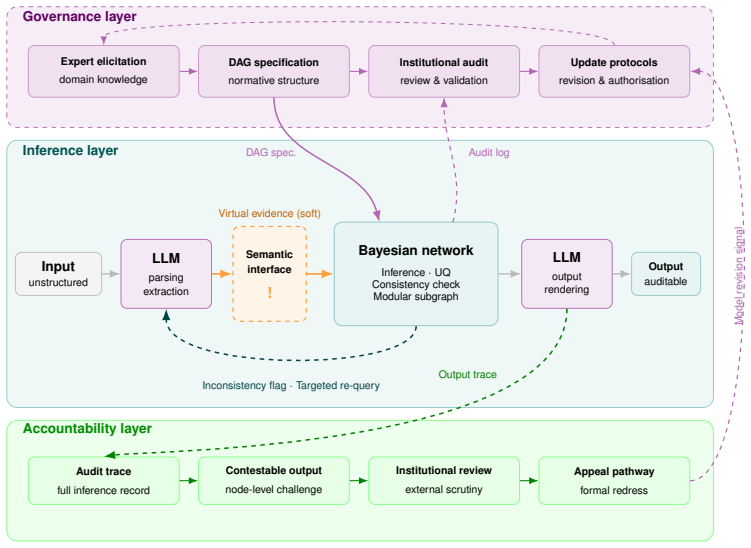
The central claim is that the absence of structured reasoning, not merely the absence of explanation, is the core problem; Bayesian networks can therefore act as transparent, ante-hoc mediation layers for generative models, encoding domain knowledge, causal assumptions, and probabilistic dependencies before inference occurs and thereby producing auditable reasoning traces, uncertainty quantification, and contestable outputs.
What carries the argument
The Glassbox Framework, in which Bayesian networks function as ante-hoc mediation layers that encode causal and probabilistic structure to mediate generative model outputs.
If this is right
- Reasoning traces become directly tied to the inference process rather than reconstructed afterward.
- Outputs gain contestability through explicit probabilistic dependencies that can be inspected and challenged.
- Uncertainty quantification is produced as an inherent part of the mediation layer.
- Applications such as benefit eligibility decisions can incorporate domain-specific causal knowledge upfront.
Where Pith is reading between the lines
- The same mediation approach could be tested in other regulated domains where causal assumptions change over time.
- Dynamic network construction would need methods that update encoded knowledge without retraining the generative model.
- Human governance procedures would have to decide which causal assumptions get encoded and how disputes over them are resolved.
Load-bearing premise
Domain knowledge, causal assumptions, and probabilistic dependencies can be encoded into Bayesian networks that preserve generative model capabilities while enabling full auditability and contestability.
What would settle it
An experiment in which a Bayesian network mediation layer is added to a generative model on a benchmark task and either the model's accuracy drops substantially or the resulting reasoning traces do not match the actual factors that drove the model's outputs.
Figures
read the original abstract
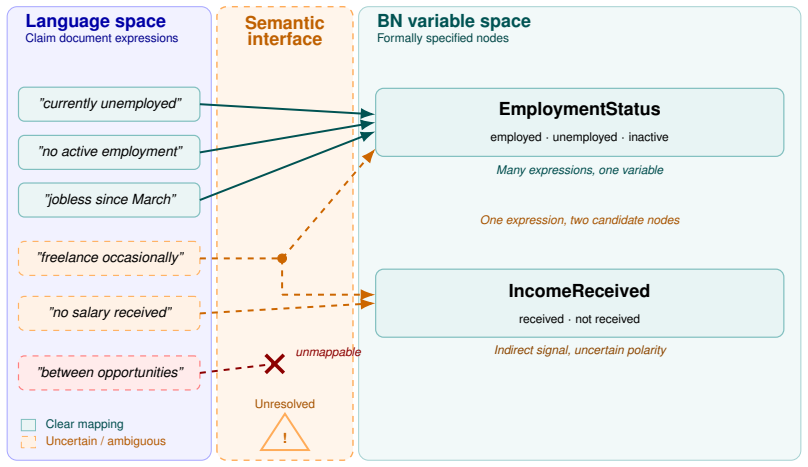
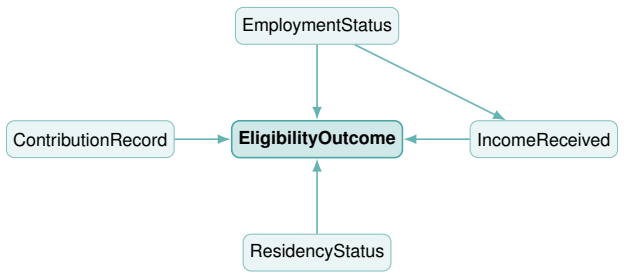
Large language models are rapidly becoming infrastructural components in high-stakes institutional settings, including public administration, legal reasoning, and healthcare, where opacity is not merely inconvenient but institutionally and legally untenable. Existing approaches to explainability are predominantly post-hoc, offering unstable, non-contestable accounts that have no formal relationship to the reasoning process that produced the output. We argue that the problem is not the absence of explanation but the absence of structured reasoning in the first place. This paper makes the case for a fundamentally different architecture, which we call the Glassbox Framework, in which Bayesian networks serve as transparent, ante-hoc mediation layers for generative models. Bayesian networks encode domain knowledge, causal assumptions, and probabilistic dependencies before inference occurs, enabling auditable reasoning traces, uncertainty quantification, and contestable outputs. We characterise the architecture of this framework and ground it in a benefit eligibility scenario, identifying the foundational challenges spanning semantic alignment, dynamic model construction, probabilistic grounding, and human governance that must be solved to realise it at scale. By shifting from post-hoc explanation to ante-hoc probabilistic mediation, this work outlines a principled path toward AI systems that are not only powerful but fundamentally accountable.
Editorial analysis
A structured set of objections, weighed in public.
Referee Report
Summary. The paper claims that post-hoc explanations for LLMs are inadequate for high-stakes domains and proposes the Glassbox Framework, in which Bayesian networks act as ante-hoc mediation layers between domain knowledge and generative models to deliver auditable reasoning traces, uncertainty quantification, and contestable outputs. It grounds the idea in a benefit eligibility scenario and explicitly lists four open challenges (semantic alignment, dynamic model construction, probabilistic grounding, and human governance) whose resolution is required for realization at scale.
Significance. If the architecture could be implemented while preserving model performance, it would offer a structural alternative to post-hoc methods and could meet institutional requirements for accountability. The paper's value is in clearly framing the shift from explanation to mediation and in naming the concrete technical and governance obstacles; however, with no formal model, implementation, or empirical test supplied, any significance remains conditional on future work.
major comments (2)
- [Abstract] Abstract: the central assertion that Bayesian networks 'enable auditable reasoning traces, uncertainty quantification, and contestable outputs' is presented without any specification of the mediation interface, the form of the joint distribution, or even a schematic of how the BN layer would constrain or audit a generative model; this absence makes the accountability claim impossible to evaluate.
- [benefit eligibility scenario] benefit eligibility scenario: the scenario is invoked to illustrate the framework yet supplies no concrete example of an input, a BN structure, a mediation step, or a contestation procedure, leaving the load-bearing claim that the architecture yields contestable outputs without any supporting illustration.
Simulated Author's Rebuttal
We thank the referee for the detailed and constructive report. The manuscript is a position paper whose primary contribution is to articulate the shift from post-hoc explanation to ante-hoc probabilistic mediation and to name the concrete technical and governance obstacles that must be overcome. We respond to the major comments below, agreeing that additional illustrative material would improve clarity while preserving the paper's conceptual scope.
read point-by-point responses
-
Referee: [Abstract] Abstract: the central assertion that Bayesian networks 'enable auditable reasoning traces, uncertainty quantification, and contestable outputs' is presented without any specification of the mediation interface, the form of the joint distribution, or even a schematic of how the BN layer would constrain or audit a generative model; this absence makes the accountability claim impossible to evaluate.
Authors: We agree that the abstract states the intended capabilities at a high level without specifying the mediation interface, joint distribution, or a schematic. This is consistent with the paper's nature as a conceptual proposal that characterises the architecture at the level of principles and then enumerates the open challenges (semantic alignment, dynamic model construction, probabilistic grounding, and human governance) whose resolution would be required to define such interfaces. To address the concern, we will revise the abstract to qualify the claims as prospective and add a high-level schematic diagram of the mediation layer in the main text. revision: partial
-
Referee: [benefit eligibility scenario] benefit eligibility scenario: the scenario is invoked to illustrate the framework yet supplies no concrete example of an input, a BN structure, a mediation step, or a contestation procedure, leaving the load-bearing claim that the architecture yields contestable outputs without any supporting illustration.
Authors: The benefit eligibility scenario is used to situate the framework in a concrete institutional setting and to motivate the requirement for contestable outputs. Because the manuscript does not present an implemented system, it contains no specific input values, BN structure, or step-by-step mediation example. We accept that a more detailed illustrative walk-through would make the contestability claim easier to evaluate and will expand the scenario section accordingly in the revision. revision: partial
Circularity Check
No significant circularity; conceptual proposal without derivations or self-referential claims
full rationale
The paper is an explicit high-level position paper that proposes the Glassbox Framework as an architecture using Bayesian networks for ante-hoc mediation. It advances no equations, derivations, fitted parameters, or empirical predictions. The central argument is limited to characterizing the framework and immediately enumerating open challenges (semantic alignment, dynamic model construction, probabilistic grounding, human governance) whose resolution is left for future work. No load-bearing step reduces to its own inputs by construction, and no self-citations are invoked to justify uniqueness or forbid alternatives. The document is therefore self-contained as a conceptual outline.
Axiom & Free-Parameter Ledger
axioms (1)
- domain assumption Bayesian networks can serve as transparent mediation layers that encode domain knowledge, causal assumptions, and probabilistic dependencies before inference occurs in generative models
invented entities (1)
-
Glassbox Framework
no independent evidence
Reference graph
Works this paper leans on
-
[1]
Nature Machine Intelligence , volume=
Stop explaining black box machine learning models for high stakes decisions and use interpretable models instead , author=. Nature Machine Intelligence , volume=. 2019 , publisher=
2019
-
[2]
Journal of Machine Learning Research , volume=
All models are wrong, but many are useful: Learning a variable's importance by studying an entire class of prediction models simultaneously , author=. Journal of Machine Learning Research , volume=
-
[3]
Proceedings of the 22nd ACM SIGKDD International Conference on Knowledge Discovery and Data Mining , pages=
``Why should I trust you?'' Explaining the predictions of any classifier , author=. Proceedings of the 22nd ACM SIGKDD International Conference on Knowledge Discovery and Data Mining , pages=
-
[4]
Advances in Neural Information Processing Systems , volume=
A unified approach to interpreting model predictions , author=. Advances in Neural Information Processing Systems , volume=
-
[5]
Advances in Neural Information Processing Systems , volume=
Towards robust interpretability with self-explaining neural networks , author=. Advances in Neural Information Processing Systems , volume=
-
[6]
International Conference on Machine Learning , pages=
Counterfactual off-policy evaluation with gumbel-max structural causal models , author=. International Conference on Machine Learning , pages=. 2019 , organization=
2019
-
[7]
Proceedings of the 2021 ACM Conference on Fairness, Accountability, and Transparency , pages=
Algorithmic recourse: From counterfactual explanations to interventions , author=. Proceedings of the 2021 ACM Conference on Fairness, Accountability, and Transparency , pages=
2021
-
[8]
2009 , publisher=
Causality , author=. 2009 , publisher=
2009
-
[9]
Risk assessment and decision analysis with
Fenton, Norman and Neil, Martin , year=. Risk assessment and decision analysis with
-
[10]
A general structure for legal arguments about evidence using
Fenton, Norman and Neil, Martin and Lagnado, David A , journal=. A general structure for legal arguments about evidence using. 2013 , publisher=
2013
-
[11]
A method for explaining
Vlek, Charlotte S and Prakken, Henry and Renooij, Silja and Verheij, Bart , journal=. A method for explaining. 2016 , publisher=
2016
-
[12]
Towards A Rigorous Science of Interpretable Machine Learning
Towards a rigorous science of interpretable machine learning , author=. arXiv preprint arXiv:1702.08608 , year=
work page internal anchor Pith review Pith/arXiv arXiv
-
[13]
Counterfactual explanations without opening the black box: Automated decisions and the
Wachter, Sandra and Mittelstadt, Brent and Russell, Chris , journal=. Counterfactual explanations without opening the black box: Automated decisions and the. 2017 , publisher=
2017
-
[14]
2024 , url =
Artificial Intelligence Act , howpublished =. 2024 , url =
2024
-
[15]
Artificial Intelligence Review , volume=
Neurosymbolic ai: The 3 rd wave , author=. Artificial Intelligence Review , volume=. 2023 , publisher=
2023
-
[16]
arXiv preprint arXiv:2002.06177 , year=
The next decade in AI: four steps towards robust artificial intelligence , author=. arXiv preprint arXiv:2002.06177 , year=
-
[17]
On the Opportunities and Risks of Foundation Models
On the opportunities and risks of foundation models , author=. arXiv preprint arXiv:2108.07258 , year=
work page internal anchor Pith review Pith/arXiv arXiv
-
[18]
Ethical and social risks of harm from Language Models
Ethical and social risks of harm from language models , author=. arXiv preprint arXiv:2112.04359 , year=
work page internal anchor Pith review Pith/arXiv arXiv
-
[19]
Proceedings of the 2021 ACM Conference on Fairness, Accountability, and Transparency , pages=
On the dangers of stochastic parrots: Can language models be too big? , author=. Proceedings of the 2021 ACM Conference on Fairness, Accountability, and Transparency , pages=
2021
-
[20]
Machine Learning and the City: Applications in Architecture and Urban Design , pages=
A unified framework of five principles for AI in society , author=. Machine Learning and the City: Applications in Architecture and Urban Design , pages=. 2022 , publisher=
2022
-
[21]
AI and Ethics , volume=
A regulatory taxonomy of AI opacity in the EU: Rethinking transparency, traceability, interpretability, and explainability , author=. AI and Ethics , volume=. 2026 , publisher=
2026
-
[22]
Advances in neural information processing systems , volume=
Attention is all you need , author=. Advances in neural information processing systems , volume=
-
[23]
International Journal of Engineering Business Management , volume=
Understanding support for AI regulation: A Bayesian network perspective , author=. International Journal of Engineering Business Management , volume=. 2025 , publisher=
2025
-
[24]
Proceedings of the AAAI/ACM Conference on AI, Ethics, and Society , volume=
Will AI take my job? Evolving perceptions of automation and labor risk in Latin America , author=. Proceedings of the AAAI/ACM Conference on AI, Ethics, and Society , volume=
-
[25]
AI & Society , volume=
Accountability in artificial intelligence: What it is and how it works , author=. AI & Society , volume=. 2024 , publisher=
2024
-
[26]
The Knowledge Engineering Review , volume=
Building large-scale Bayesian networks , author=. The Knowledge Engineering Review , volume=. 2000 , publisher=
2000
-
[27]
2009 , publisher=
Probabilistic graphical models: Principles and techniques , author=. 2009 , publisher=
2009
-
[28]
Reliability Engineering & System Safety , volume=
Computing Sobol indices in probabilistic graphical models , author=. Reliability Engineering & System Safety , volume=. 2022 , publisher=
2022
-
[29]
Queue , volume=
The mythos of model interpretability , author=. Queue , volume=. 2018 , publisher=
2018
-
[30]
Artificial Intelligence , volume=
Explanation in artificial intelligence: Insights from the social sciences , author=. Artificial Intelligence , volume=. 2019 , publisher=
2019
-
[31]
Proceedings of the 2021 ACM Conference on Fairness, Accountability, and Transparency , pages=
Outlining traceability: A principle for operationalizing accountability in computing systems , author=. Proceedings of the 2021 ACM Conference on Fairness, Accountability, and Transparency , pages=
2021
-
[32]
Closing the
Raji, Inioluwa Deborah and Smart, Andrew and White, Rebecca N and Mitchell, Margaret and Gebru, Timnit and Hutchinson, Ben and Smith-Loud, Jamila and Theron, Daniel and Barnes, Parker , booktitle=. Closing the
-
[33]
Proceedings of the 2019 Conference on Fairness, Accountability, and Transparency , pages=
Fairness and abstraction in sociotechnical systems , author=. Proceedings of the 2019 Conference on Fairness, Accountability, and Transparency , pages=
2019
-
[34]
Global sensitivity analysis of uncertain parameters in
Ballester-Ripoll, Rafael and Leonelli, Manuele , journal=. Global sensitivity analysis of uncertain parameters in. 2025 , publisher=
2025
-
[35]
Principles alone cannot guarantee ethical
Mittelstadt, Brent , journal=. Principles alone cannot guarantee ethical
-
[36]
Big Data & Society , volume=
How the machine `thinks': Understanding opacity in machine learning algorithms , author=. Big Data & Society , volume=. 2016 , publisher=
2016
-
[37]
Public Administration Review , volume=
From street-level to system-level bureaucracies: How information and communication technology is transforming administrative discretion and constitutional control , author=. Public Administration Review , volume=. 2002 , publisher=
2002
-
[38]
2018 , publisher=
Automating inequality: How high-tech tools profile, police, and punish the poor , author=. 2018 , publisher=
2018
-
[39]
Washington Law Review , volume=
The scored society: Due process for automated predictions , author=. Washington Law Review , volume=
-
[40]
Duke Law & Technology Review , volume=
Slave to the algorithm? Why a right to an explanation is probably not the remedy you are looking for , author=. Duke Law & Technology Review , volume=
-
[41]
Retrieval-augmented generation for knowledge-intensive
Lewis, Patrick and Perez, Ethan and Piktus, Aleksandra and Petroni, Fabio and Karpukhin, Vladimir and Goyal, Naman and K. Retrieval-augmented generation for knowledge-intensive. Advances in Neural Information Processing Systems , volume=
-
[42]
Technological Forecasting and Social Change , volume=
The future of employment: How susceptible are jobs to computerisation? , author=. Technological Forecasting and Social Change , volume=. 2017 , publisher=
2017
-
[43]
, author=
Fears about artificial intelligence across 20 countries and six domains of application. , author=. American Psychologist , volume=. 2026 , publisher=
2026
-
[44]
2017 , publisher=
Elements of causal inference: Foundations and learning algorithms , author=. 2017 , publisher=
2017
-
[45]
OR Spectrum , volume=
Coherent combination of probabilistic outputs for group decision making: An algebraic approach , author=. OR Spectrum , volume=. 2020 , publisher=
2020
discussion (0)
Sign in with ORCID, Apple, or X to comment. Anyone can read and Pith papers without signing in.