Revealing mixed modes in compressible hydrodynamical simulations of red giant stars
Pith reviewed 2026-06-27 21:00 UTC · model grok-4.3
The pith
Two-dimensional hydrodynamical simulations constrain mixed mode amplitudes in a red giant star for the first time.
A machine-rendered reading of the paper's core claim, the machinery that carries it, and where it could break.
Core claim
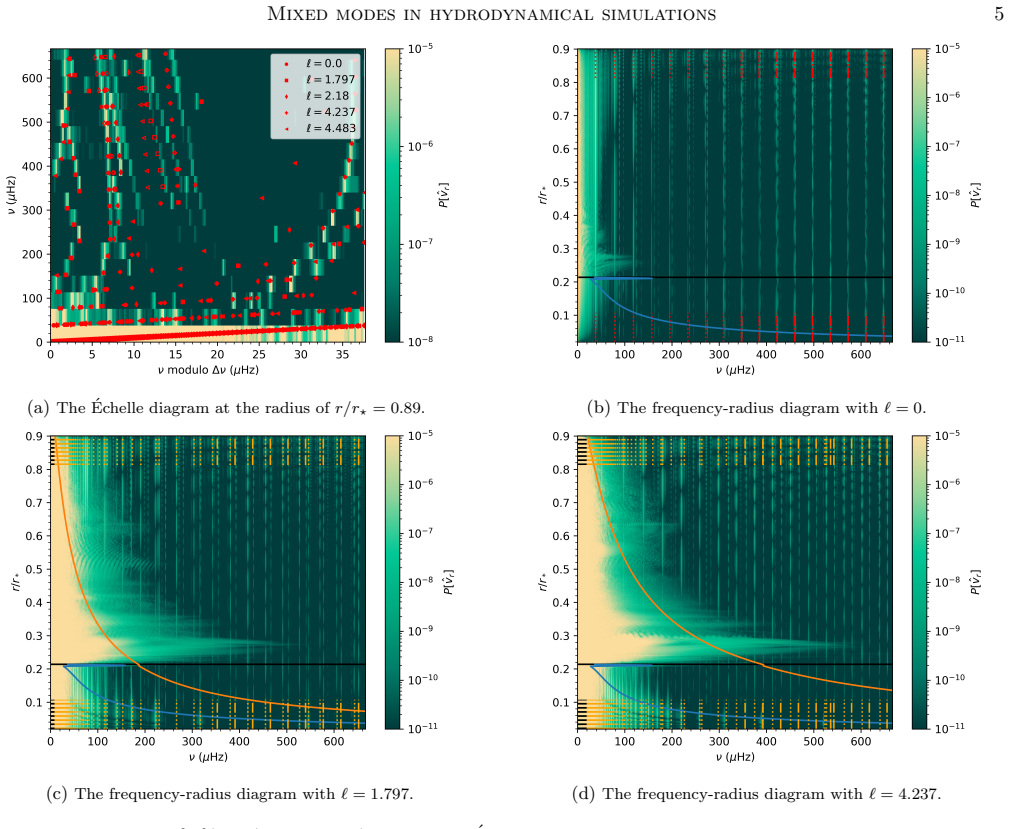
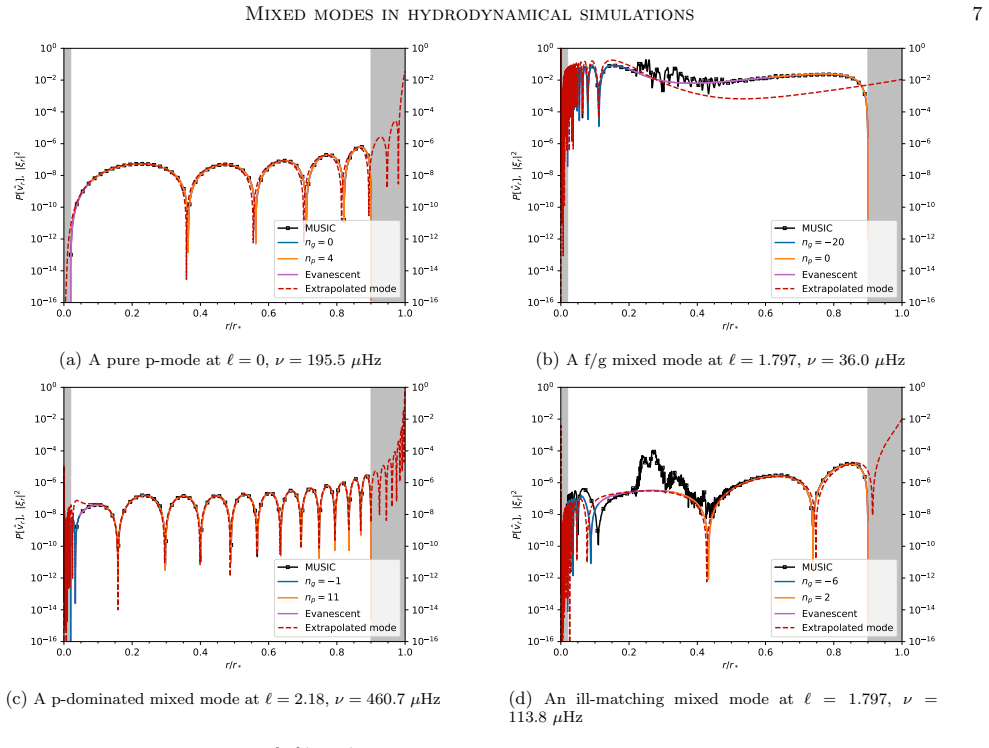
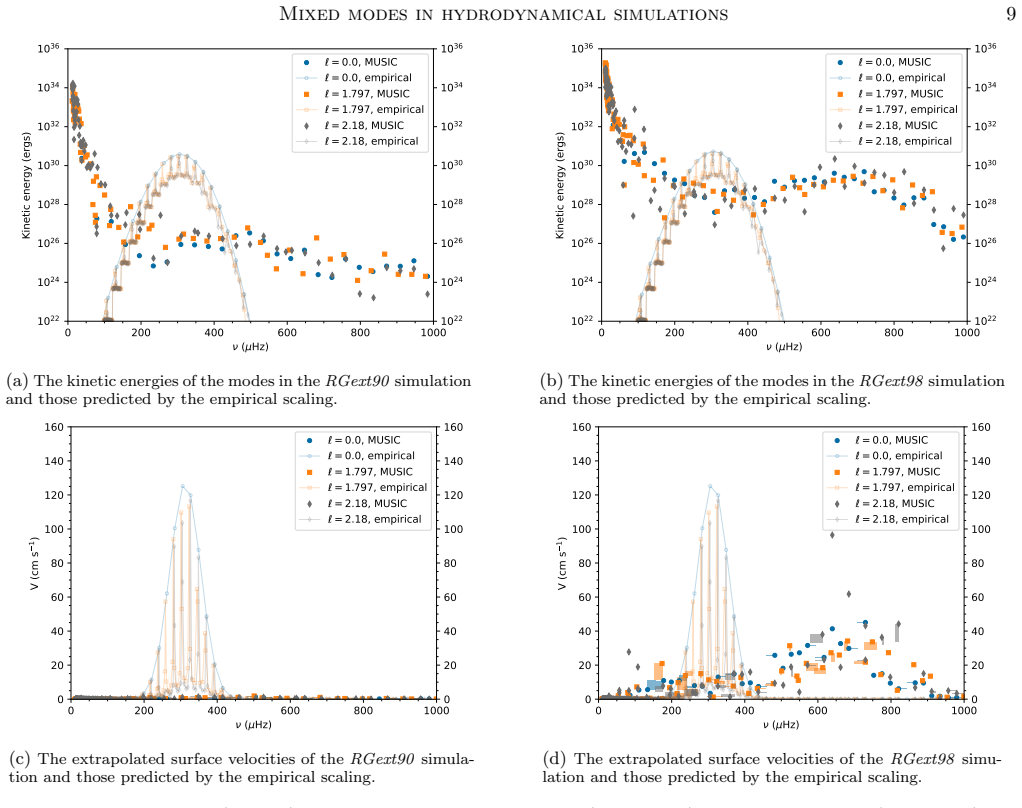
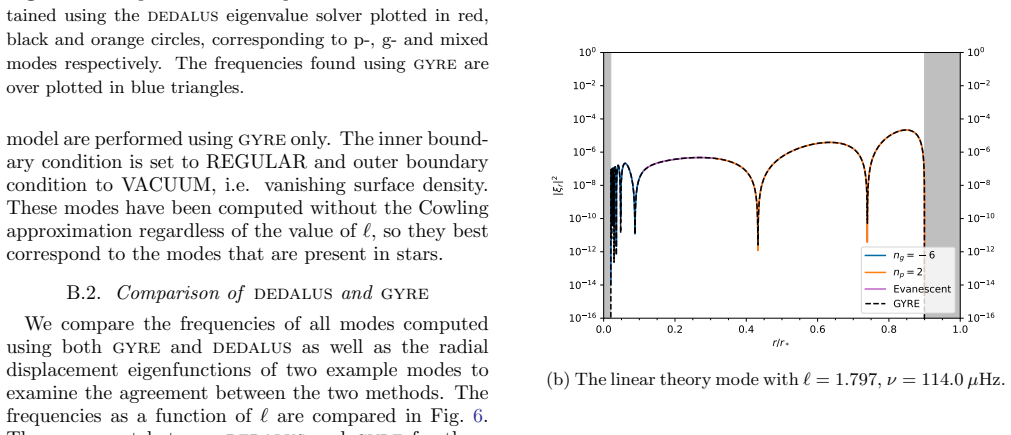
The authors find that modes with frequencies below 50 microHz have the largest kinetic energies in both simulations, contrary to empirical predictions that peak near 312.8 microHz. In the simulation truncated at 0.98 stellar radii, the extrapolated surface velocities match empirical predictions, forming a bell-shaped curve peaking near 700 microHz. Excellent agreement is found between the simulated mode frequencies and those from GYRE and Dedalus solvers for p-dominated modes, with some discrepancies for g-dominated modes in the 60 to 240 microHz range.
What carries the argument
Compressible hydrodynamical simulations using the MUSIC code on radially truncated domains, validated against linear oscillation solvers GYRE and Dedalus for frequency and eigenfunction agreement.
If this is right
- The largest kinetic energies being at low frequencies implies that these modes could have a significant effect on angular momentum transport in the interior.
- The extrapolated surface velocities being comparable to predictions in the 0.98 truncation run suggests the simulations capture observable mode properties.
- Mixed modes can be identified and their properties measured directly in non-linear hydrodynamical simulations rather than relying solely on linear theory.
- Low-frequency modes have small surface velocities, making them hard to observe but potentially important for internal dynamics.
Where Pith is reading between the lines
- If the truncation assumption holds, extending these simulations to include more of the envelope could refine the surface velocity estimates.
- These results open the possibility of using hydro simulations to test non-linear interactions between modes that linear theory cannot capture.
- The discrepancy in g-dominated modes points to potential numerical challenges in simulating gravity waves in the core that future work could address.
Load-bearing premise
The two truncated domains produce mixed-mode amplitudes and kinetic energies that are representative of the full untruncated star without dominant boundary artifacts.
What would settle it
A simulation with a domain extending to a larger fraction of the stellar radius or the full star yielding substantially different kinetic energy distributions for low-frequency modes would indicate that the current truncations introduce significant artifacts.
Figures



read the original abstract
Mixed modes are observed in many low-mass evolved stars. They provide information about core rotation rates of these stars, which are lower than predicted by stellar evolution models. The mixed modes themselves have been invoked as an angular momentum transport mechanism, but estimating their transport efficiency requires knowledge of their amplitudes. We constrain, for the first time, the mixed mode amplitudes in 2D hydrodynamical simulations of a $1.3M_\odot$ red giant using the code \textsc{music}. We perform two simulations with outer radial truncations at fractional radii $r_o/r_\star = 0.90$ and $r_o/r_\star = 0.98$. We compare the modes in the simulation with those found using both \textsc{gyre} and a \textsc{dedalus} eigenvalue solver. Excellent frequency agreement is found for all p-dominated modes, with minor discrepancies for g-dominated modes, especially in the frequency range $[60, \ 240]\ \mu\mathrm{Hz}$. We find excellent eigenfunction agreement for all modes except those in this frequency range. According to empirical predictions the largest kinetic energies are located around $\nu_{\mathrm{max}} = 312.8\ \mu\mathrm{Hz}$, but in both simulations the modes with frequencies $\nu <50\ \mu\mathrm{Hz}$ have the largest kinetic energies. In the simulation with $r/r_\star = 0.98$, the simulated modes have extrapolated surface velocities comparable to the empirical predictions, with highest surface velocities in a bell-shaped curve peaking around $\nu = 700 \ \mu\mathrm{Hz}$. The extrapolated surface velocities of the low frequency modes are small, and thus hard to observe, but their large kinetic energies deeper in the interior could significantly impact angular momentum transport, which has not yet been investigated.
Editorial analysis
A structured set of objections, weighed in public.
Referee Report
Summary. The manuscript reports the first constraints on mixed-mode amplitudes from 2D compressible hydrodynamical simulations of a 1.3 M⊙ red giant using MUSIC, performed with outer truncations at r_o/r⋆ = 0.90 and 0.98. Frequencies and eigenfunctions are compared to independent GYRE and Dedalus linear solvers, showing excellent agreement for p-dominated modes but discrepancies for g-dominated modes in [60, 240] μHz. Kinetic energies peak at ν < 50 μHz (contrary to empirical ν_max), and surface velocities are extrapolated for the 0.98 run to compare with observations.
Significance. If truncation effects can be shown to be sub-dominant, the work supplies the first direct numerical amplitudes for mixed modes in nonlinear hydro simulations, with external validation from two independent linear solvers. This could inform angular-momentum transport efficiency estimates in red-giant models.
major comments (2)
- [Simulation setup and truncation description] The central claim that the reported mixed-mode amplitudes and kinetic energies are representative of the full star rests on the untested assumption that boundary artifacts from the two truncated domains (r_o/r⋆ = 0.90 and 0.98) are negligible. No convergence test against a less-truncated domain is presented, and the largest KE at ν < 50 μHz together with g-mode discrepancies in [60, 240] μHz could arise from the omitted outer envelope where p-mode displacement peaks.
- [Mode identification and post-processing] The extraction of eigenfunctions and kinetic energies from the hydrodynamical runs is not described in sufficient detail to assess whether the post-processing isolates linear mixed-mode properties or is affected by nonlinear or compressible effects; this is load-bearing for the amplitude and surface-velocity claims.
minor comments (2)
- Clarify the precise method used to extrapolate surface velocities from the r_o/r⋆ = 0.98 run, especially for the low-frequency modes whose extrapolated values are stated to be small.
- The abstract states 'excellent eigenfunction agreement for all modes except those in this frequency range'; quantify the level of agreement (e.g., overlap integrals or L2 norms) rather than using qualitative descriptors.
Simulated Author's Rebuttal
We thank the referee for their careful reading of the manuscript and for the constructive comments. We address each major comment below and have revised the manuscript to incorporate additional details and discussion where needed.
read point-by-point responses
-
Referee: The central claim that the reported mixed-mode amplitudes and kinetic energies are representative of the full star rests on the untested assumption that boundary artifacts from the two truncated domains (r_o/r⋆ = 0.90 and 0.98) are negligible. No convergence test against a less-truncated domain is presented, and the largest KE at ν < 50 μHz together with g-mode discrepancies in [60, 240] μHz could arise from the omitted outer envelope where p-mode displacement peaks.
Authors: We performed two simulations with different outer truncations (0.90 and 0.98 r⋆) precisely to test sensitivity to the boundary location. The result that kinetic energies are largest for ν < 50 μHz holds in both runs, and the 0.98 run yields extrapolated surface velocities consistent with empirical expectations. While a simulation with still smaller truncation would be desirable, computational cost precludes it at present. The consistency across the two domains together with the close match to GYRE and Dedalus for p-dominated modes indicates that the reported trends are not dominated by truncation artifacts. We have added a dedicated subsection discussing possible truncation effects and their limited influence on the low-frequency KE peak. revision: partial
-
Referee: The extraction of eigenfunctions and kinetic energies from the hydrodynamical runs is not described in sufficient detail to assess whether the post-processing isolates linear mixed-mode properties or is affected by nonlinear or compressible effects; this is load-bearing for the amplitude and surface-velocity claims.
Authors: We agree that the post-processing procedure requires more explicit description. In the revised manuscript we have expanded the relevant methods section to detail the extraction pipeline: the temporal filtering applied to isolate oscillatory signals, the projection onto radial and horizontal components, the computation of kinetic energy integrals, and the rationale that the extracted quantities correspond to linear eigenmodes (supported by the frequency and eigenfunction agreement with the independent linear solvers). We also note the limitations arising from nonlinearity and compressibility and how they are mitigated by the comparison to linear theory. revision: yes
Circularity Check
No circularity; external GYRE/Dedalus comparisons supply independent validation of frequencies and eigenfunctions.
full rationale
The paper runs MUSIC hydro simulations on truncated domains and directly compares extracted mode frequencies and eigenfunctions to independent linear solvers (GYRE and Dedalus). Reported agreement for p-dominated modes and noted discrepancies for g-dominated modes constitute external benchmarks rather than internal fits or self-definitions. No equations reduce a derived quantity to a fitted parameter by construction, no load-bearing self-citations appear, and no ansatz or uniqueness claim is smuggled via prior author work. The truncation assumption is an untested modeling choice but does not create a circular derivation chain.
Axiom & Free-Parameter Ledger
axioms (1)
- domain assumption Compressible hydrodynamics and linear mode analysis assumptions standard in stellar oscillation theory apply to the truncated 2D domains.
Reference graph
Works this paper leans on
-
[1]
Aerts, C., Mathis, S., & Rogers, T. M. 2019, Annual Review of Astronomy and Astrophysics, 57, 35, doi: https: //doi.org/10.1146/annurev-astro-091918-104359
-
[2]
1977, A&A, 58, 41 16De Vries et al
Aizenman, M., Smeyers, P., & Weigert, A. 1977, A&A, 58, 41 16De Vries et al
1977
-
[3]
Alvan, L., Brun, A. S., & Mathis, S. 2014, A&A, 565, A42, doi: 10.1051/0004-6361/201323253
-
[4]
H., Lecoanet, D., Cantiello, M., et al
Anders, E. H., Lecoanet, D., Cantiello, M., et al. 2023, Nature Astronomy, 7, 1228, doi: 10.1038/s41550-023-02040-7
-
[5]
2009, A&A, 506, 411, doi: 10.1051/0004-6361/200810860
Auvergne, M., Bodin, P., Boisnard, L., et al. 2009, A&A, 506, 411, doi: 10.1051/0004-6361/200810860
-
[6]
2023, Monthly Notices of the Royal Astronomical Society, 519, 5333, doi: 10.1093/mnras/stad009
Baraffe, I., Clarke, J., Morison, A., et al. 2023, Monthly Notices of the Royal Astronomical Society, 519, 5333, doi: 10.1093/mnras/stad009
-
[7]
Beck, P. G., Bedding, T. R., Mosser, B., et al. 2011, Science, 332, 205, doi: 10.1126/science.1201939
-
[8]
R., Huber, D., Stello, D., et al
Bedding, T. R., Huber, D., Stello, D., et al. 2010, The Astrophysical Journal Letters, 713, L176, doi: 10.1088/2041-8205/713/2/L176
-
[9]
2008, A&A, 478, 163, doi: 10.1051/0004-6361:20077775
Belkacem, K., Samadi, R., Goupil, M.-J., & Dupret, M.-A. 2008, A&A, 478, 163, doi: 10.1051/0004-6361:20077775
-
[11]
Belkacem, K., Marques, J. P., Goupil, M. J., et al. 2015b, A&A, 579, A30, doi: 10.1051/0004-6361/201526042
-
[12]
2024, A&A, 690, A270, doi: 10.1051/0004-6361/202450802
Bessila, L., & Mathis, S. 2024, A&A, 690, A270, doi: 10.1051/0004-6361/202450802
-
[13]
2023, Monthyl Notices of the Royal Astronomical Society, 522, 1706, doi: 10.1093/mnras/stad1115
Blouin, S., Mao, H., Herwig, F., et al. 2023, Monthyl Notices of the Royal Astronomical Society, 522, 1706, doi: 10.1093/mnras/stad1115
-
[14]
Blouin, S., Woodward, P. R., Denissenkov, P. A., Pathak, P., & Herwig, F. 2026, Nature Astronomy, 10, 385, doi: 10.1038/s41550-025-02743-z Bordad´ agua, B., Ahlborn, F., Copp´ ee, Q., et al. 2025, A&A, 699, A310, doi: 10.1051/0004-6361/202555405
-
[15]
Science , year = 2010, month = feb, volume = 327, pages =
Borucki, W. J., Koch, D., Basri, G., et al. 2010, Science, 327, 977, doi: 10.1126/science.1185402
-
[16]
Boyd, J. P. 2001, Chebyshev and Fourier spectral methods (Dover Publications)
2001
-
[17]
Breton, S. N., Brun, A. S., & Garc´ ıa, R. A. 2022, A&A, 667, A43, doi: 10.1051/0004-6361/202244247
-
[18]
Brown, B. P. 2020, Physical Review Research, 2, 023068, doi: 10.1103/PhysRevResearch.2.023068
-
[19]
2014, The Astrophysical Journal, 788, 93, doi: 10.1088/0004-637X/788/1/93
Christensen-Dalsgaard, J., & Paxton, B. 2014, The Astrophysical Journal, 788, 93, doi: 10.1088/0004-637X/788/1/93
-
[20]
Cowling, T. G. 1941, Monthly Notices of the Royal Astronomical Society, 101, 367, doi: 10.1093/mnras/101.8.367
-
[21]
2020, A&A, 641, A117, doi: 10.1051/0004-6361/202038578
Deheuvels, S., Ballot, J., Eggenberger, P., et al. 2020, A&A, 641, A117, doi: 10.1051/0004-6361/202038578
-
[22]
Deheuvels, S., Do˘ gan, G., Goupil, M. J., et al. 2014, A&A, 564, A27, doi: 10.1051/0004-6361/201322779
-
[23]
Dziembowski, W. A. 1971, AcA, 21, 289
1971
-
[24]
Edelmann, P. V. F., Ratnasingam, R. P., Pedersen, M. G., et al. 2019, ApJ, 876, 4, doi: 10.3847/1538-4357/ab12df
-
[25]
2012, A&A, 544, L4, doi: 10.1051/0004-6361/201219729
Eggenberger, P., Montalb´ an, J., & Miglio, A. 2012, A&A, 544, L4, doi: 10.1051/0004-6361/201219729
-
[26]
2017, A&A, 599, A18, doi: 10.1051/0004-6361/201629459
Eggenberger, P., Lagarde, N., Miglio, A., et al. 2017, A&A, 599, A18, doi: 10.1051/0004-6361/201629459
-
[27]
2019, A&A, 621, A66, doi: 10.1051/0004-6361/201833447
Eggenberger, P., Deheuvels, S., Miglio, A., et al. 2019, A&A, 621, A66, doi: 10.1051/0004-6361/201833447
-
[28]
2014, The Astrophysical Journal, 796, 17, doi: 10.1088/0004-637X/796/1/17
Fuller, J., Lecoanet, D., Cantiello, M., & Brown, B. 2014, The Astrophysical Journal, 796, 17, doi: 10.1088/0004-637X/796/1/17
-
[29]
Fuller, J., Piro, A. L., & Jermyn, A. S. 2019, Monthly Notices of the Royal Astronomical Society, 485, 3661, doi: 10.1093/mnras/stz514
-
[30]
2017, A&A, 600, A7, doi: 10.1051/0004-6361/201628960
Goffrey, T., Pratt, J., Viallet, M., et al. 2017, A&A, 600, A7, doi: 10.1051/0004-6361/201628960
-
[31]
Goldreich, P., & Keeley, D. A. 1977, ApJ, 212, 243, doi: 10.1086/155043
-
[32]
1990, ApJ, 363, 694, doi: 10.1086/169376
Goldreich, P., & Kumar, P. 1990, ApJ, 363, 694, doi: 10.1086/169376
-
[33]
Horst, L., Edelmann, P. V. F., Andr´ assy, R., et al. 2020, A&A, 641, A18, doi: 10.1051/0004-6361/202037531
-
[34]
1996, Applied Numerical Mathematics, 20, 21, doi: https://doi.org/10.1016/0168-9274(95)00115-8
Hosea, M., & Shampine, L. 1996, Applied Numerical Mathematics, 20, 21, doi: https://doi.org/10.1016/0168-9274(95)00115-8
-
[35]
Iglesias, C. A., & Rogers, F. J. 1996, ApJ, 464, 943, doi: 10.1086/177381
-
[36]
Jermyn, A. S., Bauer, E. B., Schwab, J., et al. 2023, The Astrophysical Journal Supplement Series, 265, 15, doi: 10.3847/1538-4365/acae8d Le Saux, A., Bessila, L., & Mathis, S. 2026, Monthly Notices of the Royal Astronomical Society, stag870, doi: 10.1093/mnras/stag870 Le Saux, A., Leclerc, A., Laibe, G., Delplace, P., &
-
[37]
Venaille, A. 2025, The Astrophysical Journal Letters, 987, L12, doi: 10.3847/2041-8213/ade396 Le Saux, A., Guillet, T., Baraffe, I., et al. 2022, A&A, 660, A51, doi: 10.1051/0004-6361/202142569
-
[38]
Leclerc, A., Jezequel, L., Perez, N., et al. 2024, Phys. Rev. Res., 6, L012055, doi: 10.1103/PhysRevResearch.6.L012055
-
[39]
2022, The Astrophysical Journal, 940, 84, doi: 10.3847/1538-4357/ac99d9
Leclerc, A., Laibe, G., Delplace, P., Venaille, A., & Perez, N. 2022, The Astrophysical Journal, 940, 84, doi: 10.3847/1538-4357/ac99d9
-
[40]
Lecoanet, D., Cantiello, M., Anders, E. H., et al. 2021, Monthly Notices of the Royal Astronomical Society, 508, 132, doi: 10.1093/mnras/stab2524 Mixed modes in hydrodynamical simulations17
-
[41]
2013, Monthly Notices of the Royal Astronomical Society, 430, 2363, doi: 10.1093/mnras/stt055
Lecoanet, D., & Quataert, E. 2013, Monthly Notices of the Royal Astronomical Society, 430, 2363, doi: 10.1093/mnras/stt055
-
[42]
2024, A&A, 688, A184, doi: 10.1051/0004-6361/202449882
Li, G., Deheuvels, S´ ebastien, & Ballot, J´ erˆ ome. 2024, A&A, 688, A184, doi: 10.1051/0004-6361/202449882
-
[43]
Marques, J. P., Goupil, M. J., Lebreton, Y., et al. 2013, A&A, 549, A74, doi: 10.1051/0004-6361/201220211
-
[44]
Meakin, C. A., & Arnett, D. 2006, ApJ, 637, L53, doi: 10.1086/500544
-
[45]
2011, A&A, 532, A86, doi: 10.1051/0004-6361/201116825
Mosser, B., Barban, C., Montalb´ an, J., et al. 2011, A&A, 532, A86, doi: 10.1051/0004-6361/201116825
-
[46]
Mosser, B., Goupil, M. J., Belkacem, K., et al. 2012, A&A, 548, A10, doi: 10.1051/0004-6361/201220106
-
[47]
D., Eggenberger, P., Mosser, B., & Spada, F
Moyano, F. D., Eggenberger, P., Mosser, B., & Spada, F. 2023, A&A, 673, A110, doi: 10.1051/0004-6361/202245519 Nordlund, ˚A., & Stein, R. F. 2001, ApJ, 546, 576, doi: 10.1086/318217
-
[48]
2021, Eigentools: Tools for studying linear eigenvalue problems,, Astrophysics Source Code Library, record ascl:2101.017 http://ascl.net/2101.017
Oishi, J., Burns, K., Clark, S., et al. 2021, Eigentools: Tools for studying linear eigenvalue problems,, Astrophysics Source Code Library, record ascl:2101.017 http://ascl.net/2101.017
2021
-
[49]
2011, The Astrophysical Journal Supplement Series, 192, 3, doi: 10.1088/0067-0049/192/1/3
Paxton, B., Bildsten, L., Dotter, A., et al. 2011, The Astrophysical Journal Supplement Series, 192, 3, doi: 10.1088/0067-0049/192/1/3
-
[50]
2013, The Astrophysical Journal Supplement Series, 208, 4, doi: 10.1088/0067-0049/208/1/4
Paxton, B., Cantiello, M., Arras, P., et al. 2013, The Astrophysical Journal Supplement Series, 208, 4, doi: 10.1088/0067-0049/208/1/4
work page internal anchor Pith review doi:10.1088/0067-0049/208/1/4 2013
-
[51]
2015, The Astrophysical Journal Supplement Series, 220, 15, doi: 10.1088/0067-0049/220/1/15
Paxton, B., Marchant, P., Schwab, J., et al. 2015, The Astrophysical Journal Supplement Series, 220, 15, doi: 10.1088/0067-0049/220/1/15
work page internal anchor Pith review doi:10.1088/0067-0049/220/1/15 2015
-
[52]
Paxton, B., Schwab, J., Bauer, E. B., et al. 2018, The Astrophysical Journal Supplement Series, 234, 34, doi: 10.3847/1538-4365/aaa5a8
work page internal anchor Pith review doi:10.3847/1538-4365/aaa5a8 2018
-
[53]
2019, The Astrophysical Journal Supplement Series, 243, 10, doi: 10.3847/1538-4365/ab2241
Paxton, B., Smolec, R., Schwab, J., et al. 2019, The Astrophysical Journal Supplement Series, 243, 10, doi: 10.3847/1538-4365/ab2241
-
[54]
2019, Nature Physics, 15, 781 Pin¸ con, C., Belkacem, K., & Goupil, M
Perrot, M., Delplace, P., & Venaille, A. 2019, Nature Physics, 15, 781 Pin¸ con, C., Belkacem, K., & Goupil, M. J. 2016, A&A, 588, A122, doi: 10.1051/0004-6361/201527663 Pin¸ con, C., Belkacem, K., Goupil, M. J., & Marques, J. P. 2017, A&A, 605, A31, doi: 10.1051/0004-6361/201730998
-
[55]
Press, W. H. 1981, ApJ, 245, 286, doi: 10.1086/158809
-
[56]
Ricker, G. R., Winn, J. N., Vanderspek, R., et al. 2014, in Society of Photo-Optical Instrumentation Engineers (SPIE) Conference Series, Vol. 9143, Space Telescopes and Instrumentation 2014: Optical, Infrared, and Millimeter Wave, ed. J. M. Oschmann, Jr., M. Clampin, G. G. Fazio, & H. A. MacEwen, 914320, doi: 10.1117/12.2063489
-
[57]
Rogers, F. J., & Nayfonov, A. 2002, The Astrophysical Journal, 576, 1064, doi: 10.1086/341894
-
[58]
Rogers, T. M., Lin, D. N. C., McElwaine, J. N., & Lau, H. H. B. 2013, The Astrophysical Journal, 772, 21, doi: 10.1088/0004-637X/772/1/21
-
[59]
2011, Stochastic Excitation of Acoustic Modes in Stars, ed
Samadi, R. 2011, Stochastic Excitation of Acoustic Modes in Stars, ed. J.-P. Rozelot & C. Neiner (Berlin, Heidelberg: Springer Berlin Heidelberg), 305–340, doi: 10.1007/978-3-642-19928-8 11
-
[60]
2012, A&A, 543, A120, doi: 10.1051/0004-6361/201219253
Samadi, R., Belkacem, K., Dupret, M.-A., et al. 2012, A&A, 543, A120, doi: 10.1051/0004-6361/201219253
-
[61]
2001, A&A, 370, 136, doi: 10.1051/0004-6361:20010212
Samadi, R., & Goupil, M.-J. 2001, A&A, 370, 136, doi: 10.1051/0004-6361:20010212
-
[62]
2003, A&A, 403, 303, doi: 10.1051/0004-6361:20030356
Roxburgh, I. 2003, A&A, 403, 303, doi: 10.1051/0004-6361:20030356
-
[63]
2010, A&A, 509, A16, doi: 10.1051/0004-6361/200911868
Samadi, R., Ludwig, H.-G., Belkacem, K., et al. 2010, A&A, 509, A16, doi: 10.1051/0004-6361/200911868
-
[64]
Skoutnev, V. A., & Beloborodov, A. M. 2025, The Astrophysical Journal Letters, 989, L4, doi: 10.3847/2041-8213/adefda
-
[65]
2016, A&A, 589, A23, doi: 10.1051/0004-6361/201527591
Spada, F., Gellert, M., Arlt, R., & Deheuvels, S. 2016, A&A, 589, A23, doi: 10.1051/0004-6361/201527591
-
[66]
Spruit, H. C. 2002, A&A, 381, 923, doi: 10.1051/0004-6361:20011465
-
[67]
Stein, R. F., & Nordlund, ˚A. 2001, ApJ, 546, 585, doi: 10.1086/318218
-
[68]
Thompson, W., Herwig, F., Woodward, P. R., et al. 2024, Monthly Notices of the Royal Astronomical Society, 531, 1316, doi: 10.1093/mnras/stae1162
-
[69]
2025, The Astrophysical Journal, 988, 140, doi: 10.3847/1538-4357/addf32
Christensen-Dalsgaard, J. 2025, The Astrophysical Journal, 988, 140, doi: 10.3847/1538-4357/addf32
-
[70]
1989, Nonradial oscillations of stars
Unno, W., Osaki, Y., Ando, H., Saio, H., & Shibahashi, H. 1989, Nonradial oscillations of stars
1989
-
[71]
2011, A&A, 531, A86, doi: 10.1051/0004-6361/201016374
Viallet, M., Baraffe, I., & Walder, R. 2011, A&A, 531, A86, doi: 10.1051/0004-6361/201016374
-
[72]
2016, A&A, 586, A153, doi: 10.1051/0004-6361/201527339
Viallet, M., Goffrey, T., Baraffe, I., et al. 2016, A&A, 586, A153, doi: 10.1051/0004-6361/201527339
-
[73]
G., Baraffe, I., Constantino, T., et al
Vlaykov, D. G., Baraffe, I., Constantino, T., et al. 2022, Monthly Notices of the Royal Astronomical Society, 514, 715, doi: 10.1093/mnras/stac1278 18De Vries et al
-
[74]
2018, A&A, 616, A94, doi: 10.1051/0004-6361/201732477
Vrard, M., Kallinger, T., Mosser, B., et al. 2018, A&A, 616, A94, doi: 10.1051/0004-6361/201732477
-
[75]
Angular momentum transport by internal waves in the solar interior
Zahn, J. P., Talon, S., & Matias, J. 1997, A&A, 322, 320, doi: 10.48550/arXiv.astro-ph/9611189
work page internal anchor Pith review Pith/arXiv arXiv doi:10.48550/arxiv.astro-ph/9611189 1997
-
[76]
2019, ApJ, 880, 13, doi: 10.3847/1538-4357/ab262c
Zhou, Y., Asplund, M., & Collet, R. 2019, ApJ, 880, 13, doi: 10.3847/1538-4357/ab262c
discussion (0)
Sign in with ORCID, Apple, or X to comment. Anyone can read and Pith papers without signing in.