Freo Doctor: Atmospheric Modelling for Meteorite Falls and Spacecraft Re-Entries
Pith reviewed 2026-06-27 21:08 UTC · model grok-4.3
The pith
Wind model differences shift predicted meteorite ground positions by a median of 143 meters for 1 kg objects, exceeding fireball observation errors.
A machine-rendered reading of the paper's core claim, the machinery that carries it, and where it could break.
Core claim
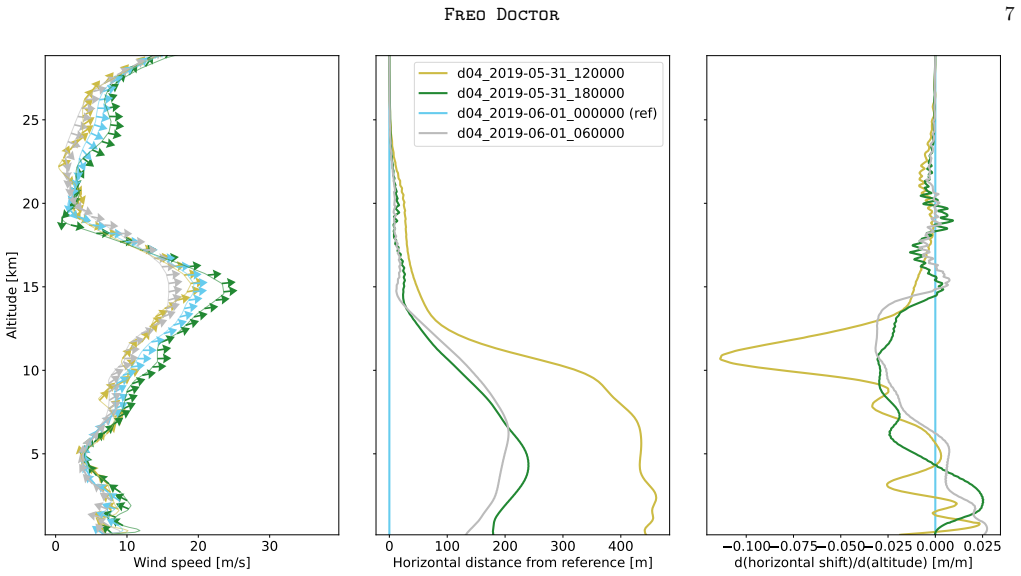
In most cases the differences on the ground positions are significant: median shift for a 1 kg meteorite is 143 m, doubling to 307 m for a 10 g rock, though these vary by over an order of magnitude between events. The differences wind model choice makes on the ground are significantly larger than the typical uncertainty on meteoroid state vector obtained from bright flight observations of the fireball (<100 m), and should be taken into account when predicting meteorite free-fall path to the ground.
What carries the argument
Weather Research and Forecasting models of the lower 30 km atmosphere run at 1 km spatial resolution, with multiple initialisation times serving as a proxy for uncertainty.
If this is right
- Median ground shifts reach 143 m for 1 kg meteorites and 307 m for 10 g rocks.
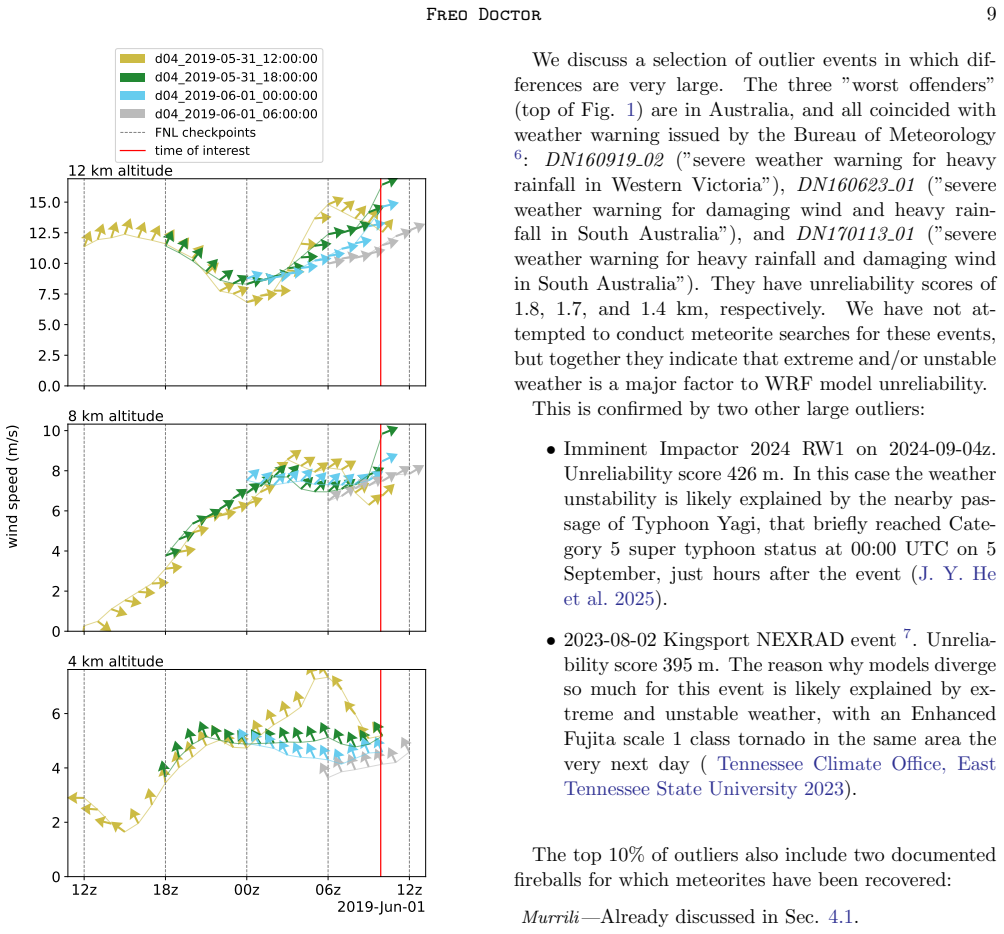
- Shifts are largest during documented extreme weather events and vary by more than an order of magnitude across cases.
- Models at 1 km resolution perform better than those at 3 km resolution.
- The same models have guided field teams to 12 meteorite recoveries.
Where Pith is reading between the lines
- Search areas for small meteorites should be planned with an ensemble of wind realisations rather than a single trajectory.
- The released model archive could be used to test whether adding wind uncertainty improves recovery rates in past events.
- The same high-resolution wind fields could be applied to refine landing predictions for controlled spacecraft re-entries.
Load-bearing premise
That the spread across models started at different times adequately captures the real uncertainty in the winds that act on the falling object.
What would settle it
Recoveries of meteorites that consistently land inside the 100 m observational error ellipse even when wind model variations are ignored would show that the wind shifts are not the dominant factor.
Figures



read the original abstract
How much does the wind affect the path of meteorite falls? We finely model the lower ~30 km of the atmosphere using Weather Research and Forecasting open source tools at 1 km spatial resolution. Models initialised at different times give different results, which can be used as a proxy for uncertainty. We find that in most cases the differences on the ground positions are significant: median shift for a 1 kg meteorite is 143 m, doubling to 307 m for a 10 g rock, though these vary by over an order of magnitude between events. The differences wind model choice makes on the ground are significantly larger than the typical uncertainty on meteoroid state vector obtained from bright flight observations of the fireball (<100 m), and should be taken into account when predicting meteorite free-fall path to the ground. Unsurprisingly the cases where we see the largest differences coincide with documented extreme weather events. We also find that high spatial resolution models (1 vs. 3 km) tend to perform better. We have successfully used these models to guide field teams to the location of 12 fallen meteorites after fireball observations. We release as open data 1107 models we have calculated for 302 meteorite fall events and spacecraft re-entries around the world.
Editorial analysis
A structured set of objections, weighed in public.
Referee Report
Summary. The manuscript presents 'Freo Doctor', an application of the open-source WRF model at 1 km horizontal resolution to simulate winds in the lowest ~30 km for dark-flight trajectory modeling of meteorites and re-entering spacecraft. Different model initialization times are used to generate an ensemble whose spread in predicted ground positions serves as a proxy for uncertainty. The central quantitative claim is that wind-model choice produces median ground-position shifts of 143 m for 1 kg meteorites and 307 m for 10 g fragments (varying by more than an order of magnitude across events), exceeding the <100 m typical uncertainty on meteoroid state vectors from bright-flight observations; the authors report successful guidance of recovery teams in 12 cases and release 1107 models for 302 events as open data.
Significance. If the initialization-time spread is shown to bound actual wind error, the work would establish that mesoscale wind modeling constitutes a first-order uncertainty source in meteorite recovery predictions and should be incorporated routinely. The public release of a large, reusable model archive is a concrete strength that directly supports community validation and follow-on studies.
major comments (2)
- [Abstract] Abstract and methods: the headline claim that wind-induced ground shifts exceed observational state-vector uncertainty (<100 m) rests on treating the spread across WRF runs initialized at different times as a quantitative uncertainty proxy. No section compares this ensemble spread to independent wind observations (radiosonde, lidar, or reanalysis profiles) at the relevant altitudes and times to demonstrate that the proxy bounds or matches actual model error.
- [Abstract] Abstract: the statement that 'high spatial resolution models (1 vs. 3 km) tend to perform better' is presented without specifying the performance metric, the reference dataset, or the number of events used for the comparison, leaving the supporting evidence for the 1 km choice unclear.
minor comments (2)
- [Abstract] The abstract reports successful application in 12 cases but provides no quantitative recovery statistics (e.g., search-area reduction or distance to recovered stones) that would allow readers to assess the practical impact of the modeling.
- Notation for meteorite mass bins (1 kg vs. 10 g) and the exact number of initialization times per event should be stated explicitly in the methods to permit reproduction.
Simulated Author's Rebuttal
We thank the referee for their constructive comments on our manuscript. We address each major comment below and agree that clarifications are required.
read point-by-point responses
-
Referee: [Abstract] Abstract and methods: the headline claim that wind-induced ground shifts exceed observational state-vector uncertainty (<100 m) rests on treating the spread across WRF runs initialized at different times as a quantitative uncertainty proxy. No section compares this ensemble spread to independent wind observations (radiosonde, lidar, or reanalysis profiles) at the relevant altitudes and times to demonstrate that the proxy bounds or matches actual model error.
Authors: We agree that the spread across initialization times is presented as a proxy for uncertainty rather than a validated bound on actual model error, and that no direct comparison to independent observations is included. This is a genuine limitation of the current work. In revision we will rephrase the relevant abstract and methods statements to explicitly identify the initialization-time ensemble as a proxy for sensitivity to initial conditions, add a dedicated paragraph discussing this choice and its limitations, and note that future validation against radiosonde or lidar profiles would be valuable. The central quantitative claim will be adjusted to reflect the proxy nature of the estimate. revision: yes
-
Referee: [Abstract] Abstract: the statement that 'high spatial resolution models (1 vs. 3 km) tend to perform better' is presented without specifying the performance metric, the reference dataset, or the number of events used for the comparison, leaving the supporting evidence for the 1 km choice unclear.
Authors: The statement is based on a subset of events for which both resolutions were computed. We will revise the abstract to qualify or remove the unqualified claim and will add the supporting details (performance metric, reference events, and count) to the methods and results sections of the revised manuscript. revision: yes
Circularity Check
No circularity: external WRF modeling with ensemble proxy
full rationale
The paper applies open-source WRF atmospheric models initialized at different times to compute wind-affected trajectories for meteorite falls, treating the spread across runs as an uncertainty proxy and comparing resulting ground positions to independent fireball observations. No load-bearing step reduces by construction to a fitted parameter, self-citation chain, or ansatz imported from the authors' prior work; the central claims rest on external tool outputs and direct comparison to state-vector uncertainties reported from observations. This is a standard application of established numerical weather prediction methods.
Axiom & Free-Parameter Ledger
free parameters (1)
- model initialization times
axioms (1)
- domain assumption The WRF model at 1 km resolution accurately captures wind fields relevant to meteorite falls in the lower 30 km.
Reference graph
Works this paper leans on
-
[1]
Anderson, S. L., Towner, M. C., Fairweather, J., et al. 2022, ApJL, 930, L25, doi: 10.3847/2041-8213/ac66d4
-
[2]
A Cloud-Based Tool for Meteorite Recovery Using Drones and Machine Learning
Anderson, S. L., Devillepoix, H. A. R., Lakerink, L., et al. 2026, arXiv e-prints, arXiv:2605.19179, doi: 10.48550/arXiv.2605.19179
work page internal anchor Pith review Pith/arXiv arXiv doi:10.48550/arxiv.2605.19179 2026
-
[3]
Meteoritics & Planetary Science , author =
Borovicka, J., & Kalenda, P. 2003, M&PS, 38, 1023, doi: 10.1111/j.1945-5100.2003.tb00296.x Boroviˇ cka, J., Spurn´ y, P., & Shrben´ y, L. 2020, AJ, 160, 42, doi: 10.3847/1538-3881/ab9608
-
[4]
Meteoritics & Planetary Science , author =
Brown, P. G., McCausland, P. J. A., Hildebrand, A. R., et al. 2023, M&PS, 58, 1773, doi: 10.1111/maps.14100
-
[5]
Carbognani, A., Fenucci, M., Salerno, R., & Micheli, M. 2025, Icarus, 425, 116345, doi: 10.1016/j.icarus.2024.116345 8 https://desertfireballnetwork.github.io/freo doctor Chennaoui Aoudjehane, H., Agee, C. B., Devillepoix, H., et al. 2024, in LPI Contributions, Vol. 86, 86th Annual Meeting of the Meteoritical Society Meeting, 6030
-
[6]
Kulichkov, S. N. 2026, Icarus, 450, 117007, doi: 10.1016/j.icarus.2026.117007
-
[7]
submitted to MAPS, 2026, The Journey of the Pindarri Punju Puri Meteorite: Trajectory, Infrasound Insights, and Recovery
Clemente, I. submitted to MAPS, 2026, The Journey of the Pindarri Punju Puri Meteorite: Trajectory, Infrasound Insights, and Recovery
2026
-
[8]
2026a, Atmospheric Models for Meteorite Falls in 2000-2009,, Zenodo doi: 10.5281/zenodo.20370903
Devillepoix, H., & Cupak, M. 2026a, Atmospheric Models for Meteorite Falls in 2000-2009,, Zenodo doi: 10.5281/zenodo.20370903
-
[9]
Devillepoix, H., & Cupak, M. 2026b, Atmospheric Models for Meteorite Falls in 2010,, Zenodo doi: 10.5281/zenodo.20068574 14 Devillepoix et al
-
[10]
2026c, Atmospheric Models for Meteorite Falls in 2011,, Zenodo doi: 10.5281/zenodo.20373031
Devillepoix, H., & Cupak, M. 2026c, Atmospheric Models for Meteorite Falls in 2011,, Zenodo doi: 10.5281/zenodo.20373031
-
[11]
2026d, Atmospheric Models for Meteorite Falls in 2012,, Zenodo doi: 10.5281/zenodo.20390830
Devillepoix, H., & Cupak, M. 2026d, Atmospheric Models for Meteorite Falls in 2012,, Zenodo doi: 10.5281/zenodo.20390830
-
[12]
2026e, Atmospheric Models for Meteorite Falls in 2013,, Zenodo doi: 10.5281/zenodo.19993752
Devillepoix, H., & Cupak, M. 2026e, Atmospheric Models for Meteorite Falls in 2013,, Zenodo doi: 10.5281/zenodo.19993752
-
[13]
2026f, Atmospheric Models for Meteorite Falls in 2014,, Zenodo doi: 10.5281/zenodo.20076769
Devillepoix, H., & Cupak, M. 2026f, Atmospheric Models for Meteorite Falls in 2014,, Zenodo doi: 10.5281/zenodo.20076769
-
[14]
2026g, Atmospheric Models for Meteorite Falls in 2015,, Zenodo doi: 10.5281/zenodo.20066406
Devillepoix, H., & Cupak, M. 2026g, Atmospheric Models for Meteorite Falls in 2015,, Zenodo doi: 10.5281/zenodo.20066406
-
[15]
2026h, Atmospheric Models for Meteorite Falls in 2016,, Zenodo doi: 10.5281/zenodo.19993886
Devillepoix, H., & Cupak, M. 2026h, Atmospheric Models for Meteorite Falls in 2016,, Zenodo doi: 10.5281/zenodo.19993886
-
[16]
2026i, Atmospheric Models for Meteorite Falls in 2017,, Zenodo doi: 10.5281/zenodo.20083376
Devillepoix, H., & Cupak, M. 2026i, Atmospheric Models for Meteorite Falls in 2017,, Zenodo doi: 10.5281/zenodo.20083376
-
[17]
2026j, Atmospheric Models for Meteorite Falls in 2018,, Zenodo doi: 10.5281/zenodo.20066732
Devillepoix, H., & Cupak, M. 2026j, Atmospheric Models for Meteorite Falls in 2018,, Zenodo doi: 10.5281/zenodo.20066732
-
[18]
2026k, Atmospheric Models for Meteorite Falls in 2019,, Zenodo doi: 10.5281/zenodo.19971296
Devillepoix, H., & Cupak, M. 2026k, Atmospheric Models for Meteorite Falls in 2019,, Zenodo doi: 10.5281/zenodo.19971296
-
[19]
2026l, Atmospheric Models for Meteorite Falls in 2020,, Zenodo doi: 10.5281/zenodo.19965050
Devillepoix, H., & Cupak, M. 2026l, Atmospheric Models for Meteorite Falls in 2020,, Zenodo doi: 10.5281/zenodo.19965050
-
[20]
2026m, Atmospheric Models for Meteorite Falls in 2021,, Zenodo doi: 10.5281/zenodo.19965309
Devillepoix, H., & Cupak, M. 2026m, Atmospheric Models for Meteorite Falls in 2021,, Zenodo doi: 10.5281/zenodo.19965309
-
[21]
2026n, Atmospheric Models for Meteorite Falls in 2022,, Zenodo doi: 10.5281/zenodo.19965661
Devillepoix, H., & Cupak, M. 2026n, Atmospheric Models for Meteorite Falls in 2022,, Zenodo doi: 10.5281/zenodo.19965661
-
[22]
2026o, Atmospheric Models for Meteorite Falls in 2023,, Zenodo doi: 10.5281/zenodo.19966240
Devillepoix, H., & Cupak, M. 2026o, Atmospheric Models for Meteorite Falls in 2023,, Zenodo doi: 10.5281/zenodo.19966240
-
[23]
2026p, Atmospheric Models for Meteorite Falls in 2024,, Zenodo doi: 10.5281/zenodo.19967162
Devillepoix, H., & Cupak, M. 2026p, Atmospheric Models for Meteorite Falls in 2024,, Zenodo doi: 10.5281/zenodo.19967162
-
[24]
2026q, Atmospheric Models for Meteorite Falls in 2025,, Zenodo doi: 10.5281/zenodo.19967973
Devillepoix, H., & Cupak, M. 2026q, Atmospheric Models for Meteorite Falls in 2025,, Zenodo doi: 10.5281/zenodo.19967973
-
[25]
2026r, Atmospheric Models for Meteorite Falls in 2026,, Zenodo doi: 10.5281/zenodo.19968955
Devillepoix, H., & Cupak, M. 2026r, Atmospheric Models for Meteorite Falls in 2026,, Zenodo doi: 10.5281/zenodo.19968955
-
[26]
2026s, Atmospheric Models for Re-Entries,, Zenodo doi: 10.5281/zenodo.19998570
Devillepoix, H., & Cupak, M. 2026s, Atmospheric Models for Re-Entries,, Zenodo doi: 10.5281/zenodo.19998570
-
[27]
Devillepoix, H. A. R., Sansom, E. K., Bland, P. A., et al. 2018, Meteoritics and Planetary Science, 53, 2212, doi: 10.1111/maps.13142
-
[28]
Devillepoix, H. A. R., Cup´ ak, M., Bland, P. A., et al. 2020, Planet. Space Sci., 191, 105036, doi: 10.1016/j.pss.2020.105036
-
[29]
Devillepoix, H. A. R., Sansom, E. K., Shober, P., et al. 2022b, M&PS, 57, 1328, doi: 10.1111/maps.13820
-
[30]
2025, Nature Astronomy, 9, 1624, doi: 10.1038/s41550-025-02659-8
Egal, A., Vida, D., Colas, F., et al. 2025, Nature Astronomy, 9, 1624, doi: 10.1038/s41550-025-02659-8
-
[31]
2025, Advances in Astronomy, 2025, 3041760, doi: 10.1155/aa/3041760 Freo Doctor 15
Fries, M., & Fries, J. 2025, Advances in Astronomy, 2025, 3041760, doi: 10.1155/aa/3041760 Freo Doctor 15
-
[32]
Publications of the Astronomical Society of Australia , author =
Rollinson, D. 2026, PASA, 43, e027, doi: 10.1017/pasa.2026.10162
-
[33]
T., & Griffin, A
Halliday, I., Blackwell, A. T., & Griffin, A. A. 1978, JRASC, 72, 15
1978
-
[34]
Hatty, I. R., Sansom, E. K., Devillepoix, H. A. R., et al. 2026, Icarus, 455, 117105, doi: 10.1016/j.icarus.2026.117105
-
[35]
He, J. Y., Lau, T. K., Chan, Y. W., et al. 2025, Meteorology and Atmospheric Physics, 137, 21, doi: 10.1007/s00703-025-01069-9
-
[36]
Experimental Astronomy , author =
Howie, R. M., Paxman, J., Bland, P. A., et al. 2017, Experimental Astronomy, doi: 10.1007/s10686-017-9532-7
-
[37]
2016, ECMWF Newsletter
Ingleby, B., Rodwell, M., & Isaksen, L. 2016, ECMWF Newsletter. https://www.ecmwf.int/en/newsletter/149/ meteorology/global-radiosonde-network-under-pressure
2016
-
[38]
Jankov, I., Gallus, W. A., Segal, M., & Koch, S. E. 2007, Weather and Forecasting, 22, 501, doi: 10.1175/WAF998.1
-
[39]
Jenniskens, P., & Devillepoix, H. A. R. 2025, M&PS, 60, 928, doi: 10.1111/maps.14321
-
[40]
Jenniskens, P., Shaddad, M. H., Numan, D., et al. 2009, Nature, 458, 485, doi: 10.1038/nature07920
-
[41]
2021, M&PS, 56, 844, doi: 10.1111/maps.13653
Jenniskens, P., Gabadirwe, M., Yin, Q.-Z., et al. 2021, M&PS, 56, 844, doi: 10.1111/maps.13653
-
[42]
2024, PSJ, 5, 253, doi: 10.3847/PSJ/ad8b22
Kareta, T., Vida, D., Micheli, M., et al. 2024, PSJ, 5, 253, doi: 10.3847/PSJ/ad8b22
-
[43]
A., Steeneveld, G.-J., & Holtslag, A
Kleczek, M. A., Steeneveld, G.-J., & Holtslag, A. A. M. 2014, Boundary-Layer Meteorology, 152, 213, doi: 10.1007/s10546-014-9925-3
-
[44]
2023, Journal of Hydrology, 620, 129443, doi: https://doi.org/10.1016/j.jhydrol.2023.129443
Liu, Y., Zhuo, L., & Han, D. 2023, Journal of Hydrology, 620, 129443, doi: https://doi.org/10.1016/j.jhydrol.2023.129443
-
[45]
Lorenz, E. N. 1969, Tellus, 21, 289, doi: 10.3402/tellusa.v21i3.10086
-
[46]
McMullan, S., Vida, D., Devillepoix, H. A. R., et al. 2024, M&PS, 59, 927, doi: 10.1111/maps.13977
-
[47]
2021, Monthly Notices of the Royal Astronomical Society, 503, 3337, doi: 10.1093/mnras/stab586
Moilanen, J., Gritsevich, M., & Lyytinen, E. 2021, Monthly Notices of the Royal Astronomical Society, 503, 3337, doi: 10.1093/mnras/stab586
-
[48]
2026, arXiv e-prints, arXiv:2602.15440, doi: 10.48550/arXiv.2602.15440
Moilanen, J., Gritsevich, M., & Visuri, J. 2026, arXiv e-prints, arXiv:2602.15440, doi: 10.48550/arXiv.2602.15440
-
[49]
M., Abou-Ghanem, M., Cziczo, D
Murphy, D. M., Abou-Ghanem, M., Cziczo, D. J., et al. 2023, Proceedings of the National Academy of Sciences, 120, e2313374120, doi: 10.1073/pnas.2313374120 NCEP/NOAA. 2000, National Centers For Environmental Prediction FNL Operational Model Global Tropospheric
-
[50]
Analyses, Continuing from July 1999, UCAR/NCAR - Research Data Archive, doi: 10.5065/D6M043C6
-
[51]
Sharples, J., & Bowman, D. M. J. S. 2020, Natural Hazards and Earth System Sciences, 20, 1497, doi: 10.5194/nhess-20-1497-2020
-
[52]
Osinski, R. D., & Radtke, H. 2020, Ocean Science, 16, 355, doi: 10.5194/os-16-355-2020
-
[53]
Picone, J. M., Hedin, A. E., Drob, D. P., & Aikin, A. C. 2002, Journal of Geophysical Research (Space Physics), 107, 1468, doi: 10.1029/2002JA009430 Priv´ e, N. C., Errico, R. M., & Tai, K.-S. 2014, Monthly Weather Review, 142, 1823, doi: 10.1175/MWR-D-13-00237.1 16 Devillepoix et al
-
[54]
Sansom, E. K., Bland, P. A., Towner, M. C., et al. 2020, Meteoritics and Planetary Science, 55, 2157, doi: 10.1111/maps.13566
-
[55]
Schaible, L. P., & Silber, E. A. 2026, Geophys. Res. Lett., 53, e2025GL120188, doi: 10.1029/2025GL120188
-
[56]
Shober, P. M., Devillepoix, H. A. R., Sansom, E. K., et al. 2022, M&PS, 57, 1146, doi: 10.1111/maps.13813 Shrben´ y, L., Boroviˇ cka, J., Spurn´ y, P., & Hankey, M. 2026, Meteoritics & Planetary Science, n/a, doi: https://doi.org/10.1111/maps.70119
-
[57]
Silber, E. A., Bowman, D. C., Egan, S., et al. 2026, Geophys. Res. Lett., 53, e2025GL120042, doi: 10.1029/ 2025GL12004210.22541/essoar.177013777.73724621/v1
arXiv 2026
-
[58]
Skamarock, W. C., Klemp, J. B., Dudhia, J., et al. 2019, UCAR/NCAR, doi: 10.5065/1DFH-6P97
-
[59]
Spisak, J., Riedel, C. P., Sushko, A., et al. 2026, arXiv e-prints, arXiv:2602.02714, doi: 10.48550/arXiv.2602.02714 Spurn´ y, P., Boroviˇ cka, J., & Shrben´ y, L. 2020, M&PS, 55, 376, doi: 10.1111/maps.13444 Spurn´ y, P., Boroviˇ cka, J., Shrben´ y, L., Hankey, M., &
-
[60]
Astronomy & Astrophysics , author =
Neubert, R. 2024, A&A, 686, A67, doi: 10.1051/0004-6361/202449735 Szab´ o, N. O., S´ arneczky, K., Kiss, L. L., et al. 2026, Acta Astronautica, 240, 1, doi: 10.1016/j.actaastro.2025.11.055 Tennessee Climate Office, East Tennessee State University. 2023, 2023 August – Tennessee Monthly Climate Report, Monthly Climate Report 72, East Tennessee State
-
[61]
2022, Atmospheric Research, 271, 106085, doi: 10.1016/j.atmosres.2022.106085
Tewari, M., Chen, F., Dudhia, J., et al. 2022, Atmospheric Research, 271, 106085, doi: 10.1016/j.atmosres.2022.106085
-
[62]
C., Jansen-Sturgeon, T., Cupak, M., et al
Towner, M. C., Jansen-Sturgeon, T., Cupak, M., et al. 2022, PSJ, 3, 44, doi: 10.3847/PSJ/ac3df5 T´ oth, J., Povinec, P. P., Ozd´ ın, D., et al. 2026, Meteoritics & Planetary Science, n/a, doi: 10.1111/maps.70120
-
[63]
2022, Wind Energy Science, 7, 1869, doi: 10.5194/wes-7-1869-2022
Vemuri, A., Buckingham, S., Munters, W., Helsen, J., & van Beeck, J. 2022, Wind Energy Science, 7, 1869, doi: 10.5194/wes-7-1869-2022
-
[64]
Warner, T. T., Peterson, R. A., & Treadon, R. E. 1997, Bulletin of the American Meteorological Society, 78, 2599, doi: 10.1175/1520-0477(1997)078 ⟨2599: ATOLBC⟩2.0.CO;2
-
[65]
forthcoming, 2026, Raja: a camera-observed EH3 fall from Oman
Zappatini, A. forthcoming, 2026, Raja: a camera-observed EH3 fall from Oman
2026
-
[66]
Zappatini, A., Gnos, E., Hofmann, B. A., et al. 2026, M&PS, 61, 522, doi: 10.1111/maps.70110
discussion (0)
Sign in with ORCID, Apple, or X to comment. Anyone can read and Pith papers without signing in.