Modelling time-irreversible avalanches
Pith reviewed 2026-06-27 20:36 UTC · model grok-4.3
The pith
A non-equilibrium extension of the ABBM model correlates an easy-to-measure avalanche asymmetry with entropy production rates.
A machine-rendered reading of the paper's core claim, the machinery that carries it, and where it could break.
Core claim
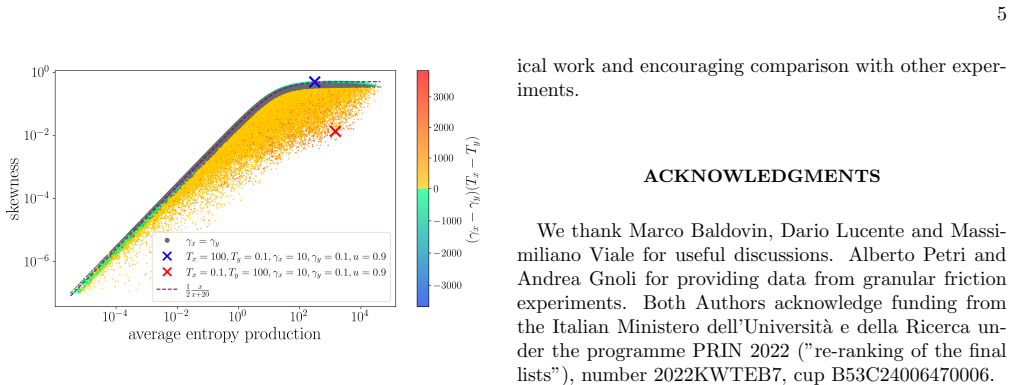
The paper establishes that the non-equilibrium extension of the ABBM model, framed via the Brownian Gyrator, reproduces experimental avalanche phenomenology in granular friction and yields a correlation between an easily computed measure of avalanche-shape asymmetry and the entropy production rates of the stochastic dynamics, thereby providing theoretical control over time-reversal symmetry breaking in fluctuations.
What carries the argument
The non-equilibrium extension of the ABBM model, which enables systematic calculation of avalanche asymmetry as a function of the underlying entropy production.
If this is right
- Avalanche asymmetry becomes a practical experimental proxy for entropy production in crackling-noise systems.
- The model supplies a systematic way to study how time-reversal symmetry breaking appears in average avalanche shapes across multiple physical realizations.
- Theoretical predictions for asymmetry can be tested directly against data from magnetic materials, earthquakes, and granular flows.
- Entropy production rates can be inferred from shape observables even when full phase-space trajectories remain inaccessible.
Where Pith is reading between the lines
- The same asymmetry-entropy link could be checked in other driven systems that exhibit crackling but were not modeled here.
- Simulations could test whether the correlation survives when additional microscopic details, such as spatial structure, are restored to the model.
- Experimental protocols could be designed to extract entropy production solely from the leading and trailing edges of recorded avalanches.
Load-bearing premise
The non-equilibrium extension of the ABBM model is assumed to capture the essential time-irreversible features of real systems such as granular friction.
What would settle it
If experiments on granular friction show that the measured avalanche asymmetry does not correlate with independent estimates of entropy production rates, the claimed relationship would not hold.
Figures


read the original abstract
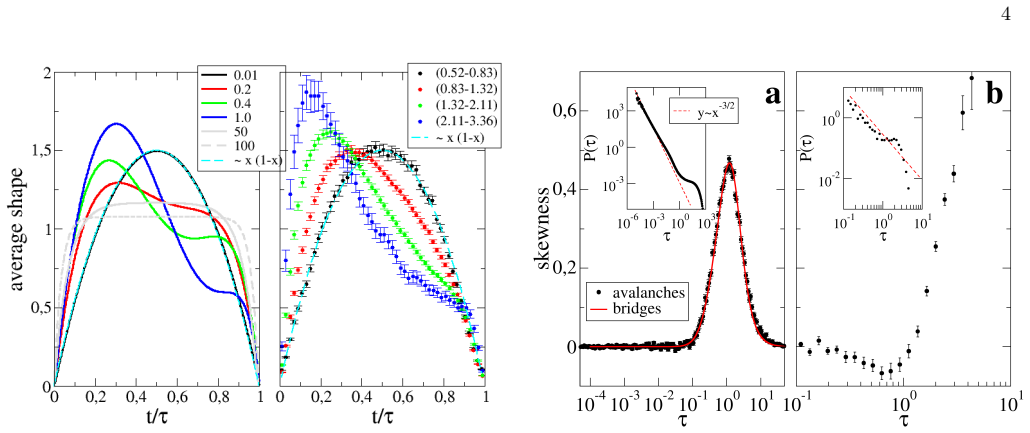
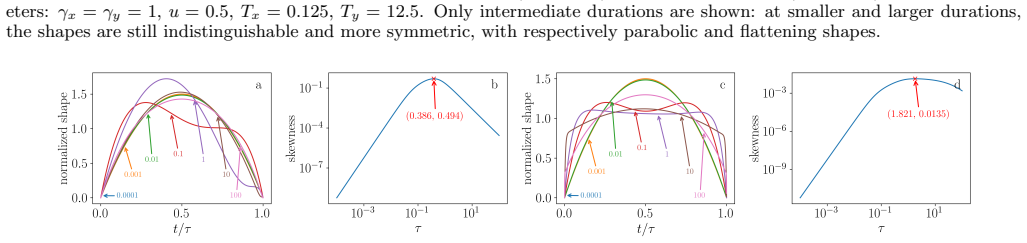
We investigate the problem of the time reversal symmetry of fluctuations, as witnessed by the average shape of avalanches. This quantity has been measured in a variety of systems, ranging from magnetic materials to earthquakes. Although an asymmetric shape is often observed, which is a signature of a non-equilibrium dynamics, there is no general theoretical control of this feature. In this paper, we propose a non equilibrium extension of a paradigmatic model for ``crackling-noise'', the so called ABBM model. Our model is strictly related to the Brownian Gyrator, which has been previously introduced in stochastic thermodynamics as the simplest model for thermal anisotropy, but it can also be framed in the context of rate-and-state models. It reproduces the phenomenology observed in experiments on granular friction, and allows for a systematic theoretical study of the asymmetry. We manage to correlate a measure of asymmetry, that can be easily computed in experiments, with the entropy production rates of the dynamics.
Editorial analysis
A structured set of objections, weighed in public.
Referee Report
Summary. The manuscript proposes a non-equilibrium extension of the ABBM model for crackling noise, framed via the Brownian Gyrator (or rate-and-state dynamics), to study time-reversal symmetry breaking as seen in the average shape of avalanches. It claims the extension reproduces granular friction phenomenology and derives a correlation between an easily measured asymmetry measure and entropy production rates.
Significance. If the correlation is derived rigorously inside the model and the modeling assumptions map to real dissipation mechanisms, the work would link an experimental observable (avalanche shape asymmetry) to a thermodynamic quantity (entropy production) in non-equilibrium systems, extending stochastic thermodynamics ideas to crackling noise.
major comments (2)
- Abstract: the assertion that the model 'reproduces the phenomenology observed in experiments on granular friction' is stated without any cited parameter values, quantitative metrics, or references to specific figures or tables showing agreement with data, which is load-bearing for the claim that the asymmetry-entropy correlation applies beyond the model.
- Abstract / modeling section: the non-equilibrium ABBM extension is assumed to capture the essential time-irreversible features of real granular avalanches via stochastic anisotropy; if this choice does not match the dominant irreversibility source, the derived correlation between shape asymmetry and entropy production does not transfer to experiments.
Simulated Author's Rebuttal
We thank the referee for their thoughtful comments on our manuscript. We address each major point below and indicate where revisions will be made to strengthen the presentation.
read point-by-point responses
-
Referee: Abstract: the assertion that the model 'reproduces the phenomenology observed in experiments on granular friction' is stated without any cited parameter values, quantitative metrics, or references to specific figures or tables showing agreement with data, which is load-bearing for the claim that the asymmetry-entropy correlation applies beyond the model.
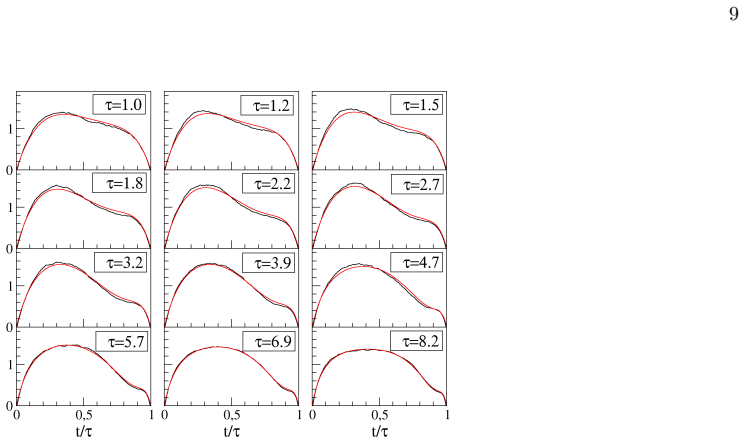
Authors: We agree the abstract statement is insufficiently supported as written. The full manuscript contains qualitative comparisons to granular friction experiments (avalanche asymmetry and shape) in the results section, with references to relevant experimental works. We will revise the abstract to include explicit references to those sections, figures, and citations, and add a brief mention of the level of agreement achieved. revision: yes
-
Referee: Abstract / modeling section: the non-equilibrium ABBM extension is assumed to capture the essential time-irreversible features of real granular avalanches via stochastic anisotropy; if this choice does not match the dominant irreversibility source, the derived correlation between shape asymmetry and entropy production does not transfer to experiments.
Authors: The stochastic anisotropy is introduced via the Brownian Gyrator/rate-and-state framing precisely because it provides a minimal, analytically tractable source of time-reversal symmetry breaking that reproduces key features of driven frictional systems. The correlation between asymmetry and entropy production is derived rigorously inside this model class. We discuss the physical motivation and limitations of the assumption in the modeling section; while other irreversibility mechanisms could dominate in some experiments, the derived relation remains valid for systems well-described by this dynamics. revision: no
Circularity Check
No circularity: model-derived correlation is independent of inputs
full rationale
The provided abstract and context describe a non-equilibrium ABBM extension (Brownian Gyrator framing) whose asymmetry-entropy correlation is obtained inside the model. No equations, self-citations, or fitted-parameter renamings are quoted that would reduce the claimed correlation to a definition or input by construction. The derivation chain is therefore self-contained against external benchmarks; the model-to-experiment transfer is an assumption, not a circularity.
Axiom & Free-Parameter Ledger
Reference graph
Works this paper leans on
-
[1]
Aspect, F
A. Aspect, F. Bouchet, ´E. Brunet, C. Cohen-Tannoudji, J. Dalibard, T. Damour, O. Darrigol, B. Derrida, P. Grangier, F. Lalo¨ e,et al., Einstein aujourd’hui, inEin- stein aujourd’hui(EDP sciences, 2021)
2021
-
[2]
Sarracino, A
A. Sarracino, A. Puglisi, and A. Vulpiani,Nonequilib- rium Statistical Mechanics: Basic concepts, models and applications(IOP Publishing, 2025)
2025
-
[3]
J. P. Sethna, K. A. Dahmen, and C. R. Myers, Crackling noise, Nature410, 242 (2001)
2001
-
[4]
Zapperi,Crackling noise: statistical physics of avalanche phenomena(Oxford University Press, 2022)
S. Zapperi,Crackling noise: statistical physics of avalanche phenomena(Oxford University Press, 2022)
2022
-
[5]
Bertotti,Hysteresis in Magnetism(Academic Press, 1998)
G. Bertotti,Hysteresis in Magnetism(Academic Press, 1998)
1998
-
[6]
Spasojevi´ c, S
D. Spasojevi´ c, S. Bukvi´ c, S. Miloˇ sevi´ c, and H. E. Stanley, Barkhausen noise: Elementary signals, power laws, and scaling relations, Physical Review E - Statistical Physics, Plasmas, Fluids, and Related Interdisciplinary Topics54, 2531 (1996)
1996
-
[7]
A. P. Mehta, A. C. Mills, K. A. Dahmen, and J. P. Sethna, Universal pulse shape scaling function and ex- ponents: Critical test for avalanche models applied to Barkhausen noise, Physical Review E - Statistical Physics, Plasmas, Fluids, and Related Interdisciplinary Topics65, 6 (2002), arXiv:0112107 [cond-mat]
2002
-
[8]
Baldassarri, F
A. Baldassarri, F. Colaiori, and C. Castellano, Average Shape of a Fluctuation: Universality in Excursions of Stochastic Processes, Physical Review Letters90, 60601 (2003)
2003
-
[9]
Colaiori, Exactly solvable model of avalanches dynam- ics for Barkhausen crackling noise, Advances in Physics 57, 287 (2008)
F. Colaiori, Exactly solvable model of avalanches dynam- ics for Barkhausen crackling noise, Advances in Physics 57, 287 (2008)
2008
-
[10]
Papanikolaou, F
S. Papanikolaou, F. Bohn, R. L. Sommer, G. Durin, S. Zapperi, and J. P. Sethna, Universality beyond power laws and the average avalanche shape, Nature Physics7, 316 (2011)
2011
-
[11]
P. Le Doussal and K. J. Wiese, Distribution of veloci- ties in an avalanche, Europhys. Lett.97, 46004 (2012), arXiv:1104.2629
Pith/arXiv arXiv 2012
-
[12]
Baldassarri, Universal excursion and bridge shapes in abbm/cir/bessel processes, Journal of Statistical Me- chanics: Theory and Experiment2021, 083211 (2021)
A. Baldassarri, Universal excursion and bridge shapes in abbm/cir/bessel processes, Journal of Statistical Me- chanics: Theory and Experiment2021, 083211 (2021)
2021
-
[13]
D. C. Chrzan and M. J. Mills, Criticality in the plas- tic deformation of L12 intermetallic compounds, Physical Review B50, 30 (1994). 6
1994
-
[14]
Antonaglia, W
J. Antonaglia, W. J. Wright, X. Gu, R. R. Byer, T. C. Hufnagel, M. LeBlanc, J. T. Uhl, and K. A. Dahmen, Bulk metallic glasses deform via slip avalanches, Phys. Rev. Lett.112, 155501 (2014)
2014
-
[15]
C. Liu, E. E. Ferrero, F. Puosi, J.-L. Barrat, and K. Martens, Driving rate dependence of avalanche statis- tics and shapes at the yielding transition, Phys. Rev. Lett.116, 065501 (2016)
2016
-
[16]
A. E. Lagogianni, C. Liu, K. Martens, and K. Samwer, Plastic avalanches in the so-called elastic regime of metal- lic glasses, The European Physical Journal B91, 104 (2018)
2018
-
[17]
Sparks and R
G. Sparks and R. Maaß, Shapes and velocity relaxation of dislocation avalanches in au and nb microcrystals, Acta Materialia152, 86 (2018)
2018
-
[18]
G. Sparks, J. Sickle, K. Dahmen, and R. Maaß, Shapes and velocity relaxation of dislocation avalanches in fcc and bcc crystals, arXiv:1705.06636 (2017)
Pith/arXiv arXiv 2017
-
[19]
L. Z. T´ oth, E. Bronstein, L. Dar´ oczi, D. Shilo, and D. L. Beke, Scaling of Average Avalanche Shapes for Acoustic Emission during Jerky Motion of Single Twin Bound- ary in Single-Crystalline Ni2MnGa, Materials16, 2089 (2023)
2089
-
[20]
Vu and J
C.-C. Vu and J. Weiss, Asymmetric Damage Avalanche Shape in Quasibrittle Materials and Subavalanche (Af- tershock) Clusters, Physical Review Letters125, 105502 (2020)
2020
-
[21]
Houston, H
H. Houston, H. M. Benz, and J. E. Vidale, Time func- tions of deep earthquakes from broadband and short- period stacks, Journal of Geophysical Research103, 29895 (1998)
1998
-
[22]
Bar´ es, M
J. Bar´ es, M. Hattali, D. Dalmas, and D. Bonamy, Fluctu- ations of Global Energy Release and Crackling in Nom- inally Brittle Heterogeneous Fracture, Physical Review Letters113, 264301 (2014)
2014
-
[23]
A. P. Mehta, K. A. Dahmen, and Y. Ben-Zion, Universal mean moment rate profiles of earthquake ruptures, Phys. Rev. E73, 056104 (2006)
2006
-
[24]
Gallotti and D
R. Gallotti and D. R. Chialvo, How ants move: individual and collective scaling properties, Journal of The Royal Society Interface15(2018)
2018
-
[25]
B. Wang, J. Kuo, and S. Granick, Bursts of active trans- port in living cells, Physical Review Letters111, 208102 (2013), publisher: American Physical Society
2013
-
[26]
M. L. Gibiansky, W. Hu, K. A. Dahmen, W. Shi, and G. C. L. Wong, Earthquake-like dynamics inMyxococ- cus xanthussocial motility, Proceedings of the National Academy of Sciences110, 2330 (2013)
2013
-
[27]
Friedman, S
N. Friedman, S. Ito, B. A. Brinkman, M. Shimono, R. E. Deville, K. A. Dahmen, J. M. Beggs, and T. C. Butler, Universal critical dynamics in high resolution neuronal avalanche data, Physical Review Letters108, 1 (2012)
2012
-
[28]
J. A. Roberts, K. K. Iyer, S. Finnigan, S. Vanhatalo, and M. Breakspear, Scale-Free Bursting in Human Cortex fol- lowing Hypoxia at Birth, The Journal of Neuroscience 34, 6557 LP (2014)
2014
-
[29]
K. K. Iyer, J. A. Roberts, L. Hellstr¨ om-Westas, S. Wik- str¨ om, I. Hansen Pupp, D. Ley, S. Vanhatalo, and M. Breakspear, Cortical burst dynamics predict clinical outcome early in extremely preterm infants, Brain138, 2206 (2015), https://academic.oup.com/brain/article- pdf/138/8/2206/13799903/awv129.pdf
2015
-
[30]
Wikstro, K
S. Wikstro, K. K. Iyer, J. A. Roberts, L. Hellstro, I. H. Pupp, D. Ley, S. Vanhatalo, and M. Breakspear, Corti- cal burst dynamics predict clinical outcome early in ex- tremely preterm infants, Brain138, 2206 (2015)
2015
-
[31]
J. P. Gleeson and R. Durrett, Temporal profiles of avalanches on networks, Nature Communications8, 1227 (2017)
2017
-
[32]
A. J. Fontenele, N. A. De Vasconcelos, T. Feliciano, L. A. Aguiar, C. Soares-Cunha, B. Coimbra, L. Dalla Porta, S. Ribeiro, A. J. Rodrigues, N. Sousa, P. V. Carelli, and M. Copelli, Criticality between Cortical States, Physical Review Letters122, 208101 (2019), publisher: American Physical Society
2019
-
[33]
Y. Tian, Z. Tan, H. Hou, G. Li, A. Cheng, Y. Qiu, K. Weng, C. Chen, and P. Sun, Theoretical foundations of studying criticality in the brain, Network Neuroscience , 1 (2022)
2022
-
[34]
Alvankar Golpayegan and A
H. Alvankar Golpayegan and A. de Candia, Bistability and criticality in the stochastic Wilson-Cowan model, Physical Review E107, 034404 (2023), publisher: Amer- ican Physical Society
2023
-
[35]
Capek, T
E. Capek, T. L. Ribeiro, P. Kells, K. Srinivasan, S. R. Miller, E. Geist, M. Victor, A. Vakili, S. Pajevic, D. R. Chialvo, and D. Plenz, Parabolic avalanche scaling in the synchronization of cortical cell assemblies, Nature Com- munications14, 2555 (2023)
2023
-
[36]
Zaccariello, H
R. Zaccariello, H. J. Herrmann, A. Sarracino, S. Zapperi, and L. De Arcangelis, Inhibitory neurons and the asym- metric shape of neuronal avalanches, Physical Review E 111, 024133 (2025)
2025
-
[37]
A. de Candia, D. Conte, H. A. Golpayegan, and S. Scar- petta, Symmetry breaking and avalanche shapes in mod- ular neural networks, Frontiers in Computational Neuro- science20, 10.3389/fncom.2026.1744991 (2026)
-
[38]
Consolini, P
G. Consolini, P. De Michelis, and R. Tozzi, On the Earth’s magnetospheric dynamics: Nonequilibrium evo- lution and the fluctuation theorem, Journal of Geophys- ical Research: Space Physics113, 1 (2008)
2008
-
[39]
M. A. Sheikh, R. L. Weaver, and K. A. Dahmen, Avalanche statistics identify intrinsic stellar processes near criticality in kic 8462852, Phys. Rev. Lett.117, 261101 (2016)
2016
-
[40]
Baldassarri, M
A. Baldassarri, M. A. Annunziata, A. Gnoli, G. Pontuale, and A. Petri, Breakdown of Scaling and Friction Weak- ening in Intermittent Granular Flow, Scientific Reports 9, 16962 (2019)
2019
-
[41]
Sickle, G
J. Sickle, G. H. Myers, K. Gausling, E. Mullen, A. Shah, S. Kawaler, and K. A. Dahmen, Interpreting luminos- ity bursts in a kepler-measured zz ceti using avalanche statistics, Phys. Rev. D112, 063059 (2025)
2025
-
[42]
Filliger and P
R. Filliger and P. Reimann, Brownian gyrator: A mini- mal heat engine on the nanoscale, Physical review letters 99, 230602 (2007)
2007
-
[43]
Stochastic thermodynamics, fluctuation theorems, and molecular machines
U. Seifert, Stochastic thermodynamics, fluctuation the- orems and molecular machines, Reports on Progress in Physics75, 10.1088/0034-4885/75/12/126001 (2012), arXiv:1205.4176
work page internal anchor Pith review Pith/arXiv arXiv doi:10.1088/0034-4885/75/12/126001 2012
-
[44]
Alessandro, C
B. Alessandro, C. Beatrice, G. Bertotti, and A. Montorsi, Domain-wall dynamics and Barkhausen effect in metallic ferromagnetic materials. I. Theory, Journal of Applied Physics68, 2901 (1990)
1990
-
[45]
J. H. Dieterich, Time-dependent friction and the mechan- ics of stick-slip, pure and applied geophysics116, 790 (1978)
1978
-
[46]
J. R. Rice and A. L. Ruina, Stability of Steady Frictional Slipping, Journal of Applied Mechanics50, 343 (1983). 7
1983
-
[47]
J. R. Rice, N. Lapusta, and K. Ranjith, Rate and state dependent friction and the stability of sliding between elastically deformable solids, Journal of the Mechanics and Physics of Solids49, 1865 (2001)
2001
-
[48]
Zapperi, P
S. Zapperi, P. Cizeau, and G. Durin, Dynamics of a ferro- magnetic domain wall: Avalanches, depinning transition, and the Barkhausen effect, Physical Review Letters79, 4669 (1997)
1997
-
[49]
M. C. Kuntz and J. P. Sethna, Noise in disordered systems: The power spectrum and dynamic expo- nents in avalanche models, Physical Review B - Con- densed Matter and Materials Physics62, 11699 (2000), arXiv:9911207 [cond-mat]
2000
-
[50]
Durin and S
G. Durin and S. Zapperi, On the power spectrum of magnetization noise, Journal of Magnetism and Magnetic Materials242-245, 1085 (2002)
2002
-
[51]
Alessandro, C
B. Alessandro, C. Beatrice, G. Bertotti, and A. Montorsi, Domain-wall dynamics and Barkhausen effect in metal- lic ferromagnetic materials. II. Experiments, Journal of Applied Physics68, 2908 (1990)
1990
-
[52]
Feller, Two Singular Diffusion Problems, Annals of mathematics54, 173 (1951)
W. Feller, Two Singular Diffusion Problems, Annals of mathematics54, 173 (1951)
1951
-
[53]
Baldassarri and A
A. Baldassarri and A. Puglisi, Bridge, Reverse Bridge, and Their Control, Entropy27, 718 (2025)
2025
-
[54]
Spasojevi´ c, M
D. Spasojevi´ c, M. Marinkovi´ c, D. Jovkovi´ c, S. Jani´ cevi´ c, L. Laurson, and A. Djordjevi´ c, Barkhausen noise in dis- ordered striplike ferromagnets: Experiment versus simu- lations, Physical Review E109, 024110 (2024)
2024
-
[55]
Baldassarri, F
A. Baldassarri, F. Dalton, A. Petri, S. Zapperi, G. Pon- tuale, and L. Pietronero, Brownian forces in sheared granular matter, Physical Review Letters96, 118002 (2006)
2006
-
[56]
Laurson, X
L. Laurson, X. Illa, S. Santucci, K. Tore Tallakstad, K. J. M˚ aløy, and M. J. Alava, Evolution of the aver- age avalanche shape with the universality class., Nature communications4, 2927 (2013)
2013
-
[57]
Zapperi, C
S. Zapperi, C. Castellano, F. Colaiori, and G. Durin, Signature of effective mass in crackling-noise asymmetry, Nature Physics1, 46 (2005)
2005
-
[58]
Durin, F
G. Durin, F. Colaiori, C. Castellano, and S. Zapperi, Sig- nature of negative domain wall mass in soft magnetic materials, Journal of Magnetism and Magnetic Materials 316, 436 (2007)
2007
-
[59]
Crisanti, A
A. Crisanti, A. Puglisi, and D. Villamaina, Nonequilib- rium and information: The role of cross correlations, Physical Review E—Statistical, Nonlinear, and Soft Mat- ter Physics85, 061127 (2012)
2012
-
[60]
Dotsenko, A
V. Dotsenko, A. Macio lek, O. Vasilyev, and G. Oshanin, Two-temperature langevin dynamics in a parabolic po- tential, Physical Review E—Statistical, Nonlinear, and Soft Matter Physics87, 062130 (2013)
2013
-
[61]
Baldassarri, A
A. Baldassarri, A. Puglisi, and L. Sesta, Engineered swift equilibration of a brownian gyrator, Physical Review E 102, 030105 (2020)
2020
-
[62]
Dotsenko, A
V. Dotsenko, A. Macio lek, O. Vasilyev, and G. Oshanin, Two-temperature Langevin dynamics in a parabolic po- tential, Physical Review E87, 062130 (2013)
2013
-
[63]
Y. Chen and T. Georgiou, Stochastic Bridges of Linear Systems, IEEE Transactions on Automatic Control61, 526 (2016), arXiv: 1407.3421
Pith/arXiv arXiv 2016
-
[64]
Lucente, A
D. Lucente, A. Baldassarri, A. Puglisi, A. Vulpiani, and M. Viale, Inference of time irreversibility from incomplete information: Linear systems and its pitfalls, Physical Re- view Research4, 043103 (2022)
2022
-
[65]
Godr` eche and J.-M
C. Godr` eche and J.-M. Luck, Characterising the nonequi- librium stationary states of Ornstein-Uhlenbeck pro- cesses, Journal of Physics A: Mathematical and Theo- retical52, 035002 (2019)
2019
-
[66]
Bizzarri, A
A. Bizzarri, A. Petri, and A. Baldassarri, Earthquake dy- namics constrained from laboratory experiments: new in- sights from granular materials, Annals of Geophysics64, SE441 (2021)
2021
-
[67]
Leoni, A
F. Leoni, A. Baldassarri, F. Dalton, A. Petri, G. Pon- tuale, and S. Zapperi, Friction memory in the stick-slip of a sheared granular bed, Journal of Non-Crystalline Solids 357, 749 (2011), publisher: Elsevier B.V
2011
-
[68]
Sarracino, D
A. Sarracino, D. Villamaina, G. Gradenigo, and A. Puglisi, Irreversible dynamics of a massive intruder in dense granular fluids, Europhysics Letters92, 34001 (2010)
2010
-
[69]
R. M. Blumenthal,Excursions of Markov Processes (Birkh¨ auser Boston, Boston, MA, 1992)
1992
-
[70]
activity
C. W. Gardiner, Handbook of stochastic methods for physics, chemistry and the natural sciences, Springer se- ries in synergetics (1985). END MA TTER Excursion and bridge for a Markov stochastic process.In stochastic process theory the excursion is a one dimen- sional stochastic process that start from a valuev(0) =v 0 and stay away from it for a timeτ, wh...
1985
discussion (0)
Sign in with ORCID, Apple, or X to comment. Anyone can read and Pith papers without signing in.