A Natural Decomposition Method for Essential Boundary Conditions in Noninterpolatory Meshfree Spaces
Pith reviewed 2026-06-27 21:03 UTC · model grok-4.3
The pith
A natural decomposition transfers boundary data before discretization to impose essential conditions in noninterpolatory meshfree spaces.
A machine-rendered reading of the paper's core claim, the machinery that carries it, and where it could break.
Core claim
The natural decomposition method imposes essential boundary conditions by solving a source subproblem for the forcing term, applying a weighted curl correction to transfer the residual trace mismatch, and recovering the solution via a scalar step from the corrected weighted gradient; for topologically trivial single domains with connected boundary this reconstructed solution is equivalent at the continuous level to the solution satisfying the prescribed essential boundary data.
What carries the argument
Natural decomposition method: source subproblem plus weighted curl correction plus scalar recovery that transfers boundary data before discretization.
If this is right
- Essential boundary conditions can be imposed without parameter tuning or auxiliary constraint equations in noninterpolatory meshfree Galerkin spaces.
- The discrete error splits into an upstream transfer error visible to the recovery space and the approximation defect of that space.
- The transfer mechanism preserves the variational structure of the original problem at the continuous level for the stated domain class.
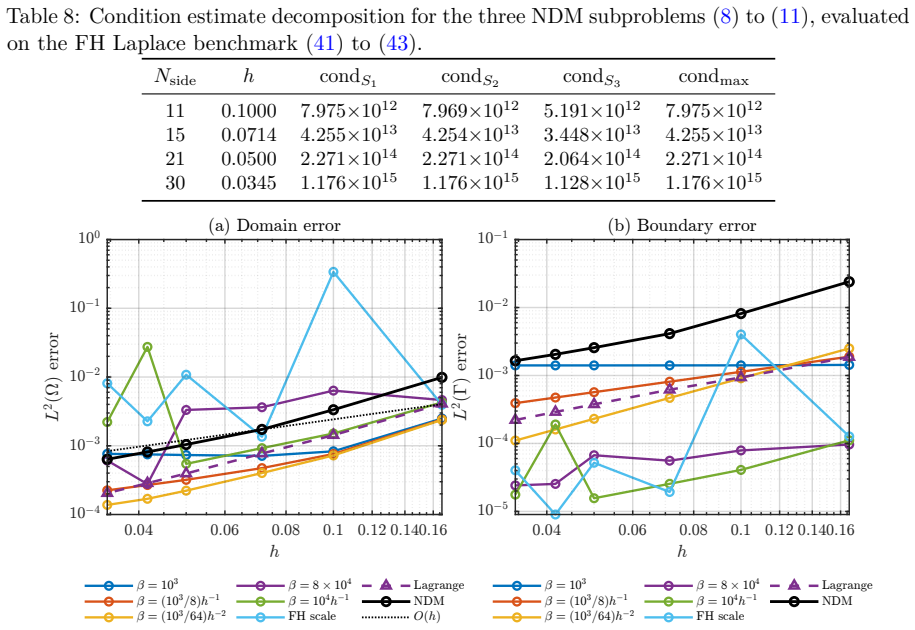
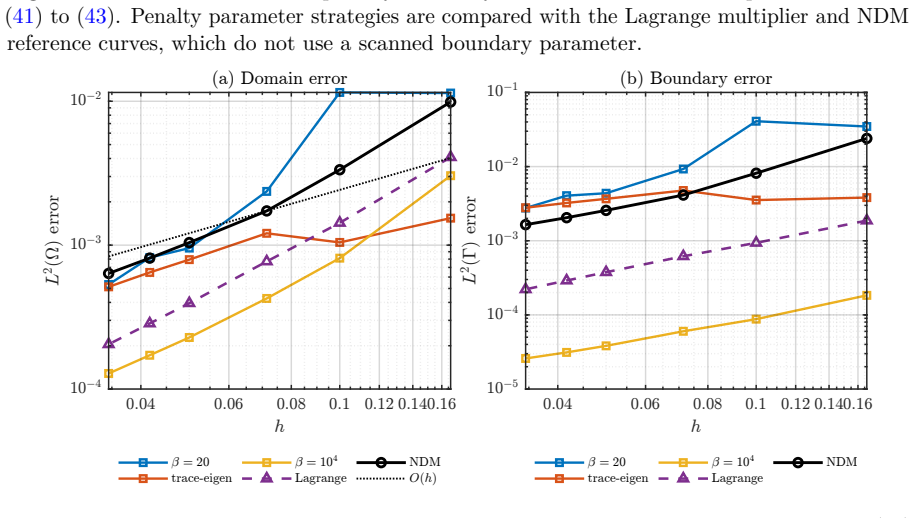
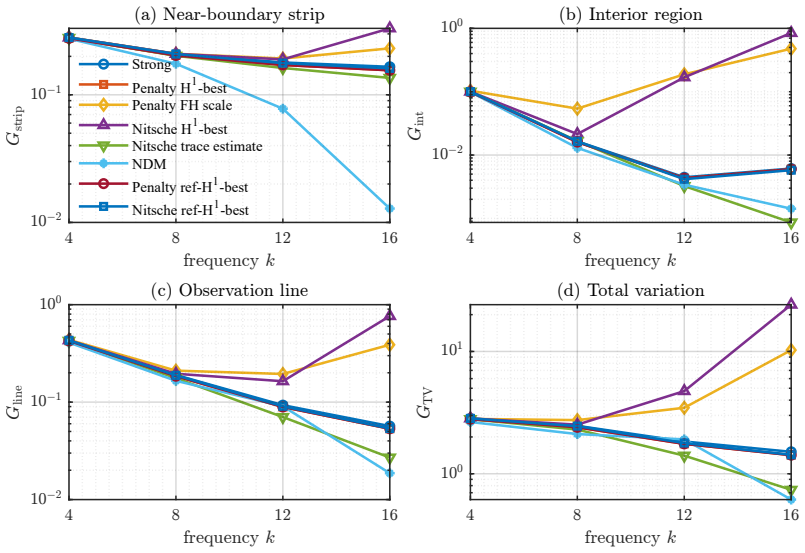
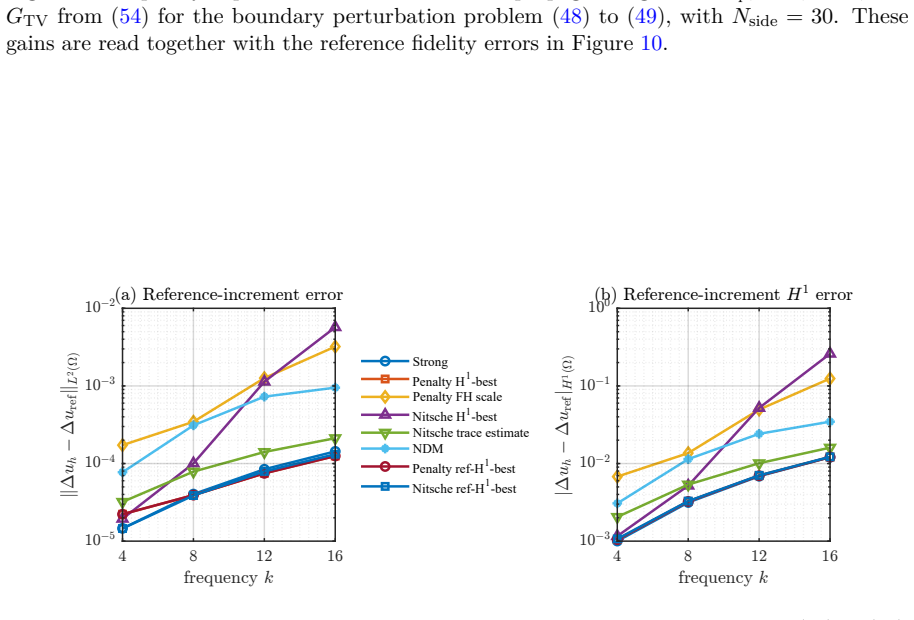
- Benchmark experiments quantify conditioning, computational cost, and boundary perturbation of the transfer step.
Where Pith is reading between the lines
- The separation of transfer error from recovery-space error may simplify a priori estimates in other meshfree or non-interpolatory discretizations.
- The pre-discretization transfer could be combined with existing meshfree basis functions without altering their support or reproduction properties.
- Extension to time-dependent or nonlinear problems would require checking whether the curl-correction step remains well-defined after each time step or iteration.
Load-bearing premise
The continuous-level equivalence between the reconstructed solution and the solution satisfying the prescribed boundary data holds only for topologically trivial single domains with connected boundary.
What would settle it
A mismatch between the reconstructed solution and the exact boundary data on a domain containing holes or a disconnected boundary component would falsify the claimed equivalence.
Figures


read the original abstract
This paper develops a natural decomposition method (NDM)for imposing essential boundary conditions in noninterpolatory meshfree Galerkin spaces without boundary parameter tuning or auxiliary constraint construction. In such spaces, algebraic coefficients generally do not coincide with boundary values; hence coefficient assignment or nodal boundary prescription is not equivalent to imposing the continuous trace required by the variational problem. NDM introduces boundary data before discretization through a natural transfer mechanism: a source subproblem accounts for the forcing term, a weighted curl correction transfers the remaining trace mismatch, and a scalar recovery step reconstructs the solution from the corrected weighted gradient. For topologically trivial single domains with connected boundary, the reconstructed solution is equivalent, at the continuous level, to the solution satisfying the prescribed essential boundary data. The discrete analysis separates the approximation defect of the recovery space from the upstream transfer error visible to that space. Numerical experiments on benchmark problems evaluate the proposed transfer mechanism and report the associated conditioning, computational cost, and boundary perturbation behavior.
Editorial analysis
A structured set of objections, weighed in public.
Referee Report
Summary. The paper introduces the Natural Decomposition Method (NDM) for enforcing essential boundary conditions in noninterpolatory meshfree Galerkin spaces. It decomposes the problem into a source subproblem accounting for the forcing term, a weighted curl correction to transfer the remaining trace mismatch, and a scalar recovery step to reconstruct the solution from the corrected weighted gradient. The central claim is that, for topologically trivial single domains with connected boundary, the reconstructed solution is equivalent at the continuous level to the solution satisfying the prescribed essential boundary data. The discrete analysis separates the approximation defect of the recovery space from the upstream transfer error, and numerical experiments on benchmark problems assess the transfer mechanism, conditioning, computational cost, and boundary perturbation behavior.
Significance. If the continuous-level equivalence and error separation hold, the NDM supplies a parameter-free mechanism for essential boundary conditions that avoids both coefficient tuning and auxiliary constraint constructions, addressing a persistent difficulty in meshfree Galerkin methods. The explicit separation of transfer error from approximation defect and the topology-restricted equivalence statement constitute clear theoretical contributions that could be directly tested in applications.
minor comments (2)
- The abstract states that numerical experiments evaluate conditioning, cost, and boundary perturbation but provides no indication of the specific benchmark problems, observed convergence orders, or comparison baselines; adding one sentence on these points would improve the summary.
- The limitation to 'topologically trivial single domains with connected boundary' is stated clearly for the continuous equivalence, yet the manuscript should indicate whether the discrete analysis or numerical tests explore any relaxation of this restriction or quantify the effect of topology on the transfer error.
Simulated Author's Rebuttal
We thank the referee for their accurate summary of the Natural Decomposition Method and for recognizing its potential significance in addressing essential boundary conditions in meshfree methods. The report does not contain any enumerated major comments, so we have no specific points to rebut or revise at this stage. We remain available to provide additional clarification or address any questions that may arise.
Circularity Check
No significant circularity; derivation is self-contained
full rationale
The paper derives the NDM from variational principles by constructing a source subproblem, weighted curl correction, and scalar recovery to transfer boundary trace mismatch. The central equivalence claim is explicitly restricted to topologically trivial single domains with connected boundary and is presented as a continuous-level property of this construction, not as a prediction fitted to data or reduced by self-citation. No load-bearing step reduces to its own inputs by definition, and the discrete analysis separates approximation defect from transfer error without circular renaming or imported uniqueness theorems. The method stands independently against external benchmarks.
Axiom & Free-Parameter Ledger
axioms (1)
- domain assumption The domain is topologically trivial with a connected boundary
Reference graph
Works this paper leans on
-
[1]
Ivo Babuška, Uday Banerjee, and John E. Osborn. Survey of meshless and generalized finite element methods: A unified approach.Acta Numerica, 12:1–125, 2003. doi: 10.1017/ S0962492902000090
2003
-
[2]
T. Belytschko, Y. Krongauz, D. Organ, M. Fleming, and P. Krysl. Meshless methods: An overview and recent developments.Computer Methods in Applied Mechanics and Engineering, 139(1–4):3–47, 1996. doi: 10.1016/S0045-7825(96)01078-X
-
[3]
Jiun-Shyan Chen, Dongdong Wang, and Stanley B. Dong. An extended meshfree method for boundary value problems.Computer Methods in Applied Mechanics and Engineering, 193(12–14):1085–1103, 2004. doi: 10.1016/j.cma.2003.12.007
-
[4]
Shaofan Li, Hongsheng Lu, Weimin Han, Wing Kam Liu, and Daniel C. Simkins. Re- producing kernel element method. part II: Globally conformingIm/Cn hierarchies.Com- puter Methods in Applied Mechanics and Engineering, 193(12–14):953–987, 2004. doi: 10.1016/j.cma.2003.12.002
-
[5]
Reproducing kernel element method
Wing Kam Liu, Weimin Han, Hongsheng Lu, Shaofan Li, and Jun Cao. Reproducing kernel element method. part I: Theoretical formulation.Computer Methods in Applied Mechanics and Engineering, 193(12–14):933–951, 2004. doi: 10.1016/j.cma.2003.12.001
-
[6]
V. P. Nguyen, T. Rabczuk, S. Bordas, and M. Duflot. Meshless methods: A review and computer implementation aspects.Mathematics and Computers in Simulation, 79(3): 763–813, 2008. doi: 10.1016/j.matcom.2008.01.003
-
[7]
Jiun-Shyan Chen and Hui-Ping Wang. New boundary condition treatments in meshfree computation of contact problems.Computer Methods in Applied Mechanics and Engineering, 187(3–4):441–468, 2000. doi: 10.1016/S0045-7825(99)00335-7
-
[8]
Sonia Fernández-Méndez and Antonio Huerta. Imposing essential boundary conditions in mesh-free methods.Computer Methods in Applied Mechanics and Engineering, 193(12–14): 1257–1275, 2004. doi: 10.1016/j.cma.2003.12.019
-
[9]
Günther and Wing Kam Liu
Frank C. Günther and Wing Kam Liu. Implementation of boundary conditions for meshless methods.Computer Methods in Applied Mechanics and Engineering, 163(1–4):205–230,
-
[10]
doi: 10.1016/S0045-7825(98)00014-0. 32
-
[11]
Michael Hillman and Kuan-Chung Lin. Consistent weak forms for meshfree methods: Full realization ofh-refinement,p-refinement, anda-refinement in strong-type essential boundary condition enforcement.Computer Methods in Applied Mechanics and Engineering, 373: 113448, 2021. doi: 10.1016/j.cma.2020.113448
-
[12]
Antonio Huerta, Sonia Fernández-Méndez, and Wing Kam Liu. A comparison of two formulations to blend finite elements and mesh-free methods.Computer Methods in Applied Mechanics and Engineering, 193(12–14):1105–1117, 2004. doi: 10.1016/j.cma.2003.12.009
-
[13]
Y. Krongauz and T. Belytschko. Enforcement of essential boundary conditions in mesh- less approximations using finite elements.Computer Methods in Applied Mechanics and Engineering, 131(1–2):133–145, 1996. doi: 10.1016/0045-7825(95)00954-X
-
[14]
Jiun-Shyan Chen, Weimin Han, Yang You, and Xueping Meng. A reproducing kernel method with nodal interpolation property.International Journal for Numerical Methods in Engineering, 56(7):935–960, 2003. doi: 10.1002/nme.592
-
[15]
J. Gosz and W. K. Liu. Admissible approximations for essential boundary conditions in the reproducing kernel particle method.Computational Mechanics, 19(2):120–135, 1996. doi: 10.1007/BF02824850
-
[16]
Koester and Jiun-Shyan Chen
Jacob J. Koester and Jiun-Shyan Chen. Conforming window functions for meshfree methods. Computer Methods in Applied Mechanics and Engineering, 347:588–621, 2019. doi: 10.1016/ j.cma.2018.12.042
2019
-
[17]
Hae-Soo Oh and Jae Woo Jeong. Almost everywhere partition of unity to deal with essential boundary conditions in meshless methods.Computer Methods in Applied Mechanics and Engineering, 198:3299–3312, 2009. doi: 10.1016/j.cma.2009.06.013
-
[18]
T. Belytschko, Y. Y. Lu, and L. Gu. Element-free Galerkin methods.International Journal for Numerical Methods in Engineering, 37(2):229–256, 1994. doi: 10.1002/nme.1620370205
-
[19]
Joachim Nitsche. Über ein variationsprinzip zur lösung von dirichlet-problemen bei ver- wendung von teilräumen, die keinen randbedingungen unterworfen sind.Abhandlun- gen aus dem Mathematischen Seminar der Universität Hamburg, 36(1):9–15, 1971. doi: 10.1007/BF02995904
-
[20]
T. Zhu and S. N. Atluri. A modified collocation method and a penalty formulation for enforcing the essential boundary conditions in the element free Galerkin method. Computational Mechanics, 21(3):211–222, 1998. doi: 10.1007/s004660050296
-
[21]
The finite element method with lagrangian multipliers.Numerische Mathe- matik, 20(3):179–192, 1973
Ivo Babuška. The finite element method with lagrangian multipliers.Numerische Mathe- matik, 20(3):179–192, 1973. doi: 10.1007/BF01436561
-
[22]
Existence et approximation de points selles pour certains probl `emes non lin´eaires
Franco Brezzi. On the existence, uniqueness and approximation of saddle-point problems arising from lagrangian multipliers.Revue Française d’Automatique, Informatique et Recherche Opérationnelle. Analyse Numérique, 8(R2):129–151, 1974. doi: 10.1051/M2AN/ 197408R201291
-
[23]
Antonio Huerta and Sonia Fernández-Méndez. Enrichment and coupling of the finite element and meshless methods.International Journal for Numerical Methods in Engineering, 48(11): 1615–1636, 2000. doi: 10.1002/1097-0207(20000820)48:11<1615::AID-NME883>3.0.CO;2-S
-
[24]
J. Y. Cho, Y. M. Song, and Y. H. Choi. Boundary locking induced by penalty enforcement of essential boundary conditions in mesh-free methods.Computer Methods in Applied Mechanics and Engineering, 197(13–16):1167–1183, 2008. doi: 10.1016/j.cma.2007.09.020. 33
-
[25]
JorgeC.Costa, PauloM.Pimenta, andPeterWriggers. Meshlessanalysisofsheardeformable shells: Boundary and interface constraints.Computational Mechanics, 57(4):679–700, 2016. doi: 10.1007/s00466-015-1253-z
-
[26]
A particle-partition of unity method part V: Boundary conditions
Michael Griebel and Marc Alexander Schweitzer. A particle-partition of unity method part V: Boundary conditions. In Stefan Hildebrandt and Hermann Karcher, editors,Geometric Analysis and Nonlinear Partial Differential Equations, pages 519–542. Springer, Berlin, Heidelberg, 2003. doi: 10.1007/978-3-642-55627-2_27
-
[27]
Andrew B. Groeneveld and Michael C. Hillman. A new meshfree variational multiscale (VMS) method for essential boundary conditions.Computer Methods in Applied Mechanics and Engineering, 427:117081, 2024. doi: 10.1016/j.cma.2024.117081
-
[28]
Thomas J. R. Hughes. Multiscale phenomena: Green’s functions, the dirichlet-to-neumann formulation, subgrid scale models, bubbles and the origins of stabilized methods.Computer Methods in Applied Mechanics and Engineering, 127(1–4):387–401, 1995. doi: 10.1016/ 0045-7825(95)00844-9
1995
-
[29]
Pablo Jiménez Recio and Marc Alexander Schweitzer. A partition of unity construction of the stabilization function in Nitsche’s method for variational problems.Computer Methods in Applied Mechanics and Engineering, 426:117002, 2024. doi: 10.1016/j.cma.2024.117002
-
[30]
Solving PDEs with radial basis functions.Acta Numerica, 24:215–258, 2015
Bengt Fornberg and Natasha Flyer. Solving PDEs with radial basis functions.Acta Numerica, 24:215–258, 2015. doi: 10.1017/S0962492914000130
-
[31]
S. Le Borne and W. Leinen. Guidelines for RBF-FD discretization: Numerical experiments on the interplay of a multitude of parameter choices.Journal of Scientific Computing, 95 (1):8, 2023. doi: 10.1007/s10915-023-02123-7
-
[32]
H. Netuzhylov, T. Sonar, and W. Yomsatieankul. Finite difference operators from moving least squares interpolation.ESAIM: Mathematical Modelling and Numerical Analysis, 41 (5):959–974, 2007. doi: 10.1051/m2an:2007042
-
[33]
Haijun Yu and Shuo Zhang. A natural deep Ritz method for essential boundary value problems.Journal of Computational Physics, 537:114133, 2025. doi: 10.1016/j.jcp.2025. 114133
-
[34]
Vivette Girault and Pierre-Arnaud Raviart.Finite Element Methods for Navier–Stokes Equa- tions: Theory and Algorithms, volume 5 ofSpringer Series in Computational Mathematics. Springer, Berlin, 1986. doi: 10.1007/978-3-642-61623-5
-
[35]
Douglas N. Arnold, Richard S. Falk, and Ragnar Winther. Finite element exterior calculus: From Hodge theory to numerical stability.Bulletin of the American Mathematical Society, 47(2):281–354, 2010. doi: 10.1090/S0273-0979-10-01278-4
-
[36]
Cambridge University Press, Cambridge, 2004
Holger Wendland.Scattered Data Approximation, volume 17 ofCambridge Monographs on Applied and Computational Mathematics. Cambridge University Press, Cambridge, 2004. doi: 10.1017/CBO9780511617539
-
[37]
Sou-Cheng T. Choi, Christopher C. Paige, and Michael A. Saunders. MINRES-QLP: A Krylov subspace method for indefinite or singular symmetric systems.SIAM Journal on Scientific Computing, 33(4):1810–1836, 2011. doi: 10.1137/100787921
-
[38]
Marc Alexander Schweitzer. An algebraic treatment of essential boundary conditions in the particle–partition of unity method.SIAM Journal on Scientific Computing, 31(2): 1581–1602, 2009. doi: 10.1137/080716499. 34
discussion (0)
Sign in with ORCID, Apple, or X to comment. Anyone can read and Pith papers without signing in.