Is US Defense Acquisition Ready to Acquire AI-Enabled Capabilities? Assessing the DoD Software Acquisition Pathway Through a Scenario-Based Policy Analysis
Pith reviewed 2026-06-27 21:16 UTC · model grok-4.3
The pith
The DoD Software Acquisition Pathway supports iterative AI delivery but leaves data provenance, lifecycle, and oversight controls scattered in supplemental documents.
A machine-rendered reading of the paper's core claim, the machinery that carries it, and where it could break.
Core claim
The SWP-centered governance stack provides a viable foundation for iterative delivery and AI testing. However, AI-specific controls for data provenance, lifecycle management, and human oversight remain distributed across supplemental documents rather than embedded in the program-facing mechanisms through which SWP is executed. This disconnect leaves program offices reliant on inconsistent local interpretation.
What carries the argument
Policy Scenario Analysis, which traces a notional AI-enabled program through SWP planning activities to check how policy becomes program artifacts and decisions.
If this is right
- Program offices must rely on inconsistent local interpretation of AI controls.
- An AI-supporting sub-path would better address the unique demands of AI acquisition.
- Targeted refinements to program artifacts can bridge the policy-to-artifact gap.
- The current stack already enables iterative delivery and AI testing in principle.
Where Pith is reading between the lines
- Similar acquisition frameworks in other agencies may encounter the same distribution of controls.
- Integrating AI rules into core documents could reduce variation across programs.
- Testing the scenario findings against completed AI acquisitions would show whether the gap affects outcomes.
- Future pathway updates could embed the missing controls without creating new sub-paths.
Load-bearing premise
The notional AI-enabled program scenario accurately surfaces the recurring actionability problems that would appear in real DoD AI acquisition programs.
What would settle it
Examination of actual DoD AI program artifacts to determine whether requirements for data provenance, lifecycle management, and human oversight appear directly in SWP documents or only in separate guidance.
Figures

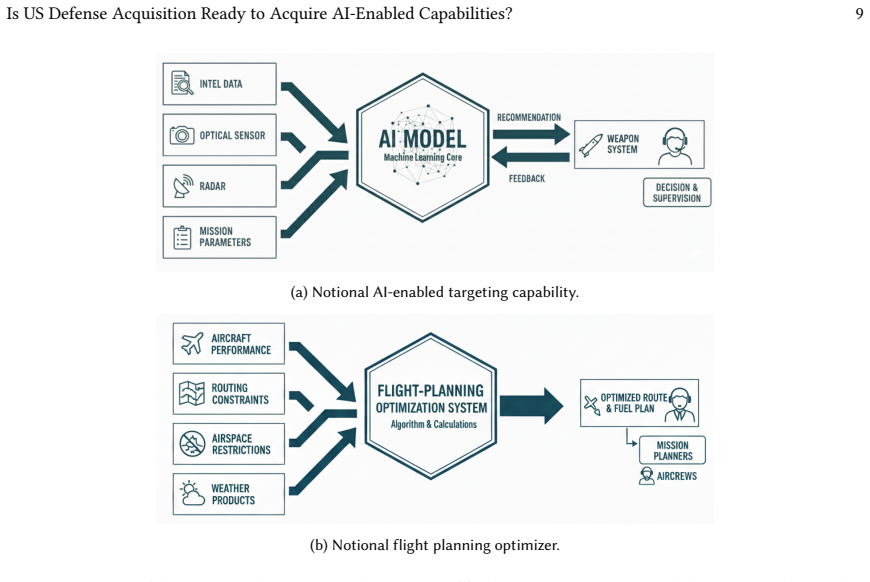

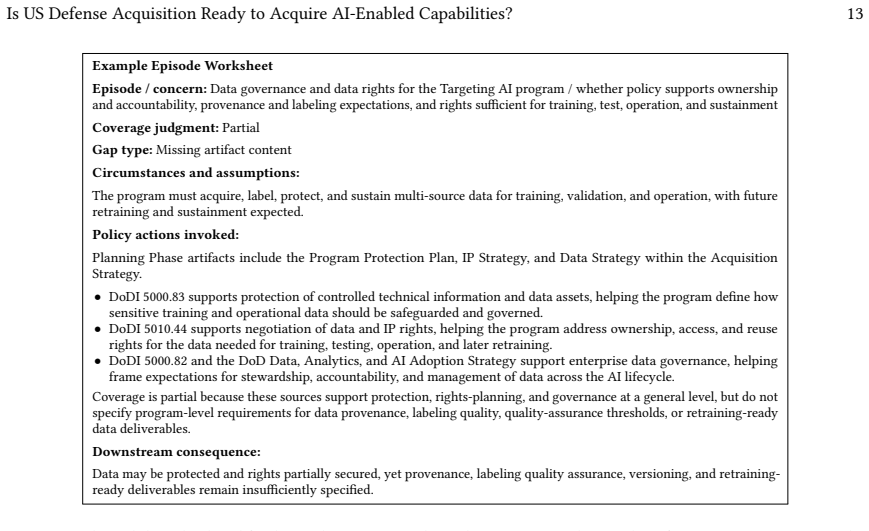
read the original abstract
As AI systems transition from experimental prototypes to mission-critical tools, their dependence on dynamic data, evolving models, and governance raises questions about whether existing acquisition pathways can keep pace. The U.S. Department of Defense has modernized its acquisition processes through the Adaptive Acquisition Framework, with the Software Acquisition Pathway (SWP) serving as the primary mechanism for acquiring software-intensive capabilities. This paper evaluates whether SWP is sufficient to address the unique demands of AI acquisition. In this work, we perform a scenario-based evaluation that traces a notional AI-enabled program through key SWP planning activities to assess how policy translates into program artifacts and decisions. We use Policy Scenario Analysis to examine whether the SWP-centered governance stack provides sufficient actionable support for AI acquisition. The governance stack provides a viable foundation for iterative delivery and AI testing. However, we identify a recurring actionability problem in the core guidance. AI-specific controls for data provenance, lifecycle management, and human oversight remain distributed across supplemental documents rather than embedded in the program-facing mechanisms through which SWP is executed. This disconnect leaves program offices reliant on inconsistent local interpretation. We conclude by recommending an AI-supporting sub-path and targeted artifact refinements to better bridge this policy-to-artifact gap.
Editorial analysis
A structured set of objections, weighed in public.
Referee Report
Summary. The paper evaluates whether the DoD Software Acquisition Pathway (SWP) within the Adaptive Acquisition Framework is sufficient for AI-enabled capabilities. It performs a Policy Scenario Analysis by tracing one notional AI-enabled program through key SWP planning activities, concluding that the governance stack provides a viable foundation for iterative delivery and AI testing but exhibits a recurring actionability problem: AI-specific controls for data provenance, lifecycle management, and human oversight are distributed across supplemental documents rather than embedded in core, program-facing SWP mechanisms. This leads to inconsistent local interpretation, and the authors recommend an AI-supporting sub-path plus targeted artifact refinements.
Significance. If the actionability gaps identified are general rather than scenario-specific, the analysis could inform targeted policy refinements to better support AI acquisition. The scenario-tracing method provides a concrete way to assess how policy documents translate into program decisions, which is a strength for a qualitative policy study in this domain.
major comments (1)
- [Policy Scenario Analysis] Policy Scenario Analysis: The central claim of a recurring actionability problem (AI-specific controls distributed across supplemental documents) rests entirely on tracing a single notional AI-enabled program through SWP activities. The manuscript provides no cross-validation against additional scenarios, actual program artifacts, or DoD case data to establish that the chosen scenario surfaces representative gaps rather than artifacts of its construction. This directly affects the defensibility of the recommendation for an AI-supporting sub-path.
Simulated Author's Rebuttal
We thank the referee for their constructive feedback, which raises a valid methodological point about our Policy Scenario Analysis. We respond to the major comment below.
read point-by-point responses
-
Referee: Policy Scenario Analysis: The central claim of a recurring actionability problem (AI-specific controls distributed across supplemental documents) rests entirely on tracing a single notional AI-enabled program through SWP activities. The manuscript provides no cross-validation against additional scenarios, actual program artifacts, or DoD case data to establish that the chosen scenario surfaces representative gaps rather than artifacts of its construction. This directly affects the defensibility of the recommendation for an AI-supporting sub-path.
Authors: The Policy Scenario Analysis method is designed to examine how the SWP governance stack translates into program decisions by tracing a representative notional AI-enabled program through core planning activities. The recurring actionability problem identified—that AI-specific controls for data provenance, lifecycle management, and human oversight are distributed across supplemental documents rather than embedded in core SWP mechanisms—is a structural feature of the policy documents themselves, not an artifact of the scenario's construction. The scenario functions as an analytical lens to surface this distribution and its implications for local interpretation. While we acknowledge that cross-validation with additional scenarios or actual program artifacts would strengthen claims of generalizability, the manuscript's scope is a qualitative policy analysis of the existing governance stack; publicly available DoD case data at the required level of detail is limited. The recommendation for an AI-supporting sub-path follows from the observed policy structure and remains defensible on that basis. revision: no
Circularity Check
No circularity in external policy evaluation
full rationale
The paper conducts a qualitative scenario-based evaluation of published DoD policy documents (SWP and related guidance) by tracing a notional AI-enabled program through planning activities. No equations, fitted parameters, or self-referential derivations appear. The central claim rests on direct comparison of external policy text to the constructed scenario rather than any reduction of outputs to inputs by construction, self-citation chains, or ansatz smuggling. This is an independent assessment of policy actionability and meets the criteria for a self-contained, non-circular analysis.
Axiom & Free-Parameter Ledger
axioms (1)
- domain assumption The notional AI-enabled program scenario is representative of the challenges faced by actual DoD AI acquisition programs.
Reference graph
Works this paper leans on
-
[1]
Dharun Anandayuvaraj, Tanmay Singla, Zain A. H. Hammadeh, Andreas Lund, Alexandra Holloway, and James C. Davis. 2026. Learning From Software Failures: A Case Study at a National Space Research Center. InProceedings of the 2026 IEEE/ACM 48th International Conference on Software Engineering (ICSE ’26). ACM, Rio de Janeiro, Brazil. doi:10.1145/3744916.3773149
-
[2]
Denis Baylor, Eric Breck, Heng-Tze Cheng, Noah Fiedel, Chuan Yu Foo, Zakaria Haque, Salem Haykal, Mustafa Ispir, Vihan Jain, Levent Koc, Chiu Yuen Koo, Lukasz Lew, Clemens Mewald, Akshay Naresh Modi, Neoklis Polyzotis, Sukriti Ramesh, Sudip Roy, Steven Euijong Whang, Martin Wicke, Jarek Wilkiewicz, Xin Zhang, and Martin Zinkevich. 2017. TFX: A TensorFlow-...
-
[3]
2019.Software Is Never Done: Refactoring the Acquisition Code for Competitive Advantage
Defense Innovation Board. 2019.Software Is Never Done: Refactoring the Acquisition Code for Competitive Advantage. Tech- nical Report. U.S. Department of Defense. https://media.defense.gov/2019/Apr/30/2002124828/-1/-1/0/SOFTWAREISNEVERDONE_ REFACTORINGTHEACQUISITIONCODEFORCOMPETITIVEADVANTAGE_FINAL.SWAP.REPORT.PDF
2019
-
[4]
Eric Breck, Shanqing Cai, Eric Nielsen, Michael Salib, and D. Sculley. 2017. The ML Test Score: A Rubric for ML Production Readiness and Technical Debt Reduction. In2017 IEEE International Conference on Big Data (Big Data). 1123–1132. doi:10.1109/BigData.2017.8258038
-
[5]
2000.A World of Standards
Nils Brunsson and Bengt Jacobsson. 2000.A World of Standards. Oxford University Press
2000
-
[6]
Chief Digital and Artificial Intelligence Office. 2023. 2023 Data, Analytics, and Artificial Intelligence Adoption Strategy. https://media.defense.gov/ 2023/Nov/02/2003333300/-1/-1/1/dod_data_analytics_ai_adoption_strategy.pdf
2023
-
[7]
2024.Systems Integration Test and Evaluation of Artificial Intelligence-Enabled Capabilities: What to Consider in a Test & Evaluation Strategy
Chief Digital and Artificial Intelligence Office (CDAO). 2024.Systems Integration Test and Evaluation of Artificial Intelligence-Enabled Capabilities: What to Consider in a Test & Evaluation Strategy. CDAO Test and Evaluation Strategy Framework (Guidance and Best Practices). U.S. Department of Defense. https://www.ai.mil/Portals/137/Documents/Resources%20...
2024
-
[8]
2016.Policy Scenario Analysis: A Methodological Overview
Stephen Cunningham. 2016.Policy Scenario Analysis: A Methodological Overview. Technical Report BOBP/WB/OPP/REP 20. Bay of Bengal Programme Inter-Governmental Organisation, Chennai, Tamil Nadu, India
2016
-
[9]
Defense Acquisition University. [n. d.]. Software Acquisition. https://aaf.dau.edu/aaf/software/
-
[10]
2025.Acquisition Policies | Adaptive Acquisition Framework
Defense Acquisition University. 2025.Acquisition Policies | Adaptive Acquisition Framework. https://aaf.dau.edu/policy/
2025
-
[11]
Defense Acquisition University. 2026. Adaptive Acquisition Framework (AAF) Overview. https://aaf.dau.edu/
2026
-
[12]
Defense Acquisition University. n.d.. Develop Strategies (Software Acquisition Pathway). https://aaf.dau.edu/aaf/software/develop-strategies/
-
[13]
Defense Acquisition University (DAU). 2022. Software Acquisition Strategy: Agile Guidance. https://aaf.dau.edu/storage/2022/06/Acquisition- Strategy-Guidance.pdf
2022
-
[14]
Department of the Air Force. 2024. Department of the Air Force Instruction 63-101/20-101,Integrated Life Cycle Management. https://static.e- publishing.af.mil/production/1/saf_aq/publication/dafi63-101_20-101/dafi63-101_20-101.pdf
2024
-
[15]
Deputy Secretary of Defense. 2021. Implementing Responsible Artificial Intelligence in the Department of Defense. Memoran- dum. https://media.defense.gov/2021/May/27/2002730593/-1/-1/0/IMPLEMENTING-RESPONSIBLE-ARTIFICIAL-INTELLIGENCE-IN-THE- DEPARTMENT-OF-DEFENSE.PDF
2021
-
[16]
Digital Agency of Japan. 2025. Guidelines for Japanese Government’s Procurement and Utilization of Generative AI (Provisional Transla- tion). https://www.digital.go.jp/assets/contents/node/basic_page/field_ref_resources/e2a06143-ed29-4f1d-9c31-0f06fca67afc/6e45a64f/20250527_ resources_standard_guidelines_guideline_04.pdf
arXiv 2025
-
[17]
Jeffrey Dunlap. 2024. Innovation in Software Acquisition: The Good, Bad, and Ugly. InProceedings of the Twenty-First Annual Acquisition Research Symposium. Monterey, CA. https://dair.nps.edu/bitstream/123456789/5136/1/SYM-AM-24-073.pdf
arXiv 2024
-
[18]
European Parliament and Council of the European Union. 2024. Regulation (EU) 2024/1689 of the European Parliament and of the Council of 13 June 2024 laying down harmonised rules on artificial intelligence (Artificial Intelligence Act).Official Journal of the European Union(July 2024). https://eur-lex.europa.eu/eli/reg/2024/1689/oj/eng
2024
-
[19]
Timnit Gebru, Jamie Morgenstern, Briana Vecchione, Jennifer Wortman Vaughan, Hanna Wallach, Hal Daumé III, and Kate Crawford. 2021. Datasheets for Datasets.Commun. ACM64, 12 (2021), 86–92. doi:10.1145/3458723
-
[20]
Google Cloud. 2025. Chief Digital and Artificial Intelligence Office Selects Google Cloud’s AI to Power GenAI.mil. https://www. googlecloudpresscorner.com/2025-12-09-Chief-Digital-and-Artificial-Intelligence-Office-Selects-Google-Clouds-AI-to-Power-GenAI-mil
2025
-
[21]
Google Cloud Architecture Center. 2024. MLOps: Continuous Delivery and Automation Pipelines in Machine Learning. https://cloud.google.com/ architecture/mlops-continuous-delivery-and-automation-pipelines-in-machine-learning
2024
-
[22]
ISACA. 2024. CMMI Levels of Capability and Performance. https://cmmiinstitute.com/learning/appraisals/levels
2024
-
[23]
Thiruvathukal, and James C
Purvish Jajal, Wenxin Jiang, Arav Tewari, Erik Kocinare, Joseph Woo, Anusha Sarraf, Yung-Hsiang Lu, George K. Thiruvathukal, and James C. Davis
-
[24]
Interoperability in Deep Learning: A User Survey and Failure Analysis of ONNX Model Converters. InProceedings of the 33rd ACM SIGSOFT International Symposium on Software Testing and Analysis(Vienna, Austria)(ISSTA 2024). Association for Computing Machinery, New York, NY, USA, 1466–1478. doi:10.1145/3650212.3680374
-
[25]
2024.Closing the Gap: Modernizing South Korea’s Defense Acquisition Framework
Won-Joon Jang and Hea Ji Park. 2024.Closing the Gap: Modernizing South Korea’s Defense Acquisition Framework. Research Papers 24/6. Korea Institute for Industrial Economics and Trade. https://EconPapers.repec.org/RePEc:ris:kietrp:2024_006
2024
-
[26]
Schorlemmer, Rohan Sethi, Yung-Hsiang Lu, George K
Wenxin Jiang, Nicholas Synovic, Matt Hyatt, Taylor R. Schorlemmer, Rohan Sethi, Yung-Hsiang Lu, George K. Thiruvathukal, and James C. Davis
-
[27]
An Empirical Study of Pre-Trained Model Reuse in the Hugging Face Deep Learning Model Registry. InProceedings of the 45th International Manuscript submitted to ACM 28 Lugo & Davis Conference on Software Engineering(Melbourne, Victoria, Australia)(ICSE ’23). IEEE Press, 2463–2475. doi:10.1109/ICSE48619.2023.00206
-
[28]
Norman P. Jouppi, Cliff Young, Nishant Patil, David Patterson, Gaurav Agrawal, Raminder Bajwa, Sarah Bates, Suresh Bhatia, Nan Boden, Al Borchers, and Rick et al. Boyle. 2017. In-Datacenter Performance Analysis of a Tensor Processing Unit. InProceedings of the 44th Annual International Symposium on Computer Architecture (ISCA ’17). ACM/IEEE, 1–12. doi:10....
-
[29]
Andrej Karpathy. 2017. Software 2.0. https://karpathy.medium.com/software-2-0-a64152b37c35
2017
-
[30]
Rainer Kattel and Wolfgang Drechsler. 2022. Public Procurement and Innovation: Theory and Practice.Standardization and Public Policy Review14, 2 (2022), 125–143. doi:10.1007/978-3-642-40258-6
-
[31]
LaPlante
William A. LaPlante. 2022.Use of the Software Acquisition Pathway for Defense Business Systems. Memorandum USA000671-22. Office of the Under Secretary of Defense for Acquisition and Sustainment, 3010 Defense Pentagon, Washington, DC 20301-3010. https://aaf.dau.edu/storage/2022/09/ USDA-S-signed-Memo-Use-of-the-SWP-for-DBS_20220824.pdf
2022
-
[32]
Nik Looker, David Webster, Duncan Russell, and Jie Xu. 2008. Scenario Based Evaluation. In2008 11th IEEE International Symposium on Object and Component-Oriented Real-Time Distributed Computing (ISORC). IEEE, 148–154. doi:10.1109/ISORC.2008.56
-
[33]
Neal Maslej et al. 2025. Artificial Intelligence Index Report 2025. https://hai.stanford.edu/assets/files/hai_ai_index_report_2025.pdf
2025
-
[34]
Sehl Mellouli, Marijn Janssen, and Adegboyega Ojo. 2024. Introduction to the Issue on Artificial Intelligence in the Public Sector: Risks and Benefits of AI for Governments.Digit. Gov.: Res. Pract.5, 1, Article 1 (March 2024), 6 pages. doi:10.1145/3636550
-
[35]
2023.Advancing AI Procurement and Adoption in the Public Sector: Considerations, Use Cases and Practical Approaches
Microsoft Worldwide Public Sector. 2023.Advancing AI Procurement and Adoption in the Public Sector: Considerations, Use Cases and Practical Approaches. Technical Report. Microsoft Worldwide Public Sector, Redmond, WA. https://wwps.microsoft.com/wp-content/uploads/2023/12/ Microsoft-AI-Procurement-Paper_Final.pdf
2023
-
[36]
Miles, A
Matthew B. Miles, A. Michael Huberman, and Johnny Saldaña. 2014.Qualitative Data Analysis: A Methods Sourcebook(3rd ed.). SAGE Publications, Thousand Oaks, CA
2014
-
[37]
2025.Framework Act on the Development of Artificial Intelligence
Ministry of Government Legislation, Republic of Korea. 2025.Framework Act on the Development of Artificial Intelligence. Technical Report. Ministry of Government Legislation, Republic of Korea. https://cset.georgetown.edu/publication/south-korea-ai-law-2025/
2025
-
[38]
Margaret Mitchell, Simone Wu, Andrew Zaldivar, Parker Barnes, Lucy Vasserman, Ben Hutchinson, Elena Spitzer, Inioluwa Deborah Raji, and Timnit Gebru. 2019. Model Cards for Model Reporting. InFAT* ’19: Conference on Fairness, Accountability, and Transparency. 220–229. doi:10.1145/ 3287560.3287596
arXiv 2019
-
[39]
2023.AI Risk Management Framework (AI RMF 1.0)
National Institute of Standards and Technology. 2023.AI Risk Management Framework (AI RMF 1.0). Technical Report NIST AI 100-1. National Institute of Standards and Technology. https://nvlpubs.nist.gov/nistpubs/ai/NIST.AI.100-1.pdf
2023
-
[40]
2025.Directing Modern Software Acquisition to Maximize Lethality
Secretary of Defense. 2025.Directing Modern Software Acquisition to Maximize Lethality. Memorandum. U.S. Department of Defense, Washington, DC. https://media.defense.gov/2025/Mar/07/2003662943/-1/-1/1/DIRECTING-MODERN-SOFTWARE-ACQUISITION-TO-MAXIMIZE-LETHALITY. PDF
2025
-
[41]
Department of Defense
U.S. Department of Defense. 2020.DoD Instruction 5000.89: Test and Evaluation. Technical Report. Office of the Under Secretary of Defense for Research and Engineering and Office of the Director, Operational Test and Evaluation. https://www.esd.whs.mil/Portals/54/Documents/DD/ issuances/dodi/500089p.PDF
2020
-
[42]
Department of Defense
U.S. Department of Defense. 2023. DoD Instruction 5000.82: Requirements for the Acquisition of Digital Capabilities. https://www.esd.whs.mil/ Portals/54/Documents/DD/issuances/dodi/500082p.pdf
2023
-
[43]
2020.Cybersecurity for Acquisition Decision Authorities and Program Managers
Office of the Under Secretary of Defense for Acquisition and Sustainment. 2020.Cybersecurity for Acquisition Decision Authorities and Program Managers. DoD Instruction 5000.90. U.S. Department of Defense. https://www.esd.whs.mil/Portals/54/Documents/DD/issuances/dodi/500090p.PDF
2020
-
[44]
2020.Operation of the Adaptive Acquisition Framework
Office of the Under Secretary of Defense for Acquisition and Sustainment. 2020.Operation of the Adaptive Acquisition Framework. DoD Instruction 5000.02. U.S. Department of Defense. https://www.esd.whs.mil/Portals/54/Documents/DD/issuances/dodi/500002p.pdf?ver=2020-01-23-144114-093
2020
-
[45]
2020.Operation of the Software Acquisition Pathway
Office of the Under Secretary of Defense for Acquisition and Sustainment. 2020.Operation of the Software Acquisition Pathway. DoD Instruction 5000.87. U.S. Department of Defense. https://www.esd.whs.mil/Portals/54/Documents/DD/issuances/dodi/500087p.pdf
2020
-
[46]
2020.Engineering of Defense Systems
Office of the Under Secretary of Defense for Research and Engineering. 2020.Engineering of Defense Systems. DoD Instruction 5000.88. U.S. Department of Defense. https://www.esd.whs.mil/Portals/54/Documents/DD/issuances/dodi/500088p.PDF
2020
-
[47]
Office of the Director, Operational Test and Evaluation. 2018. Mission Planning System (MPS) / Joint Mission Planning System–Air Force (JMPS-AF). InDOT&E FY 2018 Annual Report. U.S. Department of Defense, 197–198. https://www.dote.osd.mil/Portals/97/pub/reports/FY2018/af/2018afmps. pdf?ver=2019-08-21-155843-447
2018
-
[48]
2024.Defense Budget Overview, Fiscal Year 2025
Office of the Under Secretary of Defense (Comptroller). 2024.Defense Budget Overview, Fiscal Year 2025. Technical Report. Office of the Under Secretary of Defense (Comptroller), Washington, DC. https://comptroller.defense.gov/Budget-Materials/
2024
-
[49]
2025.Defense Budget Overview, Fiscal Year 2026
Office of the Under Secretary of Defense (Comptroller). 2025.Defense Budget Overview, Fiscal Year 2026. Technical Report. Office of the Under Secretary of Defense (Comptroller), Washington, DC. https://comptroller.defense.gov/Budget-Materials/
2025
-
[50]
2025.FY 2026 Program Acquisition Costs by Weapon System
Office of the Under Secretary of Defense (Comptroller). 2025.FY 2026 Program Acquisition Costs by Weapon System. Technical Report. U.S. Department of Defense. https://comptroller.war.gov/Portals/45/Documents/defbudget/FY2026/FY2026_Weapons.pdf
2025
-
[51]
2022.Artificial Intelligence (AI) and Machine Learning (ML) Acquisition and Policy Implications
Cheryl Pellerin, Stephen Wood, and Mark Allen. 2022.Artificial Intelligence (AI) and Machine Learning (ML) Acquisition and Policy Implications. Technical Report. Defense Acquisition University (DAU), Fort Belvoir, VA. https://www.dau.edu/library/arj/p/AI-ML-Acquisition-Implications
2022
-
[52]
Program Executive Office Intelligence, Electronic Warfare & Sensors. 2026. Project Manager Intelligence Systems & Analytics. https://cpeisw.army. mil/pm-isa/. Manuscript submitted to ACM Is US Defense Acquisition Ready to Acquire AI-Enabled Capabilities? 29
2026
-
[53]
Charles C. Ragin. 2008.Redesigning Social Inquiry: Fuzzy Sets and Beyond. University of Chicago Press, Chicago. doi:10.7208/chicago/9780226702797. 001.0001
-
[54]
Sundaram, Dominik Wolff, and Niloy Ganguly
Soumyadeep Roy, Sowmya S. Sundaram, Dominik Wolff, and Niloy Ganguly. 2025. Building Trustworthy AI Models for Medicine: From Theory to Applications. InProceedings of the Eighteenth ACM International Conference on Web Search and Data Mining (WSDM ’25). Association for Computing Machinery, Hannover, Germany, 1012–1015. doi:10.1145/3701551.3703477
-
[55]
2023.A New Path Forward: An Analysis of Current AI Software Acquisition Procedures
Kelley Sayler, Andrew Hunter, and Paul Scharre. 2023.A New Path Forward: An Analysis of Current AI Software Acquisition Procedures. Technical Report. Center for Strategic and International Studies (CSIS), Washington, D.C. https://www.csis.org/analysis/new-path-forward-ai-software-acquisition
2023
-
[56]
Sculley, G
D. Sculley, G. Holt, D. Golovin, E. Davydov, T. Phillips, D. Ebner, V. Chaudhary, M. Young, J.-F. Crespo, and D. Dennison. 2015. Hidden Technical Debt in Machine Learning Systems.Advances in Neural Information Processing Systems28 (2015)
2015
-
[57]
Sigstore. 2021. sigstore: Software Signing for Everyone. https://www.sigstore.dev
2021
-
[58]
Cristina Silvano, Daniele Ielmini, Fabrizio Ferrandi, Leandro Fiorin, Serena Curzel, Luca Benini, Francesco Conti, Angelo Garofalo, Cristian Zambelli, Enrico Calore, Sebastiano Schifano, Maurizio Palesi, Giuseppe Ascia, Davide Patti, Nicola Petra, Davide De Caro, Luciano Lavagno, Teodoro Urso, Valeria Cardellini, Gian Carlo Cardarilli, Robert Birke, and S...
-
[59]
SLSA Community. 2023. Supply-chain Levels for Software Artifacts (SLSA) v1.0. https://slsa.dev/spec/v1.0
2023
-
[60]
Monika Steidl, Michael Felderer, and Rudolf Ramler. 2023. The Pipeline for the Continuous Development of Artificial Intelligence Models: Current State of Research and Practice.Journal of Systems and Software199 (2023), 111615. doi:10.1016/j.jss.2023.111615
-
[61]
David M. Tate and John Bailey. 2022.When is it Feasible (or Desirable) to Use the Software Acquisition Pathway?Technical Report. Acquisition Research Program, Naval Postgraduate School, Monterey, CA. https://www.dair.nps.edu/handle/123456789/4569
arXiv 2022
-
[62]
Santiago Torres-Arias, Hammad Afzali, Trishank Karthik Kuppusamy, Reza Curtmola, and Justin Cappos. 2019. in-toto: Providing farm-to- table guarantees for bits and bytes. In28th USENIX Security Symposium (USENIX Security 19). USENIX Association, Santa Clara, CA, 1393–1410. https://www.usenix.org/system/files/sec19-torres-arias.pdf
2019
-
[63]
Army Public Affairs
U.S. Army Public Affairs. 2025. U.S. Army Awards Enterprise Service Agreement to Enhance Military Readiness and Drive Operational Ef- ficiency. https://www.army.mil/article/287506/u_s_army_awards_enterprise_service_agreement_to_enhance_military_readiness_and_drive_ operational_efficiency
2025
-
[64]
Army xTech Program
U.S. Army xTech Program. 2025. PEO Demand Signal Slides – Master Deck. https://xtech.army.mil/wp-content/uploads/2025/03/PEO-Demand- Signal-Slides-Master-Deck.pdf
2025
-
[65]
Army xTech Program
U.S. Army xTech Program. 2025. xTechOverwatch Informational Session Presentation Deck. https://xtech.army.mil/wp-content/uploads/2025/04/ xTechOverwatch-Informational-Session-Presentation-Deck.pdf
2025
-
[66]
Department of Defense
U.S. Department of Defense. 2008.DoD Instruction 5000.02: Operation of the Defense Acquisition System. Department of Defense Instruction 5000.02. U.S. Department of Defense. https://www.dami.army.pentagon.mil/site/artpc/docs/DoDI%205000_02p.pdf
2008
-
[67]
Department of Defense
U.S. Department of Defense. 2015.DoD Instruction 5000.02: Operation of the Defense Acquisition System. Department of Defense Instruction 5000.02. U.S. Department of Defense
2015
-
[68]
Department of Defense
U.S. Department of Defense. 2017. Establishment of an Algorithmic Warfare Cross-Functional Team (Project Maven). https://dodcio.defense.gov/ Portals/0/Documents/Project%20Maven%20DSD%20Memo%2020170425.pdf
2017
-
[69]
Department of Defense
U.S. Department of Defense. 2019.DoD Instruction 5010.44: Intellectual Property (IP) Acquisition and Licensing. Technical Report. Office of the Under Secretary of Defense for Acquisition and Sustainment. https://www.esd.whs.mil/Portals/54/Documents/DD/issuances/dodi/501044p.pdf
2019
-
[70]
U.S. Department of Defense. 2020. DoD Adopts Ethical Principles for Artificial Intelligence. Defense.gov Release. https://www.defense.gov/ Newsroom/Releases/Release/Article/2091996/dod-adopts-ethical-principles-for-artificial-intelligence/
arXiv 2020
-
[71]
Department of Defense
U.S. Department of Defense. 2020. DoD C3 Modernization Strategy. https://dodcio.defense.gov/Portals/0/Documents/DoD-C3-Strategy.pdf
2020
-
[72]
Department of Defense
U.S. Department of Defense. 2020. DoD Instruction 5000.83: Technology and Program Protection to Maintain Technological Advantage. https: //www.esd.whs.mil/Portals/54/Documents/DD/issuances/dodi/500083p.pdf
2020
-
[73]
Department of Defense
U.S. Department of Defense. 2022.Responsible Artificial Intelligence Strategy and Implementation Pathway. Strategy and Implementation Pathway AD1215042. Chief Digital and Artificial Intelligence Office (CDAO), Washington, DC. https://media.defense.gov/2022/Jun/22/2003022604/-1/- 1/0/Department-of-Defense-Responsible-Artificial-Intelligence-Strategy-and-Im...
2022
-
[74]
Software Pathway
U.S. Department of Defense. 2025.Department of Defense — Publications (Search: “Software Pathway”, since Jan 2021). https://www.war.gov/News/ Publications/StartDate/2020-01-01/?Search=software+pathway
2025
-
[75]
Department of Defense, United States Special Operations Command
U.S. Department of Defense, United States Special Operations Command. 2025. Fiscal Year 2026 Budget Estimates: Research, Development, Test & Evaluation, Defense-Wide, United States Special Operations Command. https://comptroller.defense.gov/Portals/45/Documents/defbudget/FY2026/ budget_justification/pdfs/03_RDT_and_E/RDTE_SOCOM_PB_2026.pdf
2025
-
[76]
Federal Chief Information Officers Council
U.S. Federal Chief Information Officers Council. 2025.Resources. https://www.councils.gov/resources/
2025
-
[77]
Government Accountability Office
U.S. Government Accountability Office. 2021.DOD Software Acquisition: Status of and Challenges Related to Reform Efforts. Technical Report GAO-21-105298. U.S. Government Accountability Office, Washington, DC. https://www.gao.gov/products/gao-21-105298
2021
-
[78]
Government Accountability Office
U.S. Government Accountability Office. 2023.Artificial Intelligence: DoD Needs Department-Wide Guidance to Inform Acquisitions. https://www.gao. gov/products/gao-23-105850 Manuscript submitted to ACM 30 Lugo & Davis
2023
-
[79]
Lydia Velazquez-Garcia, Antonio Cedillo-Hernandez, Maria Del Pilar Longar-Blanco, and Eduardo Bustos-Farias. 2025. Enhancing Educational Gamification through AI in Higher Education. InProceedings of the 2024 16th International Conference on Education Technology and Computers (ICETC ’24). Association for Computing Machinery, New York, NY, USA, 213–218. doi...
-
[80]
Russell T. Vought. 2025.Driving Efficient Acquisition of Artificial Intelligence in Government. Memorandum M-25-22. Office of Management and Budget, Executive Office of the President. https://www.whitehouse.gov/wp-content/uploads/2025/02/M-25-22-Driving-Efficient-Acquisition-of- Artificial-Intelligence-in-Government.pdf
2025
discussion (0)
Sign in with ORCID, Apple, or X to comment. Anyone can read and Pith papers without signing in.