A 65 nm Multi-Modal Bayesian Inference Engine with 16.3 fJ/Sample Calibration-Free GRNG for Risk-Aware At-Home Skin Lesion Screening
Pith reviewed 2026-06-27 20:16 UTC · model grok-4.3
The pith
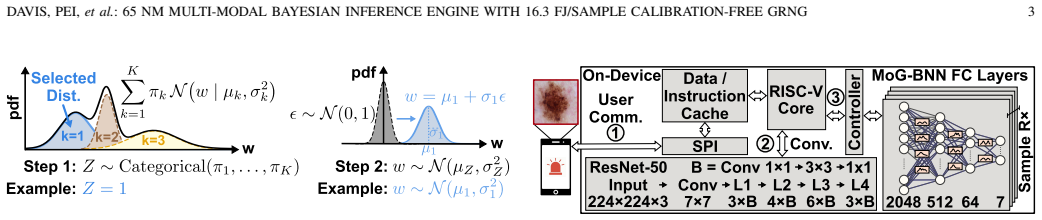
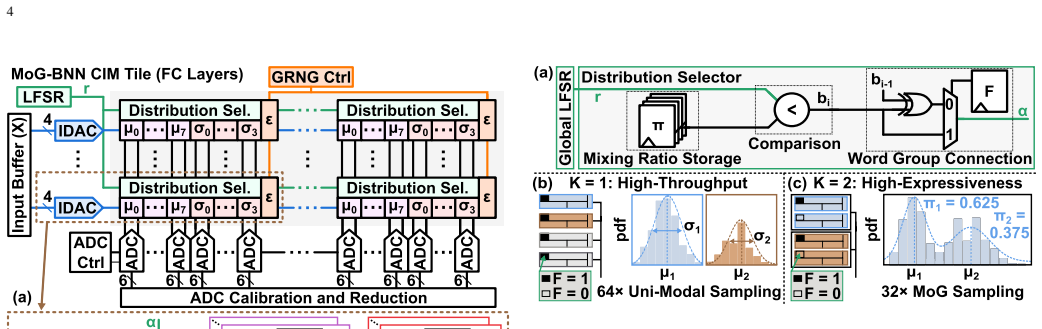
A 65 nm compute-in-memory chip performs in-word Mixture-of-Gaussian sampling to model uncertainty more expressively than unimodal Bayesian neural networks for at-home skin lesion screening.
A machine-rendered reading of the paper's core claim, the machinery that carries it, and where it could break.
Core claim
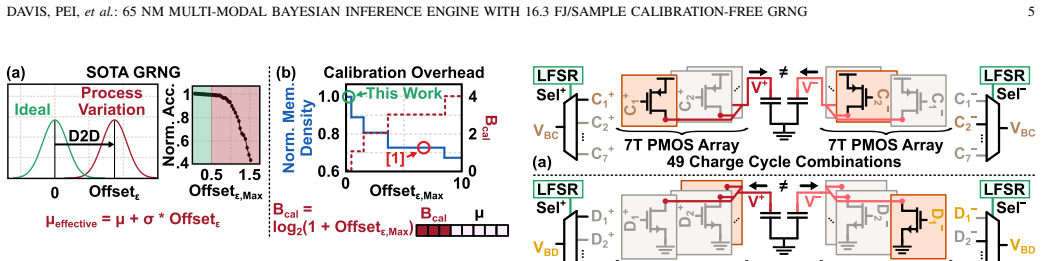
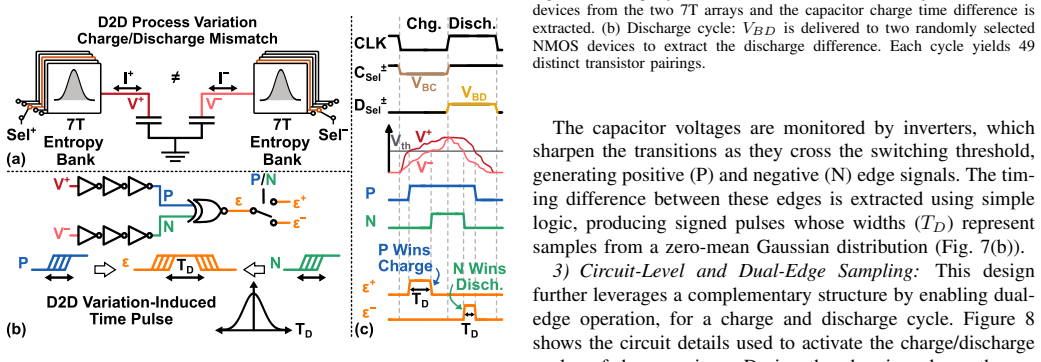
The 65-nm multimodal Bayesian inference engine uses in-word Mixture-of-Gaussian sampling inside its compute-in-memory architecture. This improves uncertainty modeling beyond conventional unimodal Bayesian neural networks, increasing equal-risk operating coverage by 1.4x, improving robustness to user-data perturbations by >1.5x, enhancing process-variation resilience by 5.5x, and improving balanced accuracy by 1.8%. Hardware support comes from a calibration-free Gaussian random-number generator using complementary process variation at 16.3 fJ/sample and 168.6 GSa/s/mm² efficiency.
What carries the argument
in-word Mixture-of-Gaussian sampling performed by the compute-in-memory architecture, which enables multi-modal uncertainty modeling and is supported by a calibration-free process-variation Gaussian random-number generator.
If this is right
- Equal-risk operating coverage increases by 1.4x over unimodal Bayesian neural networks.
- Robustness to user-data perturbations improves by more than 1.5x.
- Process-variation resilience is enhanced by 5.5x.
- Balanced accuracy improves by 1.8%.
- The architecture supplies an energy-efficient, privacy-preserving edge-AI solution for medical screening.
Where Pith is reading between the lines
- The multi-modal sampling technique could extend to other on-device medical imaging tasks where better uncertainty handling reduces over- or under-diagnosis in variable environments.
- Using process variation directly for random numbers may enable similar low-energy stochastic hardware in additional sensor-based AI applications.
- Wider adoption of such risk-aware engines might lower unnecessary clinical referrals by flagging only high-uncertainty cases for further review.
Load-bearing premise
The reported performance gains assume that the in-word Mixture-of-Gaussian sampling and complementary process-variation GRNG are correctly realized in silicon and that the measured improvements reflect actual hardware behavior under at-home conditions rather than simulation or post-selection.
What would settle it
Fabricate the 65 nm chip, run it on real skin lesion images captured in uncontrolled home lighting and user conditions, and directly compare its equal-risk coverage and accuracy against a unimodal Bayesian network implemented on the same silicon.
Figures



read the original abstract
We present a 65-nm risk-aware multimodal Bayesian inference engine for privacy-preserving, fully on-device skin lesion screening under uncontrolled at-home conditions. The proposed compute-in-memory architecture performs in-word Mixture-of-Gaussian sampling, improving uncertainty modeling beyond conventional unimodal Bayesian neural networks. This added probabilistic expressiveness increases equal-risk operating coverage by 1.4x, improves robustness to user-data perturbations by >1.5x, enhances process-variation resilience by 5.5x, and improves balanced accuracy by 1.8% over state-of-the-art unimodal Bayesian neural networks. Hardware robustness is further supported by calibration-free Gaussian random-number generation using complementary process variation, achieving 16.3 fJ/sample and 168.6 GSa/s/mm^2 efficiency. These results demonstrate a practical, energy-efficient, and risk-aware edge-AI solution for privacy-conscious medical screening.
Editorial analysis
A structured set of objections, weighed in public.
Referee Report
Summary. The manuscript describes a 65 nm compute-in-memory architecture implementing a multi-modal Bayesian inference engine for on-device skin lesion screening. It performs in-word Mixture-of-Gaussian sampling to improve uncertainty modeling over conventional unimodal Bayesian neural networks and incorporates a calibration-free GRNG based on complementary process variation. The work claims measured improvements of 1.4x in equal-risk operating coverage, >1.5x in robustness to user-data perturbations, 5.5x in process-variation resilience, and 1.8% in balanced accuracy, with the GRNG achieving 16.3 fJ/sample and 168.6 GSa/s/mm².
Significance. If the silicon measurements hold, the result would demonstrate a practical hardware path to more expressive probabilistic models at the edge, with direct relevance to privacy-preserving medical screening under uncontrolled conditions. The combination of in-word MoG sampling and process-variation GRNG is a concrete engineering contribution that could influence future risk-aware CIM designs.
major comments (1)
- [Abstract] The central claims rest on measured hardware results from the 65 nm implementation (abstract). Without the methods and results sections detailing the test setup, number of dies measured, statistical analysis, and direct silicon-vs-simulation comparison for the reported 1.4x, 5.5x, and 1.8% gains, it is not possible to confirm that the improvements reflect actual fabricated behavior rather than simulation or post-selection effects.
minor comments (1)
- [Abstract] The abstract states performance numbers without naming the exact unimodal BNN baselines or datasets used for the comparisons; adding these references would improve traceability.
Simulated Author's Rebuttal
We thank the referee for their review and for emphasizing the need for transparent hardware validation details. We address the single major comment below.
read point-by-point responses
-
Referee: [Abstract] The central claims rest on measured hardware results from the 65 nm implementation (abstract). Without the methods and results sections detailing the test setup, number of dies measured, statistical analysis, and direct silicon-vs-simulation comparison for the reported 1.4x, 5.5x, and 1.8% gains, it is not possible to confirm that the improvements reflect actual fabricated behavior rather than simulation or post-selection effects.
Authors: The referee correctly notes that the abstract's performance claims require explicit supporting evidence from the hardware characterization. While the manuscript body contains a results section describing the 65 nm test chip, probe-station setup, and measured GRNG and inference metrics, it does not currently provide the requested specifics (exact die count, statistical tests, or side-by-side silicon-simulation tables for the 1.4x/5.5x/1.8% figures). We therefore agree that additional detail is needed to allow independent verification and will expand the results section and add a summary table in the revised manuscript. revision: yes
Circularity Check
No significant circularity
full rationale
The paper is a hardware implementation report presenting measured silicon results from a 65 nm CIM chip. The abstract and available text contain no equations, derivations, fitted parameters, or self-citations that reduce any performance claim to an input by construction. All reported gains (1.4x coverage, >1.5x robustness, 5.5x resilience, 1.8% accuracy, 16.3 fJ/sample) are framed as empirical outcomes of the fabricated design rather than analytic predictions. No load-bearing step matches any of the enumerated circularity patterns.
discussion (0)
Sign in with ORCID, Apple, or X to comment. Anyone can read and Pith papers without signing in.