Time series Foundation Models based on Physics-Informed Synthetic Histories for Cold-Start Photovoltaic Forecasting
Pith reviewed 2026-06-27 22:36 UTC · model grok-4.3
The pith
Synthetic histories let foundation models forecast new PV plants
A machine-rendered reading of the paper's core claim, the machinery that carries it, and where it could break.
Core claim
A zero-shot pipeline generates synthetic production histories from plant metadata and meteorological covariates to condition time-series foundation models for inference, enabling cold-start photovoltaic forecasting that outperforms baselines under real and self-forecast feedback strategies across 440 sites.
What carries the argument
The synthetic production history that supplies plausible temporal context for conditioning the time-series foundation models during inference.
Load-bearing premise
Synthetic production histories generated from metadata and meteorological covariates provide enough plausible temporal context for the foundation models to condition on effectively.
What would settle it
Compare the forecasting error of a TSFM conditioned only on synthetic history against a baseline model on a new site with held-out real observations; if the TSFM error is not lower, the claim fails.
Figures

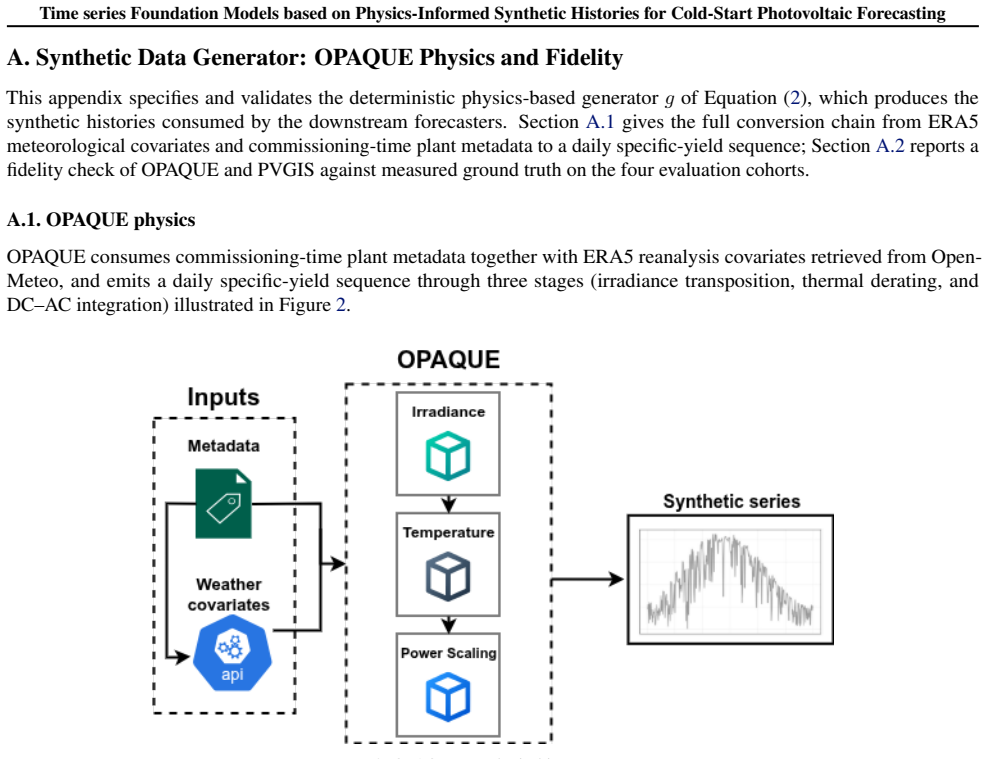
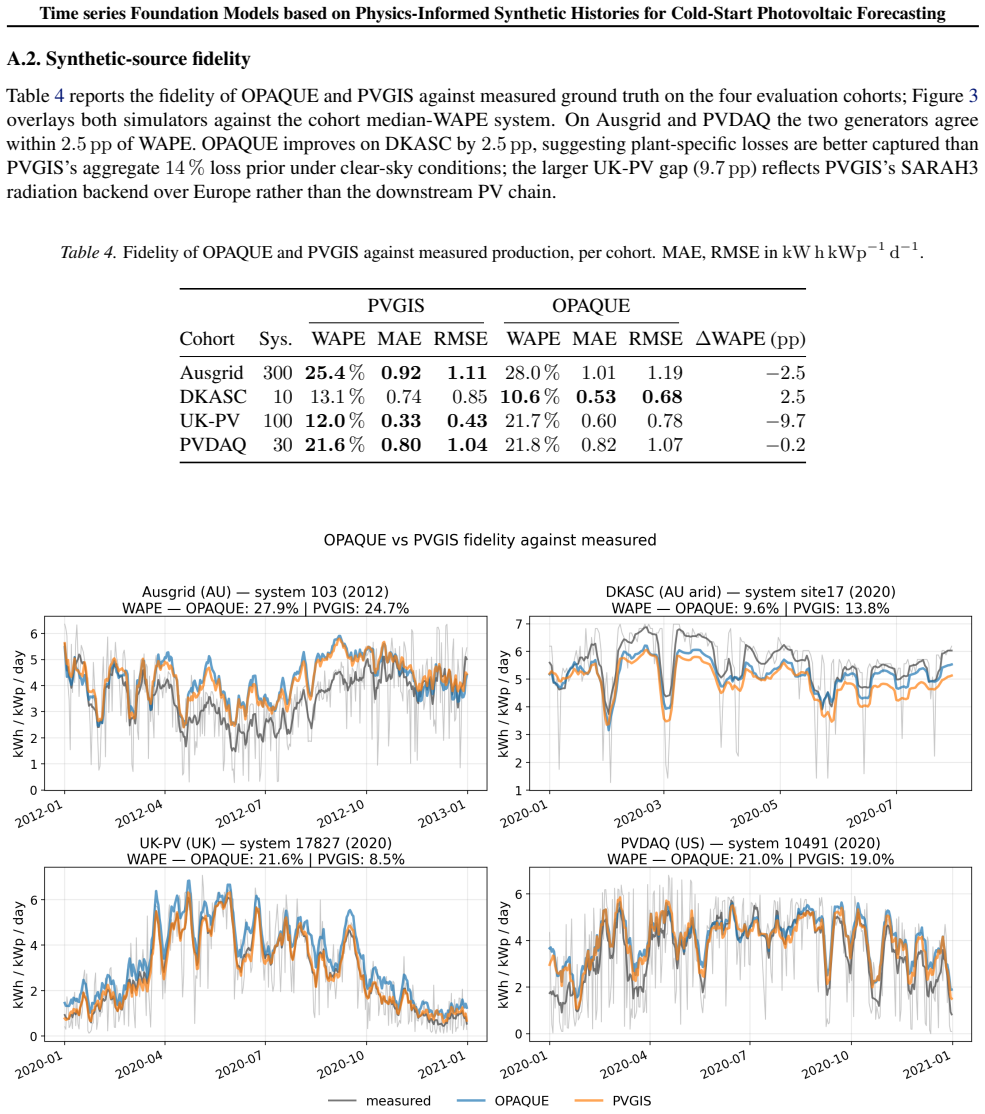
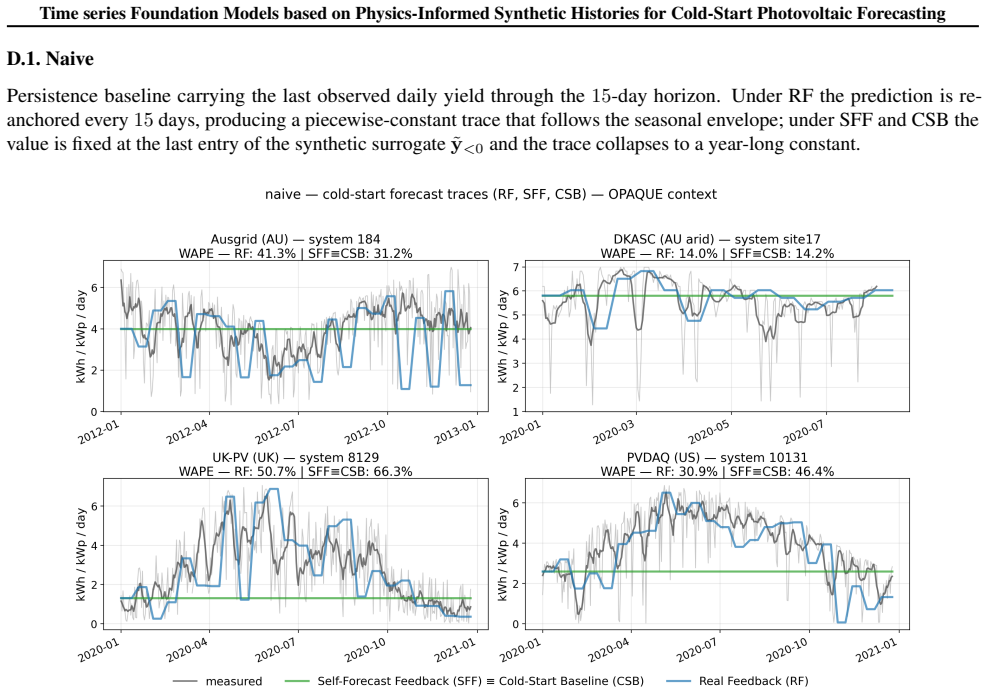


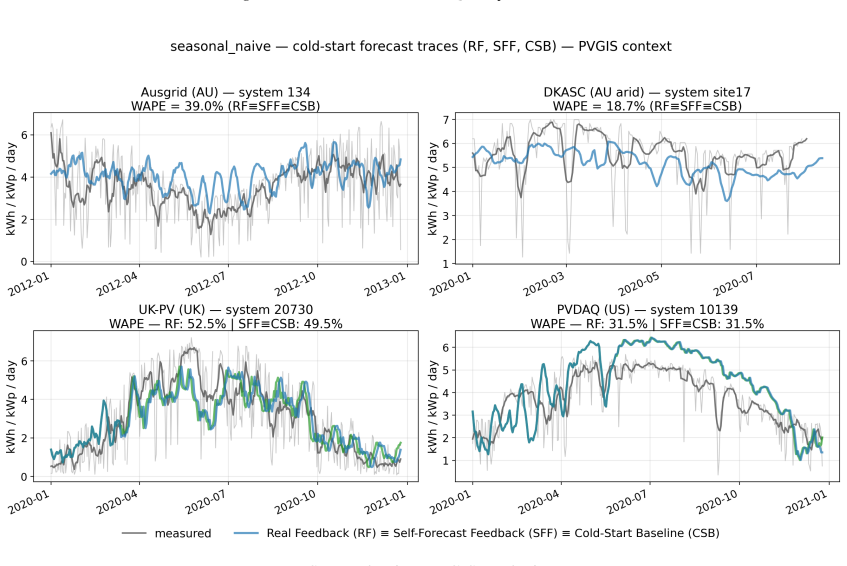


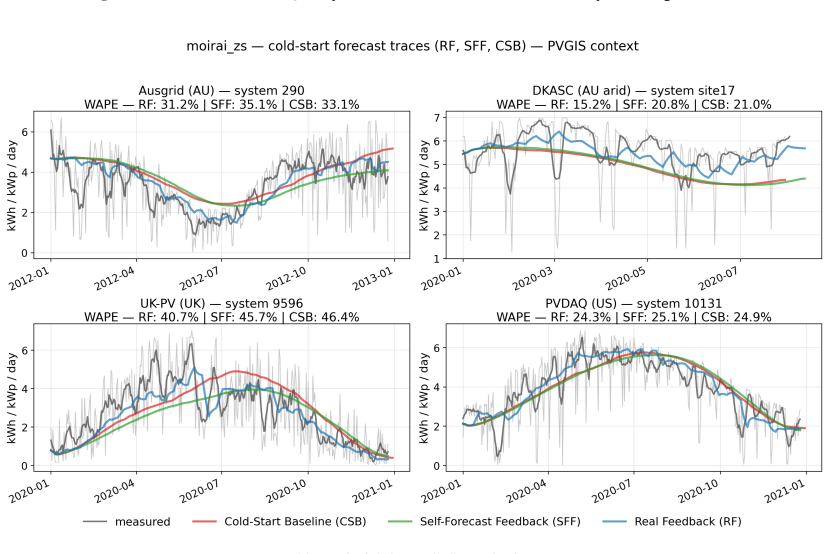


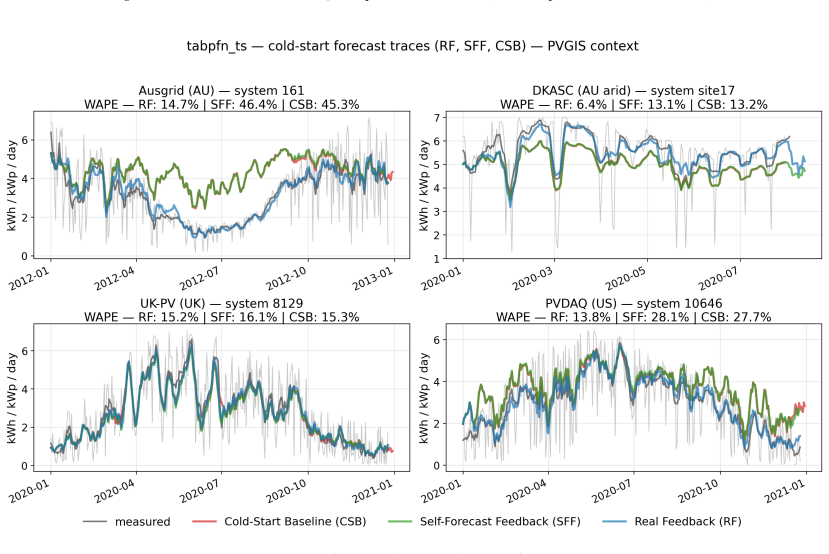
read the original abstract
At commissioning time, Photovoltaic (PV) operators must forecast production before target-site observations are available, limiting the direct use of standard supervised forecasters. This cold-start setting is addressed with a zero-shot pipeline that generates a synthetic production history from plant metadata and meteorological covariates, enabling time-series foundation models (TSFMs) to forecast through inference-time conditioning. Five TSFMs are benchmarked against classical baselines under strict Cold-Start Baseline, Real Feedback, and Self-Forecast Feedback strategies. The evaluation spans $440$ PV sites across four datasets and diverse climate regimes. Covariate-aware foundation models outperform baselines by approximately $1.7-2\times$: TabPFN-TS achieves the lowest error under Real Feedback (MAE $0.514$, RMSE $0.721$ $kWh$ ${kWp}^{-1}$ ${d}^{-1}$), while Chronos-2 is most robust under Self-Forecast Feedback. Performance is largely insensitive to the synthetic-history source, indicating that accuracy is driven more by the availability of plausible temporal context than by the specific generator.
Editorial analysis
A structured set of objections, weighed in public.
Referee Report
Summary. The manuscript presents a zero-shot pipeline for cold-start PV forecasting that generates synthetic production histories from plant metadata and meteorological covariates to condition time-series foundation models (TSFMs) at inference time. It benchmarks five TSFMs against classical baselines across 440 sites from four datasets under Cold-Start Baseline, Real Feedback, and Self-Forecast Feedback protocols, claiming covariate-aware TSFMs outperform baselines by 1.7–2× (e.g., TabPFN-TS MAE 0.514 / RMSE 0.721 kWh kWp^{-1} d^{-1} under Real Feedback) with performance largely insensitive to the synthetic-history generator.
Significance. If the empirical results hold after addressing the gaps below, the work has clear practical value for newly commissioned PV plants lacking target-site observations. The scale of the evaluation (440 sites, multiple climates) and the explicit finding that gains are insensitive to generator choice provide positive evidence that plausible temporal context, rather than generator-specific properties, drives the zero-shot performance. This is a strength of the empirical design.
major comments (3)
- [Abstract] Abstract: the central performance claims (1.7–2× outperformance, specific MAE/RMSE values for TabPFN-TS and Chronos-2) are stated without error bars, standard deviations across sites or folds, or any statistical significance tests. This is load-bearing for the empirical benchmark claim.
- [Methods] Methods / pipeline description: no details are supplied on how the synthetic production histories are generated from metadata and covariates (e.g., the physics-informed model, tunable parameters, or validation of plausibility). This directly affects the weakest assumption that such histories supply sufficient context for TSFM conditioning in the complete absence of real observations.
- [Experiments] Experiments / evaluation section: no description is given of baseline implementations, hyper-parameter choices, or training procedures. Without this, the reported superiority of the TSFM pipeline cannot be reproduced or fairly assessed.
Simulated Author's Rebuttal
We thank the referee for the constructive and detailed feedback on our manuscript. We address each major comment below and will revise the manuscript to improve reproducibility and clarity of the empirical claims.
read point-by-point responses
-
Referee: [Abstract] Abstract: the central performance claims (1.7–2× outperformance, specific MAE/RMSE values for TabPFN-TS and Chronos-2) are stated without error bars, standard deviations across sites or folds, or any statistical significance tests. This is load-bearing for the empirical benchmark claim.
Authors: We agree that the abstract and results would be strengthened by including error bars, standard deviations across sites, and statistical significance tests. In the revised manuscript we will report standard deviations across the 440 sites (and across folds where applicable) together with appropriate significance tests for the reported performance differences. revision: yes
-
Referee: [Methods] Methods / pipeline description: no details are supplied on how the synthetic production histories are generated from metadata and covariates (e.g., the physics-informed model, tunable parameters, or validation of plausibility). This directly affects the weakest assumption that such histories supply sufficient context for TSFM conditioning in the complete absence of real observations.
Authors: The referee is correct that the current manuscript supplies insufficient detail on the synthetic-history generator. We will expand the Methods section with a complete description of the physics-informed model, all tunable parameters, and the validation steps used to assess plausibility of the generated histories. revision: yes
-
Referee: [Experiments] Experiments / evaluation section: no description is given of baseline implementations, hyper-parameter choices, or training procedures. Without this, the reported superiority of the TSFM pipeline cannot be reproduced or fairly assessed.
Authors: We acknowledge that the manuscript currently lacks a full description of baseline implementations, hyper-parameter choices, and training procedures. In the revised version we will add a dedicated subsection detailing the exact implementations, hyper-parameter settings, and training protocols for all baselines and TSFMs. revision: yes
Circularity Check
Empirical benchmark with no circular derivation chain
full rationale
The paper is a pure empirical benchmark: it generates synthetic PV histories from metadata and covariates, then evaluates five TSFMs against baselines on 440 held-out sites under cold-start, real-feedback, and self-forecast protocols. All reported metrics (MAE 0.514, RMSE 0.721, 1.7–2× gains, insensitivity to generator) are direct experimental outcomes on external data; no equations, fitted parameters, or self-citations are invoked to derive the performance numbers from the target-site observations themselves. The central claim therefore rests on falsifiable cross-site comparisons rather than any self-definitional or load-bearing reduction.
Axiom & Free-Parameter Ledger
free parameters (1)
- tunable parameters inside the synthetic history generator
axioms (1)
- domain assumption Synthetic histories generated from metadata and meteorological covariates are sufficiently realistic to serve as conditioning context for TSFMs
Reference graph
Works this paper leans on
-
[1]
2025 , eprint=
Chronos-2: From Univariate to Universal Forecasting , author=. 2025 , eprint=
2025
-
[2]
Forty-first International Conference on Machine Learning , year=
Unified Training of Universal Time Series Forecasting Transformers , author=. Forty-first International Conference on Machine Learning , year=
-
[3]
2025 , url=
Liu, Chenghao and Woo, Gerald and Liu, Juncheng and Kumar, Akshat and Xiong, Caiming and Savarese, Silvio and Sahoo, Doyen , journal=. 2025 , url=
2025
-
[4]
International Conference on Machine Learning , year=
A decoder-only foundation model for time-series forecasting , author=. International Conference on Machine Learning , year=
-
[5]
Advances in Neural Information Processing Systems , year=
TiRex: Zero-Shot Forecasting Across Long and Short Horizons with Enhanced In-Context Learning , author=. Advances in Neural Information Processing Systems , year=. 2505.23719 , archivePrefix=
-
[6]
2025 , eprint=
From Tables to Time: Extending TabPFN-v2 to Time Series Forecasting , author=. 2025 , eprint=
2025
-
[7]
Four transformations on the Catalan triangle
Forecasting at Scale , author=. The American Statistician , volume=. 2018 , publisher=. doi:10.1080/00031305.2017.1380080 , url=
work page internal anchor Pith review Pith/arXiv arXiv doi:10.1080/00031305.2017.1380080 2018
-
[8]
2021 , publisher=
Forecasting: Principles and Practice , author=. 2021 , publisher=
2021
-
[9]
2024 , eprint=
SolNet: Open-source deep learning models for photovoltaic power forecasting across the globe , author=. 2024 , eprint=
2024
-
[10]
Transfer learning strategies for solar power forecasting under data scarcity , author=. Scientific Reports , volume=. 2022 , publisher=. doi:10.1038/s41598-022-18516-x , url=
-
[11]
Electric Power Systems Research , volume=
A cross-learning approach for cold-start forecasting of residential photovoltaic generation , author=. Electric Power Systems Research , volume=. 2022 , publisher=
2022
-
[12]
Energy Conversion and Management , volume=
Enhanced photovoltaic power generation forecasting for newly-built plants via Physics-Infused transfer learning with domain adversarial neural networks , author=. Energy Conversion and Management , volume=. 2024 , publisher=
2024
-
[13]
Transfer Learning for Photovoltaic Power Forecasting Across Regions Using Large-Scale Datasets , author=. IEEE Access , volume=. 2025 , publisher=. doi:10.1109/ACCESS.2025.3591040 , url=
-
[14]
Sustainable Energy, Grids and Networks , volume=
ZSIF: A zero-shot solar irradiance forecasting model based on satellite images and numerical series , author=. Sustainable Energy, Grids and Networks , volume=. 2025 , publisher=
2025
-
[15]
2025 , eprint=
SPIRIT: Short-term Prediction of solar IRradIance for zero-shot Transfer learning using Foundation Models , author=. 2025 , eprint=
2025
-
[16]
International Journal of Electrical Power & Energy Systems , year=
Ultra-short-term photovoltaic power prediction based on reprogrammed large language models , author=. International Journal of Electrical Power & Energy Systems , year=
-
[17]
Solar Energy , volume=
Photovoltaic power estimation and forecast models integrating physics and machine learning: A review on hybrid techniques , author=. Solar Energy , volume=. 2024 , publisher=
2024
-
[18]
Energy Reports , volume=
Benchmarking physics-informed machine learning-based short term PV-power forecasting tools , author=. Energy Reports , volume=. 2022 , publisher=
2022
-
[19]
2024 , eprint=
TSFM-Bench: A Comprehensive and Unified Benchmark of Foundation Models for Time Series Forecasting , author=. 2024 , eprint=
2024
-
[20]
2024 , eprint=
Benchmarking Time Series Foundation Models for Short-Term Household Electricity Load Forecasting , author=. 2024 , eprint=
2024
-
[21]
2026 , eprint=
Time Series Foundation Models for Energy Load Forecasting on Consumer Hardware: A Multi-Dimensional Zero-Shot Benchmark , author=. 2026 , eprint=
2026
-
[22]
IEEE Transactions on Power Systems , volume=
Model-Free Renewable Scenario Generation Using Generative Adversarial Networks , author=. IEEE Transactions on Power Systems , volume=. 2018 , publisher=. doi:10.1109/TPWRS.2018.2794541 , url=
-
[23]
2024 , eprint=
EnergyDiff: Universal Time-Series Energy Data Generation using Diffusion Models , author=. 2024 , eprint=
2024
-
[24]
A new solar radiation database for estimating PV performance in Europe and Africa , author=. Solar Energy , volume=. 2012 , publisher=. doi:10.1016/j.solener.2012.03.006 , url=
-
[25]
Solar Energy , volume=
Evaluation of global horizontal irradiance estimates from ERA5 and COSMO-REA6 reanalyses using ground and satellite-based data , author=. Solar Energy , volume=. 2018 , publisher=
2018
-
[26]
Solar Energy , volume=
Benchmark of estimated solar irradiance data at high-latitude locations , author=. Solar Energy , volume=. 2024 , publisher=
2024
-
[27]
Progress in Photovoltaics: Research and Applications , volume=
An Updated Simplified Energy Yield Model for Recent Photovoltaic Module Technologies , author=. Progress in Photovoltaics: Research and Applications , volume=. 2025 , publisher=. doi:10.1002/pip.3926 , url=
-
[28]
Solar Home Electricity Data , year=
-
[29]
2016 , howpublished=
Haessig, Pierre , title=. 2016 , howpublished=
2016
-
[30]
2024 , howpublished=
Download Data. 2024 , howpublished=
2024
-
[31]
2014 , howpublished=
Photovoltaic (PV) Solar Panel Energy Generation data , author=. 2014 , howpublished=
2014
-
[32]
2023 , howpublished=
2023
-
[33]
Journal of Open Source Software , volume=
pvlib python: a python package for modeling solar energy systems , author=. Journal of Open Source Software , volume=. 2018 , publisher=. doi:10.21105/joss.00884 , url=
-
[34]
Hersbach, Hans and Bell, Bill and Berrisford, Paul and Hirahara, Shoji and Horányi, András and Muñoz-Sabater, Joaquín and Nicolas, Julien and Peubey, Carole and Radu, Raluca and Schepers, Dinand and Simmons, Adrian and Soci, Cornel and Abdalla, Saleh and Abellan, Xavier and Balsamo, Gianpaolo and Bechtold, Peter and Biavati, Gionata and Bidlot, Jean and B...
-
[35]
Proceedings of the First Canadian Solar Radiation Data Workshop , editor=
Calculations of the solar radiation incident on an inclined surface , author=. Proceedings of the First Canadian Solar Radiation Data Workshop , editor=. 1980 , address=
1980
-
[36]
Progress in Photovoltaics: Research and Applications , volume=
Photovoltaic degradation rates --- an analytical review , author=. Progress in Photovoltaics: Research and Applications , volume=. 2013 , publisher=. doi:10.1002/pip.1182 , url=
-
[37]
2006 IEEE 4th World Conference on Photovoltaic Energy Conference (WCPEC) , year=
The Effect of Soiling on Large Grid-Connected Photovoltaic Systems in California and the Southwest Region of the United States , author=. 2006 IEEE 4th World Conference on Photovoltaic Energy Conference (WCPEC) , year=. doi:10.1109/WCPEC.2006.279690 , url=
-
[38]
Progress in Photovoltaics: Research and Applications , volume=
Dust-induced shading on photovoltaic modules , author=. Progress in Photovoltaics: Research and Applications , volume=. 2014 , publisher=. doi:10.1002/pip.2230 , url=
-
[39]
Proceedings of the 12th IEEE Photovoltaic Specialists Conference (PVSC) , pages=
Interface design considerations for terrestrial solar cell modules , author=. Proceedings of the 12th IEEE Photovoltaic Specialists Conference (PVSC) , pages=. 1976 , address=
1976
-
[40]
On the temperature dependence of photovoltaic module electrical performance: A review of efficiency/power correlations , author=. Solar Energy , volume=. 2009 , publisher=. doi:10.1016/j.solener.2008.10.008 , url=
-
[41]
, institution=
Dobos, Aron P. , institution=. 2014 , address=
2014
discussion (0)
Sign in with ORCID, Apple, or X to comment. Anyone can read and Pith papers without signing in.