A Mixed Virtual Element Method for the p-Laplace equation
Pith reviewed 2026-06-27 21:01 UTC · model grok-4.3
The pith
A mixed virtual element method for the p-Laplace equation achieves well-posedness and error estimates across all p in (1, infinity) via a nonlinear stabilization term.
A machine-rendered reading of the paper's core claim, the machinery that carries it, and where it could break.
Core claim
The central claim is that combining standard mixed virtual element spaces with a novel nonlinear stabilization term produces a discrete problem that is well-posed for every p in (1, infinity). The authors prove that the discrete bilinear form is continuous and coercive in non-Hilbertian norms and that a discrete inf-sup condition holds, from which a priori error bounds for the primal variable and the flux follow directly.
What carries the argument
The novel nonlinear stabilization term that mimics the power-law structure of the continuous p-Laplacian operator.
If this is right
- The discrete problem is well-posed for arbitrary p in (1, infinity).
- A priori error estimates hold for the primal variable and the flux.
- Numerical tests confirm the theoretical convergence rates.
Where Pith is reading between the lines
- The method could extend to other nonlinear elliptic problems whose growth is governed by a power law.
- Similar stabilization ideas might apply to other virtual element or finite element schemes for non-Hilbertian problems.
- The approach suggests that virtual element methods can be adapted beyond linear or quadratic cases by tailoring the stabilization to the nonlinearity.
Load-bearing premise
The novel nonlinear stabilization term must be close enough to the continuous power-law structure that the discrete inf-sup condition and coercivity still hold in the non-Hilbertian norms for every p.
What would settle it
A numerical experiment in which the discrete solution fails to converge or the computed inf-sup constant drops to zero for some p not equal to 2 would falsify the claim.
Figures
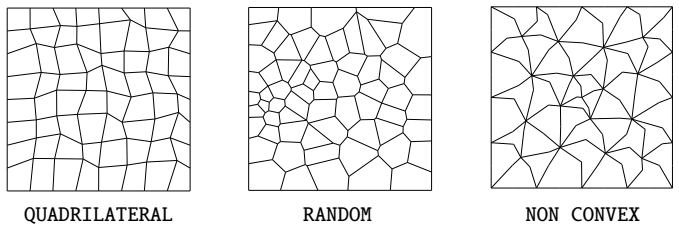
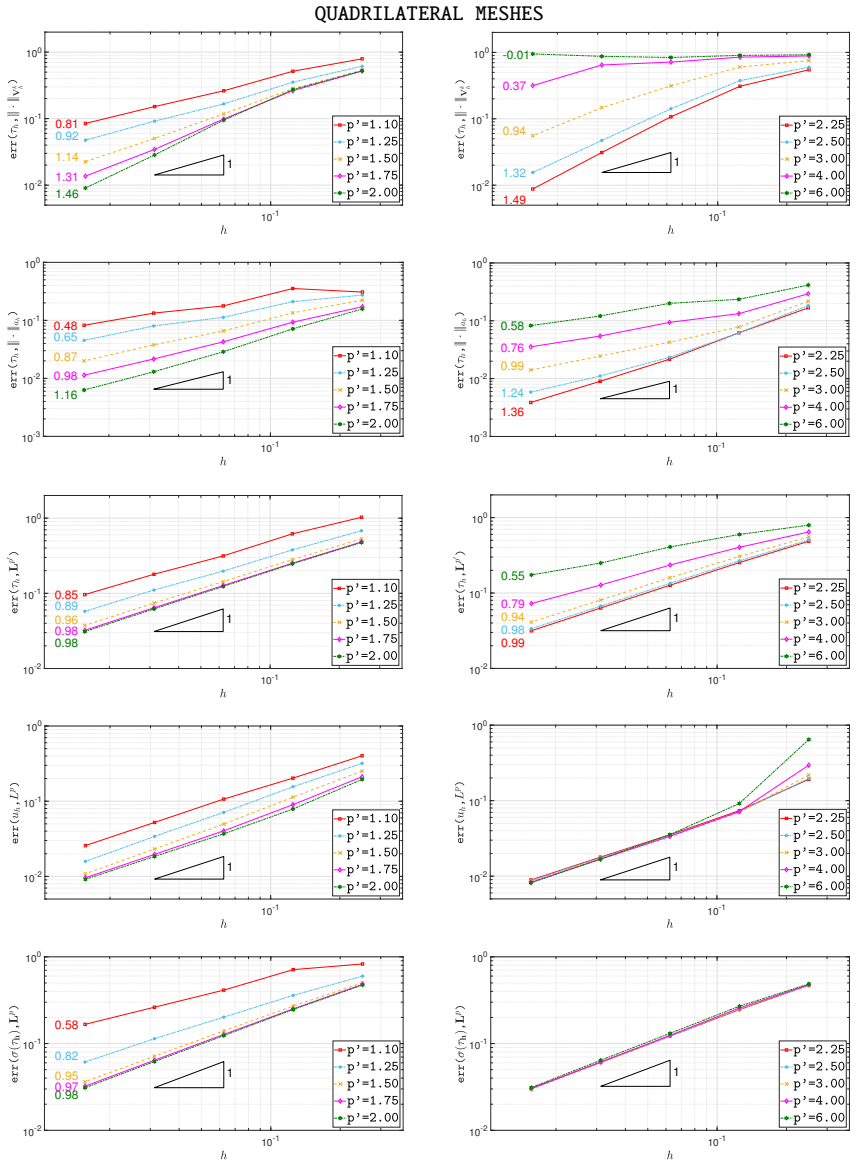
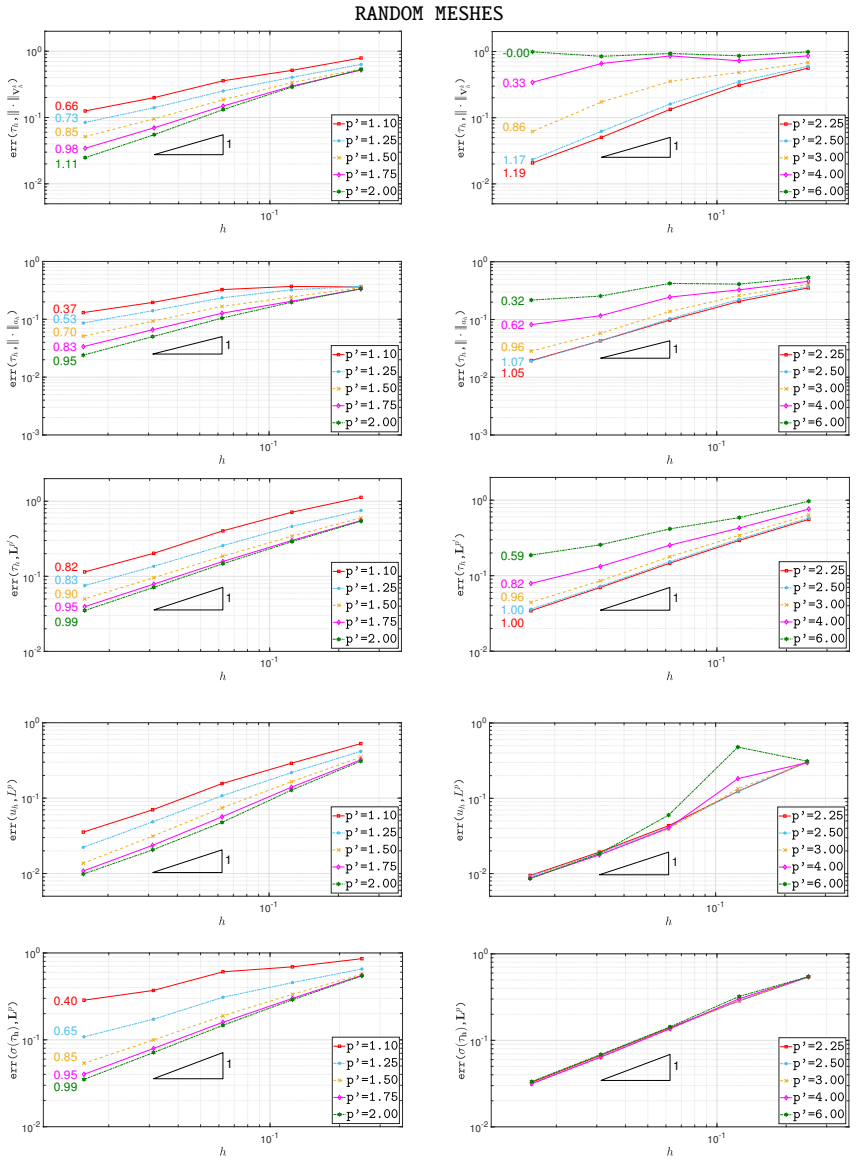
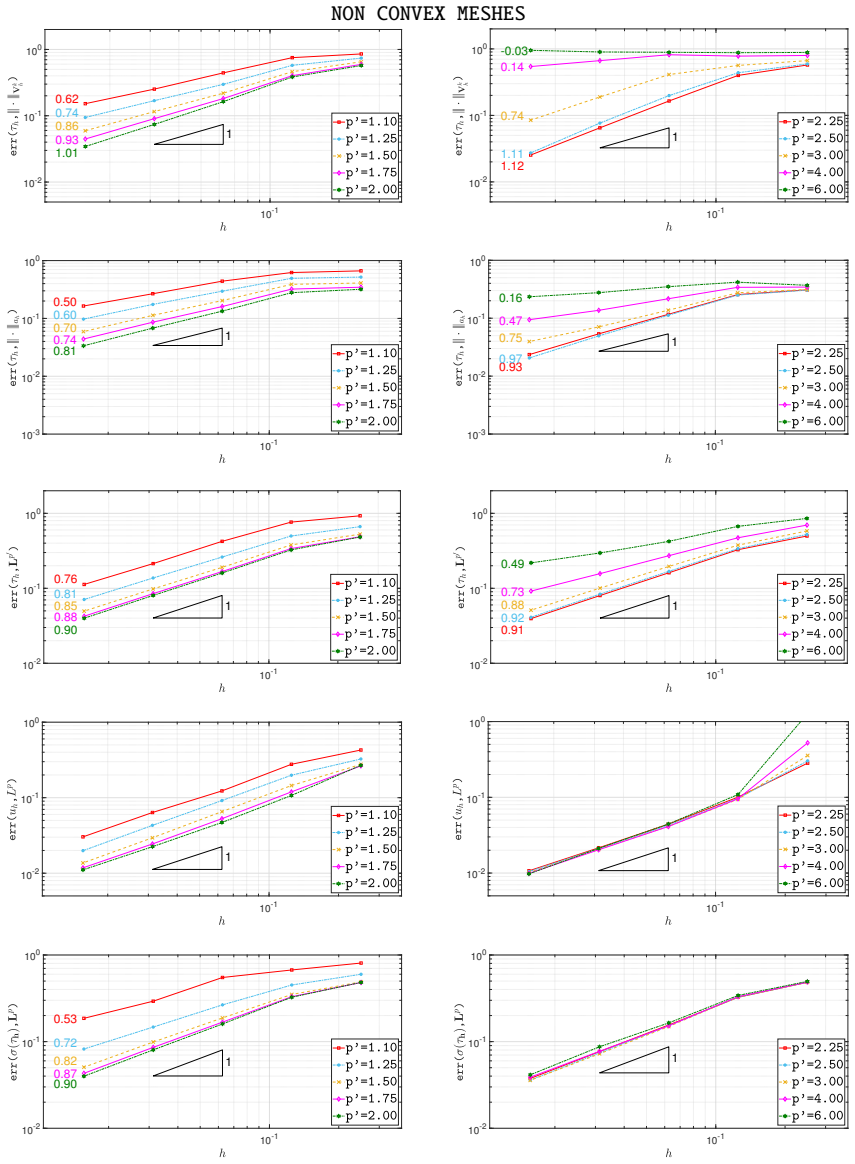
read the original abstract
We introduce and analyze a mixed Virtual Element Method for the $p$-Laplace equation in a non-Hilbertian setting, covering the full range $p \in (1, \infty)$. The discrete framework combines standard mixed Virtual Element spaces with a novel non-linear stabilization term designed to mimic the power-law structure of the continuous operator. We establish discrete inf-sup stability under non-Hilbertian norms and rigorously prove the continuity and coercivity of the discrete form. This guarantees the well-posedness of the problem and allows us to derive a priori error estimates for the primal variable and the flux. A set of numerical tests supports the theoretical derivations.
Editorial analysis
A structured set of objections, weighed in public.
Referee Report
Summary. The paper introduces a mixed Virtual Element Method for the p-Laplace equation in the non-Hilbertian setting for the full range p ∈ (1, ∞). It combines standard mixed VEM spaces with a novel nonlinear stabilization term designed to mimic the continuous power-law structure, establishes discrete inf-sup stability under non-Hilbertian norms, proves continuity and coercivity of the discrete form to guarantee well-posedness, derives a priori error estimates for the primal variable and the flux, and includes numerical tests supporting the theory.
Significance. If the proofs hold, the work provides a valuable extension of the VEM framework to nonlinear elliptic problems in non-Hilbert spaces across the entire p-range. The rigorous treatment of inf-sup stability, coercivity, and error estimates under the novel stabilization, together with numerical validation, strengthens the contribution to numerical analysis for p-Laplace-type equations.
minor comments (3)
- [§3] §3 (or the section defining the discrete spaces and stabilization): clarify the precise dependence of the nonlinear stabilization parameter on the local mesh size and polynomial degree to ensure the coercivity constant is independent of these quantities as claimed.
- [§5] The error estimate statements (likely in §5) should explicitly state the norms in which the estimates for the primal variable and flux hold, and whether the constants are independent of p.
- [Table 1] Table 1 (numerical results): include the observed convergence rates alongside the theoretical predictions for direct comparison; the current presentation makes it harder to verify the a priori estimates numerically.
Simulated Author's Rebuttal
We thank the referee for the positive summary of our manuscript on the mixed Virtual Element Method for the p-Laplace equation and for recommending minor revision. No specific major comments were provided in the report, so we have no individual points to address at this stage. We will carefully consider any minor suggestions during the revision process.
Circularity Check
No significant circularity
full rationale
The derivation chain consists of defining a mixed VEM discretization with a novel nonlinear stabilization term that mimics the p-Laplace power-law structure, followed by direct proofs of discrete inf-sup stability, continuity, and coercivity in non-Hilbertian norms for p in (1, infinity). These proofs establish well-posedness and enable a priori error estimates for the primal variable and flux. No equations reduce a claimed result to a fitted input or self-citation by construction; the stabilization is introduced as an ansatz but its properties are independently verified rather than assumed to hold tautologically. The analysis is self-contained against standard functional-analytic benchmarks and does not rely on load-bearing self-citations or renaming of known results.
Axiom & Free-Parameter Ledger
Reference graph
Works this paper leans on
-
[1]
Discrete duality finite volume schemes for Leray– Lions-type elliptic problems on general 2D meshes
B. P. Andreianov, F. Boyer, and F. Hubert. “Discrete duality finite volume schemes for Leray– Lions-type elliptic problems on general 2D meshes”. In:Numerical Methods for Partial Differ- ential Equations23.1 (2007), pp. 145–195.doi:10.1002/num.20170
-
[2]
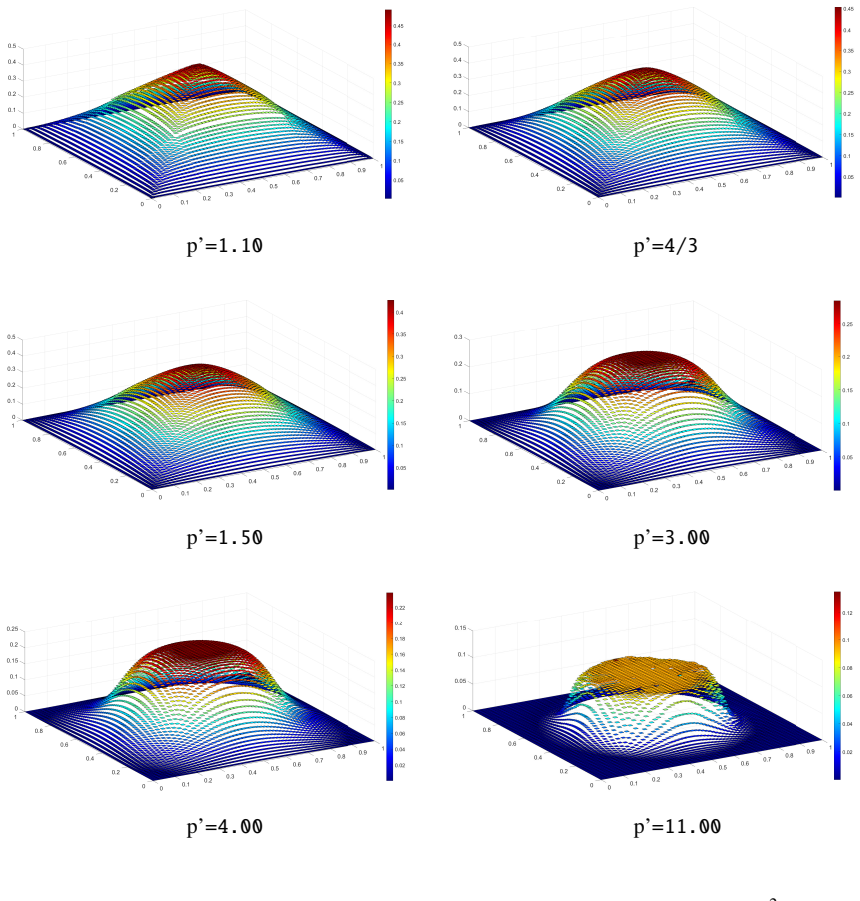
F. Andreu, J. M. Maz ´on, J. D. Rossi, and J. Toledo. “The limit as𝑝→ ∞in a nonlocal𝑝-Laplacian evolution equation: a nonlocal approximation of a model for sandpiles”. In:Calculus of Variations and Partial Differential Equations35.3 (2009), pp. 279–316.doi:10.1007/s00526-008-0205- 2. 39 p’=1.10 p’=4/3 p’=1.50 p’=3.00 p’=4.00 p’=11.00 Figure 5: Test 2. Dis...
-
[3]
A Virtual Element method for non-Newtonian pseudoplastic Stokes flows
P. F. Antonietti, L. Beir ˜ao da Veiga, M. Botti, G. Vacca, and M. Verani. “A Virtual Element method for non-Newtonian pseudoplastic Stokes flows”. In:Computer Methods in Applied Mechanics and Engineering428 (2024), p. 117079.issn: 0045-7825.doi:10.1016/j.cma.2024.117079
-
[4]
A𝐶1 virtual element method for the Cahn–Hilliard equation with polygonal meshes
P. F. Antonietti, L. Beir ˜ao da Veiga, S. Scacchi, and M. Verani. “A𝐶1 virtual element method for the Cahn–Hilliard equation with polygonal meshes”. In:SIAM Journal on Numerical Analysis 54.1 (2016), pp. 34–56.doi:10.1137/15M1008117
-
[5]
Mimetic finite difference approximation of quasilinear elliptic problems
P. F. Antonietti, N. Bigoni, and M. Verani. “Mimetic finite difference approximation of quasilinear elliptic problems”. In:Calcolo52.1 (2015), pp. 45–67.doi:10.1007/s10092-014-0107-y
-
[6]
P. F. Antonietti, L. B. da Veiga, M. Botti, A. Harnist, G. Vacca, and M. Verani.Virtual Element methods for non-Newtonian shear-thickening fluid flow problems. 2026. arXiv:2601 . 04866 [math.NA]
2026
-
[7]
C. Atkinson and C. W. Jones. “Similarity solutions in some non-linear diffusion problems and in boundary-layer flow of a pseudo-plastic fluid”. In:The Quarterly Journal of Mechanics and Applied Mathematics27.2 (1974), pp. 193–211.doi:10.1093/qjmam/27.2.193
-
[8]
Finite Element Approximation of the p-Laplacian
J. W. Barrett and W. B. Liu. “Finite Element Approximation of the p-Laplacian”. In:Mathematics of Computation61.204 (1993), p. 523.issn: 0025-5718.doi:10.2307/2153239
-
[9]
Finite Element Approximation of the Parabolic p-Laplacian
J. W. Barrett and W. B. Liu. “Finite Element Approximation of the Parabolic p-Laplacian”. In: SIAM Journal on Numerical Analysis31.2 (1994), pp. 413–428
1994
-
[10]
Quasi-norm error bounds for the finite element approximation of a non-Newtonian flow
J. W. Barrett and W. Liu. “Quasi-norm error bounds for the finite element approximation of a non-Newtonian flow”. In:Numerische Mathematik68.4 (1994), pp. 437–456.issn: 0945-3245. doi:10.1007/s002110050071
-
[11]
A Reynolds-semi-robust H(div)-conforming method for unsteady incompressible non-Newtonian flows
L. Beir ˜ao da Veiga, D. A. Di Pietro, and K. B. Haile. “A Reynolds-semi-robust H(div)-conforming method for unsteady incompressible non-Newtonian flows”. In:IMA Journal of Numerical Anal- ysis(2026). Accepted for publication. arXiv:2505.08708 [math.NA]
arXiv 2026
-
[12]
Interpolation and stability estimates for edge and face virtual elements of general order
L. Beir ˜ao da Veiga, L. Mascotto, and J. Meng. “Interpolation and stability estimates for edge and face virtual elements of general order”. In:Mathematical Models and Methods in Applied Sciences32.08 (2022), pp. 1589–1631.issn: 1793-6314.doi:10.1142/s0218202522500373
-
[13]
H(div) and H (curl)-conforming virtual element methods
L. Beir ˜ao da Veiga, F. Brezzi, L. D. Marini, and A. Russo. “H(div) and H (curl)-conforming virtual element methods”. In:Numerische Mathematik133.2 (2015), pp. 303–332.issn: 0945-3245.doi: 10.1007/s00211-015-0746-1
-
[14]
Basic principles of Virtual Element Methods
L. Beir ˜ao da Veiga, F. Brezzi, A. Cangiani, G. Manzini, L. D. Marini, and A. Russo. “Basic principles of Virtual Element Methods”. In:Mathematical Models and Methods in Applied Sciences23.1 (2013), pp. 199–214.doi:10.1142/s0218202512500492
-
[15]
A P ´eclet-robust Discontinuous Galerkin method for nonlinear diffusion with advection
L. Beir ˜ao da Veiga, D. A. Di Pietro, and K. B. Haile. “A P ´eclet-robust Discontinuous Galerkin method for nonlinear diffusion with advection”. In:Mathematical Models and Methods in Applied Sciences34.09 (2024), pp. 1781–1807.issn: 1793-6314.doi:10.1142/s0218202524500350
-
[16]
D. Boffi, F. Brezzi, and M. Fortin.Mixed Finite Element Methods and Applications. Springer Berlin Heidelberg, 2013.isbn: 9783642365195.doi:10.1007/978-3-642-36519-5
-
[17]
Solution of the first boundary value problem for an equation of continuity of an incompressible medium
M. Bogovskii. “Solution of the first boundary value problem for an equation of continuity of an incompressible medium”. In:Soviet Mathematics. Doklady20 (1979), pp. 1094–1098
1979
-
[18]
S. C. Brenner and L. R. Scott.The Mathematical Theory of Finite Element Methods. Springer New York, 2008.isbn: 9780387759340.doi:10.1007/978-0-387-75934-0. 41
-
[19]
Basic principles of mixed Virtual Element Methods
F. Brezzi, R. S. Falk, and L. Donatella Marini. “Basic principles of mixed Virtual Element Methods”. In:ESAIM: Mathematical Modelling and Numerical Analysis48.4 (2014), pp. 1227– 1240.issn: 1290-3841.doi:10.1051/m2an/2013138
-
[20]
Discontinuous Galerkin approximation with discrete variational principle for the nonlinear Laplacian
E. Burman and A. Ern. “Discontinuous Galerkin approximation with discrete variational principle for the nonlinear Laplacian”. In:Comptes Rendus. Math ´ematique346.17–18 (2008), pp. 1013– 1016.issn: 1778-3569.doi:10.1016/j.crma.2008.07.005
-
[21]
A mixed virtual element method for the pseudostress–velocity formulation of the Stokes problem
E. C ´aceres and G. N. Gatica. “A mixed virtual element method for the pseudostress–velocity formulation of the Stokes problem”. In:IMA Journal of Numerical Analysis37.1 (2017), pp. 296– 331.doi:10.1093/imanum/drw002
-
[22]
A Mixed Virtual Element Method for Quasi- Newtonian Stokes Flows
E. C ´aceres, G. N. Gatica, and F. A. Sequeira. “A Mixed Virtual Element Method for Quasi- Newtonian Stokes Flows”. In:SIAM Journal on Numerical Analysis56.1 (2018), pp. 317–343. issn: 1095-7170.doi:10.1137/17m1121160
-
[23]
A mixed virtual element method for the Brinkman problem
E. C ´aceres, G. N. Gatica, and F. A. Sequeira. “A mixed virtual element method for the Brinkman problem”. In:Mathematical Models and Methods in Applied Sciences27.04 (2017), pp. 707–743. doi:10.1142/S0218202517500142
-
[24]
Virtual element method for quasilinear elliptic problems
A. Cangiani, P. Chatzipantelidis, G. Diwan, and E. H. Georgoulis. “Virtual element method for quasilinear elliptic problems”. In:IMA Journal of Numerical Analysis40.4 (2020), pp. 2450– 2472.doi:10.1093/imanum/drz035
-
[25]
P. G. Ciarlet.The Finite Element Method for Elliptic Problems. Society for Industrial and Applied Mathematics, 2002.isbn: 9780898719208.doi:10.1137/1.9780898719208
-
[26]
A Hybridizable Discontinuous Galerkin Method for the𝑝-Laplacian
B. Cockburn and J. Shen. “A Hybridizable Discontinuous Galerkin Method for the𝑝-Laplacian”. In:SIAM Journal on Scientific Computing38.1 (2016), A545–A566.issn: 1095-7197.doi: 10.1137/15m1008014
-
[27]
E. Creus ´e, M. Farhloul, and L. Paquet. “A posteriori error estimation for the dual mixed finite element method for the𝑝-Laplacian in a polygonal domain”. In:Computer Methods in Applied Mechanics and Engineering196.25–28 (2007), pp. 2570–2582.doi:10.1016/j.cma.2006. 11.023
-
[28]
D. A. Di Pietro and J. Droniou. “Ws,p-approximation properties of elliptic projectors on poly- nomial spaces, with application to the error analysis of a Hybrid High-Order discretisation of Leray–Lions problems”. In:Mathematical Models and Methods in Applied Sciences27.05 (2017), pp. 879–908.issn: 1793-6314.doi:10.1142/s0218202517500191
-
[29]
D. A. Di Pietro and J. Droniou.The Hybrid High-Order Method for Polytopal Meshes: Design, Analysis, and Applications. Springer International Publishing, 2020.isbn: 9783030372033.doi: 10.1007/978-3-030-37203-3
-
[30]
A local discontinuous Galerkin ap- proximation for systems with p-structure
L. Diening, D. Kroner, M. Ruzicka, and I. Toulopoulos. “A local discontinuous Galerkin ap- proximation for systems with p-structure”. In:IMA Journal of Numerical Analysis34.4 (2013), pp. 1447–1488.issn: 1464-3642.doi:10.1093/imanum/drt040
-
[31]
Fractional estimates for non-differentiable elliptic systems with general growth
L. Diening and F. Ettwein. “Fractional estimates for non-differentiable elliptic systems with general growth”. In:Forum Mathematicum20.3 (2008).issn: 1435-5337.doi:10.1515/forum. 2008.027
-
[32]
On the game𝑝-Laplacian on weighted graphs with applications in image processing and data clustering
A. Elmoataz, X. Desquesnes, and M. Toutain. “On the game𝑝-Laplacian on weighted graphs with applications in image processing and data clustering”. In:European Journal of Applied Mathematics28.6 (2017), pp. 922–948.doi:10.1017/S0956792517000122. 42
-
[33]
On a mixed finite element method for the p-Laplacian
M. Farhloul and H. Manouzi. “On a mixed finite element method for the p-Laplacian”. In:Rocky Mountain Journal of Mathematics8.1 (2000), pp. 67–78.doi:10.1216/camq/1008957338
-
[34]
R. Glowinski and A. Marroco. “Sur l’approximation, par´el´ements finis d’ordre un, et la r´esolution, par p´enalisation-dualit´e d’une classe de probl`emes de Dirichlet non lin´eaires”. In:Revue franc ¸aise d’automatique, informatique, recherche op´erationnelle. Analyse num´erique9.R2 (1975), pp. 41– 76.issn: 0397-9342.doi:10.1051/m2an/197509r200411
-
[35]
R. Glowinski and J. Rappaz. “Approximation of a nonlinear elliptic problem arising in a non- Newtonian fluid flow model in glaciology”. In:ESAIM: Mathematical Modelling and Numerical Analysis37.1 (2003), pp. 175–186.issn: 1290-3841.doi:10.1051/m2an:2003012
-
[36]
On the convergence rate of the Kaˇcanov scheme for shear-thinning fluids
P. Heid and E. S¨ uli. “On the convergence rate of the Kaˇcanov scheme for shear-thinning fluids”. In:Calcolo59.1 (2022), Paper No. 4, 27.issn: 0008-0624,1126-5434.doi:10.1007/s10092- 021-00444-3.url:https://doi.org/10.1007/s10092-021-00444-3
-
[37]
Approximation of the p-Stokes Equations with Equal-Order Finite Elements
A. Hirn. “Approximation of the p-Stokes Equations with Equal-Order Finite Elements”. In: Journal of Mathematical Fluid Mechanics15.1 (2012), pp. 65–88.issn: 1422-6952.doi:10. 1007/s00021-012-0095-0
2012
-
[38]
A. Kaltenbach and M. R˚ uˇ ziˇcka. “A local discontinuous Galerkin approximation for the𝑝-Navier- Stokes system, Part I: Convergence analysis”. In:SIAM J. Numer. Anal.61.4 (2023), pp. 1613– 1640.doi:10.1137/22M151474X
-
[39]
𝑛-Diffusion
J. R. Philip. “𝑛-Diffusion”. In:Australian Journal of Physics14.1 (1961), pp. 1–13.doi:10. 1071/PH610001
1961
-
[40]
Existence et approximation de points selles pour certains probl `emes non lin´eaires
B. Scheurer. “Existence et approximation de points selles pour certains probl `emes non lin´eaires”. In:RAIRO. Analyse num´erique11.4 (1977), pp. 369–400.issn: 0399-0516.doi:10.1051/m2an/ 1977110403691
-
[41]
PolyMesher: a general-purpose mesh generator for polygonal elements written in Matlab
C. Talischi, G. H. Paulino, A. Pereira, and I. F. M. Menezes. “PolyMesher: a general-purpose mesh generator for polygonal elements written in Matlab”. In:Struct. Multidiscip. Optim.45.3 (2012), pp. 309–328.issn: 1615-147X,1615-1488.doi:10.1007/s00158-011-0706-z.url: https://doi.org/10.1007/s00158-011-0706-z
-
[42]
J. L. V ´azquez.The Porous Medium Equation: Mathematical Theory. Oxford University Press, 2006.doi:10.1093/acprof:oso/9780198569039.001.0001. A Proofs of technical lemmas A.1 Auxiliary estimate for the normal component Proof of Lemma 16.Fix𝐸∈Ω ℎ,𝒘 ℎ ∈𝑽 𝑘 ℎ (𝐸)and 1< 𝑟≤2. LetT ℎ (𝐸)be the shape-regular triangulation of𝐸(see Remark 5). Notice that for each ...
work page doi:10.1093/acprof:oso/9780198569039.001.0001 2006
discussion (0)
Sign in with ORCID, Apple, or X to comment. Anyone can read and Pith papers without signing in.