TinyJudge: Unverifiable Constraint Alignment via Lightweight Specialist Ensembles
Pith reviewed 2026-07-05 18:23 UTC · model glm-5.2
The pith
Tiny models as judges beat large LLM judges by 10%
A machine-rendered reading of the paper's core claim, the machinery that carries it, and where it could break.
Core claim
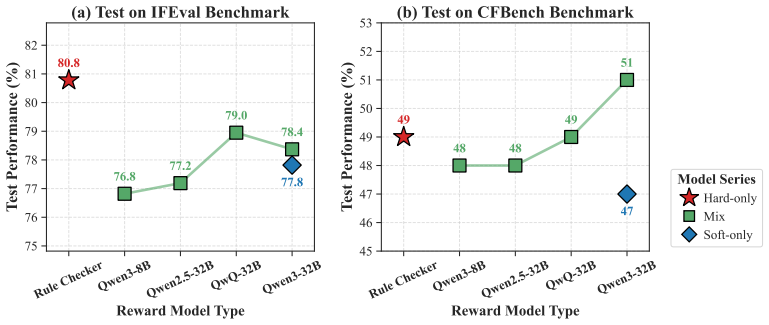
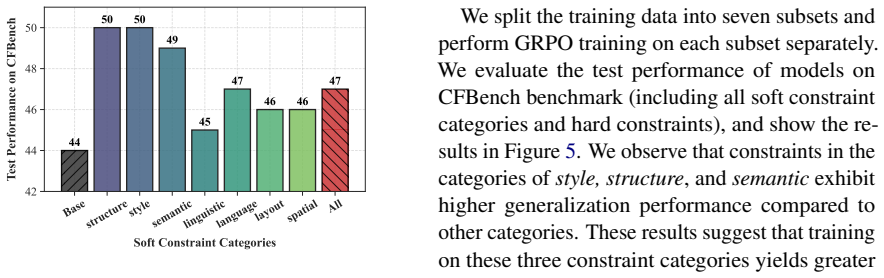
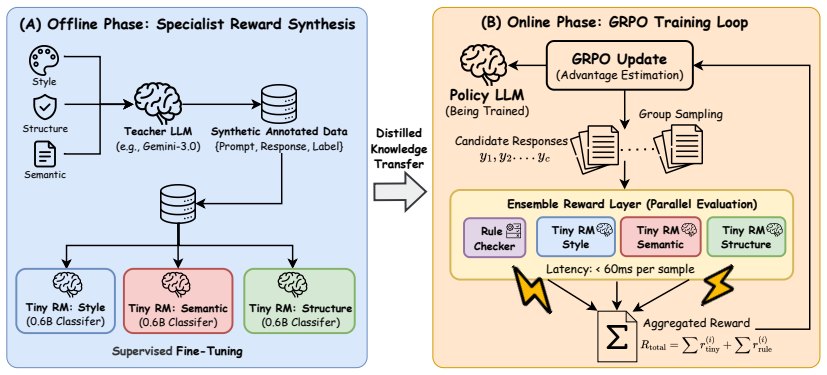
The central mechanism is constraint decoupling: instead of asking one large model to evaluate all soft constraints simultaneously (which introduces leniency bias and reward hacking), the paper trains one tiny specialist per high-generalization constraint category and evaluates each constraint independently. The generalization analysis showing that style, structure, and semantic constraints transfer better than the other four categories is what motivates the specific three-specialist design. The ablation confirms that three separate specialists outperform a single combined specialist or a single specialist trained on all constraint types, validating the decoupling principle rather than just a
What carries the argument
Three 0.6B-parameter classifiers distilled from a frontier LLM (Gemini-3.0-Pro), each specialized for one soft-constraint category (style, structure, semantic), run in parallel during GRPO training as an ensemble reward layer alongside a rule-based checker for hard constraints.
If this is right
- RLVR training for instruction following could become practical without access to frontier-scale judge models, lowering compute barriers for smaller labs.
- The constraint-generalization finding suggests that not all soft constraints are equally learnable; curriculum or constraint-selection strategies could further optimize RLVR training.
- If the specialist-distillation approach generalizes beyond instruction following, it could apply to other RL domains where reward signals are noisy or expensive (e.g., safety, helpfulness, creativity).
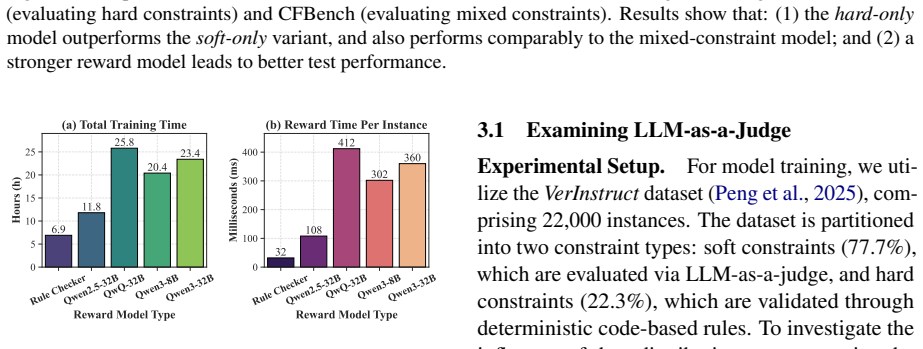
- The 3x training speedup and near-rule-based latency could enable more frequent RL training iterations, accelerating model development cycles.
Where Pith is reading between the lines
- If the three high-generalization constraints are not universally optimal across different task domains or languages, the framework would need re-calibration, and the performance gains might be domain-specific.
- The ceiling on specialist quality is set by the teacher LLM; if the teacher has systematic biases on certain constraint types, the distilled specialists will inherit those biases, potentially in a more concentrated form.
- The approach could be extended to an adaptive framework where constraint categories are dynamically selected based on observed generalization during training, rather than fixed a priori.
- The finding that point-wise (per-constraint) judgment outperforms batch judgment suggests a broader principle: decomposing complex evaluation into atomic sub-tasks may systematically reduce bias in LLM-based assessment, with implications beyond RLVR.
Load-bearing premise
The paper assumes that three soft-constraint categories (style, structure, semantic) are sufficient to capture meaningful generalization, and that the other four categories can be safely dropped during training. This selection is based on empirical generalization results on one benchmark, without a theoretical justification for why this partition is optimal or stable across different instruction distributions.
What would settle it
Train TinyJudge on a benchmark or task distribution where linguistic, layout, or spatial constraints are heavily represented and critical to instruction-following success. If performance drops significantly compared to a system that includes those categories, the three-constraint selection is not universally sufficient.
Figures

read the original abstract
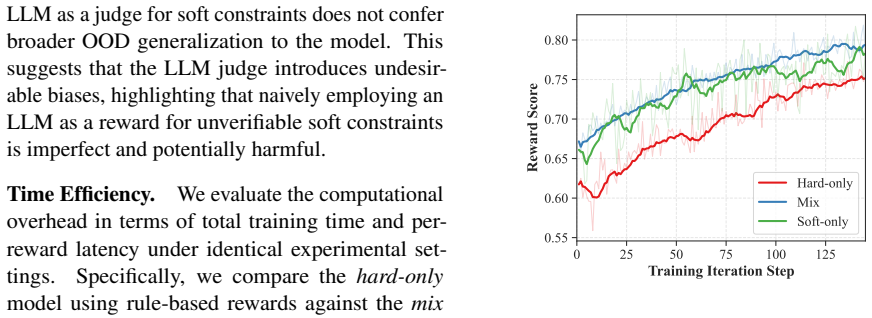
Instruction Following (IF) is a core capability of LLMs, requiring strict adherence to diverse constraints, ranging from verifiable ones (e.g., output length) to unverifiable ones (e.g., tone). Reinforcement learning with verifiable rewards has emerged as a paradigm for IF tasks, leveraging LLM-as-a-judge to assess unverifiable constraints. However, we empirically find that this approach remains a significant bottleneck, suffering from severe reward hacking and higher computational overhead. In this work, we first analyze the generalization capabilities of unverifiable constraints and discover that specific constraints exhibit distinct, high-generalization patterns. Motivated by this, we propose TinyJudge, a framework that employs an ensemble of specialized tiny language models ($\sim0.6B$) to provide rewards for soft constraints. By distilling expertise from frontier models into these tiny models, it achieves high-precision, lightweight evaluation. Extensive evaluations across five benchmarks demonstrate that TinyJudge outperforms the baselines by $\sim10\%$ in average performance and $12\%$ in reward precision. Crucially, it also achieves a $3\times$ speedup in total training time. Our work provides a scalable and robust path for aligning LLMs with unverifiable human instructions.
Editorial analysis
A structured set of objections, weighed in public.
Referee Report
Summary. This paper proposes TinyJudge, a framework that replaces large LLM-as-a-judge reward models in RLVR training with an ensemble of three lightweight (~0.6B) specialist models distilled from a frontier LLM (Gemini-3.0-Pro). The authors first conduct pilot experiments showing that LLM-as-a-judge suffers from reward hacking and high latency. They then perform a generalization analysis across seven soft constraint categories, finding that style, structure, and semantic constraints yield the highest generalization. Based on this, they distill three specialist models for these categories and integrate them into the GRPO training loop alongside rule-based hard constraint checkers. Experiments across five instruction-following benchmarks demonstrate that TinyJudge achieves ~10% improvement in average performance over baselines using 32B models as online judges, while also achieving a 3x speedup in total training time and 12% improvement in reward precision.
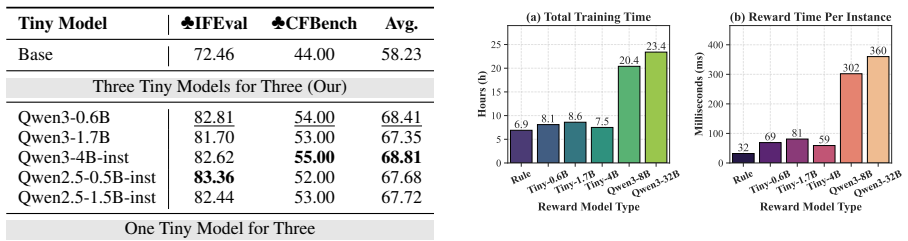
Significance. The paper addresses a practical and important bottleneck in scaling RLVR to unverifiable soft constraints: the cost and reward-hacking tendencies of large online LLM judges. The proposed solution—distilling specialist tiny models for high-generalization constraint categories—is pragmatic and well-motivated. The empirical evaluation spans five benchmarks and multiple model sizes (7B, 32B), and the ablation study (Table 3) provides useful evidence that the 3-for-3 specialist architecture outperforms monolithic alternatives. The efficiency gains (3x training speedup, 6x judging latency reduction) are concrete and practically valuable. The generalization analysis in Section 3.3, while empirically driven rather than theoretically grounded, offers a useful empirical insight for the community.
major comments (3)
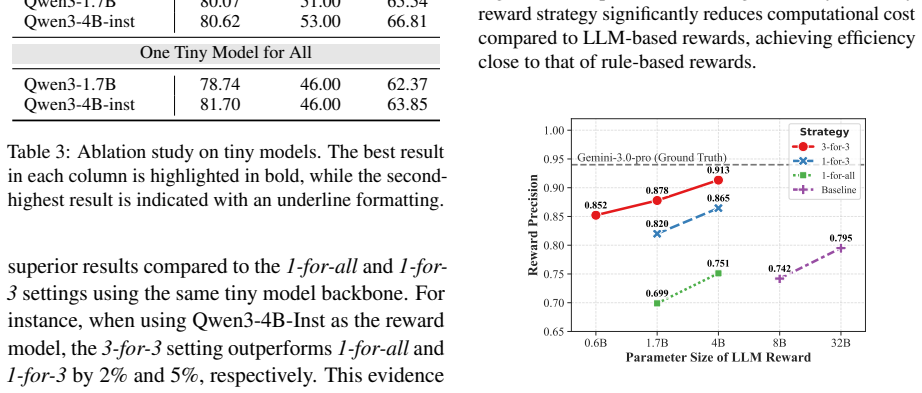
- §5.3.3 (Quantifying Reward Precision): The ground-truth labels for reward precision are established by averaging five independent evaluations from Gemini-3.0-Pro, which is the same model used as the teacher to distill the tiny specialists (§4.1). This creates a partial circularity: the distilled student models are being evaluated against their own teacher. If the teacher has systematic biases on certain constraint types, the students will inherit those biases and still score well against the teacher-derived ground truth. The 12% reward precision improvement claim (Figure 8) is thus not fully independent. The paper should either (a) use the human-annotated ground truth from Appendix B (which was used in Table 1 for the pilot study) for the reward precision evaluation in §5.3.3, or (b) explicitly acknowledge this limitation and reframe the 12% claim as measuring teacher-student alignment f
- §5.2, Table 2: The headline comparison pits TinyJudge (specialists distilled from Gemini-3.0-Pro) against LLM-as-a-judge baselines using Qwen3-32B or Qwen2.5-32B as online judges. This confounds two factors: (1) the specialist ensemble architecture and (2) teacher model quality. The ablation in Table 3 partially disentangles these: a single non-specialized tiny model distilled from Gemini-3.0-Pro (1-for-3, Qwen3-1.7B) achieves 65.54 average, versus 57.25 for the Qwen3-32B judge baseline—a gain of +8.29 points attributable almost entirely to teacher quality. The 3-for-3 specialization adds only ~2.9 points on top (68.41 vs 65.54). Thus roughly 75% of the headline ~10% improvement may stem from using a stronger teacher rather than from the specialist ensemble architecture that the paper emphasizes as its core contribution. The paper should explicitly decompose these two factors in the main
- §3.3, Figure 5: The selection of three constraint categories (style, structure, semantic) is load-bearing for the entire framework, yet the justification is purely empirical and based on a single benchmark (CFBench). The paper does not provide a theoretical or systematic empirical justification for why this subset is optimal or universally generalizable. The Limitations section acknowledges this gap, but the main text (§3.3) frames the selection as if these three categories 'represent more foundational and generalized constraint patterns' without further evidence. A sensitivity analysis varying the number of selected categories (e.g., top-2, top-4, top-5) would strengthen the claim that three is the right number, or the framing should be softened to acknowledge this is an empirically motivated design choice rather than a principled one.
minor comments (8)
- Table 2: 'Deeepseek-V3.2' has a typo (three 'e's).
- Table 2: The 'Average' column for the 7B model shows TinyJudge at 61.52, but the text in §5.2 states '~10% improvement.' The base Qwen2.5-7B-inst average is 51.56, so the gain is 9.96 points (~19.3% relative). The '~10%' refers to absolute points, which should be clarified.
- §4.1: The footnote 3 mentions disabling 'thinking' mode for Qwen3-0.6B, but it is unclear whether this affects the quality of the specialist models. A brief note on the impact of this choice would be helpful.
- §4.2, Eq. (5): The reward aggregation uses equal weights (1/N for hard, 1/M for soft). The sensitivity to these weights is not discussed. A brief ablation or justification for equal weighting would strengthen the presentation.
- Figure 8: The y-axis label and scale are unclear in the rendered text. Please ensure the figure is self-contained with clear axis labels and a legend.
- §5.1: The evaluation metric ISR is mentioned but not formally defined in the main text (only referenced to Zhang et al., 2025). A brief definition would improve readability.
- Table 3: The 'Base' row (58.23 average) appears to be the untrained Qwen2.5-7B-Instruct baseline, but this is not explicitly stated in the table caption.
- Appendix C.4, Table 6: The 7B variant shows slight degradation on GSM8K (92.10% -> 91.88%) and MMLU (74.54% -> 73.20%). While the paper frames this as 'highly competitive,' the MMLU drop of 1.34 points is non-trivial and should be acknowledged more directly.
Simulated Author's Rebuttal
We thank the referee for a careful and constructive review. The three major comments are well-taken, and we address each below. In brief: (1) we agree on the partial circularity in reward precision evaluation and will add a human-annotated evaluation; (2) we agree that the contribution decomposition should be explicit and will add it to the main text; and (3) we will soften the framing of the three-category selection and add a sensitivity analysis. We believe all three can be addressed in revision.
read point-by-point responses
-
Referee: §5.3.3 (Quantifying Reward Precision): The ground-truth labels for reward precision are established by averaging five independent evaluations from Gemini-3.0-Pro, which is the same model used as the teacher to distill the tiny specialists (§4.1). This creates a partial circularity...
Authors: The referee is correct that using Gemini-3.0-Pro as both the distillation teacher and the ground-truth label source creates a partial circularity. We acknowledge this limitation and will address it in two ways. First, we will re-run the reward precision evaluation in §5.3.3 using the human-annotated ground truth from Appendix B (the same protocol used for Table 1 in §3.2). This provides a fully independent evaluation. Second, we will explicitly acknowledge the partial circularity in the current Gemini-based evaluation and reframe that result as measuring teacher-student alignment fidelity rather than independent reward precision. The 12% improvement claim will be reported against both the human ground truth and the teacher-derived labels, with appropriate caveats on the latter. revision: yes
-
Referee: §5.2, Table 2: The headline comparison pits TinyJudge (specialists distilled from Gemini-3.0-Pro) against LLM-as-a-judge baselines using Qwen3-32B or Qwen2.5-32B as online judges. This confounds two factors: (1) the specialist ensemble architecture and (2) teacher model quality...
Authors: We agree with the referee's decomposition analysis and appreciate the careful reading of Table 3. The referee's arithmetic is accurate: the 1-for-3 Qwen3-1.7B model (distilled from Gemini-3.0-Pro) achieves 65.54 average versus 57.25 for the Qwen3-32B judge baseline, a +8.29 gain attributable largely to teacher quality, while the 3-for-3 specialization adds ~2.9 points on top (68.41 vs 65.54). We will add this decomposition explicitly to the main text in §5.2, including a paragraph that separates the contribution of teacher quality from the contribution of the specialist ensemble architecture. We want to note, however, that both factors are integral to the TinyJudge framework: the practical value proposition is that distillation from a frontier teacher enables deploying tiny models that are simultaneously faster (3x training speedup, 6x latency reduction) and more precise than online 32B judges. The efficiency gains would not be achievable without the specialist architecture, since a single monolithic tiny model cannot evaluate constraints in parallel. That said, we agree the paper should be transparent that the majority of the absolute performance gain comes from teacher quality rather than specialization per se, and we will revise accordingly. revision: yes
-
Referee: §3.3, Figure 5: The selection of three constraint categories (style, structure, semantic) is load-bearing for the entire framework, yet the justification is purely empirical and based on a single benchmark (CFBench)...
Authors: The referee is right that the selection of three categories is currently justified empirically on a single benchmark, and that the framing in §3.3 overstates the generality of this choice. We will make two changes. First, we will soften the language in §3.3 to explicitly frame the three-category selection as an empirically motivated design choice rather than a principled or universal claim. Second, we will add a sensitivity analysis varying the number of selected categories (top-2, top-3, top-4, top-5) and report the resulting downstream RLVR performance. This will provide empirical evidence for whether three is a reasonable operating point or whether the framework is robust to this choice. We note that the Limitations section already acknowledges the lack of a systematic optimization framework for constraint selection; the sensitivity analysis will partially address this gap, though we agree a fully principled justification (e.g., theoretical analysis of why certain constraint types generalize) remains future work. revision: partial
Circularity Check
Reward precision claim (12%) is partially circular: specialists distilled from Gemini-3.0-Pro are evaluated against Gemini-3.0-Pro ground-truth labels
specific steps
-
fitted input called prediction
[Section 5.3.3 (Quantifying Reward Precision), compared with Section 4.1 (Specialist Reward Synthesis)]
"Section 4.1: 'for each triplet (q, c_soft, y), where y ∈ Y, we utilize Gemini-3.0-Pro to provide a binary assessment r regarding the adherence to constraints. we then fine-tune Qwen3-0.6B as specialist judges.' Section 5.3.3: 'We utilize a 5% held-out validation set and establish ground-truth labels by averaging five independent evaluations from Gemini-3.0-Pro. We then measure the alignment between various reward models (including Qwen3-Tiny configurations in 3-for-3, 1-for-all, and 1-for-3 setups) and the ground-truth.'"
The specialist models are trained to replicate Gemini-3.0-Pro's binary judgments on soft constraints (Section 4.1). The reward precision metric (Section 5.3.3) is then defined as alignment with Gemini-3.0-Pro's judgments on held-out data. By construction, models distilled from Gemini-3.0-Pro will tend to agree with Gemini-3.0-Pro more than an unrelated model (Qwen3-32B) will. The 12% reward precision improvement of TinyJudge over Qwen3-32B is therefore partly an artifact of measuring student-teacher agreement rather than independent reward quality. The held-out split mitigates but does not eliminate this: the specialists learned Gemini-3.0-Pro's judgment policy, which generalizes to held-out data. Note that Section 3.2's reward reliability analysis (Table 1) uses human expert ground truth,
full rationale
The paper has one partially circular evaluation: the 12% reward precision claim in Section 5.3.3 measures distilled specialists against their own teacher model (Gemini-3.0-Pro), inflating apparent improvement over non-distilled baselines. However, the paper's central claims — the ~10% performance gain (Table 2, evaluated on external benchmarks with independent evaluation methods), the 3x training speedup, and the ablation showing 3-for-3 specialization outperforms 1-for-3 and 1-for-all (Table 3) — are not circular. The ablation compares architectures using the same teacher, so its conclusion is independent of teacher quality. The paper also acknowledges in Limitations that specialist performance is capped by the teacher. Score 4 reflects one headline metric with partial circularity while the core contribution remains independently validated.
Axiom & Free-Parameter Ledger
free parameters (3)
- Number of specialist models (M=3) =
3
- Constraint categories selected (style, structure, semantic) =
style, structure, semantic
- Reward aggregation weights =
1/N for hard, 1/M for soft
axioms (3)
- domain assumption GRPO is an effective RL algorithm for instruction following
- ad hoc to paper Gemini-3.0-Pro provides reliable ground-truth labels for reward precision
- ad hoc to paper The three selected constraint types (style, structure, semantic) are representative of general soft constraint distribution
Reference graph
Works this paper leans on
-
[1]
S-GRPO: Early Exit via Reinforcement Learning in Reasoning Models
Scaling instruction-finetuned language models. Journal of Machine Learning Research, 25(70):1–53. Muzhi Dai, Chenxu Yang, and Qingyi Si. 2025. S-grpo: Early exit via reinforcement learning in reasoning models.arXiv preprint arXiv:2505.07686. Guanting Dong, Keming Lu, Chengpeng Li, Tingyu Xia, Bowen Yu, Chang Zhou, and Jingren Zhou
work page internal anchor Pith review Pith/arXiv arXiv 2025
-
[2]
Self-play with execution feedback: Improving instruction-following capabilities of large language models.arXiv preprint arXiv:2406.13542. Abhimanyu Dubey, Abhinav Jauhri, Abhinav Pandey, Abhishek Kadian, Ahmad Al-Dahle, Aiesha Letman, Akhil Mathur, Alan Schelten, Amy Yang, Angela Fan, et al. 2024. The llama 3 herd of models.arXiv e-prints, pages arXiv–240...
work page internal anchor Pith review Pith/arXiv arXiv 2024
discussion (0)
Sign in with ORCID, Apple, or X to comment. Anyone can read and Pith papers without signing in.