Vessel Traffic Flow Prediction on Sparse Data via Spatio-Temporal Graph Neural Networks with a Learnable Tweedie Head
Pith reviewed 2026-06-27 22:33 UTC · model grok-4.3
The pith
A learnable Tweedie head attached to any ST-GNN improves point forecasts of sparse vessel traffic flows.
A machine-rendered reading of the paper's core claim, the machinery that carries it, and where it could break.
Core claim
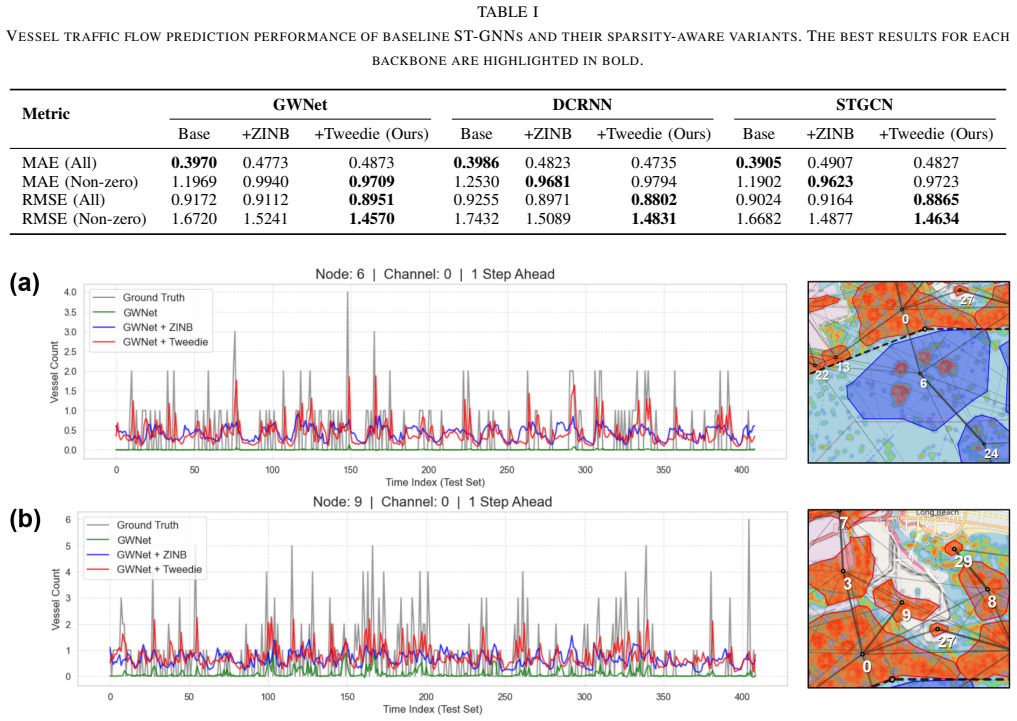
The authors claim that a model-agnostic learnable Tweedie head attached as an output module to arbitrary ST-GNN backbones, trained by optimizing the closed-form Tweedie unit deviance, enables point forecasting of the mean while learning node-level variance power to capture heterogeneous variability, yielding consistent RMSE improvements on sparse vessel traffic data especially for non-zero events compared with plain ST-GNNs and ZINB approaches.
What carries the argument
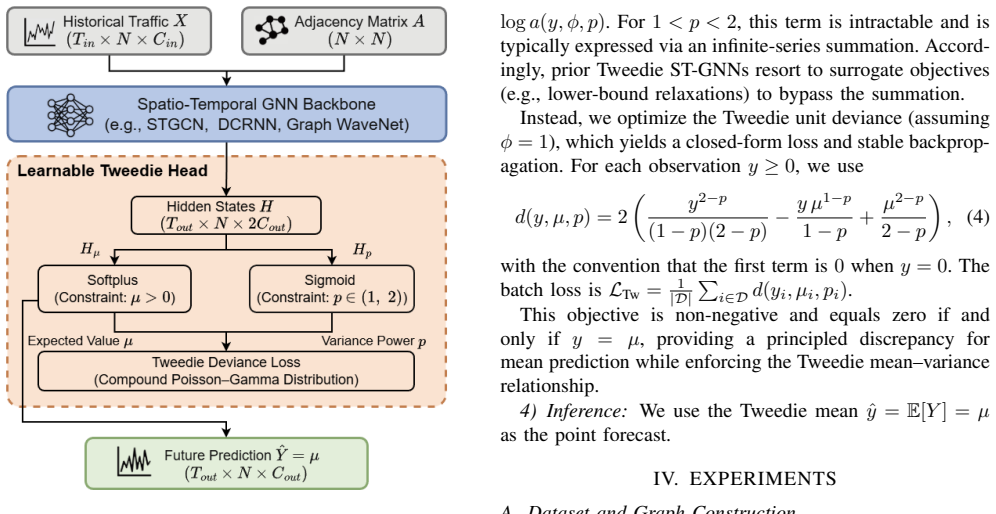
The learnable Tweedie head, a plug-and-play output module that optimizes closed-form unit deviance for training and learns per-node variance power.
If this is right
- The head delivers RMSE gains across multiple ST-GNN backbones on the maritime traffic graph.
- Gains appear mainly on non-zero events rather than zero-heavy periods.
- The method avoids surrogate objectives needed for likelihood-based Tweedie training.
- Node-level variance power learning captures heterogeneous variability across port areas better than ZINB models.
- Resulting forecasts support more reliable maritime traffic control decisions.
Where Pith is reading between the lines
- The same plug-in head could be tested on other sparse bursty time-series graphs such as road traffic or sensor networks.
- Varying the graph construction from AIS data might show whether node-level variance learning depends on specific spatial resolutions.
- The model-agnostic design allows swapping in newer ST-GNN variants without changing the head training procedure.
- If the gains hold, the approach could extend to operational systems that prioritize accurate detection of traffic bursts over average error.
Load-bearing premise
That the closed-form unit deviance optimization lets the Tweedie head attach to any ST-GNN backbone and capture heterogeneous variability without degrading performance on zero-heavy periods.
What would settle it
If experiments on the Port of Los Angeles and Long Beach AIS graph show no RMSE reduction on non-zero events when the Tweedie head is attached versus the same ST-GNN backbone without it, the central claim would be falsified.
Figures

read the original abstract
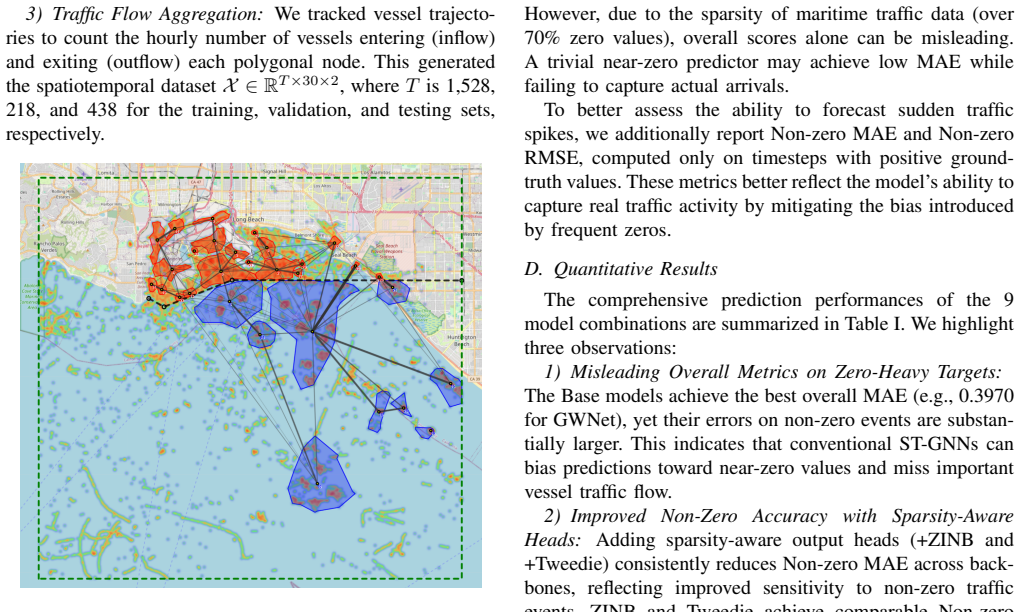
Accurate vessel traffic flow prediction is crucial for smart port operations and navigational safety. However, maritime traffic flow data are often highly sparse with intermittent bursts, making robust forecasting challenging. Under such conditions, conventional spatio-temporal graph neural networks (ST-GNNs) can degrade toward conservative near-zero predictions and fail to capture non-zero activity. Although zero-inflated negative binomial (ZINB) models partially address excess zeros, their two-part formulation can still remain conservative around abrupt transitions. To address these issues, we propose a model-agnostic learnable Tweedie head that can be attached as a plug-and-play output module to arbitrary ST-GNN backbones. Instead of likelihood-based Tweedie training, which typically requires surrogate objectives, our approach optimizes the closed-form Tweedie unit deviance and predicts the mean for point forecasting while learning a node-level variance power to capture heterogeneous variability across port areas. Experiments on a maritime traffic graph constructed from real-world AIS data in the Port of Los Angeles and Long Beach show that the proposed head consistently improves RMSE across multiple ST-GNN backbones, especially on non-zero events, leading to more reliable forecasts for practical maritime traffic control.
Editorial analysis
A structured set of objections, weighed in public.
Referee Report
Summary. The manuscript proposes attaching a model-agnostic learnable Tweedie head to arbitrary ST-GNN backbones for vessel traffic flow prediction on sparse, zero-inflated maritime data. The head predicts the mean via optimization of the closed-form Tweedie unit deviance (for 1 < p < 2) while learning node-level variance power parameters to capture heterogeneous variability; experiments on an AIS-derived graph from the Port of Los Angeles and Long Beach are claimed to show consistent RMSE gains across backbones, especially on non-zero events.
Significance. If the reported improvements prove robust under standard experimental controls, the plug-and-play Tweedie head offers a lightweight way to mitigate conservative near-zero predictions in ST-GNNs for count-valued spatio-temporal series without requiring surrogate losses or two-part zero-inflated formulations. The closed-form unit-deviance training is a concrete technical strength that aligns with established Tweedie GLM properties.
major comments (1)
- [Abstract / Experiments] Abstract and Experiments section: the central empirical claim of consistent RMSE improvement 'across multiple ST-GNN backbones, especially on non-zero events' is load-bearing, yet the manuscript supplies no quantitative baselines, error bars, ablation results, number of backbones tested, or data-split protocol; without these the claim cannot be assessed and the weakest assumption (reliable attachment without degradation on zero-heavy periods) remains untested.
Simulated Author's Rebuttal
We thank the referee for the detailed review and constructive feedback. We address the single major comment below and will revise the manuscript accordingly to strengthen the experimental reporting.
read point-by-point responses
-
Referee: [Abstract / Experiments] Abstract and Experiments section: the central empirical claim of consistent RMSE improvement 'across multiple ST-GNN backbones, especially on non-zero events' is load-bearing, yet the manuscript supplies no quantitative baselines, error bars, ablation results, number of backbones tested, or data-split protocol; without these the claim cannot be assessed and the weakest assumption (reliable attachment without degradation on zero-heavy periods) remains untested.
Authors: We agree that the current version of the manuscript does not provide sufficient quantitative detail to fully substantiate the central empirical claims. In the revised manuscript we will expand the Experiments section to include: explicit RMSE tables comparing each backbone with and without the Tweedie head; error bars or standard deviations computed over multiple random seeds; ablation results isolating the contribution of the learnable node-level variance power; the exact number and identities of the ST-GNN backbones evaluated; and a clear description of the temporal data-split protocol. We will also add a dedicated analysis (e.g., separate zero-event and non-zero-event metrics or time-series plots) to verify that attachment of the head does not degrade performance during zero-heavy periods. These additions will make the reported improvements verifiable and will directly address the concern about untested assumptions. revision: yes
Circularity Check
No significant circularity in derivation chain
full rationale
The paper proposes a model-agnostic learnable Tweedie head attached to arbitrary ST-GNN backbones, optimizing the closed-form unit deviance (standard for Tweedie GLMs when 1 < p < 2) to predict the mean while learning node-level variance power p. No equations, derivations, or self-citations in the abstract or described text reduce any claimed prediction or improvement to an input by construction, nor invoke uniqueness theorems or ansatzes from prior author work. The central claim rests on empirical RMSE improvements on real AIS data rather than tautological reparameterization, making the derivation self-contained against external benchmarks.
Axiom & Free-Parameter Ledger
axioms (1)
- domain assumption Tweedie distributions are appropriate for modeling non-negative sparse count data with varying dispersion
invented entities (1)
-
learnable Tweedie head
no independent evidence
Reference graph
Works this paper leans on
-
[1]
Smart ports solutions for cargo container tracking and vessel traffic counting systems using iot and cloud computing,
S. Priya, A. Sairam, H. Azath, S. Manivannan, N. Mohankumar, and P. V . Vinayagam, “Smart ports solutions for cargo container tracking and vessel traffic counting systems using iot and cloud computing,” in2024 10th International Conference on Communication and Signal Processing (ICCSP). IEEE, 2024, pp. 1106–1111
2024
-
[2]
Ais data driven maritime traffic flow prediction and density visualization using multi- time scale temporal feature fusion network,
Y . Wang, R. W. Liu, J. Liu, L. Yang, and Y . Liu, “Ais data driven maritime traffic flow prediction and density visualization using multi- time scale temporal feature fusion network,”IEEE Sensors Journal, 2025
2025
-
[3]
Spatiotemporal auto-regressive model for origin–destination air passenger flows,
K. Kim, V . Kim, and H. Kim, “Spatiotemporal auto-regressive model for origin–destination air passenger flows,”Journal of the Royal Statistical Society Series A: Statistics in Society, vol. 182, no. 3, pp. 1003–1016, 2019
2019
-
[4]
Fine-grained vessel traffic flow prediction with a spatio-temporal multigraph convolutional network,
M. Liang, R. W. Liu, Y . Zhan, H. Li, F. Zhu, and F.-Y . Wang, “Fine-grained vessel traffic flow prediction with a spatio-temporal multigraph convolutional network,”IEEE Transactions on Intelligent Transportation Systems, vol. 23, no. 12, pp. 23 694–23 707, 2022
2022
-
[5]
Deep latent factor model for spatio- temporal forecasting,
W. Koo, E.-Y . Ma, and H. Kim, “Deep latent factor model for spatio- temporal forecasting,”Technometrics, vol. 66, no. 3, pp. 470–482, 2024
2024
-
[6]
Looking back on the current day: interruptibility prediction using daily behavioral features,
M. Choy, D. Kim, J.-G. Lee, H. Kim, and H. Motoda, “Looking back on the current day: interruptibility prediction using daily behavioral features,” inProceedings of the 2016 ACM international joint confer- ence on pervasive and ubiquitous computing, 2016, pp. 1004–1015
2016
-
[7]
Crime risk maps: A multivariate spatial analysis of crime data,
J. Chung and H. Kim, “Crime risk maps: A multivariate spatial analysis of crime data,”Geographical analysis, vol. 51, no. 4, pp. 475–499, 2019
2019
-
[8]
Spatio-Temporal Graph Convolutional Networks: A Deep Learning Framework for Traffic Forecasting
B. Yu, H. Yin, and Z. Zhu, “Spatio-temporal graph convolutional networks: A deep learning framework for traffic forecasting,”arXiv preprint arXiv:1709.04875, 2017
work page internal anchor Pith review Pith/arXiv arXiv 2017
-
[9]
Diffusion Convolutional Recurrent Neural Network: Data-Driven Traffic Forecasting
Y . Li, R. Yu, C. Shahabi, and Y . Liu, “Diffusion convolutional recur- rent neural network: Data-driven traffic forecasting,”arXiv preprint arXiv:1707.01926, 2017
work page internal anchor Pith review Pith/arXiv arXiv 2017
-
[10]
Graph WaveNet for Deep Spatial-Temporal Graph Modeling
Z. Wu, S. Pan, G. Long, J. Jiang, and C. Zhang, “Graph wavenet for deep spatial-temporal graph modeling,”arXiv preprint arXiv:1906.00121, 2019
work page internal anchor Pith review Pith/arXiv arXiv 1906
-
[11]
Predictive modelling for vessel traffic flow: A comprehensive survey from statistics to ai,
D. Chen, C. Huang, T. Fan, H. C. Lau, and X. Yan, “Predictive modelling for vessel traffic flow: A comprehensive survey from statistics to ai,”Transportation Safety and Environment, vol. 7, no. 3, p. tdaf022, 2025
2025
-
[12]
Predicting multi-port vessel traffic flow: An improved spatial-temporal graph neural network with uncertainty quantification,
M. Zhu, J. Cao, X. Zheng, Z. Huang, S. Chen, and Y . Wen, “Predicting multi-port vessel traffic flow: An improved spatial-temporal graph neural network with uncertainty quantification,”Ocean Engineering, vol. 329, p. 121135, 2025
2025
-
[13]
Uncertainty-aware traffic accident risk prediction via multi-view hypergraph contrastive learning,
Y . Zhang, G. Shen, W. Zhang, K. Ning, R. Jiang, and X. Kong, “Uncertainty-aware traffic accident risk prediction via multi-view hypergraph contrastive learning,”Information Fusion, vol. 124, p. 103331, 2025
2025
-
[14]
Generating sparse origin– destination flows on shared mobility networks using probabilistic graph neural networks,
Y . Liang, Z. Zhao, and C. Webster, “Generating sparse origin– destination flows on shared mobility networks using probabilistic graph neural networks,”Sustainable Cities and Society, vol. 114, p. 105777, 2024
2024
-
[15]
A comparison of zero-inflated and hurdle models for modeling zero-inflated count data,
C. X. Feng, “A comparison of zero-inflated and hurdle models for modeling zero-inflated count data,”Journal of statistical distributions and applications, vol. 8, no. 1, p. 8, 2021
2021
-
[16]
Un- certainty quantification via spatial-temporal tweedie model for zero- inflated and long-tail travel demand prediction,
X. Jiang, D. Zhuang, X. Zhang, H. Chen, J. Luo, and X. Gao, “Un- certainty quantification via spatial-temporal tweedie model for zero- inflated and long-tail travel demand prediction,” inProceedings of the 32nd ACM International Conference on Information and Knowledge Management, 2023, pp. 3983–3987
2023
-
[17]
Series evaluation of tweedie exponential dispersion model densities,
P. K. Dunn and G. K. Smyth, “Series evaluation of tweedie exponential dispersion model densities,”Statistics and Computing, vol. 15, no. 4, pp. 267–280, 2005
2005
-
[18]
Uncertainty-aware probabilistic graph neural networks for road-level traffic crash prediction,
X. Gao, X. Jiang, J. Haworth, D. Zhuang, S. Wang, H. Chen, and S. Law, “Uncertainty-aware probabilistic graph neural networks for road-level traffic crash prediction,”Accident Analysis & Prevention, vol. 208, p. 107801, 2024
2024
-
[19]
Daily ship traffic volume statistics and prediction based on automatic identification system data,
S. Wang, S. Wang, S. Gao, and W. Yang, “Daily ship traffic volume statistics and prediction based on automatic identification system data,” in2017 9th International Conference on Intelligent Human-Machine Systems and Cybernetics (IHMSC), vol. 2. IEEE, 2017, pp. 149–154
2017
-
[20]
Forecast of marine traffic volume using time series model,
S.-R. Yoo, J. S. Jeong, J.-Y . Jong, and G.-K. Park, “Forecast of marine traffic volume using time series model,” in2013 International Conference on Fuzzy Theory and Its Applications (iFUZZY). IEEE, 2013, pp. 122–126
2013
-
[21]
Ship traffic flow prediction in wind farms water area based on spatiotemporal dependence,
T. Xu and Q. Zhang, “Ship traffic flow prediction in wind farms water area based on spatiotemporal dependence,”Journal of Marine Science and Engineering, vol. 10, no. 2, p. 295, 2022
2022
-
[22]
Lstm networks for vessel traffic flow prediction in inland waterway,
Z. Xie and Q. Liu, “Lstm networks for vessel traffic flow prediction in inland waterway,” in2018 IEEE International Conference on Big Data and Smart Computing (BigComp). IEEE, 2018, pp. 418–425
2018
-
[23]
Using deep learning to forecast maritime vessel flows,
X. Zhou, Z. Liu, F. Wang, Y . Xie, and X. Zhang, “Using deep learning to forecast maritime vessel flows,”Sensors, vol. 20, no. 6, p. 1761, 2020
2020
-
[24]
Contextual anomaly detection for multivariate time series data,
H. Kim and H. Kim, “Contextual anomaly detection for multivariate time series data,”Quality Engineering, vol. 35, no. 4, pp. 686–695, 2023
2023
-
[25]
Semi-supervised learning for simul- taneous location detection and classification of mixed-type defect patterns in wafer bin maps,
H. Lee, J. Lee, and H. Kim, “Semi-supervised learning for simul- taneous location detection and classification of mixed-type defect patterns in wafer bin maps,”IEEE Transactions on Semiconductor Manufacturing, vol. 36, no. 2, pp. 220–230, 2023
2023
-
[26]
Application of kernel principal com- ponent analysis to multi-characteristic parameter design problems,
W. Soh, H. Kim, and B.-J. Yum, “Application of kernel principal com- ponent analysis to multi-characteristic parameter design problems,” Annals of Operations research, vol. 263, no. 1, pp. 69–91, 2018
2018
-
[27]
Dependence maps, a dimensionality reduction with dependence distance for high-dimensional data,
K. Lee, A. Gray, and H. Kim, “Dependence maps, a dimensionality reduction with dependence distance for high-dimensional data,”Data Mining and Knowledge Discovery, vol. 26, no. 3, pp. 512–532, 2013
2013
-
[28]
Spatio- temporal graph neural network fused with maritime knowledge for predicting traffic flows in ports,
Q. Mei, Z. Li, Q. Hu, X. Zhi, P. Wang, Y . Yang, and X. Liu, “Spatio- temporal graph neural network fused with maritime knowledge for predicting traffic flows in ports,”Regional Studies in Marine Science, vol. 85, p. 104106, 2025
2025
-
[29]
Uncertainty quantification of sparse travel demand prediction with spatial-temporal graph neural networks,
D. Zhuang, S. Wang, H. Koutsopoulos, and J. Zhao, “Uncertainty quantification of sparse travel demand prediction with spatial-temporal graph neural networks,” inProceedings of the 28th ACM SIGKDD Conference on Knowledge Discovery and Data Mining, 2022, pp. 4639–4647
2022
-
[30]
Dealing with zero-inflated data: Achieving state-of-the-art with a two-fold machine learning approach,
J. M. Ro ˇzanec, G. Petelin, J. Costa, G. Cerar, B. Bertalaniˇc, M. Guˇcek, G. Papa, and D. Mladeni´c, “Dealing with zero-inflated data: Achieving state-of-the-art with a two-fold machine learning approach,”Engineer- ing Applications of Artificial Intelligence, vol. 149, p. 110339, 2025
2025
-
[31]
Contextual anomaly detection for high- dimensional data using dirichlet process variational autoencoder,
H. Kim and H. Kim, “Contextual anomaly detection for high- dimensional data using dirichlet process variational autoencoder,”IISE Transactions, vol. 55, no. 5, pp. 433–444, 2023
2023
-
[32]
Locally most powerful bayesian test for out-of-distribution detection using deep generative models,
K. Kim, J. Shin, and H. Kim, “Locally most powerful bayesian test for out-of-distribution detection using deep generative models,”Advances in Neural Information Processing Systems, vol. 34, pp. 14 913–14 924, 2021
2021
-
[33]
Uncertainty estimation by density aware evidential deep learning,
T. Yoon and H. Kim, “Uncertainty estimation by density aware evidential deep learning,”arXiv preprint arXiv:2409.08754, 2024
-
[34]
Uncertainty estimation by flexible evidential deep learning,
——, “Uncertainty estimation by flexible evidential deep learning,” Advances in Neural Information Processing Systems, vol. 38, pp. 118 601–118 641, 2026
2026
discussion (0)
Sign in with ORCID, Apple, or X to comment. Anyone can read and Pith papers without signing in.