The Windows IOCTL Census: A Corpus-Scale, Multi-Architecture Database of the Driver Control-Code Surface
Pith reviewed 2026-06-27 21:10 UTC · model grok-4.3
The pith
A queryable database recovers the IOCTL dispatch surfaces of 27,087 signed Windows drivers using a deterministic pass.
A machine-rendered reading of the paper's core claim, the machinery that carries it, and where it could break.
Core claim
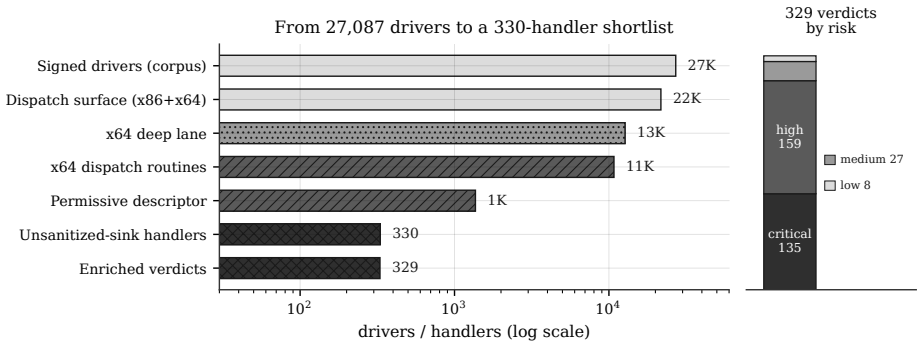
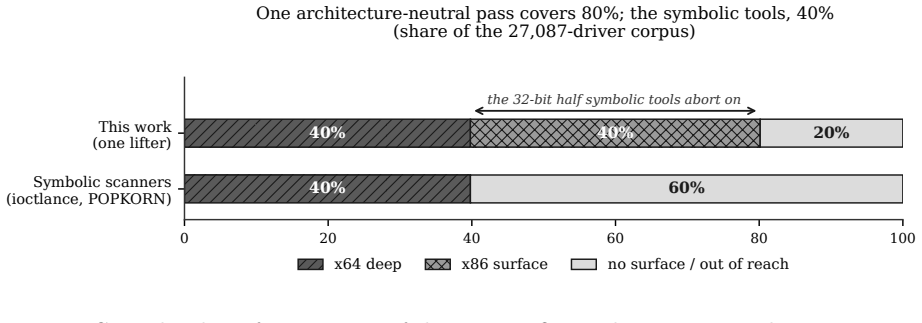
The Windows IOCTL Census is a queryable database of the control-code dispatch surface of 27,087 signed Windows drivers, recovered by one deterministic, architecture-neutral pass with no symbolic execution. Reading a lifted intermediate representation instead of running a symbolic engine lets it recover a dispatch surface for 80% of the corpus across x86 and x64, including the 32-bit half existing scanners abort on. On the 64-bit lane it adds handler reachability, taint, and the call graph. An LLM ranks the reachable handlers for triage. We release the census as a public dataset of tens of millions of rows: 27,087 binaries, 3.1M decoded control codes, 8.18M functions, and 15.95M call edges.
What carries the argument
The deterministic architecture-neutral analysis pass over the lifted intermediate representation that extracts dispatch tables and control-code logic from driver binaries.
If this is right
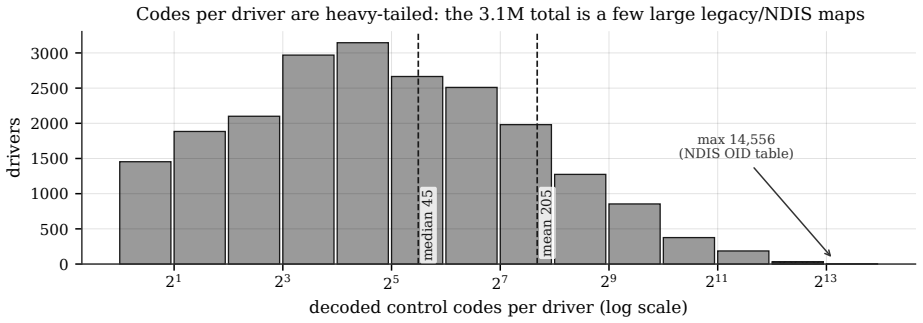
- The database enables queries over 3.1 million decoded control codes and 15.95 million call edges.
- Analysis now covers both 32-bit and 64-bit drivers in the same corpus where prior tools handled only one architecture.
- Reachability, taint, and call-graph data become available for the 64-bit drivers.
- An LLM-based ranking step produces a triage list of reachable handlers.
- The full dataset is released for public use with tens of millions of rows.
Where Pith is reading between the lines
- Security researchers could use the census to prioritize scanning of drivers that expose many reachable handlers.
- The recovery method might be extended to track additional properties such as buffer-length checks on the same IR.
- Similar corpus-scale extraction could be applied to other kernel interfaces that use dispatch tables.
- Periodic re-runs of the census on new driver releases would track changes in the exposed surface over time.
Load-bearing premise
The lifted intermediate representation accurately captures the dispatch tables and control-code logic for the 80% of drivers that succeed, without architecture-specific decoding errors or missed handlers.
What would settle it
A manual or dynamic check on a random sample of drivers that finds the extracted control codes or handler addresses differ from actual runtime dispatch behavior in more than a small fraction of cases.
Figures

read the original abstract
A Windows driver exposes its kernel through I/O control (IOCTL) codes, and a single unchecked length on the buffer behind one turns an unprivileged call into a kernel write. The research community has strong scanners for this surface and a curated list of known-bad drivers, but no map of the surface itself. We build that map. The Windows IOCTL Census is a queryable database of the control-code dispatch surface of 27,087 signed Windows drivers, recovered by one deterministic, architecture-neutral pass with no symbolic execution. Reading a lifted intermediate representation instead of running a symbolic engine lets it recover a dispatch surface for 80% of the corpus across x86 and x64, including the 32-bit half existing scanners abort on. On the 64-bit lane it adds handler reachability, taint, and the call graph. An LLM ranks the reachable handlers for triage. We release the census as a public dataset of tens of millions of rows: 27,087 binaries, 3.1M decoded control codes, 8.18M functions, and 15.95M call edges.
Editorial analysis
A structured set of objections, weighed in public.
Referee Report
Summary. The paper presents the Windows IOCTL Census, a queryable public database of the control-code dispatch surfaces recovered from 27,087 signed Windows drivers. Recovery is performed via a single deterministic, architecture-neutral lift to an intermediate representation (no symbolic execution), achieving 80% coverage across x86 and x64 (including 32-bit drivers). The release contains 3.1M decoded control codes, 8.18M functions, and 15.95M call edges; 64-bit analysis additionally includes handler reachability, taint tracking, and call graphs, with an LLM used to rank reachable handlers for triage.
Significance. If the IR-based recovery is reliable, the work supplies the first corpus-scale map of the Windows driver IOCTL surface, directly addressing a gap between existing scanners and the need for a comprehensive view of potential kernel-attack surfaces. The deterministic single-pass design, explicit multi-architecture support, and public release of tens of millions of rows constitute clear strengths that enable downstream security research without requiring symbolic execution or architecture-specific tooling.
major comments (1)
- [Abstract] Abstract: the central claim that the lifted IR recovers dispatch surfaces for 80% of the corpus rests on the unvalidated assumption that the IR accurately captures dispatch tables and control-code logic; no ground-truth comparison, false-positive rate, or manual validation set is referenced, which is load-bearing for any assertion of recovery accuracy.
minor comments (2)
- The abstract reports aggregate counts (3.1M control codes, 8.18M functions, 15.95M edges) but does not break down success rates or failure modes by architecture or driver size; adding a small table or paragraph with these statistics would improve interpretability of the 80% figure.
- The description of the LLM-based ranking step is brief; clarifying the prompt template, model used, and how rankings are stored in the released dataset would aid reproducibility.
Simulated Author's Rebuttal
We thank the referee for highlighting the need for explicit validation of the IR recovery accuracy. We address this point directly below and will revise the manuscript accordingly.
read point-by-point responses
-
Referee: [Abstract] Abstract: the central claim that the lifted IR recovers dispatch surfaces for 80% of the corpus rests on the unvalidated assumption that the IR accurately captures dispatch tables and control-code logic; no ground-truth comparison, false-positive rate, or manual validation set is referenced, which is load-bearing for any assertion of recovery accuracy.
Authors: We agree that the abstract (and current manuscript) does not reference a ground-truth comparison or manual validation set, making the 80% figure an unvalidated claim as stated. The 80% metric is computed as the share of binaries in which the deterministic IR lift located a dispatch table structure and extracted at least one control code; it does not yet include precision/recall against decompiled ground truth. We will add a new validation section that reports: (1) manual review of a stratified sample of 200 drivers (100 x86, 100 x64) with source or PDBs where available, (2) estimated false-positive rate from cross-checking decoded codes against reachable handler logic, and (3) a small false-negative probe on known drivers. This revision will be incorporated without altering the core single-pass methodology. revision: yes
Circularity Check
No significant circularity; data collection and IR-lifting effort
full rationale
The paper presents a deterministic, architecture-neutral lifting pass over 27k signed drivers to recover dispatch surfaces and build a public database. No equations, fitted parameters, predictions, or derivations appear in the abstract or described method. The 80% recovery claim is an empirical outcome of the single-pass process rather than a reduction to prior fitted values or self-citations. The work is self-contained as corpus construction; accuracy questions are external and do not create internal circularity.
Axiom & Free-Parameter Ledger
axioms (1)
- domain assumption The lifted intermediate representation faithfully represents the control flow and dispatch logic of the drivers.
Forward citations
Cited by 1 Pith paper
-
The Linux IOCTL Census: A Source-Derived Database of the Linux Kernel Control-Code Surface
Presents the Linux IOCTL Census, a source-derived database of 586 dispatch points, 1289 command codes, 3583 input sinks and 1298 permission gates extracted from the kernel, with capability-ungated surface separated an...
Reference graph
Works this paper leans on
-
[1]
Rajamani, and Abdullah Ustuner
Thomas Ball, Ella Bounimova, Byron Cook, Vladimir Levin, Jakob Lichtenberg, Con McGarvey, Bohus Ondrusek, Sriram K. Rajamani, and Abdullah Ustuner. Thorough static analysis of device drivers. InProceedings of the 1st ACM SIGOPS/EuroSys European Conference 13 on Computer Systems (EuroSys), pages 73–85, 2006. Static Driver Verifier (SDV).https: //doi.org/10...
-
[2]
Bommarito II
Michael J. Bommarito II. glaurung: A permissive, modern binary-analysis toolkit with a Rust/Python core and first-class agentic integration, 2026.https://github.com/mjbommar/gl aurung
2026
-
[3]
Bommarito II
Michael J. Bommarito II. IOCTLance: Refactored fork, 2026. Refactor of the original IOCTLance with a parallel batch runner and time and space bounds for the out-of-memory and pathological-runtime cases whole-driver symbolic execution hits at corpus scale.https: //github.com/mjbommar/ioctlance
2026
-
[4]
Bommarito II
Michael J. Bommarito II. The linux IOCTL census: A source-derived database of the kernel control-code surface, 2026. Companion source-derived census of the Linux ioctl control-code surface on the shared schema. Preprint
2026
-
[5]
Bommarito II
Michael J. Bommarito II. Needles at scale: LLM-assisted target selection for Windows vulnera- bility research, 2026. Preprint (forthcoming)
2026
-
[6]
Bommarito II
Michael J. Bommarito II. The windows IOCTL census (structural tier). Hugging Face dataset, 2026.https://huggingface.co/datasets/mjbommar/ioctl-census
2026
-
[7]
DIFUZE: Interface aware fuzzing for kernel drivers
Jake Corina, Aravind Machiry, Christopher Salls, Yan Shoshitaishvili, Shuang Hao, Christopher Kruegel, and Giovanni Vigna. DIFUZE: Interface aware fuzzing for kernel drivers. InProceedings of the 2017 ACM SIGSAC Conference on Computer and Communications Security (CCS), pages 2123–2138, 2017.https://doi.org/10.1145/3133956.3134069
-
[8]
IRPMon: A tool for monitoring requests sent to windows drivers, 2015.https: //github.com/MartinDrab/IRPMon
Martin Drab. IRPMon: A tool for monitoring requests sent to windows drivers, 2015.https: //github.com/MartinDrab/IRPMon
2015
-
[9]
Caleb Gross. Sift or get off the PoC: Applying information retrieval to vulnerability research with SiftRank, 2025.https://arxiv.org/abs/2512.06155
arXiv 2025
-
[10]
POPKORN: Popping Windows kernel drivers at scale
Rajat Gupta, Lukas Patrick Dresel, Noah Spahn, Giovanni Vigna, Christopher Kruegel, and Taesoo Kim. POPKORN: Popping Windows kernel drivers at scale. InProceedings of the 38th Annual Computer Security Applications Conference (ACSAC), 2022. https://sites.cs.ucsb. edu/~chris/research/doc/acsac22_popkorn.pdf
2022
-
[11]
Hunting vulnerable kernel drivers, 2023
Takahiro Haruyama. Hunting vulnerable kernel drivers, 2023. VMware Threat Analysis Unit. https://blogs.vmware.com/security/2023/10/hunting-vulnerable-kernel-drivers.h tml
2023
-
[12]
Nasir Hussain et al. VulBinLLM: LLM-powered vulnerability detection for stripped binaries, 2025.https://arxiv.org/abs/2505.22010
arXiv 2025
-
[13]
IOCTLance: Enhanced vulnerability hunting in Windows driver model drivers with symbolic execution and taint analysis, 2023
Zeze Lin. IOCTLance: Enhanced vulnerability hunting in Windows driver model drivers with symbolic execution and taint analysis, 2023. CODE BLUE 2023.https://github.com/zeze-z eze/ioctlance
2023
-
[14]
Efficacy of large language models in detecting vulnerabilities in Windows kernel-mode drivers, 2025
Matthias Loong. Efficacy of large language models in detecting vulnerabilities in Windows kernel-mode drivers, 2025. CSIT tech blog.https://medium.com/csit-tech-blog/effica cy-of-large-language-models-llms-in-detecting-vulnerabilities-in-windows-kerne l-mode-ff468c498c63. 14
2025
-
[15]
Aravind Machiry, Chad Spensky, Jake Corina, Nick Stephens, Christopher Kruegel, and Giovanni Vigna. DR. CHECKER: A soundy analysis for Linux kernel drivers. InProceedings of the 26th USENIX Security Symposium, pages 1007–1024, 2017.https://www.usenix.org/conference/ usenixsecurity17/technical-sessions/presentation/machiry
2017
-
[16]
LOLDrivers: Living off the land drivers, 2023
MagicSword. LOLDrivers: Living off the land drivers, 2023. Open catalog of vulnerable and malicious Windows drivers.https://www.loldrivers.io/
2023
-
[17]
Winbindex: The windows binaries index, 2020.https://winbindex.m417z
Michael Maltsev. Winbindex: The windows binaries index, 2020.https://winbindex.m417z. com
2020
-
[18]
Unveiling BYOVD threats: Malware’s use and abuse of kernel drivers
Andrea Monzani, Antonio Parata, Andrea Oliveri, Simone Aonzo, Davide Balzarotti, and Andrea Lanzi. Unveiling BYOVD threats: Malware’s use and abuse of kernel drivers. In Proceedings of the Network and Distributed System Security Symposium (NDSS), 2026. https: //www.ndss-symposium.org/wp-content/uploads/2026-s1491-paper.pdf
2026
-
[19]
Screwed Drivers: Signed, sealed, delivered, 2019
Mickey Shkatov and Jesse Michael. Screwed Drivers: Signed, sealed, delivered, 2019. DEF CON 27; Eclypsium research.https://eclypsium.com/research/screwed-drivers-signed-sea led-delivered/
2019
-
[20]
Building a scalable Windows driver vulnerability analyzer, 2026
Threat Unpacked. Building a scalable Windows driver vulnerability analyzer, 2026. Parts 1–2. https://threatunpacked.com/2026/01/21/building-a-scalable-windows-driver-vulne rability-analyzer-part-1/. 15
2026
discussion (0)
Sign in with ORCID, Apple, or X to comment. Anyone can read and Pith papers without signing in.