Extending asteroseismic magnetometry across the diverse landscape of magnetic structures
Pith reviewed 2026-06-27 20:34 UTC · model grok-4.3
The pith
Non-axisymmetric magnetic fields induce avoided crossings and polarization conversion in magnetogravity waves below a stratification threshold.
A machine-rendered reading of the paper's core claim, the machinery that carries it, and where it could break.
Core claim
By generalizing the polarization calculation to non-axisymmetric fields, including a misaligned dipole and a dipole-plus-quadrupole configuration, the work shows that such geometries induce avoided crossings between polarizations and permit waves to convert between magnetogravity polarization states as they propagate, most readily when the local field lies below a stratification-dependent threshold distinct from the critical value for mode suppression.
What carries the argument
Polarization calculation for magnetogravity waves extended to arbitrarily shaped fields, which tracks propagation and inter-polarization conversion inside a waveguide cavity.
If this is right
- Mode frequencies become predictable for stars whose magnetic fields lack rotational symmetry up to the critical strength.
- Avoided crossings appear in the oscillation spectrum from polarization interactions.
- Polarization conversion occurs in sub-threshold regions and alters wave trapping and amplitudes.
- The formalism applies equally to misaligned dipoles and to fields with no symmetry at all.
- Observed mode patterns can therefore discriminate among different internal field geometries.
Where Pith is reading between the lines
- Seismic data could be inverted for the dominant multipole components of the internal field rather than assuming axisymmetry.
- The local threshold may produce observable changes in mode damping or visibility before full suppression sets in.
- Similar polarization conversion could affect wave mixing or angular-momentum transport in other stratified, magnetized fluids.
- Numerical simulations of wave packets in three-dimensional fields could test the predicted conversion rates directly.
Load-bearing premise
The traditional approximation of rotation and magnetism extends to non-axisymmetric fields without uncontrolled errors in the polarization or waveguide treatment.
What would settle it
A measured period-spacing pattern in a red giant whose surface or core field geometry is independently mapped to be non-axisymmetric and shows avoided crossings or splitting anomalies that match only the non-axisymmetric polarization predictions.
Figures



read the original abstract
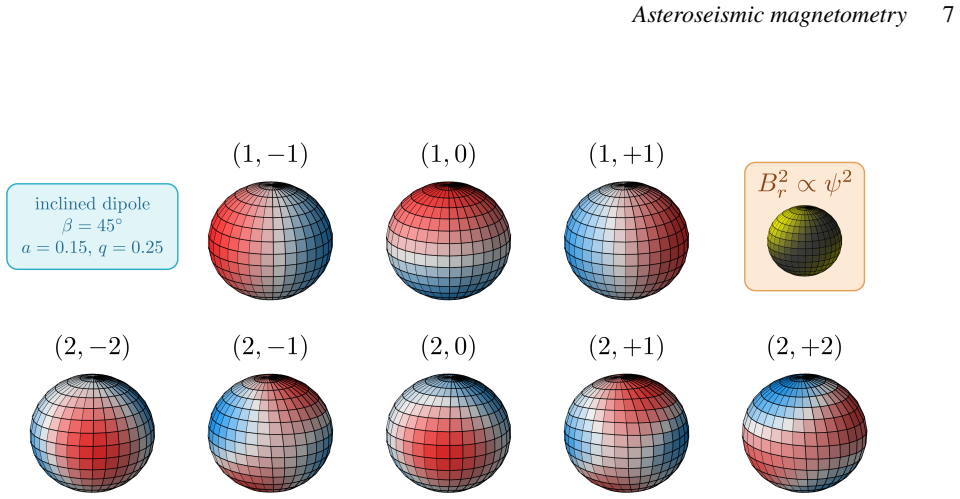
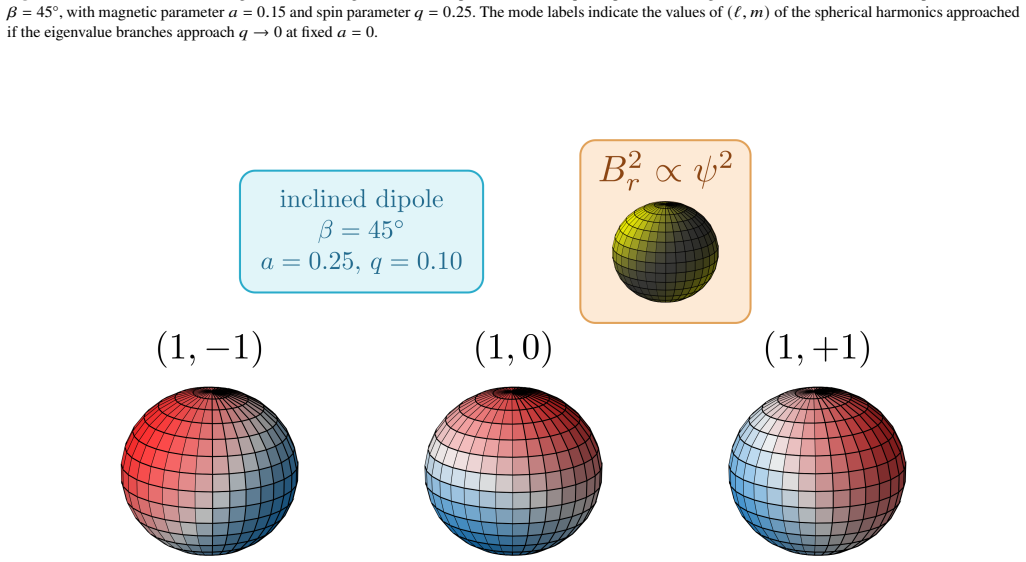
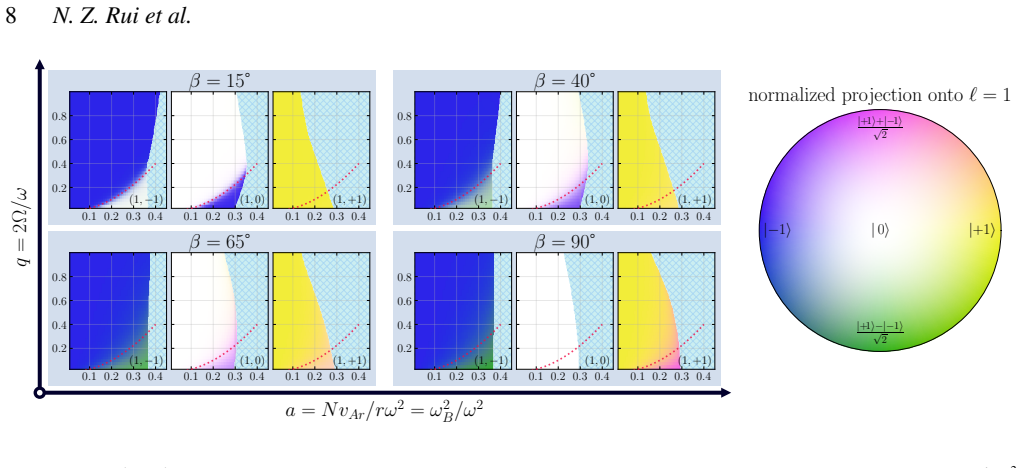
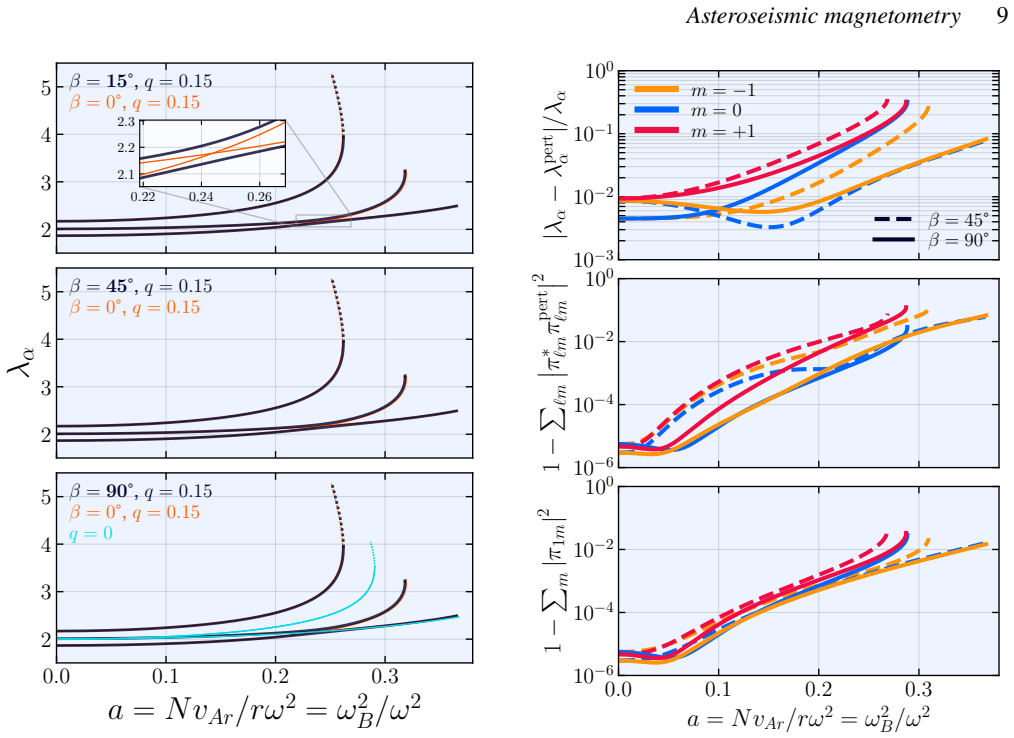
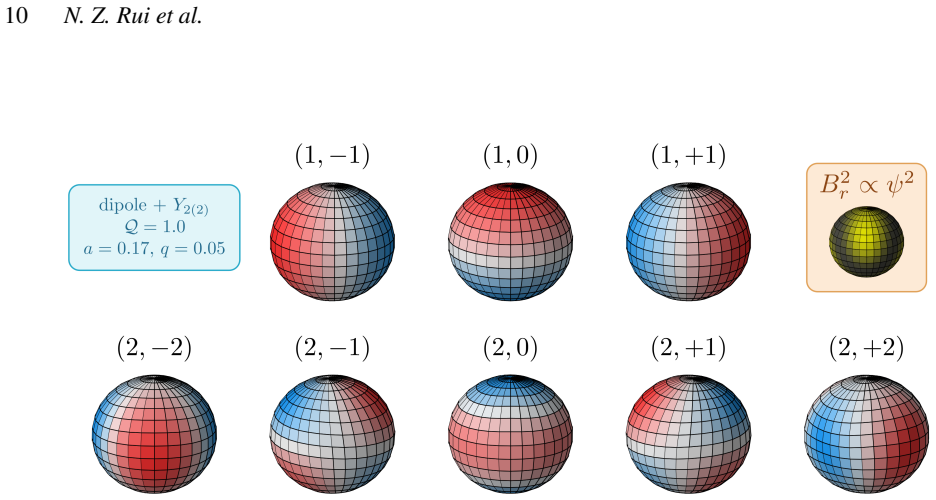
Magnetic fields have now been asteroseismically measured in the cores of many red giants. However, most interpretations of these measurements assume that the magnetic field is far below the critical field strength known to be exceeded by red giants exhibiting gravity-mode suppression. A recent method based on the traditional approximation of rotation and magnetism accurately predicts mode frequencies under fields up to this critical value by modeling gravity waves as individual magnetogravity ``polarizations'' which propagate through a waveguide-like mode cavity. So far, this formalism has been limited to magnetic fields which are axisymmetric about the rotation axis. In this study, we extend this approach by calculating the polarizations of magnetogravity waves under arbitrarily shaped magnetic fields under potentially rapid rotation. We consider the special cases of a dipolar magnetic field misaligned with the rotation axis as well as a dipole-plus-quadrupole magnetic field with no rotational symmetry. We show that non-axisymmetric field configurations can induce avoided crossings between polarizations, and that waves in such systems can convert between magnetogravity polarizations as they propagate, especially when the magnetic field strength is locally below a stratification-dependent threshold value. This threshold is distinct from the critical field strength for gravity-mode suppression, and is instead similar to the magnetic field strength at which perturbation theory breaks down.
Editorial analysis
A structured set of objections, weighed in public.
Referee Report
Summary. The paper extends the traditional approximation of rotation and magnetism to non-axisymmetric magnetic fields in red-giant cores. It computes magnetogravity-wave polarizations for a misaligned dipole and a dipole-plus-quadrupole configuration, and reports that non-axisymmetric geometries produce avoided crossings between polarizations together with polarization conversion when the local field lies below a stratification-dependent threshold (distinct from the critical field for gravity-mode suppression).
Significance. If the extension is shown to be controlled, the work would allow asteroseismic magnetometry to be applied to stars whose internal fields lack rotational symmetry, thereby enlarging the set of observable magnetic configurations that can be probed before gravity-mode suppression sets in.
major comments (1)
- [§2–3] §2–3: the wave-equation separation assumes the magnetic perturbation remains a small correction to the stratification, yet the manuscript does not derive the magnitude of the azimuthal coupling terms that appear once axisymmetry is dropped. If those terms become O(1) near the reported local threshold, the waveguide picture and the predicted conversion rates are uncontrolled.
Simulated Author's Rebuttal
We thank the referee for the careful reading and for identifying the need to quantify the azimuthal coupling terms in non-axisymmetric geometries. We address the single major comment below and will revise the manuscript accordingly.
read point-by-point responses
-
Referee: [§2–3] §2–3: the wave-equation separation assumes the magnetic perturbation remains a small correction to the stratification, yet the manuscript does not derive the magnitude of the azimuthal coupling terms that appear once axisymmetry is dropped. If those terms become O(1) near the reported local threshold, the waveguide picture and the predicted conversion rates are uncontrolled.
Authors: We agree that the manuscript does not contain an explicit derivation or scaling estimate of the azimuthal coupling terms that arise when axisymmetry is relaxed. In the revised version we will add, in §2–3, a perturbative scaling analysis demonstrating that these coupling coefficients remain O(ε) with ε ≪ 1 throughout the regime below the reported stratification-dependent threshold. This estimate will be obtained by projecting the non-axisymmetric Lorentz force onto the basis of the axisymmetric magnetogravity polarizations and showing that the off-diagonal matrix elements stay small precisely where the local Alfvén frequency is below the buoyancy frequency scale that defines the threshold. With this addition the separation remains controlled and the waveguide picture together with the conversion rates are placed on a firmer footing. revision: yes
Circularity Check
Minor self-citation to prior formalism; central extension remains independent
full rationale
The paper extends a cited prior method for axisymmetric fields to non-axisymmetric configurations by direct calculation of polarizations under arbitrary B(r,θ,φ). No equations or claims reduce by construction to fitted inputs from the same dataset, self-definitional loops, or load-bearing self-citations whose validity depends on the present work. The derivation chain is mathematically self-contained once the traditional approximation is accepted as external input, yielding a low circularity score consistent with normal citation of independent prior formalism.
Axiom & Free-Parameter Ledger
Reference graph
Works this paper leans on
-
[1]
Conversion and Damping of Non-axisymmetric Internal Gravity Waves in Magnetized Stellar Cores. arXiv e-prints , keywords =. doi:10.48550/arXiv.2510.14026 , archivePrefix =. 2510.14026 , primaryClass =
-
[2]
Dipole modes with depressed amplitudes in red giants are mixed modes
Dipole modes with depressed amplitudes in red giants are mixed modes. , keywords =. doi:10.1051/0004-6361/201629494 , archivePrefix =. 1610.03872 , primaryClass =
work page internal anchor Pith review Pith/arXiv arXiv doi:10.1051/0004-6361/201629494
-
[3]
Dissipation of mode energy in dipole-like magnetic fields
Oscillations of red giant stars with magnetic damping in the core: I. Dissipation of mode energy in dipole-like magnetic fields. , keywords =. doi:10.1051/0004-6361/202553888 , archivePrefix =. 2503.11451 , primaryClass =
-
[4]
Magnetic Webs in Stellar Radiative Zones. , keywords =. doi:10.3847/2041-8213/adefda , archivePrefix =. 2504.07223 , primaryClass =
-
[5]
Dynamo action by differential rotation in a stably stratified stellar interior
Dynamo action by differential rotation in a stably stratified stellar interior. , keywords =. doi:10.1051/0004-6361:20011465 , archivePrefix =. astro-ph/0108207 , primaryClass =
work page internal anchor Pith review Pith/arXiv arXiv doi:10.1051/0004-6361:20011465
-
[6]
Signatures of Core-envelope Rotational Misalignment in the Mixed-mode Asteroseismology of Kepler-56. , keywords =. doi:10.3847/1538-4357/ada4a3 , archivePrefix =. 2412.19451 , primaryClass =
-
[7]
Semianalytic Expressions for the Isolation and Coupling of Mixed Modes. , keywords =. doi:10.3847/1538-4357/ab9ffb , archivePrefix =. 2006.13313 , primaryClass =
-
[8]
Reports on Progress in Physics , keywords =
REVIEW ARTICLE: Magnetoconvection. Reports on Progress in Physics , keywords =. doi:10.1088/0034-4885/45/11/003 , adsurl =
-
[9]
Seismology and diffusion of ultramassive white dwarf magnetic fields. , keywords =. doi:10.1093/mnras/staf1365 , archivePrefix =. 2507.05343 , primaryClass =
-
[10]
Asteroseismology Can Reveal Strong Internal Magnetic Fields in Red Giant Stars
Asteroseismology can reveal strong internal magnetic fields in red giant stars. Science , keywords =. doi:10.1126/science.aac6933 , archivePrefix =. 1510.06960 , primaryClass =
work page internal anchor Pith review Pith/arXiv arXiv doi:10.1126/science.aac6933
-
[11]
Angular momentum transport within evolved low-mass stars
Angular Momentum Transport within Evolved Low-mass Stars. , keywords =. doi:10.1088/0004-637X/788/1/93 , archivePrefix =. 1405.1419 , primaryClass =
work page internal anchor Pith review Pith/arXiv arXiv doi:10.1088/0004-637x/788/1/93
-
[12]
It's Not Just a Phase: Oblique Pulsations in Magnetic Red Giants and Other Stochastic Oscillators. , keywords =. doi:10.3847/2041-8213/add5e2 , archivePrefix =. 2505.03169 , primaryClass =
-
[13]
Supersensitive Seismic Magnetometry of White Dwarfs. , keywords =. doi:10.3847/1538-4357/adaf9e , archivePrefix =. 2410.20557 , primaryClass =
-
[14]
Asteroseismic g-mode period spacings in strongly magnetic rotating stars. , keywords =. doi:10.1093/mnras/stad3461 , archivePrefix =. 2310.19873 , primaryClass =
-
[15]
Gravity waves in strong magnetic fields. , keywords =. doi:10.1093/mnras/stad1424 , archivePrefix =. 2303.08147 , primaryClass =
-
[16]
Asteroseismic inference of the near-core magnetic field strength in the main-sequence B star HD 43317. , keywords =. doi:10.1093/mnrasl/slac013 , archivePrefix =. 2202.03440 , primaryClass =
-
[17]
Conversion of Internal Gravity Waves into Magnetic Waves
Conversion of internal gravity waves into magnetic waves. , keywords =. doi:10.1093/mnras/stw3273 , archivePrefix =. 1610.08506 , primaryClass =
work page internal anchor Pith review Pith/arXiv arXiv doi:10.1093/mnras/stw3273
-
[18]
Magnetic signatures on mixed-mode frequencies. II. Period spacings as a probe of the internal magnetism of red giants. , keywords =. doi:10.1051/0004-6361/202243167 , archivePrefix =. 2208.14954 , primaryClass =
-
[19]
Magnetic signatures on mixed-mode frequencies. I. An axisymmetric fossil field inside the core of red giants. , keywords =. doi:10.1051/0004-6361/202039159 , archivePrefix =. 2102.01216 , primaryClass =
-
[20]
Asteroseismic signatures of evolving internal stellar magnetic fields
Asteroseismic Signatures of Evolving Internal Stellar Magnetic Fields. , keywords =. doi:10.3847/0004-637X/824/1/14 , archivePrefix =. 1602.03056 , primaryClass =
work page internal anchor Pith review Pith/arXiv arXiv doi:10.3847/0004-637x/824/1/14
-
[21]
Strong magnetic fields detected in the cores of 11 red giant stars using gravity-mode period spacings. , keywords =. doi:10.1051/0004-6361/202245282 , archivePrefix =. 2301.01308 , primaryClass =
-
[22]
Magnetic fields of 30 to 100 kG in the cores of red giant stars. , keywords =. doi:10.1038/s41586-022-05176-0 , archivePrefix =. 2208.09487 , primaryClass =
-
[23]
Suppression of quadrupole and octupole modes in red giants observed by Kepler
Suppression of Quadrupole and Octupole Modes in Red Giants Observed by Kepler *. , keywords =. doi:10.1017/pasa.2016.9 , archivePrefix =. 1602.05193 , primaryClass =
work page internal anchor Pith review Pith/arXiv arXiv doi:10.1017/pasa.2016.9 2016
-
[24]
Asteroseismic detection of a predominantly toroidal magnetic field in the deep interior of the main-sequence F star KIC 9244992. , keywords =. doi:10.1093/mnras/staf2153 , archivePrefix =. 2512.00786 , primaryClass =
-
[25]
A prevalence of dynamo-generated magnetic fields in the cores of intermediate-mass stars
A prevalence of dynamo-generated magnetic fields in the cores of intermediate-mass stars. , keywords =. doi:10.1038/nature16171 , archivePrefix =. 1601.00004 , primaryClass =
work page internal anchor Pith review Pith/arXiv arXiv doi:10.1038/nature16171
-
[26]
Asteroseismology of Solar-Type and Red-Giant Stars
Asteroseismology of Solar-Type and Red-Giant Stars. , keywords =. doi:10.1146/annurev-astro-082812-140938 , archivePrefix =. 1303.1957 , primaryClass =
work page internal anchor Pith review Pith/arXiv arXiv doi:10.1146/annurev-astro-082812-140938 1957
-
[27]
The Kepler view of Doradus stars. , keywords =. doi:10.1111/j.1365-2966.2011.18973.x , adsurl =
-
[28]
, year = 2009, month = sep, volume =
Hot Subdwarf Stars. , year = 2009, month = sep, volume =. doi:10.1146/annurev-astro-082708-101836 , adsurl =
-
[29]
Pulsating white dwarfs: new insights. , keywords =. doi:10.1007/s00159-019-0118-4 , archivePrefix =. 1907.00115 , primaryClass =
-
[30]
Study of KIC 8561221 observed by Kepler: an early red giant showing depressed dipolar modes
Study of KIC 8561221 observed by Kepler: an early red giant showing depressed dipolar modes. , keywords =. doi:10.1051/0004-6361/201322823 , archivePrefix =. 1311.6990 , primaryClass =
work page internal anchor Pith review Pith/arXiv arXiv doi:10.1051/0004-6361/201322823
-
[31]
Asteroseismic signatures of core magnetism and rotation in hundreds of low-luminosity red giants. , keywords =. doi:10.1093/mnras/stae2053 , archivePrefix =. 2409.01157 , primaryClass =
-
[32]
Period spacings of gravity modes in rapidly rotating magnetic stars. I. Axisymmetric fossil field with poloidal and toroidal components. , keywords =. doi:10.1051/0004-6361/201935462 , archivePrefix =. 1903.05620 , primaryClass =
work page internal anchor Pith review Pith/arXiv arXiv doi:10.1051/0004-6361/201935462 1903
-
[33]
Period spacings of gravity modes in rapidly rotating magnetic stars. II. The case of an oblique dipolar fossil magnetic field. , keywords =. doi:10.1051/0004-6361/201937398 , archivePrefix =. 2003.08218 , primaryClass =
-
[34]
Probing the internal magnetism of stars using asymptotic magneto-asteroseismology. , keywords =. doi:10.1051/0004-6361/202039180 , archivePrefix =. 2012.11050 , primaryClass =
-
[35]
Detecting deep axisymmetric toroidal magnetic fields in stars. The traditional approximation of rotation for differentially rotating deep spherical shells with a general azimuthal magnetic field. , keywords =. doi:10.1051/0004-6361/202142956 , archivePrefix =. 2202.10026 , primaryClass =
-
[36]
Core magnetic field imprint in the non-radial oscillations of red giant stars. , keywords =. doi:10.1093/mnras/staa1585 , archivePrefix =. 2007.09632 , primaryClass =
-
[37]
Unveiling complex magnetic field configurations in red giant stars. , keywords =. doi:10.1051/0004-6361/202450918 , archivePrefix =. 2405.20133 , primaryClass =
-
[38]
Asymmetries of frequency splittings of dipolar mixed modes: A window on the topology of deep magnetic fields. , keywords =. doi:10.1051/0004-6361/202346832 , archivePrefix =. 2306.11587 , primaryClass =
-
[39]
Internal magnetic fields in 13 red giants detected by asteroseismology. , keywords =. doi:10.1051/0004-6361/202347260 , archivePrefix =. 2309.13756 , primaryClass =
-
[40]
2024, A&A, 688, A184, doi: 10.1051/0004-6361/202449882
Asteroseismic measurement of core and envelope rotation rates for 2006 red giant branch stars. , keywords =. doi:10.1051/0004-6361/202449882 , archivePrefix =. 2405.12116 , primaryClass =
-
[41]
Core rotation braking on the red giant branch for various mass ranges
Core rotation braking on the red giant branch for various mass ranges. , keywords =. doi:10.1051/0004-6361/201832822 , archivePrefix =. 1802.04558 , primaryClass =
work page internal anchor Pith review Pith/arXiv arXiv doi:10.1051/0004-6361/201832822
-
[42]
Spin down of the core rotation in red giants
Spin down of the core rotation in red giants. , keywords =. doi:10.1051/0004-6361/201220106 , archivePrefix =. 1209.3336 , primaryClass =
work page internal anchor Pith review Pith/arXiv arXiv doi:10.1051/0004-6361/201220106
-
[43]
An Efficient Tidal Dissipation Mechanism via Stellar Magnetic Fields. , keywords =. doi:10.3847/2041-8213/ad3c40 , archivePrefix =. 2404.07085 , primaryClass =
-
[44]
Differential rotation and magnetic fields in stellar interiors
Differential rotation and magnetic fields in stellar interiors. , keywords =. doi:10.48550/arXiv.astro-ph/9907138 , archivePrefix =. astro-ph/9907138 , primaryClass =
work page internal anchor Pith review Pith/arXiv arXiv doi:10.48550/arxiv.astro-ph/9907138
-
[45]
Exploring the probing power of Dor's inertial dip for core magnetism: The case of a toroidal field. , keywords =. doi:10.1051/0004-6361/202555213 , archivePrefix =. 2507.00308 , primaryClass =
-
[46]
Detectability of Axisymmetric Magnetic Fields from the Core to the Surface of Oscillating Post-main-sequence Stars. , keywords =. doi:10.3847/1538-4357/ad4708 , archivePrefix =. 2404.17167 , primaryClass =
-
[47]
Ocean g-Modes on Rotating Neutron Stars. , keywords =. doi:10.1086/177012 , adsurl =
-
[48]
Low-Frequency Nonradial Oscillations in Rotating Stars. I. Angular Dependence. , keywords =. doi:10.1086/304980 , adsurl =
-
[49]
On the Application of Harmonic Analysis to the Dynamical Theory of the Tides. Part I. On Laplace's ``Oscillations of the First Species,'' and on the Dynamics of Ocean Currents. Philosophical Transactions of the Royal Society of London Series A , year = 1897, month = jan, volume =. doi:10.1098/rsta.1897.0009 , adsurl =
-
[50]
Part II: On the General Integration of Laplace's Dynamical Equations
On the Application of Harmonic Analysis to the Dynamical Theory of the Tides. Part II: On the General Integration of Laplace's Dynamical Equations. Philosophical Transactions of the Royal Society of London Series A , year = 1898, month = jan, volume =. doi:10.1098/rsta.1898.0005 , adsurl =
-
[51]
Slowing the Spins of Stellar Cores
Slowing the spins of stellar cores. , keywords =. doi:10.1093/mnras/stz514 , archivePrefix =. 1902.08227 , primaryClass =
work page internal anchor Pith review Pith/arXiv arXiv doi:10.1093/mnras/stz514 1902
-
[52]
Modules for Experiments in Stellar Astrophysics (MESA)
, archivePrefix =. 2011 , month =. doi:10.1088/0067-0049/192/1/3 , adsurl =. 1009.1622 , primaryClass =
work page internal anchor Pith review Pith/arXiv arXiv doi:10.1088/0067-0049/192/1/3 2011
-
[53]
2013, The Astrophysical Journal Supplement Series, 208, 4, doi: 10.1088/0067-0049/208/1/4
, archivePrefix =. 2013 , month =. doi:10.1088/0067-0049/208/1/4 , adsurl =. 1301.0319 , primaryClass =
work page internal anchor Pith review Pith/arXiv arXiv doi:10.1088/0067-0049/208/1/4 2013
-
[54]
2015, The Astrophysical Journal Supplement Series, 220, 15, doi: 10.1088/0067-0049/220/1/15
, archivePrefix =. 2015 , month =. doi:10.1088/0067-0049/220/1/15 , adsurl =. 1506.03146 , primaryClass =
work page internal anchor Pith review Pith/arXiv arXiv doi:10.1088/0067-0049/220/1/15 2015
-
[55]
, archivePrefix =. 2018 , month =. doi:10.3847/1538-4365/aaa5a8 , adsurl =. 1710.08424 , primaryClass =
work page internal anchor Pith review Pith/arXiv arXiv doi:10.3847/1538-4365/aaa5a8 2018
-
[56]
Modules for Experiments in Stellar Astrophysics (MESA): Pulsating Variable Stars, Rotation, Convective Boundaries, and Energy Conservation. , keywords =. 2019. doi:10.3847/1538-4365/ab2241 , archivePrefix =. 1903.01426 , primaryClass =
work page internal anchor Pith review Pith/arXiv arXiv doi:10.3847/1538-4365/ab2241 2019
-
[57]
Modules for Experiments in Stellar Astrophysics (MESA): Time-dependent Convection, Energy Conservation, Automatic Differentiation, and Infrastructure. , keywords =. doi:10.3847/1538-4365/acae8d , archivePrefix =. 2208.03651 , primaryClass =
-
[58]
Physical Review Research , keywords =
Dedalus: A flexible framework for numerical simulations with spectral methods. Physical Review Research , keywords =. doi:10.1103/PhysRevResearch.2.023068 , archivePrefix =. 1905.10388 , primaryClass =
-
[59]
Seismic detection of core magnetic fields in red giants using the gravity offset. arXiv e-prints , keywords =. doi:10.48550/arXiv.2602.14570 , archivePrefix =. 2602.14570 , primaryClass =
-
[60]
Magneto-Archeology of White Dwarfs. Revisiting the fossil field scenario with observational constraints during the red giant branch. arXiv e-prints , keywords =. doi:10.48550/arXiv.2601.15203 , archivePrefix =. 2601.15203 , primaryClass =
work page internal anchor Pith review Pith/arXiv arXiv doi:10.48550/arxiv.2601.15203
-
[61]
Magneto-gravity wave packet dynamics in strongly magnetized cores of evolved stars. , keywords =. doi:10.1093/mnras/staa581 , archivePrefix =. 2002.11130 , primaryClass =
-
[62]
Effects of a strong magnetic field on internal gravity waves: trapping, phase mixing, reflection, and dynamical chaos. , keywords =. doi:10.1093/mnras/sty917 , archivePrefix =. 1804.03664 , primaryClass =
work page internal anchor Pith review Pith/arXiv arXiv doi:10.1093/mnras/sty917
-
[63]
Low-degree mixed modes in red giant stars with moderate core magnetic fields. , keywords =. doi:10.1093/mnras/stz2987 , archivePrefix =. 1910.09940 , primaryClass =
-
[64]
Non-axisymmetric magnetic modes of neutron stars with purely poloidal magnetic fields
Non-axisymmetric magnetic modes of neutron stars with purely poloidal magnetic fields. , keywords =. doi:10.1093/mnras/stv2368 , archivePrefix =. 1507.00314 , primaryClass =
work page internal anchor Pith review Pith/arXiv arXiv doi:10.1093/mnras/stv2368
-
[65]
The MiMeS survey of magnetism in massive stars: introduction and overview. , keywords =. doi:10.1093/mnras/stv2568 , archivePrefix =. 1511.08425 , primaryClass =
-
[66]
A main-sequence magnetic, rotational, and magnetospheric biography
The magnetic early B-type stars - III. A main-sequence magnetic, rotational, and magnetospheric biography. , keywords =. doi:10.1093/mnras/stz2551 , archivePrefix =. 1909.02530 , primaryClass =
-
[67]
Axisymmetric spheroidal modes of neutron stars magnetized with poloidal magnetic fields
Axisymmetric spheroidal modes of neutron stars magnetized with poloidal magnetic fields. , keywords =. doi:10.1093/mnras/stx2558 , archivePrefix =. 1709.10102 , primaryClass =
work page internal anchor Pith review Pith/arXiv arXiv doi:10.1093/mnras/stx2558
-
[68]
Axisymmetric magnetic modes of neutron stars having mixed poloidal and toroidal magnetic fields
Axisymmetric magnetic modes of neutron stars having mixed poloidal and toroidal magnetic fields. , keywords =. doi:10.1093/mnras/sty406 , archivePrefix =. 1802.04957 , primaryClass =
work page internal anchor Pith review Pith/arXiv arXiv doi:10.1093/mnras/sty406
-
[69]
Low-frequency internal waves in magnetized rotating stellar radiation zones. I. Wave structure modification by a toroidal field. , keywords =. doi:10.1051/0004-6361/201015571 , adsurl =
-
[70]
Torsional Alfv \'e n resonances as an efficient damping mechanism for non-radial oscillations in red giant stars. , keywords =. doi:10.1093/mnras/stx281 , archivePrefix =. 1701.08771 , primaryClass =
work page internal anchor Pith review Pith/arXiv arXiv doi:10.1093/mnras/stx281
-
[71]
Effect of a strong magnetic field on gravity-mode period spacings in red giant stars. , keywords =. doi:10.1093/mnras/staa1823 , archivePrefix =. 2006.08635 , primaryClass =
-
[72]
Topology and obliquity of core magnetic fields in shaping seismic properties of slowly rotating evolved stars. , keywords =. doi:10.1093/mnras/stab991 , archivePrefix =. 2104.03112 , primaryClass =
-
[73]
The radial modes of stars with suppressed dipole modes. , keywords =. doi:10.1051/0004-6361/202450037 , archivePrefix =. 2409.12692 , primaryClass =
-
[74]
and Haberland, Matt and Reddy, Tyler and Cournapeau, David and Burovski, Evgeni and Peterson, Pearu and Weckesser, Warren and Bright, Jonathan and
Virtanen, Pauli and Gommers, Ralf and Oliphant, Travis E. and Haberland, Matt and Reddy, Tyler and Cournapeau, David and Burovski, Evgeni and Peterson, Pearu and Weckesser, Warren and Bright, Jonathan and. Nature Methods , year =
-
[75]
Annalen der Physik , year = 1927, month = jan, volume =
Beitr \"a ge zur Quantenmechanik der Atome. Annalen der Physik , year = 1927, month = jan, volume =. doi:10.1002/andp.19273870304 , adsurl =
-
[76]
American Journal of Physics , keywords =
Mathematical Methods for Physicists, 4th ed. American Journal of Physics , keywords =. doi:10.1119/1.19217 , adsurl =
-
[77]
The Astropy Project: Sustaining and Growing a Community-oriented Open-source Project and the Latest Major Release (v5.0) of the Core Package. , keywords =. doi:10.3847/1538-4357/ac7c74 , archivePrefix =. 2206.14220 , primaryClass =
work page internal anchor Pith review Pith/arXiv arXiv doi:10.3847/1538-4357/ac7c74
-
[78]
The Astropy Project: Building an inclusive, open-science project and status of the v2.0 core package
The Astropy Project: Building an Open-science Project and Status of the v2.0 Core Package. , keywords =. doi:10.3847/1538-3881/aabc4f , archivePrefix =. 1801.02634 , primaryClass =
work page internal anchor Pith review Pith/arXiv arXiv doi:10.3847/1538-3881/aabc4f
-
[79]
Astropy: A Community Python Package for Astronomy
Astropy: A community Python package for astronomy. , keywords =. doi:10.1051/0004-6361/201322068 , archivePrefix =. 1307.6212 , primaryClass =
work page internal anchor Pith review Pith/arXiv arXiv doi:10.1051/0004-6361/201322068
-
[80]
Hunter, J. D. , Title =. Computing in Science & Engineering , Volume =
discussion (0)
Sign in with ORCID, Apple, or X to comment. Anyone can read and Pith papers without signing in.