Hybrid simulations of the proton beam instabilities in the young solar wind. The formation of hammerhead-like distributions
Pith reviewed 2026-06-27 20:06 UTC · model grok-4.3
The pith
Proton beam relaxation via right-handed wave instabilities produces hammerhead velocity distributions.
A machine-rendered reading of the paper's core claim, the machinery that carries it, and where it could break.
Core claim
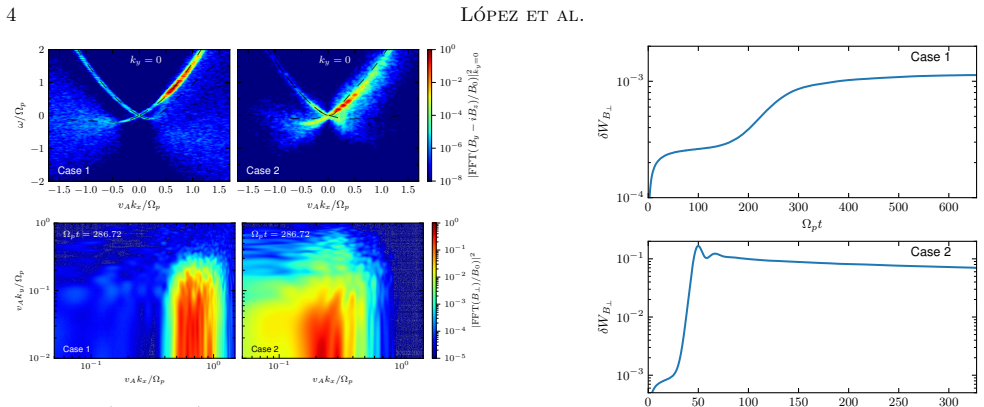
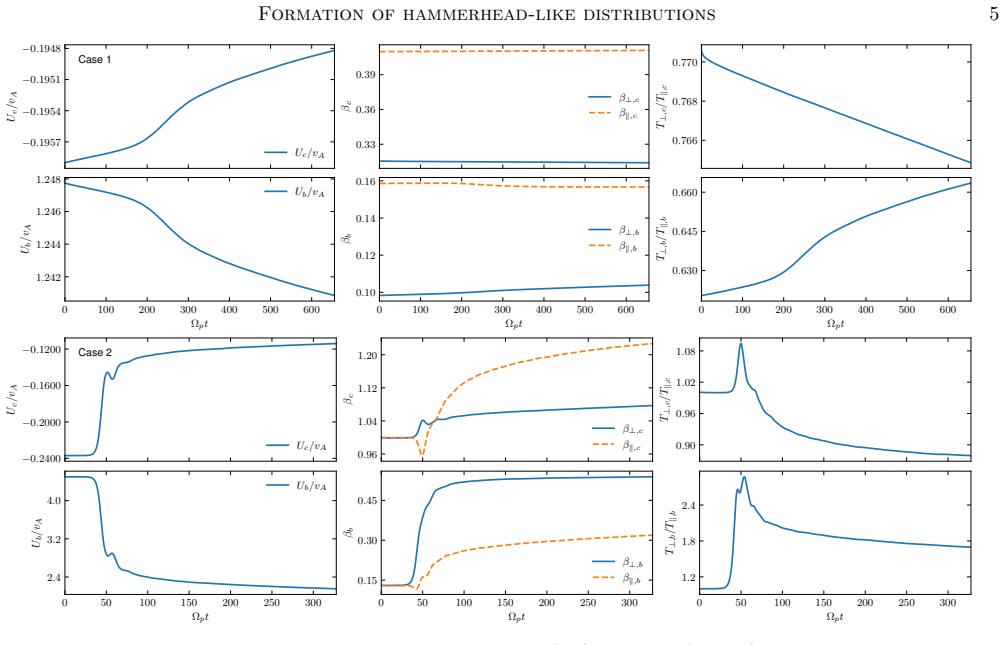
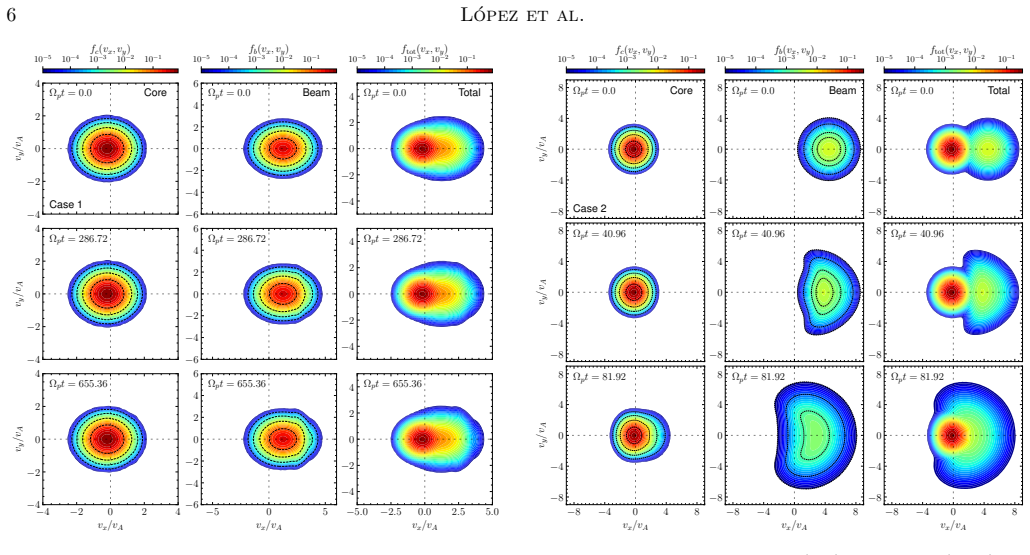
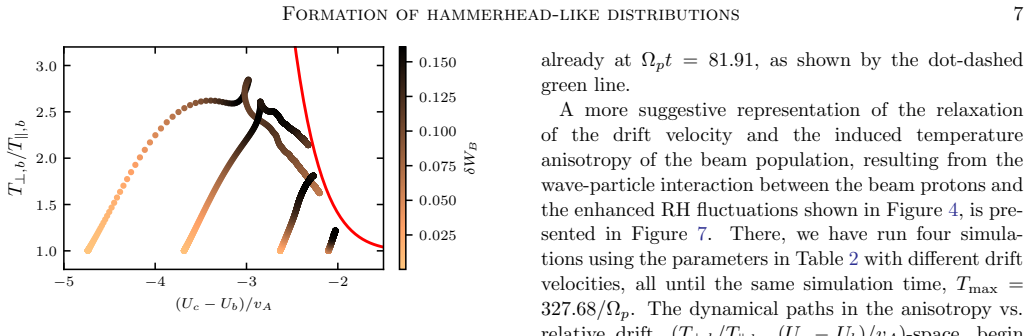
From the long-term evolution of these systems, it is found that beam relaxation is driven by instabilities and growing wave fluctuations, leading to HH-type features in the velocity distributions. The production of these features, as well as their prominence, depends on the magnetic power of the waves generated by the instabilities and, therefore, implicitly on the available free energy, quantified by the plasma beta parameter and the relative beam drift. The simulation results capture the self-consistent evolution of the instabilities and their nonlinear development. Linear theory, together with simulations, helps identify the nature of the unstable modes and the plasma conditions under whi
What carries the argument
Hybrid simulations that evolve proton-beam-plasma systems self-consistently, allowing instabilities of right-handed waves to drive beam relaxation and form hammerhead features.
If this is right
- Hammerhead feature production and strength scale directly with wave magnetic power and therefore with plasma beta and beam drift.
- Linear theory can identify the unstable modes and the plasma parameter ranges where they grow.
- Quasilinear theory provides a fast complementary tool for interpreting the wave-particle interactions seen in the simulations.
Where Pith is reading between the lines
- The same relaxation pathway may operate in other space-plasma environments that host drifting proton beams and right-handed waves.
- Varying the simulation beta and drift values across the observed PSP range could map which conditions produce the most prominent hammerhead shapes.
- Combining hybrid runs with quasilinear calculations offers a practical route to model wave generation across larger volumes of the young solar wind.
Load-bearing premise
The chosen initial beam drifts, densities, and betas are representative of the young solar wind regions where PSP observes hammerhead distributions and right-handed waves.
What would settle it
Time-resolved Parker Solar Probe measurements that either show or fail to show hammerhead features forming specifically during intervals when right-handed wave power grows at the rates and wavelengths predicted by the simulated instability.
Figures


read the original abstract
Parker Solar Probe (PSP) observations in the young solar wind reveal new properties of both plasma particle velocity distributions (VDs) and associated electromagnetic (EM) wave fluctuations. The quasilinear (QL) kinetic theory of plasma wave instabilities has recently shown that new hammerhead (HH) proton distributions can be generated by the relaxation of proton beams through the instabilities of right-handed (RH) polarized waves. Such RH waves have indeed been reported in association with HH distributions. In this paper, new results from hybrid simulations of proton-beam-plasma systems with properties typical of those observed to excite EM-RH wave instabilities are presented. From the long-term evolution of these systems, it is found that beam relaxation is driven by instabilities and growing wave fluctuations, leading to HH-type features in the velocity distributions. The production of these features, as well as their prominence, depends on the magnetic power of the waves generated by the instabilities and, therefore, implicitly on the available free energy, quantified by the plasma beta parameter and the relative beam drift. The simulation results capture the self-consistent evolution of the instabilities and their nonlinear development. Linear theory, together with simulations, helps identify the nature of the unstable modes and the plasma conditions under which they arise. The good agreement with quasi-linear (QL) theory further indicates that it can serve as a computationally efficient complementary framework for interpreting the associated wave-particle interactions.
Editorial analysis
A structured set of objections, weighed in public.
Referee Report
Summary. The manuscript presents hybrid kinetic-ion simulations of proton beam-plasma systems initialized with parameters typical of the young solar wind. It reports that beam relaxation proceeds through right-handed electromagnetic instabilities, producing hammerhead-like features in the proton velocity distributions whose prominence scales with available free energy (plasma beta and relative beam drift). The results are stated to agree with quasi-linear theory and to capture the self-consistent nonlinear evolution.
Significance. If the central claim holds, the work supplies the first self-consistent numerical demonstration that RH-wave instabilities can generate the hammerhead distributions observed by PSP, thereby linking linear/QL theory to the long-term nonlinear regime and identifying the controlling role of beta and drift. This strengthens the interpretation of PSP wave-particle observations.
major comments (2)
- [Introduction / Simulation setup] The abstract and introduction assert that the chosen initial drifts, densities, and betas are 'typical of those observed to excite EM-RH wave instabilities,' yet no table or figure quantitatively compares the simulated parameter set (beta, n_b/n_0, v_d/v_A) against the specific PSP intervals that exhibit both HH distributions and RH waves. Because the formation and prominence of HH features are stated to depend directly on these free-energy parameters, this comparison is load-bearing for the applicability claim.
- [Numerical methods / Results] The central result rests on the long-term evolution producing HH features; however, the manuscript does not report resolution studies, particle-per-cell counts, or box-size convergence tests. Without these, it is unclear whether the reported HH morphology is robust against numerical diffusion or finite-particle noise, which directly affects the reliability of the nonlinear saturation stage.
minor comments (2)
- [Abstract] Notation for the beam density ratio and drift speed should be defined once at first use and used consistently; the abstract introduces 'relative beam drift' without an accompanying symbol.
- [Figure captions] Figure captions should explicitly state the time at which the velocity distributions are shown and whether they are averaged over the simulation domain.
Simulated Author's Rebuttal
We thank the referee for their constructive comments and positive assessment of the work's significance. We address each major comment below, indicating the revisions planned for the manuscript.
read point-by-point responses
-
Referee: The abstract and introduction assert that the chosen initial drifts, densities, and betas are 'typical of those observed to excite EM-RH wave instabilities,' yet no table or figure quantitatively compares the simulated parameter set (beta, n_b/n_0, v_d/v_A) against the specific PSP intervals that exhibit both HH distributions and RH waves. Because the formation and prominence of HH features are stated to depend directly on these free-energy parameters, this comparison is load-bearing for the applicability claim.
Authors: We agree that a quantitative comparison to specific PSP intervals would strengthen the applicability claim. In the revised manuscript we will add a table (or figure) that directly compares the simulation parameters (beta, n_b/n_0, v_d/v_A) to the observed values from the PSP intervals that exhibit both hammerhead distributions and right-handed waves. revision: yes
-
Referee: The central result rests on the long-term evolution producing HH features; however, the manuscript does not report resolution studies, particle-per-cell counts, or box-size convergence tests. Without these, it is unclear whether the reported HH morphology is robust against numerical diffusion or finite-particle noise, which directly affects the reliability of the nonlinear saturation stage.
Authors: We acknowledge that explicit convergence tests are necessary to confirm the robustness of the nonlinear saturation stage. In the revised manuscript we will include resolution studies, the adopted particle-per-cell counts, and box-size convergence tests demonstrating that the hammerhead morphology is insensitive to numerical diffusion and particle noise. revision: yes
Circularity Check
No significant circularity; simulations yield independent results
full rationale
The paper's core claim—that long-term hybrid simulations of proton-beam systems with observationally motivated initial drifts, densities, and betas produce HH-type velocity distribution features via RH-wave instabilities—is an output of the self-consistent particle-in-cell evolution, not a re-expression of the inputs. Linear and quasi-linear theory are invoked only for mode identification and as a complementary check, with the abstract explicitly stating that simulations capture the nonlinear development independently. No equations reduce the reported HH formation to a fitted parameter or prior self-citation by construction; the agreement with QL theory is presented as validation rather than the source of the result. Parameter selection is justified by external PSP observations, not by internal redefinition, satisfying the criteria for a self-contained derivation.
Axiom & Free-Parameter Ledger
free parameters (2)
- plasma beta
- relative beam drift
axioms (1)
- domain assumption Hybrid approximation (fluid electrons, kinetic ions) captures the relevant wave-particle dynamics for right-handed electromagnetic modes.
Reference graph
Works this paper leans on
-
[1]
Araneda, J. A., Marsch, E., & F. -Vi˜ nas, A. 2008, PhRvL, 100, 125003, doi: 10.1103/PhysRevLett.100.125003 Bharati Das, S., Verniero, J. L., Badman, S. T., et al. 2026, The Astrophysical Journal Letters, 1001, L7, doi: 10.3847/2041-8213/ae52f6
-
[2]
Bowers, K. J., Albright, B. J., Yin, L., Bergen, B., & Kwan, T. J. T. 2008, Physics of Plasmas, 15, 055703, doi: 10.1063/1.2840133
-
[3]
Desai, M., & Giacalone, J. 2016, Living Reviews in Solar Physics, 13, 3, doi: 10.1007/s41116-016-0002-5
-
[4]
2026, The Astrophysical Journal, 997, 174, doi: 10.3847/1538-4357/ae2601
Franci, L. 2026, The Astrophysical Journal, 997, 174, doi: 10.3847/1538-4357/ae2601
-
[5]
Gary, S. P., & Lee, M. A. 1994, Journal of Geophysical Research: Space Physics, 99, 11297, doi: https://doi.org/10.1029/94JA00253
-
[6]
Klein, K. G., Verniero, J. L., Alterman, B., et al. 2021, ApJ, 909, 7, doi: 10.3847/1538-4357/abd7a0
-
[7]
Lario, D., Berger, L., Decker, R. B., et al. 2019, ApJ, 158, 12, doi: 10.3847/1538-3881/ab1e49
-
[8]
Lario, D., Richardson, I. G., Wilson III, L. B., et al. 2022, ApJ, 925, 198, doi: 10.3847/1538-4357/ac3c47
-
[9]
2021, A&A, 656, A37, doi: 10.1051/0004-6361/202141149
Lavraud, B., Kieokaew, R., Fargette, N., et al. 2021, A&A, 656, A37, doi: 10.1051/0004-6361/202141149
-
[10]
2023, Physics of Plasmas, 30, 063902, doi: 10.1063/5.0146529
Le, A., Stanier, A., Yin, L., et al. 2023, Physics of Plasmas, 30, 063902, doi: 10.1063/5.0146529
-
[11]
2021, Journal of Geophysical Research: Space Physics, 126, 1, doi: 10.1029/2021JA029125 L´ opez, R
Le, A., Winske, D., Stanier, A., et al. 2021, Journal of Geophysical Research: Space Physics, 126, 1, doi: 10.1029/2021JA029125 L´ opez, R. A., Shaaban, S. M., & Lazar, M. 2021, J. Plasma Phys., 87, 905870310, doi: 10.1017/S0022377821000593
-
[12]
2021, A&A, 656, A36, doi: 10.1051/0004-6361/202141095 L´ opez, R
Louarn, P., Fedorov, A., Prech, L., et al. 2021, A&A, 656, A36, doi: 10.1051/0004-6361/202141095 L´ opez, R. A. 2023, DIS-K: Dispersion Solver for Kappa Plasmas, 1.0, Zenodo, doi: 10.5281/zenodo.15991
-
[13]
Matteini, L., Landi, S., Velli, M., & Matthaeus, W. H. 2013, The Astrophysical Journal, 763, 142, doi: 10.1088/0004-637X/763/2/142
-
[14]
2022, ApJ, 926, 185, doi: 10.3847/1538-4357/ac402c
Larson, D. 2022, ApJ, 926, 185, doi: 10.3847/1538-4357/ac402c
-
[15]
Pezzini, L., Bacchini, F., Zhukov, A. N., Arr´ o, G., & L´ opez, R. A. 2026, The Astrophysical Journal, 997, 158, doi: 10.3847/1538-4357/ae27a3
-
[16]
Pezzini, L., Zhukov, A. N., Bacchini, F., et al. 2024, ApJ, 975, 37, doi: 10.3847/1538-4357/ad7465
-
[17]
Phan, T. D., Verniero, J. L., Larson, D., et al. 2022, Geophys. Res. Lett., 49, e96986, doi: 10.1029/2021GL096986
-
[18]
Pierrard, V., & Voitenko, Y. 2010, AIP Conf. Proc., 1216, 102, doi: 10.1063/1.3395812
-
[19]
Saeed, S., Sarfraz, M., Yoon, P. H., Lazar, M., & Qureshi, M. N. S. 2017, Monthly Notices of the Royal Astronomical Society, 465, 1672, doi: 10.1093/mnras/stw2900
-
[20]
2025, The Astrophysical Journal, 993, 1, doi: 10.3847/1538-4357/ae09ac
Poedts, S. 2025, The Astrophysical Journal, 993, 1, doi: 10.3847/1538-4357/ae09ac
-
[21]
2024, A&A, 692, L6, doi: 10.1051/0004-6361/202452205
Poedts, S. 2024, A&A, 692, L6, doi: 10.1051/0004-6361/202452205
-
[22]
Shaaban, S. M., Lazar, M., & Poedts, S. 2018, Monthly Notices of the Royal Astronomical Society, 480, 310, doi: 10.1093/mnras/sty1567
-
[23]
Tu, C.-Y., Wang, L.-H., & Marsch, E. 2002, Journal of Geophysical Research: Space Physics, 107, SSH 8, doi: https://doi.org/10.1029/2002JA009264
-
[24]
Verniero, J. L., Larson, D. E., Livi, R., et al. 2020, ApJS, 248, 5, doi: 10.3847/1538-4365/ab86af
-
[25]
Verniero, J. L., Chandran, B. D. G., Larson, D. E., et al. 2022, ApJ, 924, 112, doi: 10.3847/1538-4357/ac36d5
-
[26]
2015, SoPh, 290, 1231, doi: 10.1007/s11207-015-0661-8
Voitenko, Y., & Pierrard, V. 2015, SoPh, 290, 1231, doi: 10.1007/s11207-015-0661-8
discussion (0)
Sign in with ORCID, Apple, or X to comment. Anyone can read and Pith papers without signing in.