A null controllability data assimilation for the bulk-surface heat equation with dynamic boundary conditions
Pith reviewed 2026-06-27 19:44 UTC · model grok-4.3
The pith
The final state of the bulk-surface heat equation with Wentzell boundary conditions can be exactly reconstructed from distributed interior observations using a Carleman inequality and Tikhonov regularization.
A machine-rendered reading of the paper's core claim, the machinery that carries it, and where it could break.
Core claim
The authors prove an exact reconstruction theorem for the continuous bulk-surface heat equation with dynamic boundary conditions of Wentzell type from interior observations on ω. They derive a stability inequality and show that a penalized discrete scheme based on Lie splitting converges. An adaptive post-processing step is introduced that optimally merges the regularized reconstruction with the observation itself, selecting between them without knowledge of the noise level under noisy data.
What carries the argument
A Carleman-type observability inequality for the bulk-surface system with Wentzell dynamic boundary conditions, which underpins the unique reconstruction via Tikhonov-regularized optimal control and enables the adaptive estimator.
Load-bearing premise
A Carleman-type observability inequality holds for the bulk-surface system with dynamic boundary conditions of Wentzell type, allowing unique reconstruction of the final state from distributed interior observations on ω.
What would settle it
An explicit counterexample to the Carleman observability inequality for some choice of domain Ω, subdomain ω, or boundary condition parameters would falsify the reconstruction theorem.
Figures

read the original abstract
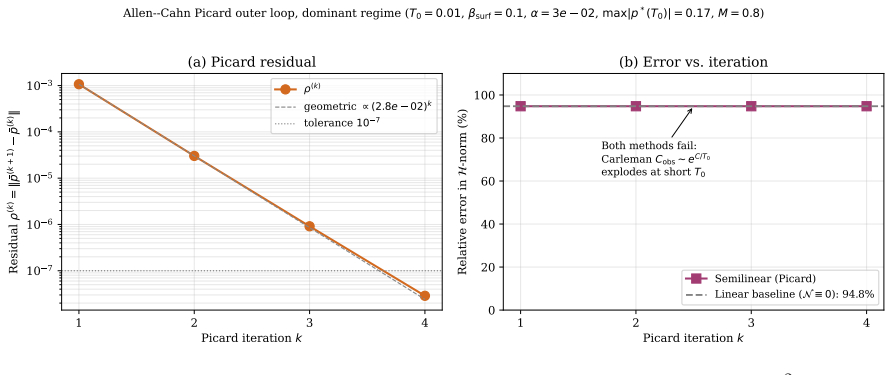
We address the inverse problem of reconstructing the state at a final time $T_0$ of a parabolic equation with dynamic boundary conditions of Wentzell type, from a distributed interior observation on a subdomain $\omega \subset \Omega$. Our approach combines (i) a Carleman-type observability inequality for the bulk-surface system, with (ii) a Tikhonov-regularized optimal-control reformulation of the data assimilation problem, and (iii) a fully implementable spatio-temporal discretization based on a Lie splitting that decouples the bulk and surface dynamics. We prove an exact reconstruction theorem for the continuous problem, derive a stability inequality, and analyze a penalized discrete scheme. We then propose an adaptive post-processing step that optimally combines the regularized reconstruction with the observation itself; under noisy data, the resulting estimator automatically selects between full post-processing and the raw reconstruction without prior knowledge of the noise level. Extensive numerical experiments on a two-dimensional Wentzell heat equation validate the method. A semilinear extension to the Allen-Cahn nonlinearity is treated via a Picard outer loop with Schauder fixed-point convergence; two complementary experiments reveal an intrinsic observability-nonlinearity trade-off in the bulk-surface setting.
Editorial analysis
A structured set of objections, weighed in public.
Referee Report
Summary. The paper develops a data assimilation method to reconstruct the terminal state at time T0 of the bulk-surface heat equation with Wentzell dynamic boundary conditions from distributed observations on a subdomain ω. It combines a Carleman-type observability inequality, a Tikhonov-regularized optimal-control reformulation, Lie-split spatio-temporal discretization, an exact reconstruction theorem with stability estimate, analysis of a penalized discrete scheme, and an adaptive post-processing rule that selects between the regularized output and raw data without explicit noise-level knowledge. Numerical experiments on a 2D Wentzell system are presented, together with a semilinear Allen-Cahn extension treated by Picard iteration and Schauder fixed-point arguments.
Significance. If the Carleman observability holds for the coupled bulk-surface Wentzell system, the work supplies a complete pipeline—continuous theory, stable discretization, and a practical adaptive estimator—for an inverse problem arising in interface heat transfer. The numerical validation on 2D domains and the explicit observability-nonlinearity trade-off identified in the semilinear experiments constitute concrete strengths. The adaptive post-processing step, which avoids prior noise-level information, is a useful practical contribution to the literature on parabolic data assimilation.
minor comments (4)
- The abstract states that the adaptive post-processing 'optimally combines the regularized reconstruction with the observation itself'; the precise selection criterion (e.g., a threshold or variational rule) should be stated explicitly in the main text, preferably with a short algorithmic box.
- Notation for the bulk-surface coupling (normal derivatives, trace operators) appears in several places; a single consolidated table of symbols at the beginning would improve readability.
- The Lie-splitting scheme is described as 'fully implementable'; a brief remark on the CFL-type restriction (if any) induced by the surface diffusion term would clarify the practical time-step choice.
- In the semilinear section, the Schauder fixed-point argument is invoked; the precise function space in which the contraction or compactness is obtained should be recalled for the reader's convenience.
Simulated Author's Rebuttal
We thank the referee for the positive summary, significance assessment, and recommendation of minor revision. No major comments were provided in the report, so we have no specific points requiring rebuttal or clarification at this stage. We will incorporate any minor suggestions during revision.
Circularity Check
No significant circularity; derivation is self-contained on standard observability
full rationale
The paper's chain proceeds from a Carleman-type observability inequality (assumed as the weakest hypothesis) to a Tikhonov optimal-control reformulation, Lie-split discretization, exact reconstruction theorem, stability estimate, and adaptive post-processing. None of these steps reduce by construction to fitted inputs, self-definitions, or load-bearing self-citations; the observability is invoked as an external analytic fact rather than derived from the method itself, and the adaptive rule is explicitly data-driven without prior noise-level dependence. The semilinear extension via Picard iteration likewise rests on standard fixed-point arguments once observability is granted.
Axiom & Free-Parameter Ledger
axioms (2)
- standard math Existence, uniqueness, and regularity of solutions to the linear and semilinear bulk-surface parabolic system with Wentzell dynamic boundary conditions
- domain assumption A Carleman-type observability inequality holds for the bulk-surface system
Reference graph
Works this paper leans on
-
[1]
Puel, Jean-Pierre , TITLE =. SIAM J. Control Optim. , FJOURNAL =. 2009 , NUMBER =. doi:10.1137/060670961 , URL =
-
[2]
and Osses, Axel and Puel, Jean Pierre , TITLE =
Garc\'ia, Galina C. and Osses, Axel and Puel, Jean Pierre , TITLE =. ESAIM Math. Model. Numer. Anal. , FJOURNAL =. 2011 , NUMBER =. doi:10.1051/m2an/2010058 , URL =
-
[3]
ESAIM: Proceedings , volume=
Variational assimilation of altimeter data into a non-linear ocean model: temporal strategies , author=. ESAIM: Proceedings , volume=. 1998 , organization=
1998
-
[4]
Luong, Bruno and Blum, Jacques and Verron, Jacques , TITLE =. Inverse Problems , FJOURNAL =. 1998 , NUMBER =. doi:10.1088/0266-5611/14/4/014 , URL =
-
[5]
I: Theory , author=
Variational assimilation of meteorological observations with the adjoint vorticity equation. I: Theory , author=. Quarterly Journal of the Royal Meteorological Society , volume=. 1987 , publisher=
1987
-
[6]
Burman, Erik and Oksanen, Lauri , TITLE =. Numer. Math. , FJOURNAL =. 2018 , NUMBER =. doi:10.1007/s00211-018-0949-3 , URL =
-
[7]
Goldstein, Gis\`ele Ruiz , TITLE =. Adv. Differential Equations , FJOURNAL =. 2006 , NUMBER =
2006
-
[8]
and Romanelli, Silvia , TITLE =
Favini, Angelo and Goldstein, Gis\`ele Ruiz and Goldstein, Jerome A. and Romanelli, Silvia , TITLE =. J. Evol. Equ. , FJOURNAL =. 2002 , NUMBER =. doi:10.1007/s00028-002-8077-y , URL =
-
[9]
Maniar, Lahcen and Meyries, Martin and Schnaubelt, Roland , TITLE =. Evol. Equ. Control Theory , FJOURNAL =. 2017 , NUMBER =. doi:10.3934/eect.2017020 , URL =
-
[10]
Elliott, Charles M. and Ranner, Thomas , TITLE =. IMA J. Numer. Anal. , FJOURNAL =. 2013 , NUMBER =. doi:10.1093/imanum/drs022 , URL =
-
[11]
Tellus A: Dynamic Meteorology and Oceanography , volume=
Variational algorithms for analysis and assimilation of meteorological observations: theoretical aspects , author=. Tellus A: Dynamic Meteorology and Oceanography , volume=. 1986 , publisher=
1986
-
[12]
II: Numerical results , author=
Variational assimilation of meteorological observations with the adjoint vorticity equation. II: Numerical results , author=. Quarterly Journal of the Royal Meteorological Society , volume=. 1987 , publisher=
1987
-
[13]
1993 , publisher=
Atmospheric data analysis , author=. 1993 , publisher=
1993
-
[14]
Fursikov, A. V. and Imanuvilov, O. Yu. , TITLE =. 1996 , PAGES =
1996
-
[15]
and Yamamoto, Masahiro , TITLE =
Imanuvilov, Oleg Yu. and Yamamoto, Masahiro , TITLE =. Publ. Res. Inst. Math. Sci. , FJOURNAL =. 2003 , NUMBER =
2003
-
[16]
and Robbiano, L
Lebeau, G. and Robbiano, L. , TITLE =. S\'eminaire sur les \'Equations aux. 1995 , ISBN =
1995
-
[17]
Le Rousseau, J\'er\^ome and Lebeau, Gilles , TITLE =. ESAIM Control Optim. Calc. Var. , FJOURNAL =. 2012 , NUMBER =. doi:10.1051/cocv/2011168 , URL =
-
[18]
Doubova, Anna and Osses, A. and Puel, J.-P. , TITLE =. ESAIM Control Optim. Calc. Var. , FJOURNAL =. 2002 , PAGES =. doi:10.1051/cocv:2002047 , URL =
-
[19]
Fern\'andez-Cara, E. and Guerrero, S. and Imanuvilov, O. Yu. and Puel, J.-P. , TITLE =. J. Math. Pures Appl. (9) , FJOURNAL =. 2004 , NUMBER =. doi:10.1016/j.matpur.2004.02.010 , URL =
-
[20]
Theory and practice of finite elements
Ern, Alexandre and Guermond, Jean-Luc , TITLE =. 2004 , PAGES =. doi:10.1007/978-1-4757-4355-5 , URL =
-
[21]
2008 , PAGES =
Strang, Gilbert and Fix, George , TITLE =. 2008 , PAGES =
2008
-
[22]
Altmann, Robert and Kov\'acs, Bal\'azs and Zimmer, Christoph , TITLE =. IMA J. Numer. Anal. , FJOURNAL =. 2023 , NUMBER =. doi:10.1093/imanum/drac002 , URL =
-
[23]
2006 , PAGES =
Hairer, Ernst and Lubich, Christian and Wanner, Gerhard , TITLE =. 2006 , PAGES =
2006
-
[24]
and Hanke, Martin and Neubauer, Andreas , TITLE =
Engl, Heinz W. and Hanke, Martin and Neubauer, Andreas , TITLE =. 1996 , PAGES =
1996
-
[25]
Kaltenbacher, Barbara and Neubauer, Andreas and Scherzer, Otmar , TITLE =. 2008 , PAGES =. doi:10.1515/9783110208276 , URL =
-
[26]
Morozov, V. A. , TITLE =. 1984 , PAGES =. doi:10.1007/978-1-4612-5280-1 , URL =
-
[27]
2008 , PAGES =
Glowinski, Roland , TITLE =. 2008 , PAGES =
2008
-
[28]
Liero, Matthias and Mielke, Alexander , TITLE =. Philos. Trans. R. Soc. Lond. Ser. A Math. Phys. Eng. Sci. , FJOURNAL =. 2013 , NUMBER =. doi:10.1098/rsta.2012.0346 , URL =
discussion (0)
Sign in with ORCID, Apple, or X to comment. Anyone can read and Pith papers without signing in.