Latent Structural Categorical Matrix Completion with Application to Quasispecies Analysis
Pith reviewed 2026-06-27 19:27 UTC · model grok-4.3
The pith
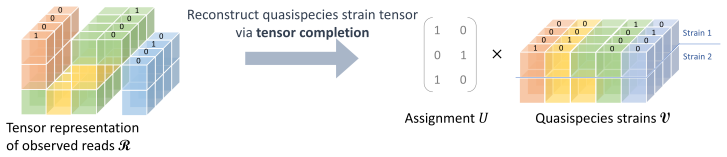
LCMC completes categorical matrices by one-hot tensor encoding and double-loop latent factorization that adapts the dimension.
A machine-rendered reading of the paper's core claim, the machinery that carries it, and where it could break.
Core claim
LCMC is a double-loop optimization framework for categorical matrix completion. Each categorical entry is encoded as a one-hot vector along a third tensor mode to preserve its discrete non-ordinal nature. The outer loop adaptively estimates the latent dimension by iteratively updating it with feedback from the inner loop, while the inner loop reconstructs the categorical matrix through tensor factorization, supported by corresponding theoretical analysis. Enhancements such as a split-merge-refine strategy and adaptive data reduction improve scalability and robustness.
What carries the argument
Double-loop optimization on a one-hot binary tensor representation, where the outer loop adapts the latent dimension from inner-loop feedback and the inner loop executes tensor factorization.
If this is right
- Categorical matrices can be completed without treating categories as ordered or real-valued quantities.
- Adaptive estimation of the latent dimension in the outer loop improves reconstruction quality on both synthetic and real data.
- The split-merge-refine strategy and adaptive data reduction allow the method to handle larger problems efficiently.
- The framework delivers superior accuracy and speed in viral quasispecies reconstruction compared with existing approaches.
Where Pith is reading between the lines
- The one-hot tensor encoding could extend naturally to higher-order categorical arrays beyond two-way matrices.
- The same double-loop structure might be applied to categorical data problems in recommendation systems or survey analysis.
- If the encoding succeeds, it suggests that explicit separation of categories in an extra dimension is more effective than numerical substitution for discrete data.
Load-bearing premise
Representing each categorical entry as a one-hot vector along a third tensor mode sufficiently preserves its discrete non-ordinal nature for effective latent factorization and reconstruction.
What would settle it
On a synthetic categorical matrix with known ground-truth factors, check whether reconstruction error remains higher than or equal to that of real-valued matrix completion methods when the one-hot tensor encoding is used.
Figures


read the original abstract
Matrix completion has been extensively studied for real-valued data, but existing methods are often limited in handling categorical variables. We propose LCMC, a double-loop optimization framework for categorical matrix completion via latent factorization based on a binary tensor representation. In this setting, each categorical entry is encoded as a one-hot vector along a third tensor mode, thereby preserving its discrete, non-ordinal nature. The outer loop adaptively estimates the latent dimension by iteratively updating it with feedback from the inner loop, while the inner loop reconstructs the categorical matrix through tensor factorization, supported by a corresponding theoretical analysis. To further improve scalability and robustness, we introduce enhancements including a split-merge-refine strategy and an adaptive data reduction technique. Experiments on synthetic and real-world datasets in viral quasispecies reconstruction, demonstrate that LCMC achieves superior accuracy and efficiency compared to existing methods.
Editorial analysis
A structured set of objections, weighed in public.
Referee Report
Summary. The manuscript introduces LCMC, a double-loop optimization framework for categorical matrix completion. Categorical entries are encoded as one-hot vectors along a third tensor mode to form a binary tensor, preserving discreteness. The outer loop adaptively estimates latent dimension using inner-loop feedback; the inner loop performs tensor factorization for reconstruction and is supported by theoretical analysis. Additional techniques include a split-merge-refine strategy and adaptive data reduction. Experiments on synthetic and real viral quasispecies datasets report superior accuracy and efficiency relative to existing methods.
Significance. If the reported experimental gains and inner-loop theory hold, the work supplies a practical advance in categorical matrix completion with direct relevance to quasispecies reconstruction. The explicit use of one-hot tensor encoding (a standard device whose discrete-preserving property is analyzed) together with the adaptive dimension procedure and theoretical support for the inner loop constitute clear strengths; reproducible code or parameter-free derivations are not claimed.
minor comments (3)
- The abstract states that LCMC 'achieves superior accuracy and efficiency' but supplies no quantitative metrics, baseline names, or effect sizes; adding a summary table of key performance numbers (e.g., reconstruction error or runtime) would strengthen the claim.
- Notation for the tensor modes (especially the categorical mode) and the precise definition of the latent factors should be introduced earlier, ideally with a small illustrative example, to aid readers outside tensor-factorization literature.
- The split-merge-refine and adaptive data reduction enhancements are mentioned only at high level; a brief algorithmic outline or pseudocode in the main text (rather than solely in the supplement) would improve readability.
Simulated Author's Rebuttal
We thank the referee for the positive summary of the manuscript, the recognition of its strengths in one-hot tensor encoding, adaptive dimension estimation, and inner-loop theory, and the recommendation for minor revision.
Circularity Check
No significant circularity detected
full rationale
The paper introduces LCMC as a double-loop optimization framework for categorical matrix completion via one-hot tensor encoding and latent factorization, with an outer loop for adaptive dimension estimation and inner-loop reconstruction supported by theoretical analysis. No load-bearing step reduces by construction to a fitted parameter or self-citation chain; the one-hot encoding is presented as an explicit design choice to preserve discrete non-ordinal properties, and performance claims rest on external experimental comparisons rather than internal redefinitions. The derivation chain remains self-contained against the stated assumptions and benchmarks.
Axiom & Free-Parameter Ledger
Reference graph
Works this paper leans on
-
[1]
Viral quasispecies reconstruction via tensor factorization with successive read removal.Bioinformatics, 34(13):i23–i31, 2018
Soyeon Ahn, Ziqi Ke, and Haris Vikalo. Viral quasispecies reconstruction via tensor factorization with successive read removal.Bioinformatics, 34(13):i23–i31, 2018. 1, 3.2, 5.2
2018
-
[2]
aBayesQR: a Bayesian method for reconstruction of viral populations characterized by low diversity.Journal of Computational Biology, 25(7):637–648, 2018
Soyeon Ahn and Haris Vikalo. aBayesQR: a Bayesian method for reconstruction of viral populations characterized by low diversity.Journal of Computational Biology, 25(7):637–648, 2018. 5.2
2018
-
[3]
Global rates of convergence for nonconvex optimization on manifolds.IMA Journal of Numerical Analysis, 39(1):1–33, 2019
Nicolas Boumal, Pierre-Antoine Absil, and Coralia Cartis. Global rates of convergence for nonconvex optimization on manifolds.IMA Journal of Numerical Analysis, 39(1):1–33, 2019. 1 17
2019
-
[4]
Structured low-rank matrix factorization for haplotype assembly.IEEE Journal of Selected Topics in Signal Processing, 10(4):647–657, 2016
Changxiao Cai, Sujay Sanghavi, and Haris Vikalo. Structured low-rank matrix factorization for haplotype assembly.IEEE Journal of Selected Topics in Signal Processing, 10(4):647–657, 2016. 1
2016
-
[5]
A singular value thresholding algorithm for matrix completion.SIAM Journal on Optimization, 20(4):1956–1982, 2010
Jian-Feng Cai, Emmanuel J Cand` es, and Zuowei Shen. A singular value thresholding algorithm for matrix completion.SIAM Journal on Optimization, 20(4):1956–1982, 2010. 1
1956
-
[6]
Robust principal component analysis? Journal of the ACM (JACM), 58(3):1–37, 2011
Emmanuel J Cand` es, Xiaodong Li, Yi Ma, and John Wright. Robust principal component analysis? Journal of the ACM (JACM), 58(3):1–37, 2011. 1
2011
-
[7]
Exact matrix completion via convex optimization.Com- munications of the ACM, 55(6):111–119, 2012
Emmanuel J Cand` es and Benjamin Recht. Exact matrix completion via convex optimization.Com- munications of the ACM, 55(6):111–119, 2012. 1
2012
-
[8]
Categorical matrix completion
Yang Cao and Yao Xie. Categorical matrix completion. InInternational Workshop on Computational Advances in Multi-Sensor Adaptive Processing, pages 369–372. IEEE, 2015. 1
2015
-
[9]
Categorical matrix completion with active learning for high-throughput screening.IEEE/ACM Transactions on Computational Biology and Bioinfor- matics, 18(6):2261–2270, 2020
Junyi Chen, Junhui Hou, and Ka-Chun Wong. Categorical matrix completion with active learning for high-throughput screening.IEEE/ACM Transactions on Computational Biology and Bioinfor- matics, 18(6):2261–2270, 2020. 1
2020
-
[10]
1-bit matrix completion
Mark A Davenport, Yaniv Plan, Ewout Van Den Berg, and Mary Wootters. 1-bit matrix completion. Information and Inference: A Journal of the IMA, 3(3):189–223, 2014. 1
2014
-
[11]
Matrix completion has no spurious local minimum.Advances in Neural Information Processing Systems, 29, 2016
Rong Ge, Jason D Lee, and Tengyu Ma. Matrix completion has no spurious local minimum.Advances in Neural Information Processing Systems, 29, 2016. 1
2016
-
[12]
Sparse tensor decomposition for haplotype assembly of diploids and polyploids.BMC Genomics, 19:1–15, 2018
Abolfazl Hashemi, Banghua Zhu, and Haris Vikalo. Sparse tensor decomposition for haplotype assembly of diploids and polyploids.BMC Genomics, 19:1–15, 2018. 1, 3.2
2018
-
[13]
ART: a next-generation sequencing read simulator.Bioinformatics, 28(4):593–594, 2012
Weichun Huang, Leping Li, Jason R Myers, and Gabor T Marth. ART: a next-generation sequencing read simulator.Bioinformatics, 28(4):593–594, 2012. 5.2.1
2012
-
[14]
A generalized information criterion for high- dimensional pca rank selection.Statistical Papers, 63(4):1295–1321, 2022
Hung Hung, Su-Yun Huang, and Ching-Kang Ing. A generalized information criterion for high- dimensional pca rank selection.Statistical Papers, 63(4):1295–1321, 2022. 1
2022
-
[15]
Low-rank matrix completion using al- ternating minimization
Prateek Jain, Praneeth Netrapalli, and Sujay Sanghavi. Low-rank matrix completion using al- ternating minimization. InProceedings of the Forty-Fifth Annual ACM Symposium on Theory of Computing, pages 665–674, 2013. 1
2013
-
[16]
ViQuaS: an improved reconstruction pipeline for viral quasispecies spectra generated by next-generation sequencing.Bioinformatics, 31(6):886–896, 2015
Duleepa Jayasundara, Isaam Saeed, Suhinthan Maheswararajah, Bill C Chang, S-L Tang, and Saman K Halgamuge. ViQuaS: an improved reconstruction pipeline for viral quasispecies spectra generated by next-generation sequencing.Bioinformatics, 31(6):886–896, 2015. 5.2
2015
-
[17]
Addison- Wesley Professional, 1998
Donald E Knuth.The art of computer programming: sorting and searching, volume 3. Addison- Wesley Professional, 1998. 4.1
1998
-
[18]
Heng Li. Aligning sequence reads, clone sequences and assembly contigs with BWA-MEM.arXiv preprint arXiv:1303.3997, 2013. 5.2.1
Pith/arXiv arXiv 2013
-
[19]
Jiawei Li, Nguyen Nguyen, Meng Lai, Ioannis Ch Paschalidis, and Jonathan H Huggins. Robust model selection for discovery of latent mechanistic processes.arXiv preprint arXiv:2602.22062, 2026. 1
arXiv 2026
-
[20]
Linearized alternating direction method with adaptive penalty for low-rank representation.Advances in Neural Information Processing Systems, 24, 2011
Zhouchen Lin, Risheng Liu, and Zhixun Su. Linearized alternating direction method with adaptive penalty for low-rank representation.Advances in Neural Information Processing Systems, 24, 2011. 1
2011
-
[21]
SARS-CoV-2 mutant spectra at different depth levels reveal an overwhelming abundance of low frequency mutations.Pathogens, 11(6):662, 2022
Brenda Mart´ ınez-Gonz´ alez, Mar´ ıa Eugenia Soria, Luc´ ıa V´ azquez-Sirvent, Cristina Ferrer-Orta, Re- beca Lobo-Vega, Pablo M´ ınguez, Lorena de la Fuente, Carlos Llorens, Beatriz Soriano, Ricardo Ramos-Ru´ ız, et al. SARS-CoV-2 mutant spectra at different depth levels reveal an overwhelming abundance of low frequency mutations.Pathogens, 11(6):662, 2...
2022
-
[22]
Distinguishing low frequency mutations from RT-PCR and sequence errors in viral deep sequencing data.BMC Genomics, 16:1–15, 2015
Richard J Orton, Caroline F Wright, Marco J Morelli, David J King, David J Paton, Donald P King, and Daniel T Haydon. Distinguishing low frequency mutations from RT-PCR and sequence errors in viral deep sequencing data.BMC Genomics, 16:1–15, 2015. 1
2015
-
[23]
Recent advances in inferring viral diversity from high-throughput sequencing data.Virus Research, 239:17–32, 2017
Susana Posada-Cespedes, David Seifert, and Niko Beerenwinkel. Recent advances in inferring viral diversity from high-throughput sequencing data.Virus Research, 239:17–32, 2017. 1
2017
-
[24]
HIV haplotype inference using a propagating dirichlet process mixture model.IEEE/ACM Transactions on Computational Biology and Bioinformatics, 11(1):182–191, 2013
Sandhya Prabhakaran, Melanie Rey, Osvaldo Zagordi, Niko Beerenwinkel, and Volker Roth. HIV haplotype inference using a propagating dirichlet process mixture model.IEEE/ACM Transactions on Computational Biology and Bioinformatics, 11(1):182–191, 2013. 5.2
2013
-
[25]
A unified convergence analysis of block successive minimization methods for nonsmooth optimization.SIAM Journal on Optimization, 23(2):1126–1153, 2013
Meisam Razaviyayn, Mingyi Hong, and Zhi-Quan Luo. A unified convergence analysis of block successive minimization methods for nonsmooth optimization.SIAM Journal on Optimization, 23(2):1126–1153, 2013. 3.3
2013
-
[26]
Evaluation of categorical matrix completion algorithms: toward improved active learning for drug discovery.Bioinformatics, 37(20):3538–3545, 2021
Huangqingbo Sun and Robert F Murphy. Evaluation of categorical matrix completion algorithms: toward improved active learning for drug discovery.Bioinformatics, 37(20):3538–3545, 2021. 1
2021
-
[27]
Estimating the number of clusters in a data set via the gap statistic.Journal of the Royal Statistical Society: Series B (Statistical Methodology), 63(2):411–423, 2001
Robert Tibshirani, Guenther Walther, and Trevor Hastie. Estimating the number of clusters in a data set via the gap statistic.Journal of the Royal Statistical Society: Series B (Statistical Methodology), 63(2):411–423, 2001. 1
2001
-
[28]
Convergence of a block coordinate descent method for nondifferentiable minimization
Paul Tseng. Convergence of a block coordinate descent method for nondifferentiable minimization. Journal of Optimization Theory and Applications, 109(3):475–494, 2001. 3.3
2001
-
[29]
Generalized low rank models
Madeleine Udell, Corinne Horn, Reza Zadeh, Stephen Boyd, et al. Generalized low rank models. Foundations and Trends®in Machine Learning, 9(1):1–118, 2016. 1
2016
-
[30]
A general approach to identify low-frequency variants within influenza samples collected during routine surveil- lance.Microbial Genomics, 8(9):000867, 2022
Laura AE Van Poelvoorde, Thomas Delcourt, Marnik Vuylsteke, Sigrid CJ De Keersmaecker, Is- abelle Thomas, Steven Van Gucht, Xavier Saelens, Nancy Roosens, and Kevin Vanneste. A general approach to identify low-frequency variants within influenza samples collected during routine surveil- lance.Microbial Genomics, 8(9):000867, 2022. 1
2022
-
[31]
ShoRAH: es- timating the genetic diversity of a mixed sample from next-generation sequencing data.BMC Bioinformatics, 12(1):1–5, 2011
Osvaldo Zagordi, Arnab Bhattacharya, Nicholas Eriksson, and Niko Beerenwinkel. ShoRAH: es- timating the genetic diversity of a mixed sample from next-generation sequencing data.BMC Bioinformatics, 12(1):1–5, 2011. 5.2
2011
-
[32]
Qinqing Zheng and John Lafferty. Convergence analysis for rectangular matrix completion using burer-monteiro factorization and gradient descent.arXiv preprint arXiv:1605.07051, 2016. 1 19
Pith/arXiv arXiv 2016
discussion (0)
Sign in with ORCID, Apple, or X to comment. Anyone can read and Pith papers without signing in.