Entanglement in the Quantum Volunteer's Dilemma
Pith reviewed 2026-06-27 19:36 UTC · model grok-4.3
The pith
Symmetric Nash equilibria in the quantum volunteer's dilemma exist above an analytically derived entanglement threshold rather than requiring maximal entanglement.
A machine-rendered reading of the paper's core claim, the machinery that carries it, and where it could break.
Core claim
Within the Eisert-Wilkens-Lewenstein framework, the generalized quantum volunteer's dilemma with entanglement parameter γ admits symmetric Nash equilibria whenever γ lies above an explicit threshold. The threshold is obtained analytically for the strategy profile valid when 2 ≤ n ≤ 9 and for the profile valid when n is even; equilibrium behavior therefore persists for any entanglement level above this value and disappears below it.
What carries the argument
The tunable entanglement parameter γ that parametrizes the shared two-qubit or n-qubit entangled state in the Eisert-Wilkens-Lewenstein quantum game.
Load-bearing premise
The analysis assumes the Eisert-Wilkens-Lewenstein framework in which each player manipulates one qubit of a shared entangled state controlled by γ.
What would settle it
Measuring whether symmetric Nash equilibria cease to exist exactly when γ falls below the derived threshold for a chosen n and strategy profile would confirm or refute the claimed dependence.
Figures

read the original abstract
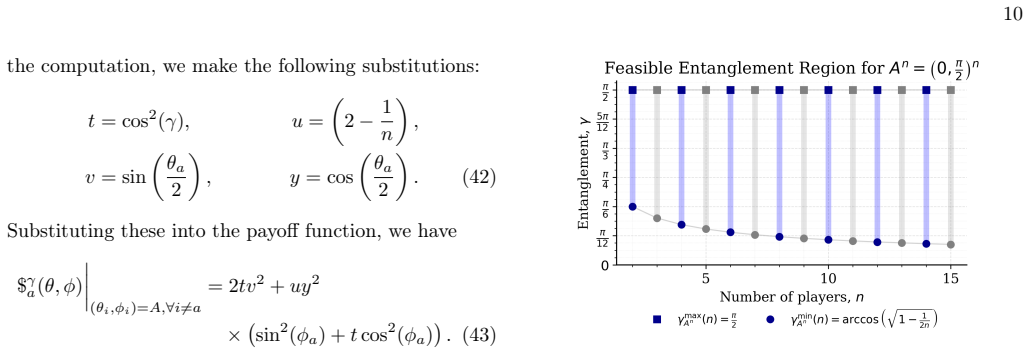
A well-known model in game theory, the Volunteer's Dilemma describes a group of $n$ players who decide whether to volunteer for a collective benefit at a personal cost, or to abstain and risk forfeiting the benefit altogether. A quantum version of this dilemma, developed within the Eisert-Wilkens-Lewenstein framework, allows each player to manipulate one qubit of a shared entangled state, leading to symmetric Nash equilibria with higher expected payoffs than in the classical game. Existing analyses, however, assume maximal entanglement. Within the same framework, we introduce a generalized Quantum Volunteer's Dilemma with a tunable entanglement parameter $\gamma$ and study the extent to which equilibrium behavior depends on the level of entanglement. We derive explicit conditions relating $\gamma$, the number of players, and the players' strategies under which symmetric Nash equilibria exist, focusing on two canonical strategy profiles: one for $2\leq n\leq 9$, and one for even $n$. We find that maximal entanglement is not required to sustain symmetric equilibria. Instead, equilibrium behavior persists above a threshold value, which we compute analytically in both cases. We also demonstrate that the threshold value directly depends on system size. This characterization is directly relevant for implementations on resource-constrained quantum devices, where entanglement is inherently limited.
Editorial analysis
A structured set of objections, weighed in public.
Referee Report
Summary. The manuscript generalizes the Quantum Volunteer's Dilemma in the Eisert-Wilkens-Lewenstein framework by introducing a tunable entanglement parameter γ. It analytically derives explicit threshold conditions on γ (depending on player number n) under which symmetric Nash equilibria exist for two specified canonical strategy profiles—one valid for 2 ≤ n ≤ 9 and one for even n—showing that maximal entanglement is not required.
Significance. If the derivations are correct, the result is significant for near-term quantum implementations: it supplies concrete, n-dependent lower bounds on γ below which the symmetric equilibria disappear, directly addressing resource constraints on entanglement generation. The analytic (rather than numerical) character of the thresholds is a clear strength.
minor comments (2)
- The abstract states that thresholds are computed analytically but does not indicate whether the payoff parameters of the underlying Volunteer's Dilemma (e.g., benefit and cost values) enter the final expressions; a brief statement clarifying this would improve readability.
- Notation for the two strategy profiles should be introduced with explicit labels (e.g., “Profile A for 2≤n≤9”) the first time they appear, rather than only in the results section, to aid cross-referencing.
Simulated Author's Rebuttal
We thank the referee for their positive summary of our work and for noting its relevance to resource-constrained quantum devices. The recommendation of minor revision is noted. No specific major comments appear in the report.
Circularity Check
No significant circularity identified
full rationale
The paper extends the established EWL quantum game framework by introducing a tunable entanglement parameter γ and performs an analytical derivation of threshold conditions for symmetric Nash equilibria in two canonical strategy profiles. These thresholds are obtained directly from the payoff expressions and Nash equilibrium conditions within the model, without reducing to fitted parameters, self-definitional loops, or load-bearing self-citations. The EWL framework and its parameterization are external to the authors, and the central claim (equilibria persist above a computable γ threshold) follows from explicit algebraic conditions on γ and n rather than by construction or renaming. No steps match the enumerated circularity patterns.
Axiom & Free-Parameter Ledger
free parameters (1)
- entanglement parameter γ
axioms (1)
- domain assumption The game is modeled within the Eisert-Wilkens-Lewenstein framework using a shared entangled state with tunable parameter γ.
Reference graph
Works this paper leans on
-
[1]
Similarly, the second case implies thatx= 1 n
1. Similarly, the second case implies thatx= 1 n. The third implies thatx= 0 n, and finally, the fourth case implies thatx= 00. . .0 1 ↑a
-
[2]
With this in mind, we now substitute this result into Eq
0. With this in mind, we now substitute this result into Eq. (10), which yields $γ a(θ, ϕ) (θi,ϕi)=Q,∀i̸=a = 2 X x∈{0,1}n x̸=0n xa=0 pθ,ϕ(x) + nX k=1 2− 1 k X x∈{0,1}n xa=1 wt(x)=k pθ,ϕ(x) (θi,ϕi)=Q,∀i̸=a = 2pθ,ϕ(1. . .101. . .1) + 2− 1 1 pθ,ϕ(0. . .010. . .0) + 2− 1 n pθ,ϕ(1n) (θi,ϕi)=Q,∀i̸=a = 2 cos2 π n sin2 θa 2 + cos2(γ) sin2 θa 2 sin2 π n + sin2(γ) ...
-
[3]
Horodecki, P
R. Horodecki, P. Horodecki, M. Horodecki, and K. Horodecki, Quantum entanglement, Rev. Mod. Phys. 81, 865 (2009)
2009
-
[4]
Ekert and R
A. Ekert and R. Jozsa, Quantum algorithms: entan- glement–enhanced information processing, Philosophi- cal Transactions of the Royal Society A: Mathematical, Physical and Engineering Sciences356, 1769 (1998)
1998
-
[5]
Jozsa and N
R. Jozsa and N. Linden, On the role of entanglement in quantum-computational speed-up, Proceedings of the Royal Society A: Mathematical, Physical and Engineer- ing Sciences459, 2011 (2003)
2011
-
[6]
Bruß and C
D. Bruß and C. Macchiavello, Multipartite entangle- ment in quantum algorithms, Phys. Rev. A83, 052313 (2011)
2011
-
[7]
J. D. Biamonte, M. E. S. Morales, and D. E. Koh, En- tanglement scaling in quantum advantage benchmarks, Phys. Rev. A101, 012349 (2020)
2020
-
[8]
Díez-Valle, D
P. Díez-Valle, D. Porras, and J. J. García-Ripoll, Quan- tum variational optimization: The role of entangle- ment and problem hardness, Phys. Rev. A104, 062426 (2021)
2021
-
[9]
J.-B.You, D.E.Koh, J.F.Kong, W.-J.Ding, C.E.Png, and L. Wu, Exploring variational quantum eigensolver ansatzes for the long-range XY model, arXiv preprint arXiv:2109.00288 (2021)
arXiv 2021
-
[10]
Katabarwa, S
A. Katabarwa, S. Sim, D. E. Koh, and P.-L. Dallaire- Demers, Connecting geometry and performance of two- qubit parameterized quantum circuits, Quantum6, 782 (2022)
2022
-
[11]
Horodecki, P
M. Horodecki, P. Horodecki, and R. Horodecki, Mixed- state entanglement and quantum communication, in Quantum Information: An Introduction to Basic Theo- retical Concepts and Experiments(Springer Berlin Hei- delberg, Berlin, Heidelberg, 2001) pp. 151–195
2001
-
[12]
Ursin, F
R. Ursin, F. Tiefenbacher, T. Schmitt-Manderbach, H. Weier, T. Scheidl, M. Lindenthal, B. Blauensteiner, T. Jennewein, J. Perdigues, P. Trojek, B. Ömer, M. Fürst, M. Meyenburg, J. Rarity, Z. Sodnik, C. Bar- bieri, H. Weinfurter, and A. Zeilinger, Entanglement- based quantum communication over 144km, Nature Physics3, 481 (2007)
2007
-
[13]
Zou, Quantum entanglement and its application in quantum communication, Journal of Physics: Confer- ence Series1827, 012120 (2021)
N. Zou, Quantum entanglement and its application in quantum communication, Journal of Physics: Confer- ence Series1827, 012120 (2021)
2021
-
[14]
J. Xing, T. Feng, Z. Fan, H. Ma, K. Bharti, D. E. Koh, and Y. Xiao, Fundamental limitations on com- munication over a quantum network, arXiv preprint arXiv:2306.04983 (2023)
arXiv 2023
-
[15]
J. Xing, Y. Li, D. Qu, L. Xiao, Z. Fan, H. Ma, P. Xue, K. Bharti, D. E. Koh, and Y. Xiao, Teleportation with embezzling catalysts, Communications Physics7, 357 (2024)
2024
-
[16]
A.K.Ekert,QuantumcryptographybasedonBell’sthe- orem, Phys. Rev. Lett.67, 661 (1991)
1991
-
[17]
Jennewein, C
T. Jennewein, C. Simon, G. Weihs, H. Weinfurter, and A. Zeilinger, Quantum cryptography with entangled photons, Phys. Rev. Lett.84, 4729 (2000)
2000
-
[18]
Yin, Y.-H
J. Yin, Y.-H. Li, S.-K. Liao, M. Yang, Y. Cao, L. Zhang, J.-G. Ren, W.-Q. Cai, W.-Y. Liu, S.-L. Li, R. Shu, Y.- M. Huang, L. Deng, L. Li, Q. Zhang, N.-L. Liu, Y.-A. Chen, C.-Y. Lu, X.-B. Wang, F. Xu, J.-Y. Wang, C.- Z. Peng, A. K. Ekert, and J.-W. Pan, Entanglement- based secure quantum cryptography over 1,120 kilome- tres, Nature582, 501 (2020)
2020
-
[19]
Giovannetti, S
V. Giovannetti, S. Lloyd, and L. Maccone, Advances in quantum metrology, Nature Photonics5, 222 (2011)
2011
-
[20]
Huang, C
Z. Huang, C. Macchiavello, and L. Maccone, Useful- nessofentanglement-assistedquantummetrology,Phys. Rev. A94, 012101 (2016)
2016
-
[21]
Augusiak, J
R. Augusiak, J. Kołodyński, A. Streltsov, M. N. Bera, A. Acín, and M. Lewenstein, Asymptotic role of entan- glementinquantummetrology,Phys.Rev.A94,012339 (2016)
2016
-
[22]
Eisert, M
J. Eisert, M. Wilkens, and M. Lewenstein, Quantum games and quantum strategies, Physical Review Letters 83, 3077 (1999)
1999
-
[23]
Eisert and M
J. Eisert and M. Wilkens, Quantum games, Journal of Modern Optics47, 2543 (2000)
2000
-
[24]
A. P. Flitney and D. Abbott, An introduction to quan- tumgametheory,FluctuationandNoiseLetters2,R175 (2002)
2002
-
[25]
F. S. Khan, N. Solmeyer, R. Balu, and T. S. Hum- ble, Quantum games: a review of the history, current state, and interpretation, Quantum Information Pro- cessing17, 309 (2018)
2018
-
[26]
D. A. Meyer, Quantum strategies, Physical Review Let- ters82, 1052 (1999)
1999
-
[27]
S.C.BenjaminandP.M.Hayden,Multiplayerquantum games, Phys. Rev. A64, 030301(R) (2001)
2001
-
[28]
Tsakiroglou, I
M. Tsakiroglou, I. Liliopoulos, G. D. Varsamis, K. Milchanowski, and I. G. Karafyllidis, Graph-encoded strategic interactions in multiplayer quantum games, Quantum Information Processing25, 109 (2026)
2026
-
[29]
K. Essalmi, F. Garrido, and F. Nashashibi, Multi- player, multi-strategy quantum game model for interaction-aware decision-making in autonomous driv- ing, arXiv preprint arXiv:2602.03571 (2026)
arXiv 2026
-
[30]
H. Li, J. Du, and S. Massar, Continuous-variable quan- tum games, Physics Letters A306, 73 (2002). 17
2002
-
[31]
R. Kay, N. F. Johnson, and S. C. Benjamin, Evolution- ary quantum game, Journal of Physics A: Mathematical and General34, L547 (2001)
2001
-
[32]
Sanz-Martín, G
L. Sanz-Martín, G. Rivas, N. Clavijo-Buriticá, M. Her- rera, and J. Parra-Domínguez, Mapping the frontier: a review of quantum and evolutionary game theory for complex decision-making, Quantum Information Pro- cessing24, 291 (2025)
2025
-
[33]
J. Du, X. Xu, H. Li, X. Zhou, and R. Han, Nash equi- librium in the quantum battle of sexes game, arXiv preprint quant-ph/0010050 (2000)
Pith/arXiv arXiv 2000
-
[34]
Piotrowski and J
E. Piotrowski and J. Sładkowski, Quantum market games, Physica A: Statistical Mechanics and its Appli- cations312, 208 (2002)
2002
-
[35]
Q. Chen, Y. Wang, J.-T. Liu, and K.-L. Wang, N-player quantum minority game, Physics Letters A327, 98 (2004)
2004
-
[36]
Nawaz and A
A. Nawaz and A. Toor, Dilemma and quantum battle of sexes, Journal of Physics A: Mathematical and General 37, 4437 (2004)
2004
-
[37]
Frąckiewicz, The ultimate solution to the quantum battle of the sexes game, Journal of Physics A: Mathe- matical and Theoretical42, 365305 (2009)
P. Frąckiewicz, The ultimate solution to the quantum battle of the sexes game, Journal of Physics A: Mathe- matical and Theoretical42, 365305 (2009)
2009
-
[38]
Consuelo-Leal, A
A. Consuelo-Leal, A. G. Araujo-Ferreira, E. Lucas- Oliveira, T. J. Bonagamba, and R. Auccaise, Pareto- optimal solution for the quantum battle of the sexes, Quantum Information Processing19, 41 (2020)
2020
-
[39]
Szopa, Efficiency of classical and quantum games equilibria, Entropy23, 506 (2021)
M. Szopa, Efficiency of classical and quantum games equilibria, Entropy23, 506 (2021)
2021
-
[40]
Kastampolidou and T
K. Kastampolidou and T. Andronikos, Quantum tap- silou—aquantumgameinspiredbythetraditionalgreek coin tossing game tapsilou, Games14, 72 (2023)
2023
-
[41]
Frąckiewicz and M
P. Frąckiewicz and M. Szopa, Permissible extensions of classical to quantum games combining three strategies, Quantum Information Processing23, 75 (2024)
2024
-
[42]
Frąckiewicz, A
P. Frąckiewicz, A. Gorczyca-Goraj, and M. Szopa, Per- missible four-strategy quantum extensions of classi- cal games, Quantum Information Processing24, 201 (2025)
2025
-
[43]
D. E. Koh, K. Kumar, and S. T. Goh, Quantum vol- unteer’s dilemma, Physical Review Research7, 013104 (2025)
2025
-
[44]
Andronikos, C
T. Andronikos, C. Bitsakos, K. Nikas, G. I. Goumas, and N. Koziris, A GHZ-based protocol for the dining information brokers problem, Future Internet17, 408 (2025)
2025
-
[45]
Essalmi, F
K. Essalmi, F. Garrido, and F. Nashashibi, Quantum game models for interaction-aware decision-making in automated driving, in2025 IEEE International Confer- ence on Advanced Robotics (ICAR)(2025) pp. 155–162
2025
-
[46]
R.Smoliński, P.Frąckiewicz, K.Grzanka,andM.Szopa, Quantum negotiation games: Toward ethical equilibria, Entropy28, 51 (2026)
2026
-
[47]
Vlachos and I
P. Vlachos and I. G. Karafyllidis, Quantum game simu- lator, using the circuit model of quantum computation, Computer Physics Communications180, 1990 (2009)
1990
-
[48]
Kotara, T
P. Kotara, T. Zawadzki, and K. Rycerz, Software aided analysis of EWL based quantum games, inPar- allel Processing and Applied Mathematics, edited by R. Wyrzykowski, J. Dongarra, E. Deelman, and K. Kar- czewski (Springer International Publishing, Cham,
-
[49]
K. Grzanka, A. Gorczyca-Goraj, M. Szopa,et al., QEGS:AMathematicapackagefortheanalysisofquan- tum extended games, arXiv preprint arXiv:2505.00714 (2025)
arXiv 2025
-
[50]
N. F. Johnson, Playing a quantum game with a cor- rupted source, Phys. Rev. A63, 020302(R) (2001)
2001
-
[51]
L. Chen, H. Ang, D. Kiang, L. Kwek, and C. Lo, Quan- tum prisoner dilemma under decoherence, Physics Let- ters A316, 317 (2003)
2003
-
[52]
A. P. Flitney and D. Abbott, Quantum games with decoherence, Journal of Physics A: Mathematical and General38, 449 (2004)
2004
-
[53]
Shuai, F
C. Shuai, F. Mao-Fa, and Z. Xiao-Juan, The effect of quantum noise on multiplayer quantum game, Chinese Physics16, 915 (2007)
2007
-
[54]
Huang and D
Z. Huang and D. Qiu, Quantum games under decoher- ence, International Journal of Theoretical Physics55, 965 (2016)
2016
-
[55]
Khan and S
S. Khan and S. Alam, The dynamics of Nash equilib- rium under non-Markovian classical noise in quantum prisoners’ dilemma, Reports on Mathematical Physics 81, 399 (2018)
2018
-
[56]
Kairon, K
P. Kairon, K. Thapliyal, R. Srikanth, and A. Pathak, Noisy three-player dilemma game: robustness of the quantum advantage, Quantum information processing 19, 327 (2020)
2020
-
[57]
A. R. Legón and E. Medina, Joint probabilities ap- proach to quantum games with noise, Entropy25, 1222 (2023)
2023
-
[58]
A. T. M. Makram-Allah, M. Y. Abd-Rabbou, and N. Metwally, The possibility of fairly mitigating penal- ties in the quantum prisoner’s dilemma via classical noise channels, The European Physical Journal Plus 141, 456 (2026)
2026
-
[59]
J. Lu, L. Zhou, and L.-M. Kuang, Linear optics imple- mentation for quantum game with two players, Physics Letters A330, 48 (2004)
2004
-
[60]
I. M. Buluta, S. Fujiwara, and S. Hasegawa, Quantum games in ion traps, Physics Letters A358, 100 (2006)
2006
-
[61]
Mitra, K
A. Mitra, K. Sivapriya, and A. Kumar, Experimental implementation of a three qubit quantum game with corrupt source using nuclear magnetic resonance quan- tum information processor, Journal of Magnetic Reso- nance187, 306 (2007)
2007
-
[62]
Prevedel, A
R. Prevedel, A. Stefanov, P. Walther, and A. Zeilinger, Experimental realization of a quantum game on a one- way quantum computer, New Journal of Physics9, 205 (2007)
2007
-
[63]
Schmid, A
C. Schmid, A. P. Flitney, W. Wieczorek, N. Kiesel, H. Weinfurter, and L. C. Hollenberg, Experimental im- plementation of a four-player quantum game, New Jour- nal of Physics12, 063031 (2010)
2010
-
[64]
Xu and Z
K. Xu and Z. Wu, Experimental implementation of quantum prisoner dilemma on IBM quantum comput- ers, in2022 15th International Conference on Advanced Computer Theory and Engineering (ICACTE)(IEEE,
-
[65]
G. D. Agreda, C. A. D. Paredes, M. B. Samboni, J. A. Andrade, and S. C. Ordoñez, Bridging theory and prac- tice in quantum game theory: Optimized implementa- tion of the battle of the sexes with error mitigation on NISQ hardware, in2025 IEEE CHILEAN Conference on Electrical, Electronics Engineering, Information and Communication Technologies (CHILECON)(20...
2025
-
[66]
G. D. D. Agreda, J. A. A. Hoyos, C. A. D. Paredes, S. C. Ordoñez, N. D. Hebdon, S. T. Goh, and D. E. Koh, Experimental implementation of the quantum vol- unteer’sdilemmaonNISQhardware: Noiseanalysisand digital-twin validation, arXiv preprint arXiv:2605.30676 (2026)
Pith/arXiv arXiv 2026
-
[67]
J.Du, X.Xu, H.Li, X.Zhou,andR.Han,Entanglement playing a dominating role in quantum games, Physics Letters A289, 9 (2001)
2001
-
[68]
J.Du, H.Li, X.Xu, X.Zhou,andR.Han,Entanglement enhanced multiplayer quantum games, Physics Letters A302, 229 (2002)
2002
-
[69]
S. K. Özdemir, J. Shimamura, and N. Imoto, A nec- essary and sufficient condition to play games in quan- tum mechanical settings, New Journal of Physics9, 43 (2007)
2007
-
[70]
A. Nawaz and A. Toor, Quantum games and quantum discord, arXiv preprint arXiv:1012.1428 (2010)
Pith/arXiv arXiv 2010
-
[71]
Ahmad, The strategic form of quantum prisoners’ dilemma, Chinese Physics Letters30, 050302 (2013)
N. Ahmad, The strategic form of quantum prisoners’ dilemma, Chinese Physics Letters30, 050302 (2013)
2013
-
[72]
Li and X
A. Li and X. Yong, Entanglement guarantees emergence of cooperation in quantum prisoner’s dilemma games on networks, Scientific Reports4, 6286 (2014)
2014
-
[73]
Wei and S
Z. Wei and S. Zhang, Quantum game players can have advantage without discord, Information and Computa- tion256, 174 (2017)
2017
-
[74]
A. C. Santos, Entanglement and coherence in quantum prisoner’s dilemma, Quantum Information Processing 19, 13 (2019)
2019
-
[75]
N. M. A. A. Mohamed, H. Taisheng, and P. Jinhui, Quantum game theory on entangled players, inInterna- tional Conference on Intelligent Information Technolo- gies for Industry(Springer, 2023) pp. 291–301
2023
-
[76]
S. Bugu, Entanglement as a strategic resource in adver- sarial quantum games, arXiv preprint arXiv:2510.22444 (2025)
arXiv 2025
-
[77]
G. D. Varsamis, I. Liliopoulos, H. Mohammadbagher- poor, A. K. Kostopoulos, K. Milchanowski, E. T. Kara- matskos, P. Dimitrakis, R. P. Padbury, and I. G. Karafyllidis, Analysis of the effect of entanglement oper- ators and the scalability of players’ payoff computation in n-player quantum games, Advanced Quantum Tech- nologies8, e00375 (2025)
2025
-
[78]
Diekmann, Volunteer’s dilemma, Journal of Conflict Resolution29, 605 (1985)
A. Diekmann, Volunteer’s dilemma, Journal of Conflict Resolution29, 605 (1985)
1985
-
[79]
J. E. Smith, S. Gavrilets, M. B. Mulder, P. L. Hooper, C. E. Mouden, D. Nettle, C. Hauert, K. Hill, S. Perry, A. E. Pusey, M. van Vugt, and E. A. Smith, Leader- ship in mammalian societies: Emergence, distribution, power, and payoff, Trends in Ecology & Evolution31, 54 (2016)
2016
-
[80]
Weesie and A
J. Weesie and A. Franzen, Cost sharing in a volunteer’s dilemma, Journal of Conflict Resolution42, 600 (1998)
1998
discussion (0)
Sign in with ORCID, Apple, or X to comment. Anyone can read and Pith papers without signing in.