A Unified Framework for Contraction Stability Analysis of Heterogeneous Grid-Forming Inverters
Pith reviewed 2026-06-27 18:10 UTC · model grok-4.3
The pith
A contraction-based framework certifies large-signal stability and exponential convergence for heterogeneous grid-forming inverters without linearization.
A machine-rendered reading of the paper's core claim, the machinery that carries it, and where it could break.
Core claim
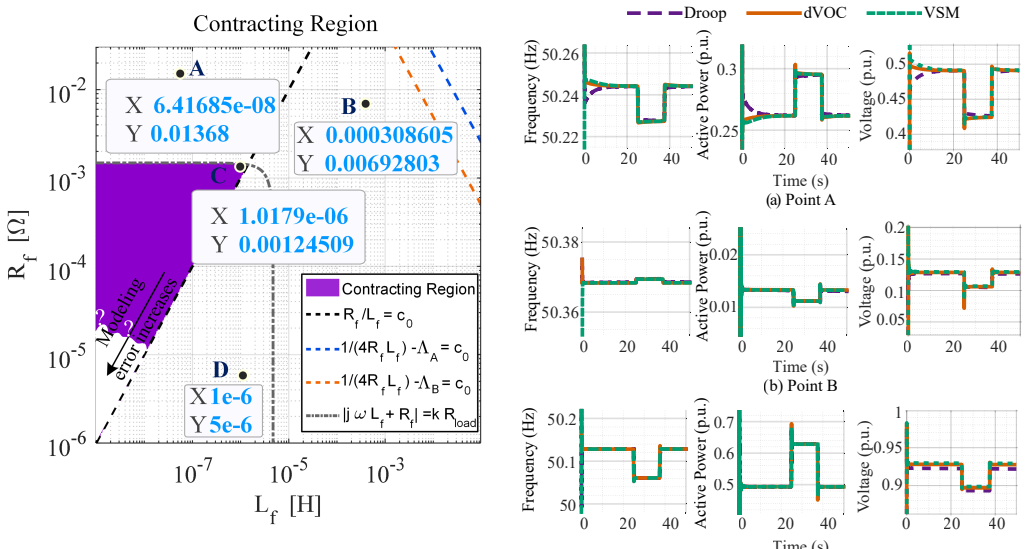
The proposed contraction stability analysis certifies system stability and convergence to desired operating points. The contraction rate provides an explicit bound on transient time: trajectories converge exponentially to the new operating point at a controlled rate, yielding computable contraction regions that certify stability and large-signal convergence across operating-point changes. These regions directly guide parameter tuning for heterogeneous GFMs.
What carries the argument
Algebraic decentralized contraction metric for nonlinear synchronization and power-sharing dynamics
If this is right
- Certifies stability without small-signal linearization or RMS assumptions.
- Provides explicit transient time bounds via contraction rate.
- Enables computable contraction regions for large-signal convergence.
- Guides parameter tuning for heterogeneous GFMs across operating-point changes.
- Works in time domain capturing nonlinear large-signal behavior.
Where Pith is reading between the lines
- The same contraction regions could support online monitoring of stability margins in live grids.
- Extension to grids mixing GFMs with synchronous machines would follow if the metric can be composed across device types.
- Controller synthesis tools might directly optimize the contraction rate as a design objective.
Load-bearing premise
The nonlinear synchronization and power-sharing dynamics of heterogeneous grid-forming inverters admit a decentralized algebraic contraction metric that certifies global convergence without operating-point linearization.
What would settle it
A counterexample where trajectories fail to converge exponentially within the predicted contraction rate for a system the metric claims is stable, or inability to compute contraction regions for a known stable heterogeneous GFM setup.
Figures


read the original abstract
The shift to renewable-dominated power systems has produced low-inertia grids, undermining system stability. In this context, grid-forming inverters (GFMs) have emerged as a promising solution. However, GFMs challenge conventional analysis techniques, especially those relying on small-signal or root-mean-square (RMS) models. Such models rely on linearization and sinusoidal steady-state assumptions, which fail in large-signal cases. Stability of GFM-based systems therefore becomes operating-point dependent, and a feasible operating point may not even exist. While large-signal analyses are available, decentralized certification of operating-point convergence with explicit transient guarantees, such as rate and overshoot, remains rare. This paper proposes an algebraic, decentralized contraction-based framework. The proposed contraction stability analysis certifies system stability and convergence to desired operating points. The method works in the time domain and captures nonlinear, large-signal behavior of synchronization and power-sharing mechanisms. Moreover, the contraction rate provides an explicit bound on transient time: trajectories converge exponentially to the new operating point at a controlled rate, yielding computable contraction regions that certify stability and large-signal convergence across operating-point changes. These regions directly guide parameter tuning for heterogeneous GFMs.
Editorial analysis
A structured set of objections, weighed in public.
Referee Report
Summary. The paper proposes an algebraic, decentralized contraction-based framework for certifying stability and convergence of heterogeneous grid-forming inverters. It analyzes nonlinear synchronization and power-sharing dynamics in the time domain without linearization or small-signal assumptions, derives explicit contraction rates that bound transient convergence times, and produces computable contraction regions to guide parameter tuning across operating-point changes.
Significance. If the central algebraic metric construction and contraction proofs hold, the work would provide a meaningful advance by delivering large-signal, operating-point-independent guarantees with explicit rate bounds for GFM systems, addressing a gap left by conventional RMS or linearized models in low-inertia grids. The decentralized character is a practical strength for heterogeneous inverter fleets.
minor comments (3)
- [§2.2] §2.2, the definition of the virtual inertia and damping parameters in the swing equation could be cross-referenced to the contraction metric construction in §3 to clarify independence from operating point.
- [Table 1] Table 1: the reported contraction rates for the three-inverter case lack units or normalization details, making direct comparison to simulation settling times difficult.
- [Figure 4] Figure 4 caption: the shaded contraction region boundaries are not labeled with the corresponding metric eigenvalues, reducing interpretability of the large-signal guarantee.
Simulated Author's Rebuttal
We thank the referee for the positive assessment of our work and the recommendation for minor revision. The summary correctly identifies the core contribution: an algebraic, decentralized contraction framework that certifies large-signal stability, exponential convergence, and explicit transient bounds for heterogeneous grid-forming inverters without linearization or small-signal assumptions.
Circularity Check
No significant circularity detected
full rationale
The abstract outlines a contraction-based algebraic framework for large-signal stability of heterogeneous GFMs without providing any equations, metric constructions, or derivation steps. No self-definitional reductions, fitted inputs renamed as predictions, load-bearing self-citations, or ansatz smuggling via prior work are present in the text. The contraction rate and regions are described as results of the analysis applied to synchronization and power-sharing dynamics, with no indication that they are defined in terms of themselves or forced by the inputs. The derivation chain cannot be walked due to lack of specific steps, but the available claims show no reduction to inputs by construction and are treated as self-contained.
Axiom & Free-Parameter Ledger
Reference graph
Works this paper leans on
-
[1]
C. -C. Liu et al., ”Microgrid Building Blocks: Concept and Feasibility,” in IEEE Open Access Journal of Power and Energy, vol. 10, pp. 463- 476, 2023, doi: 10.1109/OAJPE.2023.3282188
-
[2]
D. Groß, M. Colombino, J. -S. Brouillon and F. D ¨orfler, ”The Effect of Transmission-Line Dynamics on Grid-Forming Dispatch- able Virtual Oscillator Control,” in IEEE Transactions on Control of Network Systems, vol. 6, no. 3, pp. 1148-1160, Sept. 2019, doi: 10.1109/TCNS.2019.2921347
-
[3]
A. Tayyebi, D. Groß, A. Anta, F. Kupzog and F. D ¨orfler, ”Frequency Sta- bility of Synchronous Machines and Grid-Forming Power Converters,” in IEEE Journal of Emerging and Selected Topics in Power Electronics, vol. 8, no. 2, pp. 1004-1018, June 2020, doi: 10.1109/JESTPE.2020.2966524
-
[4]
X. He, L. Huang, I. Suboti ´c, V . H¨aberle and F. D ¨orfler, ”Quantitative Stability Conditions for Grid-Forming Converters With Complex Droop Control,” in IEEE Transactions on Power Electronics, vol. 39, no. 9, pp. 10834-10852, Sept. 2024, doi: 10.1109/TPEL.2024.3404251
-
[5]
M. Lu, ”Virtual Oscillator Grid-Forming Inverters: State of the Art, Mod- eling, and Stability,” in IEEE Transactions on Power Electronics, vol. 37, no. 10, pp. 11579-11591, Oct. 2022, doi: 10.1109/TPEL.2022.3163377
-
[6]
L. Zhang, L. Harnefors and H. -P. Nee, ”Power-Synchronization Control of Grid-Connected V oltage-Source Converters,” in IEEE Transactions on Power Systems, vol. 25, no. 2, pp. 809-820, May 2010, doi: 10.1109/TPWRS.2009.2032231
-
[7]
M. Carre ˜no, ”The RMS Model Cannot Capture PLL Small-Signal Instability,” in IEEE Transactions on Power Systems, vol. 40, no. 5, pp. 4415-4418, Sept. 2025, doi: 10.1109/TPWRS.2025.3584261
-
[8]
A Task-Based Day-Ahead Load Forecasting ModelforStochasticEconomicDispatch,
X. He and F. D ¨orfler, ”Passivity and Decentralized Stability Condi- tions for Grid-Forming Converters,” in IEEE Transactions on Power Systems, vol. 39, no. 3, pp. 5447-5450, May 2024, doi: 10.1109/TP- WRS.2024.3360707
work page doi:10.1109/tp- 2024
-
[9]
R. Sun, H. Yang, W. He and X. Yuan, ”Electric Network Stimulation- Response Relationship and Its Characteristics Under Time-Varying Amplitude and Frequency,” in IEEE Transactions on Industry Ap- plications, vol. 61, no. 3, pp. 4847-4861, May-June 2025, doi: 10.1109/TIA.2025.3534750
-
[10]
WINFRIED LOHMILLER, JEAN-JACQUES E. SLOTINE, On Contraction Analysis for Non-linear Systems, Automatica, V olume 34, Issue 6, 1998, Pages 683-696, ISSN 0005-1098, https://doi.org/10.1016/S0005-1098(98)00019-3
discussion (0)
Sign in with ORCID, Apple, or X to comment. Anyone can read and Pith papers without signing in.