Experiment-free disruption prediction for new devices enabled by synthetic diagnostic data augmentation
Pith reviewed 2026-06-27 18:04 UTC · model grok-4.3
The pith
Synthetic diagnostic data from MHD simulations of the target device raises zero-shot disruption prediction accuracy from 50% to 57% on J-TEXT.
A machine-rendered reading of the paper's core claim, the machinery that carries it, and where it could break.
Core claim
By integrating the target device's synthetic diagnostic data with Fourier Domain Adaptation, the zero-shot accurate early warning rate of the model on 1,596 J-TEXT discharges is improved from 50% to 57%, while exhibiting enhanced predictive robustness.
What carries the argument
A synthetic diagnostic framework that processes NIMROD MHD simulation data using the target device's magnetic configuration and diagnostic parameters to produce augmenting signals for cross-device models.
If this is right
- Disruption prediction models can be trained for new devices before any experimental data from them becomes available.
- The requirement for large volumes of real disruptive discharges from the target device is reduced.
- Fourier Domain Adaptation aligns synthetic and experimental signals enough to improve generalization across devices.
- Predictive robustness increases, supporting safer initial operations on devices where disruptions must be strictly avoided.
Where Pith is reading between the lines
- If the resemblance between synthetic and real signals holds for other simulation codes, the method could be applied beyond NIMROD.
- Pre-operational training on simulated data might allow virtual testing of prediction thresholds before real tokamak runs begin.
- The same augmentation strategy could transfer to other plasma monitoring tasks that face cross-device data scarcity.
Load-bearing premise
The synthetic diagnostic signals produced by the NIMROD MHD simulation framework, configured with the target device's magnetic configuration and diagnostic parameters, sufficiently resemble the real experimental diagnostic signals to enable effective data augmentation for disruption prediction.
What would settle it
Removing the synthetic data augmentation or using mismatched simulation parameters and observing whether the early warning rate on the 1,596 J-TEXT discharges falls back to 50% or below.
Figures


read the original abstract
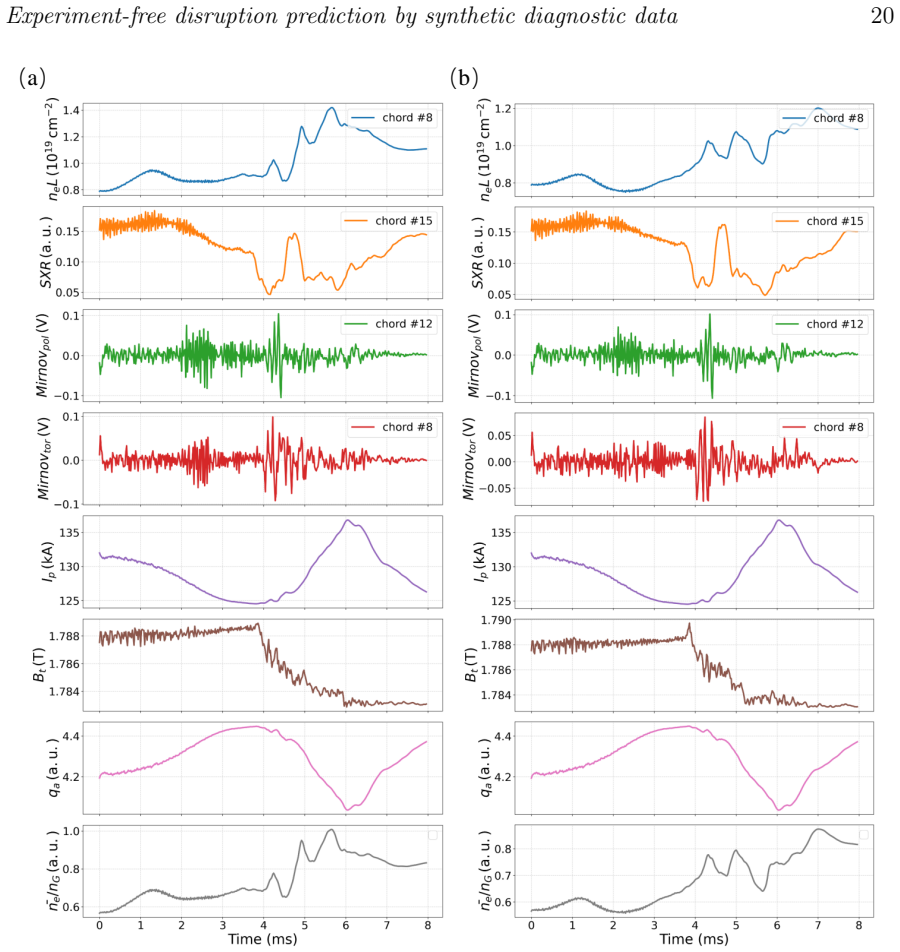
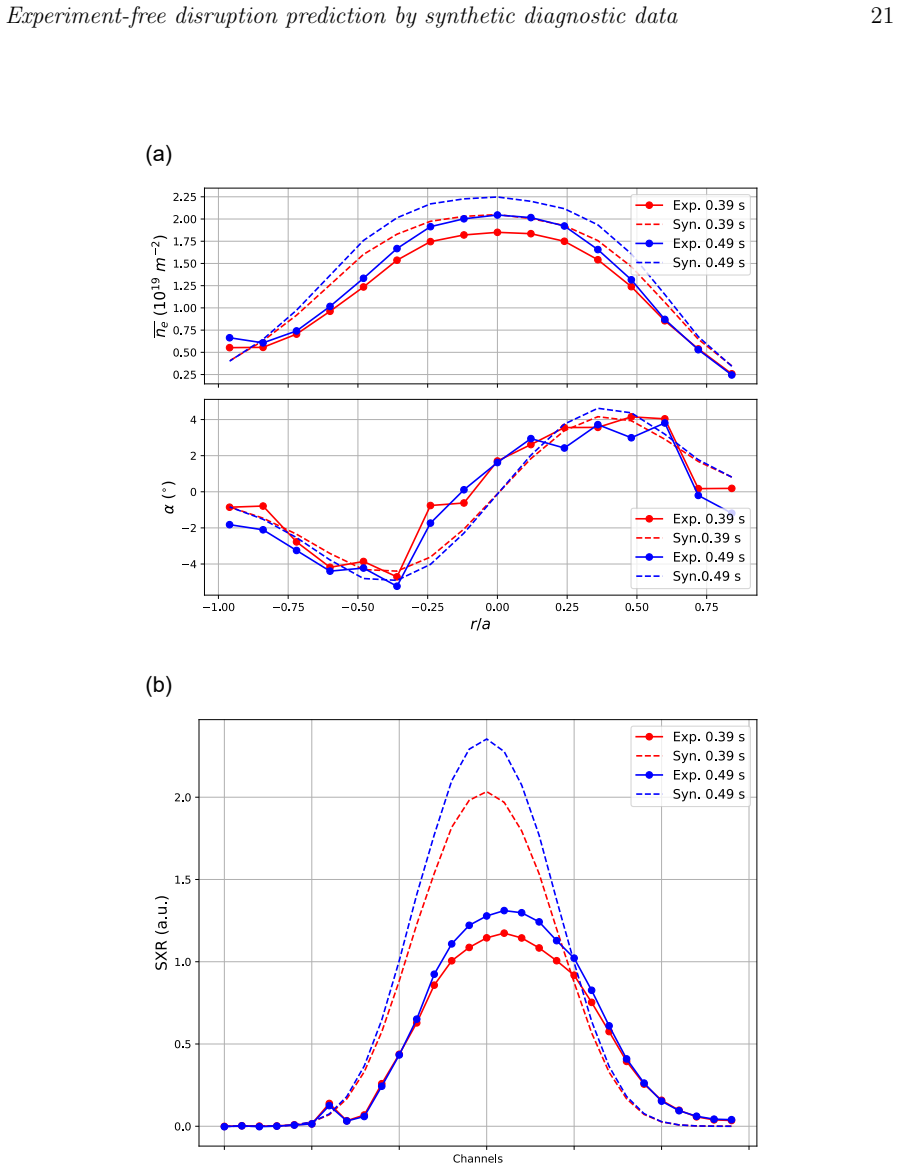
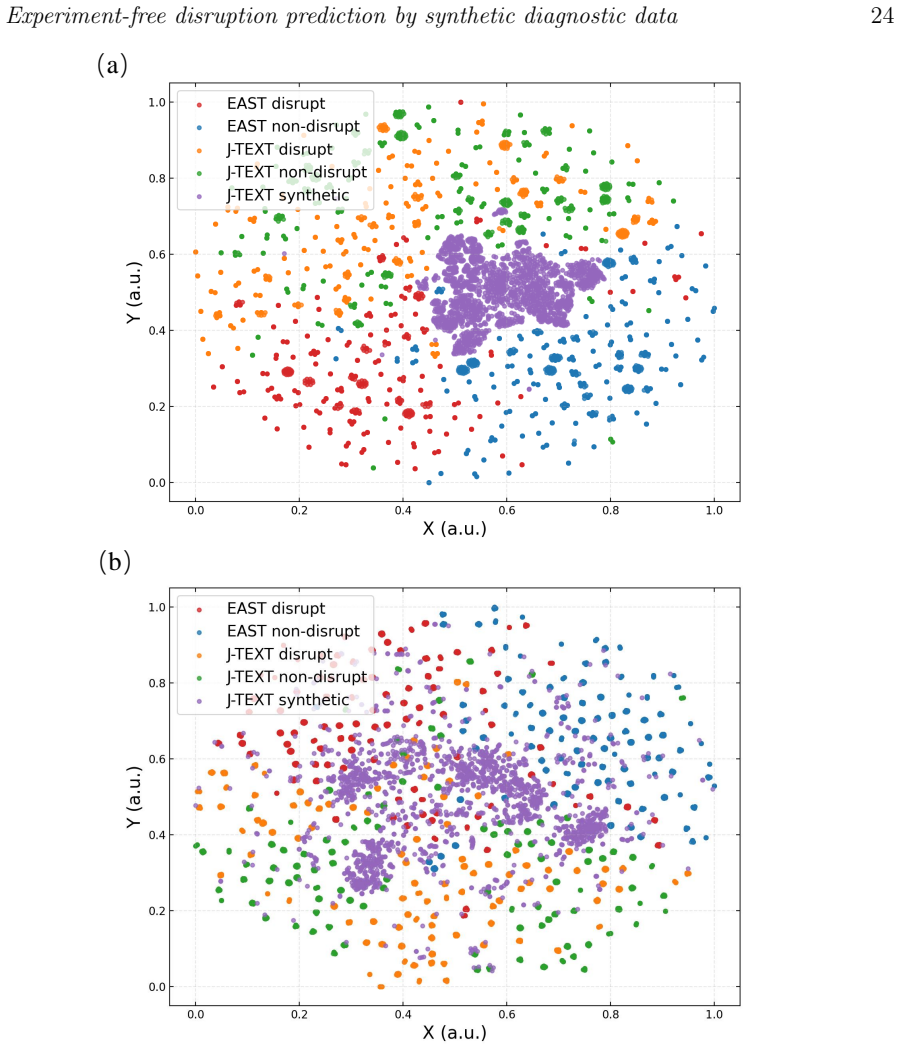
Deep learning based approaches have shown great promise in cross-device disruption prediction for tokamaks, however, the robustness of these models heavily relies on massive amounts of training data. For the upcoming ITER, to ensure the safety of the first plasma and subsequent operations, experimental data should be entirely unavailable initially, and disruptive discharges should be strictly avoided thereafter. This extreme data scarcity inherently conflicts with the data-intensive nature of deep learning algorithms. To address this challenge, we utilize synthetic diagnostic signals from the target device to supplement the experimental data from existing devices for the zero-shot disruption prediction on a new device. The detailed implementation pipeline of this scheme is presented. For experimental validation, a predictive model trained on data from the EAST tokamak is deployed for a zero-shot cross-device experiment on the J-TEXT tokamak. A synthetic diagnostic framework, configured with the diagnostic parameters of the target device, is developed to process NIMROD magnetohydrodynamic (MHD) simulation data based on the target device's magnetic configuration, thereby achieving effective data augmentation. Ultimately, the results demonstrate that by integrating the target device's synthetic diagnostic data with Fourier Domain Adaptation, the zero-shot accurate early warning rate of the model on 1,596 J-TEXT discharges is improved from 50% to 57%, while exhibiting enhanced predictive robustness.
Editorial analysis
A structured set of objections, weighed in public.
Referee Report
Summary. The paper claims that augmenting EAST experimental data with synthetic diagnostic signals generated by NIMROD MHD simulations configured to J-TEXT geometry and diagnostics, combined with Fourier Domain Adaptation, enables improved zero-shot disruption prediction on a new device; specifically, the accurate early warning rate on 1,596 independent J-TEXT discharges rises from 50% to 57%.
Significance. If the result holds, the work would address a key barrier for ITER-scale devices by showing that physics-based synthetic data can supplement scarce experimental training sets for cross-device deep learning. The validation on a large set of real, independent J-TEXT discharges (rather than synthetic test data) is a concrete strength.
major comments (2)
- [Abstract / Results] The headline 7 pp gain (50% → 57%) on the 1,596-shot J-TEXT test set is load-bearing for the central claim, yet the manuscript provides no direct distributional comparison (power-spectrum overlap, MMD, or cross-correlation) between the NIMROD-generated synthetic diagnostics and any held-out real J-TEXT discharges; without this, the improvement cannot be unambiguously attributed to the synthetic augmentation rather than the adaptation step or sampling variance.
- [Methods / Results] § on model training and baseline: the abstract reports a concrete numerical improvement but supplies no details on training hyperparameters, baseline implementation, statistical significance testing, or error bars on the 50%/57% figures, leaving the support for the claim preliminary.
minor comments (2)
- Clarify the exact definition of 'accurate early warning rate' and the time window used for the metric.
- Add a table or figure showing the number of disruptive vs. non-disruptive shots in the training, validation, and test partitions.
Simulated Author's Rebuttal
We thank the referee for the detailed and constructive report. The two major comments identify genuine gaps in the current manuscript that limit the strength of the central claim. We address each point below and will incorporate the requested analyses and details in a revised version.
read point-by-point responses
-
Referee: [Abstract / Results] The headline 7 pp gain (50% → 57%) on the 1,596-shot J-TEXT test set is load-bearing for the central claim, yet the manuscript provides no direct distributional comparison (power-spectrum overlap, MMD, or cross-correlation) between the NIMROD-generated synthetic diagnostics and any held-out real J-TEXT discharges; without this, the improvement cannot be unambiguously attributed to the synthetic augmentation rather than the adaptation step or sampling variance.
Authors: We agree that the absence of a direct distributional comparison leaves the attribution of the 7 pp gain ambiguous. In the revised manuscript we will add a new subsection (and accompanying figure) that reports (i) power-spectrum overlap between the NIMROD synthetic signals and a held-out set of real J-TEXT discharges, (ii) maximum mean discrepancy (MMD) distances, and (iii) cross-correlation statistics. These metrics will be computed on the same diagnostic channels used for training and will be presented alongside the zero-shot prediction results. revision: yes
-
Referee: [Methods / Results] § on model training and baseline: the abstract reports a concrete numerical improvement but supplies no details on training hyperparameters, baseline implementation, statistical significance testing, or error bars on the 50%/57% figures, leaving the support for the claim preliminary.
Authors: We accept that the current manuscript lacks the methodological transparency required to evaluate the reported improvement. The revised version will expand the model-training section to include: the full hyperparameter set (learning rate, batch size, architecture details, early-stopping criteria), a precise description of the baseline implementation, results of statistical significance testing (paired t-test or McNemar test on the 1,596 discharges), and error bars on the 50 % / 57 % figures obtained via bootstrapping or repeated random splits. revision: yes
Circularity Check
No circularity; central result measured on independent real discharges with external simulation inputs
full rationale
The derivation chain trains a model on EAST experimental data plus NIMROD MHD simulations (configured with J-TEXT geometry and diagnostics) and reports accuracy on 1,596 held-out real J-TEXT discharges. The reported lift (50% → 57%) is an empirical measurement against external experimental ground truth, not a quantity defined or fitted from the same inputs. No equations reduce a prediction to a fitted parameter by construction, no self-citation is invoked as a uniqueness theorem or load-bearing premise, and the synthetic data source is an independent physics code rather than a re-expression of the target dataset. This satisfies the criteria for a self-contained, non-circular result.
Axiom & Free-Parameter Ledger
free parameters (1)
- Fourier Domain Adaptation parameters
axioms (1)
- domain assumption NIMROD MHD simulations accurately model the relevant plasma dynamics for diagnostic signals
Reference graph
Works this paper leans on
-
[1]
De Vries P, Johnson M, Alper B, Buratti P, Hender T, Koslowski H and Riccardo V 2011Nuclear Fusion51053018
-
[2]
Strait E, Barr J, Baruzzo M, Berkery J, Buttery R, De Vries P, Eidietis N, Granetz R, Hanson J, Holcomb Cet al.2019Nuclear Fusion59112012
-
[3]
Park J H and Pereslavtsev P 2024Applied Sciences14936
-
[4]
Yang Z, Liu Y, Zhu X, Chen Z, Xia F, Zhong W, Gao Z, Zhang Y and Liu Y 2023Chinese Physics B32075202
-
[5]
Zheng W, Xue F, Chen Z, Chen D, Guo B, Shen C, Ai X, Wang N, Zhang M, Ding Yet al.2023 Communications Physics6181
2023
-
[6]
Seo J, Kim S, Jalalvand A, Conlin R, Rothstein A, Abbate J, Erickson K, Wai J, Shousha R and Kolemen E 2024Nature626746–751
- [7]
-
[8]
Montes K, Rea C, Granetz R, Tinguely R, Eidietis N, Meneghini O, Chen D, Shen B, Xiao B, Erickson Ket al.2019Nuclear Fusion59096015
-
[9]
Zhu J, Rea C, Granetz R, Marmar E, Montes K, Sweeney R, Tinguely R, Chen D, Shen B, Xiao Bet al.2021Nuclear Fusion61114005
-
[10]
Shen C, Zheng W, Ding Y, Ai X, Xue F, Zhong Y, Wang N, Gao L, Chen Z, Yang Zet al.2023 Nuclear Fusion63046024
2023
-
[11]
Ai X, Zheng W, Zhang M, Ding Y, Chen D, Chen Z, Guo B, Shen C, Wang N, Yang Zet al.2025 Nuclear Fusion65036011
2025
-
[12]
Zhu J, Rea C, Montes K, Granetz R, Sweeney R and Tinguely R 2021Nuclear Fusion61026007
-
[13]
Maljaars E, Felici F, Blanken T, Galperti C, Sauter O, De Baar M, Carpanese F, Goodman T, Kim D, Kim S and et al 2017Nuclear Fusion57126063 Experiment-free disruption prediction by synthetic diagnostic data17
-
[14]
Shi L, Valeo E J, Tobias B J, Kramer G J, Hausammann L, Tang W M and Chen M 2016Review of Scientific Instruments8711D303
- [15]
-
[16]
Hender T, Wesley J, Bialek J, Bondeson A, Boozer A, Buttery R, Garofalo A, Goodman T, Granetz R, Gribov Yet al.2007Nuclear Fusion47S128–S202
-
[17]
Liu C, Jardin S C, Qin H, Xiao J, Ferraro N M and Breslau J 2022Computer Physics Communications275108313
-
[18]
Hoelzl M, Huijsmans G, Artola F, Nardon E, Becoulet M, Schwarz N, Cathey A, Pamela S, Aleynikova K, Antlitz Fet al.2024Nuclear Fusion64112016
-
[19]
Jiao Z, Jiang Z, Li Z, Li K and Yuan J 2022 Implementation and Preliminary Analysis of single/dual-SPI based on NIMROD2022 IEEE 3rd China International Youth Conference on Electrical Engineering (CIYCEE)(Wuhan, China: IEEE) pp 1–7 ISBN 978-1-6654-7732-1
2022
-
[20]
Jiang Z, Yang T, Yuan J, Li C, Ye X, Huang J, Liang Y, Izzo V, Huang M, Tong Ret al.2020 Nuclear Fusion60066004
2020
-
[21]
Gong X, on behalf of EAST Team and Collaborators, The EAST Team:, Song Y, Wan B, Li J, Wan Y, Wu X, Liu Fet al.2024Nuclear Fusion64112013
-
[22]
Ding Y, Wang N, Chen Z, Xia D, Yang Z, Chen Z, Zheng W, Yan W, Li D, Zhou S and et al 2024 Nuclear Fusion64112005
2024
-
[23]
Ben-David S, Blitzer J, Crammer K, Kulesza A, Pereira F and Vaughan J W 2010Machine Learning79151–175
-
[24]
Ding Y, Zhuang G, Zhang X, Zhang J, Ba W, Wang Z and Pan Y 2009Nuclear Instruments and Methods in Physics Research Section A: Accelerators, Spectrometers, Detectors and Associated Equipment606743–748
- [25]
-
[26]
Sun B and Saenko K 2016 Deep CORAL: Correlation Alignment for Deep Domain Adaptation Computer Vision – ECCV 2016 Workshopsvol 9915 ed Hua G and J´ egou H (Cham: Springer International Publishing) pp 443–450 ISBN 978-3-319-49408-1 978-3-319-49409-8
2016
-
[27]
Shen C, Zheng W, Guo B, Ding Y, Chen D, Ai X, Xue F, Zhong Y, Wang N, Shen Bet al.2024 Nuclear Fusion64066036
2024
-
[28]
Yang L F, Lan T, Wang S X, Zhang Y, Liu H Q, Jie Y X and EAST Team 2026Plasma Physics and Controlled Fusion68015033
-
[29]
Zeng S, Zhu P and Ren H 2023Physics of Plasmas30082504
-
[30]
Zeng S, Zhu P, Izzo V, Li H and Jiang Z 2022Nuclear Fusion62026015
-
[31]
Huazhong University of Science and Technology 2025 Tokamak plasma synthetic diagnosis platform (ESDP) Chinese Software Copyright, Reg. No. 2025SR2139894
2025
-
[32]
Wang Y, Gao L, Shi P, Xu X, Zhou Y, Yang Q, Yang C, Tao Q, Shen C, Wang Y, Wang L, Chen Z, Xia D, Chen Z, Wang N, Yang Z, Ding Y and Pan Y 2022Plasma Science and Technology 24064001
-
[33]
Zeng S, Zhu P, Zhou R and Escande D F 2023Nuclear Fusion63016026
-
[34]
2025 Open-adas URLhttps://open.adas.ac.uk/
2025
-
[35]
Masi A, Colombo G, De Stasio M, Breschi M, Caponero M A, Celentano G, Marchetti M, Muzzi L, Polimadei A, Savoldi Let al.2025IEEE Transactions on Applied Superconductivity351–5
-
[36]
Huang G, Liu Z, Van Der Maaten L and Weinberger K Q 2017 Densely Connected Convolutional Networks2017 IEEE Conference on Computer Vision and Pattern Recognition (CVPR) (Honolulu, HI: IEEE) pp 2261–2269 ISBN 978-1-5386-0457-1
2017
-
[37]
Vaswani A, Shazeer N, Parmar N, Uszkoreit J, Jones L, Gomez A N, Kaiser L and Polosukhin I 2023 Attention Is All You Need (Preprinthttps://arxiv.org/pdf/1706.03762)
work page internal anchor Pith review Pith/arXiv arXiv 2023
-
[38]
Devlin J, Chang M W, Lee K and Toutanova K 2019arXiv preprint arXiv:1810.04805(Preprint https://arxiv.org/pdf/1810.04805) Experiment-free disruption prediction by synthetic diagnostic data18
work page internal anchor Pith review Pith/arXiv arXiv
-
[39]
Radford A, Kim J W, Hallacy C, Ramesh A, Goh G, Agarwal S, Sastry G, Askell A, Mishkin P, Clark Jet al.2021 Learning Transferable Visual Models From Natural Language Supervision (Preprinthttps://arxiv.org/pdf/2103.00020) Experiment-free disruption prediction by synthetic diagnostic data19 Figure 1: Overview of the proposed zero-shot cross-device transfer ...
work page internal anchor Pith review Pith/arXiv arXiv 2021
discussion (0)
Sign in with ORCID, Apple, or X to comment. Anyone can read and Pith papers without signing in.