Strong comparison principle and symmetry results for the fractional p-Laplacian
Pith reviewed 2026-06-27 18:07 UTC · model grok-4.3
The pith
A strong comparison principle for the fractional p-Laplacian yields symmetry of positive solutions.
A machine-rendered reading of the paper's core claim, the machinery that carries it, and where it could break.
Core claim
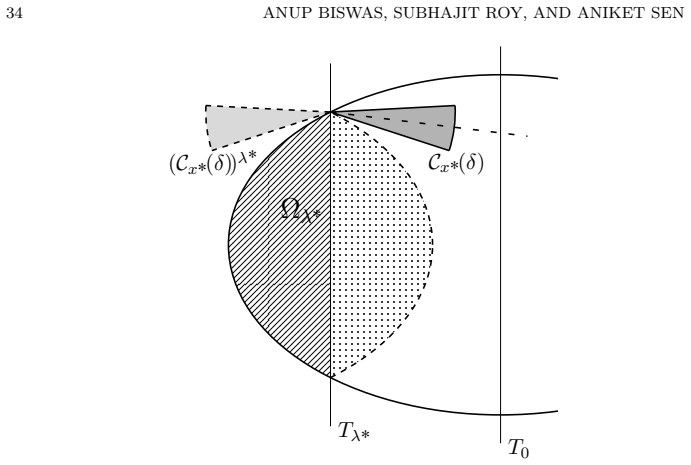
We establish a strong comparison principle in a fairly general setting and use it to derive symmetry results for positive C^1 solutions satisfying Dirichlet boundary conditions. We also show that the C^1 regularity assumption is indeed satisfied for p in [2, 2/(1-s)).
What carries the argument
The strong comparison principle for the fractional p-Laplacian operator, which upgrades pointwise touching of subsolutions and supersolutions into strict inequality in the interior.
If this is right
- Positive C^1 solutions with Dirichlet data are symmetric.
- The C^1 regularity of solutions holds for all p between 2 and 2/(1-s).
- The comparison principle applies to the equation in any bounded domain.
- Symmetry conclusions follow once two solutions touch at an interior point.
Where Pith is reading between the lines
- The same comparison device could be tested on equations with nonlocal right-hand sides beyond locally Lipschitz f.
- Symmetry might be used to reduce the problem to an ODE on radial profiles for numerical checks.
- The principle may allow comparison between solutions on different domains when one is contained in the other.
Load-bearing premise
The nonlinearity f is locally Lipschitz continuous.
What would settle it
A positive C^1 solution to the equation in a ball that satisfies the Dirichlet condition yet fails to be radially symmetric would show the symmetry claim is false.
Figures
read the original abstract
In this article, we study the equation $$ (-\Delta_p)^s u = f(u) $$ in a bounded domain $\Omega\subset \mathbb{R}^n$, where $n\geq 2$, $p>2$, and $f$ is locally Lipschitz. We establish a strong comparison principle in a fairly general setting and use it to derive symmetry results for positive $C^1$ solutions satisfying Dirichlet boundary conditions. We also show that the $C^1$ regularity assumption is indeed satisfied for $p\in \left[2,\frac{2}{1-s}\right)$.
Editorial analysis
A structured set of objections, weighed in public.
Referee Report
Summary. The paper studies the equation (-Δ_p)^s u = f(u) in a bounded domain Ω ⊂ ℝ^n (n ≥ 2, p > 2) with f locally Lipschitz. It establishes a strong comparison principle in a general setting and applies it to obtain symmetry results for positive C^1 solutions satisfying Dirichlet boundary conditions. It also proves that the C^1 regularity assumption holds for p ∈ [2, 2/(1-s)).
Significance. If the proofs are correct, the work supplies a useful strong comparison principle and symmetry results for the fractional p-Laplacian, extending classical local results to the nonlocal setting. The self-contained regularity statement for the stated p-range strengthens the applicability of the symmetry theorems to the class of solutions considered.
minor comments (3)
- [Abstract] Abstract: the statement lists p > 2 while the regularity result includes the endpoint p = 2; clarify whether the comparison principle and symmetry results are intended to hold at p = 2 or only for p > 2.
- [Introduction] The introduction should explicitly recall the precise definition of the fractional p-Laplacian operator used throughout (including the normalization constant and the range of s) to avoid any ambiguity for readers.
- [Section 2] Notation for the space of admissible functions (e.g., the precise Sobolev or Hölder space in which the comparison principle is stated) appears only after the main theorem; move a brief definition to the setup section.
Simulated Author's Rebuttal
We thank the referee for the positive evaluation of the manuscript and the recommendation of minor revision. The report does not list any major comments requiring a point-by-point response.
Circularity Check
No significant circularity identified
full rationale
The paper presents a direct mathematical proof of a strong comparison principle for the fractional p-Laplacian under the stated local Lipschitz condition on f, followed by symmetry results via moving planes and a self-contained regularity argument establishing C^1 solutions for p in [2, 2/(1-s)). No load-bearing steps reduce to self-citations, fitted parameters renamed as predictions, or definitions that presuppose the target result. The derivation chain relies on operator properties and standard analysis techniques that are independent of the paper's own outputs.
Axiom & Free-Parameter Ledger
axioms (2)
- standard math The fractional p-Laplacian operator satisfies the standard comparison and maximum principles in the nonlocal setting.
- domain assumption f is locally Lipschitz continuous.
Reference graph
Works this paper leans on
-
[1]
Badiale and E
M. Badiale and E. Naban. A note on radiality of solutions ofp-Laplacian, Applicable Analysis 52.1-4, 35–43, 1994
1994
-
[2]
Barrios and M
B. Barrios and M. Medina. Equivalence of weak and viscosity solutions in fractional non-homogeneous problems. Math. Ann., 381(3-4): 1979–2012, 2021
1979
-
[3]
Barrios, Montoro, L
B. Barrios, Montoro, L. and B. Sciunzi. On the moving plane method for nonlocal problems in bounded domains. J. Anal. Math. 135, 37–57, 2018
2018
-
[4]
Biswas and M
A. Biswas and M. Modasiya. Mixed local-nonlocal operators: maximum principles, eigenvalue problems and their applications. J. Anal. Math. 156, 47–81, 2025
2025
-
[5]
Biswas and A
A. Biswas and A. Sen. Improved Hölder regularity of fractionalpp, qq-Poisson equation with regular data, 2025
2025
-
[6]
Biswas and E
A. Biswas and E. Topp. Lipschitz regularity of fractionalp-Laplacian,Annals of PDE11, no. 27, 2025
2025
-
[7]
Bögelein, F
V. Bögelein, F. Duzaar, N. Liao, G. Molica Bisci, and R. Servadei. Regularity for the fractionalp-Laplace equation,J. Func. Anal.289(9), 2025
2025
-
[8]
V. Bögelein, F. Duzaar, N. Liao, G. Molica Bisci, and R. Servadei. Gradient regularity ofps, pq-harmonic func- tions,Calc. Var. Partial Differential Equations, to appear, arXiv:2409.02012, 2024
-
[9]
Brasco, E
L. Brasco, E. Lindgren, and A. Schikorra. Higher Hölder regularity for the fractional p-Laplacian in the su- perquadratic case,Adv. Math.338, 782–846, 2018
2018
-
[10]
F. Brock. Continuous rearrangement and symmetry of solutions of elliptic problems. Proc. Indian Acad. Sci. (Math. Sci.) 110, 157–204, 2000
2000
-
[11]
Caffarelli and L
L. Caffarelli and L. Silvestre. Regularity theory for fully nonlinear integro-differential equations, Comm. Pure Appl. Math. 62, 597–638, 2009 STRONG COMPARISON PRINCIPLE AND SYMMETRY 37
2009
-
[12]
Chaker and L
J. Chaker and L. Silvestre. Coercivity estimates for integro-differential operators. Calc. Var. Partial Differential Equations 59, no. 4, Paper No. 106, 20 pp., 2020
2020
-
[13]
W. X. Chen, and C. M. Li. Maximum principles for the fractional p-Laplacian and symmetry of solutions, Adv. Math., 335, 735–758, 2018
2018
-
[14]
Colasuonno, F
F. Colasuonno, F. Ferrari, P. Gervasio, and A. Quarteroni. Some evaluations of the fractional -Laplace operator on radial functions, Mathematics in Engineering 5(1): 1-23, 2023
2023
-
[15]
Cuesta and P
M. Cuesta and P. Takáč. A Strong Comparison Principle for the Dirichletp-Laplacian Proceedings of the Confer- ence on Reaction diffusion systems (Trieste, 1995), 79–87, Lecture Notes in Pure and Appl. Math., 194, Dekker, New York, 1998
1995
-
[16]
Damascelli
L. Damascelli. Comparison theorems for some quasilinear degenerate elliptic operators and applications to sym- metry and monotonicity results, Ann. Inst. H. Poincaré. Analyse non linéaire, 15(4), 493–516, 1998
1998
-
[17]
Damascelli and F
L. Damascelli and F. Pacella. Monotonicity and symmetry of solutions ofp-Laplace equations,1ăpă2; via the moving plane method, Ann. Scuola Norm. Sup. Pisa Cl. Sci. 26 (4), 689–707, 1998
1998
-
[18]
Damascelli and F
L. Damascelli and F. Pacella. Monotonicity and symmetry results forp-Laplace equations and applications, Adv. Differential Equations 5 (7-9), 1179–1200, 2000
2000
-
[19]
Damascelli and B
L. Damascelli and B. Sciunzi. Regularity, monotonicity and symmetry of positive solutions ofm-Laplace equa- tions, J. Differential Equations 206, 483–515, 2004
2004
-
[20]
Damascelli and B
L. Damascelli and B. Sciunzi. Harnack inequalities, maximum and comparison principles, and regularity of positive solutions ofm-Laplace equations, Calc. Var. Partial Differential Equations 25, no. 2, 139–159, 2006
2006
-
[21]
Di Castro, T
A. Di Castro, T. Kuusi, and G. Palatucci. Nonlocal Harnack inequalities,J. Funct. Anal.267 (6), 1807–1836, 2014
2014
-
[22]
Di Castro, T
A. Di Castro, T. Kuusi, and G. Palatucci. Local behavior of fractionalp-minimizers,Ann. Inst. H. Poincaré Anal. Non Linéaire33 , 1279–1299, 2016
2016
-
[23]
Dyda and M
B. Dyda and M. Kassmann. Regularity estimates for elliptic nonlocal operators, Anal. PDE 13(2), 317–370, 2020
2020
-
[24]
Felmer and W
P. Felmer and W. Wang. Radial symmetry of positive solutions to equations involving the fractional Laplacian, Commun. Contemp. Math. 61. 2014, 1350023
2014
-
[25]
Garain and E
P. Garain and E. Lindgren. Higher Hölder regularity for the fractionalp-Laplace equation in the subquadratic case.Math. Annalen390, 5753–5792, 2024
2024
-
[26]
Gidas, W
B. Gidas, W. M. Ni, and L. Nirenberg. Symmetry and related properties via the maximum principle, Comm. Math. Phys. 68, 209–243, 1979
1979
-
[27]
E. Giusti. Direct Methods in the Calculus of Variations. World Scientific Publishing Co., Inc., River Edge, 2003
2003
-
[28]
Giovagnoli, D
D. Giovagnoli, D. Jesus, and L. Silvestre.C1`α regularity for fractionalp-harmonic functions. ArXiv, 2025
2025
-
[29]
Grossi, S
M. Grossi, S. Kesavan, F. Pacella, and M. Ramaswamy. Symmetry of positive solutions of some nonlinear equations, Topol. Methods Nonlinear Anal. 12 (1), 47–59, 1998
1998
-
[30]
Guedda and L
M. Guedda and L. Véron. Quasilinear elliptic equations involving critical Sobolev exponents, Nonlinear Anal., 13, no. 8, 879–902, 1989
1989
-
[31]
Hurri-Syrjänen and Antti V
R. Hurri-Syrjänen and Antti V. Vähäkangas. On fractional Poincaré inequalities, J. Anal. Math., 120, 85–104, 2013
2013
-
[32]
Iannizzotto, S
A. Iannizzotto, S. Mosconi, and N. S. Papageorgiou. On the logistic equation for the fractional p-Laplacian. Math. Nachr. 296, 1451–1468, 2023
2023
-
[33]
Iannizzotto, S
A. Iannizzotto, S. Mosconi, and M. Squassina. Global Hölder regularity for the fractional p-Laplacian, Rev. Mat. Iberoam. 32,1353–1392, 2016
2016
-
[34]
A.Iannizzotto, S.Mosconi, andM.Squassina.Fineboundaryregularityforthedegeneratefractionalp-Laplacian, J. Funct. Anal.279, no. 8, 108659, 54 pp., 2020
2020
-
[35]
Iwaniec and J
T. Iwaniec and J. Manfredi. Regularity ofp-harmonic functions on the plane, Rev. Mat. Iberoam. 5, 1–19, 1989
1989
-
[36]
S. Jarohs. Strong comparison principle for the fractional p-Laplacian and applications to starshaped rings, Adv. Nonlinear Stud., 18(4), 691–704, 2018
2018
-
[37]
S.KichenassamyandJ.Smoller.Ontheexistenceofradialsolutionsofquasi-linearellipticequations, Nonlinearity 3, 677–694, 1990
1990
-
[38]
Korvenpää, T
J. Korvenpää, T. Kuusi and E Lindgren. Equivalence of solutions to fractionalp-Laplace type equations,J. Math. Pures Appl.132, 1–26, 2019
2019
-
[39]
Korvenpää, T
J. Korvenpää, T. Kuusi, and G. Palatucci. Hölder continuity up to the boundary for a class of fractional obstacle problems,Atti Accad. Naz. Lincei Rend. Lincei Mat. Appl.27, no. 3, 355–367, 2016
2016
-
[40]
Kuusi, G
T. Kuusi, G. Mingione, and Y. Sire. Nonlocal equations with measure data, Comm. Math. Phys. 337, 1317–1368, 2015
2015
-
[41]
Kuusi, G
T. Kuusi, G. Mingione, and Y. Sire. Nonlocal self-improving properties, Anal. PDE 8(1), 57–114, 2015
2015
-
[42]
G. Leoni. A First Course in Sobolev Spaces, Graduate Studies in Mathematics, American Mathematical Society, 2009 38 ANUP BISW AS, SUBHAJIT ROY, AND ANIKET SEN
2009
-
[43]
Lucia and S
M. Lucia and S. Prashant. Strong comparison principle for solutions of quasilinear equations, Proc. Amer. Math. Soc., 132, no. 4, 1005–1011, 2004
2004
-
[44]
Di Nezza, G
E. Di Nezza, G. Palatucci, and E. Valdinoci. Hitchhiker’s guide to the fractional Sobolev spaces, Bull. Sci. Math. 136, no. 5, 521–573, 2012
2012
-
[45]
R. T. Rockafellar. Convex Analysis. Princeton University Press, Princeton, 1970
1970
-
[46]
Roselli and B
P. Roselli and B. Sciunzi. A strong comparison principle for thep-Laplacian, Proc. Amer. Math. Soc. 135(10), 3217–3224, 2007
2007
-
[47]
Serrin, A symmetry problem in potential theory, Arch
J. Serrin, A symmetry problem in potential theory, Arch. Rational Mech. Anal. 43, 304–318, 1971 Indian Institute of Science Education and Research-Pune, Dr. Homi Bhabha Road, Pashan, Pune 411008, INDIA. Email address:anup@iiserpune.ac.in, subhajit.roy@iiserpune.ac.in, aniket.sen@students.iiserpune.ac.in
1971
discussion (0)
Sign in with ORCID, Apple, or X to comment. Anyone can read and Pith papers without signing in.