Injection-rate effects on failure in a fluid-saturated granular fault gouge
Pith reviewed 2026-06-27 17:17 UTC · model grok-4.3
The pith
Fluid injection rate into granular fault gouge produces a rate-dependent failure criterion due to pressure heterogeneity.
A machine-rendered reading of the paper's core claim, the machinery that carries it, and where it could break.
Core claim
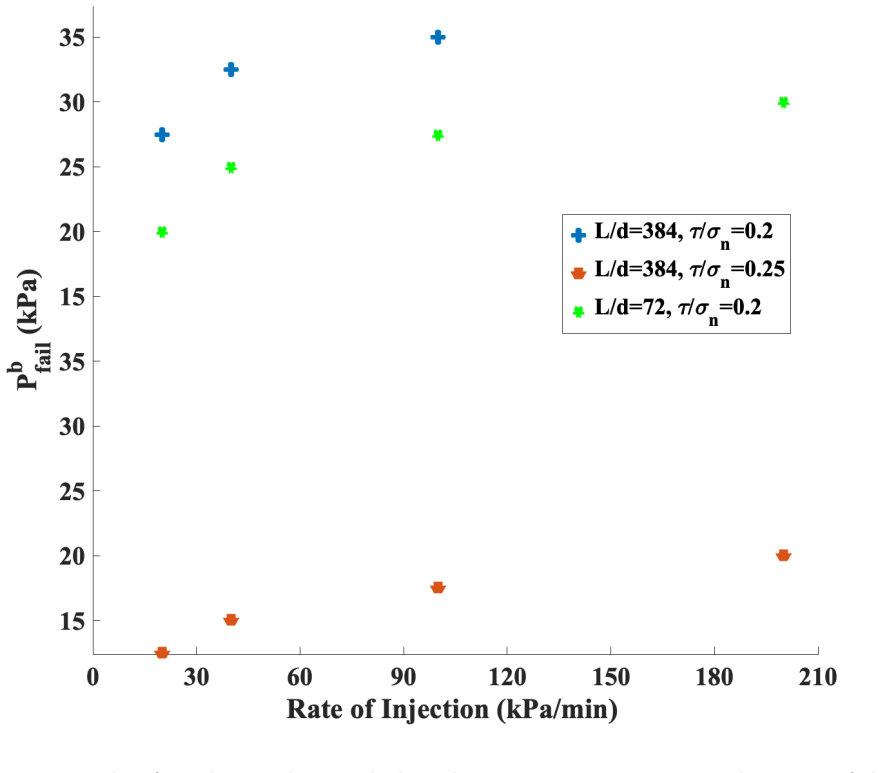
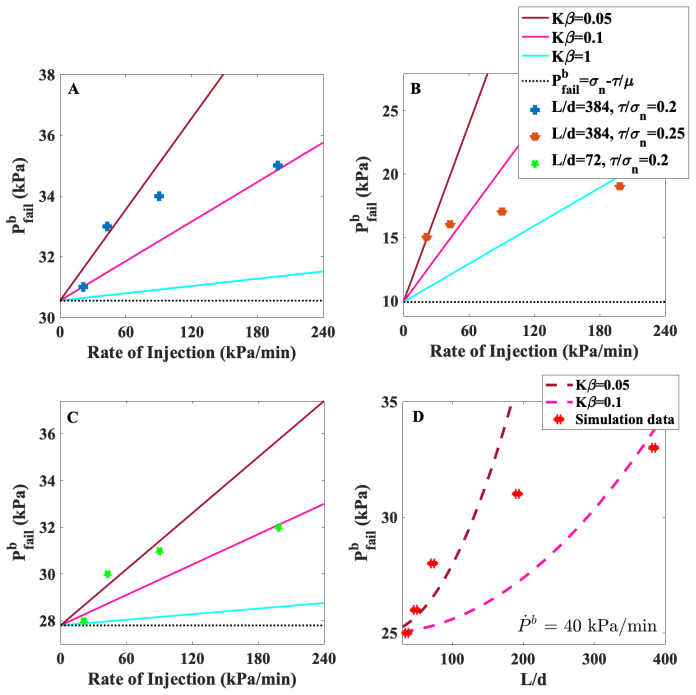
Assuming a pre-stressed gouge-filled fault subject to fluid injection, the solution to the pore-pressure diffusion equation with a dilative sink predicts a rate-dependent failure criterion arising from pressure heterogeneity within the layer: slow injection allows pressure to diffuse uniformly throughout the layer, promoting uniform weakening, whereas rapid injection produces strong gradients, leaving distal regions stronger. Numerical simulations confirm the theory and reproduce experimental observations.
What carries the argument
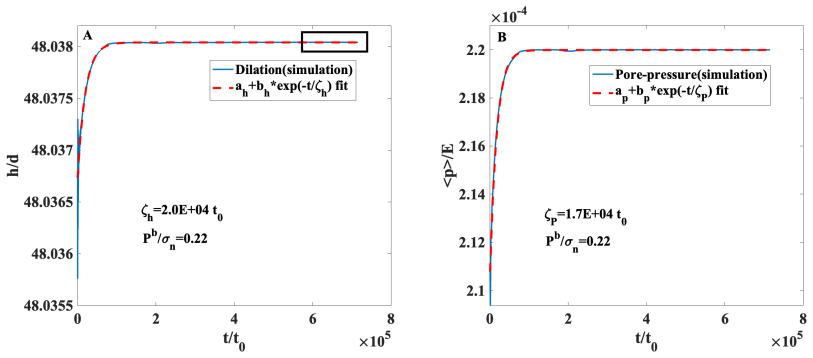
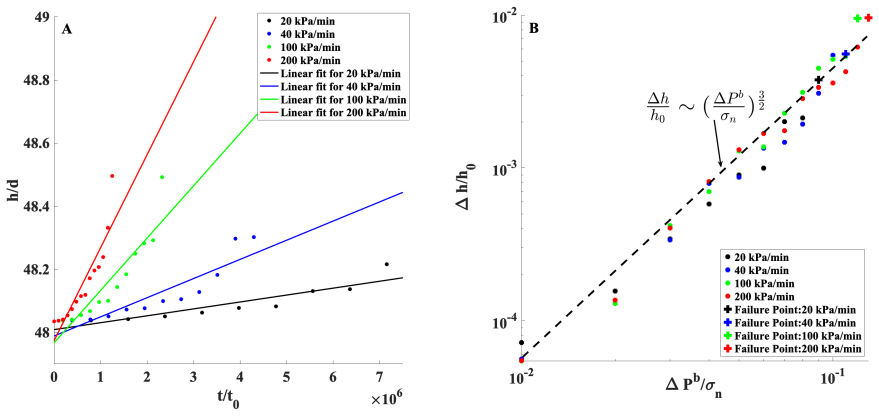
Pore-pressure diffusion equation with a dilative sink term, whose solution produces the rate-dependent failure criterion based on pressure heterogeneity within the gouge layer.
If this is right
- Slow injection promotes uniform weakening across the entire fault layer.
- Rapid injection generates pressure gradients that strengthen distal regions relative to the injection point.
- The model links grain-scale dilation effects to macroscopic fault failure behavior.
- Numerical discrete-element simulations validate the analytical predictions and match lab observations.
- Quantitative guidance emerges for designing injection rates to control fault reactivation.
Where Pith is reading between the lines
- This suggests that adjusting injection rates could be used to reduce the risk of induced seismicity in energy operations.
- The heterogeneity effect might extend to other fluid-driven failures in granular media, such as landslides or hydraulic fracturing.
- Laboratory tests measuring local pressures at varying distances from injection points at different rates could directly test the predicted gradients.
Load-bearing premise
The model assumes that a dilative sink term is present in the pore-pressure diffusion equation for the pre-stressed gouge-filled fault.
What would settle it
If laboratory experiments on fluid-saturated granular gouge show no difference in failure strength or pattern between slow and rapid injection rates, or if pressure measurements reveal uniform distribution even during fast injection.
Figures



read the original abstract
Fluid injection into the Earth's subsurface, performed for energy extraction, waste disposal, and resource development, is known to reactivate gouge-filled faults and induce seismicity, a key hazard in modern geotechnical operations. Nevertheless, the role of injection rate in controlling fault-gouge failure remains poorly understood. Here we present both an analytical theory and coupled fluid--granular (discrete element) numerical simulations to explain this rate dependence. Assuming a pre-stressed gouge-filled fault subject to fluid injection, we derive a pore-pressure diffusion equation with a dilative sink. Its solution predicts a rate-dependent failure criterion, arising from pressure heterogeneity within the layer: slow injection allows pressure to diffuse uniformly throughout the layer, promoting uniform weakening, whereas rapid injection produces strong gradients, leaving distal regions stronger. The numerical simulations confirm the theory and reproduce experimental observations not captured by classical, uniform-pressure effective-stress theory. The framework links grain-scale physics to fault-scale failure and provides quantitative guidance for the design of injection protocols in geotechnical operations involving granular geomaterials.
Editorial analysis
A structured set of objections, weighed in public.
Referee Report
Summary. The paper develops an analytical theory for fluid injection into a pre-stressed gouge-filled fault by deriving a pore-pressure diffusion equation that incorporates a dilative sink term. The solution of this equation yields a rate-dependent failure criterion arising from spatial pressure heterogeneity: slow injection produces uniform weakening while rapid injection leaves distal regions stronger. Coupled DEM simulations are stated to confirm the analytical prediction and to reproduce experimental observations beyond the reach of classical uniform-pressure effective-stress theory.
Significance. If the dilative sink derivation is internally consistent and the simulations are independent verifications, the work supplies a mechanistic link between injection rate, grain-scale dilation, and fault-scale failure. This would be a substantive advance for induced-seismicity modeling and injection-protocol design, particularly because the framework is presented as parameter-free and directly falsifiable against rate-variation experiments.
major comments (2)
- [analytical theory] Analytical theory section (abstract and theory paragraph): the addition of the dilative sink to the diffusion equation is the load-bearing step for the claimed rate dependence. The manuscript must show the explicit derivation of this sink from the pre-stress state and dilation mechanics, including the boundary conditions of the fault layer, so that it is clear the term is not introduced ad hoc to produce heterogeneity.
- [numerical simulations] Numerical simulations section: the claim that the DEM results 'confirm the theory' requires a direct, quantitative comparison (e.g., predicted vs. simulated pressure profiles or failure times at multiple injection rates) rather than qualitative agreement. Without this, it remains possible that the observed rate dependence arises from other model ingredients.
minor comments (1)
- The abstract states that the simulations 'reproduce experimental observations not captured by classical... theory.' A table or figure explicitly contrasting the new predictions against the classical uniform-pressure case would strengthen the presentation.
Simulated Author's Rebuttal
We thank the referee for the detailed and constructive report. The comments highlight important areas for improving the clarity and rigor of the presentation. We address each major comment below.
read point-by-point responses
-
Referee: [analytical theory] Analytical theory section (abstract and theory paragraph): the addition of the dilative sink to the diffusion equation is the load-bearing step for the claimed rate dependence. The manuscript must show the explicit derivation of this sink from the pre-stress state and dilation mechanics, including the boundary conditions of the fault layer, so that it is clear the term is not introduced ad hoc to produce heterogeneity.
Authors: We agree that the derivation of the dilative sink must be presented explicitly to demonstrate its physical origin. In the revised manuscript we will expand the theory section with a complete step-by-step derivation that begins from the pre-stressed state of the gouge layer, incorporates the local dilation mechanics under fluid injection, and applies the appropriate boundary conditions at the fault boundaries. This will make clear that the sink term follows directly from mass conservation and the assumed constitutive response rather than being introduced to produce the desired heterogeneity. revision: yes
-
Referee: [numerical simulations] Numerical simulations section: the claim that the DEM results 'confirm the theory' requires a direct, quantitative comparison (e.g., predicted vs. simulated pressure profiles or failure times at multiple injection rates) rather than qualitative agreement. Without this, it remains possible that the observed rate dependence arises from other model ingredients.
Authors: We accept that the current validation is only qualitative and that stronger evidence is needed. In the revised manuscript we will add direct quantitative comparisons, including side-by-side plots of analytically predicted versus DEM-simulated pressure profiles and failure times at several injection rates. These additions will allow readers to assess the degree of agreement and to confirm that the rate dependence originates from the derived diffusion equation rather than from other numerical ingredients. revision: yes
Circularity Check
No circularity: derivation introduces dilative sink as modeling step then solves forward
full rationale
The abstract and skeptic summary state that the authors assume a pre-stressed gouge-filled fault and derive a pore-pressure diffusion equation containing a dilative sink term; the rate-dependent failure criterion is obtained by solving that equation under different injection rates. No quoted step shows the sink coefficient being fitted to the target failure criterion, defined in terms of the predicted heterogeneity, or obtained via self-citation whose content reduces to the present result. The DEM simulations are described as independent confirmation rather than the source of the analytical prediction. The central claim therefore remains a forward consequence of the stated modeling assumptions and does not collapse to its inputs by construction.
Axiom & Free-Parameter Ledger
axioms (1)
- domain assumption A dilative sink term is present in the pore-pressure diffusion equation
Reference graph
Works this paper leans on
-
[1]
16 Oded Ben-Nun and Itai Einav
doi: 10.1093/gji/ggt356. 16 Oded Ben-Nun and Itai Einav. The role of self-organization during confined comminution of gran- ular materials.Philosophical Transactions of the Royal Society A: Mathematical, Physical and Engineering Sciences, 368(1910):231–247,
-
[2]
Tore I Bjørnarå, Elin Skurtveit, Emma AH Michie, and Scott A Smith
doi: 10.1016/j.jsg.2005.05.013. Tore I Bjørnarå, Elin Skurtveit, Emma AH Michie, and Scott A Smith. Characterizing along-and across-fault fluid-flow properties for assessing flow rates and overburden fluid migration along faults: a case study from the north sea.Petroleum Geoscience, 29(3):petgeo2023–033,
-
[3]
Frédéric Cappa, Marco Maria Scuderi, Cristiano Collettini, Yves Guglielmi, and Jean-Philippe Avouac
doi: 10.1680/ geot.1986.36.1.65. Frédéric Cappa, Marco Maria Scuderi, Cristiano Collettini, Yves Guglielmi, and Jean-Philippe Avouac. Stabilization of fault slip by fluid injection in the laboratory and in situ.Science advances, 5(3):eaau4065,
1986
-
[4]
Kyung Won Chang, Hongkyu Yoon, YoungHee Kim, and Moo Y Lee
doi: 10.1016/j.epsl.2020.116726. Kyung Won Chang, Hongkyu Yoon, YoungHee Kim, and Moo Y Lee. Operational and geo- logical controls of coupled poroelastic stressing and pore-pressure accumulation along faults: Induced earthquakes in pohang, south korea.Scientific Reports, 10(1):2073,
-
[5]
doi: 10.1038/s41598-020-58881-z. Jianye Chen. The emergence of four types of slow slip cycles on dilatant, fluid saturated faults. Journal of Geophysical Research: Solid Earth, 128(2):e2022JB024382,
-
[6]
doi: 10.1016/0040-1951(92)90055-B. William L Ellsworth. Injection-induced earthquakes.Science, 341(6142):1225942,
-
[7]
Liran Goren, E Aharonov, D Sparks, and Renaud Toussaint
doi: 10.1002/2016GL068893. Liran Goren, E Aharonov, D Sparks, and Renaud Toussaint. Pore pressure evolution in deform- ing granular material: A general formulation and the infinitely stiff approximation.Journal of Geophysical Research: Solid Earth, 115(B9),
-
[8]
doi: 10.1016/j.partic.2013.07.006. M. K. Hubbert and W. W. Rubey. Role Of Fluid Pressure In Mechanics Of Overthrust Faulting: I. Mechanics Of Fluid-Filled Porous Solids And Its Application To Overthrust Faulting.GSA Bulletin, 70(2):115–166,
-
[9]
doi: 10.1130/0016-7606(1959)70[115:ROFPIM]2.0.CO;2. Yinlin Ji and Wei Wu. Injection-driven fracture instability in granite: mechanism and implications. Tectonophysics, 791:228572,
-
[10]
Laboratory experiments on fault behavior towards better understanding of injection-induced seismicity in geoenergy systems.Earth-Science Reviews, 226:103916, 2022a
18 Yinlin Ji, Hannes Hofmann, Kang Duan, and Arno Zang. Laboratory experiments on fault behavior towards better understanding of injection-induced seismicity in geoenergy systems.Earth-Science Reviews, 226:103916, 2022a. Yinlin Ji, Lei Wang, Hannes Hofmann, Grzegorz Kwiatek, and Georg Dresen. High-rate fluid injection reduces the nucleation length of labo...
2008
-
[11]
Sharp increase in central oklahoma seismicity since 2008 induced by massive wastewater injection
Katie M Keranen, Matthew Weingarten, Geoffrey A Abers, Barbara A Bekins, and Shemin Ge. Sharp increase in central oklahoma seismicity since 2008 induced by massive wastewater injection. Science, 345(6195):448–451,
2008
-
[12]
Fracturing and porosity chan- neling in fluid overpressure zones in the shallow earth’s crust.Geofluids, 2020:7621759,
Daniel Koehn, Sandra Piazolo, Till Sachau, and Renaud Toussaint. Fracturing and porosity chan- neling in fluid overpressure zones in the shallow earth’s crust.Geofluids, 2020:7621759,
2020
-
[13]
doi: 10.1061/(ASCE) 0733-9399(2009)135:6(485). GrzegorzKwiatek, TeroSaarno, ThomasAder, FelixBluemle, MarcoBohnhoff, MichaelChendorain, Georg Dresen, Pekka Heikkinen, Isabella Kuber, Peter Leary, et al. Controlling fluid-induced seismicity during a 6.1-km-deep geothermal stimulation in Finland.Science Advances, 5(5): eaav7224,
-
[14]
TA Little, R Van Dissen, E Schermer, and R Carne
doi: 10.1126/sciadv.aav7224. TA Little, R Van Dissen, E Schermer, and R Carne. Late holocene surface ruptures on the southern wairarapa fault, new zealand: Link between earthquakes and the uplifting of beach ridges on a rocky coast.Lithosphere, 1(1):4–28,
-
[15]
doi: 10.3389/fphy.2015.00080. S. Parez, M. Kozakovic, and J. Havlica. Pore pressure drop during dynamic rupture and conditions for dilatancy hardening.Journal of Geophysical Research: Solid Earth, 128(7):e2023JB026396,
-
[16]
URLhttps://agupubs.onlinelibrary
doi: https://doi.org/10.1029/2023JB026396. URLhttps://agupubs.onlinelibrary. wiley.com/doi/abs/10.1029/2023JB026396. e2023JB026396 2023JB026396. Stanislav Parez, Einat Aharonov, and Renaud Toussaint. Unsteady granular flows down an inclined plane.Physical review E, 93(4):042902,
-
[17]
Development of fluid pathways and associated diagenetic variations in a natural co2 leaking fault zone.Lithosphere, 2023(Special 14):lithosphere_2023_335,
Elizabeth S Petrie, Elin Skurtveit, Thea Sveva Faleide, Kristine Halvorsen, Scott A Smith, and Brock C Arvesen. Development of fluid pathways and associated diagenetic variations in a natural co2 leaking fault zone.Lithosphere, 2023(Special 14):lithosphere_2023_335,
2023
-
[18]
doi: 10.1098/rspa.1962.0193. Alexander Y. Rozhko. Role of seepage forces on seismicity triggering.Journal of Geophysical Research: Solid Earth, 115(B11),
-
[19]
URLhttps: //agupubs.onlinelibrary.wiley.com/doi/abs/10.1029/2009JB007182
doi: https://doi.org/10.1029/2009JB007182. URLhttps: //agupubs.onlinelibrary.wiley.com/doi/abs/10.1029/2009JB007182. Allan M Rubin and Jean-Paul Ampuero. Earthquake nucleation on (aging) rate and state faults.Journal of Geophysical Research: Solid Earth, 110(B11):B11312,
-
[20]
Pritom Sarma, Einat Aharonov, Renaud Toussaint, and Stanislav Parez
doi: 10.1029/ 2005JB003686. Pritom Sarma, Einat Aharonov, Renaud Toussaint, and Stanislav Parez. Fault gouge failure induced by fluid injection: Hysteresis, delay and shear-strengthening.arXiv preprint arXiv:2411.12112, 2024a. Pritom Sarma, Einat Aharonov, Renaud Toussaint, and Stanislav Parez. GrandFrix program for simulations of granular material with f...
-
[21]
doi: 10.1007/s00603-018-1467-4. Wenzhi Zhao, Mengke An, Luca Dal Zilio, Luanxiao Zhao, Hehua Zhu, Xianda Shen, Quan Gan, Fengshou Zhang, and Derek Elsworth. Coupled evolution of seismicity and permeability in fault zones.Communications Earth & Environment, 6(1):918,
discussion (0)
Sign in with ORCID, Apple, or X to comment. Anyone can read and Pith papers without signing in.