Area and water-capacity statistics for upper hulls of Dyck paths
Pith reviewed 2026-06-27 17:49 UTC · model grok-4.3
The pith
The length radius of the Dyck path generating function by area and water capacity equals the smallest positive real denominator branch when both weights lie in (0,1).
A machine-rendered reading of the paper's core claim, the machinery that carries it, and where it could break.
Core claim
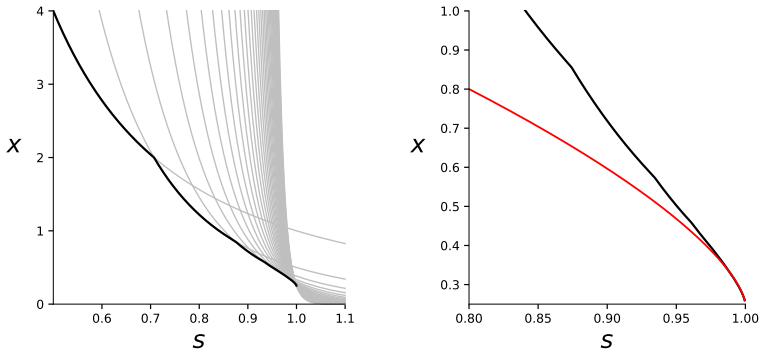
In the open square 0<p,q<1, the length radius of G(x,1,p,q) is the minimum of the positive real denominator branches. The proof combines uniform normal convergence of the height expansion below this first branch with a Perron-root representation of the branch locations and an interval log-submodularity theorem for spectral radii of weighted paths. On the diagonal p=q=s, the classical Chebyshev specialisation gives explicit branch crossings and a (1-s)^{2/3} branch-envelope accumulation law at the Dyck critical point.
What carries the argument
The upper-hull decomposition that produces a coupled area-capacity substitution and an exact four-variable height expansion whose denominator branches are indexed by height levels.
If this is right
- The dominant singularity that governs the asymptotics is always the first branch when the weights are strictly between zero and one.
- The full generating function is asymmetric under interchange of the area and capacity weights, yet each height summand admits a symmetric unreduced denominator representation.
- Explicit locations and crossings of the branches are available on the diagonal p=q=s via the Chebyshev specialisation.
- The branches accumulate at the Dyck critical point with envelope scaling (1-s)^{2/3} on that diagonal.
Where Pith is reading between the lines
- The same decomposition and convergence argument may apply directly to other pairs of additive statistics on Dyck paths or related lattice paths.
- The log-submodularity property of weighted-path spectral radii could be used to locate radii in broader families of continued-fraction or transfer-matrix enumerations.
- Numerical extraction of the first few branches for a grid of (p,q) values would give a practical test of the radius formula without summing the full series.
- The (1-s)^{2/3} accumulation law on the diagonal suggests a possible connection to cubic singularities in other refined path models.
Load-bearing premise
The height expansion converges uniformly and normally below the first branch so that the log-submodularity theorem can locate the spectral radius minimum.
What would settle it
For concrete values such as p=0.5 and q=0.3, extract the numerical radius of convergence of the partial sums of G(x,1,p,q) and test whether it equals the smallest positive real root among the denominator branches obtained from the height expansion.
Figures

read the original abstract
We study Dyck paths refined simultaneously by proper area and water capacity, where water capacity is measured above the path and below its lattice-path upper hull. The finite-height ingredients used in the enumeration are classical bounded-height area-polynomial and continued-fraction objects. The upper-hull decomposition produces a coupled area--capacity substitution, which gives an exact four-variable height expansion with denominator branches indexed by the height levels. The full generating function is asymmetric in the two weights, while the height summands admit a symmetric unreduced denominator representation under interchange of the area and capacity weights. In the open square $0<p,q<1$, we prove that the length radius of $G(x,1,p,q)$ is the minimum of the positive real denominator branches. The proof combines uniform normal convergence of the height expansion below this first branch with a Perron-root representation of the branch locations and an interval log-submodularity theorem for spectral radii of weighted paths. On the diagonal $p=q=s$, the classical Chebyshev specialisation gives explicit branch crossings and a $(1-s)^{2/3}$ branch-envelope accumulation law at the Dyck critical point.
Editorial analysis
A structured set of objections, weighed in public.
Referee Report
Summary. The paper enumerates Dyck paths refined simultaneously by proper area and water capacity (measured above the path and below its lattice-path upper hull). Classical bounded-height area polynomials and continued fractions are combined with a new upper-hull decomposition that produces a coupled area-capacity substitution, yielding an exact four-variable height expansion whose unreduced denominators are symmetric under p↔q. The central claim is that, for 0<p,q<1, the length radius of the generating function G(x,1,p,q) equals the minimum of the positive real denominator branches; the proof uses uniform normal convergence of the height expansion below the first branch, a Perron-root representation of the branches, and an interval log-submodularity theorem on spectral radii of weighted paths. On the diagonal p=q=s the Chebyshev specialization supplies explicit branch crossings and a (1-s)^{2/3} branch-envelope accumulation law at the Dyck critical point.
Significance. If the radius result holds, the work supplies a precise, non-fitted determination of the radius of convergence for a bivariate generating function arising from refined Dyck-path enumeration. The combination of classical bounded-height objects with a new decomposition, uniform convergence argument, and log-submodularity for spectral radii constitutes a technical strength; the explicit diagonal case with its (1-s)^{2/3} law is a concrete, falsifiable illustration of branch accumulation.
major comments (1)
- [Proof of the length-radius statement (the paragraph containing the uniform-normal-convergence + Perron-root + log-submod] The radius claim for G(x,1,p,q) in 0<p,q<1 rests on the interval log-submodularity theorem applying to the matrix weights obtained after the coupled area-capacity substitution (invoked after the Perron-root representation of the denominator branches). The manuscript does not supply an explicit verification that these weights remain inside the cone required by the theorem for every 0<p,q<1; without such a check the equality between length radius and minimal positive real branch is not yet supported.
minor comments (1)
- The abstract refers to 'uniform normal convergence of the height expansion'; a one-sentence reminder of the precise topology or norm in which normality is understood would improve readability for readers outside the immediate subfield.
Simulated Author's Rebuttal
We thank the referee for their careful reading of the manuscript and for highlighting this point in the proof of the length-radius claim. We respond to the major comment below.
read point-by-point responses
-
Referee: [Proof of the length-radius statement (the paragraph containing the uniform-normal-convergence + Perron-root + log-submod] The radius claim for G(x,1,p,q) in 0<p,q<1 rests on the interval log-submodularity theorem applying to the matrix weights obtained after the coupled area-capacity substitution (invoked after the Perron-root representation of the denominator branches). The manuscript does not supply an explicit verification that these weights remain inside the cone required by the theorem for every 0<p,q<1; without such a check the equality between length radius and minimal positive real branch is not yet supported.
Authors: We agree that the manuscript does not contain an explicit verification that the matrix weights after the coupled area-capacity substitution lie in the cone required by the interval log-submodularity theorem for all 0<p,q<1. In the revised version we will insert a short lemma immediately after the definition of the coupled substitution. The lemma will verify the cone condition by observing that each entry of the weighted adjacency matrix is a strictly positive linear combination (with coefficients p and q) of the classical area and capacity monomials; the strict positivity 0<p,q<1 together with the non-negativity of the underlying path statistics then places every weight in the open cone required by the theorem. This addition will make the application of the log-submodularity result fully rigorous and will not alter any other part of the argument. revision: yes
Circularity Check
No circularity: radius result rests on classical polynomials, new decomposition, and external theorem
full rationale
The paper enumerates via classical bounded-height area polynomials and continued fractions, introduces a coupled substitution yielding a four-variable height expansion, and proves the radius claim for G(x,1,p,q) by combining uniform normal convergence below the first branch with a Perron-root representation and an interval log-submodularity theorem on spectral radii. None of these steps reduces by construction to a fitted input, self-definition, or self-citation chain; the theorem is invoked as an external fact whose applicability is asserted after the substitution but does not collapse the derivation to its own inputs. The result is therefore self-contained against external benchmarks.
Axiom & Free-Parameter Ledger
axioms (1)
- standard math Bounded-height area-polynomial and continued-fraction objects for Dyck paths exist with known closed forms.
Reference graph
Works this paper leans on
-
[1]
G. E. Andrews, R. Askey and R. Roy,Special Functions, Encyclopedia of Mathematics and its Applications 71, Cambridge University Press, Cambridge, 1999
1999
-
[2]
M. Archibald and A. Knopfmacher, The water capacity of geometri- cally distributed words,Aequationes Mathematicae95(2021), 777–796. https://doi.org/10.1007/s00010-021-00785-y. 31
-
[3]
Generalized Dyck paths of bounded height
A. Bacher, Generalized Dyck paths of bounded height, arXiv:1303.2724, 2013
work page internal anchor Pith review Pith/arXiv arXiv 2013
-
[4]
J.-L. Baril, S. Fried, N. Hassler and J. L. Ramírez, Black cell capacity in Catalan polyominoes, arXiv:2601.17410, 2026. https://doi.org/10.48550/arXiv.2601.17410
-
[5]
Blecher, C
A. Blecher, C. Brennan and A. Knopfmacher, Capacity of words,Jour- nal of Combinatorial Mathematics and Combinatorial Computing107 (2018), 249–258
2018
-
[6]
https://doi.org/10.61091/ojac-1306
A.Blecher, C.BrennanandA.Knopfmacher, Thewatercapacityofinte- ger compositions,Online Journal of Analytic Combinatorics13(2018), Article 06. https://doi.org/10.61091/ojac-1306
-
[7]
A. Blecher, C. Brennan, A. Knopfmacher and M. Shattuck, Capacity of permutations,Annales Mathematicae et Informaticae50(2019), 39–56. https://doi.org/10.33039/ami.2019.03.004
-
[8]
A. Blecher, C. Brennan and A. Knopfmacher, Water capacity of Dyck paths,Advances in Applied Mathematics112(2020), 101945. https://doi.org/10.1016/j.aam.2019.101945
-
[9]
A. Blecher and A. Knopfmacher, Water capacity of random functions,Contributions to Mathematics12(2025), 82–88. https://doi.org/10.47443/cm.2025.097
-
[10]
R. Brak, A. L. Owczarek and T. Prellberg, Exact scaling behavior of partially convex vesicles,J. Stat. Phys.76(1994), 1101–1128
1994
-
[11]
D. Callan, T. Mansour and J. L. Ramírez, Statistics on bargraphs of Catalan words,Journal of Automata, Languages and Combinatorics26 (2021), 177–196. https://doi.org/10.25596/jalc-2021-177
-
[12]
L. Carlitz and J. Riordan, Two element lattice permutation numbers and theirq-generalization,Duke Mathematical Journal31(1964), 371–388. https://doi.org/10.1215/S0012-7094-64-03136-9
-
[13]
Chapman, Moments of Dyck paths,Discrete Mathematics204 (1999), 113–117
R. Chapman, Moments of Dyck paths,Discrete Mathematics204 (1999), 113–117. https://doi.org/10.1016/S0012-365X(98)00367-7. 32
-
[14]
J. Cigler and C. Krattenthaler, Bounded Dyck paths, bounded alternating sequences, orthogonal polynomials, and reciprocity, European Journal of Combinatorics123(2024), 103840. https://doi.org/10.1016/j.ejc.2023.103840
-
[15]
Deutsch, Dyck path enumeration,Discrete Mathematics204(1999), 167–202
E. Deutsch, Dyck path enumeration,Discrete Mathematics204(1999), 167–202. https://doi.org/10.1016/S0012-365X(98)00371-9
-
[16]
Flajolet, Combinatorial aspects of continued fractions,Dis- crete Mathematics32(1980), 125–161
P. Flajolet, Combinatorial aspects of continued fractions,Dis- crete Mathematics32(1980), 125–161. https://doi.org/10.1016/0012- 365X(80)90050-3
-
[17]
Fried, Black-white cell capacity ink-ary words and permutations, arXiv:2509.07533, 2025
S. Fried, Black-white cell capacity ink-ary words and permutations, arXiv:2509.07533, 2025. https://doi.org/10.48550/arXiv.2509.07533
-
[18]
S. Friedland and S. Gaubert, Submodular spectral functions of prin- cipal submatrices of a Hermitian matrix, extensions and applica- tions,Linear Algebra and its Applications438(2013), 3872–3884. https://doi.org/10.1016/j.laa.2011.11.021
-
[19]
S. Friedland and S. Karlin, Some inequalities for the spectral radius of non-negative matrices and applications,Duke Mathematical Journal42 (1975), 459–490. https://doi.org/10.1215/S0012-7094-75-04244-1
-
[20]
https://doi.org/10.1016/0097- 3165(85)90089-5
J.FürlingerandJ.Hofbauer,q-Catalannumbers,Journal of Combinato- rial Theory, Series A40(1985), 248–264. https://doi.org/10.1016/0097- 3165(85)90089-5
-
[21]
Gasper and M
G. Gasper and M. Rahman,Basic Hypergeometric Series, Encyclopedia of Mathematics and its Applications 96, Cambridge University Press, Cambridge, 2004
2004
-
[22]
I. P. Goulden and D. M. Jackson, Path generating functions and con- tinued fractions,Journal of Combinatorial Theory, Series A41(1986), 1–10. https://doi.org/10.1016/0097-3165(86)90110-X
-
[23]
J. Haglund, Conjectured statistics for theq, t-Catalan numbers,Advances in Mathematics175(2003), 319–334. https://doi.org/10.1016/S0001-8708(02)00061-0. 33
-
[24]
Journal of the American Mathematical Society , author =
J. Haglund, M. Haiman and N. Loehr, A combinatorial formula for Macdonald polynomials,Journal of the American Mathematical Society 18(2005), 735–761. https://doi.org/10.1090/S0894-0347-05-00485-6
-
[25]
J. Haglund,Theq, t-Catalan Numbers and the Space of Diagonal Har- monics: With an Appendix on the Combinatorics of Macdonald Poly- nomials, University Lecture Series 41, American Mathematical Society, Providence, RI, 2008
2008
-
[26]
Haug and T
N. Haug and T. Prellberg, Uniform asymptotics of area-weighted Dyck paths,J. Math. Phys.56(2015), 043301
2015
-
[27]
N. Haug, A. Olde Daalhuis and T. Prellberg, Higher-order Airy scaling in deformed Dyck paths,J. Stat. Phys.166(2017), 1193–1208
2017
-
[28]
https://doi.org/10.1080/00150517.2025.2460555
B. Hopkins and A. Tangboonduangjit, Water cells in composi- tions of 1s and 2s,Fibonacci Quarterly63(2025), 400–411. https://doi.org/10.1080/00150517.2025.2513335
-
[29]
R. A. Horn and C. R. Johnson,Matrix Analysis, second edition, Cam- bridge University Press, Cambridge, 2013
2013
-
[30]
A. Knopfmacher and A. Blecher, Water capacity of Dyck bridges, Applicable Analysis and Discrete Mathematics19(2025), 67–75. https://doi.org/10.2298/AADM230605004K
-
[31]
T. Mansour, J. L. Ramírez and D. A. Toquica, Counting lattice points on bargraphs of Catalan words,Mathematics in Computer Science15 (2021), 701–713. https://doi.org/10.1007/s11786-021-00501-8
-
[32]
T. Mansour and M. Shattuck, Counting water cells in bargraphs of com- positionsandsetpartitions,Applicable Analysis and Discrete Mathemat- ics12(2018), 413–438. https://doi.org/10.2298/AADM170428010M
-
[33]
T. Mansour and M. Shattuck, Counting water cells in pattern restricted compositions,Turkish Journal of Analysis and Number Theory7(2019), 98–112. https://doi.org/10.12691/tjant-7-4-2
-
[34]
T. Mansour and M. Shattuck, Enumeration of Catalan and smooth words according to capacity,Integers25(2025), Article A5. https://doi.org/10.5281/zenodo.14679307. 34
-
[35]
S. Ouvry and A. P. Polychronakos, Hamiltonian and exclusion statis- tics approach to discrete forward-moving paths,Physical Review E104 (2021), 014143. https://doi.org/10.1103/PhysRevE.104.014143
-
[36]
A. L. Owczarek and T. Prellberg, A simple model of a vesicle drop in a confined geometry,J. Stat. Mech.: Theor. Exp.(2010), P08015
2010
-
[37]
A. L. Owczarek and T. Prellberg, Enumeration of area-weighted Dyck paths with restricted height,Australas. J. Combin.54(2012), 13–18
2012
-
[38]
A. L. Owczarek and T. Prellberg, Pressure exerted by a vesicle on a surface,J. Phys. A: Math. Theor.47(2014), 215001
2014
-
[39]
Prellberg and A
T. Prellberg and A. L. Owczarek, Stacking models of vesicles and com- pact clusters,J. Stat. Phys.80(1995), 755–779
1995
-
[40]
M. A. Shattuck, Further results for the capacity statistic distribution on compositions of 1s and 2s,Ars Combinatoria163(2025), 123–139. https://doi.org/10.61091/ars163-09
-
[41]
Woan, Area of Catalan paths,Discrete Mathematics226(2001), 439–444
W.-J. Woan, Area of Catalan paths,Discrete Mathematics226(2001), 439–444. https://doi.org/10.1016/S0012-365X(00)00162-X. 35
discussion (0)
Sign in with ORCID, Apple, or X to comment. Anyone can read and Pith papers without signing in.