Line-of-sight acceleration in compact binaries with higher harmonics and eccentricity
Pith reviewed 2026-06-27 17:39 UTC · model grok-4.3
The pith
Line-of-sight acceleration must be applied consistently to all harmonics to avoid biased parameter estimates in gravitational-wave signals.
A machine-rendered reading of the paper's core claim, the machinery that carries it, and where it could break.
Core claim
We re-derive the line-of-sight acceleration effects and implement them in state-of-the-art quasi-circular waveform models with precession and higher-order modes. We also implement the corrections in eccentric waveform models, applying them consistently to all contributing harmonics. Using this model, we investigate the impact of these effects on the inference of line-of-sight acceleration and analyze a few interesting GWTC events observed during the third observing run of LIGO and Virgo. We find no substantial evidence for line-of-sight acceleration in these events. We also show that an inconsistent treatment of line-of-sight acceleration between higher harmonics can lead to biased conclusio
What carries the argument
line-of-sight acceleration phase correction applied uniformly to every harmonic in the waveform
If this is right
- An inconsistent treatment of the acceleration between different harmonics produces biased parameter estimates.
- The model can be used to search for environmental signatures in current and future gravitational-wave data.
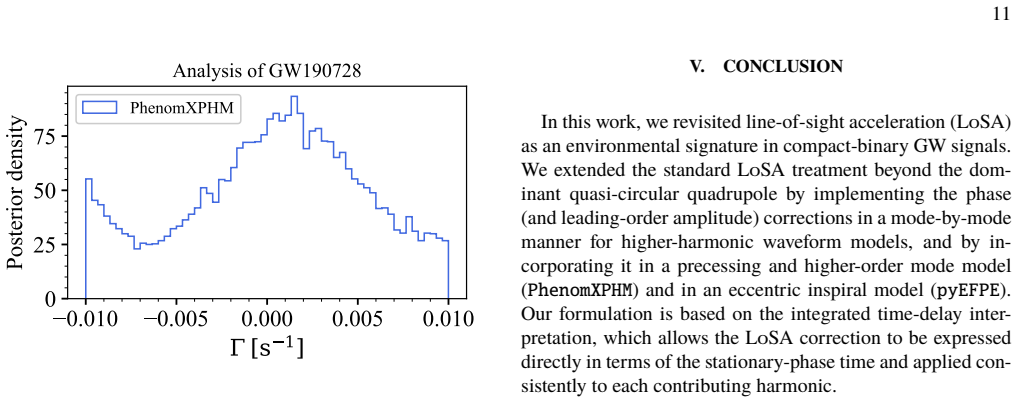
- Analysis of third-observing-run events yields no substantial evidence for line-of-sight acceleration.
- Uniform application across harmonics supports more accurate probes of compact-binary formation channels.
Where Pith is reading between the lines
- This consistency requirement may extend to modeling other dynamical effects in waveforms.
- With larger event catalogs, the framework could help separate formation channels based on acceleration measurements.
- Similar modeling consistency might be needed for space-based detectors observing lower-frequency binaries.
Load-bearing premise
Line-of-sight acceleration effects apply uniformly to all harmonics in the waveform without creating inference biases when treated consistently.
What would settle it
Recovering different values for the line-of-sight acceleration parameter from the same data when the correction is applied uniformly versus non-uniformly to the harmonics.
Figures




read the original abstract
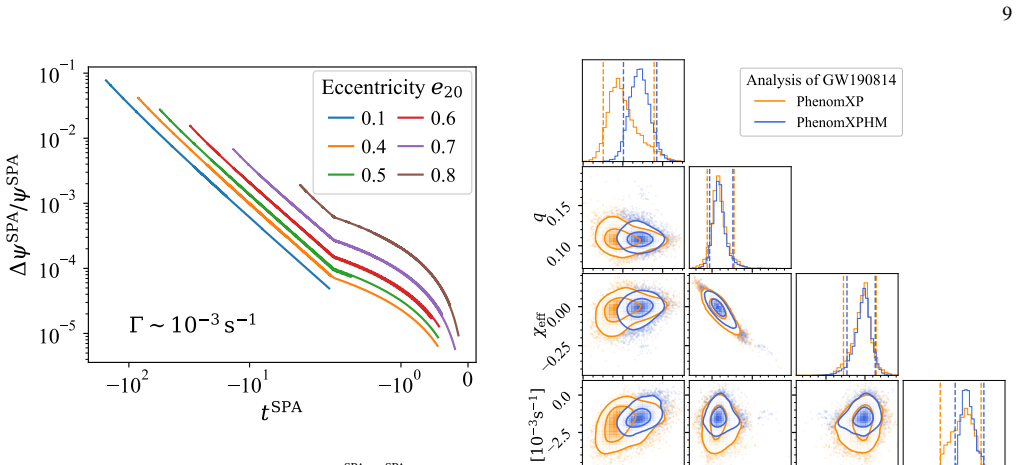
Direct detections of gravitational waves provide a unique opportunity to probe the astrophysical origin of compact binary mergers. The formation channels of these systems remain highly debated, and a fraction may originate in dynamical environments or active galactic nuclei. Binaries formed in such environments are expected to experience line-of-sight acceleration from their surroundings, which can imprint characteristic signatures on the observed gravitational-wave signal. Here, we re-derive the line-of-sight acceleration effects and implement them in state-of-the-art quasi-circular waveform models with precession and higher-order modes. We also implement the corrections in eccentric waveform models, applying them consistently to all contributing harmonics. Using this model, we investigate the impact of these effects on the inference of line-of-sight acceleration and analyze a few interesting GWTC events observed during the third observing run of LIGO and Virgo. We find no substantial evidence for line-of-sight acceleration in these events. We also show that an inconsistent treatment of line-of-sight acceleration between higher harmonics can lead to biased conclusions. Our model provides a robust framework for uncovering line-of-sight acceleration in current and future gravitational-wave observations, enabling more accurate probes of environmental signatures in compact-binary formation.
Editorial analysis
A structured set of objections, weighed in public.
Referee Report
Summary. The paper re-derives line-of-sight acceleration effects on gravitational-wave signals from compact binaries and implements the corrections consistently across all harmonics in state-of-the-art quasi-circular waveform models (including precession and higher-order modes) as well as in eccentric models. The authors apply the resulting model to a selection of GWTC-3 events, report no substantial evidence for line-of-sight acceleration, demonstrate that inconsistent treatment of higher harmonics produces biased inference, and position the framework as a tool for future environmental probes.
Significance. If the implementation and bias demonstration hold, the work supplies a practical, consistently formulated correction that can be used in current and next-generation GW analyses to test for environmental signatures in binary formation. The explicit comparison of consistent versus inconsistent harmonic treatments is a concrete, falsifiable contribution that strengthens the case for including such effects in parameter estimation.
minor comments (3)
- [Abstract / §3] The abstract refers to 'a few interesting GWTC events' without stating the selection criteria or the number of events examined; this should be stated explicitly in §3 or §4 with a table listing the events and their posterior constraints on the acceleration parameter.
- [§2] Notation for the line-of-sight acceleration parameter (denoted variously as a_LOS or similar) should be unified throughout; the current usage mixes symbols between the re-derivation and the waveform implementation sections.
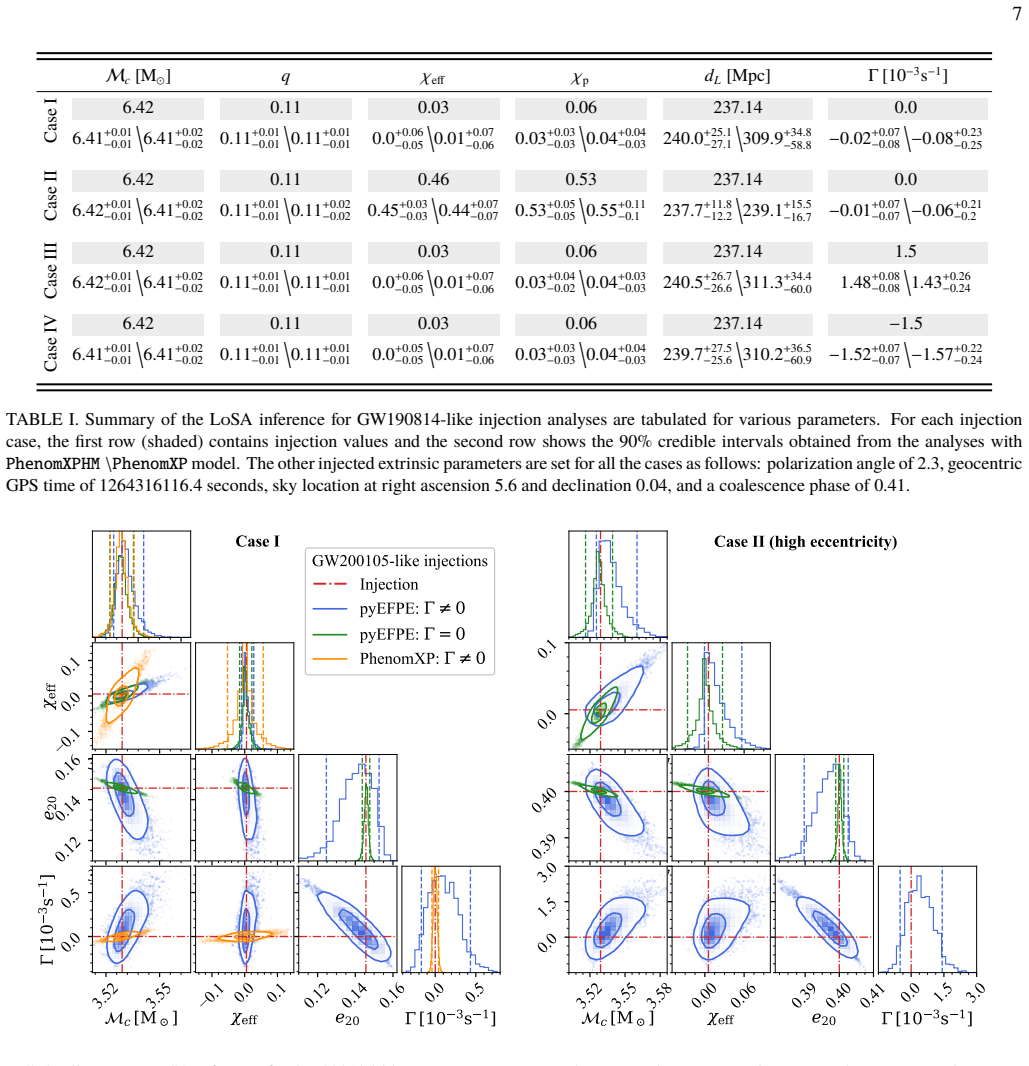
- [Figure 4] Figure captions for the bias demonstration plots should include the injected values and the recovered posterior means with 90% credible intervals so that the magnitude of the bias is immediately quantifiable.
Simulated Author's Rebuttal
We thank the referee for their positive summary and recommendation of minor revision. No specific major comments were provided in the report, so we have no individual points to address. We are pleased that the referee recognizes the value of consistent implementation across harmonics and the demonstration of bias from inconsistent treatment.
Circularity Check
No significant circularity identified
full rationale
The abstract describes re-deriving line-of-sight acceleration effects, implementing them consistently across harmonics in quasi-circular and eccentric waveform models, analyzing GWTC events, and demonstrating bias from inconsistent treatment. No load-bearing step reduces by construction to a fitted parameter, self-definition, or self-citation chain; the central claims rest on implementation details and external data analysis rather than tautological renaming or imported uniqueness theorems. This matches the default expectation of a self-contained derivation against external benchmarks.
Axiom & Free-Parameter Ledger
Forward citations
Cited by 1 Pith paper
-
Constraints on Line-of-Sight Acceleration from O1-O4
All known compact binary mergers show line-of-sight accelerations consistent with zero under a new time-domain Doppler-shift model, with current detectors only sensitive to high-acceleration scenarios.
Reference graph
Works this paper leans on
-
[1]
shows theLoSAresult obtained with the PhenomXPHMmodel when theLoSAcorrection is computed using a quadrupolarprescriptionandapplieduniformlyacrossthefullhigher- harmonic waveform, similar to Ref. [85]. The inconsistent applica- tion ofLoSAcorrection in the higher-order modes can lead to a re- duction in the support for a non-zeroΓ. favoroftheLoSAhypothesis...
-
[2]
Aasiet al.(LIGO Scientific),Advanced LIGO, Class
J. Aasiet al.(LIGO Scientific),Advanced LIGO, Class. Quant. Grav.32, 074001 (2015), arXiv:1411.4547 [gr-qc]
Pith/arXiv arXiv 2015
-
[3]
F. Acerneseet al.(VIRGO),Advanced Virgo: a second- generation interferometric gravitational wave detector, Class. 14 Quant. Grav.32, 024001 (2015), arXiv:1408.3978 [gr-qc]
Pith/arXiv arXiv 2015
-
[4]
T. Akutsuet al.(KAGRA),Overview of KAGRA: Detector de- sign and construction history, PTEP2021, 05A101 (2021), arXiv:2005.05574 [physics.ins-det]
arXiv 2021
-
[5]
The LIGO Scientific Collaboration, the Virgo Collaboration, andtheKAGRACollaboration,GWTC-5.0: Observationsfrom the Second Part of the Fourth LIGO-Virgo-KAGRA Observing Run and Updates to the Gravitational-Wave Transient Catalog, arXiv e-prints , arXiv:2605.27225 (2026), arXiv:2605.27225 [gr-qc]
Pith/arXiv arXiv 2026
-
[6]
A.G.Abacetal.(LIGOScientific, VIRGO,KAGRA),GWTC- 4.0: Updating the Gravitational-Wave Transient Catalog with Observations from the First Part of the Fourth LIGO-Virgo- KAGRA Observing Run, arXiv e-prints , arXiv:2508.18082 (2025), arXiv:2508.18082 [gr-qc]
Pith/arXiv arXiv 2025
-
[7]
R. Abbottet al.(KAGRA, VIRGO, LIGO Scientific),GWTC- 3: CompactBinaryCoalescencesObservedbyLIGOandVirgo during the Second Part of the Third Observing Run, Phys. Rev. X13, 041039 (2023), arXiv:2111.03606 [gr-qc]
Pith/arXiv arXiv 2023
-
[8]
R. Abbottet al.(LIGO Scientific, Virgo),GWTC-2: Compact Binary Coalescences Observed by LIGO and Virgo During the FirstHalfoftheThirdObservingRun,Phys.Rev.X11,021053 (2021), arXiv:2010.14527 [gr-qc]
Pith/arXiv arXiv 2021
-
[9]
B. P. Abbottet al.(LIGO Scientific, Virgo),GWTC-1: A Gravitational-Wave Transient Catalog of Compact Binary Mergers Observed by LIGO and Virgo during the First and Second Observing Runs, Phys. Rev. X9, 031040 (2019), arXiv:1811.12907 [astro-ph.HE]
Pith/arXiv arXiv 2019
-
[10]
A.H.Nitz,S.Kumar,Y.-F.Wang,S.Kastha,S.Wu,M.Schäfer, R. Dhurkunde, and C. D. Capano,4-OGC: Catalog of Gravita- tionalWaves fromCompactBinary Mergers,Astrophys. J.946, 59 (2023), arXiv:2112.06878 [astro-ph.HE]
arXiv 2023
-
[11]
D. Wadekar, J. Roulet, T. Venumadhav, A. K. Mehta, B. Za- ckay, J. Mushkin, S. Olsen, and M. Zaldarriaga,New black hole mergers in the LIGO-Virgo O3 data from a gravitational wavesearchincludinghigher-orderharmonics,arXive-prints, arXiv:2312.06631 (2023), arXiv:2312.06631 [gr-qc]
arXiv 2023
-
[12]
19, 1 (2016), arXiv:1304.0670 [gr-qc]
B.P.Abbottetal.(KAGRA,LIGOScientific,Virgo),Prospects for observing and localizing gravitational-wave transients with AdvancedLIGO,AdvancedVirgoandKAGRA,LivingRev.Rel. 19, 1 (2016), arXiv:1304.0670 [gr-qc]
Pith/arXiv arXiv 2016
-
[13]
A.G.Abacetal.(LIGOScientific, VIRGO,KAGRA),GWTC- 4.0: PopulationPropertiesofMergingCompactBinaries,arXiv e-prints , arXiv:2508.18083 (2025), arXiv:2508.18083 [astro- ph.HE]
Pith/arXiv arXiv 2025
-
[14]
R. Abbottet al.(KAGRA, VIRGO, LIGO Scientific),Popu- lation of Merging Compact Binaries Inferred Using Gravita- tionalWavesthroughGWTC-3,Phys.Rev.X13,011048(2023), arXiv:2111.03634 [astro-ph.HE]
Pith/arXiv arXiv 2023
-
[15]
A. Antonelli, K. Kritos, K. K. Y. Ng, R. Cotesta, and E. Berti, Classifying the generation and formation channels of individ- ualLIGO-Virgo-KAGRAobservationsfromdynamicallyformed binaries, Phys. Rev. D108, 084044 (2023), arXiv:2306.11088 [gr-qc]
arXiv 2023
-
[16]
C. L. Rodriguez, S. Chatterjee, and F. A. Rasio,Binary Black Hole Mergers from Globular Clusters: Masses, Merger Rates, and the Impact of Stellar Evolution, Phys. Rev. D93, 084029 (2016), arXiv:1602.02444 [astro-ph.HE]
Pith/arXiv arXiv 2016
-
[17]
M. Mapelli, Y. Bouffanais, F. Santoliquido, M. A. Sedda, and M. C. Artale,The cosmic evolution of binary black holes in young,globular,andnuclearstarclusters: rates,masses,spins, and mixing fractions, Mon. Not. Roy. Astron. Soc.511, 5797– 5816 (2022), arXiv:2109.06222 [astro-ph.HE]
arXiv 2022
-
[18]
F. Antonini, S. Toonen, and A. S. Hamers,Binary black hole mergers from field triples: properties, rates and the impact of stellar evolution, Astrophys. J.841, 77 (2017), arXiv:1703.06614 [astro-ph.GA]
Pith/arXiv arXiv 2017
-
[19]
K. Silsbee and S. Tremaine,Lidov-Kozai Cycles with Gravita- tional Radiation: Merging Black Holes in Isolated Triple Sys- tems, Astrophys. J.836, 39 (2017), arXiv:1608.07642 [astro- ph.HE]
Pith/arXiv arXiv 2017
-
[20]
J.863, 68 (2018), arXiv:1805.03202 [astro- ph.HE]
B.LiuandD.Lai,BlackHoleandNeutronStarBinaryMergers in Triple Systems: Merger Fraction and Spin–Orbit Misalign- ment, Astrophys. J.863, 68 (2018), arXiv:1805.03202 [astro- ph.HE]
Pith/arXiv arXiv 2018
-
[21]
J.835, 165 (2017), arXiv:1602.03831 [astro- ph.HE]
I.Bartos,B.Kocsis,Z.Haiman,andS.Márka,RapidandBright Stellar-mass Binary Black Hole Mergers in Active Galactic Nu- clei, Astrophys. J.835, 165 (2017), arXiv:1602.03831 [astro- ph.HE]
Pith/arXiv arXiv 2017
-
[22]
B. McKernan, K. E. S. Ford, and R. O’Shaughnessy,Black hole, neutron star, and white dwarf merger rates in AGN discs, Mon. Not. Roy. Astron. Soc.498, 4088–4094 (2020), arXiv:2002.00046 [astro-ph.HE]
arXiv 2020
- [23]
-
[24]
Lasky,ImplicationsofEccentricObservationsonBinaryBlack Hole Formation Channels, Astrophys
M.Zevin, I.M.Romero-Shaw, K.Kremer, E.Thrane,andP.D. Lasky,ImplicationsofEccentricObservationsonBinaryBlack Hole Formation Channels, Astrophys. J. Lett.921, L43 (2021), arXiv:2106.09042 [astro-ph.HE]
arXiv 2021
-
[25]
M. Dall’Amico, M. Mapelli, S. Torniamenti, and M. A. Sedda, Eccentric black hole mergers via three-body interactions in young, globular, and nuclear star clusters, Astron. Astrophys. 683, A186 (2024), arXiv:2303.07421 [astro-ph.HE]
arXiv 2024
-
[26]
J. Stegmann, D. Gerosa, I. Romero-Shaw, G. Fumagalli, H. Tagawa, and L. Zwick,Distinguishing the Origin of Eccen- tricBlackHoleMergerswithGravitational-waveSpinMeasure- ments, Astrophys. J. Lett.994, L47 (2025), arXiv:2505.13589 [astro-ph.HE]
arXiv 2025
-
[27]
G. Fumagalli and D. Gerosa,Spin-eccentricity interplay in merging binary black holes, Phys. Rev. D108, 124055 (2023), arXiv:2310.16893 [gr-qc]
arXiv 2023
-
[28]
P. C. Peters,Gravitational Radiation and the Motion of Two Point Masses, Phys. Rev.136, B1224–B1232 (1964)
1964
-
[29]
A. Tucker and C. M. Will,Residual eccentricity of inspiralling orbits at the gravitational-wave detection threshold: Accu- rate estimates using post-Newtonian theory, Phys. Rev. D104, 104023 (2021), arXiv:2108.12210 [gr-qc]
arXiv 2021
-
[30]
J. Calderón Bustillo, N. Sanchis-Gual, A. Torres-Forné, and J. A. Font,Confusing Head-On Collisions with Precessing Intermediate-MassBinaryBlackHoleMergers,Phys.Rev.Lett. 126, 201101 (2021), arXiv:2009.01066 [gr-qc]
arXiv 2021
-
[31]
I. Romero-Shaw, J. Stegmann, H. Tagawa, D. Gerosa, J. Sam- sing, N. Gupte, and S. R. Green,GW200208_222617 as an eccentric black-hole binary merger: Properties and as- trophysical implications, Phys. Rev. D112, 063052 (2025), arXiv:2506.17105 [astro-ph.HE]
arXiv 2025
-
[32]
Divyajyotiet al.,Biased parameter inference of eccen- tric, spin-precessing binary black holes, arXiv e-prints , arXiv:2510.04332 (2025), arXiv:2510.04332 [gr-qc]
Pith/arXiv arXiv 2025
-
[33]
S. Tibrewal, A. Zimmerman, J. Lange, and D. Shoemaker, 15 Misinterpreting Spin Precession as Orbital Eccentricity in Gravitational-Wave Signals, arXiv e-prints , arXiv:2601.02260 (2026), arXiv:2601.02260 [gr-qc]
arXiv 2026
-
[34]
R. Takahashi and T. Nakamura,Determination of the equation of the state of the universe using ~ 0.1 Hz gravitational wave detectors, Prog. Theor. Phys.113, 63–71 (2005), arXiv:astro- ph/0408547
arXiv 2005
-
[35]
N. Yunes, M. Coleman Miller, and J. Thornburg,The Effect of Massive Perturbers on Extreme Mass-Ratio Inspiral Wave- forms,Phys.Rev.D83,044030(2011),arXiv:1010.1721[astro- ph.GA]
Pith/arXiv arXiv 2011
-
[36]
Y.Meiron,B.Kocsis,andA.Loeb,Detectingtriplesystemswith gravitationalwaveobservations,Astrophys.J.834,200(2017), arXiv:1604.02148 [astro-ph.HE]
Pith/arXiv arXiv 2017
-
[37]
C. Bonvin, C. Caprini, R. Sturani, and N. Tamanini,Effect of matter structure on the gravitational waveform, Phys. Rev. D 95, 044029 (2017), arXiv:1609.08093 [astro-ph.CO]
Pith/arXiv arXiv 2017
-
[38]
K. Inayoshi, N. Tamanini, C. Caprini, and Z. Haiman,Probing stellarbinaryblackholeformationingalacticnucleiviatheim- print of their center of mass acceleration on their gravitational wavesignal,Phys.Rev.D96,063014(2017),arXiv:1702.06529 [astro-ph.HE]
Pith/arXiv arXiv 2017
-
[39]
N. Tamanini, A. Klein, C. Bonvin, E. Barausse, and C.Caprini, Peculiar acceleration of stellar-origin black hole binaries: Measurement and biases with LISA, Phys. Rev. D101, 063002 (2020), arXiv:1907.02018 [astro-ph.IM]
arXiv 2020
-
[40]
A. Vijaykumar, A. Tiwari, S. J. Kapadia, K. G. Arun, and P. Ajith,Waltzing Binaries: Probing the Line-of-sight Accel- erationofMergingCompactObjectswithGravitationalWaves, Astrophys.J.954,105(2023),arXiv:2302.09651[astro-ph.HE]
arXiv 2023
-
[41]
A. Tiwari, A. Vijaykumar, S. J. Kapadia, S. Ghosh, and A. B. Nielsen,A pipeline to search for signatures of line-of-sight ac- celeration in gravitational wave signals produced by compact binarycoalescences,arXive-prints,arXiv:2506.22272(2025), arXiv:2506.22272 [astro-ph.HE]
Pith/arXiv arXiv 2025
- [42]
-
[43]
M. Lazarow, N. Leslie, and L. Dai,Gravitational waveform modelfordetectingacceleratinginspiralingbinaries,Phys.Rev. D110, 083008 (2024), arXiv:2401.04175 [gr-qc]
arXiv 2024
-
[44]
S. Gera and P. Dutta Roy,Impact of neglecting center- of-mass acceleration in parameter estimation of stellar- mass black holes, arXiv e-prints , arXiv:2512.21979 (2025), arXiv:2512.21979 [gr-qc]
arXiv 2025
-
[45]
J. Samsing, K. Hendriks, L. Zwick, D. J. D’Orazio, and B. Liu, Gravitational-wavePhaseShiftsinEccentricBlackHoleMerg- ers as a Probe of Dynamical Formation Environments, Astro- phys. J.990, 211 (2025), arXiv:2403.05625 [astro-ph.HE]
arXiv 2025
-
[46]
K. Hendriks, L. Zwick, and J. Samsing,Eccentric Features in the Gravitational-wave Phase of Dynamically Formed Black HoleBinaries,Astrophys.J.985,252(2025),arXiv:2408.04603 [gr-qc]
arXiv 2025
-
[47]
A. Tiwari, A. Vijaykumar, S. J. Kapadia, G. Fragione, and S. Chatterjee,Accelerated binary black holes in globular clus- ters: forecasts and detectability in the era of space-based gravitational-wave detectors, Mon. Not. Roy. Astron. Soc.527, 8586–8597 (2023), arXiv:2307.00930 [astro-ph.HE]
arXiv 2023
-
[48]
S. H. W. Leong, J. Janquart, A. K. Sharma, P. Martens, P. Ajith, and O. A. Hannuksela,Constraining Binary Merg- ers in Active Galactic Nuclei Disks Using the Nonobservation of Lensed Gravitational Waves, Astrophys. J. Lett.979, L27 (2025), arXiv:2408.13144 [astro-ph.HE]
arXiv 2025
-
[49]
K. Chamberlain, C. J. Moore, D. Gerosa, and N. Yunes, Frequency-domain waveform approximants capturing Doppler shifts, Phys. Rev. D99, 024025 (2019), arXiv:1809.04799 [gr- qc]
Pith/arXiv arXiv 2019
-
[50]
A.G.Abacetal.(LIGOScientific, VIRGO,KAGRA),GWTC- 4.0: Tests of General Relativity. II. Parameterized Tests, arXiv e-prints , arXiv:2603.19020 (2026), arXiv:2603.19020 [gr-qc]
Pith/arXiv arXiv 2026
-
[51]
T. Damour, B. R. Iyer, and B. S. Sathyaprakash,A Comparison of search templates for gravitational waves from binary inspi- ral, Phys. Rev. D63, 044023 (2001), [Erratum: Phys.Rev.D 72, 029902 (2005)], arXiv:gr-qc/0010009
Pith/arXiv arXiv 2001
-
[52]
A. Buonanno, B. Iyer, E. Ochsner, Y. Pan, and B. S. Sathyaprakash,Comparison of post-Newtonian templates for compactbinaryinspiralsignalsingravitational-wavedetectors, Phys. Rev. D80, 084043 (2009), arXiv:0907.0700 [gr-qc]
Pith/arXiv arXiv 2009
-
[53]
K. Hendriks, D. Atallah, M. Martinez, M. Zevin, L. Zwick, A. A. Trani, P. Saini, J. Takátsy, and J. Samsing,Large Grav- itational Wave Phase Shifts from Strong 3-body Interactions in Dense Stellar Clusters, arXiv e-prints , arXiv:2411.08572 (2024), arXiv:2411.08572 [astro-ph.HE]
arXiv 2024
-
[54]
G. Prattenet al.,Computationally efficient models for the dominant and subdominant harmonic modes of precess- ing binary black holes, Phys. Rev. D103, 104056 (2021), arXiv:2004.06503 [gr-qc]
Pith/arXiv arXiv 2021
-
[55]
C.García-Quirós,M.Colleoni,S.Husa,H.Estellés,G.Pratten, A.Ramos-Buades,M.Mateu-Lucena,andR.Jaume,Multimode frequency-domain model for the gravitational wave signal from nonprecessing black-hole binaries, Phys. Rev. D102, 064002 (2020), arXiv:2001.10914 [gr-qc]
arXiv 2020
-
[56]
M.Hannam,P.Schmidt,A.Bohé,L.Haegel,S.Husa,F.Ohme, G.Pratten,andM.Pürrer,SimpleModelofCompletePrecessing Black-Hole-Binary Gravitational Waveforms, Phys. Rev. Lett. 113, 151101 (2014), arXiv:1308.3271 [gr-qc]
Pith/arXiv arXiv 2014
-
[57]
LIGO Scientific Collaboration, LIGO Algorithm Library - LALSuite, free software (GPL) (2023)
2023
- [58]
-
[59]
A. Klein,EFPE: Efficient fully precessing eccentric gravita- tionalwaveformsforbinarieswithlonginspirals,arXive-prints , arXiv:2106.10291 (2021), arXiv:2106.10291 [gr-qc]
arXiv 2021
-
[60]
J.N.Arredondo,A.Klein,andN.Yunes,Efficientgravitational- wave model for fully-precessing and moderately eccentric, compact binary inspirals, Phys. Rev. D110, 044044 (2024), arXiv:2402.06804 [gr-qc]
arXiv 2024
-
[61]
Damour and N
T. Damour and N. Deruelle,General relativistic celestial me- chanics of binary systems. I. The post-newtonian motion, An- nales de l’I.H.P. Physique théorique43, 107–132 (1985)
1985
-
[62]
Damour and N
T. Damour and N. Deruelle,General relativistic celestial me- chanics of binary systems. II. The post-newtonian timing for- mula, Annales de l’I.H.P. Physique théorique44, 263–292 (1986)
1986
-
[63]
A. Klein, N. Cornish, and N. Yunes,Gravitational waveforms for precessing, quasicircular binaries via multiple scale anal- ysis and uniform asymptotics: The near spin alignment case, Phys. Rev. D88, 124015 (2013), arXiv:1305.1932 [gr-qc]
Pith/arXiv arXiv 2013
- [64]
-
[65]
A. Klein, N. Cornish, and N. Yunes,Fast Frequency-domain Waveforms for Spin-Precessing Binary Inspirals, Phys. Rev. D 90, 124029 (2014), arXiv:1408.5158 [gr-qc]
Pith/arXiv arXiv 2014
-
[66]
R. J. E. Smith, G. Ashton, A. Vajpeyi, and C. Talbot,Massively parallelBayesianinferencefortransientgravitational-waveas- tronomy, Mon. Not. Roy. Astron. Soc.498, 4492–4502 (2020), arXiv:1909.11873 [gr-qc]
arXiv 2020
-
[67]
G. Ashtonet al.,BILBY: A user-friendly Bayesian inference li- brary for gravitational-wave astronomy, Astrophys. J. Suppl. 241, 27 (2019), arXiv:1811.02042 [astro-ph.IM]
Pith/arXiv arXiv 2019
-
[68]
I. M. Romero-Shawet al.,Bayesian inference for compact binary coalescences with bilby: validation and application to the first LIGO–Virgo gravitational-wave transient cata- logue, Mon. Not. Roy. Astron. Soc.499, 3295–3319 (2020), arXiv:2006.00714 [astro-ph.IM]
Pith/arXiv arXiv 2020
-
[69]
J. S. Speagle,dynesty: a dynamic nested sampling package for estimating Bayesian posteriors and evidences, Mon. Not. Roy. Astron. Soc.493, 3132–3158 (2020), arXiv:1904.02180 [astro- ph.IM]
Pith/arXiv arXiv 2020
-
[70]
Skilling,Nested sampling for general Bayesian computation, Bayesian Analysis1, 833 – 859 (2006)
J. Skilling,Nested sampling for general Bayesian computation, Bayesian Analysis1, 833 – 859 (2006)
2006
-
[71]
R. Abbottet al.(LIGO Scientific, Virgo),GW190814: Gravi- tational Waves from the Coalescence of a 23 Solar Mass Black Holewitha2.6SolarMassCompactObject,Astrophys.J.Lett. 896, L44 (2020), arXiv:2006.12611 [astro-ph.HE]
Pith/arXiv arXiv 2020
-
[72]
S.Roy,A.S.Sengupta,andK.G.Arun,Unveilingthespectrum of inspiralling binary black holes, Phys. Rev. D103, 064012 (2021), arXiv:1910.04565 [gr-qc]
arXiv 2021
-
[73]
L.Barsotti,S.Gras,M.Evans,andP.Fritschel,TheupdatedAd- vancedLIGOdesigncurve,LIGOTechnicalNoteT1800044-v5 (LIGOScientificCollaboration,2018)updatedfromT0900288- v3
2018
-
[74]
A. Manzotti and A. Dietz,Prospects for early localization of gravitational-wave signals from compact binary coalescences with advanced detectors, arXiv e-prints , arXiv:1202.4031 (2012), arXiv:1202.4031 [gr-qc]
Pith/arXiv arXiv 2012
-
[75]
R. Abbottet al.(LIGO Scientific, KAGRA, VIRGO),Obser- vation of Gravitational Waves from Two Neutron Star–Black Hole Coalescences, Astrophys. J. Lett.915, L5 (2021), arXiv:2106.15163 [astro-ph.HE]
arXiv 2021
- [76]
-
[77]
M. d. L. Planas, S. Husa, A. Ramos-Buades, and J. Valencia, First Eccentric Inspiral–Merger–Ringdown Analysis of Neu- tron Star–Black Hole Mergers, Astrophys. J.995, 47 (2025), arXiv:2506.01760 [astro-ph.HE]
arXiv 2025
-
[78]
K. Kacanja, K. Soni, and A. H. Nitz,Eccentricity sig- natures in LIGO-Virgo-KAGRA’s binary neutron star and neutron-star black holes, Phys. Rev. D112, 122007 (2025), arXiv:2508.00179 [gr-qc]
arXiv 2025
-
[79]
A.Jan,B.-J.Tsao,R.O’Shaughnessy,D.Shoemaker,andP.La- guna,GW200105: A detailed study of eccentricity in the neu- tron star-black hole binary, Phys. Rev. D113, 024018 (2026), arXiv:2508.12460 [gr-qc]
arXiv 2026
-
[80]
T. A. Clarke, I. M. Romero-Shaw, C. Hoy, J. Stegmann, P. D. Lasky, and E. Thrane,A universal framework to identify eccen- tric binary mergers: GW200105 case study, arXiv e-prints , arXiv:2605.18742 (2026), arXiv:2605.18742 [astro-ph.HE]
Pith/arXiv arXiv 2026
discussion (0)
Sign in with ORCID, Apple, or X to comment. Anyone can read and Pith papers without signing in.