Hybridizing Equilibrium Propagation with Ising Machines for Efficient Energy-Based Learning
Pith reviewed 2026-06-27 17:36 UTC · model grok-4.3
The pith
An Ising-inspired equilibrium propagation replaces Hopfield relaxation with extended phase-space dynamics using conjugate variables to lower energy barriers and match backpropagation performance.
A machine-rendered reading of the paper's core claim, the machinery that carries it, and where it could break.
Core claim
By replacing dissipative Hopfield relaxation with an extended phase-space dynamics that incorporates conjugate variables, the Ising-dynamics-inspired equilibrium-propagation framework lowers effective energy barriers, accelerates convergence, improves noise robustness, and trains deep convolutional Hopfield networks on MNIST, FashionMNIST, and CIFAR-10 with performance comparable to backpropagation.
What carries the argument
Extended phase-space dynamics with conjugate variables, which replaces dissipative Hopfield relaxation while preserving the local two-phase learning rule.
If this is right
- Effective energy barriers in the training landscape are lowered.
- Convergence of equilibrium propagation is accelerated.
- Robustness to noise during training is increased.
- Deep convolutional Hopfield networks reach backpropagation-level accuracy on image classification tasks.
Where Pith is reading between the lines
- If the dynamics map directly to physical Ising hardware, overall training energy could drop below that of GPU-based backpropagation.
- The conjugate-variable route might generalize to other local learning rules that currently suffer from phase-space contraction.
- The same extension could be tested on non-convolutional energy-based architectures to check whether the barrier-lowering effect is architecture-independent.
Load-bearing premise
The extended phase-space dynamics with conjugate variables can be physically realized or efficiently simulated on Ising machines without new instabilities or implementation overhead that would erase the claimed gains.
What would settle it
An implementation or simulation of the conjugate-variable dynamics on Ising hardware or equivalent simulator that fails to produce faster convergence or comparable accuracy on CIFAR-10 while preserving stability would falsify the central claim.
Figures
read the original abstract
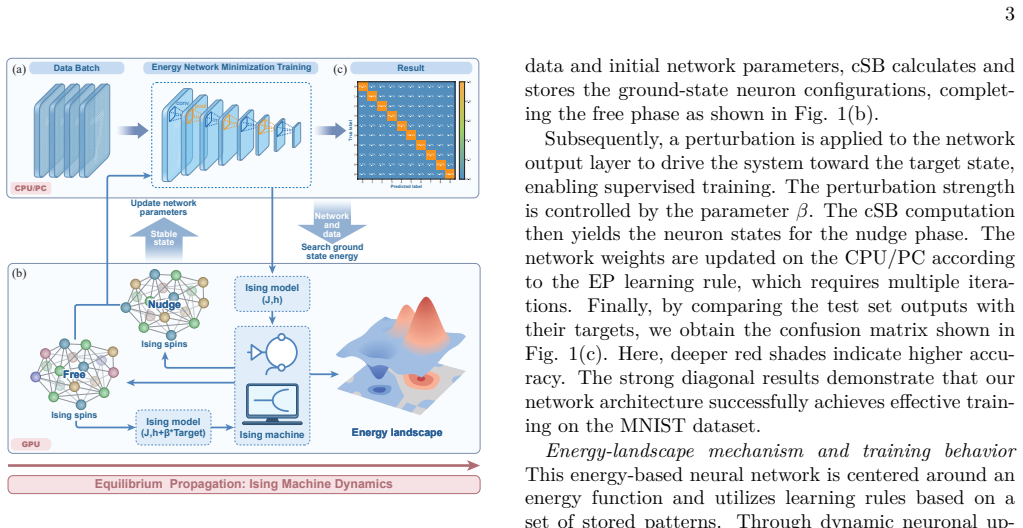
The rapid evolution of artificial intelligence has led to substantial advances in deep neural networks. Nonetheless, conventional GPU-based training remains highly energy-demanding, motivating the exploration of physical dynamics and compatible energy-based learning schemes, such as equilibrium propagation (EP). EP-based training, however, frequently suffers from convergence to local minima due to phase-space contraction. Here we introduce an Ising-dynamics-inspired equilibrium-propagation framework in which dissipative Hopfield relaxation is replaced by an extended phase-space dynamics with conjugate variables. The resulting training paradigm keeps the local two-phase learning rule of EP while changing the physical route by which neural states reach equilibrium. We show that this dynamics lowers effective energy barriers, accelerates convergence, improves noise robustness, and trains deep convolutional Hopfield networks on MNIST, FashionMNIST, and CIFAR-10 with performance comparable to backpropagation.
Editorial analysis
A structured set of objections, weighed in public.
Referee Report
Summary. The paper proposes an Ising-dynamics-inspired equilibrium propagation (EP) framework that replaces dissipative Hopfield relaxation with extended phase-space dynamics involving conjugate variables. It claims this preserves the local two-phase EP learning rule while lowering effective energy barriers, accelerating convergence, improving noise robustness, and enabling training of deep convolutional Hopfield networks on MNIST, FashionMNIST, and CIFAR-10 with performance comparable to backpropagation.
Significance. If the central claims hold, the work could advance energy-efficient training of energy-based models on physical hardware such as Ising machines by mitigating local-minima issues in standard EP. The hybridization approach that retains the local two-phase rule while altering the relaxation dynamics is a potentially useful direction, though its practical impact depends on explicit realizability and quantitative validation.
major comments (1)
- [Hardware mapping / extended dynamics description] The central claim requires that the extended phase-space dynamics with conjugate variables can be physically realized or efficiently simulated on Ising machines without introducing new instabilities or implementation overhead that would offset the claimed gains. No explicit construction is provided showing how conjugate variables are encoded in quadratic Ising interactions, whether auxiliary spins or continuous variables are introduced, or any stability analysis confirming absence of new overhead (see the section describing the mapping to Ising hardware and the extended dynamics).
minor comments (1)
- [Abstract] The abstract states performance claims on MNIST/FashionMNIST/CIFAR-10 but supplies no experimental details, error bars, ablation studies, or quantitative comparisons; these should be added to the main text with specific figures/tables for evaluation.
Simulated Author's Rebuttal
We thank the referee for highlighting the need for explicit details on hardware realizability. We agree this strengthens the central claim and will expand the relevant section in revision while preserving the paper's focus on the dynamical and empirical contributions.
read point-by-point responses
-
Referee: [Hardware mapping / extended dynamics description] The central claim requires that the extended phase-space dynamics with conjugate variables can be physically realized or efficiently simulated on Ising machines without introducing new instabilities or implementation overhead that would offset the claimed gains. No explicit construction is provided showing how conjugate variables are encoded in quadratic Ising interactions, whether auxiliary spins or continuous variables are introduced, or any stability analysis confirming absence of new overhead (see the section describing the mapping to Ising hardware and the extended dynamics).
Authors: We acknowledge that the manuscript emphasizes the dynamical advantages and empirical performance but provides only a high-level description of the Ising-inspired mapping. In revision we will add an explicit construction: conjugate variables are introduced as auxiliary continuous degrees of freedom whose quadratic couplings to the original spins preserve the overall Ising-like form while allowing the extended phase-space flow; the two-phase EP rule remains strictly local. A short Lyapunov-style stability argument will be included showing that the added terms do not create new fixed-point instabilities beyond those already present in standard Hopfield relaxation. Because the auxiliary variables evolve in parallel with the original spins, the per-step computational overhead remains linear and does not offset the reported gains in convergence speed and noise robustness. These additions will be placed in the section on mapping to Ising hardware. revision: yes
Circularity Check
No circularity: derivation chain is self-contained with no reductions to inputs or self-citations
full rationale
The abstract and provided text introduce an extended phase-space dynamics for EP without exhibiting any equations, fitted parameters, or load-bearing self-citations that reduce claims to definitions or prior fits. The central assertions (lower barriers, faster convergence, comparable performance) are presented as empirical outcomes on MNIST/FashionMNIST/CIFAR-10 rather than derived quantities forced by construction. No self-definitional loops, renamed known results, or uniqueness theorems imported from the authors' prior work appear in the given material. The derivation therefore remains independent of its inputs.
Axiom & Free-Parameter Ledger
Reference graph
Works this paper leans on
-
[1]
Training was performed on 60,000 handwritten digit images of size 28×28, with a batch size of 128
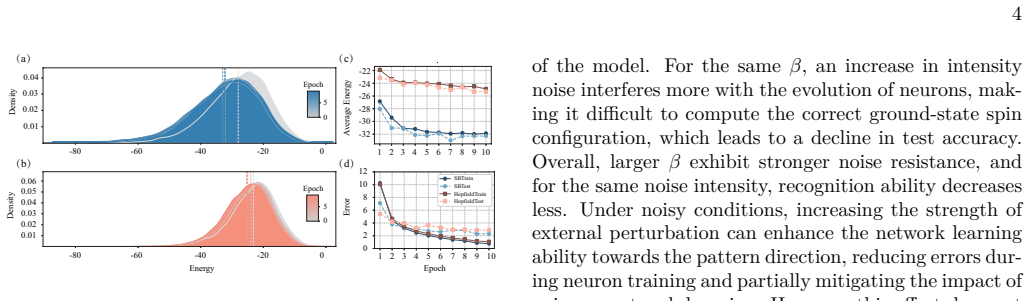
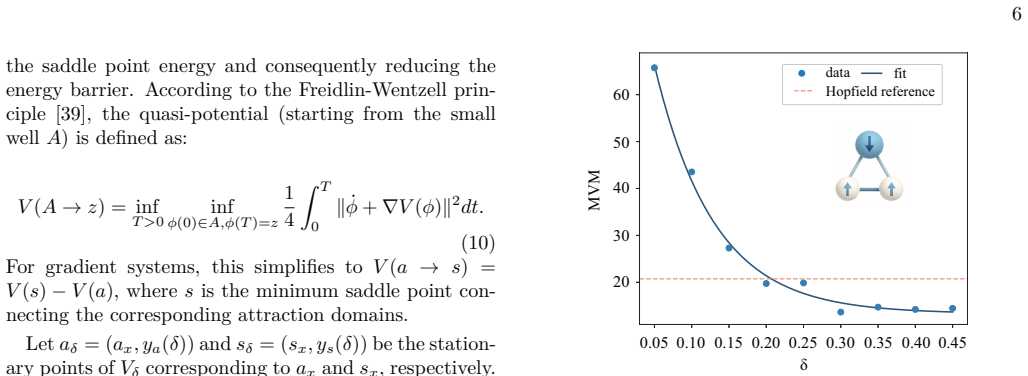
The trained model was a fully connected neural net- work with a single hidden layer of 120 neurons. Training was performed on 60,000 handwritten digit images of size 28×28, with a batch size of 128. Each batch underwent 20 free-phase and 15 nudge-phase iterations. Over 10 training epochs, we recorded the energy distribution for each image as it evolved to...
-
[2]
LeCun, L
Y. LeCun, L. Bottou, Y. Bengio, and P. Haffner, Gradient-based learning applied to document recogni- tion, Proceedings of the IEEE 86, 2278 (1998)
1998
-
[3]
K. M. He, X. Y. Zhang, S. Q. Ren, and J. Sun, Deep residual learning for image recognition, in Proceedings of the IEEE Conference on Computer Vision and Pattern Recognition (2016) pp. 770–778
2016
-
[4]
Vaswani, N
A. Vaswani, N. Shazeer, N. Parmar, J. Uszkoreit, L. Jones, A. N. Gomez, L. Kaiser, and I. Polosukhin, At- tention is all you need, Advances in Neural Information Processing Systems 30 (2017)
2017
-
[5]
X. W. Xu, Y. K. Ding, S. X. Hu, M. Niemier, J. Cong, Y. Hu, and Y. Shi, Scaling for edge inference of deep neural networks, Nature Electronics 1, 216 (2018)
2018
-
[6]
Carbon Emissions and Large Neural Network Training
D. Patterson, J. Gonzalez, Q. Le, C. Liang, L. M. Munguia, D. Rothchild, D. So, M. Texier, and J. Dean, Carbon emissions and large neural network training, arXiv:2104.10350 (2021)
work page internal anchor Pith review Pith/arXiv arXiv 2021
-
[7]
T. P. Lillicrap, A. Santoro, L. Marris, C. J. Akerman, and G. Hinton, Backpropagation and the brain, Nature Reviews Neuroscience 21, 335 (2020)
2020
-
[8]
Xia and J
Q. Xia and J. J. Yang, Memristive crossbar arrays for brain-inspired computing, Nature Materials 18, 309 (2019)
2019
-
[9]
Aguirre, A
F. Aguirre, A. Sebastian, M. Le Gallo, W. Song, T. Wang, J. J. Yang, W. Lu, M.-F. Chang, D. Ielmini, Y. Yang, et al. , Hardware implementation of memristor- based artificial neural networks, Nature Communications 15, 1974 (2024)
1974
-
[10]
S. Jain, S. Li, H. Zheng, L. Li, X. Fong, and K.-W. Ang, Heterogeneous integration of 2d memristor arrays and silicon selectors for compute-in-memory hardware in con- volutional neural networks, Nature Communications 16, 2719 (2025)
2025
-
[11]
X. Lin, Y. Rivenson, N. T. Yardimci, M. Veli, Y. Luo, M. Jarrahi, and A. Ozcan, All-optical machine learning using diffractive deep neural networks, Science 361, 1004 (2018)
2018
-
[12]
X. Xu, M. Tan, B. Corcoran, J. Wu, A. Boes, T. G. Nguyen, S. T. Chu, B. E. Little, D. G. Hicks, R. Moran- dotti, et al. , 11 tops photonic convolutional accelerator for optical neural networks, Nature 589, 44 (2021)
2021
-
[13]
B. J. Shastri, A. N. Tait, T. Ferreira de Lima, W. H. Pernice, H. Bhaskaran, C. D. Wright, and P. R. Pruc- nal, Photonics for artificial intelligence and neuromorphic computing, Nature Photonics 15, 102 (2021)
2021
-
[14]
S. Pai, Z. Sun, T. W. Hughes, T. Park, B. Bartlett, I. A. Williamson, M. Minkov, M. Milanizadeh, N. Abebe, F. Morichetti, et al., Experimentally realized in situ back- propagation for deep learning in photonic neural net- works, Science 380, 398 (2023)
2023
-
[15]
L. G. Wright, T. Onodera, M. M. Stein, T. Wang, D. T. Schachter, Z. Hu, and P. L. McMahon, Deep physical neural networks trained with backpropagation, Nature 601, 549 (2022)
2022
-
[16]
Grollier, D
J. Grollier, D. Querlioz, K. Y. Camsari, K. Everschor- Sitte, S. Fukami, and M. D. Stiles, Neuromorphic spin- tronics, Nature Electronics 3, 360 (2020)
2020
-
[17]
J. J. Hopfield, Neurons with graded response have collec- 8 tive computational properties like those of two-state neu- rons, Proceedings of the National Academy of Sciences of the United States of America 81, 3088 (1984)
1984
-
[18]
Stern and A
M. Stern and A. Murugan, Learning without neurons in physical systems, Annual Review of Condensed Matter Physics 14, 417 (2023)
2023
-
[19]
Scellier and Y
B. Scellier and Y. Bengio, Equilibrium propagation: bridging the gap between energy-based models and back- propagation, Frontiers in Computational Neuroscience 11, 24 (2017)
2017
-
[20]
Scellier and Y
B. Scellier and Y. Bengio, Equivalence of equilib- rium propagation and recurrent backpropagation, Neural Computation 31, 312 (2019)
2019
-
[21]
Ernoult, J
M. Ernoult, J. Grollier, D. Querlioz, Y. Bengio, and B. Scellier, Updates of equilibrium prop match gradients of backprop through time in an RNN with static input, Advances in Neural Information Processing Systems 32 (2019)
2019
-
[22]
Laborieux and F
A. Laborieux and F. Zenke, Holomorphic equilibrium propagation computes exact gradients through finite size oscillations, in Proceedings of the 36th International Con- ference on Neural Information Processing Systems , NIPS ’22 (Curran Associates Inc., Red Hook, NY, USA, 2022)
2022
-
[23]
Helwegen, J
K. Helwegen, J. Widdicombe, L. Geiger, Z. Liu, K.- T. Cheng, and R. Nusselder, Latent weights do not ex- ist: Rethinking binarized neural network optimization, Advances in neural information processing systems 32 (2019)
2019
-
[24]
Laborieux, M
A. Laborieux, M. Ernoult, B. Scellier, Y. Bengio, and J. Grollier, Scaling equilibrium propagation to deep con- vnets by drastically reducing its gradient estimator bias, Frontiers in Neuroscience 15, 633674 (2021)
2021
-
[25]
Laydevant, M
J. Laydevant, M. Ernoult, D. Querlioz, and J. Grollier, Training dynamical binary neural networks with equi- librium propagation, in Proceedings of the IEEE/CVF Conference on Computer Vision and Pattern Recognition (2021) pp. 4640–4649
2021
-
[26]
S.-i. Yi, J. D. Kendall, R. S. Williams, and S. Kumar, Activity-difference training of deep neural networks using memristor crossbars, Nature Electronics 6, 45 (2023)
2023
-
[27]
Q. Wang, C. C. Wanjura, and F. Marquardt, Training coupled phase oscillators as a neuromorphic platform us- ing equilibrium propagation, Neuromorphic Computing and Engineering 4, 034014 (2024)
2024
-
[28]
arXiv preprint arXiv:2504.11884 (2025)
T. Rageau and J. Grollier, Training and synchronizing oscillator networks with equilibrium propagation, arXiv preprint arXiv:2504.11884 (2025)
-
[29]
Laydevant, D
J. Laydevant, D. Marković, and J. Grollier, Training an ising machine with equilibrium propagation, Nature Communications 15, 3671 (2024)
2024
-
[30]
Yamamoto, K
Y. Yamamoto, K. Aihara, T. Leleu, K. Kawarabayashi, S. Kako, M. Fejer, K. Inoue, and H. Takesue, Coherent ising machines-optical neural networks operating at the quantum limit, npj Quantum Information 3, 49 (2017)
2017
-
[31]
Mohseni, P
N. Mohseni, P. L. McMahon, and T. Byrnes, Ising ma- chines as hardware solvers of combinatorial optimization problems, Nature Reviews Physics 4, 363 (2022)
2022
-
[32]
A. Gower, Learning at the speed of physics: Equilibrium propagation on oscillator ising machines, arXiv preprint arXiv:2510.12934 (2025)
-
[33]
R. K. Srivastava, K. Greff, and J. Schmidhuber, Train- ing very deep networks, Advances in Neural Information Processing Systems 28 (2015)
2015
-
[34]
H. Goto, K. Tatsumura, and A. R. Dixon, Combina- torial optimization by simulating adiabatic bifurcations in nonlinear Hamiltonian systems, Science Advances 5, eaav2372 (2019)
2019
-
[35]
Kanao and H
T. Kanao and H. Goto, High-accuracy ising machine using kerr-nonlinear parametric oscillators with local four-body interactions, npj Quantum Information 7, 18 (2021)
2021
-
[36]
H. Goto, K. Endo, M. Suzuki, Y. Sakai, T. Kanao, Y. Hamakawa, R. Hidaka, M. Yamasaki, and K. Tat- sumura, High-performance combinatorial optimization based on classical mechanics, Science Advances 7, eabe7953 (2021)
2021
-
[37]
Razmkhah, M
S. Razmkhah, M. Kamal, N. Yoshikawa, and M. Pe- dram, Josephson parametric oscillator based ising ma- chine, Physical Review B 109, 014511 (2024)
2024
-
[38]
Yamaji, S
T. Yamaji, S. Masuda, A. Yamaguchi, T. Satoh, A. Morioka, Y. Igarashi, M. Shirane, and T. Yamamoto, Correlated oscillations in kerr parametric oscillators with tunable effective coupling, Physical Review Applied 20, 014057 (2023)
2023
-
[39]
B. Z. Ucpinar, S. Razmkhah, M. Kamal, and M. Pedram, Scalable superconductor ising machine for combinatorial optimization problems, in 2024 IEEE Computer Society Annual Symposium on VLSI (ISVLSI) (IEEE, 2024) pp. 565–570
2024
-
[40]
M. I. Freidlin and A. D. Wentzell, Random perturba- tions, in Random Perturbations of Dynamical Systems (Springer, Berlin Heidelberg, 1998) pp. 15–43
1998
-
[41]
Bovier and F
A. Bovier and F. Den Hollander, Metastability: A Potential-Theoretic Approach , Vol. 351 (Springer, Switzerland, 2016)
2016
-
[42]
Bovier, M
A. Bovier, M. Eckhoff, V. Gayrard, and M. Klein, Metastability in reversible diffusion processes. I. sharp asymptotics for capacities and exit times, Journal of the European Mathematical Society 6, 399 (2004)
2004
-
[43]
Scellier, M
B. Scellier, M. Ernoult, J. Kendall, J. Grollier, and Y. Bengio, Energy-based learning algorithms for analog computing: a comparative study, Advances in Neural In- formation Processing Systems 36, 52705 (2023)
2023
-
[44]
B. Scellier, S. Mishra, Y. Bengio, and Y. Ollivier, Ag- nostic physics-driven deep learning, arXiv:2205.15021 (2022)
-
[45]
Y. Gao, L. Qi, H.-L. Lin, W. Fu, and A. Danner, All- optical interferometer-based ising machine, Optica 12, 831 (2025)
2025
-
[46]
Honjo, T
T. Honjo, T. Sonobe, K. Inaba, T. Inagaki, T. Ikuta, Y. Yamada, T. Kazama, K. Enbutsu, T. Umeki, R. Kasa- hara, et al. , 100,000-spin coherent ising machine, Science Advances 7, eabh0952 (2021)
2021
-
[47]
F. Böhm, G. Verschaffelt, and G. Van der Sande, A poor man’s coherent ising machine based on opto-electronic feedback systems for solving optimization problems, Na- ture Communications 10, 3538 (2019)
2019
-
[48]
Q. Cen, H. Ding, T. Hao, S. Guan, Z. Qin, J. Lyu, W. Li, N. Zhu, K. Xu, Y. Dai, et al. , Large-scale coherent ising machine based on optoelectronic parametric oscillator, Light: Science & Applications 11, 333 (2022)
2022
-
[49]
Cılasun, W
H. Cılasun, W. Moy, Z. Zeng, T. Islam, H. Lo, A. Vanasse, M. Tan, M. Anees, R. S, A. Kumar, et al. , A coupled-oscillator-based ising chip for combinatorial optimization, Nature Electronics , 1 (2025)
2025
-
[50]
Kato, Perturbation Theory for Linear Operators , Vol
T. Kato, Perturbation Theory for Linear Operators , Vol. 132 (Springer Science & Business Media, Berlin Heidel- berg, 2013)
2013
discussion (0)
Sign in with ORCID, Apple, or X to comment. Anyone can read and Pith papers without signing in.